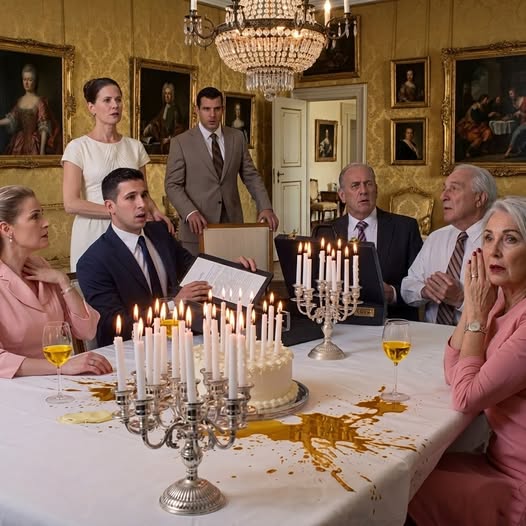
My family sat around a circular table in a private alcove. There was my mother, Lydia, draped in pearls that didn’t quite hide the tension in her throat; my father, Arthur, who had spent the last decade complaining about “market volatility” while sipping fifty-year-old scotch; and my Grandfather Silas.
Silas was the sun around which our family’s cold, dark planets orbited. He had built an empire in shipping and logistics, a man carved out of granite and old-school grit. He had been living in a villa in Zurich for the last ten years, making rare, terrifying appearances like a vengeful deity.
He leaned forward, his hands clasped on the white linen. His eyes, sharp as flint despite his eighty-eight years, locked onto mine.
“Caleb,” he said, his voice a low rumble. “You’ve had five years to grow that seed I planted. Tell me. How is the $3 million trust fund doing? Did you invest in that tech firm we discussed, or did you waste it on something frivolous like your father’s ‘art gallery’ phase?”
The table went silent. The only sound was the faint clink of a distant dessert spoon.
I looked at my grandfather. Then I looked at my mother, whose hand was shaking so violently the wine in her glass was creating tiny, rhythmic waves. My father was staring at a point six inches above Silas’s head, his face a mask of sudden, waxy perspiration.
“Grandpa,” I whispered, my throat feeling like it was filled with dry sand. “I never got one.“
The Briefcase
The silence that followed wasn’t just quiet; it was a vacuum. It sucked the oxygen out of the room.
Silas didn’t blink. He didn’t roar. He simply turned his head three inches to the left, where a man I hadn’t noticed—a small, clinical-looking man in a grey suit—was sitting at a small side table.
“Mr. Vance,” Silas said. “The briefcase.”
The man, Silas’s long-time personal attorney, stood up. He placed a leather briefcase on the table, right between the appetizers and the vintage Bordeaux. The locks clicked—snap, snap—with the finality of a guillotine.
He pulled out a sheaf of documents. “The Caleb Harrison Trust,” Vance read in a monotone voice. “Established on Caleb’s twenty-fifth birthday. Total disbursement: $3 million. According to the signatures here, the funds were accessed in full three weeks after the trust’s inception.”
My mother’s hand finally gave out. Her wine glass hit the edge of the table, shattered, and a dark, blood-red stain began to spread across the white cloth, creeping toward my father’s sleeve. She didn’t even try to clean it.
My father tried to say something. His mouth opened, his jaw worked, but no sound came out. He looked like a man who had forgotten the fundamental mechanics of speech.
The Paper Trail
“Let me see those,” Silas said.
Vance handed him a single sheet. Silas put on his spectacles, read for ten seconds, and then let out a laugh that was more of a growl.
“Arthur,” Silas said, looking at my father. “I didn’t know you spelled your name C-A-L-E-B. And Lydia… it seems you’ve been co-signing for your ‘son’ for five years. Funny, because Caleb looks like he’s been living in a one-bedroom apartment in Echo Park and driving a car that sounds like a lawnmower.”
I felt a strange, cold numbness. For five years, I had struggled. I had worked two jobs to pay off my student loans. I had asked my parents for a small loan once, three years ago, when my car engine died. They had told me, with tears in their eyes, that the family was “struggling” and that I needed to learn the value of a dollar.
Meanwhile, they were living in a $5 million house in San Marino that they told me was “heavily mortgaged.” They were taking “business trips” to the French Riviera.
“You stole it,” I said. It wasn’t a question.
“Caleb, honey,” my mother finally gasped, her voice cracking. “We were going to give it back. Your father had a… a situation. A bad investment. We just needed to bridge the gap. We did it for the family’s future.”
“The family’s future?” Silas roared, slamming his palm on the table. The plates jumped. “You robbed the boy of his foundation! You let him sweat and scrape while you played pretend in the hills!”
The Reckoning
Silas looked at Mr. Vance. “What is the penalty clause in the trust’s bylaws regarding unauthorized access by trustees?”
Vance cleared his throat. “Immediate liquidation of the perpetrator’s assets to restore the trust, plus a 15% interest penalty. Furthermore, Mr. Harrison, you have the right to press criminal charges for identity theft and wire fraud.”
My father finally spoke. “Silas, please. You can’t. We’re your children.”
“You’re parasites,” Silas said, his voice deathly calm. “And Caleb is the only one with my blood who hasn’t tried to bleed me dry.”
He turned to me. The anger vanished from his face, replaced by a look of profound, weary pride.
“Caleb, tomorrow morning, you will go to Mr. Vance’s office. You won’t be getting $3 million. You’ll be getting the San Marino house, the remaining liquid assets from their accounts, and a seat on my board. It seems you’ve already learned the value of a dollar the hard way. Now, I want to see what you can do with a fortune.”
The New Birthday
I walked out of The Gilded Oak ten minutes later. Behind me, the muffled sounds of my mother’s sobbing and my father’s begging faded into the night air of Pasadena.
I stood on the sidewalk and looked at my beat-up sedan. I thought about the three jobs I’d held. I thought about the “struggling” parents who had watched me eat ramen while they dined on caviar bought with my inheritance.
I didn’t feel angry. I felt light.
I pulled my phone out and called a towing company.
“Yeah, I have a car I’d like to donate,” I said, smiling at the stars. “And then, I need a ride to a hotel. Somewhere with a lot of stars. I think I’m finally ready to start my thirty-second year.”
The “Good Vibes” weren’t in the money. They were in the sudden, sharp clarity of the truth—and the knowledge that from now on, the only person writing my story was me. I walked down the street, leaving the broken glass and the red stains behind, stepping into a life that was finally, truly, mine.