My hands locked around the steering wheel.
I read it again. The words didn’t change. I read it a third time, moving my lips the way I used to when my first-grade teacher put a sentence on the board and told us not to rush, to make sure we understood before we moved on. I understood. I just didn’t believe it.
Outside, the loading docks sat quiet in the late afternoon light. Dock Three had a crack in the concrete apron that I’d been reporting since 2019. Nobody ever fixed it. I used to steer the forklift around it so automatically I stopped thinking about it, the way you stop thinking about the loose step on your porch stairs. For thirty-two years I’d navigated that crack, and now some stranger in an office building somewhere had typed a sentence that undid all of it.
I set the letter on the passenger seat, smoothed it flat with my palm, and read the rest.
The language was careful. Corporate language always is, the way a surgeon is careful — precise, clean, no wasted motion, no visible feeling. The plant’s pension fund, the letter explained, had been restructured as part of a broader reorganization initiative. Employees who had not yet reached the age of sixty-two at the time of vesting were subject to a modified benefit schedule. I was fifty-nine. The modified benefit schedule, when I worked through the math in my head, came to less than a third of what I’d been promised when I was twenty-seven years old and a plant manager with soft hands and a firm handshake had sat me down and explained why the pension plan was one of the best reasons to build a life here.
I had built a life here.
My daughter Renae was born the same year I made lead operator. She was thirty-one now and lived in Columbus with her husband and two kids I saw on a tablet screen more often than in person. My son Marcus had gone to college on a combination of loans and the money Carol and I had saved by not taking vacations, by driving used cars, by eating out on birthdays and anniversaries only. He was a physical therapist in Nashville. He called on Sundays.
Carol had died four years ago. Breast cancer, caught late. I’d used my FMLA leave to drive her to treatments, and when that ran out I’d traded shifts with Darnell Pruitt for six months because Darnell was a decent man and didn’t ask for much in return, just that I cover him during deer season. I did. Carol died on a Thursday in November. I was back on the floor the following Monday because the alternative was sitting in a house full of her things and no sound.
The plant had felt like structure when everything else had become shapeless. I’m not proud of that. I know what it says about a man, that he found more comfort in a factory floor than in his own grief, but I also know what it’s like to need somewhere to put your hands, somewhere to stand that tells you who you are. At fifty-five, with Carol gone and my kids grown and the house paid off, the pension was the shape of the future. Thirty-two years times a promised number equaled a kind of safety. Enough to fix the roof if it leaked. Enough to drive to Columbus for birthdays without checking the account first. Enough to not be afraid.
I sat in the truck until the security lights clicked on over the loading docks.
There was a number at the bottom of the letter. A benefits coordinator named Sheila Marsh, extension 4471. I folded the letter back into the envelope and drove home.
The house smelled like the leftover coffee I hadn’t finished that morning. I put the envelope on the kitchen table, between the napkin holder and the little ceramic rooster Carol had bought at a craft fair in 2008 that I’d always thought was ugly and now would not move for anything in the world.
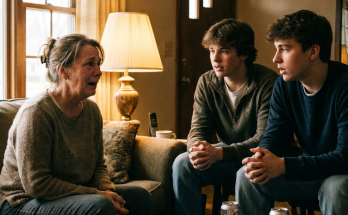
I called Renae. She answered on the second ring, which meant the kids were already in bed, which meant it was later than I thought.
“Hey, Dad. How was it?”
“It was fine,” I said. “Sheet cake.”
She laughed a little. “Forty years earns you fondant, apparently.”
“Thirty-two.”
“Right. Sorry. You okay?”
I looked at the envelope. “I got a letter today. With my — they gave it to me at the party. About the pension.”
Silence. Then: “What kind of letter?”
I read her the first line.
The silence that followed was different. Renae is an accountant. She thinks in numbers the way I think in tolerances and load weights, and I could hear her running calculations, feel the moment she arrived at the same place I had.
“Dad.” Her voice was careful now. The careful voice she’d used when she called to tell me about Carol’s second scan.
“I know.”
“That can’t be legal.”
“I don’t know what it is yet.”
“You need a lawyer. Not — I mean tomorrow, Dad. First thing.”
“I was going to call the benefits number on the letter.”
“No.” She said it the way her mother used to say it, flat and final. “You don’t call their number and talk to their person without knowing your own position first. Do you still have all your employment paperwork? Your original offer letter? The pension documents?”
I had a filing cabinet in the spare bedroom that Carol had organized in 2011. Green folders for insurance, blue for taxes, yellow for employment. I had not opened it since the week after her funeral, when I’d needed the life insurance policy.
“I have it,” I said.
“Okay. I’m going to make some calls tonight. I know someone who does employment law. Used to do pension cases for the UAW.” She paused. “I’m sorry your party was sheet cake and then this.”
“The soda was warm too.”
She laughed again, and this time I laughed with her, and it felt like something necessary, like releasing a valve before pressure builds past a safe threshold.
I didn’t sleep much. I lay in the bed on my side of it — I still sleep on my side, have never once in four years drifted to the middle — and stared at the ceiling and did the math I’d already done and then did it again hoping for a different answer.
At some point before dawn I got up, made coffee, and went to the filing cabinet.
The yellow folder was exactly where Carol had left it. Her handwriting on the tab, neat and slightly slanted to the right, a habit she’d picked up from her own mother. I spread the documents on the kitchen table under the good light.
The original offer letter was dated March 1993. The pension plan summary attached to it used words like guaranteed and vested benefit and defined contribution upon full service completion of twenty years or more. I had completed thirty-two.
I read those documents the way I’d read the letter in the truck. Carefully. Moving my lips.
Then I read the letter from Sheila Marsh again.
The plant’s letter referenced a plan amendment adopted in 2021 pursuant to Section 204(g) of ERISA. I did not know what that meant. I wrote it down on the back of an envelope — a different envelope, a bill from the electric company — and underlined it twice.
By six in the morning I had two pages of notes and a full pot of coffee gone.
Renae’s contact was a woman named Patricia Osei who worked out of a small office in Cincinnati and had spent eleven years fighting pension cases before going private. She called me at eight-fifteen, while I was still sitting at the kitchen table.
She asked me to describe the letter. She asked me the date I was hired, my age, and whether I had the original pension plan documents. She asked me whether I’d signed anything at the retirement party, any acknowledgment forms or separation agreements.
I hadn’t. I’d shaken hands and smiled and carried an envelope to my truck.
“Good,” she said. “That’s good.” She had a manner of speaking that reminded me of my old foreman Earl Hutchins — plain, unhurried, nothing wasted. “Here’s what I can tell you in the next five minutes before I need to pull the actual plan documents. What they’re referencing, the 204(g) amendment, that’s a real provision. Plan sponsors can amend pension plans. What they cannot do, under ERISA, is apply those amendments retroactively to benefits you’ve already accrued. That’s called an anti-cutback violation.”
I wrote anti-cutback on my paper.
“The question,” she continued, “is whether the benefit they’re modifying is one you’d already accrued before the 2021 amendment, or whether it’s a future benefit they had the right to adjust. That depends entirely on how your plan document was written. So I need to see it.”
“I have the original summary.”
“I need the full plan document. Not the summary. The actual legal document. You’re entitled to that under ERISA — you can request it from the plan administrator. They have thirty days to provide it. But I want to look at it before we decide whether you have a case.”
“Do you think I have a case?”
A pause. Not the pause of someone who doesn’t know, but the pause of someone deciding how much honesty to spend.
“Based on what you’ve told me,” she said, “I think there’s a real question here. And real questions are worth answending.”
I requested the full plan document that same day. I sent a certified letter to the address on the benefits notice, which felt strange — sending a formal letter to a building I’d pulled up to in a truck for thirty-two years, to people I’d maybe passed in a hallway without knowing their names.
While I waited, I did things I’d been putting off. I fixed the porch step. I called Marcus, who was angrier about the letter than I expected, who said they can’t do that, Dad with a conviction I found both touching and uninformed. I drove to Columbus for a weekend and sat on Renae’s couch while my grandkids climbed on me like I was a piece of furniture, which is the highest compliment a five-year-old can pay.
The plan document arrived on day twenty-eight. I overnight-shipped it to Patricia Osei.
She called me four days later.
“You had a defined benefit,” she said. “Fully accrued as of your twentieth year of employment, per plan language that was in effect before the 2021 amendment. The amendment they’re citing modified the early distribution schedule for employees who hadn’t yet vested. You were vested in 2013. They applied the amendment to the wrong population.”
I sat down in the kitchen chair.
“Are you saying —”
“I’m saying they made an error. Whether it was a deliberate error or an administrative one, I can’t tell you yet. But your benefit as calculated under the pre-amendment plan document is the number you were expecting. And I believe we can compel them to honor it.”
It took seven months. There were letters, and responses to letters, and a period where the plant’s corporate parent — a holding company three acquisitions removed from the name on the building where I’d spent my career — hired their own attorneys and sent documents in batches thick as phone books.
Patricia was unbothered. She had seen thicker.
In the end, they did not want a trial. A trial meant discovery, and discovery meant questions about how many other retirees had received the same letter, and that was a number they did not want anyone calculating in front of a judge.
I received the corrected benefit determination on a Tuesday in April. I was sitting at the kitchen table when the email notification came, the table where I’d spread Carol’s yellow folder in the dark before dawn, where the ceramic rooster still stood between the napkin holder and the salt.
The number was what it was supposed to be.
I still drive past the plant sometimes when I’m out that way. The crack in the concrete apron of Dock Three is still there. Somebody put an orange cone next to it, which made me laugh out loud in the car.
I don’t miss the work exactly. I miss the shape it gave things — the way a shift has a beginning and a middle and an end, the way you go home knowing what you accomplished, the physical fact of something built or moved or made right. I’ve been doing some volunteer work at a trade school two towns over, teaching basic machine operation to kids who’ve aged out of the foster system and need something to put their hands into. It’s not the same. It’s something else. Maybe something better.
The pension clears on the first of every month. I drive to Columbus the second weekend of every month. Marcus came up from Nashville for Thanksgiving and stayed five days, which is the longest he’s been home since Carol died.
I think about her a lot, about what she’d have said if she’d been there in the truck with me that afternoon, the loading docks going gray in the October light, the letter in my hands. She’d have read it once. She wouldn’t have needed to read it three times. She’d have folded it back into the envelope, patted my hand, and said well, let’s go home and figure out what to do.
That was always her answer to things. Not the weight of the problem but the next step inside it. Thirty-four years I watched her do that. I must have absorbed more of it than I knew.
I go home and figure out what to do.
It turns out to be enough.