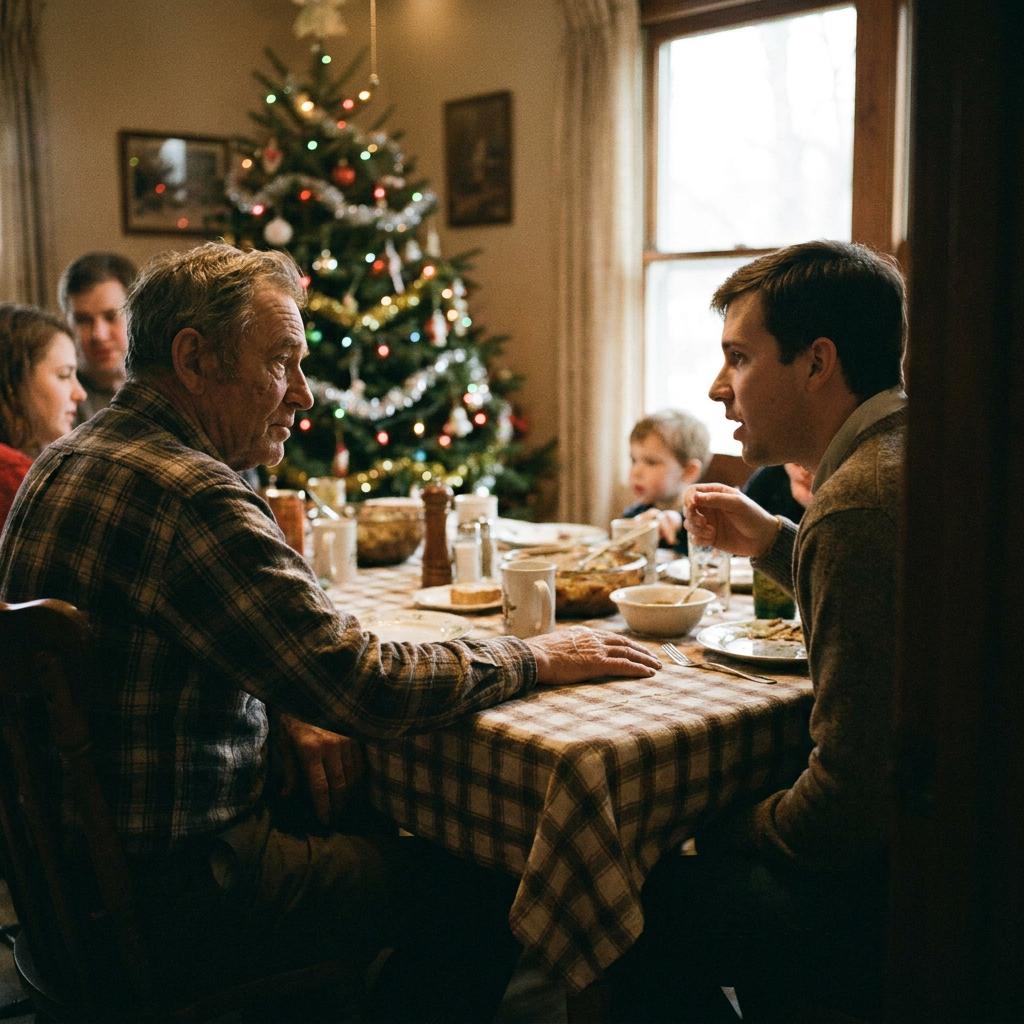
I watched my father get up to “check the furnace”—his old excuse for disappearing into the basement whenever my brother-in-law humiliated him.
But this time, Dad didn’t make it to the stairs.His hands went to the arms of his chair.He pushed once.
Stopped.Then he placed one trembling hand flat on the Christmas table.
The room went silent.
My brother-in-law, Derek, was halfway through another joke about people who had “spent their whole lives punching a clock.”Dad looked at him.
And for the first time in thirty years, he didn’t walk away.
He said, quietly, “Derek, I think it’s time you learned who paid for that clock.”
Nobody moved.My sister dropped her fork.
I felt the air leave my lungs.Because I knew exactly what Dad meant.And I knew Derek had no idea what was coming.
My father, Raymond Miller, had worked thirty-three years at the paper mill outside Chillicothe.
Thirty-three years.Rotating shifts.Days.Nights.Weekends.
Christmas mornings when other fathers were opening presents with their kids.
He worked around chemicals, steam, machinery, and temperatures so hot that he once came home with burns across both forearms.
When I was little, I asked him what happened.
He told me he’d brushed against a hot pipe.
I believed him.
Years later, I learned the truth.
He had been working a twelve-hour overnight shift because the mill was short-staffed.
He hadn’t complained.
He hadn’t taken the day off.
He’d simply wrapped his arm, finished the shift, and come home before sunrise so he could take me to school.
That was Dad.
He never told us what anything cost him.
Not really.
When my college acceptance letter arrived, he hugged me so tightly my feet nearly left the floor.
“You’re going,” he said.
I laughed.
“Dad, we can’t afford it.”
He looked at me like I’d said something ridiculous.
“You’re going.”
“But tuition—”
“I’ll handle it.”
“How?”
He smiled.
“That’s my problem.”
I didn’t know then that “handling it” meant picking up overtime.
It meant sleeping four hours between shifts.
It meant driving a rusted pickup with a cracked windshield because he refused to replace it.
It meant eating sandwiches from home while his coworkers went out for lunch.
And it meant selling the little fishing boat he’d owned since before I was born.
I found that out years later.
Dad never mentioned it.
He never asked me for a dollar.
Not when I graduated.
Not when I got married.
Not when I bought my first house.
He only said, “Take care of yourself.”
My sister, Melissa, had always been different.
She loved Dad.
At least, I thought she did.
But after she married Derek, something changed.
Derek was an accountant at a downtown firm.
He wore expensive watches.
He talked about investments at dinner.
He used phrases like “net worth” and “professional trajectory.”
And somehow, over the years, he started treating my father like a relic.
At first, it was subtle.
“Still working on cars yourself, Ray?”
Then:
“Dad, you know they make people for that now.”
Then came the comments about the mill.
“Thirty-three years punching a clock. That’s dedication.”
He’d laugh.
Dad would smile politely.
And eventually, Dad started saying those words.
“I ought to check the furnace.”
Then he’d disappear downstairs.
I knew the furnace wasn’t the reason.
Dad’s furnace worked perfectly.
He went downstairs because he needed somewhere Derek couldn’t see his face.
One Thanksgiving, I followed him.
I found him sitting on the bottom step in the dark.
“Dad?”
He wiped his eyes immediately.
“Furnace is fine,” he said.
“I know.”
He looked at me.
“Then why are you down here?”
He sighed.
“Your sister’s happy.”
“That doesn’t answer my question.”
He stared at the floor.
“Some things aren’t worth making a family fight over.”
I sat beside him.
“Derek is disrespecting you.”
Dad shrugged.
“He’s young.”
“He’s forty-eight.”
Dad smiled faintly.
“Still young compared to me.”
“That’s not an excuse.”
Dad put his hand on my shoulder.
“Promise me something.”
“What?”
“Don’t make Melissa choose.”
“Between you and him?”
He nodded.
“She loves him.”
“She should still defend you.”
Dad didn’t answer.
He just looked toward the ceiling.
“I’ve already had a good life.”
I hated when he said things like that.
Because Dad was only seventy-two.
He wasn’t old.
At least not to me.
But I had started noticing things.
He took longer getting out of chairs.
He rubbed his left shoulder when he thought nobody was watching.
Sometimes he stopped halfway through a sentence because his breathing became shallow.
Whenever I asked, he said the same thing.
“I’m fine.”
Then came Christmas.
And Derek was in rare form.
The house was full.
My sister.
Her two kids.
My wife.
Dad.
Derek.
There were presents beneath the tree and candles on the table.
Dad sat near the fireplace wearing the same dark green sweater he’d worn for years.
Derek was telling a story about one of his coworkers.
Then somehow the conversation turned toward retirement.
Derek looked at Dad.
“So, Ray, how’s that pension treating you?”
Dad smiled.
“Can’t complain.”
“You actually can,” Derek said. “I’ve seen the numbers.”
Dad’s smile disappeared.
I looked at Derek.
“What numbers?”
He waved his hand.
“Oh, nothing.”
“No. What numbers?”
Derek laughed.
“I’m just saying Dad’s pension isn’t exactly impressive.”
Dad looked down at his plate.
Melissa shifted uncomfortably.
“Derek…”
“What?”
“Leave it.”
“I’m having a conversation.”
“No, you’re performing.”
His face tightened.
Then he looked at Dad.
“You know, Ray, there’s no shame in admitting that punching a clock your whole life didn’t exactly set you up for retirement.”
Dad’s fingers tightened around his fork.
I said, “Enough.”
Derek looked at me.
“Why? Did I say something untrue?”
“You’re insulting him.”
“I’m being realistic.”
Dad quietly pushed his chair back.
I knew what was coming.
The furnace.
He’d go downstairs.
He’d sit in the dark.
He’d wait until the burning in his chest eased.
But his hands stopped.
He didn’t stand.
Instead, he placed his palm flat on the table.
And looked directly at Derek.
“Derek,” he said, “you’ve been talking about my pension for years.”
Derek smiled.
“So?”
“You’ve been talking about my job.”
Dad’s voice remained calm.
“My hands.”
His eyes dropped briefly to the scars along his forearms.
“My education.”
He looked at me.
Then back at Derek.
“You’ve talked about everything except the things you don’t know.”
Derek leaned back.
“And what exactly don’t I know?”
Dad reached into his pocket.
He pulled out a folded envelope.
My stomach tightened.
I’d never seen it before.
Dad placed it on the table.
“This.”
Derek glanced at it.
“What is it?”
“Open it.”
Derek laughed.
“I don’t need to—”
“Open it.”
Something in Dad’s voice made him stop.
He picked up the envelope.
Inside was a photocopy of a document.
Derek unfolded it.
His expression changed.
“What is this?”
Dad looked at me.
“Tell him.”
I looked at the paper.
It was a bank statement.
Then another.
Then another.
I recognized the account number.
It was Dad’s old savings account.
But the amounts weren’t what shocked me.
It was the transfers.
Every month.
For years.
Payments to my college.
My first apartment.
My sister’s nursing program.
The down payment on Melissa’s first house.
Derek stared at the papers.
“Where did you get these?”
Dad answered.
“They’re mine.”
Derek looked confused.
Then he noticed something.
A line near the bottom.
“$18,500…”
Dad nodded.
“That was the loan I took against my retirement account.”
“For what?”
Dad looked at Melissa.
“For your sister.”
Melissa covered her mouth.
Dad continued.
“She needed help after you two bought your first house.”
Derek’s face reddened.
“I didn’t ask you for money.”
“No.”
Dad nodded.
“You didn’t.”
Melissa whispered, “Dad…”
He looked at her.
“I’m not angry.”
“But I didn’t know.”
“I know.”
She started crying.
Derek looked back at the papers.
“You’re saying you paid for our house?”
“No.”
Dad shook his head.
“I helped your wife keep it.”
Derek stood.
“This is ridiculous.”
Dad didn’t move.
“You’re right.”
He pointed at the documents.
“The ridiculous part is that you think a man’s worth is measured by his job title.”
Derek opened his mouth.
Dad raised one hand.
“Let me finish.”
And that stopped everyone.
“My whole life, I worked with my hands.”
He looked at his palms.
“I wasn’t ashamed of it.”
“I wasn’t ashamed when I came home smelling like chemicals.”
“I wasn’t ashamed when my back hurt.”
“I wasn’t ashamed when my coworkers got promoted and I stayed on the floor.”
“I had a job.”
“I did it.”
“And I came home to my family.”
His voice cracked.
“That was enough for me.”
Nobody spoke.
Then Dad looked directly at Derek.
“But you know what I am ashamed of?”
Derek said nothing.
“I am ashamed that I let you make me feel small.”
My heart broke.
Dad’s eyes filled with tears.
“I thought if I stayed quiet, Melissa wouldn’t have to choose sides.”
Melissa began sobbing.
Dad looked at her.
“I thought I was protecting you.”
She stood and walked around the table.
She hugged him.
“You were.”
Dad held her.
Then she whispered something.
“I should have protected you.”
Dad closed his eyes.
Derek stood alone beside the table.
For once, he had nothing to say.
But Dad wasn’t finished.
He reached into his coat.
He pulled out another folder.
This one was thicker.
He handed it to me.
“I want you to read this.”
I opened it.
Inside were documents from the paper mill.
Retirement records.
Medical records.
Insurance statements.
And a letter.
I read the first line.
Then stopped.
“What is this?”
Dad said, “The mill offered me a settlement when I retired.”
“How much?”
He looked at me.
“Enough.”
“That doesn’t answer me.”
He smiled.
“$286,000.”
Everyone stared.
Derek finally spoke.
“You had nearly three hundred thousand dollars?”
Dad nodded.
“And you never told anyone?”
“No.”
“Why?”
Dad shrugged.
“Didn’t need to.”
I stared at him.
“What did you do with it?”
He looked at me.
“I gave most of it away.”
My heart stopped.
“To whom?”
He pointed toward the children.
“Your sister’s kids.”
Melissa gasped.
Dad smiled.
“College accounts.”
Derek’s face went white.
“You put money into their accounts?”
“Some.”
“How much?”
Dad didn’t answer.
I did the math from the statements.
More than $160,000.
Derek sat down.
For the first time that night, he looked smaller than Dad.
Then Dad said something I will never forget.
“I didn’t give that money because I thought you deserved it.”
He looked at Derek.
“I gave it because those kids deserved a chance.”
Derek stared at the floor.
My father folded his hands.
“You think I worked thirty-three years because I loved punching a clock?”
He shook his head.
“I worked because people I loved were depending on me.”
Then he looked around the room.
“And I would do it again.”
Silence.
Then Derek whispered, “I didn’t know.”
Dad nodded.
“No.”
He looked tired now.
“You never asked.”
That sentence hit harder than anything else.
Because it was true.
Derek had spent years judging a man whose story he had never bothered to learn.
Then something unexpected happened.
Derek stood.
He walked over to Dad.
I expected an apology.
Instead, he said:
“I was wrong.”
Dad looked up.
Derek swallowed.
“I thought because I had a degree and an office and a salary, I was doing better than you.”
Dad said nothing.
“I thought your life was… smaller.”
Dad’s expression didn’t change.
Derek’s voice cracked.
“But you spent your whole life making sure everyone else’s life could be bigger.”
Melissa cried harder.
Derek sat beside Dad.
“I don’t know if you can forgive me.”
Dad looked at him for a long moment.
Then he said:
“Forgiveness isn’t the hard part.”
Derek waited.
“Respect is.”
Derek nodded.
“I understand.”
Dad leaned back.
Then suddenly his hand went to his chest.
I jumped up.
“Dad?”
He waved me off.
“I’m okay.”
“No.”
My wife was already reaching for her phone.
“Call 911.”
Dad tried to stand.
His knees buckled.
We caught him.
The ambulance came twelve minutes later.
At the hospital, we learned he’d been ignoring chest pain for months.
Months.
The doctor said the stress, combined with years of physical labor, had taken a toll.
Dad needed treatment.
And rest.
Real rest.
The kind he’d spent his entire life refusing to give himself.
That night, while we waited outside his room, Melissa sat beside me.
“I hate myself.”
“You shouldn’t.”
“I let Derek talk to him like that.”
“You didn’t know everything.”
“I knew enough.”
She looked at me.
“I remember when we were kids. Dad used to leave at five in the morning.”
I nodded.
“He’d come home smelling like that mill.”
She smiled through tears.
“And he’d still make pancakes.”
I laughed.
“He couldn’t cook anything else.”
“He burned pancakes.”
“Every time.”
We sat quietly.
Then Derek came down the hallway.
He looked exhausted.
He sat across from us.
“I called my office.”
I looked at him.
“I resigned from the partnership.”
Melissa stared.
“What?”
“I’ve been working sixty hours a week chasing promotions.”
He rubbed his face.
“I missed my kids’ school plays. I missed dinners. I missed birthdays.”
He looked toward Dad’s room.
“And I thought I was the successful one.”
Nobody answered.
He continued.
“I don’t know what happens next.”
I said, “Start by changing how you treat people.”
He nodded.
“I will.”
Dad came home three days later.
Christmas was over by then.
The tree stayed up anyway.
Dad sat in his favorite chair while Melissa cooked dinner.
Derek helped.
Badly.
He nearly burned the rolls.
Dad laughed.
“See? That’s how you know you’re family.”
Derek smiled.
For the first time, it wasn’t forced.
A month later, Derek asked Dad if he could come with him to the mill.
Dad raised an eyebrow.
“Why?”
“I want to see where you worked.”
Dad looked at me.
Then smiled.
“Sure.”
They went on a Saturday.
When they returned, Derek was quiet.
I asked what happened.
He said, “I thought it would look different.”
Dad laughed.
“Most things do when you actually see them.”
Derek nodded.
“I met one of your old coworkers.”
Dad’s smile faded.
“Who?”
“Frank.”
Dad stared.
“Frank’s still there?”
“Yeah.”
Dad laughed softly.
“Stubborn old man.”
Derek sat down.
“He told me something.”
“What?”
“He said you once worked fourteen hours straight because another employee had a family emergency.”
Dad shrugged.
“That’s nothing.”
Derek shook his head.
“He said you gave that guy your Christmas bonus.”
Dad looked uncomfortable.
“Frank talks too much.”
Derek smiled.
“You gave it away, didn’t you?”
Dad didn’t answer.
That was his answer.
A year later, Dad’s health had improved.
He couldn’t return to the mill.
He didn’t want to.
Instead, he started fixing things around the house.
He planted tomatoes.
He took long walks.
He joined a group of retired mill workers who met for coffee every Tuesday.
And he stopped saying, “I ought to check the furnace.”
That phrase disappeared from our family.
But sometimes, when someone made a joke about work or money, we’d all remember.
The Christmas when Dad finally stayed at the table.
The Christmas when he stopped disappearing.
The Christmas when he finally told us the truth.
Not the truth about the money.
Not really.
The truth about himself.
He had never been ashamed of the mill.
He had never been ashamed of his scars.
He had never been ashamed of punching a clock.
He was only ashamed that we’d allowed someone else to convince him those things made him less valuable.
One evening, almost two years later, I found Dad sitting on the porch.
The sun was going down.
I sat beside him.
“You happy?”
He smiled.
“Most days.”
“Regret anything?”
He thought for a moment.
Then shook his head.
“No.”
“What about the mill?”
“No.”
“What about all the money you gave away?”
He laughed.
“Money’s meant to be used.”
I smiled.
“You know, Dad…”
“What?”
“You could have told us.”
He looked at me.
“Would it have changed anything?”
I thought about it.
“Yes.”
He shook his head.
“I don’t think so.”
“Why?”
“Because the important part wasn’t what I gave you.”
He pointed toward the house.
“It was that you knew I loved you.”
I looked at him.
“I did.”
He smiled.
“Then I did my job.”
A few weeks later, Derek came over.
He had something in his hands.
A small wooden box.
He handed it to Dad.
Dad opened it.
Inside was an old watch.
Not expensive.
Not fancy.
Just a simple workman’s watch.
Derek said, “I bought it because I wanted you to have something.”
Dad stared at it.
“Why?”
“Because you spent thirty-three years punching a clock.”
Dad looked up.
Derek smiled.
“And I finally understand what that clock meant.”
Dad’s eyes filled with tears.
He put the watch on.
Then he pulled Derek into a hug.
I stood in the doorway watching them.
And for a moment, I thought about that Christmas table.
About Dad’s hand on the chair.
About the furnace downstairs.
About all those years when he had quietly disappeared because someone had made him feel like he wasn’t enough.
He had spent thirty-three years working so his children wouldn’t have to struggle.
And somehow, the greatest thing he gave us wasn’t money.
It wasn’t college.
It wasn’t the house.
It wasn’t the retirement account.
It was a lesson.
Never confuse someone’s occupation with their worth.
Never mistake quietness for weakness.
And never assume that because someone doesn’t tell you what they sacrificed, they sacrificed nothing.
My father had spent his whole life carrying things.
Heavy machines.
Long shifts.
Bills.
Family problems.
Other people’s emergencies.
And, for years, he carried the humiliation too.
Until that Christmas.
Until he finally put his hand flat on the table and stayed.
The furnace had never needed checking.
My father did.
And that night, for the first time, we all finally understood that the man who had spent his life making sure everyone else was warm had been standing in the cold for far too long.
So we stopped letting him.
And he never went down those basement stairs again.