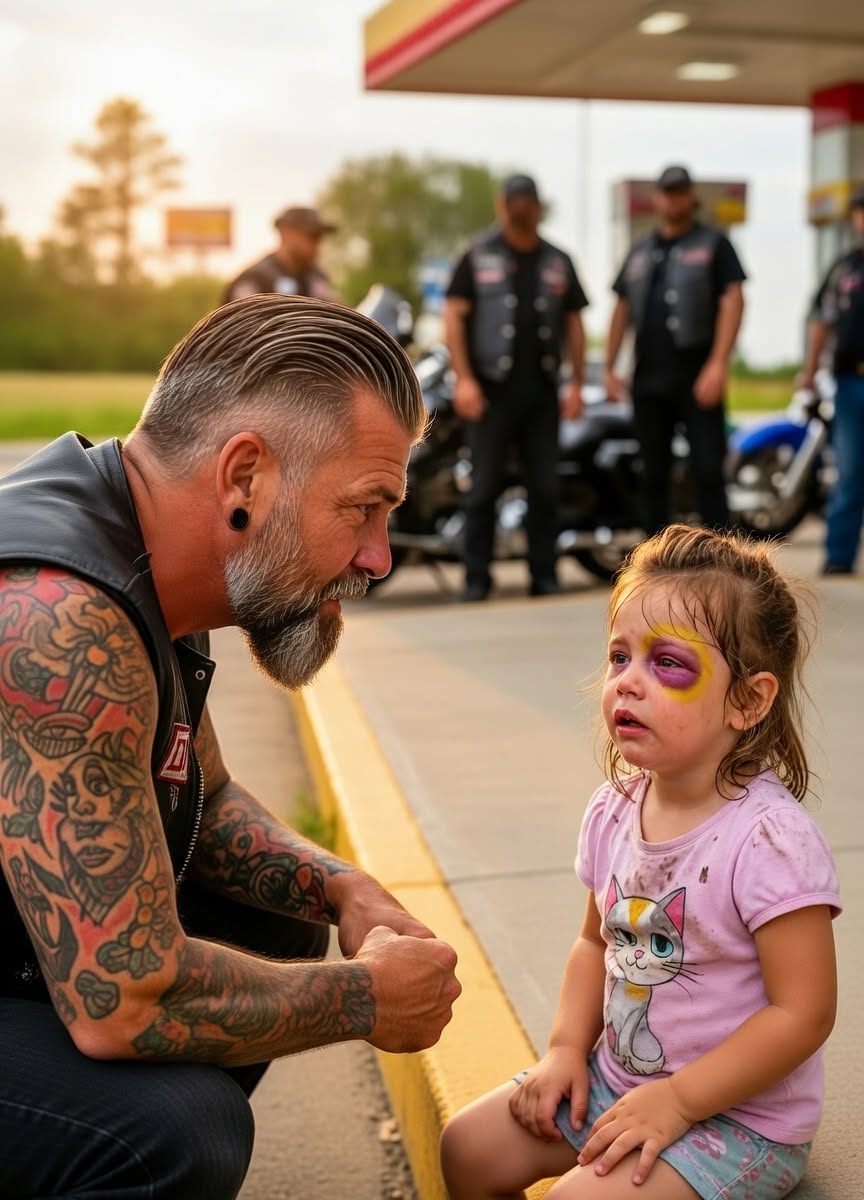
Part I — The Girl at Pump Number Four
By the time Bull Hadley rolled into Rudy’s Gas and Go on Route 9, the sun had turned the Tennessee sky the color of old copper and bruised peaches, and the whole parking lot shimmered with that thin autumn heat that makes everything look a second away from catching fire.
Twelve motorcycles thundered in together, loud enough to rattle the soda machine by the front door. Heads turned. They always did. Men in leather cuts had a way of changing the temperature of a place before they ever spoke.
Bull killed his engine and swung one long leg over his bike. At fifty-four, he moved like a man who had paid dearly for every mile of his life. He was big enough to blot out a doorway, with a beard gone silver at the chin and arms sleeved in tattoos that looked like wars someone had written down in ink. The patch on the back of his vest wasn’t for decoration. Nothing about Bull was decorative.
He would have gone inside for coffee like the others if he hadn’t seen her.
A little girl sat on the curb beside pump number four, knees pressed to her chest, one sneaker unlaced, pink T-shirt dirty at the hem. She was too still. Children weren’t meant to sit that still. Not in daylight. Not alone.
Bull took off his helmet and saw her face.
His chest locked.
Her left eye was swollen almost shut, purple fading to yellow at the edges. Her lip was split. There was dried blood near her jaw. Her hair looked like somebody had grabbed it hard enough to leave the memory behind.
Bull had seen bar fights, knife wounds, wrecked bodies on hot pavement, and men die from choices they’d made years before they knew the bill would come due.
But this—this was different.
He crouched down in front of her, bringing all six feet three of himself to one knee. Behind him, the other bikers went silent without being told.
“Hey, sweetheart,” he said gently, his voice rough as gravel dragged across wood. “You okay?”
The girl looked up slowly. She studied him with one clear eye, taking in the beard, the skull ring, the tattoos, the leather.
“You got a skull on your jacket,” she said.
Bull glanced down. “I do.”
“Does that mean you’re dangerous?”
A few of the men behind him shifted. One snorted softly. Bull didn’t smile.
“Depends,” he said. “On what you need.”
She stared at him for another long second. Then she said, in a voice so flat it sounded older than she was, “My dad hit me and then he left and I don’t know where he went.”
The air in the parking lot changed.
Nobody moved.
Bull felt something ancient and ugly uncoil in the center of him, but he kept his face steady. Angry adults scared children. He knew that. So he swallowed the violence and asked, “What’s your name?”
“Lily.”
“Okay, Lily. I’m Bull.”
She nodded once, as if filing it away.
“Are you hurt anywhere else?”
She lifted one shoulder. “My ribs hurt when I breathe deep.”
That did it.
Bull rose so fast the leather on his vest cracked. He turned to the men behind him. “Mace, call 911. Doc, get the trauma kit.” Then, to Lily, softer again: “You stay right here with me.”
One of the bikers—Doc, a former Army medic with hands as careful as a jeweler’s—knelt beside the girl and opened a red kit. Another draped a clean flannel shirt around her shoulders. None of them cracked jokes. None of them pretended this was ordinary.
The cashier inside, a narrow man with nicotine-stained fingers, came hurrying out. “I seen her maybe twenty minutes ago,” he said nervously. “Thought her folks were in the bathroom or something.”
Bull’s eyes cut toward him. “And when you saw a seven-year-old bleeding by herself, you thought that was enough?”
The man swallowed and looked away.
Lily flinched at the sudden edge in Bull’s voice. He immediately lowered it. “Not at you, baby girl. Not at you.”
Sirens sounded in the distance.
“Do you know your address?” Bull asked.
She nodded. “The blue trailer with the broken steps behind the feed store.”
“Who else lives there?”
“My mama.” Her mouth trembled for the first time. “But she didn’t wake up this morning.”
Bull went completely still.
“What do you mean she didn’t wake up?”
May you like
“A 29-year-old single man fought to keep five siblings under seven from being separated—and when the judge finally asked why he was willing to sacrifice everything for children he barely knew, his answer changed the entire courtroom.
He Got $900 For The Computer, But Judge Judy Refused To Return The Phone
He Sued His Ex Over Their Daughter’s Legal Bills, But The Real Expectation Was Her Parents
Lily stared at the ground. “Daddy was yelling. She was on the kitchen floor. He said she was lazy and bad and if I said anything, they’d take me away and it’d be my fault.” Her little fingers tightened around the flannel. “Then he hit me because I was crying.”
The oldest biker in the group muttered, “Jesus Christ.”
The ambulance arrived first, then a county sheriff’s cruiser. Two paramedics hurried over, and with them came Deputy Lonnie Wren, thin, sunburned, and already annoyed to find a dozen bikers surrounding the scene.
“What’s going on here?” he snapped.
Bull straightened to his full height. “What’s going on is a child’s been beaten, and her mother may be dying in a trailer while you ask stupid questions.”
The deputy bristled. “Watch your tone.”
Bull stepped closer—not threatening, not loud, just towering. “Watch your priorities.”
Lily suddenly clutched Bull’s wrist. Hard.
He looked down. Her face had gone chalk-white. Her one good eye was fixed not on the deputy but beyond him, toward the road.
A rusted green pickup had just turned into the station.
The man behind the wheel wore a stained ball cap and a mean mouth. Even from thirty feet away, Bull knew exactly who he was.
Lily’s voice came out as a whisper shredded by terror.
“That’s him.”
The truck door opened.
Her father climbed out smiling.
Not worried. Not frantic. Smiling.
Like he’d come to collect a thing that belonged to him.
Bull felt every biker behind him go still as stone.
The man looked at Lily, then at the bruises, then at Bull, and his grin sharpened. “Well, there you are,” he called. “You had me scared half to death, baby girl.”
Bull didn’t answer.
The deputy did. “You the father?”
“Tom Grady,” the man said, stepping forward with practiced innocence. “Single dad. Hard life. Little girl here likes to wander and make up stories.” He laughed softly, shaking his head. “She fell out of the truck this morning and got dramatic.”
Lily made a sound so small Bull almost missed it.
“No,” she whispered. “No, no, no.”
Tom Grady’s eyes flashed. Just for a second. But Bull saw it. So did Lily.
And then Bull noticed something else.
A silver locket hung around Lily’s neck, half-hidden under the dirty pink shirt. It had slipped out when she clutched his arm.
Bull stared.
A tiny, dented St. Christopher medal.
His heart gave one brutal kick against his ribs.
He knew that medal.
He had given it to a seventeen-year-old girl named Grace twenty-three years ago on the night she ran away from him in tears.
The only daughter he had ever had.
The daughter he had buried in his mind because thinking about losing her had always felt too close to dying.
Bull lifted a shaking hand and touched the edge of the pendant.
“Where did you get this?” he asked Lily.
She looked confused. “My mama gave it to me. She said it was from her daddy. She said if I was ever scared, I should wear it close.”
Bull turned very slowly toward the road, toward the deputy, toward Tom Grady smiling with dead eyes, and for the first time in thirty-one years, Bull Hadley felt fear.
Not for himself.
For what happened if this child was who he suddenly thought she might be.
And for what he would do next if she was.
Part II — The Name He Buried
The next four hours passed like a storm no one could outrun.
The paramedics wanted to take Lily alone, but the second they tried to separate her from Bull, she started shaking so violently the medic swore under his breath and gave in. Bull rode in the back of the ambulance on the little fold-down seat, his massive hands awkwardly resting on his knees while Lily held onto one finger like it was the last solid thing in the world.
At the station, Deputy Wren had tried to wave Tom Grady through with a warning and a smirk.
He didn’t get far.
Because Mace, the chapter’s road captain, had quietly walked back to the gas pump island and checked the security camera mounted under the awning. The clerk—suddenly very cooperative—had admitted the camera recorded audio too. And on that recording, plain as a church bell, Lily’s broken little voice could be heard saying, “My dad hit me.”
By the time Tom realized the balance had shifted, Bull had him pinned with nothing but his eyes.
“Don’t touch that truck,” Bull said.
Tom laughed. “Or what?”
Bull’s smile held no warmth at all. “Or the next few minutes go a way you don’t survive.”
Deputy Wren stepped in, but the ambulance crew had already called child services, and once a state investigator got on speaker, Wren’s swagger began to leak out of him. Tom Grady was told he was not leaving until further questions could be asked.
He went from smiling to furious in one heartbeat.
“She’s my kid!” he shouted. “That woman in the trailer ain’t any better. You don’t know what she is.”
Bull’s voice became dangerously quiet. “Then today’s a good day to find out.”
At County General, Lily was taken for X-rays. Two cracked ribs. Severe bruising. Dehydration. Concussion symptoms. A pediatric nurse named Carla crouched low and gave Lily a stuffed fox with one ear bent. Lily accepted it solemnly, then handed it to Bull to hold while they examined her.
He held that ridiculous stuffed animal like it was a sacred object.
When the social worker arrived, Bull expected suspicion. Instead, the woman—Ms. Reyes, practical shoes and kind eyes—took one look at Lily’s face, then one look at Bull sitting ramrod straight in a plastic chair with the fox in his lap, and said, “You’re the biker from the gas station.”
“Yes, ma’am.”
“She asked if you could stay.”
Bull glanced toward Lily, who was on the bed in oversized hospital scrubs, suddenly looking even smaller than before.
“I’ll stay,” he said.
Ms. Reyes folded her arms. “Are you family?”
Bull looked at the medal in his palm. “I don’t know yet.”
He asked to see Lily’s mother’s name on the intake report from the emergency call placed after officers finally checked the trailer. Ms. Reyes hesitated, then said quietly, “Grace Nolan.”
The world tilted.
For a long moment Bull couldn’t hear the machines, the voices in the hall, the squeak of nurses’ shoes. He heard only the echo of a younger girl laughing on the back of his old bike, hair whipping wild in the summer air. Grace at ten. Grace at thirteen, learning to throw a punch. Grace at seventeen, screaming, “You love your club more than your family!”
Grace walking out the door with tears on her face.
Grace gone.
He had looked for her for a year, then two. There had been rumors. A boyfriend. A different last name. A move across state lines. Then a trailer fire in Kentucky and a dead woman with no clean ID. The detective who called him had said there wasn’t much left. Bull, drunk and broken and furious at himself, had believed it because the alternative was hope, and hope hurt worse.
Now his daughter was in a hospital down the hall.
Alive.
And her child—his grandchild—had found him by accident on a Tuesday at a gas station.
Bull stood up so abruptly the stuffed fox fell to the floor.
Mace caught it, handed it back, and stared into his president’s face. “Bull?”
Bull’s voice came out cracked. “It’s Grace.”
The room went silent.
Even Lily looked up.
Bull swallowed hard and moved to the bed. “Lily… your mama’s full name is Grace Nolan?”
She nodded. “Sometimes she says Grace Hadley when she’s sad.”
Bull shut his eyes.
There it was. The knife. Straight in.
He sat down beside her carefully, as if afraid one wrong move would shatter the moment. “Baby girl,” he said, and his voice failed him once before he forced it steady, “Grace Hadley is my daughter.”
Lily blinked.
He saw the exact instant the meaning hit her.
“You’re…” She looked down at the medal, then back at his face. “You’re my grandpa?”
Bull had imagined many things in his life. Prison. Death. Redemption, maybe, if God was feeling theatrical.
He had never imagined hearing that word from a bruised child in a hospital bed.
“Yes,” he whispered. “I think I am.”
Lily stared at him for three long breaths.
Then she reached out with both little arms.
Bull gathered her against his chest, and the men who had seen him break noses and windshields and locked doors looked away to give him the dignity of privacy while their president silently wept into a child’s tangled hair.
That night the trailer behind the feed store gave up its secrets.
Grace had been found unconscious with a skull fracture, internal bleeding, and signs of repeated abuse. Tom Grady was not Lily’s biological father. He was Grace’s boyfriend of two years, a man with prior assault charges reduced through plea deals and favors. Deputy Wren, it turned out, was his wife’s cousin and had responded to three domestic disturbance calls at that trailer in six months without filing one report.
That alone would have been enough to wreck the town by morning.
But there was more.
Lily, between exhausted tears and drifting sleep, told Bull something she had never told anyone: Tom sometimes made Grace sign papers after hitting her. Sometimes men came at night with duffel bags. Sometimes Tom said if Grace ever tried to leave, he’d make sure “old things she buried” came out and she’d lose Lily forever.
“What old things?” Ms. Reyes asked gently.
Lily shook her head. “I don’t know. But Mama cried when he said he knew what happened to the baby.”
The room went cold.
Bull leaned forward. “What baby?”
Lily frowned, trying to remember. “Before me. Mama said she had a baby that died.”
Bull’s heartbeat slowed. Then stopped. Then started again all wrong.
Grace had never had another child before Lily. He knew that much from the dates.
Unless—
At 2:14 a.m., while rain lashed the hospital windows and most of the town slept, Bull stood outside Grace’s ICU room staring through the glass as machines breathed around her.
Carla the nurse came up beside him. “You should sit.”
“I’m fine.”
“No,” she said softly. “You’re not.”
Bull gave a humorless laugh. “You got me there.”
She handed him a photocopy. “This was in her belongings. Social work said you should see it.”
It was an old newspaper clipping, folded until the creases looked white. He opened it.
INFANT DISAPPEARS AFTER TRAILER FIRE
MOTHER CLAIMS CHILD TAKEN DURING CHAOS
Bull read the article once. Then again.
Twenty-one years ago. Kentucky.
A three-week-old baby boy.
Mother: Grace Nolan.
Authorities suspected trauma and confusion after the fire. No child was found. Case went cold.
Bull’s fingers tightened until the paper crumpled.
Tom had said he knew what happened to the baby.
Which meant Grace’s first child had not died.
He had been taken.
And suddenly Bull understood something so terrible it made his vision blur:
Tom Grady had not stayed with Grace because he loved her.
He had stayed because he owned the secret that had kept her obedient for years.
Bull lifted his head.
“Mace,” he said.
His brother came out of the shadows where he’d been keeping watch.
“Yeah?”
Bull’s eyes had gone flat and fierce. “Wake everybody. We’re not riding to Chattanooga.”
“What are we doing?”
Bull looked through the glass at his unconscious daughter, then down the hall at the room where Lily slept under state protection.
“We’re going hunting.”
Part III — What Waited in the Cornfield
By sunrise, the whole county was boiling.
Tom Grady had been arrested just before dawn after hospital staff found meth in the lining of his boot and the state investigator formally took Lily into emergency protective custody. Deputy Wren was suspended. Reporters started circling. The sheriff gave one nervous statement about “an ongoing investigation,” which convinced no one.
But Bull wasn’t interested in statements.
He was interested in the old fire.
Mace pulled favors through half the state by breakfast. Another biker, a retired private investigator named Harlan, dug through archived records. By noon they had enough to build the outline of a nightmare.
The trailer fire in Kentucky had never been properly investigated. Grace, eighteen at the time, had staggered out screaming that someone had taken her baby in the smoke. Witnesses assumed hysteria. She had been concussed, alone, poor, and dating a drifter named Troy Grady—Tom’s older brother.
Troy disappeared three days later.
Five months after that, he died in a county jail fight in Missouri.
No one ever connected the missing infant to his family.
Until now.
Tom hadn’t been there during the fire. But he had known. Somehow he had inherited the secret, and once he found Grace again years later, he had used it like a knife pressed to her throat.
By afternoon, Bull was sitting across from Tom in an interrogation room.
Tom had lawyered up, but sometimes men like him wanted an audience more than protection.
Bull got five minutes.
Tom grinned through split lips he’d earned resisting arrest. “You look tired, old man.”
Bull sat down. “Where is he?”
Tom’s smile widened. “Who?”
Bull didn’t blink. “Grace’s son.”
Tom leaned back. “That all this is? Family reunion?”
Bull folded his hands. Calm. Too calm. “You know what I think? I think you never hurt Grace just because you could. I think you enjoyed what she knew you knew. I think that was the point.”
Something shifted in Tom’s eyes.
Bull saw it and pressed harder.
“I think your brother stole that baby. I think he sold him, traded him, hid him—something ugly. And before Troy died, he told you enough to make yourself useful.”
Tom’s jaw ticked.
Then, very softly, he said, “You wanna know the funny part? She almost found him once.”
Bull went still.
Tom laughed. “County fair in Paducah, ten years ago. Kid walked right past her carrying a blue balloon. Same eyes as hers. She cried the whole ride home and didn’t know why.”
Bull’s voice dropped into something lethal. “Where is he?”
Tom leaned across the table. “I’ll tell you for a price.”
Bull just looked at him.
“Get me out,” Tom said. “Quiet charges. New start.”
Bull stood.
Tom’s grin faltered. “That’s it?”
Bull knocked once on the metal table with one thick knuckle. “No. That’s the sound of you having exactly one more chance to decide whether you die in prison as a wife-beater and child abuser or spend the next twenty years remembered as the man who finally told the truth.”
Tom scoffed, but there was sweat at his hairline now.
Bull turned to the mirrored glass. “Bring him in.”
The door opened.
Lily stepped in holding Ms. Reyes’s hand.
Tom’s face changed.
Not to shame. Men like him rarely found that road.
To fear.
Because Lily wasn’t crying.
She walked to the table with her bruised face lifted and said, in a voice small but steady, “You told Mama if she went to the police, you’d make my brother disappear again. I heard you.”
Tom went pale.
Bull hadn’t known about the brother threat. Neither had the investigators. But Lily had remembered in the night, and Ms. Reyes had asked whether she wanted to say it where it counted.
“I didn’t mean—” Tom started.
“You did,” Lily said.
Then she did something none of them saw coming.
She reached into the pocket of her borrowed hospital hoodie and put a Polaroid photograph on the table.
A teenage boy stood in front of a cornfield wearing a red baseball cap and a crooked half-smile. On the back, in shaky marker, were the words:
For proof. You keep your mouth shut.
—T
Tom lunged for the photo.
The detectives moved first.
Everything broke open after that.
The photo had been hidden for months inside the torn lining of Lily’s stuffed rabbit back at the trailer. She’d found it once when Tom made her hold laundry baskets, but she was too scared to show Grace. After the gas station, after the hospital, after hearing the grown-ups finally call Tom what he was, she had remembered exactly where she’d hidden it again—inside the fox Bull had been carrying, because in a frightened child’s mind, one stuffed animal could guard another’s secret.
The cornfield in the picture was recognized by an agricultural deputy within the hour. It belonged to an abandoned farmhouse just over the county line, land once leased by Troy Grady’s widow.
At dusk, Bull stood with law enforcement at the edge of that field while the sky went black-purple over the rows.
He wanted to charge in.
Instead he waited.
A search team moved through the farmhouse first. Then the cellar. Then the shed.
No boy.
Just when despair started to drag at everyone’s feet, one of the deputies shouted from behind the barn.
There was a storm bunker buried under a rusted sheet of metal.
Inside, sitting on a wooden crate beneath a single hanging bulb, was a young man of about twenty-one with Grace’s eyes, Bull’s jaw, and a shotgun across his knees.
He looked up at the flashlight beams and said, calm as weather, “If you’re with Tommy, tell him I ain’t hauling another box.”
Bull’s whole body locked.
The deputy lowered his light. “Easy, son.”
The young man stood in one swift movement, defensive and wild. He had been made into something feral by isolation, by lies, by years of being told the world aboveground was full of police and devils and men who would kill him if he ran.
Then Bull stepped forward into the doorway.
The young man’s gaze snagged on the St. Christopher medal in Bull’s hand.
Bull held it up with trembling fingers.
“Your mama had one just like this.”
The shotgun dipped.
“My mama’s dead,” the young man said.
Bull swallowed. “No, son. She’s not.”
Silence.
Then, in a voice that had broken more men than Bull had ever heard, the young man asked, “Who are you?”
Bull’s answer came from somewhere deeper than speech.
“I’m what’s left of your family.”
The boy—no, not a boy, a man stolen before he ever had the chance to become himself—was named Noah now. Troy Grady had raised him under three different names in three different counties, keeping him half-hidden, half-employed, half-afraid. After Troy died, Tom had taken over the arrangement, using Noah as unpaid labor on isolated properties and showing Grace the occasional proof-of-life photograph whenever she looked too close to freedom.
For twenty-one years, a missing child had been alive less than a hundred miles from the mother who mourned him.
The county exploded when the truth came out.
Deputy Wren resigned before he could be fired. The sheriff lost his next election. Charges stacked against Tom Grady like bricks: aggravated assault, child abuse, coercive control, drug trafficking, witness intimidation, false imprisonment, obstruction. More came from Kentucky once Noah’s identity was confirmed.
But none of that was the ending.
The ending came three days later.
Grace woke just after dawn.
Bull was there, shoulders hunched in the uncomfortable hospital chair, Lily asleep with her head in his lap and Noah standing stiffly by the window like he didn’t yet know whether he belonged in any room that held softness.
Grace opened her eyes, turned her head, and saw all three of them.
For one fractured second, she looked terrified.
Then she saw Bull.
And Noah.
And Lily.
And realization moved across her face like sunrise after a lifetime of night.
Her hand shook as she reached toward them.
Bull stood so fast he nearly overturned the chair. “Grace?”
Her voice came out thin and scraped raw. “Daddy?”
He took her hand in both of his, enormous and careful. “I’m here, baby girl.”
Grace started crying. Not delicately. Not prettily. The kind of crying that comes from years breaking open all at once.
Noah stared at her like he might shatter.
Grace turned to him. “My baby,” she whispered.
He crossed the room in three steps and dropped to his knees beside the bed.
Lily woke, saw them all together, and burst into tears too.
And Bull—great, scarred, terrifying Bull Hadley, whom whole counties stepped aside for—stood over the bed with his daughter, his granddaughter, and the grandson stolen from her arms, and bowed his head because the room was suddenly too full of miracle for a man like him to look at directly.
Outside, reporters waited. Cameras waited. The world waited for the bloody version, the violent version, the outlaw version.
But what happened next would never fit their headlines.
Bull canceled the memorial ride and turned it into something else.
Three weeks later, every biker in his chapter rode back through that same gas station parking lot—not for revenge, not for spectacle, but to escort Lily and Grace and Noah to the courthouse where Bull filed paperwork to establish kinship placement and emergency guardianship support until Grace recovered.
The whole town came out to watch.
This time, nobody moved away.
They moved closer.
Because sometimes the most shocking thing in the world is not brutality.
Sometimes it is what rises up to oppose it.
And in the front row, wearing a clean pink dress and both sneakers laced properly, Lily held Bull’s giant hand and looked up at him with the solemn confidence of someone who had crossed through darkness and found something impossible on the other side.
“Grandpa?”
Bull looked down. “Yeah, baby girl?”
She smiled—a real smile this time, bright enough to change the whole day.
“You were dangerous after all.”
Bull’s laugh broke halfway into a sob.
“Only,” he said, squeezing her hand, “for the right people.”
“A 29-year-old single man fought to keep five siblings under seven from being separated—and when the judge finally asked why he was willing to sacrifice everything for children he barely knew, his answer changed the entire courtroom.
“A 29-year-old single man fought to keep five siblings under seven from being separated—and when the judge finally asked why he was willing to sacrifice everything for children he barely knew, his answer changed the entire courtroom.
Preview
PART 1
I’m twenty-nine years old.
Single. No wife. No enormous bank account. No mansion with endless bedrooms.
But right now, I’m sitting outside a family courtroom watching five frightened children, all younger than seven, huddled together on a plastic bench like letting go of each other might make everything worse.
In less than an hour, a judge could sign an order sending them to different homes. Different families. Different counties.
The system calls it “”placement split.”” To me, it feels like another brutal loss they shouldn’t have to survive.