The 400 Pages
My twelve-year-old daughter came home from school on a Tuesday afternoon, dropped her backpack by the front door, and said six words that made my entire world stop.“Everyone hates me, Mom.”I looked up from the kitchen counter.“What?”
She stood there in her school uniform, still wearing her sneakers. Her dark hair was pulled into the ponytail she wore every day. But something about her face was different.
She looked exhausted.Not physically.Something deeper.“Everyone hates me,” she repeated.I forced a smile.
“That’s not true.”“It is.”She dropped her eyes.“I eat lunch alone every day. I walk the halls alone. Nobody talks to me.”
My heart tightened.I wiped my hands on a dish towel and walked toward her.“Did someone say something to you?”She shrugged.“Everybody says something.”“Who?”She shook her head.
“I don’t want to talk about it.”Then she walked upstairs.I followed her halfway before stopping.
There are moments when a mother knows something is wrong, even when every piece of evidence says otherwise.
For weeks, I’d asked her how school was.“Fine.”How were her friends?“Fine.”
Did she have homework?“Yes.”Her teachers had never called.Her grades were good.She wasn’t getting into trouble.So I’d believed the adults.I shouldn’t have.
That night, after she fell asleep, I sat on the edge of her bed.Moonlight came through the curtains.
Her phone was charging beside her pillow.
I stared at it for almost five minutes.
I knew I shouldn’t look.
But I was her mother.
And something inside me whispered:Look.I picked it up.
There were hundreds of notifications.
At first, I thought they were normal.
Then I opened the messages.
My blood went cold.
“Why are you still here?”
“Nobody wants you.”
“You should disappear.”
“Your parents would be happier without you.”
“Everyone at school is laughing at you.”
“Just go away.”
Some were from classmates.
Others were from parents.
And some were anonymous accounts.
I kept scrolling.
There were messages I’d never seen before.
Pictures.
Screenshots.
Videos.
Someone had taken photographs of my daughter sitting alone at lunch.
Someone had photographed her walking down the hallway.
Someone had taken a picture of her crying in the bathroom.
Then someone had written across the picture:
“Look at the freak.”
I covered my mouth.
I couldn’t breathe.
I kept scrolling.
There were hundreds.
I started taking screenshots.
Then I printed them.
Page after page.
By three in the morning, I had printed more than four hundred pages.
Four hundred pages documenting what adults at that school had somehow failed to notice.
The next morning, I put the stack into two boxes.
Then I drove to school.
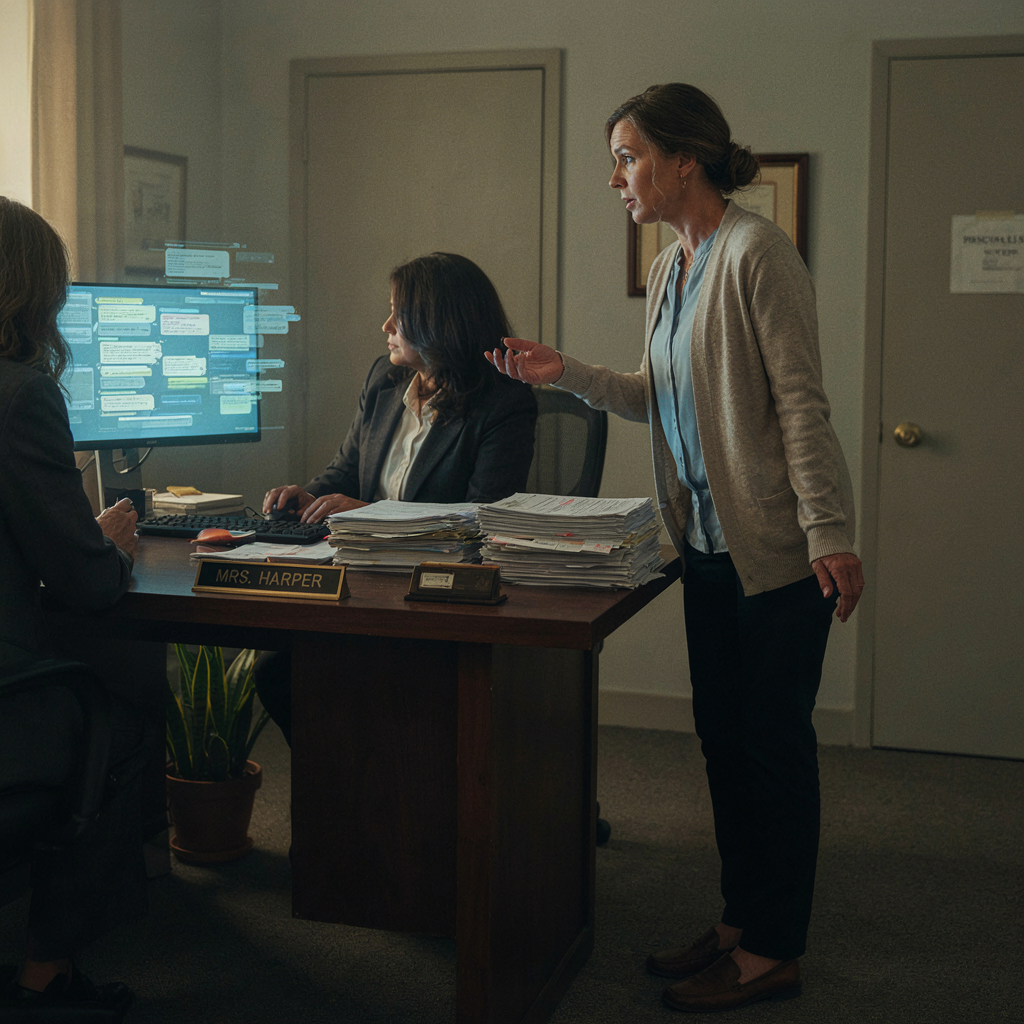
I walked into the principal’s office carrying the boxes.
The secretary looked surprised.
“Mrs. Harper?”
“I need to see Principal Bennett.”
“She isn’t available right now.”
“I’ll wait.”
Twenty minutes later, Principal Bennett finally opened the door.
She smiled politely.
“Mrs. Harper, what can I do for you?”
I put the first box on her desk.
Then the second.
Her smile disappeared.
“What is this?”
“Your school’s problem.”
She looked at me.
“What?”
“Four hundred pages.”
“Of what?”
“Messages sent to my daughter.”
Her face changed.
She opened the box.
She read the first page.
Then the second.
By the fifth page, she stopped.
“Mrs. Harper…”
“Don’t.”
She looked up.
“Before you say anything, there’s something I need to show you.”
She turned her computer screen toward me.
I leaned closer.
On the screen was a school disciplinary dashboard.
There was my daughter’s name.
EMMA HARPER — BEHAVIORAL CONCERN.
I stared.
“What is that?”
Principal Bennett swallowed.
“It’s a report.”
“A report about what?”
“Emma.”
“Emma isn’t the problem.”
“I know.”
Those three words made me pause.
“You know?”
She nodded.
“That’s why I asked you to come in.”
She clicked another file.
It was a timeline.
Every incident involving my daughter.
Lunchroom isolation.
Hallway avoidance.
Anonymous messages.
Rumors.
Teacher complaints.
But beside every incident was another name.
A name I didn’t recognize.
Eleanor Vance.
“Who is Eleanor Vance?”
The principal didn’t answer immediately.
Then she said:
“She is the school’s counselor.”
I frowned.
“What does she have to do with my daughter?”
Principal Bennett leaned back.
“That’s the question we’ve been trying to answer.”
Then she clicked on a folder labeled:
PROJECT ORCHID.
Inside were hundreds of pages.
My stomach dropped.
“What is Project Orchid?”
The principal looked at me.
“It’s an intervention program.”
“For what?”
“For bullying.”
I stared at her.
“My daughter wasn’t enrolled in any intervention program.”
“No.”
“Then why is her name here?”
The principal took a breath.
“Because Emma wasn’t supposed to know she was part of it.”
I felt something cold move through my chest.
“What do you mean?”
Principal Bennett opened a document.
It was an internal school memo.
It said:
Target student: Emma Harper.
I stood so quickly my chair scraped backward.
“Target?”
“Please sit down.”
“No.”
“Mrs. Harper, listen to me.”
“You called my daughter a target?”
“Not in the way you’re thinking.”
“Then explain it.”
The principal looked terrified.
And that frightened me more than anything I’d seen that morning.
She whispered:
“Someone has been using our school system to manufacture a bullying crisis around Emma.”
I stared at her.
“Why?”
“We don’t know.”
“You’re telling me someone created hundreds of fake accounts and encouraged children to attack my daughter?”
“Yes.”
“Who?”
“We thought it was students.”
“And now?”
Principal Bennett looked at the screen.
“We don’t think it came from students.”
She clicked on another file.
There was an IP address.
Then another.
Then another.
All connected to the same network.
The school’s network.
I felt dizzy.
“You mean someone inside this school did this?”
“Yes.”
“Who?”
“We have one strong suspect.”
She clicked the name.
ELEANOR VANCE.
I stared at it.
“The counselor?”
Principal Bennett nodded.
“Why would she do this?”
“We don’t know.”
I looked back at the four hundred pages on her desk.
“But there’s something else.”
She opened another file.
It contained emails.
Between Eleanor Vance and several parents.
One message caught my attention.
She’s becoming socially isolated exactly as predicted.
Another:
The mother must not be told yet.
Another:
The intervention cannot fail.
I felt sick.
“Intervention?”
Principal Bennett nodded.
“Eleanor created a program called Project Orchid. She claimed she was testing a new anti-bullying strategy.”
“And my daughter was the test?”
“Yes.”
I finally sat down.
“My daughter was twelve.”
“I know.”
“She wasn’t a research subject.”
“I know.”
“Who approved this?”
Principal Bennett looked away.
“No one.”
The room became silent.
Then I heard something that made everything worse.
“Eleanor didn’t act alone.”
I looked up.
“What?”
The principal opened another folder.
Inside were photographs.
Parents.
Teachers.
Students.
And one photograph stopped me cold.
It was a picture of Emma.
Standing beside me.
At her school orientation.
But someone had circled my face in red.
Underneath it was written:
Primary obstacle.
I looked at Principal Bennett.
“What does that mean?”
“We believe Eleanor wanted to study what would happen when a child became completely socially isolated.”
“And I was the obstacle because I might notice?”
“Yes.”
My hands began shaking.
“Where is she?”
Principal Bennett hesitated.
“She isn’t here.”
“Where is she?”
“She resigned yesterday.”
I stood.
“You’re telling me she resigned yesterday?”
“Yes.”
“After I found all this?”
“No.”
She looked directly at me.
“She resigned three days ago.”
My stomach dropped.
“Then where did she go?”
The principal opened one final document.
It was an email.
From Eleanor.
Sent that morning.
To me.
The subject line was:
YOU WERE NEVER SUPPOSED TO FIND OUT.
I couldn’t move.
Principal Bennett whispered:
“Don’t open it here.”
I opened it anyway.
There was only one sentence.
Ask your daughter what happened three years ago.
My heart stopped.
Three years ago?
Emma was nine.
I drove home immediately.
When I walked inside, Emma was sitting at the kitchen table.
She looked up.
“Mom?”
I sat across from her.
“Emma, I need to ask you something.”
She became nervous.
“What?”
“What happened three years ago?”
Her face went completely white.
I felt my blood run cold.
“You know what I’m talking about.”
She looked down.
“No.”
“Emma.”
She began crying.
“I didn’t want you to know.”
I reached across the table.
“You can tell me anything.”
She whispered:
“It’s about Dad.”
My breath caught.
Her father, Daniel, had died three years earlier.
A car accident.
At least that’s what we’d always believed.
“What about Dad?”
Emma wiped her eyes.
“Before he died, he told me something.”
“What?”
“He said someone was watching us.”
I stared at her.
“Who?”
“I don’t know.”
“What else did he say?”
She hesitated.
“He said if anything happened to him, I shouldn’t trust people who say they’re trying to help me.”
I couldn’t speak.
Emma reached into her backpack.
She pulled out a small envelope.
It was old.
Yellowed.
She handed it to me.
“Dad gave me this.”
I opened it.
Inside was a photograph.
Daniel.
Emma.
And Eleanor Vance.
I stared at the picture.
On the back was a handwritten note.
If Emma ever starts being isolated, find Eleanor.
My hands trembled.
Suddenly, everything changed.
The bullying wasn’t the beginning.
It was the continuation.
Three years earlier, Daniel had discovered something.
And Eleanor had known about it.
I called Principal Bennett.
She answered immediately.
“Mrs. Harper?”
“I know about the photograph.”
Silence.
“You need to come back.”
“Why?”
“Because I know why Eleanor targeted Emma.”
“Why?”
“She was afraid Emma remembered something.”
“What?”
“I don’t know.”
Then I heard Principal Bennett whisper:
“But I think Daniel left something behind.”
An hour later, I was back at the school.
Principal Bennett took me to an old storage room beneath the administration building.
Dust covered everything.
Files.
Boxes.
Broken furniture.
Old computers.
She pointed toward a metal cabinet.
“This was Eleanor’s.”
We opened it.
Inside was a single folder.
DANIEL HARPER.
I stopped breathing.
Inside were medical records.
School records.
Police reports.
And a handwritten journal.
I recognized Daniel’s handwriting immediately.
The first page said:
If you’re reading this, I was right.
I turned the page.
Daniel had been investigating a group of adults connected to several schools.
They called themselves The Orchid Circle.
Their purpose wasn’t bullying research.
It was something far darker.
They manipulated vulnerable children.
They isolated them.
They monitored their behavior.
They collected psychological profiles.
Then they sold those profiles to private organizations.
Children weren’t students.
They were data.
Emma had been one of their earliest subjects.
Daniel discovered it when she was nine.
He confronted Eleanor.
He threatened to expose the program.
Then he died.
The official report said his car lost control on a wet road.
But Daniel’s journal said:
If I die, it wasn’t an accident.
I couldn’t breathe.
Principal Bennett sat beside me.
“There’s more.”
She pointed to the final page.
Daniel had written:
Emma doesn’t know she was selected because of me. They believe children forget. They are wrong.
I looked at my daughter.
Suddenly, her entire childhood made sense.
The nightmares.
The fear of being watched.
The way she’d refused to sleep with her bedroom door open.
The strange drawings she’d made at age nine.
A woman standing outside a school.
A purple flower.
An eye.
I had thought they were children’s drawings.
They weren’t.
They were memories.
Principal Bennett looked at me.
“There’s one problem.”
“What?”
“The Orchid Circle isn’t just Eleanor.”
“Who else?”
She pointed to the folder.
Names filled the pages.
Teachers.
Parents.
Administrators.
And one name made my heart stop.
Dr. Samuel Harper.
My husband’s older brother.
Emma’s uncle.
I stared.
“No.”
Principal Bennett nodded.
“Daniel’s brother.”
I remembered him.
Samuel had always been kind to Emma.
He sent birthday cards.
He visited on holidays.
He had attended Daniel’s funeral.
He had even helped me with legal expenses afterward.
I suddenly felt sick.
“He knew?”
“We believe he helped fund the program.”
I grabbed my phone.
I called him.
He answered immediately.
“Claire?”
“Where are you?”
A pause.
“Why?”
“Where are you?”
“I’m at home.”
“Don’t leave.”
Another pause.
Then he laughed nervously.
“What is this about?”
“You know what happened to Emma.”
Silence.
Then his voice changed.
“You shouldn’t have found that file.”
I froze.
“You just admitted it.”
He hung up.
Principal Bennett looked at me.
“Call the police.”
I did.
Samuel was arrested that evening.
But Eleanor was still missing.
Three days later, police found her.
She had been hiding in a rented house two states away.
And she had one final message for me.
She asked to speak with me.
I almost refused.
But I went.
She sat behind the glass.
She looked nothing like the monster I’d imagined.
She looked tired.
Broken.
“You ruined everything,” she said.
“No.”
I leaned toward the glass.
“You ruined children’s lives.”
She shook her head.
“I was trying to expose them.”
I frowned.
“What?”
“The Orchid Circle.”
She looked at me.
“I joined them years ago.”
“Why?”
“To destroy them from inside.”
I stared.
She continued.
“Daniel discovered the truth before I could.”
“And you targeted Emma.”
“I needed them to believe I was still loyal.”
“So you bullied my daughter?”
“I created the appearance of bullying.”
“You sent her those messages.”
“Yes.”
My anger exploded.
“You told my twelve-year-old daughter the world would be better without her!”
“I knew the system was monitoring her.”
“That doesn’t excuse it!”
“No.”
Her eyes filled with tears.
“It doesn’t.”
She lowered her head.
“But I needed the people behind the program to reveal themselves.”
I stared at her.
“What happened?”
“Daniel died before he could expose them.”
“And Samuel?”
“He took over.”
“Why Emma?”
“Because Emma remembered.”
“What?”
Eleanor looked directly into my eyes.
“She saw the man who tampered with your husband’s car.”
I couldn’t move.
“Who?”
“Samuel.”
The room seemed to tilt.
Eleanor continued.
“Emma was nine. She saw him near the car that night.”
“But she never told anyone.”
“She was terrified.”
I thought about the photograph.
The drawings.
The nightmares.
Everything.
Then Eleanor said something I’ll never forget.
“The bullying wasn’t meant to destroy Emma.”
“Then what was it meant to do?”
“To make you angry enough to investigate.”
I stared at her.
“You used my daughter as bait.”
“Yes.”
“You could have come to me.”
“They were watching you.”
“Then you could have gone to the police.”
“They controlled the evidence.”
I shook my head.
“You nearly broke my daughter.”
Eleanor closed her eyes.
“I know.”
“And for that, you’ll answer for what you did.”
She nodded.
“I expected that.”
Months later, the Orchid Circle was dismantled.
The school district was investigated.
Several teachers lost their licenses.
Parents who had participated were charged.
Samuel was convicted for his role in Daniel’s death and the illegal program.
But the hardest part came afterward.
Emma had to learn how to trust people again.
She started therapy.
She joined a small art club.
She made two friends.
Then three.
One afternoon, months after everything ended, I found her sitting at the kitchen table drawing.
“What are you drawing?”
She smiled.
“A flower.”
I looked at the page.
It was an orchid.
But this time, it was surrounded by sunlight.
“What does it mean?” I asked.
She shrugged.
“Something bad can grow from something good.”
I smiled.
“And something good can grow from something bad.”
She looked at me.
“Mom?”
“Yes?”
“Do you still have those four hundred pages?”
I nodded.
“They’re in a box.”
“Why?”
“Because I never want to forget.”
Emma was quiet for a moment.
Then she said:
“I don’t want you to remember me as the girl everyone hated.”
I reached across the table.
“I don’t.”
“What do you remember?”
I smiled through tears.
“I remember the girl who survived.”
Emma leaned against me.
For the first time in a long time, she didn’t look afraid.
She looked twelve.
Just twelve.
And as I held my daughter, I finally understood something.
The four hundred pages had started as evidence of cruelty.
But they became evidence of something else.
Proof that someone had tried to convince my daughter she was unwanted.
And failed.
Because she wasn’t unwanted.
She was loved.
She was seen.
And she was still here.
That was the part they never planned for.
They had calculated every message.
Every rumor.
Every photograph.
Every lonely lunch.
They had calculated how long it would take before she broke.
But they had forgotten to calculate the one variable they couldn’t control.
A mother who refused to stop looking.
And sometimes, that’s all it takes to bring an entire hidden world crashing down.