The movers had already taken the last box when my ex-husband stood in the doorway of the house we’d spent fourteen years paying for.He looked around as if he were inspecting a property he’d just won at auction.
“The garage is mine. The house is mine. The cars are mine. The camper is mine.”He had fought for all of it.Every chair.Every appliance.
Even the stupid outdoor firepit we’d bought for eighty dollars at a yard sale and used exactly twice.
Our divorce had turned into a war over things neither of us had loved while we were married.
I had stopped fighting months earlier.Not because I thought he deserved everything.Because I was tired.Tired of lawyers.Tired of receipts.
Tired of hearing strangers discuss the value of objects that had once been part of our life.
So when he wanted the house, I let him have it.
When he wanted the SUV, I signed.
When he wanted the camper, I didn’t even argue.And when his attorney asked whether I wanted anything else from the house, I looked around and realized there was only one thing I cared about.
A heavy, dark wooden vanity that had belonged to his grandmother.
It had sat in the hallway outside the upstairs bedrooms for as long as I’d known his family.
It was ugly.At least, that’s what everyone called it.
Dark walnut.Cloudy oval mirror.
Brass handles that had turned almost black with age.
The wood had scratches everywhere, and one leg had been repaired badly enough that it leaned slightly to one side.
My husband had never liked it.
His mother hated it.
His sisters joked that it belonged in a haunted house.
But I’d always found something strangely beautiful about it.
His grandmother, Evelyn, had been the only person in his family who had ever made me feel completely welcome.
She used to sit at that vanity every morning, brushing her silver hair while I sat beside her and listened to stories about the family.
After she died, the vanity remained in the hallway.
Nobody wanted it.
Except me.
So during the final move, I asked my husband if I could take it.
He laughed.
“You can have the ugly thing. Nobody wants it.”
I signed the final papers two days later.
And that was how I ended up with a broken-down vanity in a new apartment, while my ex-husband walked away with almost everything else.
For nearly a year, I didn’t touch it.
It sat in my spare room.
At first, I planned to restore it.
Then I got busy.
Then I got lazy.
Eventually, it became a glorified laundry table.
Clean clothes went on it.
Towels went on it.
Mail went on it.
One Christmas, I put wrapping paper on it.
It was ridiculous.
But every time I thought about throwing it away, I remembered Evelyn.
She had once held my hand across that vanity and told me something I never understood until much later.
“People can fight over what they see,” she’d said.
“But the things that matter are usually hidden.”
I’d smiled at the time.
I thought she was talking about people.
I was wrong.
One Saturday afternoon, almost a year after my divorce, I decided enough was enough.
I was going to sell the vanity.
I opened my laptop and searched for antique furniture dealers.
The first person I called offered me fifty dollars.
The second offered seventy-five.
A third said someone might pay two hundred if the wood underneath the finish was genuine walnut.
I figured two hundred dollars was better than nothing.
So I cleared the laundry off the vanity and started cleaning it.
That’s when I noticed the middle drawer.
It wouldn’t open.
I pulled it.
Nothing.
I pushed it back.
Then pulled again.
It came forward about three inches and stopped.
Something was catching behind it.
I tried lifting the drawer.
Nothing.
I tried twisting it.
Still nothing.
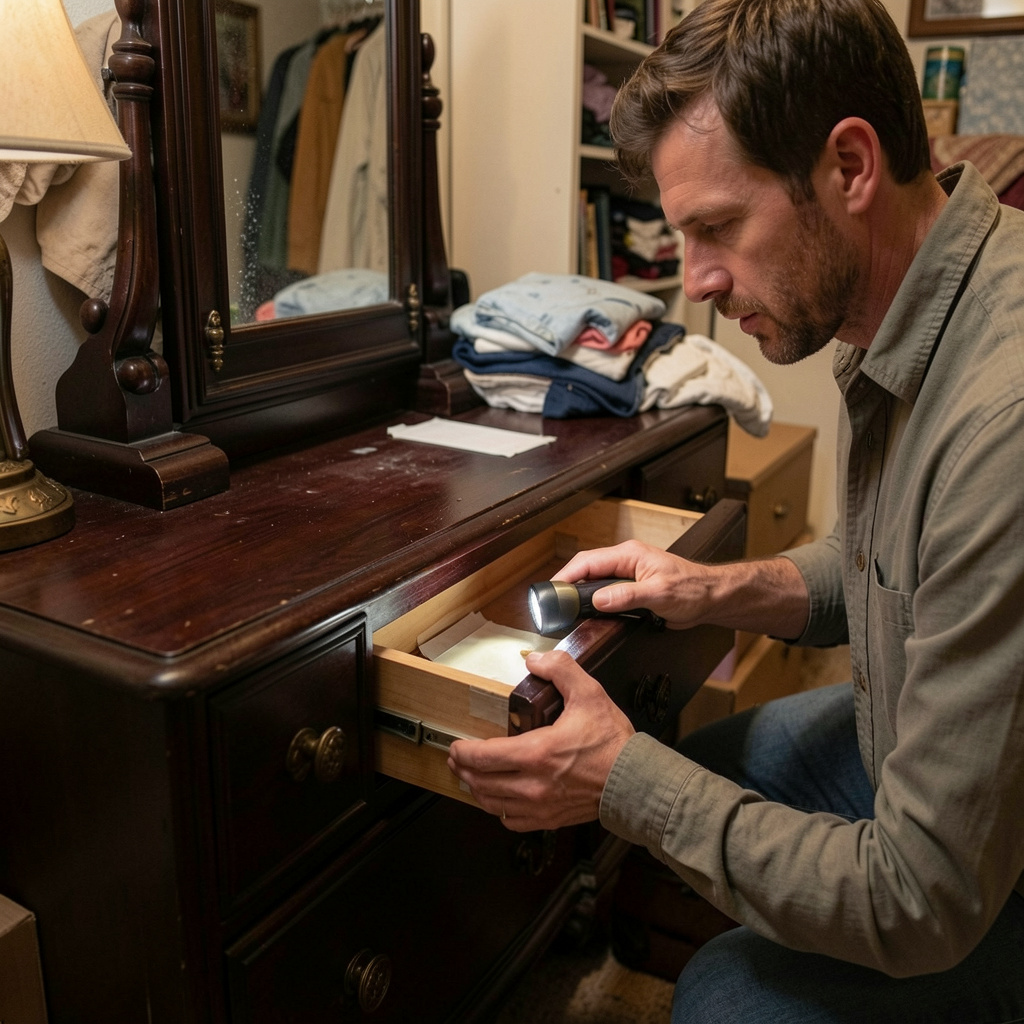
Finally, I grabbed a flashlight.
I knelt on the floor and looked into the gap.
I couldn’t see much.
Just darkness.
I reached my hand behind the drawer.
My fingers brushed something flat.
Something that wasn’t wood.
I froze.
I pulled my hand back.
Then reached in again.
My fingers found a piece of tape.
It was stuck to the back wall of the vanity.
I grabbed the edge and peeled.
A small brown envelope came loose.
My heart started pounding.
The envelope was old.
Very old.
The paper had yellowed, and the corners were soft from age.
On the front, written in faded blue ink, were four words.
For the woman who stays.
I stared at them.
Then I whispered,
“What the hell?”
I opened the envelope.
Inside was a photograph.
It showed Evelyn as a young woman, perhaps twenty-five.
She was standing beside the same vanity.
Behind her was a little girl.
My husband’s mother.
On the back of the photograph was a date.
Underneath it, Evelyn had written:
Margaret, if you’re reading this, you were wrong about him.
I read it twice.
Then three times.
I knew immediately that “him” meant someone in the family.
But who?
I turned the photograph over again.
There was another piece of paper folded behind it.
I opened it.
The handwriting was Evelyn’s.
I recognized it instantly.
I have kept this hidden because I was afraid of what would happen if the truth came out.
My mouth went dry.
I kept reading.
Your father did not die the way they told you.
I stopped.
The room seemed to tilt.
My husband’s grandfather had supposedly died in a car accident in 1970.
Everyone in the family knew that story.
He’d been driving home from work.
His truck had gone off an icy road.
He’d died instantly.
At least, that was what I’d been told.
I continued.
He was murdered.
I dropped the paper.
For several seconds, I just sat there.
Then I picked it up.
There were only three more sentences.
I know who did it.
And if you’re reading this, it means I’m gone and you finally deserve the truth.
Look beneath the mirror.
My hands began to shake.
I stood.
I touched the cloudy mirror.
Nothing.
I ran my fingers along the wooden frame.
Nothing.
Then I noticed something.
The mirror wasn’t sitting flush against the wood.
There was a tiny gap at the bottom.
I grabbed a butter knife from the kitchen.
Carefully, I worked it into the gap.
The mirror shifted.
Behind it was a narrow compartment.
And inside that compartment was a metal box.
I pulled it free.
It was heavy.
Locked.
But taped to the bottom was a small key.
My grandmother-in-law had apparently thought of everything.
I opened the box.
Inside were documents.
Bank statements.
Letters.
A newspaper clipping.
And a police report.
I read the police report first.
The accident wasn’t considered suspicious.
But one handwritten note in the margin said:
Brake failure. Vehicle should have been inspected.
The next document was an insurance policy.
The beneficiary was Evelyn.
The policy had been changed six months before her husband’s death.
The previous beneficiary had been his business partner.
I kept digging.
Then I found a letter.
It was from a man named Thomas Reed.
He had worked with Evelyn’s husband.
The letter was dated three weeks after the accident.
Evelyn,
I don’t know if I should be writing this. But I can’t carry it anymore.
Robert was going to expose Margaret’s husband. He had discovered money missing from the company accounts. Your husband confronted him. They argued.
I saw them together that night.
The brakes were tampered with.
I stopped reading.
Margaret was my ex-husband’s mother.
Her husband was his father.
I felt cold.
There was more.
Thomas claimed Robert had discovered that his own son had been stealing money from the family business.
When Robert threatened to expose him, he was killed.
And Evelyn had known.
She hadn’t gone to the police because she was afraid her son would destroy the family.
Instead, she hid the evidence.
For decades.
Then I found something that changed everything.
A bank statement.
A transfer.
The date was six months before Robert’s death.
A large amount of money had been moved from the family business into an account belonging to my ex-father-in-law.
The same amount appeared again after the death.
Then another transfer.
Then another.
It wasn’t just theft.
It was a fortune.
Millions by today’s standards.
And there was one final document.
A handwritten note from Evelyn.
If they ever discover this, they will say I was protecting my son. That’s partly true.
But I was also protecting Margaret.
She knows what happened. She has always known.
I sat on the floor.
Margaret knew?
My ex-mother-in-law had known her father was murdered.
She’d known her husband was involved.
And she had said nothing.
I thought about all the family gatherings.
The Christmas dinners.
The birthday parties.
The stories about how wonderful their family was.
The way Margaret always became quiet whenever someone mentioned her father.
I’d assumed grief made her uncomfortable.
Now I wondered if it was guilt.
I spent the entire night reading the documents.
There were business records.
Receipts.
Letters.
A second insurance policy.
And finally, a cassette tape.
I didn’t even own a cassette player.
I drove to a twenty-four-hour electronics store and bought an old used one.
At two in the morning, I sat alone in my apartment and pressed play.
Static filled the room.
Then Evelyn’s voice.
Older.
Tired.
But unmistakable.
“If you’re listening to this, I’m dead.”
I closed my eyes.
“I don’t know who will find this. Maybe Margaret. Maybe one of the grandchildren. Maybe nobody.”
A pause.
Then she said something that made my stomach twist.
“Robert didn’t die because he knew about the money.”
I leaned closer.
“He died because he knew who was helping my son.”
There was another pause.
“Margaret.”
I stopped breathing.
“She was the one who gave him the information.”
I stared at the cassette player.
Evelyn continued.
“She knew Robert was going to the police. She told her husband. She thought he would frighten him into silence. She didn’t know he would kill him.”
I covered my mouth.
“After Robert died, Margaret helped hide the evidence.”
The tape crackled.
“I have hated myself every day since.”
Then Evelyn said the sentence I would never forget.
“Family can turn good people into cowards.”
The tape ended.
I sat in silence.
The next morning, I called a lawyer.
Not the lawyer who handled my divorce.
A different one.
A criminal attorney recommended by a friend.
I showed him the documents.
He listened.
Then he asked me a question.
“Why do you have this?”
I told him the truth.
“My ex-husband didn’t want the vanity.”
He looked at me.
Then looked at the documents.
“That’s the strangest sentence I’ve heard all year.”
The investigation began quietly.
The lawyer contacted authorities.
Experts examined the documents.
The cassette was analyzed.
The handwriting was verified.
The signatures were compared.
The bank records were real.
The insurance policies were real.
The police report was real.
And then something happened I never expected.
My ex-husband called me.
“What did you find?”
I said nothing.
He laughed nervously.
“Mom told me you took Grandma’s vanity.”
I stared at the phone.
“Why?”
“Because she thinks you found something.”
My heart stopped.
“She told you that?”
“No.”
His voice became quieter.
“She asked me if you had contacted a lawyer.”
I didn’t answer.
He swore under his breath.
Then he said,
“Listen. Whatever you found, just give it to me.”
“Why?”
“Because you don’t understand what you’re dealing with.”
I almost laughed.
“Then explain it.”
Silence.
Finally he said,
“Grandma wasn’t a saint.”
“No,” I said. “She wasn’t.”
“She lied about a lot of things.”
“Apparently.”
“She wanted to destroy my family.”
“No,” I said. “She wanted the truth.”
He hung up.
Three days later, Margaret came to my apartment.
I hadn’t seen her since the divorce.
She looked older.
Smaller.
She stood outside my door holding a photograph.
“I know what you found.”
I let her inside.
She sat at my kitchen table.
For several minutes, neither of us spoke.
Then she placed the photograph down.
It was the same photograph I’d found in the vanity.
“I wondered when someone would find it,” she whispered.
“Why did you never tell anyone?”
She looked at me.
“Because I was twenty-three.”
“That’s not an answer.”
“It was enough of one at the time.”
She began crying.
“My husband told me he’d only scare my father. He said Robert was going to ruin us. We had a baby. We had debts. We were terrified.”
“Did he kill him?”
She closed her eyes.
“Yes.”
The word came out barely above a whisper.
“And you helped cover it up?”
She nodded.
“I told myself I was protecting my child.”
“Your child?”
“My son.”
My ex-husband.
I felt sick.
Margaret wiped her face.
“He never knew the truth.”
“Are you sure?”
She looked at me.
“Your husband knew there was money missing. He knew his father had secrets. But he never knew about Robert.”
“Then why did he call me?”
“Because he found out something else.”
“What?”
Margaret hesitated.
“Your divorce.”
I frowned.
“What does my divorce have to do with this?”
She looked toward the hallway.
“Everything.”
She told me something that made my blood run cold.
My ex-husband hadn’t fought for the vanity because he didn’t care about it.
He had fought for the house because he knew there were financial records hidden somewhere on the property.
His attorney had been instructed to make sure he kept the house.
The cars.
The camper.
Everything that could be sold or searched.
But he hadn’t known where the records were.
Until I asked for the vanity.
Margaret’s face crumpled.
“When you said you wanted it, he realized the one thing nobody had thought to search was the old furniture.”
“How did you know?”
“Because he called me that night.”
She looked at me.
“He asked whether Grandma ever hid things.”
I felt a chill.
“What did you tell him?”
“I said no.”
“Why?”
“Because I wanted you to find it.”
The room went silent.
“You knew?”
She nodded.
“Your grandmother-in-law told me where she’d hidden everything three days before she died.”
I stared at her.
“Why didn’t you get it yourself?”
“Because I was afraid.”
“Of what?”
“My son.”
I understood then.
Margaret had been protecting her son for decades.
And now she was finally choosing to protect someone else.
Me.
The authorities eventually arrested my ex-father-in-law’s estate executor, who had been moving money through dormant family accounts for years.
But the bigger truth was more complicated.
The original murder couldn’t be prosecuted.
The people involved were dead.
My ex-father-in-law had died twelve years earlier.
Thomas Reed had died twenty years ago.
Evelyn had died.
The case was closed decades ago.
But the financial crimes were another matter.
The investigation uncovered millions of dollars in hidden assets.
Money that had been stolen from employees, investors, and family members.
And because of Evelyn’s records, much of it was recovered.
My ex-husband’s claim to the house suddenly became complicated.
It turned out that some of the property he’d inherited had been purchased with stolen business funds.
The house was tied to the estate.
The cars were seized.
The camper was seized.
The bank accounts were frozen.
Everything he’d fought me for began disappearing.
But I didn’t care.
I never wanted his house.
I never wanted his cars.
I never wanted the camper.
I wanted the truth.
Months later, the legal case finally ended.
I received a settlement.
Not because I had demanded one.
Because investigators discovered that some of the stolen money had been used to purchase property during my marriage.
My lawyer told me the amount.
I stared at him.
It was more money than I’d ever had in my life.
“Do I have to accept it?”
“No.”
“Then I don’t want it.”
He looked surprised.
“What will you do?”
I thought about Evelyn.
I thought about Robert.
I thought about the family that had spent decades pretending everything was fine.
“I want to create a fund.”
“For what?”
“For people who get trapped by family secrets.”
He smiled.
“That’s a very specific charity.”
“Good.”
A year later, the vanity was restored.
I hired a professional furniture restorer.
The dark wood came alive beneath decades of grime.
The scratches remained.
I wanted them to.
The cloudy mirror was replaced.
The brass handles were polished.
The crooked leg was repaired.
When the restoration was finished, the vanity looked completely different.
Not beautiful in the modern sense.
Beautiful in the way old things become beautiful when you finally understand what they’ve survived.
I placed it in my bedroom.
One evening, I sat in front of it and opened the middle drawer.
It slid smoothly.
Inside, I kept the photograph.
The letters.
And one copy of Evelyn’s final note.
I had the original sealed with the legal records.
The note said:
People will tell you that family is everything.
It isn’t.
Truth is everything.
And sometimes loving someone means refusing to protect the lie that is destroying them.
I read those words again.
Then I looked at myself in the mirror.
For the first time since my divorce, I didn’t see a woman who had lost her house.
I saw a woman who had walked away from a marriage with almost nothing and somehow ended up with the one thing her ex-husband could never take.
The truth.
A few months later, I received a letter.
It was from my ex-husband.
I almost threw it away.
Instead, I opened it.
There were only four sentences.
I used to think you were the reason my life fell apart.
Now I understand my family built that life on lies long before you entered it.
I’m sorry I fought you for everything.
You were the only person who walked away with something worth keeping.
I folded the letter.
I put it in the vanity drawer.
Not because I forgave him.
I didn’t.
Forgiveness wasn’t necessary anymore.
Neither was anger.
Some doors close because you choose to shut them.
Others close because you finally discover what was hiding behind them.
And sometimes the ugliest thing in the room is the only thing telling the truth.
The vanity had been called worthless for decades.
My ex-husband had laughed when I took it.
“You can have the ugly thing,” he’d said.
Nobody wants it.
He had been wrong.
Someone wanted it.
Someone needed it.
And someone, long before I ever knew her, had trusted that one day the right person would finally open the drawer.
I never sold the vanity.
I never will.
Because every Sunday evening, when the apartment gets quiet, I sit in front of that old mirror.
And I think about Evelyn.
About Robert.
About Margaret.
About the family that buried the truth.
And about the strange way life sometimes gives you exactly what you need by taking almost everything else away.
The house had been his.
The cars had been his.
The camper had been his.
The money had been fought over.
The furniture had been divided.
But the ugly old vanity?
That was mine.
And inside it was a truth worth more than everything he had fought so hard to keep.