Unit 47
When my uncle left me his house, I thought the hardest part would be cleaning it out.I was wrong.
The hardest part was discovering that the man I had trusted most in my family had been quietly robbed for four years—and that the person who robbed him was someone I had spent my entire life calling cousin.
My uncle Daniel had lived alone for nearly twenty years.
His house sat at the end of a quiet country road, surrounded by oak trees and an overgrown garden he never seemed to have enough time to maintain. It wasn’t a mansion. It wasn’t even particularly large.
But it was worth something.
The realtor later estimated its value at $285,000.
To me, though, it had always been worth more.It was where I spent summers as a kid.Where Uncle Daniel taught me how to change a tire.Where he kept a freezer full of homemade chili.
Where he sat at the kitchen table every Sunday morning, drinking black coffee and reading the newspaper while I complained about school.
He had never married.
He had no children.
And when he died quietly in his sleep at seventy-two, his attorney called me three days later.”Daniel left the house to you,” she said.I remember staring at the wall.”Me?””Yes.”
There was something strange about the way she said it.Not surprise.Concern.But I didn’t ask.
At the time, grief had made everything feel distant.
I spent the next two weeks sorting through my uncle’s belongings.
His clothes.
His tools.
His old fishing equipment.
Stacks of receipts.
Boxes of photographs.
I found birthday cards I had sent him when I was eight, ten, twelve.
He had kept everything.
One afternoon, while cleaning the kitchen cabinets, I noticed a small envelope wedged behind a stack of old cookbooks.
Inside was a storage unit receipt.
I almost threw it away.
Then I looked closer.
Unit 47.
Monthly payment: $89.
Contract length: six years.
I frowned.
Six years?
I didn’t know my uncle had a storage unit.
The receipt showed that he had been paying for it for exactly six years.
At $89 a month, that was more than $6,000.
Why would a man who barely spent money on himself pay for a storage unit that long?
I turned the receipt over.
There was a handwritten note.
One line.
If something happens to me, check Unit 47.
My stomach tightened.
I called the storage company.
The woman on the phone asked for identification and proof of inheritance.
The next morning, I drove there.
The facility was twenty minutes outside town, surrounded by a chain-link fence and security cameras.
The manager was an older man named Frank.
He looked at my documents, then looked at me.
“You’re Daniel’s nephew?”
“Yes.”
He nodded slowly.
“I was wondering when you’d come.”
I stared at him.
“You knew my uncle?”
“Everybody knew Daniel.”
Then he hesitated.
“There is something you should know.”
“What?”
“Your uncle gave access to your cousin Gerald.”
I felt my expression change.
“Gerald?”
Frank nodded.
“Gerald has been listed as an authorized person on the unit for years.”
My cousin Gerald.
My uncle’s sister’s son.
Gerald had always been the family favorite.
He was charming.
Confident.
The kind of man who could walk into a room and have everyone laughing within five minutes.
He had also been the person who handled many of Uncle Daniel’s errands after Daniel started getting older.
Picking up prescriptions.
Buying groceries.
Taking him to doctor’s appointments.
At least, that’s what I had believed.
“When was Gerald last here?” I asked.
Frank checked his computer.
“Yesterday.”
My heart stopped.
“Yesterday?”
“Yes.”
“Did he remove anything?”
Frank frowned.
“Not that I noticed.”
I swallowed.
“Can I see the unit?”
He handed me a key.
Unit 47 was at the far end of the facility.
The lock opened easily.
I pulled up the metal door.
Inside was nothing.
Absolutely nothing.
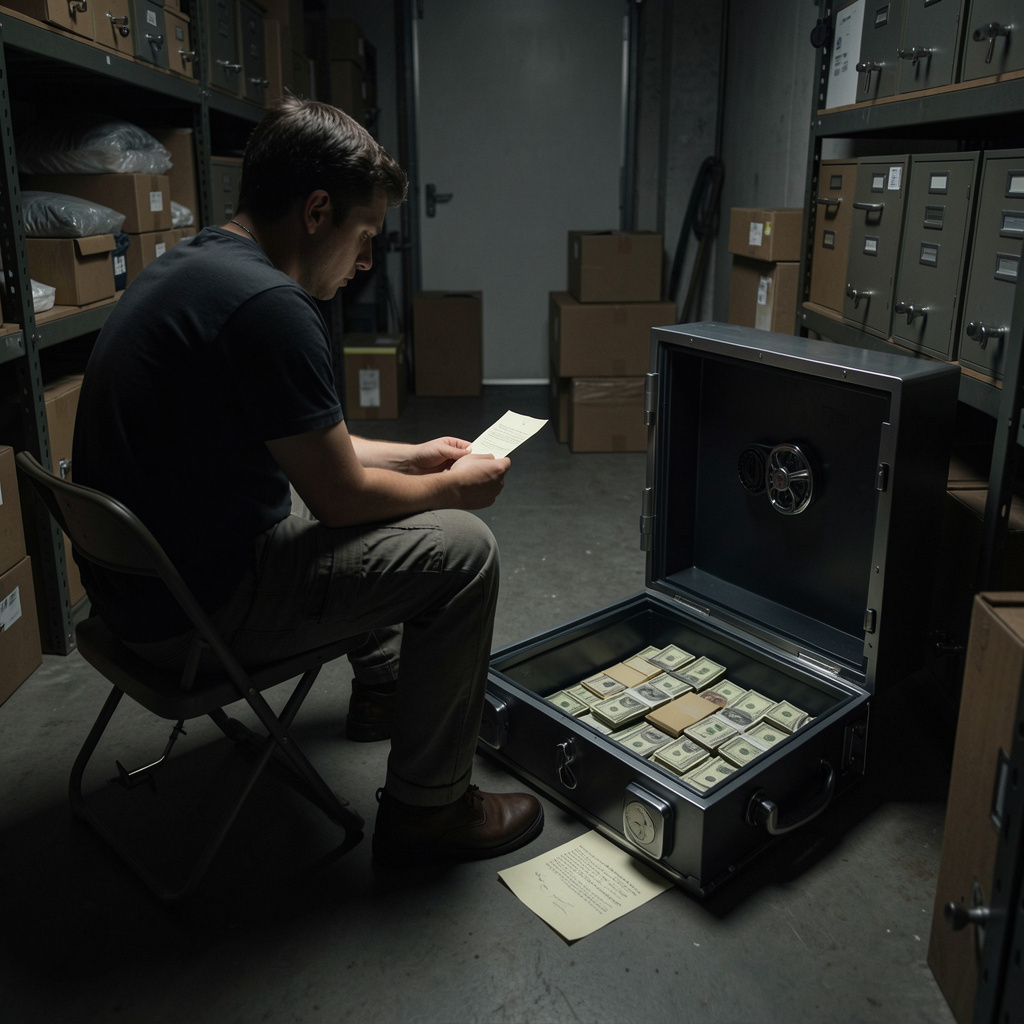
The unit was empty except for a folding chair.
I stared.
“That’s it?”
Frank stood behind me.
“That’s all that’s in there.”
I walked inside.
The folding chair sat in the center of the concrete floor.
I picked it up.
Nothing underneath.
I walked around the walls.
Empty.
No boxes.
No furniture.
No old photographs.
Nothing.
I felt foolish.
Maybe my uncle had simply forgotten about the unit.
Maybe Gerald had cleared it out.
Then I noticed something.
The carpet.
There was a strip of worn carpet covering most of the floor.
But one corner looked slightly different.
I crouched down.
The carpet wasn’t secured.
I pulled it back.
Underneath was concrete.
Except for one rectangular section.
There were tiny scratches around the edges.
I ran my fingers across it.
“Frank?”
He came closer.
“What?”
“Does this floor look normal to you?”
He crouched beside me.
“No.”
Together, we found a recessed metal handle.
I pulled.
A section of flooring lifted.
Beneath it was a steel box.
A fireproof safe.
My hands began shaking.
Frank stepped backward.
“Well,” he whispered. “That explains the chair.”
“What do you mean?”
He pointed.
“Your uncle probably wanted whoever opened that door to sit down before they opened the safe.”
I stared at him.
The safe had a combination lock.
I tried my uncle’s birthday.
Nothing.
His wedding anniversary didn’t work.
Then I remembered something.
Daniel had once told me:
“People always use the date they love. I use the date I remember.”
I entered the date his father died.
The lock clicked.
I stopped breathing.
Inside was a thick envelope.
A smaller metal cash box.
Several bank statements.
And stacks of hundred-dollar bills.
I counted them twice.
$162,000.
I sat down on the folding chair.
My hands shook so badly that I could barely hold the envelope.
The first document was my uncle’s will.
Not the one his attorney had shown me.
A handwritten copy.
Then I found the letter.
It was addressed to me.
To my nephew,
I stopped.
I couldn’t read further.
I closed my eyes.
Then I forced myself to continue.
If you’re reading this, I’m probably gone. I hope I’m wrong about why you found this.
My throat tightened.
I need you to know something before you trust anyone in this family.
I read the next sentence three times.
Gerald has been taking $3,000 a month from my pension.
I stared at the page.
My heart began pounding.
The letter continued.
He started four years ago. He told me he was moving money between accounts because I was becoming forgetful. At first, I believed him. Then I started checking my statements.
There were copies of bank records.
Transfers.
Withdrawals.
Thousands of dollars at a time.
The total was written in my uncle’s handwriting.
$144,000.
Four years.
Three thousand dollars a month.
One hundred forty-four thousand dollars.
I kept reading.
When I confronted Gerald, he said I was confused. He told me I was imagining things. Then he threatened to put me in a nursing home if I made trouble.
I felt sick.
My uncle had always hated nursing homes.
He had told me once, “I’d rather die in my own bed.”
The next paragraph made my stomach turn.
I wanted to tell you. But Gerald told me that if I accused him, he would make sure you never got this house. He said he’d convince everyone I was mentally incompetent and that you only wanted my money.
I lowered the letter.
For a moment, the storage unit seemed to spin around me.
Then I saw the final paragraph.
Gerald knows about this safe. He does not know I moved it beneath the floor. He thinks the money is somewhere else. If he comes here after I die, do not confront him alone. Call the police.
I looked at Frank.
“Gerald was here yesterday.”
Frank’s face had gone pale.
“Then he was looking for something.”
I folded the letter.
“What happens to the access code?”
Frank looked uncomfortable.
“The system resets in forty-eight hours.”
“When?”
“Tomorrow night.”
“And Gerald has a second key?”
Frank nodded.
“He was issued one years ago.”
I stared at the open door.
“Can you change the code now?”
“I can change your access code.”
“What about his?”
Frank hesitated.
“Not without documentation.”
I pulled out my uncle’s will.
“Would this be enough?”
Frank read it.
Then his eyes widened.
“You need to call the police.”
“I know.”
But before I did, I noticed something else.
The bank statements weren’t complete.
There were six months missing.
I searched the safe again.
Nothing.
Then I saw the underside of the folding chair.
A tiny envelope had been taped beneath it.
Inside was a USB drive.
And another note.
The money is only proof. The truth is on the drive.
I called the police.
Detective Harris arrived forty minutes later.
He was calm, methodical, and didn’t touch anything until photographs had been taken.
When I showed him the letter, he read it twice.
“This changes things,” he said.
“Can you arrest Gerald?”
“Not yet.”
I felt frustrated.
“He stole $144,000.”
“We need evidence connecting him directly to the withdrawals.”
I handed him the USB drive.
“Maybe this does.”
The detective inserted it into a laptop.
There were dozens of files.
Bank statements.
Audio recordings.
Scanned letters.
And one folder labeled:
GERALD
Detective Harris opened it.
The first recording was dated three years earlier.
My uncle’s voice came through the speakers.
“Gerald, I know you took the money.”
Then Gerald’s voice.
“You’re confused, Uncle Daniel.”
“I’m not confused.”
“You forget things all the time.”
“I remember giving you permission to help me with bills. I never gave you permission to take three thousand dollars every month.”
Silence.
Then Gerald laughed.
“You want to know what happens if you accuse me?”
My blood went cold.
“You’ll lose everything.”
Another recording.
Another confrontation.
Another threat.
There were seven recordings.
The final one had been recorded two weeks before my uncle died.
Gerald sounded angry.
“You don’t understand how this works anymore.”
“I understand perfectly.”
“Then understand this: if you tell him, I’ll make sure he doesn’t get anything.”
“That’s enough.”
“You think the family will believe you?”
“I don’t care.”
“You’re old, Daniel.”
My uncle’s voice was quiet.
“But I’m not stupid.”
The recording ended.
Detective Harris leaned back.
“Now we have something.”
I asked, “What do we do?”
“Wait.”
“For what?”
“Gerald.”
The next morning, Gerald called me.
I stared at his name on my phone.
I didn’t answer.
He called again.
Then sent a message.
We need to talk about Uncle Daniel’s house.
Another message came.
There are things you don’t know.
I finally replied.
What things?
His response came instantly.
Meet me at the house. Alone.
I showed Detective Harris.
He told me not to go alone.
So I went.
But I wasn’t alone.
Two officers waited nearby.
Gerald arrived twenty minutes later.
He stepped out of his car wearing a clean shirt and sunglasses.
He looked exactly as he always had.
Confident.
Relaxed.
He smiled when he saw me.
“I’m sorry about Daniel.”
I said nothing.
He walked toward the porch.
“You know, I think he’d want us to settle things like family.”
“What things?”
“The house.”
“It’s mine.”
His smile disappeared.
“That’s not really what Daniel intended.”
“I have his will.”
“Do you?”
I watched him carefully.
“What do you mean?”
He sighed.
“Daniel was confused near the end.”
There it was.
The same excuse.
The same lie.
I took a step closer.
“Did he tell you about Unit 47?”
Gerald froze.
Only for half a second.
But I saw it.
His eyes shifted.
Then he smiled.
“Unit 47?”
“Yes.”
“I don’t know anything about that.”
“You were there yesterday.”
His face hardened.
“Who told you?”
“The manager.”
He cursed under his breath.
Then recovered.
“You shouldn’t believe everything Frank says.”
“Why were you there?”
“I was checking Daniel’s belongings.”
“You’ve had access for years.”
“Because I helped him.”
“Did you help yourself too?”
Gerald stared at me.
Then he laughed.
“You really have no idea what you’re talking about.”
I pulled the letter from my pocket.
His face changed.
I didn’t show him the entire thing.
Just the first line.
Gerald has been taking $3,000 a month from my pension.
Gerald stopped breathing.
For several seconds, neither of us spoke.
Then he said quietly:
“Where did you get that?”
I smiled.
“That’s what I wanted to hear.”
His expression changed.
“You don’t understand.”
“Explain it.”
“I borrowed it.”
“One hundred forty-four thousand dollars?”
“I was going to pay him back.”
“Over four years?”
“I had problems.”
“Did you threaten him?”
“No.”
I stared at him.
“I heard the recordings.”
He went completely still.
Then he turned toward his car.
The police officers stepped out.
“Gerald,” Detective Harris called.
Gerald stopped.
“We need to talk.”
He looked back at me.
There was no charm left.
Only fear.
The investigation lasted months.
The bank records confirmed almost everything.
Gerald had accessed my uncle’s pension account through credentials he had obtained while helping him manage bills.
The money had been transferred into multiple accounts.
Some went toward credit cards.
Some toward gambling debts.
Some toward a business that had failed.
And some had simply disappeared.
But the investigation uncovered something even worse.
Gerald hadn’t only stolen the pension.
He had tried to manipulate my uncle’s legal documents.
There were emails showing that Gerald had contacted an attorney months earlier asking whether he could challenge the inheritance if Daniel became mentally incompetent.
He had also told relatives that Daniel was “losing his mind.”
That explained something I had never understood.
At family gatherings during Daniel’s final year, Gerald had constantly told people:
“Uncle Daniel isn’t himself anymore.”
I had believed him.
We all had.
Except Daniel.
He had been preparing.
Quietly.
Carefully.
He had kept copies of everything.
And he had known exactly who would find them.
Me.
Six months after his death, Gerald pleaded guilty to theft and financial exploitation.
The court ordered him to repay what he could.
Most of the $144,000 was gone.
But some assets were recovered.
The $162,000 in the safe was never part of Gerald’s stolen money.
It was my uncle’s emergency savings.
His final gift to me.
But there was one last surprise.
A month after the case ended, Detective Harris called me.
“We found something else in Daniel’s records.”
“What?”
“An insurance policy.”
I sat down.
“How much?”
“Two hundred thousand dollars.”
I closed my eyes.
My uncle had spent his final years planning for a future he knew he might not live to see.
Not for himself.
For me.
A week later, I returned to Unit 47.
The storage company had removed Gerald’s access.
The door opened with my new code.
The unit looked completely different.
The folding chair was still there.
I carried it outside.
Then I sat on it for a moment.
I looked at the empty floor.
The place where my uncle had hidden everything.
I thought about the letter.
About the recordings.
About how afraid he must have been.
And how alone.
I wished I had known.
I wished he had trusted me enough to tell me.
But maybe he had.
Maybe that was what the safe meant.
Maybe that was why he had left the receipt in the kitchen.
He knew I would find it.
I reached underneath the chair.
There was nothing there.
Just dust.
I laughed softly.
Then I cried.
When I returned home, I opened every box I had inherited from him.
At the bottom of one box was an old photograph.
My uncle was standing beside me when I was about nine.
I was holding a fishing rod twice my size.
He was laughing.
On the back he had written:
My favorite troublemaker.
I put the photograph on the kitchen counter.
Then I noticed something written beneath it.
A date.
And another sentence.
You were always worth protecting.
I sat down.
For the first time since his death, I understood.
The house wasn’t the inheritance.
The $162,000 wasn’t the inheritance.
The insurance money wasn’t the inheritance.
The real inheritance was the truth.
My uncle had spent years being told that he was confused.
That he was weak.
That no one would believe him.
But he had left behind proof.
And when he could no longer defend himself, he trusted me to do it.
I eventually renovated the house.
Not completely.
I kept the kitchen table.
The one with the little burn mark near the edge from when I was twelve and accidentally dropped a hot pan.
I kept his old coffee mug.
His chair.
His newspaper rack.
And every Sunday morning, I sat at the kitchen table with a cup of black coffee.
Sometimes I imagined him sitting across from me.
Sometimes I told him about my week.
Sometimes I said nothing.
A year after his death, I planted an oak tree in the backyard.
It was small.
Barely taller than I was.
I put a stone beneath it.
There was no long inscription.
Only six words.
He trusted me with the truth.
I never saw Gerald again.
But I heard through relatives that he had finally admitted everything.
Not because he suddenly became honest.
Because the evidence left him nowhere to hide.
And maybe that was what my uncle had understood all along.
People can lie about you.
They can question your memory.
They can manipulate your family.
They can tell everyone that you’re confused.
But truth has a strange way of waiting.
Sometimes it waits in a bank statement.
Sometimes in a recording.
Sometimes beneath a carpet in an empty storage unit.
And sometimes it waits for exactly the right person to sit down on a folding chair, open a fireproof safe, and finally understand why someone they loved had been trying so hard to leave them a message.
I still have the receipt for Unit 47.
I keep it in my desk.
$89 a month.
Six years.
A meaningless piece of paper at first.
Now I see it differently.
It wasn’t a storage receipt.
It was a trail.
My uncle knew I would eventually find it.
He knew Gerald would come back.
He knew the truth might disappear if he didn’t hide it somewhere no one would think to look.
So he left me a house.
He left me money.
He left me evidence.
But most of all, he left me one final act of trust.
And every time I look at that receipt, I remember something he once told me when I was a kid.
We were standing beside his old truck, and I’d just told him I was afraid I’d never be good enough at anything.
He had wiped the grease from his hands and looked straight at me.
“Don’t worry about being the strongest person in the room,” he said.
“Just be the person who doesn’t look away when the truth gets uncomfortable.”
For years, I thought he was talking about life.
Now I know he was preparing me for him.