The Letter to Santa
The letter arrived on a Tuesday morning, three weeks before Christmas.It was folded in half and tucked inside a plain white envelope with my name written across the front in my son’s teacher’s careful handwriting.
Mrs. Walker.I remember smiling when I saw it.For one brief second, I thought it was going to be something sweet.
Maybe a Christmas drawing.
Maybe a little note about how proud his teacher was of him.
Maybe a list of toys he had asked Santa for at school.My son, Noah, was six years old and obsessed with Legos. He had been talking about a red bicycle for months. I was already quietly putting money aside for one.
I opened the envelope while standing at the kitchen counter.Then I unfolded the paper.
The handwriting was large and uneven, with some letters written backward and several words spelled incorrectly.
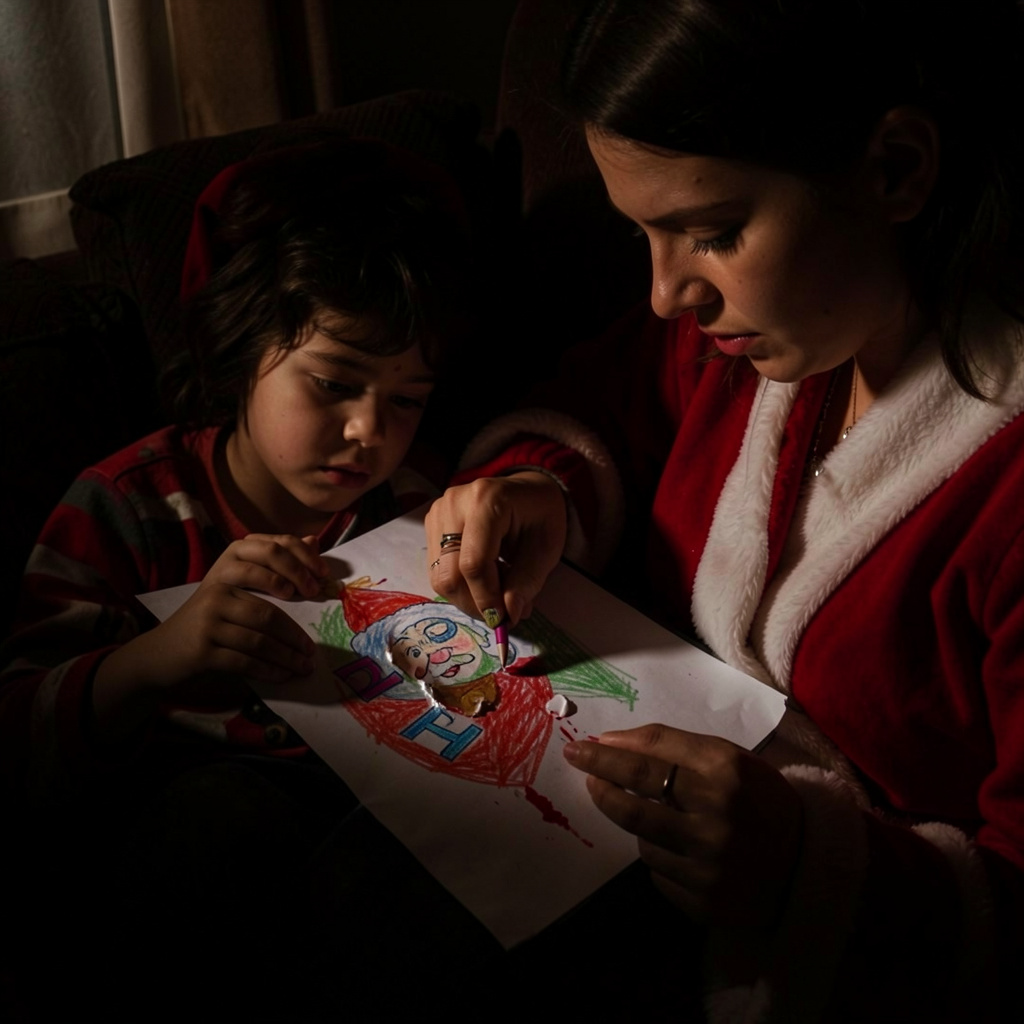
At the top, Noah had written:Dear Santa,Underneath were the words that changed my life.
“I don’t want toys.”I stopped smiling.“I want my mom to stop crying at night.”My eyes moved down the page.“I want the man who yells at her to go away.”My fingers tightened around the paper.
“He broke the kitchen table. He says bad words.”I couldn’t breathe.“Mommy says it’s our secret. But I don’t like secrets.”
I read it once.Then again.Then a third time.
My hands wouldn’t stop shaking.
Because there was only one man in our lives who fit every word.Derek.My boyfriend.The man I had spent nearly two years convincing myself wasn’t really as bad as everyone thought.
The man I had defended.The man I had made excuses for.The man I had allowed into my home.
The man I had allowed around my son.
I lowered myself into a kitchen chair.
The same kitchen chair where, two nights earlier, Derek had slammed his fist against the table hard enough to make the plates jump.
The same table he’d broken three weeks before.
The same table Noah had drawn pictures on when he was four.
The same table I’d told Noah we would fix.
I had told myself Derek was angry because he’d had a terrible day.
I had told myself he didn’t mean it.
I had told myself he would never hurt us.
I had told myself so many things.
But Noah hadn’t believed any of them.
He had simply written the truth.
A few hours later, the phone rang.
It was Noah’s teacher.
“Mrs. Walker,” she said gently, “I read the letter before I mailed it.”
My stomach dropped.
“I’m required to report what he wrote.”
I closed my eyes.
There was a pause.
Then she said, “Your son also told me something yesterday.”
My throat tightened.
“What did he say?”
She inhaled slowly.
“He said, ‘The man told me if I tell anyone, he’ll make Mommy disappear.'”
Everything inside me went cold.
I looked toward the hallway.
Noah was at school.
Derek was supposed to be at work.
And suddenly, for the first time, I understood that I wasn’t living in a bad relationship.
I was living inside a threat.
And my six-year-old son had been trying to save me.
I met Derek two years earlier.
At the time, I was exhausted.
I was a single mother working two jobs, earning about $34,000 a year, and trying to make one small apartment feel like a home for Noah.
His father had left when Noah was two.
Not dramatically.
Not with screaming or broken furniture.
He had simply disappeared one day and slowly stopped answering calls.
I had learned to survive without him.
Then Derek appeared.
He was charming.
Funny.
Helpful.
When my car wouldn’t start outside the grocery store, he helped me jump the battery.
When Noah needed a bookshelf, Derek built one.
He remembered Noah’s favorite cereal.
He brought me coffee before work.
He told me I deserved someone who would stay.
And when you’re tired enough, lonely enough, and desperate enough to believe someone might finally make life easier, kindness feels like rescue.
I mistook Derek’s attention for safety.
At first, there were no warning signs.
Then came the little things.
He didn’t like one of my coworkers.
Then he didn’t like my neighbor.
Then he wanted to know why I was five minutes late coming home.
He started checking my phone.
He questioned every expense.
He complained that I spent too much time with Noah.
One evening, I told him I needed to take Noah to the doctor.
Derek rolled his eyes.
“He’s always sick.”
I stared at him.
“He’s six.”
“So?”
I remember that moment clearly.
I should have walked away then.
But I didn’t.
Instead, I apologized.
That was how it began.
Not with a broken table.
With me apologizing for things that weren’t wrong.
The first time Derek screamed at me, Noah was in his bedroom.
The first time Derek punched a wall, Noah heard it.
The first time Derek broke something, I told Noah that Daddy’s old table had finally given out.
The first time Derek grabbed my wrist, I wore a sweater the next morning.
The first time he told me nobody would believe me, I believed him.
And every time, I became a little quieter.
Derek became a little louder.
Until one night, he broke the kitchen table.
It happened because I told him I couldn’t give him money.
My paycheck had arrived that morning.
Most of it was already gone.
Rent.
Utilities.
Groceries.
Noah’s school expenses.
I had $86 left.
Derek wanted $60.
“For what?” I asked.
He stared at me.
“You don’t need to know.”
“I need to know where our money is going.”
“Our money?”
He laughed.
“You mean your money.”
Then he slammed his hand down.
The table cracked.
Noah screamed from the hallway.
Derek turned toward him.
“What are you looking at?”
Noah ran into his bedroom.
I followed.
I shut the door.
And I whispered, “It’s okay.”
Noah looked at me with tears in his eyes.
“Mommy, are you okay?”
I nodded.
Even though my wrist was still red where Derek had grabbed me earlier.
“I’m okay.”
That was the night I taught my son the worst lesson a mother can teach.
I taught him to lie for me.
The day after the letter arrived, a social worker came to my apartment.
Her name was Angela.
She spoke softly.
She didn’t accuse me.
She didn’t ask why I had stayed.
She didn’t say the words I was already saying to myself.
Instead, she asked Noah questions.
Then she asked me questions.
When she asked whether I felt safe, I started crying.
Not because I didn’t know the answer.
Because I finally did.
“No,” I whispered.
Angela nodded.
“Okay.”
That was all she said.
No judgment.
No surprise.
Just one word.
Okay.
Then she helped me make a plan.
I packed a small bag for Noah.
Then another for myself.
I put our birth certificates in a folder.
Our medications.
A few clothes.
Noah’s favorite stuffed dinosaur.
His Christmas letter.
I folded that letter carefully and placed it inside my purse.
At the bottom of the page, Noah had drawn a tiny Christmas tree.
I couldn’t stop looking at it.
Derek came home at 6:18 that evening.
I heard his key in the lock.
My heart nearly stopped.
Noah was beside me.
I had already called the police.
Angela had told me not to confront him.
So I didn’t.
Derek walked into the apartment.
“Hey.”
I said nothing.
He looked at me.
Then at the packed bags.
His expression changed.
“What is that?”
I remained silent.
“Where are you going?”
Noah grabbed my hand.
Derek took one step toward us.
Then another.
“Who did you talk to?”
His voice was quiet now.
That frightened me more than yelling.
I stepped backward.
“Stay away from us.”
He stared at me.
Then he smiled.
A cold, humorless smile.
“So that’s what this is?”
My heart pounded.
“You’ve been talking.”
I didn’t answer.
“Who?”
Then I heard footsteps outside.
Derek heard them too.
The front door opened.
Two police officers entered.
For a second, Derek froze.
Then he looked at me.
I had never seen so much hatred in a person’s eyes.
But for the first time, I wasn’t alone.
The investigation took months.
Derek denied everything.
He said I was unstable.
He said I was angry.
He said Noah had misunderstood.
He said the broken table was an accident.
He said my bruises came from clumsiness.
He said I was trying to destroy his life.
But the truth had already started building its own case.
There were photographs.
Text messages.
Neighbors who had heard the screaming.
The school report.
Noah’s statement.
And there was something I hadn’t known existed.
A recording.
One of Derek’s threats had been captured accidentally by my phone.
I had forgotten to end a voice call with my sister.
She heard everything.
Every word.
Every threat.
Every insult.
Every promise that if I ever left, I’d regret it.
My sister had been begging me for months to leave.
I had stopped answering her calls because Derek said she was poisoning my mind.
Now she sat beside me in the courthouse.
She held my hand.
“You don’t have to protect him anymore,” she whispered.
I nodded.
“I know.”
The hardest part wasn’t leaving.
The hardest part was forgiving myself.
I kept thinking about all the moments I’d missed.
The way Noah had started sleeping with his bedroom light on.
The way he flinched whenever someone raised their voice.
The way he had started asking me, “Are you sure you’re okay?”
The way he stopped inviting friends over.
The way he listened whenever Derek’s car pulled into the driveway.
And then there was the letter.
I carried it everywhere.
Sometimes I read it before going to sleep.
Sometimes I cried.
Sometimes I wanted to tear it into pieces because I hated what it represented.
But I never did.
Because that letter wasn’t evidence of my failure.
It was evidence of my son’s courage.
A six-year-old boy had looked at Christmas and decided he didn’t need a bicycle.
He needed his mother alive.
Three weeks before Christmas, Derek was ordered to stay away from us.
No calls.
No messages.
No visits.
No contact.
I found a small apartment across town.
It wasn’t beautiful.
The carpet was old.
The kitchen was tiny.
The windows rattled when the wind blew.
But the first night we slept there, I cried.
Not because I was afraid.
Because I wasn’t.
No one screamed.
No doors slammed.
No furniture broke.
No one checked my phone.
No one told me I was worthless.
No one threatened to make me disappear.
Noah woke up the next morning and crawled into my bed.
“Mommy?”
“Yeah?”
“Are we safe?”
I hugged him.
“Yes.”
He was quiet for a moment.
Then he smiled.
“Can I have pancakes?”
I laughed.
Real laughter.
The kind I hadn’t heard from myself in years.
“Yes,” I said.
“Extra syrup.”
On Christmas morning, there were two presents under our tiny tree.
One for Noah.
One for me.
Noah opened his first.
Inside was a red bicycle.
His eyes grew enormous.
“Mommy!”
I smiled.
“Santa remembered.”
He ran toward me and hugged me so hard I nearly fell over.
Then he opened the second package.
Inside was a small wooden kitchen table.
I had bought it from a local craftsman.
It wasn’t expensive.
But it was sturdy.
Solid.
New.
No cracks.
No broken legs.
No memories attached to it.
Noah touched the surface.
“Is this ours?”
“Yes.”
He smiled.
“What about the old one?”
I swallowed.
“The old one is gone.”
He nodded thoughtfully.
Then he took a marker from his stocking and drew something on a piece of paper.
“What are you making?”
“A letter.”
“To Santa?”
He shook his head.
“To you.”
He handed it to me.
There were only a few words.
The letters were crooked.
Some were backward.
But I understood every one.
Dear Mommy,
You don’t have to cry anymore.
I pressed the paper against my chest.
Then I hugged him.
For a long time.
A year later, we had a different life.
I still worked for $34,000 a year.
I still counted grocery money.
I still worried about bills.
Nothing magical happened financially.
I didn’t suddenly become rich.
No prince arrived to rescue me.
There was no enormous inheritance.
There was no perfect new man.
There was just me.
Working.
Parenting.
Healing.
And slowly discovering that ordinary peace was worth more than anything money could buy.
Noah was seven now.
His teacher told me he had become one of the most talkative children in class.
He laughed more.
He made friends.
He slept through the night.
And one afternoon, his teacher called me.
“Mrs. Walker?”
“Yes?”
“I wanted to tell you something.”
My heart jumped.
“Is Noah okay?”
She laughed.
“He’s wonderful.”
I relaxed.
“Then what is it?”
“He told his class that secrets are dangerous.”
I smiled.
“Did he?”
“He said, ‘If someone tells you to keep a secret because you’ll get hurt if you tell, you should tell a grown-up.'”
My eyes filled with tears.
His teacher continued.
“He also said, ‘My mommy taught me that.'”
I covered my mouth.
For so long, I had believed that I had failed my son.
But maybe healing wasn’t about pretending the past hadn’t happened.
Maybe it was about teaching him something different from what I had taught him before.
That silence isn’t safety.
That love isn’t fear.
That apologies don’t erase violence.
That broken things aren’t always meant to be repaired.
Sometimes they’re meant to be thrown away.
Years later, I kept Noah’s Santa letter in a wooden box.
The paper had become soft at the folds.
The ink had faded slightly.
But I could still read every word.
“I don’t want toys.”
“I want my mom to stop crying at night.”
“I want the man who yells at her to go away.”
“Mommy says it’s our secret. But I don’t like secrets.”
Whenever I read it, I remember the woman I was when I first opened that envelope.
Tired.
Afraid.
Ashamed.
Convinced she had no choices.
Then I remember the woman I became.
Not fearless.
Not invincible.
Just willing to choose safety.
Willing to admit the truth.
Willing to walk away.
And most importantly, willing to listen when my child tried to tell me what I couldn’t yet tell myself.
Because that letter wasn’t really written to Santa.
Not entirely.
It was written by a little boy who had watched his mother disappear behind fear.
A little boy who didn’t know how to call the police.
Didn’t know what domestic violence meant.
Didn’t know how adults were supposed to solve impossible problems.
So he wrote to the one person he believed could fix anything.
Santa.
And somehow, that letter found its way home.
Not to the North Pole.
To me.
And it saved our lives.
On the last page of the box, I keep another piece of paper.
A note I wrote to myself after everything was over.
It says:
You were not stupid for staying.
You were scared.
You were not weak for being afraid.
You were surviving.
But the day you knew your child was afraid too, you found the strength to leave.
I read that note every Christmas.
Then I put the box away.
And downstairs, I hear Noah laughing.
He’s older now.
His voice is deeper.
He’s taller than I ever imagined he’d be.
But sometimes, when he laughs, I can still hear the six-year-old boy who wrote a letter to Santa instead of asking for a toy.
And every Christmas, when he hugs me, I whisper the same words into his hair.
“Thank you for telling.”
He always laughs.
“You’re welcome, Mom.”
Then he pulls away and smiles.
“Besides, Santa wasn’t the one who fixed everything.”
I smile back.
“No?”
He shakes his head.
“You did.”
I look at my son.
At the home we built.
At the little kitchen table where we eat dinner.
At the Christmas lights glowing in the window.
And I finally understand something I should have known all along.
Sometimes the bravest person in a house is the smallest one.
Sometimes the most important words come from a child who doesn’t know how powerful they are.
And sometimes a six-year-old’s letter to Santa isn’t asking for a miracle.
Sometimes it’s the beginning of one.