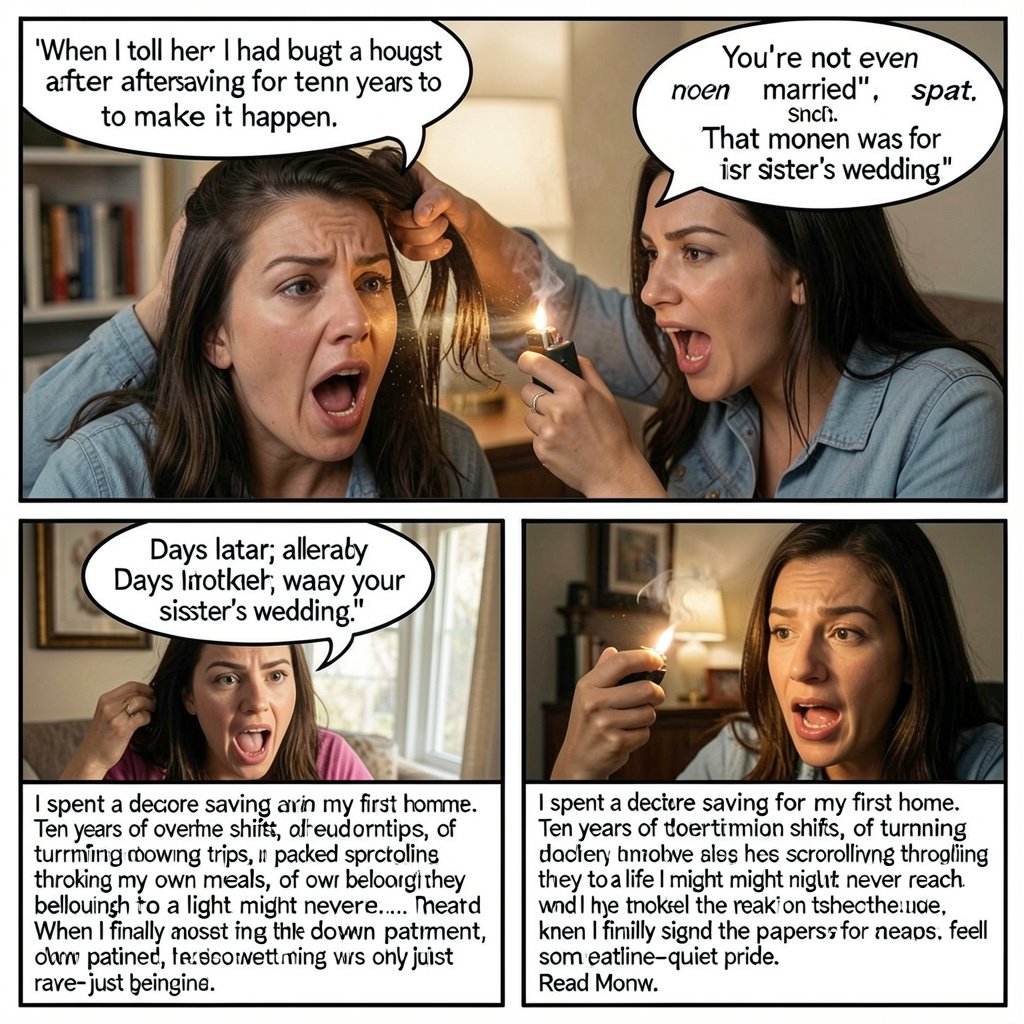
My mother screamed the words so loudly that the neighbors probably heard every syllable.“You’re not even married!”Her fingers were twisted in my hair, pulling my head backward until tears filled my eyes. In her other hand, she held a cigarette lighter.
“That money was for your sister’s wedding!”The little metal lighter clicked open.I stopped breathing.
For ten years, I had saved for one thing: a house of my own.
Ten years of waking before sunrise. Ten years of overtime shifts, cheap lunches, canceled vacations, secondhand furniture, and telling myself, One day.
While my friends traveled, I stayed home.While coworkers upgraded their cars, I kept driving my twelve-year-old sedan.Whenever I wanted something expensive, I asked myself one question:
Do I want this, or do I want my house?
The answer was always the house.
I didn’t grow up in a family where money meant security. Money meant arguments. It meant my parents deciding who deserved what and reminding me that family came first.
And somehow, whenever “family” was mentioned, it meant me sacrificing something.
My younger sister, Emily, had always been treated differently.
She was beautiful, outgoing, and charming. She knew exactly how to cry at the right moment and exactly what to say to make our mother feel needed.
I was the responsible one.
The quiet one.
The one who never caused trouble.
So when Emily wanted an expensive dress for prom, I was told to understand.
When she needed money for college, I was told that I was already working and could take care of myself.
When she got engaged, my mother announced that Emily deserved the wedding of her dreams.
I smiled.
I said congratulations.
And then I went home and worked another Saturday shift.
Because I had learned something very young:
If I wanted something, I couldn’t expect anyone to give it to me.
I had to build it myself.
By the time I was thirty-two, I had finally saved enough.
Not enough for a mansion.
Not even close.
But enough for a small three-bedroom house on a quiet street.
It had a narrow front porch, an old maple tree in the backyard, and a kitchen with cabinets that desperately needed repainting.
I loved it immediately.
The first time I walked through the empty rooms, I stood in the middle of the living room and imagined my future.
A couch.
A bookshelf.
A little garden.
Maybe a dog.
Maybe someday children.
Maybe not.
For the first time in my life, I wasn’t thinking about what someone else wanted.
I was thinking about what I wanted.
When I signed the papers, my hand trembled.
The realtor smiled.
“Congratulations. You’re officially a homeowner.”
I almost cried.
I called my mother.
“Mom,” I said, unable to hide my excitement. “I did it. I bought a house.”
There was silence.
Then she asked, “What house?”
I gave her the address.
Another silence.
Then:
“How much?”
I told her.
Her voice changed.
“You spent that much?”
“It’s my savings, Mom.”
“Your savings?”
“Yes.”
She laughed bitterly.
“You mean the money you’ve been saving while your sister has been planning her wedding?”
I frowned.
“What does Emily’s wedding have to do with my house?”
“Everything.”
I thought she was joking.
She wasn’t.
“You were supposed to help us pay for the wedding.”
“I never agreed to that.”
“You’re her sister!”
“I know.”
“You have money.”
“I saved it for my house.”
My mother sighed as though I were being incredibly selfish.
“You’re not married. You don’t have children. What do you need a house for?”
I stared at the phone.
“Because I want one.”
“That money could make your sister’s wedding beautiful.”
“Mom, Emily’s wedding isn’t my responsibility.”
Her voice became cold.
“You’ve changed.”
“No,” I said quietly. “I finally stopped living for everyone else.”
She hung up.
I thought that was the end of it.
It wasn’t.
Three days later, my mother showed up at my new house.
Emily was with her.
I opened the door and immediately knew something was wrong.
Neither of them congratulated me.
Neither even looked around.
Emily walked inside and dropped her purse onto my kitchen counter.
“So this is it?”
I nodded.
“It’s small,” she said.
“It’s perfect for me.”
Mom folded her arms.
“You’ve made a terrible decision.”
I closed the door.
“I’ve already bought it.”
“You could have waited.”
“For what?”
“For Emily’s wedding.”
I took a breath.
“Mom, we’ve already talked about this.”
“No, you talked. I listened.”
Emily suddenly started crying.
Of course she did.
“I can’t believe my own sister would do this to me,” she whispered.
I stared at her.
“Do what?”
“You knew how important this wedding was.”
“You knew I was saving for a house.”
“But I thought family mattered!”
“Family does matter.”
“Then prove it.”
Something inside me snapped.
“I have spent ten years proving it.”
Silence.
Mom’s face hardened.
“You’re selfish.”
“Maybe.”
“You’re abandoning your sister.”
“No. I’m refusing to abandon myself.”
That was when my mother grabbed me.
Her fingers tangled into my hair.
I cried out.
“Mom!”
She pulled me toward her.
“You ungrateful girl!”
Then she took the lighter from her pocket.
She flicked it open.
A tiny flame appeared.
I froze.
Emily stopped crying.
For one second, the entire room was silent.
My mother brought the flame dangerously close to my hair.
“You think you’re an adult because you bought a house?”
“Mom, put it down.”
“You’re not even married!”
She moved the flame closer.
“That money was for your sister’s wedding!”
I slapped her hand away.
The lighter fell to the floor.
Emily screamed.
Mom stared at me in disbelief.
Then she raised her hand.
I stepped backward.
“No.”
It was the first time I’d ever said that to her.
Not please.
Not I’m sorry.
Not I’ll fix it.
Just:
“No.”
She stared at me.
Then she walked out.
Emily followed.
At the door, my sister turned around.
Her expression wasn’t sad anymore.
It was angry.
“You’re going to regret this.”
The door slammed.
I stood there shaking.
For several minutes, I couldn’t move.
Then I picked up my phone and called the police.
I gave them the truth.
My mother had grabbed me.
She had threatened me with fire.
There were no witnesses inside the house.
But I didn’t care.
I had spent too much of my life protecting other people’s feelings.
I wasn’t going to protect someone who had just threatened me.
That night, I barely slept.
The next morning, I changed the locks.
I installed cameras.
I saved every text message.
I contacted a lawyer.
I thought I was prepared.
I wasn’t.
Four days later, there was a knock on my door.
Two police officers stood outside.
My stomach dropped.
“Are you Rachel Morgan?”
“Yes.”
One officer looked uncomfortable.
“We need to ask you some questions.”
“About what?”
“Your mother filed a complaint against you.”
I stared at him.
“What?”
“She claims you assaulted her.”
My mouth fell open.
“She attacked me!”
“We understand there’s conflicting information.”
Then he handed me a document.
My mother claimed I had shoved her into a table and threatened her.
She also claimed that I had stolen money from her.
Money she said she had given me to help pay for Emily’s wedding.
I felt sick.
“I never took money from her.”
The officer nodded.
“We’ll need you to come to the station and give a statement.”
I did.
I told them everything.
And then I showed them my evidence.
Texts.
Bank records.
Security footage from the exterior camera.
And, most importantly, a voice recording.
Because after my mother had left that night, I had remembered something.
My phone had been recording.
I hadn’t deliberately recorded the confrontation.
I’d been using my phone to time a recipe earlier, and the recording had remained active in my pocket.
The entire argument was there.
Every word.
Every threat.
Every second of the lighter clicking open.
The detective listened silently.
When the recording ended, he looked at me.
“Your mother knows you have this?”
“No.”
“Don’t tell her.”
I nodded.
For the first time since the confrontation, I felt something other than fear.
I felt hope.
But then the detective said something that changed everything.
“There’s another issue.”
“What?”
He turned a folder toward me.
“Your mother told us she had access to your financial information.”
My stomach tightened.
“What does that mean?”
“She claims you owe her money.”
“I don’t.”
“Then you should speak with your bank.”
I left the station and immediately called my bank.
The manager asked me to come in.
When I arrived, she closed the office door.
“We noticed something unusual.”
“What?”
“Someone attempted to access your account.”
“Who?”
She hesitated.
“Your mother.”
My blood went cold.
She had tried to transfer money from my savings account.
Not once.
Three times.
The first two attempts had failed because the bank’s fraud system blocked them.
The third attempt had been stopped manually.
“How did she have my information?”
The manager showed me the application.
My mother’s name wasn’t listed as an account holder.
But someone had entered security answers that were personal.
My favorite childhood pet.
My high school.
My mother’s maiden name.
Information only family would know.
I left the bank shaking.
Then I called Emily.
She answered immediately.
“What?”
“Did you try to access my bank account?”
Silence.
“Emily?”
“No.”
“Mom did.”
Another silence.
“Rachel…”
“Did you know?”
“I don’t know what you’re talking about.”
“Don’t lie to me.”
She hung up.
That was when I understood.
This wasn’t about a wedding.
It never had been.
My house represented something my family couldn’t control.
Independence.
I had spent ten years building an escape route.
And now that I had escaped, they wanted to pull me back.
The next day, my lawyer called.
“Rachel, you need to sit down.”
I did.
“What happened?”
“There was a document filed against your property.”
My heart stopped.
“What kind of document?”
“A claim stating that your mother contributed financially toward the purchase of your home.”
“She didn’t!”
“I know.”
“Then how can she claim that?”
“She can’t successfully claim it without evidence. But she’s trying.”
I closed my eyes.
My mother was willing to lie about me.
Willing to attack me.
Willing to risk legal consequences.
All because she believed my money belonged to Emily.
Then my lawyer said:
“There’s something else.”
“What?”
“Your sister’s wedding venue contacted me.”
“Why?”
“They said your mother had told them you would be responsible for a significant portion of the wedding expenses.”
I laughed.
Not because it was funny.
Because I didn’t know what else to do.
“How much?”
My lawyer gave me the number.
I nearly dropped the phone.
Thirty-eight thousand dollars.
That was what my mother had apparently promised using my name.
Thirty-eight thousand dollars.
I had spent ten years saving for my house.
My mother had spent months planning how to spend it.
Then, unexpectedly, Emily called.
I almost didn’t answer.
“Hello?”
Her voice was quiet.
“Rachel.”
“What do you want?”
“I need to tell you something.”
I said nothing.
“Mom lied to me.”
My chest tightened.
“About what?”
“She told me you had promised to pay for the wedding.”
“I never did.”
“I know.”
“Then why did you believe her?”
Emily began crying.
“Because she said you hated me.”
I closed my eyes.
“She told me you were jealous.”
I couldn’t speak.
“She said you were trying to ruin my wedding because you couldn’t stand seeing me happy.”
I swallowed.
“Emily…”
“She also told me that you had stolen money from her.”
I almost laughed.
“She said you were unstable.”
There it was.
The story my mother had created.
The villain.
Me.
The selfish daughter.
The jealous sister.
The ungrateful child.
Emily continued.
“I believed her.”
“Why are you telling me now?”
“Because I found something.”
“What?”
“A folder.”
My heart began pounding.
“What folder?”
“Dad’s.”
Our father had died five years earlier.
Emily said she’d found the folder in Mom’s closet.
“There were bank statements.”
“For what?”
“For you.”
I went silent.
“She had been taking money from an account Dad left for you.”
I felt the room tilt.
“What?”
“Dad left you money.”
I knew nothing about it.
Emily explained that their father had created a small trust for both daughters.
But the records showed that money intended for me had been withdrawn over several years.
“How much?”
Emily hesitated.
“Almost forty-two thousand dollars.”
I couldn’t breathe.
The number was almost exactly what my mother had claimed I should contribute to Emily’s wedding.
My mother hadn’t simply expected me to sacrifice my savings.
She had already been taking from me.
Emily sent me photographs of the documents.
I forwarded everything to my lawyer.
The case changed overnight.
The police investigation changed.
The financial investigation changed.
And my mother suddenly stopped answering calls.
Two weeks later, she was arrested for financial fraud and making a false report.
I wasn’t there when it happened.
I didn’t celebrate.
I didn’t feel victorious.
I just felt tired.
For years, I had believed that if I worked hard enough, gave enough, forgave enough, maybe my family would finally see my worth.
But some people don’t value what you give them.
They simply become accustomed to receiving it.
The day I got the final legal confirmation that my house was entirely mine, I stood on the front porch.
The maple tree moved gently in the wind.
The house was still imperfect.
The cabinets were ugly.
The hallway needed paint.
The backyard needed work.
But it was mine.
Every wall represented a sacrifice.
Every room represented a decision.
Every key represented ten years of refusing to give up.
Emily eventually canceled the wedding.
Months later, she apologized.
Not with excuses.
Not with tears designed to manipulate me.
She simply said:
“I was wrong.”
I appreciated that.
But forgiveness didn’t mean forgetting.
We rebuilt our relationship slowly.
As for my mother, I haven’t spoken to her since the court proceedings.
Maybe one day I will.
Maybe I won’t.
For the first time, I understand that distance isn’t cruelty.
Sometimes distance is protection.
One evening, almost a year after I bought the house, I was sitting on my porch with a cup of coffee.
The sunset painted the sky orange.
My phone buzzed.
It was a message from Emily.
Mom asked me to tell you something.
I stared at the screen.
Then another message appeared.
She says she wants the house.
I laughed softly.
Of course she did.
Even after everything.
Even after the lies.
Even after the police.
Even after the bank records.
She still believed the house belonged to someone else.
I typed one sentence.
Tell her she should get used to hearing the word no.
Then I turned my phone off.
I looked around my home.
My home.
Not Emily’s.
Not my mother’s.
Not something I owed anyone.
Mine.
Ten years ago, I had started saving because I wanted a place where nobody could tell me I wasn’t enough.
I didn’t know then that the hardest part wouldn’t be buying the house.
It would be believing I deserved to keep it.
Now I did.
And nobody—not my mother, not my sister, not anyone—could take that away from me.
The next morning, I woke before sunrise.
I made coffee.
Opened the curtains.
And watched the first light spill across the living room floor.
For years, I’d thought freedom would feel dramatic.
Like fireworks.
Like victory.
Instead, it felt quiet.
It felt like standing barefoot in my own kitchen.
It felt like turning a key in a lock and knowing the door belonged to me.
It felt like finally understanding that love doesn’t require you to destroy yourself for other people.
And family doesn’t give someone the right to hurt you.
I had spent ten years saving for a house.
But what I had really saved for was a life.
And finally, after all those years, I was living it.