The morning after my father died, I learned that grief could be interrupted by something as simple as a sentence.“You’re not family anymore. Get out.”Cheryl said it with her arms crossed over her chest, standing in the hallway where my father had hung photographs of me, my mother, and himself.My mother had been dead for nine years.My father had been dead for two days.And apparently, that was all the time Cheryl needed to erase me.
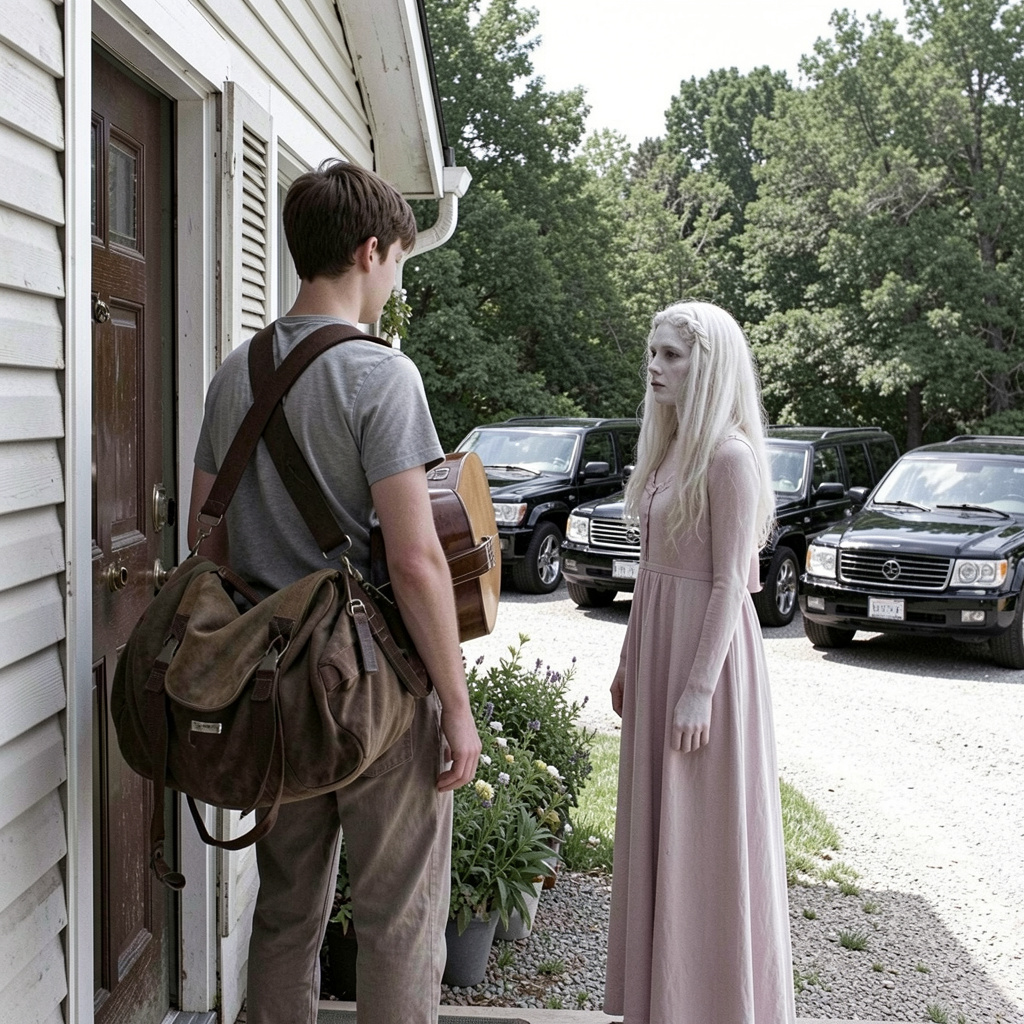
I was nineteen years old.I had one duffel bag.
And my guitar.That was it.
I looked at the woman who had married my father five years earlier and tried to find even a trace of the woman she had pretended to be.When Dad introduced Cheryl to me, she had smiled constantly.
She’d called me “sweetheart.”She’d told neighbors how excited she was to become a stepmother.
She’d even hugged me at the wedding.
But once the guests left, the smiling stopped.
The first time she snapped at me, I was fourteen.“You’re not a little kid anymore,” she said after I accidentally left a glass in the sink. “Stop expecting everyone to clean up after you.”
I stared at her.“I was going to wash it.”“Then do it without announcing it.”Dad came home twenty minutes later.
Cheryl smiled.“Everything’s fine,” she said.
I learned quickly that she had two faces.
The one Dad saw.
And the one I saw.
Whenever he traveled for work, she became colder.
She complained about the groceries I ate.
She criticized my clothes.
She told me I was becoming selfish.
She once locked the refrigerator after midnight because she said I was “eating like a stray dog.”
But whenever Dad came home, there was food waiting for me.
She’d put her arm around my shoulder and tell him, “We had such a lovely time together.”
I never told him.
Not because I was afraid of Cheryl.
Because I was afraid of losing him.
My father was all I had left.
My mother had died when I was ten after a long illness.
I remembered sitting beside her hospital bed, holding her hand while machines beeped around us.
I remembered her voice becoming softer.
I remembered Dad crying in the hallway when he thought I wasn’t looking.
And I remembered my mother squeezing my fingers one last time.
“Take care of your father,” she’d whispered.
So I did.
Even when taking care of him meant staying quiet.
Even when Cheryl made me feel like a guest in my own home.
Dad always told me, “She’s adjusting.”
Then later, “She’s trying.”
Eventually, “She’s good for me.”
So I swallowed everything.
Until the day he died.
His death was sudden.
A heart attack.
One moment he was talking to me about my college applications.
The next, I was sitting in a hospital corridor while a doctor told me there was nothing more they could do.
I didn’t even cry at first.
I just stared at the floor.
My father was gone.
The only person in the world who had never abandoned me was gone.
At the funeral, Cheryl performed grief like she had rehearsed it.
She cried into tissues.
She accepted condolences.
She held my arm when people approached.
She told everyone, “He loved us both equally.”
I wanted to scream.
But I couldn’t.
Two days later, after the flowers had barely begun to wilt, she changed.
She walked into the living room while I was sitting on the couch.
“You need to pack.”
I looked up.
“Pack?”
“Yes.”
“For what?”
She crossed her arms.
“For leaving.”
I thought I’d misunderstood.
“Where am I going?”
She shrugged.
“That’s not my problem.”
“Cheryl, Dad just died.”
Her expression hardened.
“And he’s not coming back.”
The words hit me like a slap.
She pointed toward the stairs.
“You’re nineteen. You’re an adult. You can figure something out.”
I stared at her.
“This is my home.”
“No,” she said coldly. “It was your father’s home.”
I stood.
“Dad told me I could stay here while I finished school.”
“I don’t care what he told you.”
I felt my throat tighten.
“Did he leave a will?”
Something flickered across her face.
Then it disappeared.
“You don’t get anything.”
“I didn’t ask for anything.”
“You’re asking for the house.”
“I didn’t say that.”
“You don’t have to.”
I looked around the room.
The photographs.
The old leather chair Dad always sat in.
The bookshelf he’d built himself.
My mother’s picture on the mantel.
Everything I’d known was suddenly being turned into something I wasn’t allowed to touch.
Cheryl pointed toward the front door.
“Get out.”
I waited for her to soften.
She didn’t.
So I went upstairs.
I packed clothes into my old duffel bag.
I put my guitar case over my shoulder.
I took my mother’s photograph from my nightstand.
Then I walked downstairs.
Cheryl was standing by the door.
She didn’t say goodbye.
I stepped outside.
And closed the door behind me.
I spent that night on a friend’s couch.
I barely slept.
The next morning, I returned to the house.
I wanted to collect the rest of my things.
But when I turned onto the street, I stopped.
Five black SUVs were parked outside.
Not one.
Five.
Men in dark suits stood near the driveway.
For a moment, I thought Cheryl had hired security.
Maybe she was afraid I’d come back.
Maybe she’d decided to make sure I never entered again.
I walked toward the house.
One of the men stepped forward.
“Are you Daniel?”
I froze.
“Yes.”
He exchanged a glance with another man.
Then he opened the gate.
“Please go inside.”
My heart started pounding.
I walked to the front door.
Before I could knock, it opened.
Cheryl stood there.
But she wasn’t the Cheryl I’d seen yesterday.
Her face was pale.
Her hands were trembling.
And for the first time since I’d known her, she looked genuinely frightened.
“Oh!” she said quickly.
“I was just about to call you, sweetheart.”
I blinked.
Sweetheart?
That word had never sounded so suspicious.
“What’s going on?”
She glanced over my shoulder at the SUVs.
Then back at me.
“I… I think you should come inside.”
“I came for my things.”
“Yes. Of course.”
She stepped aside.
I entered.
The living room was full of strangers.
Three lawyers.
A notary.
A man in a gray suit.
And an older woman I’d never seen before.
Everyone became quiet when I walked in.
The man in the gray suit stood.
“Daniel, my name is Robert Hale. I was your father’s attorney.”
My stomach dropped.
“My father had an attorney?”
“Yes.”
Cheryl swallowed.
Robert looked at her.
“Apparently, you were not aware.”
Her eyes narrowed.
“I was aware he had a lawyer.”
Robert nodded.
“You were not aware of everything.”
Silence.
He turned to me.
“Your father left very specific instructions.”
I looked at Cheryl.
She suddenly looked like she wanted to disappear.
“What instructions?”
Robert opened a leather folder.
“First, he wanted you to know that he anticipated there might be a conflict between you and Cheryl after his death.”
My heart started beating faster.
“He anticipated it?”
“Yes.”
Robert removed a sealed envelope.
“Your father gave this to me eleven months ago.”
He handed it to me.
My name was written across the front.
In my father’s handwriting.
I stared at it for several seconds before opening it.
Inside was a letter.
Daniel,
If you’re reading this, I’m probably gone.
I’m sorry.
I wish I had more time.
There are things I should have told you.
Things I thought I was protecting you from.
I was wrong.
My hands began to shake.
I continued reading.
I know Cheryl has not always treated you the way she should have.
I know more than you think.
I stopped.
My eyes lifted.
Cheryl was staring at me.
“What does it say?” she whispered.
I ignored her.
I kept reading.
I have known about the arguments.
I have known about the way she speaks to you when I’m gone.
I have known about the things she has said about your mother.
My breath caught.
I looked at Cheryl.
She looked away.
The letter continued.
I confronted her more than once.
She denied everything.
But I made arrangements.
You may think I left you alone.
I didn’t.
I made sure you would never be forced out of the home your mother and I built.
The house belongs to you.
I stopped breathing.
“What?”
Robert spoke quietly.
“The house is yours.”
Cheryl suddenly stepped forward.
“No.”
Robert looked at her.
“Yes.”
“No, that’s impossible.”
He opened another document.
“Your husband transferred ownership into a trust almost a year ago.”
Cheryl’s face drained of color.
“What trust?”
“The Daniel Carter Family Trust.”
My knees nearly buckled.
“But I’m Daniel.”
Robert nodded.
“You are the beneficiary.”
Cheryl stared at me.
“You knew?”
I shook my head.
“I didn’t know anything.”
Robert continued.
“There are additional assets.”
He began listing them.
The house.
My father’s investment accounts.
A college fund.
A life insurance policy.
Several properties.
And shares in the company he’d spent twenty years building.
I couldn’t process it.
“Why didn’t Dad tell me?”
Robert looked at me.
“Because he wanted you to finish school without worrying about money.”
I felt tears forming.
For the first time since his death, I cried.
Not because I’d inherited anything.
Because my father had been thinking about me while I thought he had left me alone.
Then Robert said something that changed everything.
“There is one more matter.”
He looked toward Cheryl.
She stiffened.
“Your father requested an investigation into financial transfers from his personal accounts.”
Cheryl’s lips parted.
“I don’t know what you’re talking about.”
Robert placed several papers on the table.
“Over the past three years, approximately $86,000 was transferred from your husband’s accounts into an account under your name.”
Cheryl shook her head.
“That was household money.”
“Some of it was.”
He turned another page.
“Some wasn’t.”
She looked at me.
“You don’t understand.”
I finally spoke.
“Then explain it.”
Her face crumpled.
For a moment, I thought she might cry.
Instead, she whispered, “Your father was going to leave me.”
The room went silent.
“What?”
“He told me.”
She sat down.
“He said he was changing the will.”
Robert corrected her.
“He did not change the will. He created the trust.”
Cheryl covered her face.
“He was going to leave me with nothing.”
I stared at her.
“You kicked me out two days after he died.”
“I panicked.”
“You told me I wasn’t family.”
“I didn’t mean it.”
“You meant it yesterday.”
She looked at me.
“No.”
Her voice broke.
“I meant that I was scared.”
I wanted to hate her.
Maybe I did.
But suddenly, I remembered something.
My father had always said, “Fear makes people reveal themselves.”
Cheryl had revealed herself.
Robert closed the folder.
“There is another reason the attorneys are here.”
He handed me a second document.
It was a letter from my father.
This one was shorter.
My son,
If Cheryl ever tries to force you out, do not fight her.
Leave.
Take only what you need.
Let her believe she has won.
Then return the next morning.
The instructions were bizarre.
I looked at Robert.
“Why?”
“Because your father wanted witnesses present when the trust became active.”
I frowned.
Robert smiled sadly.
“He knew Cheryl would probably try to remove you from the property.”
I thought about yesterday.
The duffel bag.
The guitar.
The door closing behind me.
Dad had predicted all of it.
There was one final envelope.
Robert handed it to me.
“Your father told me to give you this only after you had returned to the house.”
I opened it.
Inside was a photograph.
It showed my mother, Dad, and me when I was six.
On the back, Dad had written:
You were never replaceable.
Not by Cheryl.
Not by anyone.
You are my son.
You are family.
Always.
I couldn’t hold it together.
I bent forward and cried.
Not the quiet tears I’d cried at the funeral.
Not the tears I’d swallowed when Cheryl told me to leave.
These were the tears of a child who had finally learned that his father had seen him.
Really seen him.
Robert waited.
Eventually, I wiped my face.
“What happens now?”
He answered calmly.
“You decide.”
I looked at Cheryl.
She looked exhausted.
“Does she have to leave?”
Robert nodded.
“She does not own the property.”
Cheryl looked at me.
“Please.”
It was the first time she’d ever asked me for anything.
“Daniel, please.”
I remembered being fourteen.
Standing in the kitchen while she told me I was a burden.
I remembered eating dinner alone.
I remembered my father coming home and Cheryl smiling.
I remembered every time I had wanted to tell him.
And every time I had stayed silent.
I could have thrown her out immediately.
Part of me wanted to.
But I thought about my father.
He hadn’t created this trust so I could become cruel.
He created it because he wanted me safe.
So I said, “You can stay for thirty days.”
Cheryl looked shocked.
“What?”
“You have thirty days to find somewhere else to live.”
Her eyes filled with tears.
“Why would you do that?”
“Because Dad wouldn’t want me to become you.”
She looked down.
That sentence destroyed whatever was left of her pride.
“I am sorry,” she whispered.
I didn’t answer.
She walked upstairs.
For the first time, she didn’t have the last word.
Over the next few weeks, everything changed.
The lawyers helped me understand my father’s estate.
I learned that the company was doing far better than I’d realized.
I learned that Dad had quietly paid my college tuition in advance.
I learned that he’d created a small foundation in my mother’s name.
And I learned something else.
The older woman in the living room that morning was my mother’s sister.
My aunt.
I hadn’t seen her in years.
Dad had apparently been reconnecting with her behind my back.
He had wanted me to have more family.
When she hugged me, I broke down again.
“I wanted to find you sooner,” she whispered.
“Dad kept saying he had time.”
We both cried.
Thirty days later, Cheryl left.
She didn’t slam the door.
She didn’t curse.
She simply placed her keys on the table and looked at me.
“I really did love your father.”
“I know.”
“I just…”
She stopped.
“I don’t know why I hated you.”
I looked at her.
“You didn’t hate me.”
She frowned.
“You hated what I reminded you of.”
“What?”
“My mother.”
Her eyes filled with tears.
“Your father loved her.”
“Yes.”
“And you.”
“Yes.”
She nodded slowly.
“I always felt like I was standing beside a ghost.”
I didn’t know what to say.
Finally, she whispered, “I’m sorry.”
This time, I believed her.
Not because she’d earned forgiveness.
Because she had finally stopped pretending.
After she left, I walked through the house alone.
It was quiet.
The kind of quiet that felt different from grief.
I went upstairs.
My old bedroom was exactly as I’d left it.
I opened the closet.
My guitar case was there.
I pulled out the guitar and sat on the edge of the bed.
Then I noticed something carved into the wooden desk.
Two letters.
D.C.
My father had carved them there when I was little.
I ran my fingers over them.
And suddenly I remembered him teaching me my first guitar chord.
My fingers had hurt.
I wanted to quit.
He had laughed.
“Anything worth learning hurts a little at first.”
I smiled through my tears.
Then I played.
The first chord sounded terrible.
The second wasn’t much better.
But eventually, my hands remembered.
I played the song my mother used to sing to me when I was little.
Halfway through, I heard footsteps behind me.
My aunt stood in the doorway.
She smiled.
“Your mother loved that song.”
I nodded.
“I know.”
She sat beside me.
For a while, neither of us spoke.
Then she said, “Your father wanted you to know something else.”
I looked at her.
“What?”
“He told me that if you ever doubted whether you were loved, I was supposed to tell you this.”
She paused.
“He said, ‘Tell my son that I was proud of him every single day. Even on the days I didn’t say it.’”
I lowered my head.
My fingers tightened around the guitar.
For nine years, I’d thought losing my mother meant I had lost half of my family.
For five years, I’d thought Cheryl had slowly pushed me out of the other half.
And for two terrible days, I believed my father’s death had left me completely alone.
But I wasn’t alone.
I had my mother’s memory.
My father’s love.
My aunt.
My music.
And a home that wasn’t really about walls or money.
It was proof that my father had planned for me even when I couldn’t see it.
Months later, I stood in the backyard with the house behind me.
The old garden was beginning to bloom.
My mother had planted roses there.
Dad had kept them alive for years.
I had almost cut them down after he died.
Instead, I rebuilt the garden.
I added a small stone bench.
On it, I engraved:
For Mom and Dad.
You were my first home.
And my forever family.
I eventually finished college.
I started working with my father’s company, but I also began playing music again.
Sometimes, people asked me about the five black SUVs.
They’d seen them that morning.
They wanted to know what had happened.
I usually smiled.
Then I’d say, “My father left me a message.”
“What kind?”
“The kind that arrived two days after he died.”
And every time I told the story, I remembered standing outside that house with one duffel bag and a guitar.
I remembered thinking I had lost everything.
But I hadn’t.
Because my father had understood something I didn’t.
Family isn’t determined by who shares your blood.
And it certainly isn’t determined by who claims ownership of a house.
Family is the person who stays in your corner when you can’t see the way forward.
The person who protects you when you’re not there to defend yourself.
The person who makes sure that, even after they’re gone, you still know where you belong.
My father couldn’t stop Cheryl from saying those words.
He couldn’t stop me from walking away with a duffel bag.
But he had made sure that when I came back the next morning, I would finally discover the truth.
I had never stopped being family.
I had never been forgotten.
And I had never been alone.
The five black SUVs weren’t there to keep me out.
They were there because my father had spent the final year of his life making sure no one ever could.