Chapter 1: The Weight of the Blood We Carry
Yet, last July, standing on a sun-drenched porch overlooking Norris Lake, my own mother introduced me to her church congregation as her grandson’s babysitter.
That was the exact afternoon my five-year-old nephew stopped breathing in the murky green depths of the water. I brought him back from the void before the county ambulance even crested the ridge. But the true reckoning didn’t happen on those blood-stained dock boards. It happened later, under the harsh, humming fluorescent lights of my own hospital waiting room. What my Chief of Surgery said when she walked through those double doors—and the absolute devastation it brought down upon my family’s carefully curated delusions—is the part my mother still refuses to explain to her Wednesday book club.
Welcome to the space where buried family secrets are finally exhumed, and the truth refuses to be silenced. If you have ever been chronically underestimated, erased, or diminished by the very people whose blood runs in your veins, this chronicle is going to echo in your bones.
The stage was set the night before the lake house party. I had just survived a punishing sixteen-hour shift at UT Medical Center. Three consecutive, grueling surgeries. A head-on collision on Chapman Highway. A brutal laceration from a knife fight on Cumberland Avenue. And finally, a teenager who had launched his motorcycle into a guardrail at seventy miles per hour, arriving with his femur shattered into a jagged jigsaw puzzle.
That last case was a forty-minute tightrope walk over an abyss. I had both hands submerged in his abdominal cavity, blindly clamping a severed artery I couldn’t even see through the pooling blood, while the anesthesiologist barked out his plummeting blood pressure. He finally stabilized at two in the morning. Eleven days later, he would walk out of my hospital with a titanium rod and a miracle he’d recount for the rest of his life.
When I finally retreated to the surgical call room, I sat on the edge of the stiff cot and peeled off latex gloves that had crusted over with dried betadine. My wrists smelled sharply of iodine and iron. They always did.
Donna, the veteran night-shift charge nurse who had been running trauma bays since I was still dissecting frogs in high school, pushed the door open. “Briggs, go home,” she commanded, her voice raspy from decades of unfiltered cigarettes and hospital air. “You look like you went ten rounds with a cement mixer and lost.”
“I just have one more set of operative notes to dictate,” I mumbled, rubbing my burning eyes.
She shook her head, dropping a steaming cup of black coffee on the metal counter. “If Briggs is on the floor, I sleep soundly. But even Briggs needs a mattress. Get out of here.”
The coffee was lukewarm by the time I took a sip. I typed my surgical summaries with my right hand and mindlessly scrolled through my phone with my left. A text from my older brother, Grant, glared back at me.
Lakehouse party Saturday. The whole family is coming. Bring a swimsuit.
I stared at the glowing pixels until they blurred. In these pristine, sterile halls, people called me Dr. Briggs. They trusted me with their final breaths and their worst nightmares. But the moment I crossed the threshold into my family’s orbit, the laws of physics and respect fundamentally altered.
I was raised in Maryville, a sleepy town twenty minutes south of Knoxville, close enough to see the Great Smoky Mountains rising like bruised knuckles against the horizon. It was the kind of town where everyone knew my father, Dale Briggs, had poured the concrete foundations for half their homes. My dad ran a lucrative construction outfit—three heavy-duty trucks, a dozen loyal guys, callused hands, and brutally early mornings. My mother, Lorraine, kept an immaculate house, orchestrated the church bake sales with an iron fist, and harbored fierce opinions about everything on earth, except her own buried ambitions.
Grant was four years my senior. Built like a collegiate linebacker, he was anointed from the moment of his birth to inherit the Briggs construction empire. Nobody ever explicitly stated it; they didn’t have to. The gravitational pull of our dinner table revolved entirely around him.
I was the anomaly. The quiet, intense girl reading advanced anatomy textbooks in the bleachers during his Friday night football games. When I secured a full academic scholarship to UT’s pre-med program, my mother’s immediate response was a disappointed sigh. “Four more years of school? And then how many more after that? Piper, when are you planning on coming home and settling down?”
“I’m building something, Mom,” I had replied, my voice steady.
She had simply blinked, pivoted on her heel, and changed the subject to the new suspension on Grant’s pickup truck. The pattern of my erasure began early, and it calcified into an impenetrable armor. During my second year of medical school, I called home. Lorraine had me on speakerphone. I could hear the clatter of dishes, the drone of the television, and the voice of a neighbor who had dropped by for coffee.
“Oh, Piper?” my mother chirped, her voice dripping with artificial sweetness. “She helps out at a little clinic somewhere up in the city.”
I spoke loudly into the receiver, determined to cut through the noise. “I am in medical school, Mom. I literally dissected a human cadaver last Tuesday.”
Lorraine offered a breathless, dismissive laugh. “Oh, you know what I mean, dear.”
But I did know what she meant. She meant that she had already constructed a comfortable, non-threatening narrative about who I was, and objective reality was no longer invited to participate. That was the first time I heard her actively amputate my identity. It would not be the last.
I never swallowed the insult. I fought back, year after year. When I finished my residency, I mailed them a beautifully framed copy of my medical school diploma. Doctor of Medicine. Summa Cum Laude. Six weeks later, I drove down for a visit. I looked for it in the living room. I checked the den, where Grant’s general contractor license and a framed photograph of him shaking hands with the county supervisor hung like holy relics.
I finally found my diploma shoved in the hall closet, leaning haphazardly against the vacuum cleaner, still wrapped in its protective bubble wrap.
When I pulled it out and placed it on the kitchen island, Lorraine casually dried her hands on a dish towel. “Oh, honey. I just haven’t found the right lighting for it yet.”
I pointed a stiff finger toward the den. “The lighting right behind the couch seems to work perfectly fine for Grant’s certificates.” She immediately started talking about her pot roast recipe.
The day I passed my grueling, multi-day surgical board certifications, I called her. “Mom, I passed. I am an officially board-certified trauma surgeon.”
“That’s nice, honey,” she replied breezily. “Did Grant tell you? He just signed a massive contract for a thirty-two-house subdivision.”
“Mom. I am a surgeon. I am not a nurse. I am not a candy striper.”
“Playing nurse, playing doctor, what’s the difference, Piper? You’re still just up at that hospital at all hours of the night.”
That was the absolute last time I ever tried to correct her. Not out of surrender, but because I chose to redirect my finite energy toward the shattered bodies bleeding out on my operating table at three in the morning.
I stared at Grant’s text message. I almost declined. I had a fourteen-hour overnight shift swap I could have easily picked up. Nobody in Maryville would have questioned it. But then, my phone vibrated with a voice note.
It was my five-year-old nephew, Colton. His voice was a high, breathless squeak. “Aunt Piper! Daddy says you’re maybe coming to the lake! I learned how to swim! I can float on my back and everything! You have to come watch me!”
In the background, I heard Grant’s wife, Kristen, sharply prompting him. “Say please, Colton.”
I leaned against my cold apartment counter. Colton was the singular entity in the Briggs family who never required me to be anything other than exactly who I was. He didn’t care about my surgical statistics or my framed diplomas. He just wanted me to watch him conquer the water.
“I’ll be there, buddy,” I texted back. “Save me a spot on the dock.”
On Saturday morning, I packed a canvas bag with denim shorts, sunscreen, and a tank top. Then, driven by the deeply ingrained paranoia that comes from cutting trauma out of people for a living, I grabbed the emergency medical kit from the trunk of my car. Tourniquets, heavy-duty gauze, a pocket CPR mask, medical shears, and a penlight. Trauma surgeons don’t believe in safe spaces; we only believe in pattern recognition.
I also grabbed a brightly colored, Coast Guard-approved child’s life vest. Swimming lessons in a shallow municipal pool were vastly different from the dark, unpredictable drop-offs of an open lake. My hospital ID badge, heavy with its magnetic access keys, remained clipped to the strap of my bag.
I had absolutely no idea that before the sun set, my two entirely separate universes were going to collide with the force of a freight train.
Chapter 2: The Architecture of Erasure
I pulled my sedan onto the crushed gravel driveway of Grant’s new property just before noon. The house was an impressive, sprawling brown A-frame perched aggressively on a sloped lot overlooking the shimmering expanse of Norris Lake. A massive wooden dock jutted out into the deep emerald water. The heavy, oppressive July heat hung in the air like a wet wool blanket, carrying the distinct scents of freshly cut Bermuda grass and Kingsford charcoal.
A Bluetooth speaker mounted on the wraparound porch was blasting a country anthem. The driveway was choked with vehicles: Dale’s heavy-duty Ford, Lorraine’s pristine sedan, and a fleet of expensive SUVs I didn’t recognize. Grant hadn’t just invited the family; he had invited half the county to witness his architectural triumph.
I slung my heavy bag over my shoulder and climbed the wooden porch steps. Lorraine was holding court in the center of a knot of women from her church circle, a sweating glass of sweet tea in her hand. The moment her eyes locked onto me, her social smile tightened by a fraction of a millimeter.
“Oh, look, there she is!” Lorraine announced, waving me over. “Everyone, this is my daughter, Piper. She works up at the hospital.”
A woman wearing a vibrant floral blouse offered me a condescendingly sweet smile. “Oh, a nurse! That is just lovely work, dear.”
Lorraine did not correct her. Instead, she patted my arm. “Yes, she’s always been such a dedicated little helper.”
I dropped my heavy canvas bag onto the porch boards with a solid, echoing thud. I looked directly into the eyes of the woman in the floral blouse. “I am a physician, actually. A board-certified trauma surgeon. I operate in the emergency department.”
The woman’s painted eyebrows shot toward her hairline. “Oh. My apologies.”
But Lorraine was already physically steering the woman away by the elbow, launching into a frantic monologue about her famous potato salad. I stood alone on the porch. I had spoken the words. I always spoke the truth. The agonizing reality wasn’t that I was silent; it was that my family possessed a pathological inability to retain the information once I provided it.
Kristen emerged from the sliding glass doors, presenting a massive tray of paprika-dusted deviled eggs like they were the crown jewels. She offered me a stiff, one-armed hug—the kind designed to maintain a physical perimeter.
“Piper! Wow, you actually made it. We honestly figured you’d be too busy playing Florence Nightingale at your little job to show up,” Kristen laughed. It was the specific, grating laugh of a woman who had decided you were beneath her the day you met.
I casually plucked an egg from her tray. “Trauma surgery is a lot of things, Kristen. ‘Little’ isn’t one of them.”
She rolled her eyes dramatically. “Right, right. Hey, since you’re so strong, be a doll and help me haul the extra cooler out of Grant’s truck?”
I carried the cooler. I wasn’t going to engage in a turf war over crushed ice and light beer. I had far larger emotional battles to wage.
Down at the edge of the porch, my father sat deep in an Adirondack chair, a dripping can of beer resting on his knee. He was surrounded by two of his oldest crew foremen, deep in the throes of his favorite mythology.
“I’m telling you,” Dale bellowed, “Grant had the crew pour that massive foundation in record time. Forty yards of concrete in a single afternoon. That boy works harder than any man I’ve ever seen.”
As I walked past, Dale finally glanced up. “Hey, Pip.”
That was the entirety of our interaction. No questions about my week. No inquiries about the lives I had pulled back from the brink of death. Just a passing nod.
I found Colton crouched at the edge of the dock, aggressively poking a wet stick into the shallows to scatter a school of silver minnows. The moment he spotted me, he abandoned his stick and launched his small body at my legs.
“Aunt Piper!”
I scooped his warm, squirming frame into my arms. “Let’s see this Olympic swimming you’ve been bragging about on the phone.”
He wiggled free, pointing a small finger toward the deep water. “Watch me!”
I scanned the dock with a clinician’s critical eye. There was no safety railing on the deep end. There was no life ring mounted anywhere on the pilings. Just three feet from the edge, the water shifted from a translucent green to an opaque, terrifying black, indicating a severe, sudden drop-off.
I cupped my hands around my mouth and shouted up the slope toward the grill. “Grant! Where is the life ring for this dock?”
Grant barely looked up from flipping burgers. “Relax, Pip! It’s a lake, not one of your sterile operating rooms!”
I ignored him, meticulously buckling the Coast Guard-approved life vest I had brought and setting it prominently on the edge of the dock railing. Some habits are forged in blood, and I wasn’t about to abandon mine.
By early afternoon, the heat had become a physical weight. Pastor Holt and his wife, Darlene, arrived in a gleaming white Buick. Lorraine greeted them with the reverence usually reserved for visiting dignitaries. She orchestrated a grand tour of the party, dispensing introductions like royal titles. Dale was “my rock of thirty-eight years.” Grant was “the visionary expanding the family empire.” Kristen was “the absolute greatest daughter-in-law God could provide.”
Then, the procession reached me. I was standing near the galvanized drink tub, pouring a cup of lemonade for Colton. Lorraine draped a heavy arm around my shoulders, squeezing with a vice-like grip.
“And this,” Lorraine announced, her voice ringing out, “is Piper. She is our official babysitter for the afternoon! She is just so wonderful with little Colton.” She laughed, a light, tinkling sound, as if she had just delivered a brilliant punchline.
Darlene offered me a warm, polite smile.
I set the pitcher of lemonade down so hard the ice cracked. “I am not a babysitter, Mom. I am a surgeon.”
Lorraine’s smile froze into a rictus grin. “Oh, Pastor, you know how these millennials are. So serious! They all think they are single-handedly saving the world.” She immediately hooked her arm through Darlene’s, physically pivoting the pastor’s wife toward the dessert spread.
Colton tugged sharply on the hem of my shorts. “Aunt Piper? Why did Grandma call you a babysitter?”
I looked down at his honest, uncorrupted face. “Because sometimes, buddy, Grandma genuinely forgets what I do for a living.”
He furrowed his small brow. “But Daddy said you’re a doctor. You fix broken people.”
“I do, Colton. I do.”
The psychological progression was undeniable. It was a terminal disease I was tracking in real-time. First, I “helped out.” Then, I was a “nurse.” Now, I had been demoted to “babysitter.” With every passing year, Lorraine actively rewrote my existence to ensure I remained a non-threatening footnote in Grant’s sprawling epic.
Needing a moment to breathe air that wasn’t saturated with passive-aggression, I retreated into the cool, air-conditioned dimness of the A-frame to use the restroom.
As I walked down the hallway, my eyes caught a thick manila folder resting on the kitchen island. The hand-written tab read: Important Documents – Lorraine B. I shouldn’t have looked. But the edge of a crisp, white legal document was protruding from the flap, and my own name, typed in bold black ink, caught my eye.
When you see your name on a legal document you didn’t authorize, your training takes over. You investigate.
I slid the paper out. It was an Advanced Healthcare Directive. Lorraine’s living will, heavily notarized and dated just three months prior. It is the grim paperwork people execute when they confront the reality of their own eventual incapacitation. I read it with the same icy, detached focus I bring to a pre-op chart.
Section One: Primary Medical Decision Maker – Grant Briggs.
Section Two: Consulting Physician – Dr. Raymond Hess, Family Medicine, Maryville.
And then, down in the margins of Section Three, written in Lorraine’s shaky but perfectly legible cursive, was a single, devastating sentence.
Do not burden Piper with any of these medical decisions. She has already given too much of her life to that horrible hospital. Let her rest.
I stood in the silent kitchen, the blood roaring in my ears. I read it three times to ensure I wasn’t hallucinating. My mother had drafted a legally binding document dictating the terms of her own potential demise, and she had systematically excluded her only daughter—the board-certified trauma surgeon, the singular person in her bloodline trained to make life-or-death neurological and physiological decisions under catastrophic pressure.
And her stated reasoning was… mercy.
She believed she was protecting me. The sudden realization hit me like a physical blow to the sternum. I suddenly saw Lorraine at fourteen years old, sitting on the curb outside her middle school, waiting for a mother who would never arrive. My Grandmother Rose had been a dedicated rural midwife. She had died of a massive coronary occlusion behind the wheel of her car on a pitch-black dirt road, exhausted from delivering someone else’s child, while her own daughter waited in the cold.
Lorraine’s ultimate, paralyzing fear had a face. And it looked exactly like mine. She wasn’t just erasing my career out of spite; she was trying to erase the terrifying reality that the hospital might swallow me whole, just as the backroads had swallowed her mother.
But understanding the pathology of a wound does not stop the hemorrhage.
I meticulously slid the directive back into the folder, placing it exactly as I had found it. I walked back out into the blistering Tennessee sun, the weight of that legal document sitting in my chest like a ticking bomb. I was not going to detonate this party. Not yet. In the trauma bay, the moment you lose control of the timeline, the patient dies. I would confront my mother on my own terms.
But the universe, I was about to learn, cares absolutely nothing for our carefully constructed timelines.
Chapter 3: The Physics of Drowning
By three o’clock, the party had descended into a lethargic, sun-baked haze. The adults had surrendered to the heat and the steady flow of alcohol. Dale was snoring softly in his chair, a baseball cap pulled low over his eyes. Kristen was sequestered inside, likely agonizing over social media filters. Grant and his foremen had hiked up the grassy slope to debate the logistics of a future retaining wall.
Down at the water’s edge, Colton and two older neighborhood children—maybe seven and nine years old—were splashing near the wooden ladder. There was not a single adult within forty feet of the shoreline.
I walked down to the dock. The child’s life vest I had left on the railing remained untouched.
“Colton,” I called out, holding the bright orange foam open. “Arms in, buddy. Rules are rules.”
From halfway up the hill, Grant’s voice boomed down. “He’s fine, Piper! Stop hovering! He can touch the bottom right there!”
I visually measured the distance from the boy to the terrifying shift in water color. “Grant, past that wooden post, the shelf drops off entirely. He cannot stand there.”
Grant waved his hand dismissively, the universal gesture of a man who refuses to be corrected in front of his friends. “He knows his limits! Just let him be a kid!”
I didn’t argue. I set the vest on the lowest rung of the ladder and sat heavily on the edge of the dock, my bare feet dangling inches above the water. I did not take my eyes off the children. Some instincts do not have an off-switch. When you spend your life waiting for the monitor to flatline, you never truly relax.
The sun began its slow descent, casting long, skeletal shadows across the surface of the lake. The water shifted from a welcoming emerald to a deep, impenetrable bruised violet. The older boys were aggressively dunking each other near the ladder, their shrieks masking all other sounds.
Colton had drifted. Slowly, imperceptibly, he had paddled his way out toward an orange buoy he had been fixated on all morning. He was treading water furiously. Then, his chin dipped below the surface. He bobbed up, his eyes wide and panicked, reaching desperately for the slick plastic of the buoy. His small fingers slipped.
He went under.
There were fifteen adults scattered across the property. Not a single one of them was looking at the water.
The physics of sound traveling over a flat, liquid surface is a fascinating phenomenon. Minimum interference yields maximum acoustic reach. So, when Lorraine’s voice drifted down from the porch, it arrived with crystalline, devastating clarity. She was speaking to Darlene and another woman I didn’t recognize.
“Oh, Piper? Yes, she answers phones up at the hospital clinic, I believe. Or maybe she hands out the bandages. I can never quite keep track. You know how these young girls are, changing their minds every week.”
It wasn’t just a demotion. It was a complete, surgical eradication of a decade of my blood, sweat, and trauma.
I turned on the wooden planks, my jaw clenched so hard my teeth ached, preparing to finally unleash the rage I had been suppressing all day.
But as I turned, my eyes swept the water.
Colton was fifteen feet past the drop-off. He was no longer splashing. He was no longer fighting. He was floating entirely motionless, face down in the black water, his small arms hanging slack, his blonde hair fanned out on the surface like dead lake grass.
The shrieking of the older boys faded into static. Lorraine’s voice vanished. The music ceased to exist. My brain snapped into the icy, hyper-focused corridor of an emergency resuscitation.
I didn’t scream. I didn’t call for help. I kicked off my sandals and hit the water in a dead sprint off the edge of the dock.
The thermocline was a shock—warm bathwater on the surface, biting, breathless cold just inches below. I tore through the water with violent, desperate strokes. I reached him in less than ten seconds.
I grabbed him by the shoulders, violently flipping his limp body face-up, and locked his head against my collarbone to keep his airway clear. His lips were a terrifying, bruised blue. His eyelids were translucent and still. His chest was entirely concave.
I swam backward, a powerful sidestroke, hauling his dead weight toward the wooden pilings. I grabbed the edge of the dock and unceremoniously heaved him onto the rough, splintered wood. I dragged myself up behind him, the abrasive planks tearing the skin off my knees. I didn’t feel it.
I tilted his head back, hyperextending the neck slightly to open the airway. I pressed my ear to his mouth. No breath. I checked the carotid. Nothing.
In a cardiac arrest, you start with compressions. But drowning is a hypoxic event. It is a respiratory failure. You must lead with oxygen. The protocols I had executed a hundred times in sterile rooms took over my bare hands.
I pinched his small nose shut, sealed my mouth completely over his blue lips, and forced a deep, measured breath into his lungs. I watched his tiny chest manually rise. I pulled back, let the air escape, and forced a second breath into him.
No cough. No sputter.
I immediately interlaced my hands, placing the heel of my palm perfectly on the lower half of his sternum. He was five years old. His ribs were as fragile as balsa wood. I had to instantly calculate the exact geometric force required to pump his heart without shattering his chest cavity.
I drove my weight down. One, two, three, four…
Thirty brutal, rapid compressions. Then, back to the airway. Two more breaths.
Behind me, the oblivious world finally shattered.
Kristen let out a blood-curdling, primal scream that tore through the heavy air. A glass plate shattered on the porch. I heard the thunderous, chaotic pounding of heavy boots sprinting down the wooden steps.
“Colton! Oh my God, Colton!” Grant’s voice was ragged, tearing at the seams. The dock violently shook under his weight.
I did not look up. I did not break my rhythm. I sealed my mouth over my nephew’s and breathed life into his failing lungs. I dropped back to his chest. One, two, three, four…
My hands, slick with lake water, did not tremble. They have never trembled. Not when I was pulling a bullet out of a shattered spine, and not now, with my own nephew’s fading pulse under my palm.
On the eighty-ninth compression, Colton’s body violently seized.
A thick, dark stream of lake water erupted from his mouth, splashing hot and foul across my forearms and the wooden dock. He convulsed again. I instantly grabbed his hip and shoulder, rolling him smoothly into the lateral recovery position. He retched, coughing up another lungful of water.
And then, the most beautiful sound in the universe: a ragged, wet, desperate gasp for air. He was breathing. He was crying. He was alive.
I kept my hand firmly clamped on his shoulder, keeping him on his side, and pressed two fingers deep into his upper arm, locating the brachial artery. His heart rate was skyrocketing—a panicked 140 beats per minute—but it was thick, strong, and undeniable. The terrifying blue tint around his mouth was already receding, replaced by a flush of angry, vital pink.
I finally looked up.
Grant had collapsed to his knees inches away from me, his face the color of wet ash. His hands hovered over his son, shaking so violently he couldn’t even make contact. Kristen stood paralyzed behind him, both hands clamped over her mouth, tears cutting tracks through her makeup. Dale was frozen halfway down the grassy hill, a look of profound, unadulterated horror etched into his weathered face.
At the top of the slope, Lorraine stood perfectly still, her hands covering her eyes, refusing to watch.
I gently shifted Colton, sliding him toward Grant. “Keep him strictly on his side,” I commanded, my voice stripping away the sister and leaving only the surgeon. “If he vomits again, let it flow out. Do not, under any circumstances, lay him flat on his back.”
Grant clutched his weeping son to his chest, burying his face in the boy’s wet hair. “Piper… how did you… how…”
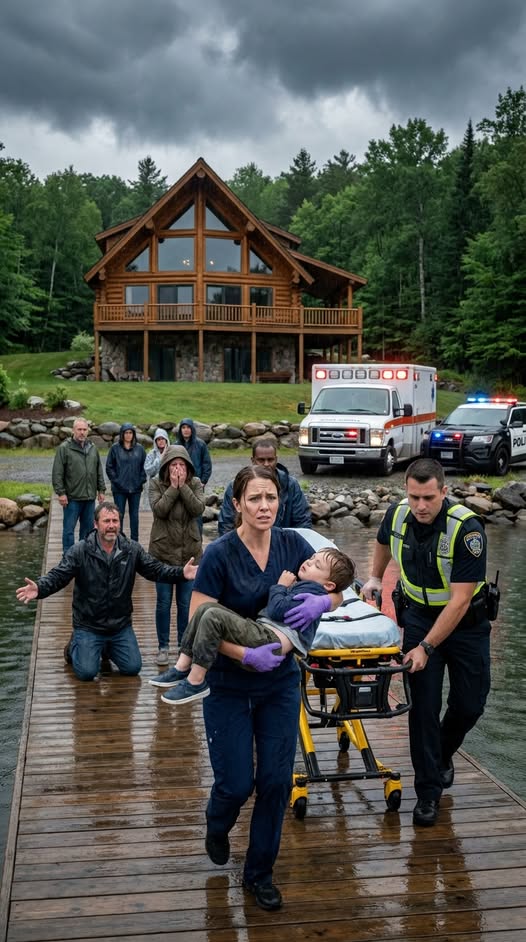
“Someone dial 911 immediately,” I barked, my tone echoing the absolute authority of the trauma bay. “Tell dispatch you have a pediatric submersion. The patient is currently responsive but requires immediate emergency transport. Tell them we will meet the rig at the top of the gravel drive.”
For the very first time in my thirty-three years of existence, the Briggs family did exactly what I told them to do without a single word of debate.
The county paramedics arrived in a blistering fourteen minutes, sirens wailing. Two EMTs sprinted down the slope carrying heavy trauma bags and a portable cardiac monitor. The lead paramedic, a veteran with a shaved head and calloused, steady hands, dropped to his knees beside Colton.
He rapidly strapped a pulse oximeter to Colton’s small finger. “O2 sat is 92 and climbing. Resps are 24. No immediate signs of severe aspiration.” He clicked a penlight, shining it into Colton’s swollen eyes. “Pupils are equal and reactive.”
He rocked back on his heels and looked directly at me. “Who initiated the resuscitation?”
“I did,” I replied, my voice clinical and flat. “Two initial rescue breaths, followed by thirty compressions. He achieved spontaneous return of circulation on the third cycle. Total submersion time was estimated at under two minutes. Active CPR duration was approximately ninety seconds.”
The paramedic paused, his eyes narrowing as he absorbed my vocabulary. He wasn’t looking at a panicked aunt in a wet tank top anymore. He was reading my operational code.
“You’re medical. UT Medical Center?”
“Trauma surgeon. Board certified.”
He gave a sharp, definitive nod—the universal sign of professional respect. “Your field intervention just saved this kid from catastrophic brain damage, Doc. Leading with ventilation instead of straight compressions on a drowning… that was textbook execution. We are transporting for mandatory observation, but based on these vitals, you just bought him a full recovery.”
Grant, hovering over the stretcher, heard every single word. Kristen heard it. Dale, finally reaching the bottom of the hill, heard it.
Lorraine, who had slowly drifted down to join the periphery of the group, crossed her arms defensively. “Well,” she muttered, her voice trembling but stubborn, “I’m sure anyone would have known to do that in an emergency.”
The paramedic didn’t even bother turning around to look at her. As he strapped the pediatric oxygen mask over Colton’s face, his voice cut through the humid air like a scythe.
“Ma’am, ninety percent of untrained civilians freeze in total panic during a pediatric drowning. What she just did isn’t ‘anyone.’ That is elite, trained physiological response. Your daughter is a hero.”
The silence that blanketed the dock was absolute. But as I grabbed my keys to follow the ambulance, I knew the war wasn’t over. The final battle was waiting for us at the hospital.
Chapter 4: The Illusions Shatter in the Light
I drove behind the screaming ambulance in my own sedan, my hands gripping the steering wheel. I was still wearing my soaked denim shorts and a clinging tank top. My hair was plastered to my skull, stiff with drying lake water and sweat. I didn’t have my pristine white coat. I didn’t have my stethoscope draped like a talisman around my neck. My hospital ID badge was buried at the bottom of my canvas bag. I was re-entering my kingdom disguised as a peasant.
Grant rode in the back of the rig with Colton. Kristen, Dale, Lorraine, and Darlene packed into the SUVs and followed closely behind.
We coalesced in the emergency department waiting room at UT Medical Center. It was the exact same waiting room I bypassed a dozen times a shift. I knew the sterile smell of the linoleum. I knew the hum of the vending machines. I knew the exact chairs where I had sat across from shattered families to deliver the news that their loved ones were never coming home.
Now, I was sitting in one of those cheap vinyl chairs, trapped on the civilian side of the reinforced glass doors.
Colton was immediately swept back into pediatric triage. Grant paced a rut into the floorboards. Kristen sat rigidly, her knuckles white as she strangled her cell phone. Dale stared blankly at a faded poster about heart health, looking like a man who had been violently relocated to a foreign planet without a translator.
A triage nurse hurried past the glass partition holding a stack of charts. It was Maria, one of my most trusted night-shift nurses. She glanced into the waiting area, took three more steps, stopped dead in her tracks, and walked backward.
“Dr. Briggs?” Maria pushed the door open, her eyes wide as she took in my soaked, disheveled appearance. “Is that you? I didn’t see you on the surgical rotation board today. Are you clocking in?”
I offered her a tight, subtle shake of my head and mouthed, Not right now.
Maria’s eyes darted to the tense, miserable group surrounding me. She immediately understood the context. She gave me a deferential nod and vanished down the corridor.
From across the room, Grant stopped his pacing. He stared at me, his brow furrowed in confusion. “Did that nurse just call you Doctor?”
“That is what the professionals in my workplace call me, Grant.”
Waiting rooms possess the unique ability to warp the fabric of time. Ten minutes feels like a geological epoch. The silence became too heavy for Lorraine to bear. She had to fill the vacuum with her own narrative before reality had a chance to set in. She turned to Darlene, her voice slightly elevated, ensuring the entire room could hear her rewrite history.
“It all just happened so fast,” Lorraine murmured, clutching her purse to her chest. “One minute he was splashing, and the next… honestly, I just thank God above that Grant managed to get down to the water when he did.”
I was sitting exactly three chairs away. I didn’t raise my voice. I simply let the ice coat my words. “I got to him, Mom. Not Grant. Grant was looking at dirt on a hill.”
Lorraine adjusted her posture without missing a single beat of her delusion. “Well, yes, obviously you were in the water as well, Piper. You helped pull him up. But like that paramedic said, anyone’s adrenaline would have kicked in.”
“The paramedic said the exact opposite, Lorraine. You were standing three feet away from him when he said it.”
Her fingers dug so fiercely into the leather of her purse I thought the seams might burst. “I am simply saying, let us not turn this into a selfish competition about who did what! The only important thing is that my grandson is breathing!”
I leaned forward, resting my elbows on my knees, staring a hole straight through her. “You are entirely correct. The only important thing is that Colton is alive. So perhaps you should stop desperately trying to invent a version of this afternoon where my hands weren’t the reason his heart is beating.”
The waiting room achieved a state of absolute, suffocating silence. Kristen suddenly found her fingernails fascinating. Dale coughed awkwardly into his fist. Darlene stared intently at the scuffed floor tiles. Lorraine offered one long, deliberate stroke to smooth her skirt, turned her face toward the blank cinderblock wall, and refused to speak.
She wasn’t apologizing. She was merely retreating. She could successfully rewrite a decade of my grueling career over church potlucks and neighborhood barbecues, but she could not alter a traumatic event that twenty people had witnessed with their own eyes two hours ago. The distance between her fabricated reality and the objective truth was collapsing rapidly.
Grant eventually stopped pacing and dropped heavily into the chair beside me. His face looked hollowed out, carrying the specific, haunted exhaustion of a parent whose adrenaline has completely evaporated, leaving only terror in its wake. He buried his face in his large, calloused hands.
“Piper,” Grant rasped, his voice cracking. “If you hadn’t been watching him. If you hadn’t brought that vest… if you hadn’t…”
“But I was watching,” I replied softly.
He pressed the heels of his hands brutally into his eye sockets. “I should have listened to you about the drop-off. I should have been watching the water. I was staring at a stupid pile of rocks while my son was dying.”
“Yes,” I said, refusing to offer him false comfort. “You should have been watching.”
He flinched. The truth has a profound weight, and I was done carrying it for them.
“And I should have been watching for years, Pip,” Grant confessed, his voice barely a whisper. “I should have confronted Mom and Dad about the way they talk about you. About who you actually are. I bragged to Colton about you, but I never defended you to them.”
“Why didn’t you, Grant?”
He lifted his head, fixing me with our father’s eyes—eyes that fundamentally abhorred conflict. “Because it was easier. Because as long as they were completely focused on building my pedestal, I didn’t have to risk fighting them to stop them from tearing you down.”
I let his confession hang in the sterile air. It was cowardice, plain and simple, but there was a jagged sliver of courage in finally admitting it out loud.
“I don’t need you to feel guilty, Grant,” I said quietly. “I just need you to stop being comfortable with their lies.”
He nodded slowly, the grim acknowledgment of a man recognizing a debt he could never fully repay.
I had spent over a decade systematically proving my worth to people who were actively choosing to look the other way. I literally held beating human hearts in my hands on a weekly basis, only to return to a family that introduced me as a receptionist.
But what happened next was the ultimate, inescapable reckoning.
The heavy double doors at the far end of the corridor violently swung open. Dr. Rebecca Callaway strode through them like a conquering general. The Chief of Trauma Surgery was fifty-eight years old, stood five-foot-ten in her pristine, knife-creased white coat, and possessed an aura that could freeze water. She was mid-sentence, aggressively dissecting a surgical chart with a terrified resident half-jogging to keep pace at her elbow.
Dr. Callaway was scanning the waiting area with her trademark diagnostic intensity. Her eyes swept past the vending machines. Past Dale’s slumped form. Past Lorraine. And then, they locked onto me.
She stopped dead. The resident, failing to brake in time, collided softly with her shoulder. Callaway didn’t even flinch. She tilted her head, a physical manifestation of a brilliant mind encountering an impossible variable.
Then, she changed course, striding directly across the waiting room, her stethoscope rhythmically tapping against her sternum. She halted directly in front of my plastic chair.
“Dr. Briggs,” she said. Her tone was sharp, professional, and entirely deferential—the exact voice she used when consulting me on a catastrophic hemorrhage.
But in this specific room, surrounded by my family, those two words detonated like a flashbang grenade.
Lorraine’s head whipped around so fast I thought she might snap her neck. Dale sat bolt upright. Kristen gasped audibly.
Callaway, entirely oblivious to the psychological warfare she had just interrupted, frowned at my wet clothes. “What on earth are you doing sitting out here in the civilian overflow? If your family is back in the bays, I can badge you through right now. Let me pull the attending physician.”
“I am here as a civilian today, Chief,” I replied evenly. “My nephew is the pediatric submersion case that was wheeled in an hour ago.”
Callaway’s intense expression instantly softened, then sharpened into acute realization. “Your nephew?” She paused, her brilliant mind connecting the data points. “I just reviewed the preliminary intake notes on that case. The field resuscitation was described as absolute textbook perfection.”
She stared at me. “Wait. That was you on the dock?”
I nodded once.
“Of course it was,” Callaway muttered, shaking her head in awe.
She turned on her heel, pivoting to face my family. She wasn’t performing for them. She was simply delivering a factual briefing, assuming they were already operating with the same baseline reality she was.
“You all must be unfathomably proud,” Dr. Callaway announced, her voice echoing in the quiet room. “Piper is arguably the most lethal, precise trauma surgeon on my entire staff. The field save she executed this afternoon? Immediate ventilation-first CPR on a pediatric drowning victim, in open water, without a single piece of medical equipment? I have attending ER physicians who would panic and botch that outside these walls.”
She delivered the information like she was reading lab results off a monitor. Factual. Undeniable.
Lorraine’s mouth opened. She resembled a fish suffocating on dry land. She tried to force words out. “I… we… yes, well, of course we know she works here at the hospital…”
Dr. Callaway’s eyes narrowed, her diagnostic tilt returning. “Works here? Ma’am, she doesn’t just ‘work here.’ Your daughter is an attending surgeon, dual-board certified in trauma and critical care. She ran our primary trauma bay completely solo last month during the Route 33 highway pileup. Nine critical patients simultaneously. Zero fatalities. I formally submitted her name for the Regional Surgical Commendation last quarter.”
Callaway let that massive achievement land like an anvil. Then, she casually dropped the final bomb.
“She is also on the short-list to be named Deputy Chief of Trauma Surgery by the end of this fiscal year. But, considering you’re her family, I assume you already know all of this.”
The barometric pressure in the room dropped so low it felt hard to breathe.
Darlene stared at Lorraine with an expression of pure, unadulterated shock. Dale looked down at his calloused hands as if they had betrayed him. Kristen looked like she was going to be physically sick. Grant squeezed his eyes shut, a tear finally escaping and tracking down his cheek.
Callaway, possessing the emotional intelligence of a seasoned doctor, immediately sensed the toxic atmosphere. She looked from my mother’s pale, trembling face back to me.
“Did I… did I interrupt a private moment, Piper?”
“No, Dr. Callaway,” I said, my voice ringing out clearly. “You said exactly what desperately needed to be said.”
Callaway looked deeply confused. “I apologize. I just naturally assumed you all understood her prestige. What exactly did you people think she did in this hospital?”
Lorraine could not summon the breath to answer. So, I answered for her.
“She thinks I play Florence Nightingale, Chief. She tells her friends I hand out band-aids.”
Dr. Callaway looked at my mother. It wasn’t a look of anger. It was a look of profound, devastating pity. It was the look you give someone who has just revealed themselves to be fundamentally foolish. She didn’t offer a single word of commentary. She simply reached out, squeezed my shoulder firmly, and said, “I am going to check on your nephew personally, Dr. Briggs. He is in the best hands.”
She turned and walked back through the double doors, leaving the ruins of my family’s delusions scattered across the linoleum floor.
Chapter 5: The Resurrection of the Truth
Lorraine stood up. The pristine, impenetrable facade she had worn for three decades was cracking wide open, the fissures visible in the violent trembling of her hands.
“Now you wait just a minute,” Lorraine stammered, her voice shrill and defensive. “I never… I have always told people how proud I am that she is at the hospital! Always! I have been supportive! I don’t understand why Piper is making it sound like I—”
“Lorraine,” Darlene interrupted. The pastor’s wife’s voice was quiet, but it possessed the weight of a heavy gavel. “You literally told me she handed out bandages two hours ago on that wooden dock.”
“I… I said no such thing!”
“And you specifically told me she answered the phones at a clinic,” added the cousin from the porch, who had ridden in Darlene’s SUV and was now shrinking into the corner of the waiting room.
Lorraine spun wildly toward me. Genuine tears were finally welling in her eyes, blurring her makeup. “Piper, you don’t understand! I was trying to… Your grandmother…”
She choked on the words. The sentence stalled at the precipice of a trauma she had spent forty-eight years running away from.
I gave her the silence I give my patients before delivering a terminal diagnosis. I did not rush her. I did not retreat. I just held my ground. When it became clear she lacked the courage to finish the thought, I performed the excision for her.
“I know about Grandma Rose, Mom,” I said softly, but with absolute finality. “I know you were fourteen years old. I know she died of a heart attack on a freezing dirt road coming home from delivering a baby, and you were left waiting at your middle school for a play she never showed up to see. I know you are paralyzed by the terror that the exact same thing is going to happen to me.”
Lorraine collapsed back into her plastic chair as if her bones had suddenly turned to liquid. Dale reached out and desperately grabbed her hand. She let him take it, her face buried in her chest. Dale looked at me, his expression reflecting the devastation of a man realizing he had spent his life guarding the wrong fortress.
“But Mom,” I continued, my voice unwavering, “instead of just telling me you were afraid of losing me, you decided to humiliate me. Instead of asking about my life, you erased it. You didn’t protect me from the dangers of medicine. You only protected yourself from having to admit that I chose this life, that I thrive in it, and that I am extraordinary at it.”
She didn’t speak. She just wept silently.
Dale cleared his throat, the sound rough like sandpaper. “Pip… we’re… I’m…” He looked helplessly at the floor. “I should have been in that auditorium when you graduated. I should have come to your ceremonies. I convinced myself you were too smart to need your old man there. I was a damn fool.”
I nodded slowly. It wasn’t a magic eraser. It didn’t heal a decade of absence. But it was the very first piece of honest debris pulled from the wreckage, and I wasn’t going to punish his honesty.
“You don’t owe me a groveling apology right now, Dad,” I told him. “You just owe me reality. The next time a foreman asks what your daughter does, you tell him the truth. My version. Not hers.”
Grant spoke up from his corner, his voice thick with emotion. “I swear to God, I’ll make sure of it, Pip.”
I looked down at Lorraine’s bowed head. “I love you, Mom. But I will never allow you to teach Colton that my life’s work doesn’t matter. He already knows exactly who I am. He is the only person bearing the Briggs name who has ever been proud of me out loud.”
Lorraine flinched violently as the truth landed its final blow. They had all known. Every single one of them knew I was a surgeon. They had simply chosen the lie because it required less effort than confronting their own insecurities.
Dr. Callaway returned twenty minutes later. Colton’s chest X-rays were crystal clear. His lung sounds were pristine bilaterally. His oxygen saturation was holding beautifully at 98%. They were keeping him overnight purely as a standard pediatric protocol, but she guaranteed a total, unblemished recovery.
“He’s asking for his Aunt Piper,” Callaway added, a rare, genuine smile touching the corners of her mouth.
We filed into the sterile pediatric ICU room. Colton looked impossibly small swimming in the stark white hospital sheets, a clear nasal cannula resting against his pale cheeks. His heavy eyelids fluttered open, and his brown eyes instantly locked onto mine.
“Aunt Piper,” he whispered, his voice raspy from the lake water. “The nice doctor lady said I’m going to be completely fine.”
I sat gently on the edge of his mattress, brushing his damp blonde hair back from his forehead. “She’s absolutely right, buddy. You are the toughest kid I know.”
He let out an enormous, jaw-cracking yawn. His tiny body was demanding the restorative sleep it needed after enduring the most terrifying hour of his existence.
“She said somebody did really, really good CPR on me to save my life,” he mumbled, his eyes slipping shut. “Was it you?”
“Yeah, buddy. It was me.”
He smiled, a soft, sleepy curve of his lips. “I knew it. Because you’re a real doctor.”
I leaned down and pressed a long kiss to his warm forehead. I sat there for several minutes in the quiet hum of the machines, my fingers resting lightly on his wrist, instinctively tracking his strong, rhythmic pulse.
When I finally looked up, Lorraine was standing silently in the doorway. There was no audience to perform for. There were no church friends to impress. There was no false narrative left to construct. There was only a mother, finally forced to look at the daughter she had spent thirty years refusing to see.
We didn’t say a word. Some wounds require more debridement than a single waiting room can provide.
The following week unfolded in fractured, healing pieces. Grant called me on a Tuesday afternoon. He had driven into town to a professional framing gallery. He had taken my medical school diploma and my surgical board certification out of the closet. He had mounted them in heavy, expensive mahogany frames and hung them prominently in his executive office at Briggs Construction, right beside his contractor’s license, for every client to see.
“I should have driven the nail into that wall myself years ago, Pip,” he said.
“Yes, Grant. You should have.” And I left it at that.
Dale left me a voicemail on Wednesday night. It was two agonizing minutes long, composed mostly of heavy breathing and the creak of his porch swing. But right before the beep, his voice broke through the static. “I’m so damn sorry, Piper. I am so proud of the things you build.”
Kristen texted me a brief, mortified apology for the daycare comment. I replied with a simple “Thumbs up” emoji. It was all the grace she was going to get, and it was enough.
From Lorraine, there was nothing. No phone call, no tearful voicemail, no unannounced visit to my apartment with a peace offering. I didn’t expect one. My mother’s ability to bend reality to her will was a lifelong addiction; one traumatic afternoon wasn’t going to cure it overnight.
But the following Sunday, Darlene called me. She told me that after the morning service, a new parishioner had approached Lorraine during the coffee hour and asked about her children.
According to Darlene, Lorraine stood incredibly straight, looked the woman directly in the eye, and said, “My son runs a highly successful construction company. And my daughter, Piper, is a trauma surgeon at UT Medical Center.”
There were no qualifiers. There was no “she helps out.” There was no diminishment. For the first time in a decade, Lorraine spoke my truth to the people whose validation she craved the most. She didn’t say it to my face, but she said it to her congregation, where reputations are forged in stone. And honestly, that meant more than any private apology ever could.
I didn’t win my family’s respect the day my boss walked into that waiting room. I had won my own respect years before that—on the very first night I held a scalpel under the blinding surgical lights and knew, down to the marrow in my bones, that I was standing exactly where I was meant to be.
The lake didn’t make me a hero. It just forced the rest of the world to catch up to the truth I already knew. I had stopped waiting for my family to see me a long time ago.
Because the scalpel never lied, and it always knew exactly who I was.