The divorce papers arrived on a Tuesday, which felt like an insult. Tuesdays were supposed to be ordinary — laundry days, grocery-run days, the kind of day nothing important was meant to happen.
But there they were on the kitchen counter when Sandra woke up, a neat manila envelope with a return address she didn’t recognise, some law firm downtown called Kellerman & Voss. She made her coffee first. She drank it standing at the window, watching the neighbour’s cat stalk something invisible in the grass. Then she opened the envelope.
Eighteen years. She kept turning that number over in her mind like a stone she expected to find something interesting under. Eighteen years of shared grocery lists and shared colds and shared silences at dinner that had started out comfortable and gradually, without either of them noticing, become something else entirely. Eighteen years of a man named Gerald who used to bring her flowers for no reason and had, somewhere around year eleven, stopped.
She didn’t cry. That surprised her. She’d done most of the crying already — months of it, enough to embarrass herself — back when Gerald had first sat her down and said the words she’d half been expecting and fully been dreading. I haven’t been happy for a long time. I think we both know that. As if her unhappiness were equivalent. As if she had co-authored this ending.
She signed the papers the same afternoon and mailed them back.
Her friend Diane was the one who suggested the dating site.
“You’re fifty-one, not dead,” Diane said over wine one Friday, with the blunt authority of a woman who had been happily remarried for six years and had therefore forgotten what it felt like to be terrified. “And you’re gorgeous. You always have been. Gerald was an idiot.”
“I’m not ready,” Sandra said.
“You’ll never feel ready. That’s the whole point. You just do it anyway.”
Sandra made the profile at midnight, sitting in bed in her reading glasses, feeling faintly ridiculous. She uploaded a photo Diane had taken at a birthday dinner the previous spring — Sandra laughing at something off-camera, her dark hair loose around her shoulders, looking, she had to admit, like a woman who was fine. Like a woman who had things to laugh about.
She described herself honestly. Fifty-one. Two grown kids who didn’t need her the way they used to. A job she liked well enough — office manager at a small architecture firm. A habit of reading too many books and starting too many jigsaw puzzles she never finished. She pressed publish and put her phone face-down on the nightstand and told herself she’d check it in the morning.
She checked it in four minutes.
Marcus’s message arrived three days later, and it was different from the others.
Most of the messages she’d received were either awkward or aggressive, sometimes both simultaneously, in ways that made her feel exhausted on behalf of the entire male gender. But Marcus wrote in full sentences. He said he’d read her profile twice because he’d liked the part about the jigsaw puzzles — he had the same problem, he said, a graveyard of half-finished ones under his bed — and he thought that probably said something interesting about a person’s relationship with completion, though he wasn’t sure what yet. He said she had a wonderful smile in her photo and that he was only mentioning it because it was genuinely the last thing on his list of reasons for writing, not the first.
Sandra read the message three times.
He was fifty-four. A structural engineer, semi-retired. Divorced, amicably, eight years ago. Two kids he clearly adored — she could tell by the way he mentioned them, casually and warmly, the way you mention people who are simply part of the furniture of your life. He lived twenty minutes away. He had the kind of face in his photos — strong jaw, easy eyes, silver at the temples — that looked like it smiled often and meant it.
She wrote back. He wrote back. They went back and forth for two weeks, messages that grew longer and more comfortable, that made her laugh on her lunch break and think about things she hadn’t thought about in years. One evening she realised she’d been sitting at the kitchen table reading and rereading a thread of his messages for forty-five minutes, and she felt something shift behind her sternum. Something that was either hope or its annoying cousin, vulnerability.
He asked if she’d like to meet for dinner.
She said yes before she could think herself out of it.
The restaurant was Italian, warmly lit, in a neighbourhood she liked. She arrived five minutes early and sat at the bar with a glass of sparkling water and told herself to breathe. She’d worn the blue wrap dress Diane had approved. She’d had her hair done that afternoon. She felt like a woman going to her own audition, which was perhaps the most accurate description of a first date after a long marriage that she’d ever conceived.
Marcus walked in and she knew him immediately, even though his photos hadn’t quite captured the way he moved — unhurried, certain of himself in a way that wasn’t arrogance but just solidity, the way of a man comfortable in his own dimensions. He was taller than she’d expected. He saw her, and the smile appeared, and it was exactly the kind she’d suspected: the kind that meant something.
“Sandra,” he said, as if confirming something he’d already known.
“Marcus,” she said back.
They talked for four hours. She couldn’t afterwards have reconstructed the whole of it — only that it was effortless in the way that rare things are effortless, the way a door opens that you’ve been leaning against for so long you’ve forgotten you’re leaning. They talked about their kids and their marriages and the strange specific grief of a life you’d built becoming a life you used to have. They talked about structural engineering, which was more interesting than Sandra had anticipated, and about the architecture firm where she worked, which Marcus had genuinely interesting things to say about. They argued, enjoyably, about a novel they’d both read. They discovered they’d both spent a formative holiday in the same small town in Portugal and had probably been there the same summer, which felt like the kind of coincidence that a more superstitious person might call a sign.
The restaurant filled and thinned around them. The candle on the table burned low. The bill came and was sorted without awkwardness.
“I’d really like to do this again,” Marcus said, outside, the night air cool and soft around them.
“I’d really like that too,” Sandra said.
She slept better that night than she had in months.
She woke to the sound of birds and the particular light of early morning through unfamiliar curtains, and before she’d fully surfaced she was already smiling — the evening coming back to her in warm fragments, the restaurant, the conversation, the walk they’d taken afterwards through quiet streets, ending at his apartment building where he had been a gentleman about everything and she had been the one to suggest coming up for a last glass of wine, which had led to things she had not planned and did not, lying there in the pleasant fog of early waking, regret.
Then she opened her eyes properly.
The ceiling was wrong.
Not wrong in the way an unfamiliar ceiling is wrong after a night in someone else’s home — she’d accounted for that. Wrong in a more fundamental way. It was too close, and it had the wrong colour, a kind of flat institutional beige, and there was a water stain in the corner shaped like a boot.
She sat up.
She was on a narrow couch, covered with a rough wool blanket that smelled of cedar and something medicinal. The room was unfamiliar in every detail — functional, sparse, softened here and there by evidence of someone living in it. A small table with a Bible on it. A poster on the wall, laminated, with a phone number and the words You Are Not Alone. Fluorescent light through a frosted window.
She was still in the blue dress, which was now badly creased.
Her handbag was beside her on the floor, and her phone was in it, and the phone said 7:14am, and there were no messages from Marcus, and the address shown in her map application, when she opened it with trembling fingers, was not the apartment building they’d walked to last night.
The rest of it came back in pieces, over the following twenty minutes, as Sandra sat very still on the institutional couch and tried to be methodical about what she knew.
She remembered the wine at Marcus’s apartment. She remembered the view from the window, city lights, and music he’d put on quietly in the background, something with piano. She remembered a second glass of wine, which she hadn’t finished because she’d started to feel peculiar — not drunk, not quite, but soft around the edges in a way that wine alone had never made her feel, a softness that had moved quickly into confusion and then into a blankness that had no edges at all.
She did not remember leaving the apartment.
She did not remember anything between that blankness and the couch.
The door to the room opened and a woman came in — mid-thirties, efficient-looking, wearing a lanyard — carrying two cups of tea.
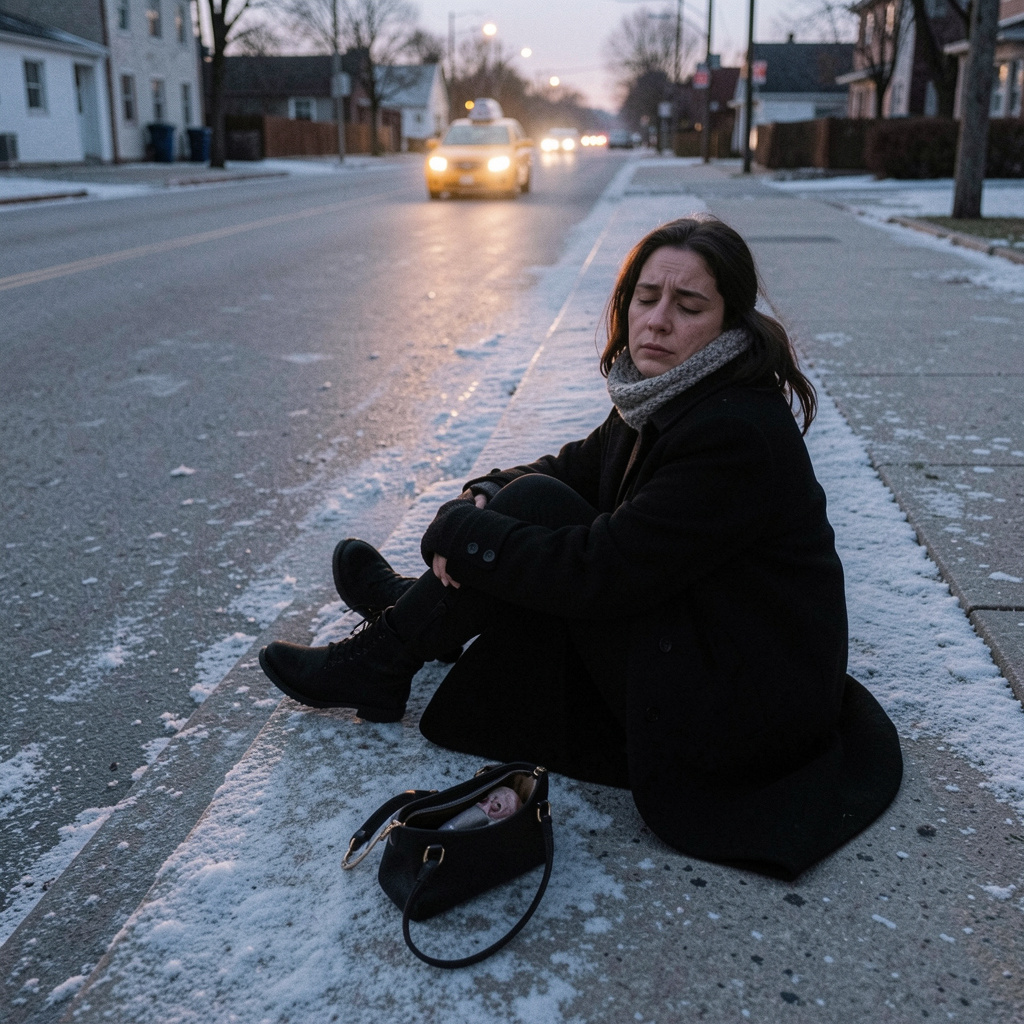
“Good morning,” she said. “I’m Priya. You’re at the Clearwater Centre. A night patrol found you on Deakin Street at around 1am and brought you in. You were confused and distressed but not physically harmed. We let you sleep.” She set a cup of tea on the table beside Sandra. “Can you tell me your name?”
Sandra told her.
“Is there someone we can call for you?”
Sandra thought of Diane. She thought of her daughter, Caitlin, who would panic. She thought of Marcus’s apartment and the soft blankness and the city lights, and something hardened cleanly in the centre of her chest like a small bright stone.
“In a minute,” she said. “Can I ask — Deakin Street. Where on Deakin Street, exactly?”
She called the police that morning, from the small office Priya offered her, with Priya’s quiet presence in the chair beside her. She was calm on the phone in a way that seemed to surprise the officer on the other end. She gave Marcus’s full name, the address of the apartment building, the name of the restaurant, the rough timeline. She noted that her second glass of wine had been poured while she was in the bathroom and had tasted slightly different from the first. She had not, she was fairly certain, consented to leaving the apartment.
The officer asked her several times if she was all right.
“I’m fine,” she said, each time, because she was — not in the sense that nothing had happened, but in the sense that she was intact, and thinking clearly, and fully intended to remain that way.
She called Diane next.
Diane arrived in twenty-two minutes, which suggested she’d exceeded several speed limits.
“I’m okay,” Sandra said, before Diane could say anything. “I need you to not cry, because if you cry I’ll cry, and I need to be functional today.”
Diane, who was crying, pressed her lips together and nodded.
“And I need you to drive me to the police station.”
It took three months.
Marcus — whose real name turned out to be different from the one he’d given her, whose profile photos were a collage assembled from three different people’s social media accounts, whose structural engineering credentials were fiction — had done this before. The police had known that almost immediately. There were two other women in the same city. Five others, it eventually emerged, in other cities, over several years.
Sandra gave her statement twice, in detail, and then a third time when the case expanded. She was asked if she wanted to use a pseudonym in any public proceedings. She said no.
“Are you certain?” the detective, a tired-looking woman named Callahan, had asked.
“I didn’t do anything wrong,” Sandra said. “I’d prefer my name attached to the right version of this story.”
Detective Callahan looked at her for a moment, then nodded. “Fair enough.”
Diane wanted Sandra to take a leave of absence, to rest, to process. Caitlin, once she knew, wanted to come home and take care of her. Her son James called from across the country and talked too fast and asked too many questions, the way he did when he was frightened.
Sandra let Caitlin come for a weekend and cooked for her, which seemed to reassure both of them. She told James, gently, that she was managing. She took a week off work, not because she needed to recover but because the case required some of her time and attention and she wanted to give it properly.
She did not stop sleeping well. That surprised her too.
She thought about this sometimes, in the quiet mornings, trying to understand it. She thought she’d perhaps expected herself to feel stupid — the cliché, the cautionary tale, the woman who should have known better. But she didn’t feel stupid. She’d met someone who had refined a complex deception over years, who had practiced it on many people, who was very good at it. The problem hadn’t been her judgment. The problem had been him.
She felt, more than anything, angry. It was a clean and useful anger, the kind that motivates rather than paralyses. She let it motivate her.
She started a private online forum. That wasn’t something she’d planned — it began as a message she sent to one of the other women, a woman named Renata who lived forty minutes away and whom Detective Callahan had connected her with. They met for coffee and spoke for three hours. Renata was fifty-three and a former teacher and had the kind of dry, wry humour that emerges in people who have survived several things. They liked each other instantly.
Renata mentioned the other women. Sandra mentioned the other cities.
“There should be somewhere to talk,” Sandra said. “Not about victimhood. About what you actually learn.”
The forum started with six members. Within eight months it had four hundred and twelve, from fourteen countries, representing a range of similar experiences — not only the specific kind she had lived through, but the broader experience of finding yourself, mid-life, unexpectedly alone and trying to navigate a landscape that felt designed for younger, more naive versions of yourself. Women sharing information. Flagging warning signs. Talking about what rebuilt trust looks like, what it’s supposed to feel like, how long it takes.
Sandra moderated it two evenings a week and found it, unexpectedly, one of the more meaningful things she’d done in some years.
The case concluded in the way these things do: imperfectly, with a sentence that felt both significant and insufficient, and a small procedural satisfaction from having contributed to stopping something. Sandra sat in the courtroom on the day of the verdict and felt nothing dramatic, only a kind of closing, a door swinging quietly shut on a corridor she no longer needed.
She had lunch with Renata and Detective Callahan afterward. Callahan turned out to be unexpectedly funny over a sandwich, and they made each other laugh several times about things that were not, strictly speaking, funny, which is one of the best kinds of laughing.
The jigsaw puzzle was a thousand pieces, a photograph of a Portuguese town — terracotta rooftops and white walls and the deep blue of the Atlantic in the background. She’d ordered it deliberately. She spread the pieces on the dining table on a Saturday afternoon in early spring, almost exactly a year from the date she’d woken up on that institutional couch, and began the way she always began: corners first, then edges, then the long uncertain interior.
She was an hour in, the border complete and a satisfying section of rooftop assembled, when her phone buzzed.
A message from a man she’d met through a colleague’s dinner party six weeks ago — a man whose name she’d actually verified, because Renata had built a light, useful checklist that she shared with forum members, three easy steps that took fifteen minutes and told you a great deal. His name was Tom. He was an urban planner. He had strong opinions about public transport infrastructure and a dog named Herbert and a laugh that she’d heard across the dinner table and thought: there it is. They’d been seeing each other, carefully and at a pace that felt right, for six weeks.
Are you free this afternoon? Herbert needs a walk and apparently so do I.
She looked at the jigsaw. She looked at the message. She thought about the woman who had signed those divorce papers on a Tuesday and had not cried and had not yet understood that the not-crying was a kind of strength she hadn’t known she possessed.
She thought about what she’d learned: that despair is not an ending, only a particular kind of weather. That being deceived says nothing about you and everything about the deceiver. That there are women everywhere who have woken in strange places and chosen, against all reasonable expectation, to rebuild. That a forum of four hundred and twelve people is, when you consider it, a great deal of proof that you are not alone.
She typed back: Give me thirty minutes. And tell Herbert I’ve been looking forward to this.
She covered the jigsaw carefully with a cloth — she’d come back to it tonight, or tomorrow, or whenever it wanted to be finished. That had always been the thing about jigsaw puzzles that people misunderstood. They thought the leaving was the problem, the reason the puzzle sat undone.
Sandra had come to think it was actually the point. You could walk away, and the pieces would wait, and you could come back, and it would all still be there: patient, complete-able, exactly where you’d left it.
She picked up her keys and went out into the spring afternoon.