Part One: The Call
The phone rang on a Tuesday in October, the kind of pale, indifferent autumn morning that doesn’t bother to apologize for arriving. Daniel Marsh was in the kitchen making coffee when his son came downstairs in the particular way eighteen-year-olds descend stairs — half-falling, hand dragging along the wall, still wearing yesterday as a costume. “Happy birthday,” Daniel said.
Marcus looked at him with the expression of someone who had been told the same thing forty times already and had run out of genuine reactions. “Thanks, Dad.”
“I’m going to call Uncle Roy today. About the trust.” Daniel set a mug on the counter and slid it toward his son. “Your grandfather set it up when you were born. Ten thousand dollars. It’s yours now.”
Marcus wrapped both hands around the mug the way his grandfather always had — Elias Marsh, dead eleven years now, who had believed that warmth was something you held onto rather than simply felt. “I know,” Marcus said. “You’ve told me.”
“I know I’ve told you.”
“Like, a lot.”
“Because it’s important. Your grandfather worked —”
“A laundry route for thirty years, saved every dollar, wanted his grandchildren to start life with something solid under them.” Marcus looked up. “Dad. I know.”
Daniel smiled despite himself. He was proud of the boy for knowing. He was proud of his father for making the knowing possible.
He made the call at nine o’clock, after Marcus left for school. Roy Marsh answered on the third ring, the way he always did — not so eager as to seem waiting, not so delayed as to seem busy. Roy had always existed in a careful middle space between impression and reality.
“Danny.” The voice was warm, the voice of a man who had been managing rooms his whole life. “I wondered when you’d call.”
“It’s Marcus’s birthday. He’s eighteen.”
A pause. Not long. But Daniel would remember that pause later, the way you remember the last moment before an accident — the stillness, the ordinary world still intact.
“Danny,” Roy said. “I have to tell you something.”
The trust was empty.
Not overdrawn, not reduced by fees or mismanagement, not diminished by some catastrophic investment that Roy had reluctantly approved. Empty. The kind of empty that is a destination rather than an accident. The kind of empty that has been carefully, methodically achieved over a very long time.
Daniel sat at the kitchen table for a long time after the call ended. He looked at his father’s photograph on the wall — Elias Marsh in 1974, thirty-two years old, standing beside his laundry truck with the expression of a man who found it genuinely satisfying to do a thing well and honestly. He was lean and dark-haired and he was smiling at whoever was behind the camera, and Daniel’s mother had always said that Elias smiled at the world the way some men pray — not asking for anything, just acknowledging that it was there.
Twelve grandchildren. Ten thousand dollars each. One hundred and twenty thousand in 1985 dollars, invested over nearly four decades. The trust should have held four hundred thousand dollars, at conservative estimates. Maybe more.
Daniel’s son had turned eighteen that morning and received nothing from a grandfather who had arranged, from beyond death, to give him everything he could.
He did not tell Marcus that day. He waited until he had something more than a phone call from a man who had always known how to explain things away.
Part Two: The Records
The court order took six weeks and a lawyer Daniel couldn’t comfortably afford. Her name was Patricia Wen, and she had the manner of someone who had spent twenty years watching people steal from people they loved and had developed a very precise, very quiet fury about it.
“Executor fraud is more common than people think,” she told Daniel at their second meeting. She spread papers across her desk with the practiced efficiency of a card dealer. “Family trusts, especially older ones from the eighties, were often structured informally. A lot of trust in the trustee, you might say.”
“He’s my uncle.”
“Yes.” She looked at him over her glasses. “They usually are.”
The court order yielded the records. And the records told a story that was patient and methodical and had no interest in being misunderstood.
The first withdrawal was in March 2002. Four thousand dollars, listed in Roy Marsh’s own handwriting as “property maintenance.” Daniel hired an accountant to help him parse the documents, a quiet man named Gerald who communicated primarily through the sounds he made while reading — low hums that meant I see, sharper intakes of breath that meant here we go.
The property in question was a three-bedroom house in Sarasota, Florida. On a canal. With a dock. Roy Marsh had purchased it in 2001 with a down payment of forty thousand dollars that the bank records, once subpoenaed, sourced directly from the Marsh Family Educational and Opportunity Trust.
After that first withdrawal, there was a rhythm to it. Three thousand here. Forty-five hundred there. Sometimes twice a month, sometimes skipping a month entirely, as if Roy had a conscience that occasionally needed resting before being overruled again. Roof repairs. Landscaping. A new boat. Dock maintenance. A screened porch. Furniture, twice. A new HVAC system in the summer of 2014.
The family had visited that house every Thanksgiving for fifteen years.
Daniel had grilled on that dock. His children had swum in that canal. His mother, Elias’s widow, had sat on that screened porch and said, every single year, that Roy had done so well for himself, that Elias would have been proud, that family was everything and Roy was proof of it.
Gerald, reviewing the final tally, made a sound Daniel had not heard him make before. Something that wasn’t quite a hum and wasn’t quite a word.
“What?” Daniel asked.
“Over twenty-two years,” Gerald said carefully, “factoring in the withdrawal amounts against the trust’s documented growth and distribution records —” He paused. “Your uncle took approximately three hundred and eighty thousand dollars.”
The remaining twelve thousand dollars, Patricia Wen told him later, had been disbursed correctly to the first two grandchildren who reached eighteen, back in 2003 and 2006, before Roy apparently decided that the trust’s remaining obligations were someone else’s problem.
Part Three: Christmas
The decision to do it at Christmas was not made lightly.
Daniel’s wife, Sandra, argued against it for six weeks. “This is not the way,” she said, more than once, in the particular quiet voice she used when she meant something absolutely. “There are courts for this. There are lawyers. You have Patricia. This is not something you do in front of everyone.”
“He did it in front of everyone,” Daniel said. “He sat at that Thanksgiving table for fifteen years. He carved the turkey in a house he bought with our children’s money. He looked my mother in the eye.”
“And you confronting him at Christmas makes that different how?”
“It makes it honest.”
Sandra looked at him for a long time. She was a woman who understood the difference between justice and theatre, and she was not always convinced Daniel understood it too. But she also knew her husband, knew the specific quality of grief he carried for his father, knew that Elias Marsh had died believing his grandchildren were taken care of, and that this particular betrayal had dimensions that a courtroom, however correct, could not fully address.
“Don’t make a speech,” she finally said. “Say what you know. Show the papers. Then stop.”
“Okay.”
“I mean it. Don’t make a speech.”
“I won’t make a speech.”
He made a small speech. But he waited until after dinner.
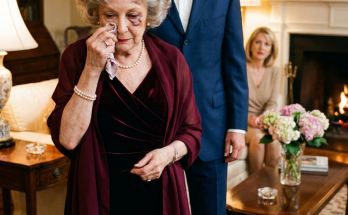
The family gathered at his cousin Elaine’s house — Roy’s daughter, who knew nothing, who had spent thirty years being proud of her father and would need some time before she could be angry at him. There were thirty-five people. Four generations. The youngest was fourteen months old and was currently systematically dismantling a decorative arrangement of pine cones. The oldest was Miriam Marsh, ninety-two years old, Elias’s wife, the woman who had come from nothing and helped build everything, who had not spoken a coherent sentence in nearly eight months and who sat in her wheelchair near the fireplace with the expression of someone who has traveled so far into their own interior that the outside world has become a country they no longer need a visa to visit.
Roy was across the room, holding a glass of wine and telling a story about tarpon fishing. He was seventy-one years old and looked sixty. He had always been the handsome one, the one with the easy manner, the natural raconteur. People laughed at the right moment in the tarpon story. He caught Daniel’s eye and raised his glass slightly, the nod of a man with a clear conscience.
Daniel waited until the dessert plates had been cleared. Until the children had been settled in the back room with a movie. Until the adults were in that comfortable post-dinner suspension between contentment and tiredness, warm and briefly at peace.
Then he stood up.
He didn’t use the word “steal” for the first three minutes. Patricia had advised against it — not because it was inaccurate, but because once you said it, people stopped listening to evidence and started managing their own emotional responses. He used the trust documents. He used Gerald’s summary. He used dates and amounts and the address of a house on a canal in Sarasota, Florida.
He could feel the room shifting under him as he spoke, the way a boat shifts when the weight redistributes. His aunts exchanged glances. His cousins looked at their hands. His mother put her fork down very slowly, as though setting something fragile on a glass shelf.
Roy, for the first two minutes, wore an expression of mild, patient bemusement — the expression of a man who is accustomed to misunderstandings and confident in his ability to clear them up. Then, as Daniel moved from general summary to specific figures, the expression changed in a way that was imperceptible to anyone who didn’t know what to look for, but Daniel had been watching his uncle his whole life and knew exactly what the change meant.
Roy had not expected the records.
When Daniel finished, the room was quiet in the way rooms go quiet before deciding what to be.
Roy set down his wine glass. He straightened his collar. He looked at Daniel with an expression that was, Daniel realized, not guilt and not remorse but something closer to the look of a man who has been caught in a simplification — someone who has told a story for so long that he has stopped distinguishing it from fact, and is now merely irritated at being asked to account for the difference.
“Danny,” he said, and his voice was still warm, still managed. “Your grandfather was my brother. I knew him better than anyone. I knew what he wanted for this family.” A pause, calibrated. “He would have wanted me to enjoy life.”
Part Four: Miriam
The silence that followed this statement was of a different quality than the one before it.
It was not the silence of people processing information. It was the silence of people waiting to see what the room would decide to be — whether it would reorient itself around Roy’s explanation, find a way to let the warmth and the wine and the years of Thanksgiving dinners on that Florida dock soften the edges of what the numbers plainly said, allow the family the comfortable mercy of ambiguity.
Families were very good at ambiguity. Families had built entire architectures out of the things they had collectively decided not to clearly see.
Later, Daniel would not be able to say what made everyone look toward the fireplace at that moment. It may have been the sound — a low, effortful groan of something wooden under pressure — or it may have been some quality of collective peripheral attention, the way a room senses movement before consciously registering it.
Miriam Marsh was standing up.
Not being helped to stand. Not assisted by her aide, who had lunged forward too late, hand hovering near an elbow that did not accept it. Standing of her own determination, both hands gripping the armrests of her wheelchair, pushing herself upright with a force that seemed to come from somewhere not entirely physical — from some reserve that had been saving itself for exactly this occasion.
She was a small woman, four feet eleven since her eighties had begun their quiet subtraction. She had white hair pinned in the manner of another decade, and her eyes, which had spent the last year seeming increasingly distant, were not distant now. They were here. They were entirely, ferociously here.
She looked at her son.
Roy’s warm expression did a thing it had perhaps never done publicly in seventy-one years. It faltered. Not crumbled — Roy was too practiced for crumbling — but faltered, the way a fire falters when a window is unexpectedly opened and the air pressure changes.
“Mama,” he said, softly, reflexively, the word of a child rather than the reassurance of a man.
Miriam Marsh said: “Your father drove a laundry truck for thirty-one years. Six days a week. He came home with his hands red from the bleach and he never once complained to me, not once, because he said a man who complains about honest work hasn’t understood what dishonest work costs.”
Her voice was not frail. It was thin with age, yes — the instrument had worn — but the quality of conviction in it had not diminished, had perhaps concentrated, as old things sometimes do, into a purer and more essential form.
“He saved for those grandchildren for twenty years,” she continued. “He put money in that trust like it was a prayer. Every month. When we had it easily and when we didn’t have it easily. He used to say, Each of them gets a start. Not a finish — just a start. Enough to not be afraid. That was all he wanted. For them not to be afraid.”
Roy opened his mouth.
“Don’t,” his mother said.
He closed it.
“I used to wonder,” Miriam said, still looking at her son with that clear, merciless attention, “why Elias made you the executor. I thought it was because he trusted you more than anyone. I think now maybe I was wrong about that. I think he trusted you because he loved you, and he confused the two things, and I should have said something to him about it at the time, and I didn’t, and I’ll carry that.”
Someone in the room was crying. Probably more than one person, though the sound was quiet, the way family grief tends to be — pressed flat, held close.
“Enjoy life,” Miriam repeated, and there was no volume to it now, just the shape of the words, their flat, incredulous weight. “Thirty-eight years I’ve lived without that man, and not one day did I look at the life he built and think it was insufficient. Not one day.” She looked at the room then — at her grandchildren, her daughters and daughters-in-law, the great-grandchildren asleep in the back room, the full and complicated human architecture of a life carefully constructed by a man who drove a laundry truck. “He enjoyed his life, Roy. He just didn’t need to steal anyone else’s to do it.”
She lowered herself back into the chair then, slowly, with the deliberate care of someone who has spent everything and is managing the return trip with whatever remains.
Part Five: After
Roy left before the evening was over. He was driven by his daughter Elaine, who said nothing to him in the car — Daniel would hear this later, from her, in one of the longer and more difficult phone calls of the following months — and who sat in the passenger seat and watched the winter-pale Florida road (they were in Sarasota; the irony had not escaped anyone) and said nothing for forty minutes because she was trying to locate, within herself, a response that was adequate to what had happened, and she could not find one.
There were lawyers after that. Patricia Wen was very good at her job. The civil case took fourteen months and settled for two hundred and sixty thousand dollars — not the full amount, but Roy was seventy-one and the house on the canal sold for less than expected in a softening market, and Patricia’s assessment was that a jury, despite everything, might extend mercy to an old man that his own family had declined to extend. The settlement was distributed to all twelve grandchildren, pro-rated and adjusted for the years and amounts they had been separately shorted.
Marcus Marsh received nineteen thousand dollars on his nineteenth birthday, a year and some months after the birthday on which he had received nothing.
Daniel had not told him how to spend it. His grandfather had not put conditions on the trust, had not specified education or investment or the responsible management of futures. He had simply said: A start. So they’re not afraid.
Marcus used part of it for a second-hand car, which Daniel privately thought his grandfather would have approved of — a man who drove other people’s laundry understood the dignity of having your own way of getting somewhere. The rest went into a savings account, where it sat accumulating small interest and large significance.
Miriam Marsh died the following April, seventeen months after Christmas.
She had not spoken at length again after that night, had returned to the quieter country of her final year with something that the family understood, without discussing it directly, as the peace of a woman who had said the last important thing she had to say and did not need to add to it.
Daniel gave the eulogy. He talked about his grandfather, mostly, because he thought that’s what she would have wanted — she had never needed much talking about herself. He talked about the laundry truck and the trust and what it meant to decide, in the particular privacy of your own character, what kind of person you were going to be. He talked about the moment she had stood up from that wheelchair — the room had mostly known about it by then — and he said that he had spent his whole life thinking of his grandfather as the extraordinary one, the one who had built something from nothing, the one whose photograph hung in his kitchen. And all of that was true.
But that night, he said, he had understood something about his grandmother that he should perhaps have always known: that behind every man who builds something carefully and honestly and without complaint, there is usually a woman who taught him what was worth building in the first place.
He did not look at Roy’s side of the aisle when he said this. He didn’t need to.
Epilogue
The photograph still hangs in Daniel’s kitchen. Elias Marsh, 1974, beside his truck, his hand raised to the camera in something between a wave and a salute.
On the counter below it, Marcus had taped a small card before he left for university. It was written in his uneven, still-developing handwriting, and it said only:
Thanks, great-grandpa. I’ve got it from here.
Daniel straightened it every morning, the way you straighten a thing you want to keep.