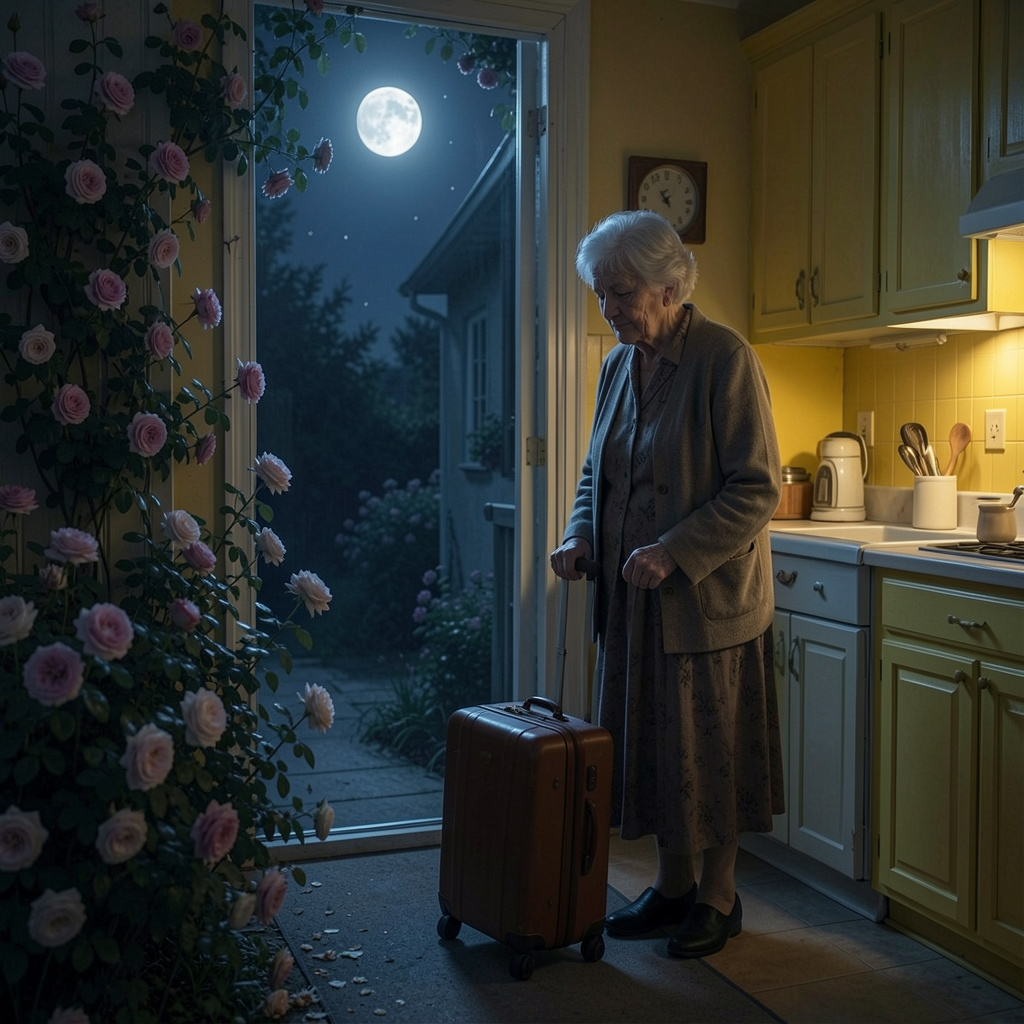
Margaret Briggs had learned long ago that humiliation rarely arrived shouting. Most times, it came quietly—wrapped in ordinary moments. A slammed cabinet. A forgotten invitation. A sigh too loud to ignore.
Or a sentence spoken across mashed potatoes at exactly 6:18 p.m. “Mom, when are you finally going to move out?”
Daniel didn’t yell it. That was the worst part. He said it the way someone asked whether there was more iced tea in the fridge.
The room went still after that.
Renee stared at her plate. Their daughter Ava, sixteen and permanently attached to her phone, suddenly looked fascinated by the wallpaper. Even the grandfather clock in the hallway seemed to hesitate before ticking again.
Margaret kept holding the basket of dinner rolls.
“Oh,” she said softly. “I didn’t realize I was in the way.”
Daniel rubbed his forehead immediately, annoyed now that the words existed. “That’s not what I meant.”
But it was.
Renee finally spoke. “Daniel’s just under pressure lately.”
Pressure.
Margaret almost smiled.
She had survived childbirth in 1979 without anesthesia after a sandstorm shut down half the roads in Tucson. She had worked double shifts at a diner while Harold recovered from a collapsed lung. She had buried her husband after forty-eight years of marriage.
But yes, Daniel was under pressure.
“I understand,” she said.
And she did.
More than they knew.
For two years she had lived in the converted downstairs guest room of their sprawling suburban home outside Phoenix. Daniel had insisted after Harold died.
“You shouldn’t be alone, Mom.”
At first it sounded loving. Necessary. Family.
Then came the conditions.
Don’t rearrange the kitchen.
Don’t spoil Ava.
Don’t leave your shoes near the back door.
Don’t watch television late.
Don’t use the good towels.
Slowly, invisibly, Margaret became a guest in every room she entered.
She ate earlier than everyone else because Renee liked “a calmer kitchen.” She folded herself smaller during conversations. She stopped mentioning Harold because Daniel always looked uncomfortable afterward.
Meanwhile, upstairs life continued without her.
Vacations she wasn’t invited on.
Inside jokes she didn’t understand.
Family photos where she stood at the edge like a neighbor visiting for coffee.
That night, after dinner, she washed every plate by hand though nobody asked her to.
At 9:42 p.m., she closed the guest room door and sat quietly on the edge of the bed.
Then she opened her purse.
Inside was a folded lottery ticket.
Three weeks earlier, Margaret had stopped at a gas station on Camelback Road after a doctor’s appointment. The cashier—a tired woman with bright purple nails—asked if she wanted a ticket.
“Why not?” Margaret had replied.
Harold used to buy one every Friday. Never expecting anything. Just enjoying possibility.
Two days later, Margaret discovered she had won eighty-nine million dollars.
After taxes, the amount was smaller but still absurd enough to feel fictional.
She had told no one.
Not Daniel.
Not Renee.
Not even her sister Carol in Nevada.
For twenty-one days Margaret sat with the secret alone. Long enough to discover something unexpected.
Money did not make her feel powerful.
It made her feel visible again.
At 11:15 that night, she called a private financial advisor whose number she’d been given by the lottery office.
By midnight, hotel reservations were booked under a legal trust.
At 6:10 the next morning, Margaret made coffee one last time in Renee’s silent kitchen.
She cleaned the mug carefully afterward.
Then she wrote a note.
Thank you for opening your home to me these past two years. I know it wasn’t always easy. You won’t need to worry about space anymore.
Love,
Mom
No accusation.
No drama.
No guilt.
At 7:02 a.m., she walked out carrying two suitcases and Harold’s old leather duffel bag.
Nobody woke up.
By 7:30 a.m., Margaret Briggs purchased the house Daniel and Renee had spent six years dreaming about.
The one with the iron gates and mountain view.
The one Renee used to show people online.
“Someday,” she would sigh.
Margaret bought it outright through a trust named H.B. Sunrise Holdings.
Harold Briggs.
The initials made her smile.
Then she checked into a luxury hotel downtown and ordered blueberry pancakes with room service.
For the first time in years, nobody needed anything from her.
Three days later, Daniel called.
At first, only once.
Then seven more times.
Margaret finally answered while sitting beside a rooftop pool.
“Mom?!” Daniel sounded breathless. “Where are you?”
“I’m safe.”
“What does that even mean? You just disappeared!”
“I left a note.”
“You left without talking to us!”
Margaret removed her sunglasses slowly. “You seemed eager for me to move out.”
Silence.
Then, “Mom… come on.”
“No,” she said gently. “You come on.”
Daniel exhaled hard. “You’re overreacting.”
There it was.
The oldest weapon in the world.
Your pain is inconvenient.
Margaret looked across the glittering Phoenix skyline. “I loved raising you, Daniel. But somewhere along the way, you stopped seeing me as a person.”
“That’s not fair.”
“It’s accurate.”
Another silence.
Finally he said, quieter now, “Where are you staying?”
“At a hotel.”
“For how long?”
“I haven’t decided.”
Renee called later that evening.
Unlike Daniel, she cried immediately.
“We never wanted you to feel unwanted.”
Margaret listened kindly.
But kindness and belief were different things.
“I think,” Margaret said, “you wanted me grateful enough not to notice.”
Renee broke harder after that.
Margaret almost pitied her.
Almost.
A week passed.
Then another.
The newspapers eventually published the lottery winner story after Margaret agreed to a limited statement through her attorney. The article used an older photograph taken at Harold’s retirement party.
Daniel recognized her instantly.
He arrived at the hotel within two hours.
Margaret met him in the lobby lounge.
He looked pale. Shocked.
“Eighty-nine million dollars?”
Margaret stirred cream into her tea. “Apparently.”
“You won the lottery and didn’t tell us?”
“You wanted me gone before I was rich too.”
His face collapsed slightly.
For a second, he looked ten years old again.
“Mom…”
“No,” she said softly. “Listen to me now.”
He sat.
Margaret folded her hands carefully.
“When your father died, I lost the only person who spoke to me like I still mattered every single day. Then I came into your house and slowly became… storage. An obligation everyone stepped around politely.”
“That’s not true.”
“You know what hurt most?” she continued. “Not the comment at dinner. Not even close.”
Daniel stared downward.
“It was realizing I had started believing you.”
Tears filled his eyes then.
Real tears.
“I was stressed,” he whispered.
Margaret nodded. “I know.”
“The mortgage… work… Ava’s school—”
“I know.”
“I never meant—”
“But you still did it.”
The truth landed between them, unavoidable and clean.
Daniel wiped his face roughly. “Are you never coming back?”
Margaret smiled sadly.
“Oh, Daniel. I already left long before I packed those suitcases.”
For the first time in his adult life, he had no response.
Two months later, the dream house on Silver Ridge Drive officially transferred ownership.
Not to Daniel.
To Ava.
Margaret established an education trust that would secure her granddaughter’s future entirely.
There was only one condition.
The property could not be sold while Margaret was alive.
When Daniel learned this, he was stunned.
“You bought the house… for Ava?”
Margaret nodded.
“You still did that for us?”
“No,” she corrected gently. “I did it for her.”
Ava began visiting Margaret alone every Saturday.
At first the teenager came awkwardly, unsure how to behave around this new version of her grandmother—the elegant woman in linen pants who suddenly traveled, attended art auctions, and owned three passports.
But eventually the walls softened.
One afternoon, while baking peach cobbler together, Ava asked quietly, “Did Dad really hurt you that bad?”
Margaret looked at her granddaughter carefully.
“Yes,” she answered.
Ava nodded like someone confirming something they already suspected.
Then she said, “He hurts people when he’s scared.”
The simplicity of it nearly broke Margaret’s heart.
Children always know.
By winter, Margaret purchased a smaller home of her own in Sedona.
Nothing extravagant.
Warm stone floors.
A reading room.
A garden filled with climbing roses like the ones she left behind in Tucson.
Every morning she drank tea on the porch at sunrise.
Just like Harold used to.
Sometimes Daniel visited too.
He was different now. Quieter. More careful with words.
Not transformed completely.
People rarely change in cinematic ways.
But guilt had opened something in him. Awareness, perhaps.
One evening he helped Margaret plant lavender along the walkway.
Halfway through, he said suddenly, “I think I spent years treating you like you’d always just… stay.”
Margaret pressed soil gently around the roots.
“Most people do that with mothers.”
He swallowed hard. “I’m sorry.”
She studied him for a long moment.
Then nodded once.
“I know.”
And for the first time in years, the silence between them no longer felt cold.
It felt honest.
That night, after Daniel left, Margaret remained outside beneath the desert sky.
The air smelled like earth and jasmine.
Somewhere far away, coyotes cried into the darkness.
She thought about the strange mercy of life.
Sometimes losing your place at the table is the very thing that teaches you how much space you deserved all along.