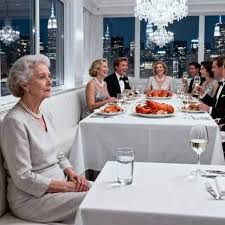
The restaurant glowed with amber light and quiet elegance, the kind that made people lower their voices without realizing it. Crystal glasses shimmered under chandeliers, waiters moved like dancers between tables, and the scent of garlic butter and fresh herbs floated through the air.
I sat at the end of the long table, hands folded neatly in my lap, pretending not to notice how uncomfortable my presence made my daughter-in-law.
Vanessa had chosen the restaurant for her birthday dinner. She spent the evening showing off her diamond bracelet, her designer handbag, and the fact that she now belonged to what she called “a higher class of people.”
My son, Daniel, sat beside her, laughing too loudly at every joke her father made.
I barely recognized him anymore.
The waiter approached with a silver tray.
“Tonight’s special is the butter-poached lobster with saffron risotto,” he announced politely.
Vanessa smiled. “Perfect. We’ll take four.”
The waiter glanced at me kindly. “And for you, ma’am?”
Before I could answer, Vanessa cut in.
“We don’t serve extra food,” she said with a soft laugh, as though it were harmless humor.
A few people at the table chuckled awkwardly.
Then she slid a glass of water toward me.
“This should be enough.”
I looked at my son.
Surely he would say something.
Instead, Daniel leaned back in his chair and sighed.
“You should know your place, Mom.”
The words landed harder than any slap could have.
For a second, the room disappeared. All I could hear was the faint ringing in my ears.
This was the boy I had raised alone after his father died.
The boy whose school tuition I paid by working double shifts.
The boy whose fever I sat through night after night, praying he would recover.
The boy who once held my hand and said, “When I grow up, I’ll take care of you forever.”
Now he couldn’t even offer me dinner.
But I didn’t cry.
I didn’t argue.
I simply smiled.
“Noted,” I said softly.
Vanessa smirked in victory and returned to scrolling through her phone.
Minutes later, steaming lobster plates arrived at the table. Butter glistened under the candlelight while everyone dug in enthusiastically.
I lifted my water glass calmly.
Then the restaurant suddenly fell quiet.
The head chef himself had stepped into the dining room.
Conversations around us faded as several employees straightened immediately.
Chef Marco rarely left the kitchen during service. His appearance alone turned heads.
He scanned the room until his eyes landed on me.
And then something unexpected happened.
The famous chef walked directly to our table.
When he reached me, he bowed slightly.
“Mrs. Helen,” he said respectfully, “we need you in the office.”
Every face at the table froze.
Vanessa blinked. “Wait… you know her?”
Chef Marco looked confused.
“Of course I know her,” he replied. “This restaurant belongs to her.”
Silence.
Absolute silence.
Daniel laughed nervously. “What?”
Chef Marco straightened. “Mrs. Helen is the owner.”
The color drained from Vanessa’s face so quickly it almost frightened me.
Her father stopped chewing.
Her mother slowly lowered her fork.
Daniel stared at me like he’d never seen me before.
I placed my napkin gently on the table and stood.
“I’ll be back shortly,” I said.
Chef Marco escorted me across the dining room while stunned whispers spread from table to table.
Inside the private office, he closed the door carefully.
“I’m sorry you had to experience that,” he said quietly.
I gave him a tired smile.
“You heard?”
“The entire staff heard.”
He hesitated.
“Should I ask them to leave?”
I looked through the glass window toward the dining room. My son sat frozen in his chair while Vanessa looked moments away from panic.
For years, I had hidden my success from Daniel.
Not because I was ashamed — but because I wanted him to love me for who I was, not for what I owned.
Twenty years earlier, after my husband’s death, I had borrowed money to buy a tiny struggling seafood café near the harbor. I cleaned tables myself, washed dishes myself, and learned recipes from old fishermen’s wives.
Eventually, that tiny café became one of the most respected seafood restaurants in the city.
Then another.
Then another.
By sixty-five, I owned five restaurants across the state.
But Daniel never cared enough to ask how I survived all those years.
Vanessa certainly never did.
To them, I was simply old-fashioned Helen with simple clothes and sensible shoes.
I sighed.
“No,” I told Chef Marco. “Let them finish dinner.”
He nodded carefully.
“But send their bill to me.”
Back at the table, nobody touched their food.
Vanessa stood abruptly when I returned.
“Helen, I—I didn’t know—”
“No,” I said calmly. “You didn’t.”
Daniel looked shattered.
“Mom… why didn’t you tell me?”
I sat down slowly.
“Because I wanted a son, not an employee.”
His eyes filled instantly.
The little boy I once knew suddenly appeared beneath the expensive watch and tailored suit.
But the damage was done.
Vanessa attempted a shaky laugh.
“This is all just a misunderstanding.”
I looked at her gently.
“No, dear. It was a revelation.”
Nobody spoke after that.
The waiter eventually arrived with the check inside a black leather folder and placed it near me.
Vanessa looked horrified.
“Oh no, we can pay—”
“I’m sure you can,” I replied.
I opened the folder.
Total: $482.
I placed my card inside calmly.
Daniel’s voice cracked.
“Mom… please let me explain.”
I looked at him for a long moment.
“Do you know what hurts the most?”
He lowered his eyes.
“It’s not that you insulted me,” I said softly. “It’s that you were comfortable doing it.”
Tears slid down his face.
Several nearby diners pretended not to watch.
Vanessa sat motionless, her confidence completely gone.
I signed the receipt and stood.
Then I reached into my purse and removed a small envelope.
I slid it toward Daniel.
“What’s this?” he whispered.
“The deed to the little house on Maple Street.”
His eyes widened.
“The house I grew up in?”
I nodded.
“I was going to give it to you next month.”
Vanessa immediately looked hopeful again.
But then I continued.
“Now I think I’ll donate it instead.”
Daniel closed his eyes.
“Mom…”
“I spent my life building things for you,” I said. “But somewhere along the way, you learned to measure people by what they could offer you.”
I glanced at Vanessa.
“And some lessons cost more than lobster dinners.”
I turned and walked toward the exit.
The entire staff stood quietly as I passed.
Outside, the night air felt cool against my skin.
Behind me, I heard footsteps.
Daniel.
“Mom, wait.”
I stopped but didn’t turn around.
“I’m sorry,” he said, voice breaking completely. “I don’t know when I became this person.”
For the first time that night, my own eyes filled with tears.
“That,” I whispered, “is the right question to start asking yourself.”
Then I got into my car and drove away, leaving him standing beneath the golden lights of the restaurant built by the mother he had tried to humiliate.