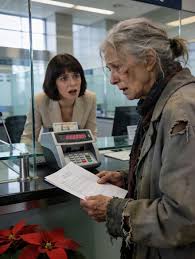
The plastic card felt strangely heavy in Eleanor’s hand. Three hundred dollars. After thirty-seven years of marriage, after raising two children, after moving across four states for Daniel’s promotions, after clipping coupons and sewing curtains and learning how to stretch one roasted chicken into three meals—that was what remained between them.
Three hundred dollars and silence.
Eleanor didn’t cry in the courthouse. Not when the judge signed the papers. Not when Daniel walked away without looking back. And not even when she returned to the tiny apartment she had rented on the edge of Cleveland with its flickering hallway lights and windows that rattled during storms.
She simply placed the bank card inside an old blue ceramic sugar bowl in her kitchen cabinet and closed the lid.
Then she began again.
The first year after the divorce felt like learning to breathe underwater. Everything was unfamiliar. She had never lived alone before. At night, the silence in the apartment pressed against her ears so hard she would leave the television on just to hear another human voice.
Money was tight.
Eleanor worked part-time at the local library shelving books and helping children find stories about pirates and dragons. The pay wasn’t much, but she loved the smell of old pages and the quiet kindness of people who still read novels on rainy afternoons.
Her daughter, Melissa, begged her to use the card.
“Mom, it’s your money,” she insisted over the phone. “You need groceries. Why are you saving it?”
But Eleanor always gave the same answer.
“I don’t know,” she said softly. “Maybe because it’s the last thing he ever gave me.”
The truth was more complicated.
Part of her wanted to prove she could survive without touching a single dollar from Daniel Hayes. Another part feared the moment she used the card would make the ending final, undeniable.
So the card remained hidden in the sugar bowl while life moved forward.
Five years passed.
Eleanor learned how to repair a leaking sink by watching videos online. She made friends with a widowed neighbor named Ruth who brought over banana bread every Sunday. She started taking morning walks by Lake Erie, feeding birds pieces of stale toast while the sunrise painted the water gold.
Little by little, the sharp ache inside her dulled into something quieter.
Not happiness exactly.
But peace.
Then, one icy November afternoon, her car broke down in a grocery store parking lot.
The mechanic’s estimate was devastating.
“Transmission’s gone,” he said apologetically. “I’m sorry, ma’am.”
Eleanor sat behind the steering wheel gripping the paper estimate with trembling hands. Her savings were thin. Social Security barely covered rent and utilities. For the first time in years, she thought about the card.
Three hundred dollars wouldn’t fix the car entirely, but it might help.
That evening she climbed onto a chair, reached into the kitchen cabinet, and lifted the sugar bowl down carefully. Dust coated the lid.
Inside, the bank card waited exactly where she had left it.
She stared at it for a long moment.
Then she slipped it into her purse.
The next morning, snow drifted lazily across Cleveland as Eleanor walked to the ATM outside the corner pharmacy. Her breath formed pale clouds in the cold air.
Her fingers shook while inserting the card.
For a moment, nothing happened.
Then the screen flashed:
ACCOUNT BALANCE: $187,430.62
Eleanor blinked.
Surely that couldn’t be right.
She checked again.
$187,430.62
Her knees nearly gave out beneath her.
People passed behind her on the sidewalk while she stared frozen at the glowing numbers. The machine hummed quietly, unaware that the world had suddenly tilted sideways.
Daniel had told her there was three hundred dollars.
Not nearly two hundred thousand.
Her first thought was that there had been some mistake.
Her second was that Daniel had lied.
Hands trembling violently now, Eleanor printed the receipt and hurried home through the snow. Inside her apartment, she sat at the kitchen table for nearly an hour staring at the paper.
Finally, she called the bank.
After verifying her identity, the representative explained calmly, “Mrs. Hayes, this account has been active for several years. There have been regular deposits.”
“Deposits?” Eleanor whispered.
“Yes. Monthly transfers.”
“From who?”
There was a pause.
“From Daniel Hayes.”
Eleanor’s heart stopped.
“What?”
“The transfers continued until eleven months ago,” the woman explained gently. “Then a final amount was deposited from an estate account.”
Estate account.
The room suddenly felt too small.
“When did my ex-husband die?” Eleanor asked, barely able to force out the words.
Another pause.
“I’m very sorry, ma’am. According to our records… Mr. Hayes passed away last year.”
Eleanor dropped the phone.
No one had told her.
Not their son, who hadn’t spoken to Daniel in years. Not old friends. No one.
She sat motionless at the kitchen table while memories flooded back in fragments she had spent years trying to bury.
Daniel bringing her coffee every morning before work.
Daniel holding her hand during Melissa’s difficult birth.
Daniel crying quietly in the garage the night his own father died.
And then later memories too—colder ones.
The distance.
The silence.
The long evenings spent in separate rooms.
The divorce neither of them truly fought against because somehow they had already lost each other long before the paperwork began.
With trembling hands, Eleanor searched Daniel’s name online.
The obituary appeared immediately.
He had died of pancreatic cancer.
Under the obituary was a message from the funeral home:
“In lieu of flowers, Daniel Hayes requested that donations be made anonymously to local women’s shelters.”
Eleanor covered her mouth and began to cry for the first time in five years.
Real, shaking sobs that bent her forward in the kitchen chair.
Because suddenly she understood.
The card had never been about three hundred dollars.
Daniel had known she would never accept charity from him. He knew her pride too well after nearly four decades together. So he lied about the amount, giving her a reason to ignore it until she truly needed help.
And every month afterward, while battling an illness he never told her about, he quietly kept adding money to the account.
Not enough to erase the pain between them.
Not enough to repair what had broken.
But perhaps enough to say what he could never say aloud:
I’m sorry.
Outside her apartment window, snow continued falling softly over Cleveland, covering streets and rooftops in white.
Eleanor wiped her tears and looked again at the receipt resting on the kitchen table.
For the first time in years, she took Daniel’s photograph from the hallway drawer where she had hidden it after the divorce.
“You stubborn man,” she whispered through tears.
Then she smiled—a small, trembling smile—and placed the picture gently beside the sugar bowl.