The silence of the hallway was a thick, institutional grey. I held a small, wrapped box in my hands—a vintage locket I’d found in an antique shop, the kind of thing my daughter, Sophie, had been asking for since her mother passed away three years ago. I wanted to surprise her. I wanted to see that rare, gap-toothed smile that had become so elusive lately.
I had been traveling for work more than I liked, but I felt at peace knowing Sophie had Julianna. Julianna was a miracle. Elegant, soft-spoken, a philanthropist with a pedigree that suggested old-world grace. When we married six months ago, I thought I had finally fixed our broken world.
I reached the double doors of the cafeteria. I expected to see Sophie at the “Golden Table,” surrounded by the children of the city’s elite, laughing under Julianna’s watchful eye. Julianna volunteered here every Wednesday as the “Grace Coordinator.” I pushed the door open an inch. The room was a roar of high-pitched voices and the clatter of plastic trays. But my eyes didn’t find the Golden Table. They drifted to the far corner, near the heavy swinging doors of the kitchen, right beside the overflowing industrial trash cans.
There was Sophie.
She wasn’t wearing the designer sweater Julianna had told me she “insisted” on wearing that morning. She was in a thin, stained t-shirt. She sat on a low plastic stool, her head bowed. Standing over her was Julianna.
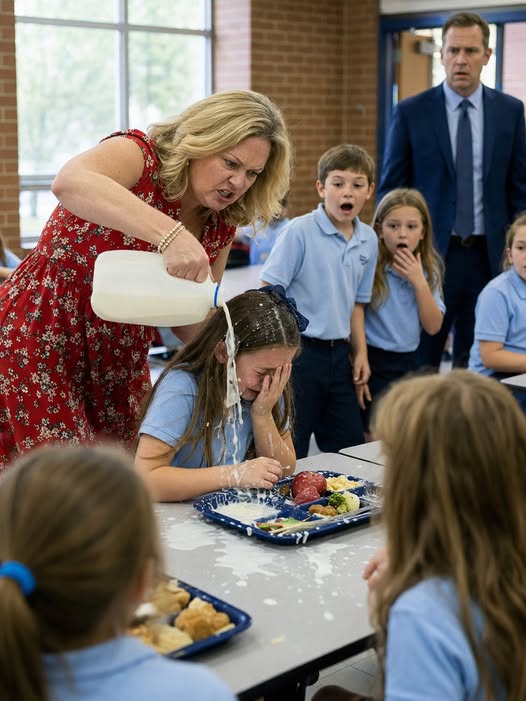
The woman I loved didn’t look elegant now. Her face was contorted into a mask of cold, sharp angles. She was holding a plastic baggie. Inside was a sandwich—the bread green with bloom, the edges curled and grey.
“Eat it,” Julianna hissed. Her voice was a low lash that carried over the lunchroom din. “You told your father you wanted to go to the park this weekend. Every bite is a minute of fresh air. If you throw it up, you stay in the cellar for two days instead of one.”
Sophie’s small, trembling hand reached into the bag. I watched, my soul turning into a block of jagged ice, as my eight-year-old daughter took a bite of rotten meat while Julianna adjusted her pearls and checked her reflection in the glass of the vending machine.
I didn’t burst in. I didn’t scream. I didn’t wrap my hands around Julianna’s throat, though every cell in my body demanded it.
I knew Julianna. She was a creature of reputation. If I attacked her now, she would play the victim, her high-priced lawyers would shred my “unstable” grief, and Sophie would be caught in a decades-long custody battle.
I needed more than a rescue. I needed an execution.
I turned around, walked out of the school, and threw the gift into the backseat of my car. I took a breath that felt like inhaling broken glass, and I began to build a cage.
The Week of Ghosts
For the next seven days, I was the perfect husband. I kissed Julianna’s cheek. I praised the “nutritious” meals she claimed to be making for Sophie—meals I now knew were being scraped into the disposal the moment I left the room, replaced by the scraps Julianna kept in a locked mini-fridge in the basement.
I installed cameras. Not the obvious security kind, but pinhole lenses hidden in the molding, in the smoke detectors, and—most importantly—in the lining of the “Grace and Heritage” ballroom where Julianna was set to host her annual Winter Gala.
I hired a private investigator who specialized in “Identity Erasure.” By day four, I had the truth. Julianna wasn’t a Thorne or a Wentworth. She was Julia Miller, a woman who had been barred from foster care in three states and had “reinvented” herself after a suspicious fire at a previous employer’s estate.
The night before the gala, I sat in my home office, watching the live feed from the basement. I saw Julianna force Sophie to sit on the cold concrete floor because she had “looked at her father with too much longing” that morning.
I watched Julianna smile at herself in the mirror, practicing her speech about “The Sanctity of the Child.”
“One more day, Sophie,” I whispered to the screen, my knuckles white. “Just one more day.”
The Ballroom of Fire
The Winter Gala was the social event of the decade. Three hundred of the most powerful people in the state sat under a five-tier crystal chandelier. Julianna was a vision in white lace, looking like a saint carved from marble.
I stood at the back of the room, near the tech booth.
“Ladies and gentlemen,” Julianna’s voice chimed through the speakers. “We are here tonight to raise money for the ‘Hidden Hearts’ foundation. Because every child deserves a mother’s protection. Every child deserves to feel safe at the table.”
Applause rippled through the room. Julianna looked at me in the back and blew a dainty kiss.
“And now,” Julianna said, “a short video on the progress we’ve made this year.”
The lights dimmed. Julianna stood to the side of the stage, a spotlight catching the diamonds at her throat.
The screen didn’t show the foundation’s work.
It flickered, then showed a grainy, high-definition shot of a school cafeteria. The audio was crisp—I’d spent ten thousand dollars on the restoration.
“Eat it,” Julianna’s voice boomed through the ballroom. “Every bite is a minute of fresh air.”
The room went so silent I could hear the hum of the projector. Three hundred people watched as the “Saint in White” forced an eight-year-old to eat rot. Then the video cut to the basement footage from thirty-six hours ago—Julianna mocking Sophie’s dead mother while she shivered on the concrete.
Julianna froze. The spotlight stayed on her, but it no longer felt like a crown; it felt like a target.
“What is this?” she shrieked, turning to the booth. “Stop this! It’s a deepfake! It’s a hack!”
I stepped out from the shadows and walked down the center aisle. I wasn’t the grieving, quiet husband anymore. I was the man who had seen the trash cans.
“It’s not a hack, Julia,” I said, my voice amplified by the lapel mic I wore.
The use of her real name hit her like a physical blow. She stumbled back against the podium.
The doors at the back of the ballroom swung open. Uniformed officers, led by a detective I’d been feeding evidence to for seventy-two hours, marched down the aisle.
“Julia Miller, also known as Julianna Thorne,” the detective shouted. “You are under arrest for felony child endangerment, aggravated assault, and multiple counts of identity fraud.”
The crowd parted like the Red Sea. Julianna tried to run, her white lace skirt catching on the edge of a table, sending a tower of champagne glasses crashing to the floor. The sound was like a thousand tiny bells of justice.
The police tackled her right under the center of the ballroom. As the handcuffs clicked shut, the diamonds she had bought with my daughter’s inheritance glinted mockingly in the light.
I didn’t look at her. I looked past her, to the side door where my sister was waiting with Sophie.
Sophie was wearing the locket now. She ran to me, her small feet thudding against the expensive carpet. I picked her up, burying my face in her hair, which no longer smelled like the basement, but like the lavender soap I had used to wash her that morning.
Julianna was dragged out, screaming that I was a monster, that I had trapped her. But the ballroom remained silent. The elite of the city watched in a collective, horrified realization that they had been applauding a predator.
I looked up at the crystal chandelier. It was beautiful, but it was just glass. Julianna was just glass. And finally, the light was shining right through her.
“Let’s go home, Sophie,” I whispered. “The table is set. And everything on it is for you.”