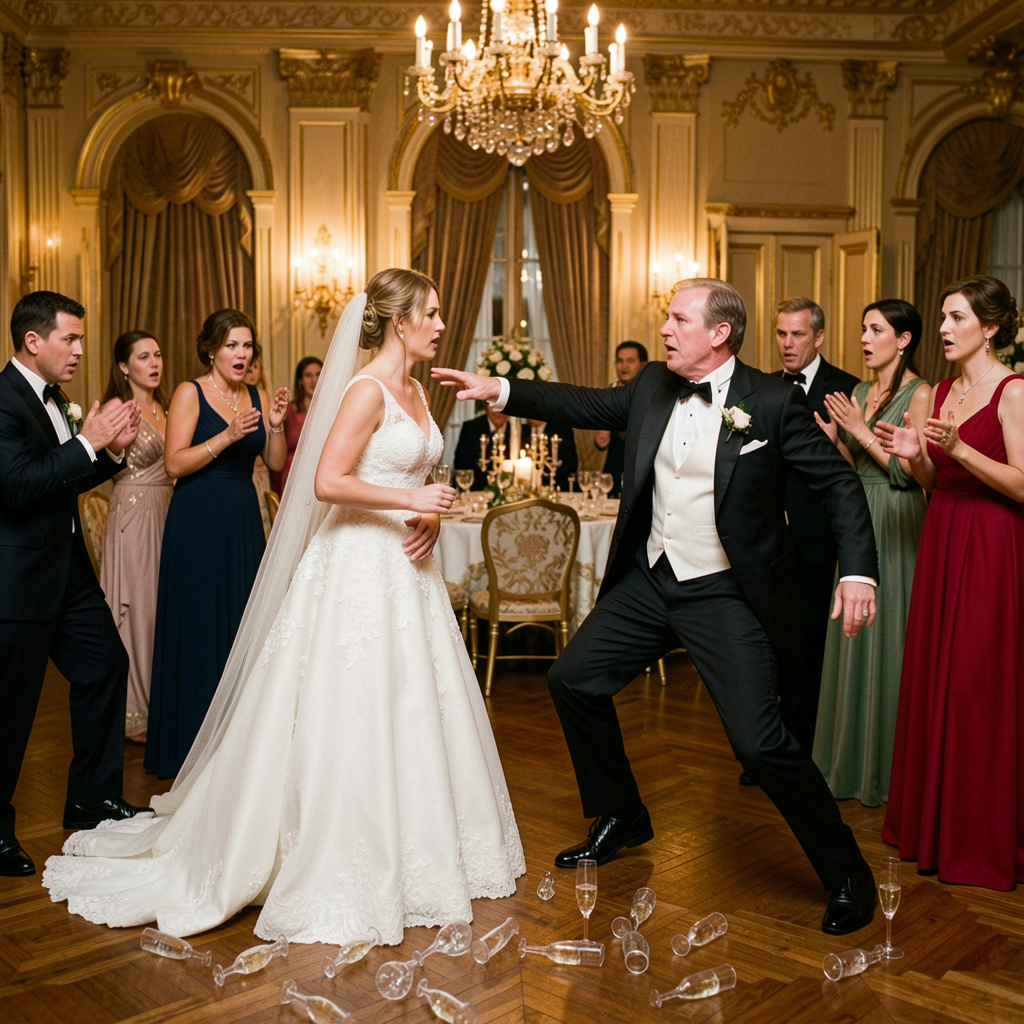
The slap echoed across the wedding hall so loudly the music nearly disappeared beneath it.
For one stunned second, over two hundred guests went silent and stared at me like I was the one ruining my daughter’s wedding day.
My knees nearly gave out.
I grabbed the edge of the gift table to stop myself from falling as champagne glasses shook and whispers spread across the ballroom. The chandelier light caught the tears gathering in my eyes, and I blinked them back with everything I had — sixty-three years of hard living, of drought and frost and market crashes, of burying a husband and raising a daughter alone — and I refused to let Carter Whitmore see a single one fall.
Standing in front of me, smiling like he already owned my entire life, was my new son-in-law.
“The keys, Ruth.” His voice was quiet now, almost gentle, which made it worse. He held out his palm like a man who had simply asked for the salt shaker. “Don’t make this harder than it needs to be.”
I looked at his hand. Then I looked past him, at my daughter.
Lily stood ten feet away in her ivory gown, her bouquet of wildflowers trembling at her side. She had her father’s eyes — soft brown, honest — but in that moment they were somewhere far away, fixed on the marble floor like a woman studying a map of a country she no longer recognized.
She didn’t move toward me. She didn’t say his name.
That hurt worse than the slap.
The farm had been in my family for four generations. One hundred and twelve acres of black Georgia soil that my great-grandmother had worked as a sharecropper, that my grandmother had scraped and saved to buy the deed on, that my mother had defended through a flood that took the barn and a fire that nearly took everything else, and that my late husband David had poured thirty years of mornings into before his heart gave out beside the tractor on a Tuesday in October.
I had never once considered selling it.
Carter Whitmore had been in our lives for eighteen months. He arrived the way certain men do — charming, well-dressed, full of plans. He had a firm handshake and a financial advisor’s vocabulary and a way of talking about the future that made you feel foolish for being attached to the past. He took Lily to nice restaurants. He sent me flowers on my birthday. He asked thoughtful questions about the farm at Sunday dinners, nodding along as I explained crop rotations and soil chemistry and the particular mercy of a late spring rain.
I told myself I liked him.
What I actually felt, buried under the politeness, was the slow, creeping certainty that he was measuring everything with his eyes.
The first sign had come four months ago, when he’d mentioned, casually, over pot roast, that a developer out of Atlanta had been buying up farmland in our county. Good prices, he’d said. Generational wealth, he’d said. I’d changed the subject. He’d let me.
The second sign came six weeks before the wedding, when I discovered he’d already spoken to that same developer — without telling Lily, without telling me — and described the farm as “an inheritance asset likely to transfer post-marriage.” I found this out because the developer’s assistant had called my landline by mistake, thinking she was reaching Carter’s office.
I hadn’t told Lily. I wish I could explain why. Maybe I was afraid she wouldn’t believe me. Maybe I was afraid she would believe me and lose the happiness she’d been wearing like sunlight. Maybe I was just a mother making the oldest mistake there is — protecting her child from a truth that was always going to arrive.
It arrived tonight, in a wedding hall, with two hundred witnesses.
“I’m going to step outside for some air,” I said to Carter, to no one, to the room.
My voice came out steadier than I expected. The cheek was still burning. I could feel the shape of his hand on my face like a brand, and I thought of my mother, who once told me that the best response to humiliation was to move through it with your spine straight, because dignity was the one thing nobody could take from you unless you handed it over yourself.
I walked across the ballroom. The crowd parted. I heard Carter say something — an explanation, a dismissal — and I heard a few murmured voices respond, and I heard the band pick nervously back up, some bright and inappropriate song about celebration.
I pushed through the double doors into the warm Georgia night.
The parking lot was lit by tall iron lamps that cast amber circles on the asphalt. Cicadas sang in the dark tree line beyond the venue fence. I could smell cut grass and the particular sweetness of the gardenias they’d planted along the entrance path for the wedding.
I stood still for a moment and pressed two fingers to my cheek.
Then I took out my phone and found the number I’d been carrying in my contacts for two months, ever since the developer’s assistant had called by mistake and I’d spent the following three weeks doing what David always said I was best at: quiet, thorough, unrelenting research.
The phone rang twice.
“Mrs. Calloway,” said the voice on the other end. “I wondered when you might call.”
“I’m ready,” I said. “Tonight, if you can manage it.”
A pause. Then: “Give me forty minutes.”
I went back inside.
I did not go back to Carter. I found my sister-in-law, Bev, at a table near the back, who took one look at my face and stood up without a word and put her arms around me. I let her. Just for a moment.
“What do you need?” she asked.
“I need you to keep Lily away from the front entrance for about forty minutes.”
Bev leaned back and studied me with the expression she’d been perfecting since 1987. “Ruth Ellen Calloway, what are you about to do?”
“Something I should have done two months ago.”
She pursed her lips. She looked across the room at Carter, who was now at the bar with two of his friends from the city, laughing at something, his jacket perfectly pressed, his whole body radiating the ease of a man who believed the evening was already settled.
“Forty minutes,” Bev said. “Go.”
I spent those forty minutes doing three things.
First, I found Lily.
She was in the bridal suite off the main hallway, sitting on a cream-colored loveseat with her shoes off and her bouquet laid across her lap. She looked up when I came in, and something moved across her face — guilt, relief, sorrow, love — all the complicated weather of a daughter looking at her mother after witnessing something she could not undo.
“Mama—”
“I’m not here for an apology,” I said. I sat down beside her. I took her hand. “I’m here to tell you that I love you, and that nothing that happens tonight changes that. Not one single thing.”
She cried. I let her. I handed her a tissue from the box on the vanity and watched her carefully repair her mascara in the mirror, and I thought about the night she was born, how David had held her up in the delivery room light like she was the most astonishing thing the world had ever produced, which she was.
“Did you know?” I asked. Quietly. No accusation in it.
She was quiet for a long moment. “I knew he’d talked to someone about the land,” she said finally. “He told me it was just an inquiry. That he was exploring options for us. For our future.”
“And you believed him.”
“I wanted to.” She looked at her hands. “I’m sorry, Mama. I should have come to you.”
I squeezed her fingers. “You’ll know better next time.”
She laughed, wet and surprised. “There better not be a next time.”
I kissed her temple. “Stay here with Bev for a little while. I’ll come get you.”
Second, I spoke to Frank Delacroix.
Frank was our county’s District Attorney and had been David’s best friend since the third grade. He was also, by coincidence, a guest at the wedding, seated at table eleven with his wife. I found him on the way back from the bridal suite and told him, in roughly three minutes, what had happened — the slap, the keys, the developer, the phone call that had come in error.
He listened without interrupting, which was something I’d always admired about Frank.
When I finished, he set down his champagne glass very deliberately.
“You have documentation?” he asked.
“I have the call recording, the developer’s correspondence, and a real estate attorney who has been holding a signed document for me since last month.”
Frank looked at me for a long moment. Then he nodded slowly, the way men nod when they realize a woman was fourteen steps ahead of them and they’re only just catching up.
“Where do you want me?” he asked.
“Front entrance,” I said. “Ten minutes.”
Third, I went to the coat check window near the lobby and retrieved the small envelope I had left there three hours earlier, before the ceremony, when I’d had a quiet word with the coat check attendant — a young woman named Dee who had smiled and said yes, ma’am without asking any questions, God bless her.
Inside the envelope were the original deed to the Calloway farm, a letter from my attorney confirming that the property was held in an irrevocable trust established two months prior, and a business card.
Not a developer’s business card.
A different one.
The black car arrived in thirty-eight minutes.
I was standing just inside the glass front doors when it pulled up, and I watched Carter across the lobby — he’d drifted from the bar toward the entrance, some instinct pulling him, the way predators sometimes sense a change in atmosphere before they can name it.
He saw me standing by the doors. He smiled. Still confident. Still certain.
Then the doors opened.
The man who walked in was tall, silver-haired, dressed in a dark suit that cost more than Carter’s monthly rent. He had the unhurried walk of someone who had learned decades ago that rooms rearrange themselves around you when you have enough patience.
His name was Henry Aldridge. He was the founder and chairman of Aldridge Agricultural Trust — the largest farmland preservation organization in the southeastern United States, with a legal and financial endowment that made the Atlanta developer Carter had been courting look like a child with a lemonade stand.
I had called Henry Aldridge the morning after that misdirected phone call, having found his name through three weeks of research into every counter-option available to a sixty-three-year-old woman who owned a hundred-and-twelve acres and was watching a man try to position himself to steal it.
Henry and I had spoken four times since then. He’d reviewed the farm’s history, its soil registry, its heritage crop records. He’d sent two of his team members to walk the land on a Wednesday when Lily was at work and Carter was in the city.
He had made me an offer — not to buy the land, but to partner with it. A conservation easement, a heritage farm designation, a funded restoration of the original barn, and a guaranteed income stream through the Trust’s agricultural program that would outlast me, outlast Lily, outlast any developer’s five-year flip horizon by about a century.
I had signed the paperwork on a Monday afternoon in my kitchen, with my attorney and two witnesses present.
The farm was untouchable.
Carter didn’t know any of this.
He crossed the lobby toward us, and I watched the confidence in his face curdle into something else as Henry Aldridge turned and extended his hand to me with the warmth of a man greeting a long-respected colleague.
“Ruth,” Henry said. “I’m sorry I couldn’t be here earlier.”
“You’re right on time,” I said.
Carter stopped five feet away. Frank Delacroix appeared at his left shoulder, not threateningly, just present, the way a fact is present.
“Carter,” I said. I kept my voice level. I kept my spine straight. “I’d like to introduce you to Henry Aldridge, who is the chairman of the Trust that now holds the Calloway farm in permanent conservation easement. The land cannot be sold, subdivided, or transferred without the Trust’s consent in perpetuity. My attorney filed the final paperwork six weeks ago.”
I paused.
“There are no keys to hand over,” I said. “There never were.”
The smile was completely gone now. In its place was something younger, rawer — the face of a man realizing that the game he’d been playing was on a board he never actually understood.
He looked at Lily.
Lily was standing in the lobby entrance behind me. I hadn’t heard her come out of the bridal suite, but there she was, shoes back on, chin up, bouquet still in her hands.
She looked at her husband for a long, quiet moment.
Then she looked at me.
And I saw her father’s eyes — honest, clear — and I knew that whatever came next, my daughter was going to be all right. She was a Calloway. She knew how to survive a hard season.
She had been raised on one hundred and twelve acres of proof.
The rest of that night is a series of quieter moments.
Carter left. His two city friends left with him. The band played on. Bev danced with Frank’s wife near the edge of the floor, slightly off-rhythm and completely unbothered. Henry Aldridge had a glass of sweet tea and told me stories about a heritage peach orchard in the Carolinas until nearly midnight.
Lily sat beside me for most of it, her heels off again, her head occasionally resting on my shoulder the way it had when she was small and the world had been too much.
We didn’t talk about what would happen next. There was time for that.
What I know is this: the farm will be there when the talking is done. It will be there in the February cold and the August heat and the mud of early March. The soil my great-grandmother worked will keep its memory and its patience, the way good soil always does.
David’s tractor still sits in the shed. I start it every Sunday just to hear it run.
And the keys — the real ones, the ones that open the house and the barn and the gate at the end of the long gravel road — those are right where they’ve always been.
In my pocket.
Where they belong.