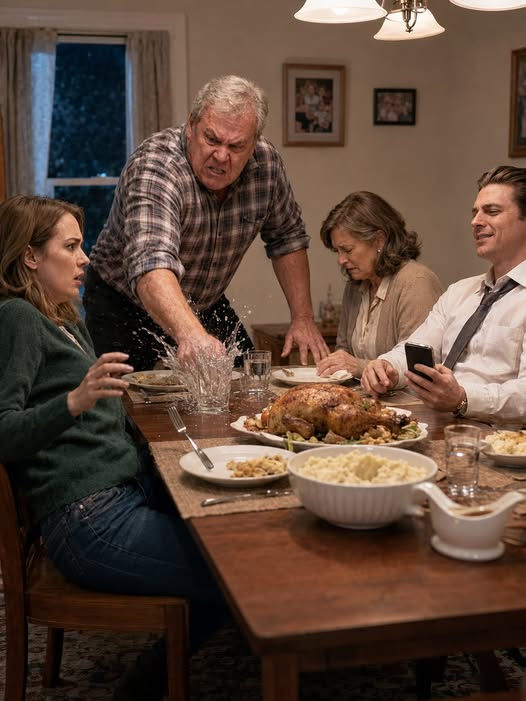
The dinner table was set with the fine china—the gold-rimmed plates we only used for birthdays, holidays, and, apparently, the public execution of my dignity.
The roast beef sat in the center, bleeding juice into the porcelain, but the air was thick with something much more sour than vinegar. My father, Arthur, sat at the head of the table, his face a map of burst capillaries and stubborn pride. Across from me sat my brother, Julian. Julian, who had never held a job for more than six months; Julian, who had been “finding himself” on my dime for three years; Julian, who was currently smirking at his mashed potatoes. “It’s decided, then,” my father said, his voice booming with a finality that brooked no debate. He didn’t look at me. He looked at the wine glass in his hand. “The beach house. It’s too much for a single woman to maintain. Julian is getting married in the spring. He needs a legacy. He needs a foundation.”
I felt the fork in my hand go cold. “The beach house? Dad, I’ve lived there for eight years. I paid off the back taxes when you almost lost it. I did the renovations. I fixed the roof with my own hands.”
Arthur slammed his fist onto the table. The plates rattled. “I don’t care about the shingles, Claire! I care about this family. And in this family, the eldest son carries the name. You have a career. You have a fancy apartment in the city. You don’t need a four-bedroom house on the coast.”
He leaned forward, his eyes narrowed into slits of cold iron. “You have two days to get your stuff out. Exactly forty-eight hours. After that, the locks are being changed. That house belongs to your brother now.”
Julian looked up then, his eyes glittering with a predatory triumph. “Don’t worry, sis. I’ll let you visit. For a fee.”
I looked around the table. My mother was staring at her lap, her silence a heavy, suffocating shroud. This was the way it had always been. Julian was the prince, and I was the labor.
I didn’t argue. I didn’t scream. I didn’t even cry. I slowly placed my napkin on my plate, stood up, and looked at the clock on the wall.
“Forty-eight hours,” I said quietly. “I understand.”
I walked out of the room, the silence of my departure louder than any shout could have been. As I drove toward the coast, the moonlight reflecting off the dark Atlantic, I wasn’t thinking about moving boxes. I was thinking about the “foundation” my father wanted to give his son.
They thought they were taking a house. They didn’t realize they were inheriting a debt they couldn’t possibly pay.
The Forty-Eight Hour Shift
For the next two days, I didn’t sleep. But I wasn’t packing clothes or furniture.
The beach house was a beautiful Victorian, a “painted lady” perched on a cliffside. To the neighbors, it was a dream. To me, it was a machine. Over the last eight years, I had integrated every modern luxury into its bones—but I had also integrated the fail-safes.
Hour 12: I went into the basement. Behind a false panel in the wine cellar sat the hub for the smart-home integration I had designed. I didn’t disable the system. I simply changed the “Master” status to “Guest.” I stripped away the administrative privileges of anyone with the last name Vance, except for myself.
Hour 24: I called the contractors. Not to move things out, but to finalize the “restoration” I had been planning. You see, the beach house wasn’t just on the coast; it was built on an old limestone vein that was prone to “shifting” if the moisture levels weren’t perfectly balanced by the sophisticated sump-pump system I had installed.
Hour 36: I moved my actual valuables—my mother’s real jewelry that I’d kept safe, my grandmother’s journals, my own legal documents—into a secure storage unit five towns over. I replaced them with look-alikes. I replaced the high-end appliances with “shells”—refrigerators that looked new but had cooling coils that were designed to fail the moment they were loaded with more than ten pounds of weight.
Hour 47: I stood in the center of the living room. The house looked perfect. It looked like a magazine spread. It looked like the “legacy” Julian had always dreamed of.
I pulled out my phone and looked at the clock. 5:59 p.m.
I stepped onto the porch, locked the front door with my key for the very last time, and dropped the key into the decorative milk box. Then, I walked to my car and waited.
The Arrival
At 6:05 p.m., my father’s black SUV and Julian’s flashy convertible pulled into the driveway. They stepped out like conquerors. Julian was wearing a “Captain” hat, laughing as he pointed at the wrap-around porch.
“See, Dad? This is where the Vance name returns to glory!”
They didn’t even look toward my car parked down the street. They marched up to the door, found the key, and stepped inside.
I counted to ten. Then, I tapped a single button on my phone.
The House Awakens
Inside the house, the “Welcome Home” sequence began.
First, the lights. I had replaced every bulb with high-frequency smart LEDs. Instead of a warm glow, the house was suddenly bathed in a flickering, strobing ultraviolet light—the kind they use in high-security psych wards to prevent sleep.
Next, the sound. The hidden speakers in the crown molding didn’t play music. They began to emit a low-frequency infrasound—18.9 Hz. It’s a frequency that the human ear can’t consciously hear, but it causes the liquid in the inner ear to vibrate, inducing intense feelings of dread, nausea, and the sensation of being watched.
Julian and Arthur stood in the foyer, their smiles beginning to fade.
“What’s that… that hum?” Julian asked, rubbing his temples. “Dad, I feel sick.”
“It’s just the sea air, boy,” Arthur grunted, though his face was turning a shade of grey. “Open the windows.”
Julian ran to the windows. But the “smart” shutters didn’t budge. I had engaged the “Storm Shield” protocol. The house was now an airtight box.
Then came the smell.
I had rigged the vents. Years of coastal living had taught me that the local marsh gas was harmless but smelled like a rotting carcass if concentrated. I released the canisters I had placed in the HVAC system. Within seconds, the “legacy” smelled like a mass grave.
But the real “gift” was in the basement.
I had reversed the sump pumps. Instead of pushing the encroaching seawater out, the system began to pump the salt-rich brine into the limestone foundations beneath the floorboards.
Through the windows of my car, I saw the house begin to “settle.” It was a slow, agonizing groan of wood and stone. The Victorian wasn’t collapsing—not yet—but it was shifting just enough that every door in the house was now jammed in its frame.
Julian and Arthur were trapped in a strobing, nauseating, foul-smelling tomb.
The Final Lesson
I sat in my car and watched through the security feed on my tablet. I saw my father pounding on the reinforced glass of the front door. I saw Julian curled in a ball on the rug, clutching his head as the infrasound tore through his nervous system.
They had wanted the house. They had wanted the “foundation.”
They had forgotten that a foundation is only as strong as the person who built it. They had spent their lives taking from me, assuming I was the weak link because I was the one who served. They didn’t realize that the person who serves is also the person who knows where all the wires are hidden.
I picked up my phone and called my father. He answered on the first ring, his voice a panicked sob.
“Claire! Claire, something is wrong! The house… it’s haunted! It’s trying to kill us!”
“It’s not haunted, Dad,” I said, my voice calm and cool as the evening tide. “It’s just behaving like you taught it. It’s looking out for its own interests.”
“Get us out! Call someone!”
“I can’t, Dad. You told me I had forty-eight hours to get my stuff out. I’m officially no longer associated with that property. It’s Julian’s legacy now. He should be able to fix it, right? He’s the eldest son. He’s the foundation.”
“Claire, please!”
“The code to the override is the date Mom died,” I said. “The day you forgot to show up for her because you were at Julian’s graduation. If you can remember that date, the doors will open. If not… well, I hear the tide is coming in quite high tonight.”
I hung up.
I put the car in gear and drove toward the city. I didn’t look back at the flickering lights of the Victorian on the cliff. I had a new life to start, and for the first time in my life, I didn’t have to carry anyone else’s weight.
They wanted the house. And in forty-eight hours, they had finally realized that a house is just a pile of wood—but a home is something you have to earn.