My name is Sophia Burke. I am thirty years old, and for most of my life, I believed there were only two kinds of daughters in a family like mine. There was the daughter people displayed. That was my sister, Elena. She was the “Legacy.” She had the law degree from the university my father’s portrait hung in. She had the perfect pearls, the perfect posture, and the perfect husband—a man named Julian whose last name held more weight than his personality.
And then there was the daughter people used. That was me. I was the “Fixer.” I was the one who managed the family’s real estate holdings from a windowless office in the basement of our ancestral home. I was the one who balanced the books when Elena’s “charity galas” went over budget. I was the one who stayed up until 3:00 a.m. drafting the contracts that kept my father’s failing construction firm from being seized by the bank. But tonight, the roles were about to collide.
The Dinner
We were at L’Escale, the kind of restaurant where the menus don’t have prices and the waiters move like ghosts. The occasion was the “final celebration” before Elena’s appointment to the State Bar Committee—a position my father had spent six months lobbying for.
My mother, Catherine, stood up. She wore a dress that cost more than my first car, and her diamonds caught the candlelight, throwing jagged sparks across the white linen tablecloth.
“To Elena,” my mother said, her voice trembling with a rehearsed, cinematic pride. “The daughter who carries the Burke name forward. The daughter I am truly proud of.”
The table erupted in applause. My father beamed. Elena tilted her head with a practiced modesty, her smirk grazing me for just a second—a silent reminder of where I sat on the family tree.
Then, the waiter appeared.
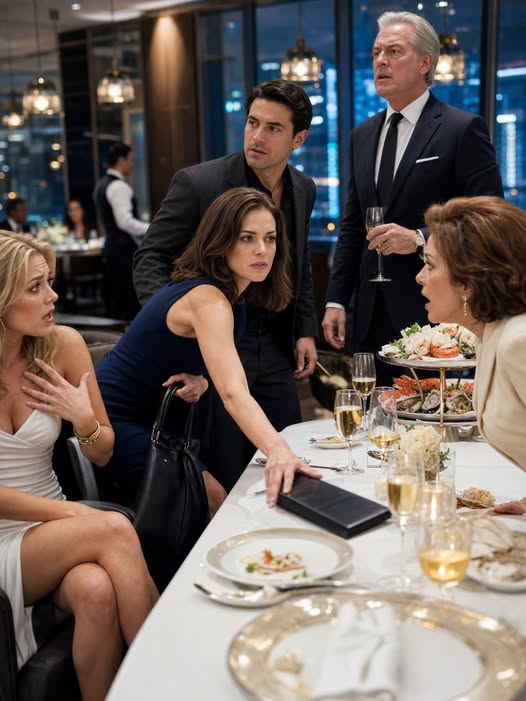
He didn’t go to my father, the patriarch. He didn’t go to Elena, the guest of honor. He walked straight to me. He placed the leather folder on the table. It landed with a soft, heavy thud.
I didn’t need to open it to know the number. I had seen the wine list. I had seen the caviar service Elena had ordered “for the table” without asking.
I opened it anyway. $3,450.00.
The table went quiet. My mother was still smiling, but it was the smile of a predator waiting for its meal to be served. My father was looking at his watch, already mentally checked out.
“Sophia, dear,” my mother whispered, her voice like silk over a blade. “Go ahead and take care of that. We forgot our wallets in the rush to get here.”
Elena’s smirk deepened. She leaned back, crossing her arms. “It’s the least you can do, Soph. After all, it’s a big night for the family.”
For fifteen years, I would have reached into my bag. I would have pulled out the corporate card—the one I paid the interest on—and I would have swallowed the resentment along with the expensive champagne.
But three hours ago, I had sat in my basement office and found the one thing my father thought he had buried deep enough to hide.
I stood up.
The chair scraped against the marble floor, a harsh, ugly sound in the refined room. I didn’t reach for my purse. Instead, I reached for the folder. I didn’t pull out a card.
I slid the bill back across the table.
I watched it glide over the white cloth until it stopped directly in front of my father.
The whole room went silent. The waiter blinked. My mother’s smile didn’t just fade; it curdled.
“Sophia?” my father said, his voice dropping into that dangerous, low register he used when a subordinate stepped out of line. “What is this?”
“It’s a bill, Dad,” I said, my voice calm, ringing out with a clarity that surprised even me. “And it’s the last one I’m ever going to see.”
“Don’t be dramatic,” Elena snapped, her face flushing. “Just pay it. You’re embarrassing us.”
“I’m embarrassing you?” I laughed. It wasn’t a bitter laugh; it was the laugh of someone who had just realized the cage door had been unlocked the whole time. “Elena, you’re sitting there in a dress paid for by the ‘administrative fees’ I diverted from the trust just to keep you from being sued by your tailor. Mom, those diamonds are currently collateral for a bridge loan I had to take out last Tuesday to cover Dad’s payroll.”
“Sophia, sit down,” my mother hissed, looking around the restaurant.
“No,” I said. I looked at my father. “I found the ledger, Dad. The real one. The one that shows the Burke name isn’t a legacy. It’s a laundromat. You haven’t been building skyscrapers; you’ve been building a house of cards, and you’ve been using my signature to glue it together.”
My father’s face went from red to a terrifying, sickly grey. “You don’t know what you’re talking about.”
“I know that at 9:00 a.m. tomorrow, the bank is going to call about the shortfall in the escrow account,” I said. “And for the first time in thirty years, I won’t be there to answer the phone.”
I leaned over the table, my hands flat on the linen, looking directly at the daughter my mother was “proud of.”
“Elena, since you’re the lawyer, I suggest you start looking into the penalties for co-signing fraudulent loans. Because your name is on the bottom of the last three. I made sure of it.”
Elena’s smirk didn’t just vanish; it turned into a mask of pure terror.
“You… you wouldn’t,” she whispered.
“I already did,” I said.
I turned to the waiter, who was trying to merge with the wallpaper. “The gentleman at the head of the table will be taking care of the check. In fact, he’ll be taking care of everything from now on.”
I grabbed my coat. I didn’t look back at the table of “Legacy” and “Pride.” I walked through the restaurant, out into the cool night air of the city.
My phone buzzed in my pocket. A text from the bank’s fraud department: Activity detected. Would you like to authorize?
I hit No.
I watched the city lights, feeling the weight of the “Fixer” role sloughing off me like dead skin. I wasn’t the daughter they used anymore. And as for the daughter they displayed?
By morning, the only thing the Burkes would be displaying was a “For Sale” sign.
I started my car and drove. Not to the basement office. Not to the ancestral home. I drove toward the state line, where the only name that mattered was my own.