I was in the kitchen pressing biscuit dough into a cast-iron skillet when my granddaughter called. It was a Tuesday in late October, the kind of East Tennessee afternoon that makes ordinary life feel briefly trustworthy. The light came in low and honey-colored through the window over the sink. The rosemary I had cut from the pot on the back step was drying on a towel. Butter was softening on the counter. The dishwasher hummed. My radio, turned down low, was playing an old Patsy Cline song that made the whole house feel like memory. I remember thinking how quiet everything was.
I saw Simone’s name and smiled before I answered, because she had started calling more now that she was seven months pregnant, usually to ask me small things she already knew the answers to. Did I think the baby needed more blankets in November? Was it too early to wash newborn clothes? Did I still have Loretta’s old rocking chair? She liked hearing me tell her yes. She liked hearing that things existed before her and would still be here when she needed them. But when I answered, she did not say hello.
She said, “Grandma.” Just that. One word.
And the way she said it made the room change shape. I dropped the dough right there on the counter. I did not even bother to wipe my hands. I grabbed my keys, my purse, and the cardigan hanging on the chair back, and I was already out the door before she made another sound. Her apartment was fourteen minutes from my house if you caught the lights right, seventeen if you didn’t. I made it in eleven. All the way there I kept calling her name through the speaker. “Simone? Baby, stay with me. I’m almost there. Keep talking to me.” Sometimes I heard her breathing. Sometimes I heard nothing. Once, very faintly, I heard her say, “Hurry.”
I parked crooked in front of her building, left the engine running, and ran inside without locking the car. Her apartment door was not shut all the way. That frightened me more than anything up to that moment. Simone was careful by nature. She checked stove knobs twice. She folded legal envelopes before she put them in the trash. She locked doors out of habit, not fear. An open door meant she had not been able to close it.
Her purse was on the entry table. One flat shoe was in the hall. The other lay on its side near the living room rug. A glass had broken in the kitchen sink. There was a chair knocked halfway over by the dining table, and one of the placemats was twisted under it like someone had caught it on the way down.
Then I saw the bathroom light.
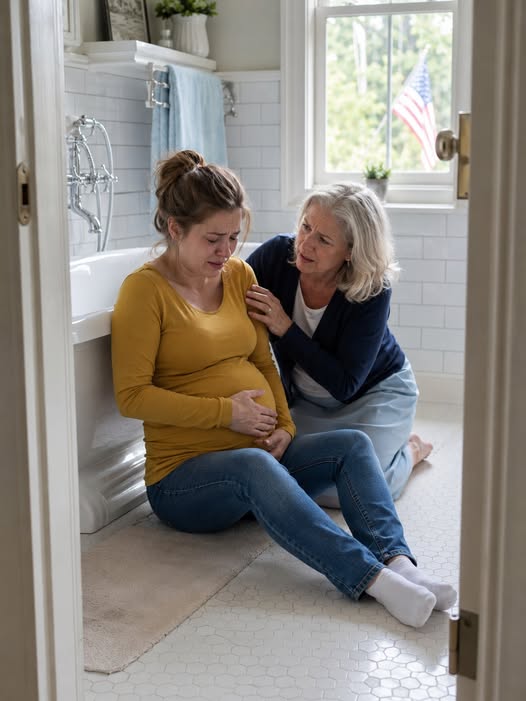
I found her on the floor beside the tub, curled as tightly as her pregnant body would allow. She was still in her work clothes. The yellow cardigan she had loved since college, the one with the little pearl buttons, was torn at the shoulder. Two buttons were gone. Her left eye was swollen nearly shut. There was a cut above her ear, and dried blood had made a dark line down her cheek into her hair. One hand was braced protectively over her stomach even in pain, as if the body knows what matters most before the mind can form the thought.
I knelt so fast my knees struck tile hard enough to bruise.
“Baby. Baby, look at me.”
She did.
With that one good eye she looked straight at me, and in a whisper that barely moved the air, she said the thing that changed everything.
“It was Renee.”
For one long second, I could not make sense of the words.
Then I could.
Renee was Marcus’s older sister.
And because I had met Renee, and because I had watched her for three years with the attention older women learn to hide, I believed Simone immediately.
“She said,” Simone whispered, her mouth trembling, “my blood doesn’t belong in that family. She said Marcus deserved better than what I am.”
My hands were shaking, but my voice was calm. Thirty-two years as a nurse will do that for you. You can feel your heart slam itself bloody against your ribs and still sound like the person in the room who knows what to do.
“You listen to me,” I said. “You stay right here. Don’t move. I’m calling an ambulance.”
Her fingers caught my sleeve.
“Don’t let them take the baby.”
That nearly broke me.
I bent low so she would not see what was on my face.
“They are not taking anything,” I said. “I am right here.”
I called 911. I gave the address. I described her injuries. I told them she was seven months pregnant. I told them to move faster than they normally would if they wanted to earn their pay that day.
Then I sat on that cold tile floor and held my granddaughter’s hand while we waited.
I did not let myself think ahead. Not yet. Not about who had done this. Not about what I wanted done in return. Not about the fact that my daughter Loretta had died eight years earlier and the only thing she had left me in this world that still called me Mama in a voice that sounded like hers was lying on a bathroom floor trying not to bleed.
I just counted Simone’s breaths.
The paramedics came with practiced speed and that false briskness medical people use when they know the room is saturated with fear. They loaded her onto a stretcher. One of them asked her questions about the baby, the assault, her pain level. She answered what she could. I rode in the ambulance pressing a folded towel to the side of her head and staring at the monitor as if I could command those green lines to remain orderly by force of will.
At the hospital, they moved quickly once they heard the right words. Assault. Pregnant. Abdominal trauma.
Those words still work, in spite of everything.
They took her through double doors into obstetrics triage. A young nurse with tired eyes handed me a plastic visitor badge and told me to wait. She called me “ma’am” the way younger people do when they think respect might soften bad news.
I sat in a molded chair under fluorescent light and looked at my flour-dusted hands.
I had not realized until then that I had brought biscuit dough with me. It was dried in the lines of my knuckles, pale against my skin like dust from an old road.
A detective arrived forty minutes later with a legal pad and a styrofoam cup of coffee that smelled burnt from halfway across the room. He introduced himself as Hanley. He was not rude. He was not especially interested either. I have met many men like him. Men whose decency extends exactly as far as procedure.
He asked me what Simone had said.
I told him.
He wrote down Renee’s name.
He asked if there had been previous conflicts between them.
At that, I looked up.
“Detective,” I said, “there’s a difference between conflict and campaign. What my granddaughter has endured from that woman for three years has not been family friction. It has been a campaign.”
He blinked once, then asked me to elaborate.
So I did.
The first time I met Renee, she came fifteen minutes late to Sunday dinner at Marcus and Simone’s place carrying a bakery pie in a white box as if Simone’s homemade peach cobbler might not be sufficient for the table. She wore cream trousers, pearl studs, and the expression of a woman entering a home inspection. Her hair was pulled so tight at the nape of her neck it made her eyebrows look faintly surprised. She kissed the air near my cheek, looked around the apartment, and said, “Oh, how cozy,” in the tone people use when they mean temporary.
Simone had spent all morning cooking. Pot roast, green beans, deviled eggs, cornbread from scratch. Marcus had lit a candle. They were nervous and trying not to show it. Young people do not understand that older women can see nerves the way dogs hear weather.
Renee accepted a glass of iced tea and asked Simone where she had gone to school.
“UTC,” Simone said.
Renee nodded as if she were filing away a modest but manageable flaw.
“And you’re a librarian?”
“Yes.”
“How sweet. Marcus always did have a soft spot for caretaking personalities.”
It was the sort of sentence that makes everyone pause just half a beat too long and then continue, because naming cruelty at the table feels more disruptive than the cruelty itself. That is how women like Renee survive. They rely on manners to do their violence for them.
Later that same evening she stood in Simone’s kitchen, looking at the refrigerator magnets and ultrasound appointment card, and asked, lightly, “Did you ever find out much about your father’s side?”
Simone’s father had left before she was born. Everyone at that table knew it. Renee knew it because Marcus had told her. She asked anyway.
Simone, being Simone, answered with dignity.
“Not enough to matter.”
Renee smiled.
“It always matters eventually.”
Marcus told her to stop. To his credit, he always did when he heard it. But he did not always hear it. Most of Renee’s sharpest work was done in hallways, powder rooms, parking lots, and the few seconds after someone else had gone to answer the door.
There were other moments.
At Thanksgiving the year after they married, Renee handed Simone a place card with her first name only while every other woman at the table had “Mrs.” before hers. Simone noticed. I noticed. Marcus did not until dessert.
At a church luncheon, Renee introduced her to a woman from the country club by saying, “This is Marcus’s wife, Simone. She has such a humble background, but you’d never know it from how well she’s adapted.”
At a baby shower planning brunch she insisted on hosting, she spread color swatches across a granite island the size of a dance floor and asked, “Do you think your side of the family will be comfortable with a plated luncheon, or should we do something simpler?”
My side of the family.
As though Simone were a border issue.
As though kindness required curation.
Simone told me once, quietly, that the worst part was not the words. It was the patience. Renee never lost her temper. Never shouted. Never gave you anything clean enough to point at. She only applied pressure in small, elegant increments until the room itself seemed to agree with her version of things.
That is harder to fight than a slap.
I told Detective Hanley all of this. I told him about the phone calls Simone had received from blocked numbers after the engagement. I told him about the expensive monogrammed baby blanket that arrived without a card, embroidered with the wrong initials. I told him about the afternoon Renee had looked directly at Simone’s stomach and said, “Let’s hope the child gets Marcus’s steadiness,” as if the baby were a breeding project and not a person.
Hanley wrote some of it down.
Not enough.
“She named Renee,” I said finally. “Write that down twice.”
He looked tired.
“We’ll look into it.”
There are few sentences in the English language less reassuring than that one.
When Simone was finally moved to a private room, the doctor told me the baby’s heartbeat was strong, there was no placental abruption they could see, and they were going to keep her overnight for observation. Her face needed stitches. She had bruising along her ribs and shoulder. They wanted to monitor contractions because trauma can start labor early.
The doctor was kind.
Kindness, in hospitals, is almost indecently precious.
When Simone woke, her voice was papery with exhaustion. I sat beside her bed and held a cup with a straw while she took tiny sips of water.
“Tell me exactly,” I said. “From the beginning.”
She shut her eyes.
“Renee called this morning,” she said. “She said she needed to talk, woman to woman. She said it was about Marcus and the baby shower and she was sorry for how things had been. She sounded calm. Almost nice.”
That last word broke my heart more than the rest of it. Nice. As if Simone still wanted so badly to be met halfway that she could be lured by the sound of civility.
“She asked me to come to the house outside Maryville,” Simone said. “The one on the private road through the pines. She said Marcus was at work and she wanted to fix this before dinner. I thought…”
She stopped.
“What did you think?”
“That maybe the baby had changed something.”
I put my hand over hers.
She kept going.
The house was one Renee and her husband Raymond used for entertaining clients when they wanted to perform rustic ease—wide porches, reclaimed beams, leather chairs nobody ever sat in, a refrigerator stocked by someone else. Simone had only been there twice before. Both times she had felt as if she were walking through a brochure written by people who had never opened their own mail.
Renee met her at the door in a cashmere wrap, smiling.
There was another woman there, heavyset, with dark hair and a stone-colored sweater. Renee called her Patrice and said she was a cousin in town from Georgia.
“I knew something was wrong when I saw the papers on the kitchen island,” Simone said. “There was a manila folder. Legal paper. A check.”
“What papers?”
“Separation papers. Temporary custody language. A statement saying I agreed not to make claims on family assets.” Her lips started shaking again. “Grandma, there was a clause about the baby.”
I felt something go cold all the way through me.
“What clause?”
“That if I accepted the settlement, I would agree to limited contact after birth until the family determined a ‘stable arrangement.’”
Family.
Meaning them.
Meaning money and bloodlines and polite annihilation.
“Renee said Marcus had finally admitted he’d made a mistake. She said he was too weak to tell me directly, so she was doing what he should have done weeks ago. She said if I signed, she’d make sure I was set up somewhere nice, maybe Asheville, maybe out of state, somewhere quiet. She kept saying quiet. Like she was offering me peace.”
“What did you say?”
“I said I wanted to hear Marcus say it to my face.”
I could see it then. The polished kitchen. The check lying there like bait. Renee with one hand resting lightly on the papers as if she were explaining a seating chart. Patrice standing near the pantry pretending not to listen. Simone alone, seven months pregnant, still trying to appeal to human decency in a room where decency had never been invited.
“She told me Marcus had already signed his part,” Simone said. “I asked to see it. She said I didn’t need to. Then I said I was leaving.”
“And then?”
Simone swallowed.
“Patrice moved behind me.”
That was the moment the room changed, she said. The moment civility dropped its mask. Renee’s face went flat. Not angry. Not wild. Just resolved.
“She said, ‘Don’t make this uglier than it has to be.’”
Simone tried to step around the island. Patrice grabbed her from behind, hard enough to wrench her shoulder. Simone shouted Marcus’s name without thinking, though he was nowhere near that house. Renee came around the counter and hit her once in the face with the side of her hand. When Simone bent instinctively over her stomach, Renee struck her again in the ribs. Patrice forced her down. The papers slid to the floor. The check fluttered under a stool.
“I kept saying I was pregnant,” Simone whispered.
I looked at the wall because if I looked at her I was afraid I would stop breathing.
“She said, ‘That is exactly why you should have signed.’”
After that, Simone’s memory broke into pieces. A coat thrown over her. Gravel under her knees. The smell of pine and cold dirt. A car door. Being left on a county road three miles from the highway with no purse, no charger, and one shoe twisted sideways under her heel. She walked until she saw the fluorescent sign of a gas station and went inside looking, she said, “like somebody who had fallen out of a war.”
The clerk, a boy younger than Marcus, let her use the phone.
She called me.
I asked the question I had been holding back.
“Did Marcus know any of this?”
Simone turned her head toward me and cried for the first time since I had found her.
“He called me this morning before I left,” she said. “He called to ask if I wanted him to pick up anything for dinner. He told me he loved me.”
That was when the full shape of it became clear.
Renee had not only attacked my granddaughter. She had staged an entire reality around her. She had moved people like pieces on a board Marcus did not know existed. She had likely been preparing for longer than any of us understood.
I left Simone sleeping and went into the hallway.
Then I called my brother.
Earl is seventy-one years old, eight years older than me, and still moves like a man who trusts his knees because he never stopped giving them reasons to deserve it. He spent three years in Vietnam, twenty after that with the Maury County sheriff’s department, and the last fifteen doing precisely what he pleased. He lives alone out on Route 7 in a house full of fishing tackle, cast-iron pans, and military neatness. He reads Civil War histories in hardback and keeps the tools on his pegboard outlined in pencil so there is no excuse for putting one back in the wrong place.
When he answered, I did not say hello either.
I said, “It’s time.”
There was a pause.
Then I said the rest of it, the line that came up from somewhere older than language.
“Use what Grandpa taught us.”
Earl did not ask me what I meant. He knew.
“How bad?” he asked.
I told him.
The silence that followed was not empty. It was the silence of a man making internal arrangements.
“Is she alive?”
“Yes.”
“Baby?”
“For now.”
Another silence.
“Is she staying with you when they release her?”
“Yes.”
“Good,” he said. “I’ll be there tomorrow at seven. Put fresh batteries in your porch light and lock every window. And Dot?”
“Yes?”
“Don’t answer the door for anybody you weren’t expecting.”
He hung up.
That was Earl. Not cold. Just already working.
Simone was released the next afternoon with instructions to rest, watch for contractions, return immediately if anything changed, and avoid stress, which is a doctor’s way of saying “good luck with being human.”
I took her home with me to Birchwood Court, the same brick ranch where Loretta had grown up, where Simone had spent Saturdays building forts out of couch cushions, where every drawer still held some fossil of earlier lives—birthday candles, report cards, rubber bands gone brittle with age.
I put her in Loretta’s old room because I did not know where else to put my grief and my love except in the same place. The wallpaper had been changed years ago, but the bones of the room were the same. Afternoon light still angled across the dresser in a square. The old cedar chest still sat at the foot of the bed. I took Loretta’s photograph from the nightstand and moved it closer to Simone’s pillow.
Then I made soup.
There are people who think cooking is adjacent to love. They are wrong. For women like me, it is one of its purest forms. I made chicken stock from the carcass I kept in the freezer. I chopped carrots, celery, onion. I added thyme, black pepper, a bay leaf. I put saltines in a bowl beside the bed and a paper bag from the pharmacy on the chair with her antibiotics and prenatal vitamins lined up in order.
Simone ate six spoonfuls and fell asleep holding the bowl.
At seven the next morning, Earl came through the back door carrying two thermoses of coffee and a duffel bag I recognized from no good chapter of our family history. He set both on the kitchen table and took off his cap.
He had his working face on.
It is a particular expression, one I have known since childhood. No panic. No performance. Just a slight narrowing at the eyes, a settling of the mouth, as if he has already moved several pieces ahead and sees no point announcing it.
“How is she?” he asked.
“Asleep.”
“Good.”
He poured coffee for both of us. We sat at my kitchen table while the sunrise turned the backyard fence pale gold. I could hear the refrigerator motor kick on and off. Somewhere down the block a dog barked twice, then quit. Earl cradled his mug in both hands the way men do when they want warmth without seeming to seek comfort.
“Renee knows Simone named her,” he said.
It was not a question.
“Yes.”
“Then she knows the plan failed.”
I stared at him.
“The plan?”
He met my eyes.
“Dot, women like Renee don’t improvise at that level. Not with papers, an extra set of hands, and a location chosen for privacy. That was a plan.”
I hated hearing it said aloud because it was true.
“Marcus doesn’t know where she is,” I said. “He still isn’t answering.”
Earl nodded slowly.
“Then either he’s being managed, or he’s scared enough to be useless. We’ll sort out which later. Right now the question is where Simone is safest if law enforcement moves at the speed law enforcement usually moves.”
I knew that speed.
I had worked too many emergency rooms and sat beside too many hospital beds not to know that official concern and actual protection are distant cousins at best.
“What are you thinking?” I asked.
Before he could answer, my phone rang.
Unknown number.
The kind of number you answer when your granddaughter has been assaulted and the world has split into before and after.
I picked up.
“Dorothy?” Renee’s voice was as smooth as pressed linen. “I’m so sorry things have become… complicated.”
There are some voices that should only ever come through glass.
I said nothing.
She continued, gentle as a church hostess.
“I truly wanted what was best for everyone involved. Simone is a lovely girl in her way, but some roots simply don’t graft. Marcus is under tremendous strain. We all are. The kindest thing now would be a clean break before this turns into something ugly.”
I could hear ice in a glass on her end. Or maybe she wanted me to.
“You put your hands on my granddaughter,” I said.
A small sigh.
“Dorothy, emotions ran high.”
“She is seven months pregnant.”
“And that is exactly why cooler heads should prevail.”
Then she said the thing that turned my blood cold.
“I know she’s at your house. I’ve always known where that house is.”
The line went silent.
I hung up.
Earl was already standing.
“We need to go,” he said.
I did not ask where. I had learned by then that questions can wait when a competent man is already moving.
I woke Simone. I told her to get dressed. I packed a bag in seven minutes—three changes of clothes, medications, prenatal vitamins, charger, Loretta’s photograph, the soft gray blanket from the sofa, toiletries, insurance card, a folder with her discharge papers.
Simone did not ask where we were going either. Her face had gone very still in the way trauma makes some people quiet instead of loud. She moved carefully, one hand at the small of her back, the other over her stomach.
Earl loaded the bag into his truck, then crouched by the rear wheel and ran his hand under the frame with a deliberate sweep.
“What are you doing?” I asked.
“Checking the undercarriage.”
He found it within seconds.
A small magnetic device clipped above the left rear wheel. Black. Clean. No bigger than a matchbox.
Simone, seated in the passenger seat, looked through the window and made a sound like a swallowed gasp.
“A tracker?” I said.
“Looks like.”
He did not remove it immediately. Instead, he glanced once down the street, spotted a plumber’s van parked by the curb two houses over, and walked to it with the device concealed in his palm. He crouched by the bumper, disappeared from view for a second, then came back.
“That poor plumber,” I said.
Earl opened the driver’s door.
“He’s about to get a very confusing afternoon.”
He backed out of my driveway and turned west, which made no sense because we lived east of anything worth disappearing into. He drove three neighborhood streets over, cut south, doubled back north, took an exit toward downtown, then abruptly rejoined the interstate in the opposite direction. He watched his mirrors the way he always had—not anxiously, just attentively, like a man listening for something faint.
“She could’ve had someone at the hospital,” I said.
“Or here earlier in the week,” he replied. “House cleaner, delivery, neighbor’s teenager paid fifty bucks to stick a hand under a truck. Doesn’t matter now.”
Simone sat with both hands on her belly, staring out the windshield.
“What about Marcus?” she asked after a while, in a voice so tired it sounded borrowed.
“We’ll get word to him,” I said.
“The right way,” Earl added. “Not through anybody named Barnes.”
Barnes was Raymond’s last name. Renee’s by marriage, but hers in spirit long before the paperwork ever caught up.
We drove for forty minutes in a pattern that would have embarrassed a sane map. Then Earl took a state highway east and kept going.
“There’s a place in the Unaka Range,” he said. “Old hunting cabin. My friend Thomas used it for thirty years. No listed address. Deed sits under a trust no one thinks about. No cell signal within a couple miles.”
“And Thomas?”
“Died in 2019. But I have a key.”
That was also Earl. Entire human beings disappeared from earth and still left him access to useful shelter.
The road narrowed to two lanes, then one and a half, then something that barely deserved the name road at all. We climbed through ridges gone copper and red with late leaves. The sky widened. Houses thinned. Then they disappeared.
At last Earl turned onto a forest service track half swallowed by brush. We drove six slow miles through birch and poplar and old pine until a cabin appeared in a clearing like something memory had kept hidden for emergencies.
Gray boards. Tin roof. Covered porch. Hand pump out front. Smoke-blackened chimney. A stack of cut wood under a tarp and an old rocking chair with one arm repaired three separate times.
It was perfect.
The nearest paved road was miles behind us. The air smelled like cold leaves and woodsmoke and clean distance. For the first time since the hospital, I felt the edge of my own breathing loosen.
Earl got a fire going in the stove with the speed of a man who can make heat out of stubbornness. I made up the narrow bed in the back room with quilts from a cedar chest. Simone lay down without arguing, which told me more than tears could have. She was beyond exhaustion, down in that animal place where the body takes over because the mind has nothing useful left to contribute.
I sat beside her until she fell asleep.
In the next room, Earl had spread papers across the table—county maps, a notepad, an old-fashioned road atlas, and a yellow legal pad with names written in two neat columns.
When I came in, he tapped the page.
“Gerald Holt,” he said.
I knew the name. Raymond Barnes’s former business partner. There had been a quiet split years earlier that everyone in Maryville pretended was mutual and tasteful, which is usually how you know money was involved and somebody lied.
“I knew Gerald when we were deputies in the nineties,” Earl said. “Different county, same headaches. He’s been collecting things on Raymond for three years. Land transfers. shell companies. Easement fraud. Quiet payoffs. He says Renee has used intimidation before when she thought someone threatened the family image.”
“What kind of intimidation?”
Earl looked at the fire.
“A former assistant who quit after a stairwell incident that never made it into a report. A contractor’s wife who got followed for a week after disputing an invoice. Nothing that stuck. Enough that people whispered. Not enough that prosecutors moved.”
“And now?”
“Now a pregnant woman was assaulted, left by a road, and named names. That changes a few calculations.”
I sat across from him.
“You called Gerald from my driveway.”
“Yes.”
“You had that whole time?”
He shrugged once.
“I had the drive over.”
I laughed then, unexpectedly, because the alternative was crying and because Earl had always had that effect on me. When we were children and the creek flooded the lower pasture, I would stand in the kitchen wringing my hands while Earl was already outside moving feed sacks to higher ground. When Daddy’s truck broke down three weeks in a row during tobacco season, Earl took the carburetor apart on the porch with Grandpa talking over his shoulder and had the thing running by dark. My brother does not waste motion. He does not dramatize. He simply believes there is usually something useful to be done, and that panic is often a vanity.
That evening, while Simone slept, we ate canned soup heated on the stove and crackers out of the sleeve. The wind pushed lightly at the cabin walls. Somewhere outside an owl called once, then again.
“Do you remember what Grandpa used to say?” Earl asked.
I did.
You protect what’s yours. Not with noise. With patience and precision.
Grandpa had been a farmer and mechanic, not a philosopher, but the most durable truths in my life have often arrived from men in work boots saying practical things.
“It’s not blood that makes people belong,” I said.
Earl looked at me over his spoon.
“No,” he said. “But people who’ve got nothing inside but status usually mistake one for the other.”
That night I lay awake on a cot in the front room listening for Simone. Every creak of the cabin sounded purposeful. Every gust of wind made me think of Renee’s white SUV turning into my street, of papers prepared in advance, of a check left on a counter beside custody language as if my granddaughter and her child were a property dispute to be settled between cocktails.
I thought about Loretta too.
My daughter had been twenty-five when Simone was born, frightened and brave and determined to raise that baby without begging anybody to stay who had already chosen to leave. She had worked double shifts at a dental office, clipped coupons, and taken night classes in medical billing until her hands shook from exhaustion. She died at forty-two from a stroke that arrived on a Thursday and took her by Saturday. There is no civil language for what it does to a mother to outlive her child. You simply carry it. Like rebar. Like weather.
I had raised Simone through the rest of it. Parent-teacher meetings, cheap braces, prom dress alterations, grief coming back on random Tuesdays. I had watched her become the kind of woman who returned library books early and remembered the names of cashiers and bought thank-you cards before she needed them.
And some woman with a polished smile and a private road had decided she did not belong.
Around midnight, Simone woke crying from a dream. I went to her and sat on the bed until her breathing steadied.
“She told me the baby would be better off with them,” she whispered into the dark. “Like I was some temporary inconvenience.”
I smoothed her hair back from her face.
“Listen to me,” I said. “There are families that believe love is stewardship, and there are families that believe love is ownership. You married into the second by accident. That doesn’t make them right.”
She turned toward me like a child for half a second, though she was a grown woman and about to become a mother herself.
“Do you think Marcus knew anything?”
I answered honestly.
“No. But I think he’s going to have to decide, very quickly, what kind of man he is.”
The next day passed in a strange suspended quiet.
Earl drove to a ridge a mile away where a weak signal sometimes surfaced and made calls from there. He came back each time with less expression than before, which was his version of good news.
“Gerald met with the district attorney’s investigator,” he said at noon.
At three: “They’re talking warrants.”
At six: “Marcus still hasn’t been reached directly.”
That part worried me more than I liked admitting. Not because I thought Marcus had arranged any of this. I did not. But fear makes people available for manipulation, and Marcus had grown up inside Renee’s gravity. You do not emerge from a family like that with all your instincts intact.
Marcus was twenty-nine, steady, hardworking, and, until recent months, visibly devoted to Simone in the ordinary ways that matter most. He called her on lunch breaks. He did the grocery run without being asked. He rubbed her feet during pregnancy and assembled the crib twice because the first time the drawer tracks didn’t glide smoothly enough for his liking. Men are often judged by speeches they never had the sense to make, when what counts is whether they show up with a wrench and patience. In that regard, Marcus had always seemed solid.
But he worked for Raymond’s development company.
That was the fault line.
Raymond had taken him in early, trained him, put him on sites, made him feel important. Family firms do that. They wrap control in opportunity and call it loyalty. Marcus thought he had a career. What he had, often enough, was a leash he couldn’t see.
Later he would tell us that Renee had been “helping” him for months after his phone screen shattered and his upgrade got delayed. She added him to a family plan, synced backups, forwarded work messages through a shared office account Raymond could access. It sounded convenient because that is how traps sound when they are fresh.
By the second night at the cabin, the temperature had dropped hard. Earl banked the stove before bed. I wrapped extra quilts over Simone’s feet and set a basin of water by the bed. Outside, the woods went black in layers.
I do not know if Earl slept at all.
At two in the morning, Simone called my name from the doorway.
Not loudly. Not panicked.
But I knew before I was fully awake.
There is a particular note in a woman’s voice when labor has begun, especially early labor with fear braided through it. It bypasses words and goes straight to instinct.
I got up and went to her. She was gripping the doorframe, breath shallow, one hand under her belly.
“Grandma,” she said, “I think it’s time.”
I put my hand on her abdomen and felt the contraction move under my palm, deep and hard as a tightening cable.
“I know, sweetheart,” I said. “Come sit down.”
Earl appeared in the doorway with the first aid kit, two extra blankets, and a flashlight. Of course he did. He looked from me to Simone once.
“How long?”
“We have some time,” I said. “But not a lot.”
He checked his watch.
“Road’s clear. I can have her at Unicoi County Hospital in forty-five minutes if we leave within the hour.”
We did not leave within the hour.
What followed were the longest and most focused three hours of my life.
I have delivered babies before—not as an obstetrics nurse, though I had done enough emergency medicine to know trouble when I saw it, but in the messy, human way life sometimes arrives before systems can. One in the back seat of a Buick outside Cleveland, Tennessee, during an ice storm in 1988. One in a double-wide bathroom while the father tried and failed not to faint. One on a screened porch in August because the nearest ambulance got lost.
Birth is older than institutions. Women remember more than they are credited with.
Simone labored in that cabin with a courage so pure it made the room holy. She gripped my hand hard enough to leave crescent marks. She sweated. She cried. She said things that were not words and then apologized for them, which is exactly the sort of nonsense women do while literally bringing forth life. I kept my voice low and steady. I counted breaths. I told her when to let the pain move through and when to push against it. I told her the truth every minute. Not “you’re fine” when she wasn’t, but “you’re doing it,” which is what people actually need in the worst moments of their lives.
Earl boiled water, laid out clean towels, and stayed just where he was useful. Once he stepped onto the porch and stood there in the cold dark with both hands on the railing, giving us privacy and himself a place to put whatever was happening in his chest.
At 4:47 in the morning, with the wind at the eaves and the woodstove snapping softly behind us, Simone gave birth to a little girl.
She was small.
Too small for comfort.
But when I cleared her airway and rubbed her back, she opened her mouth and screamed at that old cabin with a fury so indignant and alive I laughed out loud.
“That’s right,” I said, crying and laughing at once. “Tell the whole mountain about it.”
I wrapped her in the cleanest flannel I had and laid her on Simone’s chest.
There are expressions human faces make that language can only limp toward. Relief is one. Awe is another. But there is one look beyond both, the one that passes over a new mother when she understands in one devastating flash what she would die for without hesitation.
That is what came over Simone’s face.
She looked wrecked and luminous and more certain than I had ever seen her.
“Clara,” she whispered.
“What?”
“If she lives,” Simone said, tears slipping into her hair, “I want her to be Clara.”
“As in clear?”
She nodded.
“Simple,” she said. “Clean. No weight on her but herself.”
Earl stood in the doorway holding his cap in both hands. He had taken it off without thinking, the way men do in churches and funeral homes and rooms where life has become too large for habit.
He cleared his throat.
“Truck’s ready,” he said.
We bundled mother and baby like contraband grace and got them to Unicoi County Hospital before sunrise.
The emergency entrance was washed in that gray-blue light the world gets just before day admits what it has in store. A nurse took one look at the baby’s size, Simone’s chart, and the words “delivered in cabin,” and everything accelerated.
They wheeled Simone away. Another team took Clara to neonatal assessment. Someone asked me if I was the grandmother. I said yes and apparently that made me enough of an authority to sign three things and answer nine questions before my own body remembered to tremble.
Then I sat down in a waiting room chair with my hands in my lap and shook for exactly four minutes.
After that, I stopped.
Earl stepped outside to make calls. Through the glass I watched him in the cold pre-dawn parking lot, his breath making small clouds while he held the phone to his ear. He paced once. Not from nerves. From concentration. Then he stopped, wrote something in a small notebook, and made a second call. Then a third.
When he came back in, he handed me machine coffee.
“Gerald met with the district attorney’s investigator last night,” he said. “Warrants are being drafted.”
“For Renee?”
“For Renee. For Patrice too. Georgia records show Patrice has a prior assault charge that got pled down. And separately for Raymond, on things Gerald’s been holding for three years.”
I closed my eyes for a second.
“And Marcus?”
Earl sat beside me.
“Gerald’s daughter-in-law drove out to the Knoxville site office at six this morning and found him in person.”
“Why in person?”
“Because his phone’s been handled. Blocked numbers, deleted voicemails, forwarded texts. He’s been told Simone left voluntarily. Told she signed papers. Told she needed space.”
“He believed that?”
Earl looked at me without softness, which is his tenderest expression.
“He was scared. Renee told him Simone had been unhappy for months, that pregnancy was revealing instability, that she didn’t want pressure from him or the family. Raymond backed it. Marcus wanted to believe he could fix it later. Fear makes cowards out of decent men faster than evil does.”
I sipped the coffee. It was terrible.
“That sounds like an excuse.”
“It’s not,” Earl said. “It’s an explanation. He still has to answer for it.”
I respected him for saying that.
A doctor came out twenty minutes later and told us Simone was stable. Clara was premature but breathing on her own, which he delivered like a cautious gift. They wanted to keep the baby in the neonatal unit for monitoring, mostly because seven months is seven months no matter how loudly a child announces herself.
I thanked him and cried only after he walked away.
Marcus arrived at 8:17.
I remember the exact time because the digital clock above the television in the waiting room changed numbers just as the automatic doors opened and he came in.
He looked like a man who had driven through the night carrying every worst possibility in the body at once. His work clothes were wrinkled. There was dried mud on the hem of his jeans. He had a cut on his lower lip and a bruise beginning along his jaw. His eyes were red enough to startle me.
He saw me first.
Stopped.
The whole lobby seemed to hold still around us.
I stood up slowly.
For one second I saw him not as he was, but as the boy I first met at twenty-six, standing in my kitchen with a grocery-store bouquet for Simone and the posture of a man who knew he was in the presence of women whose opinions would matter. He had been earnest from the beginning. Gentle. A little too eager to keep everyone pleased. That quality ages badly unless life corrects it.
Now he looked broken open.
“Where is she?” he asked.
“Alive,” I said.
He closed his eyes.
“The baby?”
“Alive.”
He made a sound I will not try to write down because some grief and relief enter the world as pure animal noise and should be left there.
“She named your sister,” I said.
His face changed.
Not in surprise. In confirmation.
“You knew,” I said.
“No.” He swallowed hard. “Not what happened. But I knew something was wrong. I knew it by yesterday afternoon and I let them talk over it. I let them keep telling me I was overreacting. I let—”
He stopped because he could not continue without breaking entirely.
“What happened to your face?” I asked.
He wiped at his mouth as if he had forgotten the cut was there.
“Raymond told me Simone had signed an agreement and gone to stay with friends until after delivery. Said it was temporary. Said she needed calm and didn’t want me ‘complicating things.’ Then Gerald’s daughter-in-law found me this morning and told me there were warrants coming. I went to Raymond first.”
“And?”
Marcus laughed once with no humor in it.
“He said I was ruining everything. That if I had married properly none of this would be happening. I told him to move. He didn’t. We were in the site trailer. He shoved me into the cabinet.”
That explained the lip.
“Then Renee came in,” Marcus said. “And she said, ‘You always were weak where women were concerned.’”
I stared at him.
“What did you do?”
His eyes filled.
“I left,” he said. “I should have left sooner. I know that. I came here.”
I looked at him for a long moment.
Older women are asked, sometimes silently, to do a great deal of emotional laundering for men. To take their fear, their hesitation, their delayed clarity, and transform it into absolution because they have finally arrived trembling at the right door.
I have done enough of that in my life.
So I said only this:
“She is here. She is safe for the moment. And whether you remain in her life from this day forward will depend less on what you feel than on what you do next.”
He nodded once.
“Yes, ma’am.”
I took him down the corridor.
Clara was in a small neonatal bassinet with wires and tape too large for her body, her fists no bigger than moths. Simone was propped up in bed, pale and exhausted, but awake. When Marcus stepped into the room, she looked at him the way people look at a shoreline after a storm—needing it, doubting it, still angry at the sea.
He stopped three feet from the bed.
“I’m sorry,” he said.
Nothing theatrical. No speeches. Just a sentence stripped to the frame.
Simone stared at him for so long I thought he might collapse under it.
Then she said, “Did you know?”
“No.”
“Did you believe her?”
He closed his eyes.
“For a little while,” he said. “Enough to fail you. Not enough to stop loving you. I know that’s not the same thing.”
That was the right answer, painful as it was.
He came closer.
“I should’ve come to you myself. I should’ve torn the whole thing down the minute it smelled wrong. I didn’t. I am so sorry.”
Simone looked at Clara through the clear plastic wall of the bassinet. Then back at Marcus.
“You don’t get to be sorry once and call it done.”
“I know.”
“You don’t get to stand between me and them.”
“I won’t.”
“You don’t get to ask me to make this easier because you’re grieving your sister.”
At that, Marcus’s face hardened in a way I had not seen before.
“I am not grieving my sister,” he said. “I am trying to understand who she was while I was too blind to see it.”
That, more than anything, made me step back.
Some men do not become clear until something burns away their excuses.
Marcus sat by Simone’s bed and cried quietly into the blanket by her shoulder. Not loud. Not performative. Just broken and ashamed and grateful she had not died while he was being lied to by people whose approval had shaped him since boyhood.
I left them there and went into the hall.
Earl was leaning against the wall with his coffee.
“Well?” he asked.
“He’s either finally become a man,” I said, “or he’s about to.”
The next eleven days moved with the strange rhythm of crisis giving way to systems.
Statements. Nurses. Social workers. A victim advocate with kind hands and practical shoes. Detectives who cared more once prosecutors leaned on them. Forms signed on clipboards. Simone giving a formal account while Clara slept under warm lights. Marcus sitting outside the room with both elbows on his knees as if posture itself could become penance.
The warrants were filed on a Thursday morning.
Renee was arrested at the gated development outside Maryville where she had lived for fourteen years in a house with stone columns and imported planters that always looked too clean to have weathered anything real. One of the deputies later told Gerald, who told Earl, who told me, that she came to the door in tennis whites and asked if there had been some sort of misunderstanding.
There had not.
Patrice was picked up in Atlanta that same afternoon.
Raymond was arrested separately on fraud charges that had been ripening quietly in Gerald Holt’s files for years—land valuations, forged signatures, sham contractors, money routed through shells so thin they could barely bear their own names. Gerald said it had been like waiting for a dam to crack. Simone’s assault did not create his trouble. It merely removed the last good reason for anyone to keep pretending the wall was sound.
There was talk in town, of course.
There is always talk when wealthy people are arrested. Church women who had once smiled too quickly at Renee now said they had always found her “intense.” Men at the diner shook their heads over eggs and called Raymond “too slick by half” as if that had not impressed them last spring. The country club, I was told, entered one of its moral phases.
I paid none of it any mind.
What mattered was Simone and Clara.
Clara remained in the neonatal unit for twelve days. Small but stubborn. A nurse with silver glasses and a Tennessee Volunteers lanyard taught Simone how to tuck blankets around the monitor wires without dislodging them. Marcus learned how to change a diaper on a baby no larger than a loaf of sandwich bread. He learned how to warm bottles, chart feedings, and ask nurses questions without pretending he already knew the answers.
He also learned how to choose.
That part took longer.
One afternoon, while Clara slept and Simone was meeting with the advocate, Marcus found me in the hospital cafeteria staring at a bowl of soup I did not want.
He sat across from me.
“I resigned,” he said.
“From Raymond’s company?”
“Yes.”
“Did he try to stop you?”
Marcus almost smiled.
“He tried to tell me I’d regret leaving the only family that ever put a roof over my head.”
That told me a great deal in very few words.
Marcus’s parents had died when he was in college. Renee, older by twelve years, had stepped in then. She had paid bills, helped with tuition gaps, folded him into her household while Raymond tutored him in work and manhood and gratitude. Gratitude is a beautiful thing until someone uses it like a chain.
“What did you say?” I asked.
Marcus looked at his hands.
“I said a roof isn’t the same as a home.”
That was a good answer too.
He had taken a temporary job through a friend in Johnson City. Less money. Honest work. Distance from Maryville. He and Simone would move into a smaller apartment, somewhere no one in the Barnes orbit had picked out for them or subsidized. They would begin badly and freely, which is better than beginning luxuriously in the wrong cage.
“Simone doesn’t owe me quick forgiveness,” he said.
“No.”
“I know that.”
“Good.”
“I don’t expect you to like me right now either.”
I looked at him over the rim of my coffee.
“Marcus, my feelings about you are not the issue. My granddaughter survived an attempted erasure. What I care about is whether you understand the difference between loving a woman and protecting the conditions in which she can live.”
He took that in the way decent men take truth: like medicine they would not have chosen and know they need.
“I’m learning,” he said.
“That had better become your favorite activity.”
He nodded.
“Yes, ma’am.”
By the time Clara came home, frost had begun finding the edges of morning. Simone looked thinner. Stronger too. Those two things often arrive together. Motherhood had not softened her; it had clarified her. There is a kind of fear that either shrinks a woman or burns away the last of her useless doubt. Simone came out of that hospital with a car seat, a diaper bag, and a face that no longer asked permission to take up moral space.
She and Marcus moved into a second-floor apartment in a brick complex near Elizabethton with rent they could afford and walls the color of old oatmeal. The appliances were nothing to brag on. The parking lot sloped. The upstairs neighbor played country music too loud on Saturdays. It was perfect.
Because it was theirs.
I helped set up the kitchen. Earl installed a better deadbolt and motion lights without being asked. Marcus assembled a secondhand dresser for Clara’s room and cursed under his breath when one drawer track stuck. Simone sat in the rocker by the window nursing the baby with that distant, astonished expression new mothers get when they realize the world continues while they have become its axis.
At night, Marcus began taking the 2:00 a.m. feeding on weekends so Simone could sleep four uninterrupted hours. This impressed me more than any courtroom statement would have. Character rarely reveals itself in grand gestures. It reveals itself in who gets up when the bottle needs warming and no one is watching.
The legal case moved slower after the arrests, as legal cases do. Bonds. hearings. continuances. attorneys in expensive shoes talking around brutality as though language could deodorize it. Renee’s lawyer tried first for misunderstanding, then for emotional distress, then for a mutual confrontation gone regrettably physical. But there were photographs. Medical reports. Gas station security footage. Cell tower data. Patrice’s prior charge. And, thanks to Gerald, a pattern of private coercion no longer isolated enough to ignore.
Simone testified at the preliminary hearing with Clara at home and me sitting in the second row behind the prosecutor. She wore a navy dress, small gold hoops, and the expression of a woman who had done enough apologizing for being harmed.
Renee sat at the defense table in a cream suit. Hair immaculate. Chin lifted. She did not look at Simone. That struck me as cowardice. Women like Renee can look directly at you while they are diminishing you over lunch, but once consequences acquire fluorescent lighting and a court reporter, their eyes tend to find paperwork.
When the prosecutor asked Simone why she had gone to the house that day, she answered plainly.
“Because I thought decency had finally reached her.”
There was a murmur somewhere behind me.
When he asked why she had refused to sign the papers, Simone rested one hand on the witness stand and said, “Because my daughter is not a settlement term.”
That was the moment I knew my granddaughter had crossed fully into herself.
Renee still tried to stare her down then. Simone did not notice. Or perhaps she noticed and no longer cared.
After the hearing, as people filed out under the courtroom’s stale vents and institutional beige walls, Renee finally looked straight at me.
For three years she had treated me as background furniture. The mother of the lesser side. The old woman in practical shoes whose casseroles could be praised without ceding status.
Now she looked tired.
Not repentant. Just tired.
And smaller than I had expected.
It was almost disappointing.
I had spent so much energy imagining her as formidable that seeing her inside consequence—powder wearing off, jaw tight, lawyers whispering over her shoulder—felt like discovering an expensive vase was hollow when tapped.
She held my gaze for half a second, then turned away.
I did not follow. Victory that requires audience is often just insecurity in better clothes.
By early December, ordinary life had begun its careful return.
Not fully. Never fully. Trauma does not leave the way guests do. It leaves the way floodwater does—slowly, after it has shown you where the cracks were all along. But there were groceries to buy and laundry to fold and pediatric checkups to keep. There were tiny socks that disappeared in the dryer. There were pharmacy receipts and crockpot dinners and the everyday domestic labor by which people stitch themselves back into time.
Marcus came to dinner every Sunday, then every Sunday and Wednesday. Eventually “came to dinner” became “helped make dinner,” which I approved of. He learned how to season greens without making them timid. He changed Clara on a folded towel in my living room and fixed the uneven hinge on my hall closet. He did not talk much about his guilt anymore. That, too, I approved of. Guilt has a season. After that, usefulness is holier.
Earl visited most weekends. He brought fish when he had them, stories when he didn’t, and once a hand-carved wooden rattle for Clara that looked like something a better generation would have made as a matter of course. He never said much about the case. He believed, correctly, that once the right levers were pulled, you let the machinery do its own clanking.
Still, one Sunday as he was washing a skillet at my sink, I said, “You saved her.”
He kept his eyes on the pan.
“No,” he said. “You did. You answered the phone.”
“That’s not what I mean.”
He set the skillet in the rack to dry.
“What Grandpa taught us wasn’t how to win,” he said. “It was how not to freeze.”
I thought about that for a long time.
People like to imagine courage as dramatic—raised voices, brave speeches, fists on tables. But most real courage is procedural. You answer the call. You get in the car. You pack the medicines. You check the undercarriage. You drive the back road. You hold the hand. You call the one man who never wastes motion. You do the next precise thing until daylight returns.
By Christmas, Clara had put on enough weight that her cheeks softened. She had Simone’s eyes and Marcus’s mouth and a cry that could cut through any adult conversation like a siren through fog. Simone laughed more now, though differently than before. The laugh had edges. That did not make it worse. Just truer.
One cold Sunday in January, they all came to my house on Birchwood Court for supper.
I made roast chicken, turnip greens, cornbread, and mashed potatoes with enough butter to redeem half a year’s bad decisions. Marcus arrived early and carried in a Costco sheet cake somebody had sent after Clara’s latest checkup came back good. Simone rolled her eyes at the size of it. Earl said, “Nothing says American healing like a supermarket cake designed for forty-two people.”
Clara slept in the carrier by the window until the smell of food and voices woke her into soft, indignant noises. Simone fed her in Loretta’s old rocking chair. Marcus cleared plates without being asked. Earl told a story about a fishing trip that began with a misplaced minnow bucket and somehow ended with a deputy losing one boot in a mud bank and proposing to his girlfriend three months later. It made no structural sense at all and was still very funny by the time he finished.
I stood at the sink rinsing dishes and watched them reflected faintly in the dark window glass.
The table with the uneven leg I had meant to fix since 1999.
The baby by the window.
The man learning how to deserve a second chance.
The woman who had been told her blood did not belong anywhere and had answered by bringing a child into the world under a mountain roof and then teaching a courtroom how to name what was done to her.
I thought about Loretta’s laugh.
My mother’s hands.
Grandpa in his work boots by the barn door, saying practical holy things and never once calling them that.
I thought about Renee too.
About how she had looked at my granddaughter and seen deficiency where there was only dignity she could not understand. She had mistaken lineage for worth, polish for class, control for family. She had believed belonging was something conferred downward by people like her.
What a small way to live.
After supper, Marcus took Clara and walked her slowly through the living room while Simone fell asleep on the couch the way new mothers do—suddenly, completely, without apology. Her hand was still half-curled near her face. The television glowed blue and silent. The house smelled like cornbread and dish soap and baby lotion.
Earl and I stepped out onto the back porch with our coffee.
The night had gone hard and clear. Stars over East Tennessee in winter are sharper than people deserve. We stood there in our coats, shoulders almost touching, steam lifting from our cups.
After a while Earl said, “Grandpa’s move.”
I looked at him.
He smiled into the dark.
“You remember what he used to say whenever things went bad? When the creek flooded, when the truck died, when Mama got sick?”
I remembered.
You protect what’s yours. Not with noise. With patience and precision.
“He would have loved her,” I said.
I meant Clara.
I meant Simone.
I meant the whole stubborn, fragile, repaired thing.
Earl took a sip of coffee.
“He does,” he said in that calm, matter-of-fact way he had when he was saying something too large to decorate. “Don’t be dramatic about it. He just does.”
I laughed.
So did Earl.
Inside, Clara made one of those small newborn sounds that are not quite cries, just declarations of ongoing existence. A modest little announcement to the universe that she was here, awake, and expected the world to accommodate the fact.
We stood listening to that sound.
And I thought, not for the first time, that the moments which hold everything are almost never the ones you prepare for. They do not arrive under banners. They find you in ordinary kitchens with butter on the counter. In hospital corridors that smell like coffee and antiseptic. In a mountain cabin before dawn while wind presses at the walls and a woman you love does the oldest hard thing in the world.
You answer.
You go.
You do the next thing.
And if you are very lucky, if you are held up by the dead and the living both, if the right people still know how to move when it counts, then one day you find yourself on a back porch in the cold, hearing a baby breathe inside the house, and understanding with terrible clarity that this was the point all along.
Not money.
Not bloodlines.
Not who was invited in by people who mistook themselves for gatekeepers.
This.
The table. The uneven leg. The tired new mother on the couch. The young father walking laps with a child against his shoulder. The old brother beside you who still knows where to hide and where to strike and where to be silent. The memory of all the hands that taught your hands what to do when fear came through the phone line speaking in someone else’s voice.