A Lonely Cowboy Smashed Open a Locked Freight Wagon Expecting Stolen Cattle—But Inside He Found Eight Starving Children Sealed in the Dark for Days, and When the Smallest Boy Whispered, “Please Don’t Leave Us,” Ethan Cole Swore He’d Get Them Across 42 Miles of Desert… Even If It Meant Standing Bleeding at a Homestead Well While the Reverend Who Sold Them Came Riding Back With Guns, Papers, and the Judge’s Name Behind Him
“I’m so hungry…”
The little girl’s voice was almost too small for the city to hear. It slipped out between the roar of morning buses, the hiss of taxi brakes, the clatter of shoes on wet pavement, the sharp barking of horns, the cough of engines, and the hard, steady rhythm of a city that had taught itself how to step around suffering without slowing down. It was late October, cold enough that steam rose from coffee cups and sewer grates, but not cold enough yet for people to feel generous simply because winter had arrived with its teeth showing. The sky above 8th and Monroe hung low and gray, caught between rain and early frost, and the sidewalks were crowded with office workers moving fast beneath dark coats. Nobody wanted to be late. Nobody wanted to be bothered. Nobody wanted to look too closely at the child standing beside the hotdog stand with one hand gripping the metal edge of the cart as if it were the only thing keeping her upright.
People passed around her without stopping. A man in a charcoal suit stepped over her shadow, balancing coffee and a phone call, speaking loudly about market numbers as if the city existed only to carry his voice. A woman with a leather briefcase glanced down, saw the child’s tangled hair and thin dress, and immediately looked across the street with such determination that Lena Morales, behind the cart, felt a familiar bitterness rise in her throat. A pair of teenagers walked by laughing, one of them turning just enough to stare before being pulled forward by the other. Shoes clicked, boots splashed, coats brushed the girl’s shoulder, and still she held on. She was six, maybe seven, though hunger had a way of making children look both younger and older than they were. Her brown hair was tangled from sleep and wind, knotted around her cheeks in uneven strands. Her dress had once been blue, maybe with flowers, but city dirt and too many washings had faded it into a tired gray. It was too short for the weather, leaving her knees bare and reddened by cold. Her socks did not match. One shoe had a broken strap. Her lips trembled, but she tried not to cry loudly. Lena noticed that first. Not the coins. Not the dress. Not the hunger. The restraint. The way the child’s face tightened around the need to stay quiet.
Children who have been safely loved cry as if the world will come running. Children who have been punished for need learn other languages. They cry into sleeves, into corners, into the back of their own hands. They cry without sound because sound has consequences. This child had learned that loud crying made adults angry. Quiet crying made them ignore you. So she cried quietly.
Behind the hotdog stand, Lena Morales turned sausages on the grill with a pair of tongs and counted change with the other hand. She was thirty-two years old, though the city had already put tired lines around her mouth and a roughness into her hands that made her look older when she forgot to smile. She had been awake since four-thirty that morning. Her room on the fourth floor of a narrow building on Benton Street had been cold when the alarm went off, and for a few minutes she had lain still beneath two thin blankets, staring at the ceiling stain above her bed and wondering whether she could afford to be sick if the ache in her chest turned worse. The answer, as always, was no. So she got up, washed at the small sink, pinned her dark hair at the back of her neck, pulled on her red apron, counted the bills in the cracked ceramic bowl by the stove, and left before dawn with one cheap coffee warming her hands and bus fare folded into her glove.
The stand did not belong to her then. Nothing truly did, except the clothes in her dresser, her mother’s rosary wrapped in tissue in the bottom drawer, a chipped mug with a blue handle, and the stubborn belief that she could keep showing up one more day. She rented the cart from Mr. Bellucci, a man who owned six carts, two small parking lots, and a face that had forgotten how concern was supposed to look. He counted everything. Sausages, buns, paper wrappers, napkins, mustard packets, onions, coins, bills, seconds. He would appear without warning, smelling faintly of aftershave and cigars, open the storage compartment, check the numbers, and remind Lena that softness was not a business model. “Every free bite comes out of your pocket,” he liked to say. “Remember that before you start feeling like a saint.” He never asked whether she had eaten. That morning, she had not. She had enough money for bus fare and one coffee because the coffee kept her upright, and sometimes staying upright was the closest thing to hope a person could afford.
Still, when she heard the little voice, her hand stopped over the grill.
“I’m so hungry…” the girl whispered again.
Lena looked down, and the world narrowed.
The child was staring at the food with the kind of hunger that made adults look away. Real hunger. Not impatience, not craving, not the hunger of someone who skipped breakfast because they were rushing and would complain over lunch. This was the hunger that hollowed a face from the inside. The hunger that made eyes too large, hands too still, knees unreliable. The hunger that made the smell of warm bread and sizzling meat feel less like comfort and more like punishment.
Lena swallowed. “Where are your parents, sweetheart?”
The girl lowered her eyes. “I don’t know.”
Those four words hit Lena harder than she expected. The city was full of children who did not know where someone was. A mother working three jobs. A father gone somewhere he promised was temporary. A caseworker who changed offices. A grandmother in a hospital room. A safe bed. A next meal. An adult who knew their full name and cared whether they made it home. Lena had heard every variation, spoken and unspoken, over the years. But the way this girl said it—small, practiced, almost ashamed—opened a door in Lena’s chest she usually kept bolted while she worked.
The girl slowly lifted her hand. In her palm were a few coins. Not enough. Not even close. Two nickels, three pennies, one dime so worn the silver had dulled, and a subway token that no longer worked because the city had changed the system months earlier. The coins rattled as her fingers shook. One nearly slipped, and she quickly closed her fist around them as if the whole world might steal even that. Then, with visible courage, she opened her palm again. “This is all I have.”
Lena stared at the coins. Then at the girl. The city kept moving. The grill kept sizzling. A businessman at the edge of the cart cleared his throat because he had already ordered and did not appreciate being paused for somebody else’s problem. Someone behind him muttered about being late. A bus exhaled at the curb. Steam rose from the hotdog water. The child’s hand stayed open, trembling.
Lena knew what she was supposed to say. Sorry, honey. It’s not enough. Move along. That was what the world said to children like this. That was what people had once said to her.
Lena had grown up hungry too, though she rarely spoke of it because hunger, even years later, remained less a memory than a smell, a temperature, a shape in the body. Her mother, Marisol Morales, had cleaned hotel rooms until her back gave out, and even after that, she kept cleaning because rent did not pause for pain. Marisol had hands like worn leather and a singing voice she only used when she thought Lena was asleep. She would come home smelling of bleach, soap, and strangers’ perfume, take off her shoes by the door, rub her ankles, and smile at Lena as if exhaustion were merely weather. Lena’s father had been a name on a paper and a photograph cut in half after one too many broken promises. There had been church basements, neighbors who helped once and then closed their curtains, school lunches Lena ate slowly because dinner was not guaranteed, and afternoons when she learned how to divide a piece of bread into three bites and pretend each one was enough.
When Lena was fourteen, she had once stood in a bakery doorway with sixty-two cents in her palm, staring at a tray of day-old rolls. She remembered the woman behind the counter looking at the coins, then at Lena’s thin wrists, then saying, “Come back when you can pay.” Not cruelly. That was what made it worse. Cruelty could be resisted. Indifference settled into the bones. She remembered stepping outside and sitting in an alley behind the bakery, not crying because crying used energy, listening to people inside buying pastries for office meetings and birthday trays. That afternoon, an old janitor from the building next door had found her and given her half his sandwich wrapped in wax paper. “Don’t thank me,” he said, almost gruffly. “Just eat.” She had never known his name. She had never forgotten his face.
So when the little girl at the cart held out coins that would not buy even the bun, Lena felt the old hunger wake inside her. Not in her stomach. In her memory.
For one second, she hesitated. Not because she did not want to help, but because helping meant losing money she did not have. Because Mr. Bellucci would yell if inventory came up short. Because her own rent was late. Because softness had cost her before. Because the city punished people with tender instincts and then called it common sense. Then the child’s fingers tightened around the cart again. So small. So tired. That settled it.
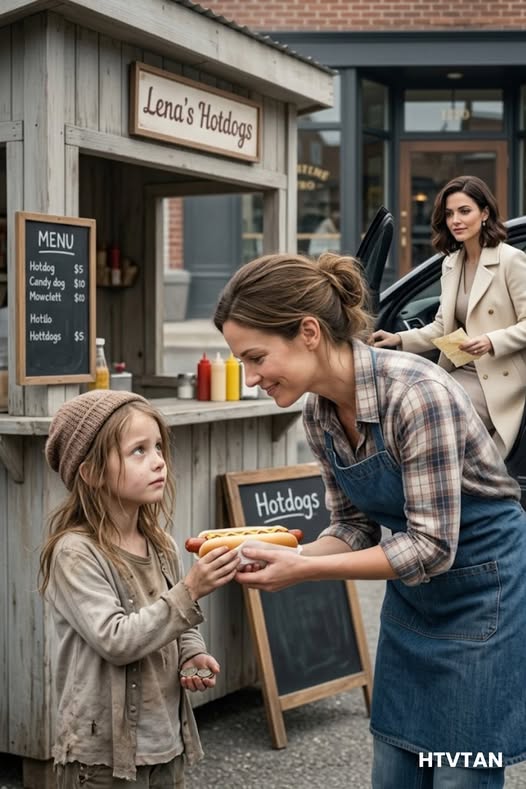
Lena turned back to the grill. Her movements became slower, more deliberate. She chose the best bun, not the one slightly split at the edge. She placed a hotdog into it, added mustard because mustard was free enough for mercy, tucked in a few onions because onions made things feel like a meal, and wrapped it carefully in paper. The businessman in the gray scarf said, “Excuse me, I ordered first.” Lena looked at him once, and something in her face made him take half a step back. She came around the cart, knees already stiff from cold, and knelt in front of the girl. The child looked frightened, as if kindness might disappear if she reached too quickly.
Lena held out the food. “This one is for you.”
The girl did not take it right away. Her eyes searched Lena’s face with the seriousness of someone trying to determine whether a cost would appear later. “Really?”
“Really.”
“But I can’t pay.”
“You already did.”
The girl looked down at her coins. Lena smiled gently. “You asked nicely. That counts today.”
The girl’s face broke. Not into joy. Not yet. First came disbelief, because hope had to push through caution. Then relief. Then tears. She took the hotdog with both hands and held it like something precious, not biting immediately, just holding warmth and proof. Before she ate, she looked up at Lena. “One day,” she whispered, “I will pay you back.”
Lena’s throat tightened. “You don’t have to, sweetheart.”
The girl shook her head, suddenly fierce in a way that made Lena’s heart ache. “I will.”
“What’s your name?”
“Emily.”
“Emily what?”
The child hesitated. “Just Emily.”
Lena did not push. Some children had names that hurt to say. Some had last names that changed with foster homes, shelters, temporary guardians, and adults who signed forms without remembering faces. Lena reached into her apron pocket and pulled out a napkin. Her pencil was dull, but it worked. She wrote carefully: Lena Morales. Hotdog Stand, 8th and Monroe. Then she folded the napkin once and handed it to the child. “If you ever need help again, you come here.”
Emily folded the napkin carefully and put it into the pocket of her thin dress as if it were a banknote, a photograph, a map. Then she took one small bite of the hotdog. Her eyes closed. For a moment, she was not a lost child, not a hungry child, not a problem people stepped around. She was just a child eating something warm.
Lena never forgot that look.
The day did not stop for sentiment. It never did. The businessman got his hotdog, though not with a smile. The morning rush pushed forward, impatient and hungry in its own less desperate way. Lena served office workers, cab drivers, delivery men, a woman carrying flowers, a construction crew, a student with paint on his sleeve, and an elderly man who bought one plain dog and ate it slowly on the corner. Her hands moved automatically. Bun, sausage, mustard, onions, paper, coins, change. But part of her remained kneeling on the sidewalk in front of Emily, watching the girl hold the food with reverence.
At noon, Mr. Bellucci came by. He appeared in his brown wool coat, hair slicked back, mouth already tight with suspicion. He had a habit of standing too close while he counted, as if proximity could force honesty. He opened the side compartment, checked buns, checked sausages, checked bills, checked his notebook, and frowned. “You short one.”
Lena wiped the counter. “Yes.”
“Dropped it?”
“No.”
“Customer didn’t pay?”
“Not exactly.”
His eyes narrowed. “Lena.”
“A child was hungry.”
Bellucci’s face hardened with the comfort of a man who had been waiting to prove a point. “Charity don’t pay cart fees.”
“I know.”
“Do you? Because every woman thinks she’s got a big heart until bills come due. You feed every hungry face in this city, you’ll be hungry beside them.”
“I fed one child.”
“You lost one sale.”
Lena looked him in the eye. “Then take it out of my pay.”
“I will.”
“I know.”
He stared at her for another second, annoyed perhaps that she had denied him the satisfaction of fear. Then he snapped his notebook shut. “You do it again, I find someone else to run this corner.”
After he left, Raul from the coffee cart across the street called over, “Not smart, Lena.”
She kept wiping the counter. “Maybe not.”
“You can’t save every kid.”
She looked at the sidewalk where Emily had stood. “No. But I can feed one.”
For the next few weeks, Lena watched the crowd for Emily. Every small brown-haired girl made her look twice. Every thin child near the corner tightened something inside her. She kept a wrapped hotdog near the warmer sometimes, telling herself it was for slow inventory, not hope. But Emily did not return. Not the next day. Not the next week. Not through the first hard frost, when puddles near the curb glazed over before sunrise. Not through November rain. Not through December, when Christmas lights were strung above the streets and made the city look kinder than it was.
Sometimes Lena wondered if the girl had found a shelter. Sometimes she feared worse. In the city, children could vanish without the city appearing to lose anything. Buildings stayed tall. Buses ran. Coffee was poured. Corners filled and emptied. Only certain people noticed absences, and Lena was one of them.
The hotdog was not a miracle in the sense people later tried to make it. It did not deliver Emily instantly into safety. It did not solve hunger, housing, loss, fear, or the thick web of systems a child falls into when the adults around her fail. That night, Emily slept in the back stairwell of a church because the shelter was full by the time she reached it. She ate half the hotdog before noon and saved the other half wrapped in paper until evening, though it had gone cold and hard by then. She kept touching the napkin in her pocket to make sure it remained there. Lena Morales. Hotdog Stand, 8th and Monroe. The words became the first address in the city that felt like it might belong to a person who would remember her.
Emily had once had a mother. Her name was Dana, and she had braided Emily’s hair when she was little enough to believe pain could always be kissed away. Dana had worked nights cleaning offices and days wherever she could find hours. She was not perfect, but she loved Emily with the exhausted devotion of a woman trying to outrun poverty with shoes that kept breaking. Then came illness. Then hospital bills. Then an apartment lost because rent did not care about pneumonia or fever. Then a man Dana trusted too soon because loneliness makes bad offers sound like rescue. Emily remembered yelling. Remembered hiding under a table. Remembered her mother crying while packing a plastic bag. Remembered a shelter cot and a nurse’s hand on her forehead. Then one winter morning, Dana did not wake up, and the city that had already taken everything else took her too.
After that, Emily belonged to paperwork.
There were shelters, emergency placements, foster homes that smelled of cigarettes, group homes with metal bunk beds, caseworkers who changed too often, schools where teachers mispronounced her last name until she stopped correcting them. Some adults were kind. Some were tired. Some wanted the check more than the child. Some used soft voices in front of visitors and sharp ones at night. Emily learned to pack quickly, hide food, read moods, keep her school papers in a plastic bag, and never get attached to a bedspread. The napkin moved with her. In a sock. In a book. Under a mattress. Inside a cracked pencil case. When someone stole her backpack in a group home at eleven, she fought a bigger girl over that napkin and earned a split lip. She told the staff it was because of homework. The truth was too precious to explain.
Lena did not know any of that. She only knew that once, a child had promised to pay her back, and then the child was gone.
Years passed.
Cities change slowly, then all at once. The buildings grew taller. The coffee shops became brighter. The old stores disappeared. The laundromat became a bank. The bank became a boutique selling candles that cost more than Lena used to spend on groceries. The corner pharmacy closed and reopened as a juice bar. The diner with cracked red stools became a glass-fronted café where people sat with laptops and spent seven dollars on toast. Rent rose. Customers changed. Some of the old morning regulars vanished into retirement, relocation, illness, or death. New ones came with earbuds and phones and no cash. The city updated parking meters, bus routes, payment systems, signage. But on the corner of 8th and Monroe, the hotdog stand remained. Lena remained too….