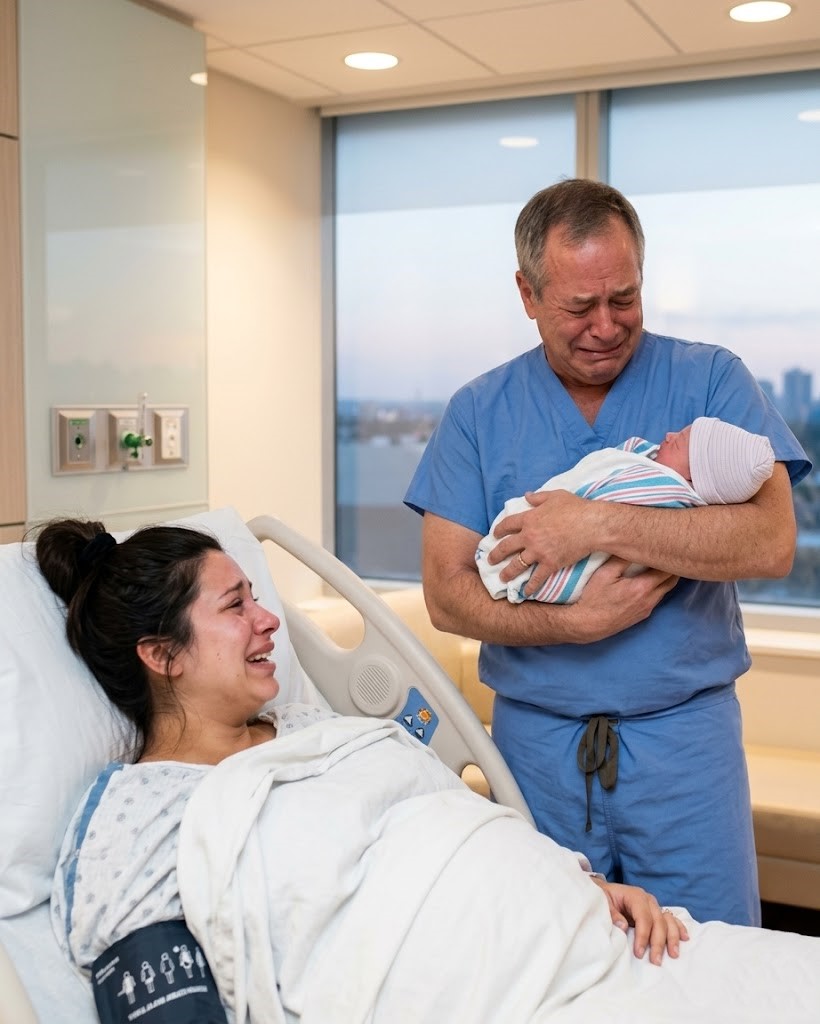
The morning Michael walked out of the clinic, he carried himself with the stiff, gingerly gait of a man who had just conquered his own biology. He had always been a man who liked control—of his finances, of his career as a structural engineer, and especially of our future. We had two beautiful children, a boy and a girl, and Michael had decided the “shop was closed.”
“That’s it,” he said as he buckled his seatbelt, wincing slightly. “No more scares. No more ‘what-ifs.’ We are back in the driver’s seat, Claire.”
I smiled and squeezed his hand. I believed him. He was a man of cold logic and precise measurements; if a doctor told him the pipes were cut and cauterized, then the pipes were cut and cauterized. I looked forward to a life where we didn’t have to worry about the chaos of a third child we hadn’t planned for.
How foolish I was.
Two months later, the world tilted on its axis. It started with a lingering nausea that I tried to blame on a stomach flu. But by the fourth day, when the smell of Michael’s morning coffee made me heave into the kitchen sink, a cold dread settled in my marrow.
I stood in the bathroom at six in the morning, the tiles cold beneath my bare feet. I held the plastic stick in my shaking hands. Two pink lines. Bold. Unapologetic. Defiant.
“No,” I whispered to the empty room. “This isn’t possible.”
I went back to the bedroom, my heart hammering a frantic rhythm against my ribs. Michael was propped up in bed, scrolling through his emails. He looked up, saw my face, and his brow furrowed.
“Claire? You look like you’ve seen a ghost.”
I didn’t speak. I simply held out the test.
The silence that followed was louder than any scream. Michael didn’t reach for it. He stared at the two lines as if they were a death warrant. When he finally looked up, the warmth I had known for a decade was gone. In its place was a crystalline, jagged ice.
“Who is he?” he asked. His voice was terrifyingly calm.
“What? Michael, no. There is no one. This… this must be a failure. The procedure—”
“The procedure was 100% successful,” he snapped, throwing the covers off and standing up. He seemed to tower over me, his face contorted with a sudden, violent loathing. “I had the follow-up, Claire. The count was zero. Zip. Nothing. You think I’m an idiot? You think I don’t know how biology works?”
“I haven’t been with anyone else!” I cried, the tears finally breaking. “I swear to you on our children’s lives!”
“Don’t you dare bring them into this,” he hissed. “You’ve spent the last ten years playing the perfect wife, and all the while, you were waiting for me to be ‘safe’ so you could bring your lover into our bed? Or were you just careless?”
Within an hour, he was packing a bag. He didn’t listen to my pleas. He didn’t care about the medical possibility of “recanalization”—the rare instance where the body heals itself and restores fertility. To Michael, the world was binary. Either he was sterile, or I was a liar.
He left that morning. By the end of the week, I learned through a mutual friend that he wasn’t just staying at a hotel. He had moved in with a woman from his office—a woman he had told me was “just a colleague” for months. The betrayal stung like acid; he had condemned me for an infidelity that didn’t exist while he had his escape plan already in motion.
The Silent Months
The next few months were a blur of gray. I was a single mother of two, working a full-time job, and carrying a “miracle” pregnancy that felt more like a curse. My friends stayed neutral or drifted away, poisoned by the rumors Michael was spreading about my “infidelity.”
He filed for divorce. He refused to attend any appointments. He sent cold, formal emails about child support, always ending with a demand for a paternity test the moment the child was born so he could “legally wash his hands of the intruder.”
I grew larger. My belly was abnormally big for being only twenty weeks along, but I attributed it to the stress and the late-night comfort eating.
Finally, the day of the anatomy scan arrived. I went alone. I sat in the waiting room surrounded by happy couples holding hands, feeling like a pariah. When the technician, a soft-spoken woman named Sarah, called my name, I felt a wave of nausea that had nothing to do with pregnancy.
“Okay, Claire,” Sarah said, squirted the cold gel onto my stomach. “Let’s see what’s going on in there.”
She moved the transducer across my belly. She was quiet for a long time. Too long. My heart began to race.
“Is something wrong? Is the baby… is it okay?”
Sarah didn’t answer immediately. She zoomed in, clicking the keys on her console. Then she paused and looked at me, her eyes wide.
“Claire… did you say your husband had a vasectomy?”
“Yes,” I whispered. “That’s why he left. He thinks I cheated.”
Sarah turned the monitor toward me. “Well,” she said, a small, stunned smile playing on her lips. “I think you need to call him. Because I don’t think any ‘lover’ could explain this.”
I looked at the screen. I saw a head. Then another. And then… another.
“Are those… twins?” I asked, breathless.
“No,” Sarah said, pointing to the flickering pulses on the screen. “One, two, three. Claire, you’re having triplets. But that’s not the shock.”
She zoomed in closer on the first baby’s face, then the second, then the third.
“Look at the bone structure, Claire. Look at the bridge of the nose and the jawline. Even at this stage, the fetal morphology is incredibly distinct.”
She pulled up a 3D render. I gasped. Even in the grainy, sepia-toned image, the resemblance was undeniable. They weren’t just babies. They were carbon copies of Michael. One of them had the exact, unique “V” shaped cleft in the chin that had been in Michael’s family for four generations—a trait so dominant it was practically a genetic signature.
But the real “shock” Sarah was referring to was something else.
“Claire,” she said, her voice dropping. “Look at the membrane. These are identical triplets. Spontaneous, identical triplets are a one-in-a-million occurrence. For this to happen after a vasectomy… it’s not just a medical failure. It’s a biological explosion. When his body tried to heal, it didn’t just reconnect. It surged.”
The Confrontation
I didn’t call Michael. I sent him an image of the 3D scan with a single note: “The ‘intruder’ has your chin. All three of them do.”
An hour later, my phone exploded. He wanted to meet. He was “confused.” He was “sorry for the misunderstanding.”
I met him in a park, far away from the home he had abandoned. He looked haggard, the guilt finally catching up to his logic. The woman from his office was nowhere to be seen—apparently, the reality of three more children wasn’t part of her “office romance” fantasy.
“Claire, I… the doctor said it was impossible,” he stammered, staring at my protruding stomach.
“Nothing is impossible, Michael,” I said, my voice cold and steady. “You chose a lab result over ten years of marriage. You chose a colleague over the mother of your children. You didn’t just miss the pregnancy; you missed the point of being a partner.”
“I want to come home,” he whispered. “I’ll help. I’ll make it right.”
I looked at him—really looked at him—and realized that the “shock” of the ultrasound hadn’t just been the triplets. It was the realization that I was stronger than I had ever been.
“You can be a father to these children, Michael. We’ll do the DNA tests you wanted so badly, just so the record is clean. But you aren’t coming home.”
The biggest shock wasn’t the three lives growing inside me. It was the fact that for the first time in my life, I didn’t need his permission to be happy.
I walked away, leaving him on that park bench, finally realizing that while he had been worried about his “ego” being intact, he had lost the only thing that actually mattered.
I was going to have three more “miracles.” And I was going to raise them to be men who knew that trust was worth more than any surgery.