And I understood that he had seen me.
He hadn’t just noticed me in the periphery. He had seen me.
He had seen his mother standing flush against the cold cinderblock wall while complete strangers occupied the premium seat he had specifically saved for me. He had seen his father, David, sitting in the very center of the first row like a proud, conquering king. He had seen Chloe, the new, perfectly polished wife, smiling brightly from a place that was never, ever hers to take.
And my Michael did not smile back.
My older sister, Claire, stood beside me, gripping a massive bouquet of vibrant sunflowers so fiercely that I heard a thick green stem audibly snap in her hands.
“I told you,” Claire whispered, her voice trembling with a potent cocktail of grief and rage. “He didn’t know. He didn’t know they did this to you.”
I could not answer her. My throat felt as though it had been packed with dry sand.
Up at the wooden podium, the principal, Dr. Wallace, continued speaking, her voice warm, measured, and heavily practiced. She spoke eloquently about achievement, about teenage resilience, about community, and most painfully, about the devoted families who had helped the Class of 2026 reach this momentous stage.
Families who helped.
Each syllable felt like a physical hand pressing down hard on the center of my chest. I stared blankly at the back of David’s perfectly groomed head, a hundred feet away.
For twelve long, agonizing years following our divorce, David Vance had been a father mostly in photographs. He was a master of the easy moments. He appeared magically for school award ceremonies where cameras were flashing; he arranged birthday lunches at obscenely expensive steakhouses; he showed up for the graduation suit fitting because it was a moment where he could loudly pay for something visible.
But David missed the grueling nights of 103-degree fevers. He missed the desperate tears over AP Calculus homework at 2:00 AM. He missed the quiet panic of broken sneakers two weeks before payday, the terrifying months where the rent was agonizingly short, the suffocating anxiety of the college application process, and the gray, early mornings when Michael would sit at the kitchen table, pretending not to hear me quietly weeping over a stack of past-due bills in the next room.
David knew exactly how to show up when applause was readily available.
I knew how to stay when absolutely nobody was watching.
And Chloe? Chloe knew only how to occupy space. She sat in the first row right now, her long legs elegantly crossed, one manicured hand resting possessively, territoriality on David’s suit sleeve. Every few minutes, she would casually glance over her shoulder toward the back of the auditorium, scanning the shadows beneath the exit sign, as if routinely checking to ensure I had remembered my designated place. Beside her sat her mother, her cousin, and two men in business suits I had never seen before in my life. They were all snapping photos on the latest smartphones, acting as though they had personally earned the right to frame my son’s future.
Claire leaned closer, her shoulder brushing mine. “I’m going to walk down there. I’m going to say something, Sarah.”
“No,” I managed to choke out.
“Sarah, she literally peeled your name—”
“No,” I whispered harsher this time, though my entire body was shaking. “Not today. Do not ruin this. Let him have his day.”
Claire’s eyes filled with hot, angry tears. “This is his day entirely because of you.”
I looked back at the stage, at the sea of blue caps. “I know.”
But knowing the truth did not make the humiliation burn any less.
This school was one of the most elite private high schools in Northern Virginia, the kind of institution with towering stone columns, manicured emerald lawns, and wealthy parents who casually discussed Ivy League admissions the way other people discussed the weather. Michael had earned a nearly full academic scholarship after scoring in the top one percent on his entrance exam four years ago.
I had covered the remaining, terrifyingly large gap by working grueling double shifts at a crowded community medical clinic in Arlington. I cleaned exam rooms, I managed chaotic patient files, I translated medical jargon for terrified Spanish-speaking families, and when that wasn’t enough, I sat up until 3:00 AM sewing alterations for neighbors who paid me in crumpled cash.
I had never told Michael how dangerously close we came to losing his spot during his sophomore year when my car transmission died.
He had found out anyway.
One rainy Tuesday night, when he was sixteen, he walked into the kitchen and quietly placed a folded, slightly damp envelope beside my lukewarm coffee. Inside was $312 in small bills. He had earned it secretly tutoring younger students in geometry.
“For tuition,” he had said, looking at the floor.
I had cried so hard that night I actually had to sit down on the linoleum. Mijo, that is not your job, I had told him, my heart breaking. He just hugged me from behind, his chin resting on my tired shoulder, and whispered, Then let me help with our dream.
Our dream.
That was exactly what this graduation was supposed to be. The culmination of a thousand silent sacrifices. It was not supposed to be David’s curated photo opportunity. It was not supposed to be Chloe’s high-society performance.
The ceremony dragged forward. Departmental scholarships were announced. Honors students were recognized to polite clapping. The wealthy parents cheered, whistled, and proudly waved glossy programs in the air. I stood at the very back, the arches of my feet throbbing in cheap heels, wearing a smile that I held together with nothing but sheer, desperate willpower.
Then, Dr. Wallace stepped back to the microphone, adjusting her glasses.
“And now,” she said, her voice echoing through the massive room, “it is my distinct honor to introduce the Class of 2026 Valedictorian, and the recipient of the Sterling Leadership Award… Michael Angel Evans.”
The auditorium erupted.
My knees gave out. I slammed my hand against the cinderblock wall to keep from collapsing.
Valedictorian? I knew he had earned high honors. I knew he had worked himself to the bone. But he had not told me he was the valedictorian. When he left the apartment this morning, adjusting his tie in the hallway mirror, he had only hugged me tightly and said, Mom, please just make sure you’re near the front when I walk.
Claire grabbed my arm, her nails digging into my sleeve. “Valedictorian?” she gasped, weeping openly now. “That beautiful boy hid this from you?”
My tears finally spilled, hot and fast, ruining the cheap makeup I had carefully applied at dawn.
Up on the brightly lit stage, Michael rose from the front row of students.
Down in the audience, David stood up first. He was clapping loudly, turning halfway toward the crowd behind him, absorbing the applause as if it were partially meant for him. Chloe stood too, smiling a wide, blinding, camera-ready smile, lifting her phone high to record. Her mother wiped theatrical, fake tears from her cheeks. The two strange men clapped like associates closing a lucrative corporate merger.
Michael did not look at any of them.
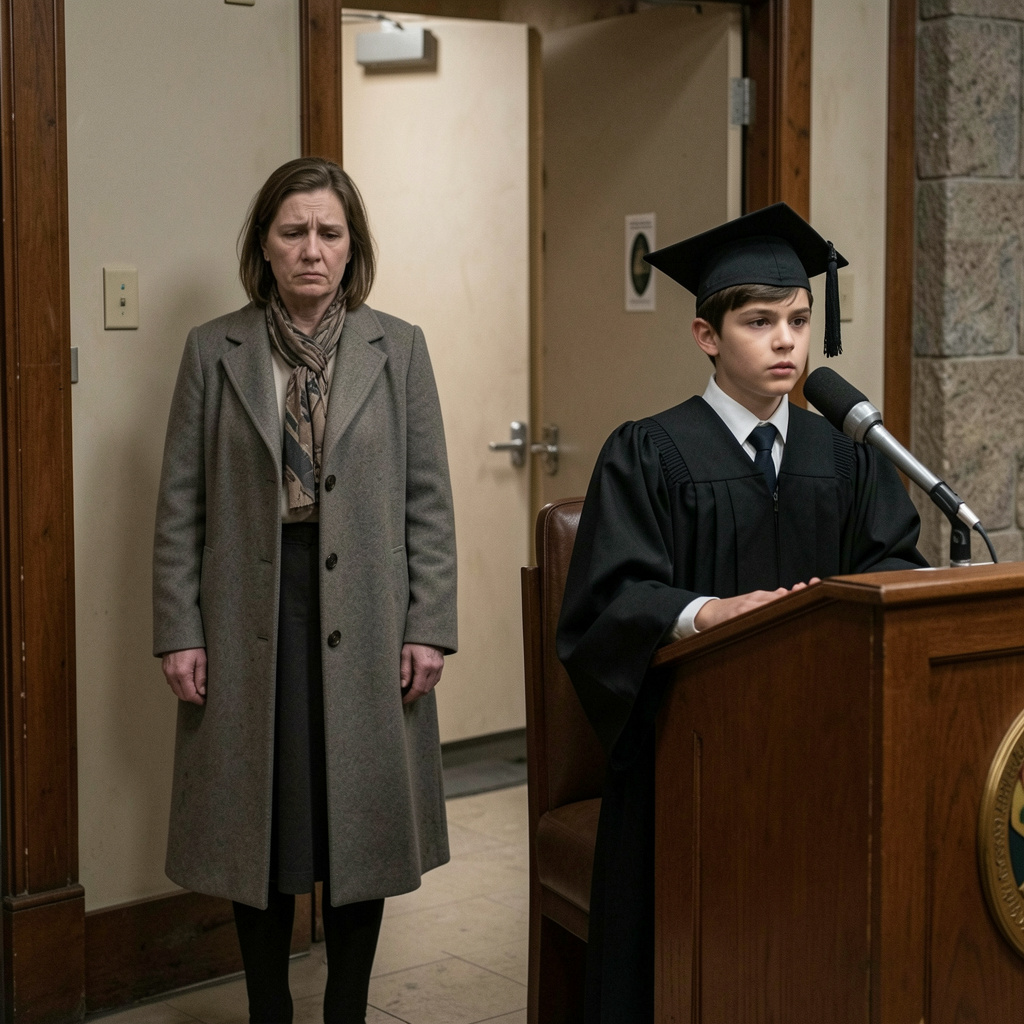
He walked slowly to the wooden podium. He placed both of his hands firmly on the outer edges of the wood, anchoring himself, and waited in absolute silence for the applause to fade.
He looked so incredibly old in that moment. It wasn’t the blue cap and gown. It was the fact that pain and realization had sharply chiseled his features. His dark eyes moved methodically across the massive auditorium, scanning over the heads of the wealthy, the entitled, the comfortable.
He scanned until his eyes reached the back wall.
Until they found me, standing in the shadows under the red light.
For one agonizingly long second, the entire room full of a thousand people seemed to evaporate. There was only the mother who had given everything, and the son who had finally realized the exact cost.
Then, Michael looked down at his printed speech resting on the podium.
He did not begin reading.
Slowly, deliberately, he folded the thick paper in half. Then he folded it again.
He slid it into the pocket of his gown.
A nervous, confused murmur rippled through the rows of faculty seated behind the podium. Dr. Wallace smiled politely, though her eyes darted with sudden uncertainty.
Michael reached out and adjusted the microphone, pulling it closer. A sharp screech of feedback pierced the air, silencing the room instantly.
“I had a speech prepared for today,” Michael began, his voice surprisingly deep, steady, and devoid of the typical teenage tremble. “It was exactly what you would expect. It was about perseverance, about gratitude, about looking toward the bright future. I think it had three mild jokes, two inspirational quotes from dead presidents, and a very solid paragraph about how proud we all should be of ourselves.”
Soft, relieved laughter moved through the room. They thought it was a rhetorical pivot.
Michael smiled, but it was a faint, cold thing. “But something happened this morning. And as I sat there watching the audience fill up, I realized I absolutely cannot give the speech I wrote.”
I stopped breathing entirely. My chest froze.
In the front row, David’s broad shoulders stiffened. Chloe slowly lowered her phone a few inches, her perfectly arched eyebrows drawing together in confusion.
Michael continued, his voice echoing off the high, vaulted ceiling.
“When I was a little kid, I used to think heroes were supposed to wear uniforms. You know the ones. Firefighters covered in soot. Soldiers in camouflage. Surgeons in pristine scrubs. I thought heroes were the people who ran toward the danger while everyone else had the luxury of running away.”
He paused, letting the silence hang heavy in the air.
“Then I grew up,” he said softly. “And I realized that the real heroes in this world don’t get medals. Some heroes wear faded clinic scrubs that always smell faintly of bleach and have old coffee stains on the pockets. Some heroes come home at midnight, their feet bleeding from standing for fourteen hours, take off their shoes at the door in the dark, and still walk into your bedroom to ask if you need help with your history homework.”
The auditorium grew uncomfortably quiet. The polite shifting in seats ceased.
“Some heroes,” Michael’s voice cracked slightly, but he forced it to hold, “skip dinner. They push their plate away and smile, claiming they already ate at work, just so there is enough food for the child sitting across the table.”
I pressed both of my hands over my mouth, suppressing a sob that threatened to tear me apart. Beside me, Claire was crying so hard she was shaking against the wall.
Michael lifted his head and looked past the sea of faces, directly toward the back exit again.
“My hero,” he said, his voice ringing with absolute, unyielding clarity, “is currently standing in the shadows under the exit sign at the back of this room. She is standing there because someone with money and audacity told her she did not belong in the front row.”
A collective, sharp gasp moved through the auditorium like a sudden gust of wind.
Down in the first row, David slowly sank into his seat as if his legs had been cut from beneath him. Chloe’s face went chalk-white, the color draining from her lips.
Michael’s voice did not rise to a shout. He didn’t need to. The quiet rage in it made it ten times stronger.
“My mother, Sarah Evans, worked double shifts for ten years so I could stand on this stage today. She cleaned infectious clinic rooms, she translated complex medical forms for terrified immigrants, she sewed hems on rich kids’ uniforms late at night, she packed my lunches, she held me when I thought I was breaking, and she never, ever let me believe that a lack of money decided my worth as a human being.”
He gripped the podium, leaning forward. “She did not have a front-row life. But she bled to build one for me anyway.”
The first person to stand up was an elderly English teacher seated near the center aisle. She stood up slowly, deliberately, wiping her eyes behind her spectacles.
Then another teacher stood.
Then an entire row of graduating students in their blue gowns rose to their feet.
Then the parents.
The sound began softly, like the first heavy drops of a summer storm hitting a tin roof. Applause.
Michael held up one hand, palm out, not to stop the applause completely, but to ask the room for just one more sentence. The room instantly quieted, hanging on his every breath.
He looked directly at me, tears finally spilling over his dark eyelashes, tracing lines down his cheeks.
“So, if my mother is standing in the back of this auditorium,” Michael said, his voice breaking with fierce pride, “then the back is where the most important person in this room currently is.”
For the span of a single heartbeat, there was profound silence.
And then, the entire auditorium stood up.
It wasn’t a polite smattering. It wasn’t half the room. It was everyone. The applause exploded, thundering against the stone walls with a physical force. Hundreds of students turned completely around in their chairs to look at the back wall. Teachers clapped with tears streaming down their faces. Wealthy parents, strangers who had never known my name or my struggle, wiped their eyes and cheered.
Even the young, overwhelmed student usher who had nervously sent me to the back wall an hour ago stood frozen by the door, looking deeply ashamed, clapping slowly as if trying to apologize with his hands.
I was paralyzed. I couldn’t move. I couldn’t breathe.
Claire roughly shoved the heavy bouquet of sunflowers into my chest. “Stand up straight, Sarah!” she yelled over the deafening roar of the crowd. “Let them see you! Don’t you dare hide!”
I was already standing, but I understood what she meant. I pulled my shoulders back. I lifted my chin out of the shadows. I let the red light fall on my face.
The applause swelled even louder.
On the stage, Michael took a step back from the podium. Dr. Wallace immediately rushed over to him, leaning in and whispering something frantically in his ear, likely trying to save the schedule of the ceremony.
Michael listened, nodded exactly once, and then stepped right back to the microphone.
“Dr. Wallace,” Michael said, his voice amplified over the still-standing crowd, “with all due respect to this institution… I absolutely cannot, and will not, accept my diploma until my mother is seated in the exact chair I reserved for her.”
The room erupted into absolute chaos.
Down in the front row, David shot up halfway out of his chair, his face burning a dark, humiliating crimson. Chloe frantically grabbed his wrist, hissing loudly enough for the second row to hear, “David, do something! Stop him!”
But the trap had been sprung, and there was absolutely nothing left for David Vance to do.
Dr. Wallace, visibly shaken and realizing she was losing control of the largest event of the year, approached the primary microphone.
“Mrs. Evans,” the principal called out, raising a hand to shield her eyes from the stage lights as she scanned the back wall. “Mrs. Evans, please… please come forward.”
My immediate instinct was to shake my head. No. No, I couldn’t do this. Not in front of thousands of people. I had spent twelve years making myself intentionally small to avoid trouble. I had spent a decade swallowing bitter humiliation so Michael could keep the fragile peace with a father who appeared just often enough to keep the boy utterly confused. I had told myself, every single day, that true dignity meant silent endurance.
But my son was waiting.
My beautiful, brilliant boy was standing on a stage, holding the entire ceremony hostage, refusing the culmination of his life’s work until the world properly acknowledged his mother.
Claire grabbed my free hand, her grip like iron. “Walk, Sarah. You walk down there right now.”
I took a breath that filled my lungs for the first time in years. And I walked.
The center aisle felt three miles long. As I passed, people turned to look at me. Some smiled with gentle, profound respect. Some were openly weeping. A few of the parents sitting near the front looked actively embarrassed, realizing they had witnessed my quiet humiliation earlier and had done absolutely nothing to intervene.
The young usher near the middle section stepped aside, bowing his head slightly. “I am so sorry, ma’am,” he whispered as I passed.
I did not stop. I kept my eyes locked on the front row.
When I reached the very front, Chloe remained firmly seated. She was stiff as a marble statue, her arms crossed defensively over her chest.
I stopped right beside her chair.
The seat closest to the aisle—the best seat in the house—still had a small, white piece of cardstock violently ripped near the top. Someone had desperately tried to peel the reservation card off, but the heavy adhesive had held, and the bottom half of the printed name remained perfectly legible:
Sarah Evans.
I looked down at the torn card. Then, I slowly shifted my gaze to Chloe.
Chloe’s mouth tightened into a thin, furious line. She looked at me with pure venom. “This is entirely ridiculous. You are ruining his graduation for a petty stunt.”
Claire, who had marched down the aisle right behind me like a bodyguard, leaned over my shoulder. “Move,” my sister said. The word was low, guttural, and carried a promise of absolute violence if ignored.
Chloe’s eyes darted to David, silently pleading for him to use his money, his influence, his loud, booming voice to save her.
David stared resolutely at the hardwood floor between his expensive leather shoes.
For the second time that morning, David Vance failed to defend anyone but his own fragile ego. But this time, his cowardice was going to cost him everything.
Dr. Wallace actually stepped down from the elevated stage, her heels clicking sharply against the wood. Her expression was highly controlled, but her tone was absolute ice.
“Mrs. Vance,” the principal said, looking directly at Chloe. “That seat was officially reserved by the valedictorian specifically for his mother. You bypassed the ushers. You need to vacate the seat immediately.”
Chloe’s face flushed an ugly, mottled red. “There… there must have been a clerical misunderstanding at the office—”
“There wasn’t,” Michael’s voice boomed through the speakers.
He was still standing at the microphone. The entire auditorium heard him shut her down.
Chloe rose from the chair. She moved slowly, her humiliation a physical weight. Her mother hastily rose next. Then her cousin. The two men in business suits gathered their phones and glossy programs, averting their eyes, trying desperately to look like they had an urgent meeting to attend elsewhere.
David remained seated for one frozen, agonizing moment. He finally looked up, directly at his son on the stage.
“Dad,” Michael said into the microphone, his voice devoid of any warmth. “You can sit wherever you want in this building. But that specific seat was never yours to give away to someone else.”
A strange sound moved through the massive room. It wasn’t quite a gasp. It wasn’t applause. It was something much sharper, much more dangerous. It was the collective realization of the unvarnished truth.
David stood up. His face was a sickly, ashen gray.
He looked at me, his eyes pleading, silently asking me to rescue him from this public execution. Once upon a time, the old Sarah might have done it. The old Sarah might have forced a tight smile, whispered, It’s fine, David, really, and allowed everyone to pretend his cruelty had just been a silly, innocent mistake.
Not today. Today, the old Sarah was dead.
I sat down in the first row.
Claire sat heavily in the seat right beside me, holding the massive bouquet of sunflowers upright like a golden flag of victory.
David and his entourage were forced to take the walk of shame, moving to a side section of folding chairs three rows back. It wasn’t the back wall beneath the exit sign—that would have been too poetic—but it was far enough away that every single person in the room understood that the map of power had permanently changed.
Up on the stage, Michael finally stepped back to the podium. He looked instantly lighter, calmer. The sharp anger had evaporated, replaced by a radiant peace.
“Thank you,” he said simply.
The room laughed softly, a wet, emotional sound.
And then, he gave his speech. Not the one he had prepared with quotes from presidents. He gave the real one.
He spoke passionately about the teenagers who worked the drive-thru after school to pay for textbooks. He spoke of the immigrant parents who packed cheap lunches before dawn. He honored the exhausted grandparents who were raising children for a second time because the world had broken their own kids. He acknowledged the invisible janitors who unlocked the school before the sun rose. He spoke of success not as a solitary climb to a mountain peak, but as the undeniable evidence of a hundred invisible, calloused hands pushing you upward.
“Every single diploma handed out on this stage today has names written on it in invisible ink,” Michael said, looking right at me. “Mine has my mother’s name etched onto every single corner.”
I covered my face, sobbing freely. Claire rubbed my shaking shoulders.
Then, Michael delivered the final line, the one that would ensure nobody in that school would ever forget his name.
“I am graduating as valedictorian today,” he said, “because my mother stood in every dark, forgotten place life violently pushed her into… and then she made that place holy.”
This time, even the stoic Dr. Wallace was crying as she handed him his leather-bound diploma.
When Michael finally received the heavy folder, he did not turn first toward the official school photographer waiting at the edge of the stage. He turned directly toward the front row. Toward me.
He lifted the diploma high into the air with both hands.
For you, Mom, he mouthed over the noise.
I broke then. Not gracefully. Not with elegant, cinematic tears. I cried the ugly, heaving way mothers cry when eighteen years of sheer terror, bone-deep exhaustion, fierce pride, and overwhelming love finally find an exit wound.
After the endless ceremony concluded, the auditorium devolved into a chaotic sea of rushing families, drifting Mylar balloons, flashing cameras, and joyous shouting. I stayed seated in the front row for a long time because my legs felt completely numb.
Claire leaned close, wiping her ruined mascara. “You know this whole thing is going to be everywhere on the internet by noon, right?”
“What are you talking about?”
Claire tilted her head toward the dispersing crowd. “Look at the phones, Sarah. Half the room was recording. This is going viral.”
She was right. Within minutes, fragmented clips were already circulating wildly through private parent group chats and local community Facebook pages.
But in that exact moment, I didn’t care about the internet. I only saw Michael pushing his way through the crowd, running down the center aisle toward me.
He was so tall now—taller than David, broader than the little boy I still carried in my memory. But when he finally reached the front row, he folded his large frame into my arms, burying his face in my neck as if he were six years old again, waking up from a nightmare.
“I’m so sorry,” he whispered fiercely into my hair.
I held him so tightly the sunflower stems bruised my forearms. “No, baby. No. You did absolutely nothing wrong.”
“I told them, Mom. I sent Dad the exact seat numbers. I explicitly told him those seats were for you and Aunt Claire.”
“I know, honey.”
“I didn’t know she would actually take them—”
“I know.”
His broad shoulders shook against me. I pulled back, gripping his handsome face in both of my hands, forcing him to look at me.
“Look at me, Michael. This is your day. Do not let them steal the joy of it.”
He shook his head stubbornly. “No. It’s ours.”
Before I could reply, a shadow fell over us.
David had arrived. He approached slowly, cautiously, with Chloe lagging a few feet behind him. Her face was pulled tight with absolute, unadulterated humiliation. The other families lingering nearby immediately grew quiet, their eyes darting over. A few teenagers brazenly held their phones up, openly recording the confrontation.
“Michael,” David said, forcing a calm, authoritative tone he hadn’t earned. “Can we speak privately for a moment?”
Michael slowly turned around.
For years, I had watched my son soften around his father. He had wanted so desperately to be chosen by David that even the pathetic crumbs of affection had looked like a feast. But something fundamental had snapped on that stage. Michael had finally seen the brutal arrangement clearly: David wanted all the glory of fatherhood without paying a single cent of the loyalty it cost.
“There’s absolutely nothing private about what just happened in there,” Michael said, his voice hard.
David flinched.
Chloe stepped forward, attempting a sickly sweet, maternal voice. “Michael, sweetheart, everyone’s emotions are just running so high today. I was honestly only trying to avoid any awkward tension for you—”
Michael cut her off with a look so sharp she stepped back. “You created the tension, Chloe.”
Her jaw dropped. Nothing came out.
David tried again, adopting the wounded victim routine. “Son, be reasonable. I didn’t know she moved your mother.”
Michael stared at him, unblinking. “Yes, Dad. You did.”
David’s face hardened, the veneer cracking. “Careful how you speak to me, Michael.”
The old, conditioned fear rose in my chest automatically, a ghost from my marriage. I stepped forward to intervene, to shield my son.
But Michael didn’t need a shield anymore.
“No,” Michael said, stepping closer to his father. “You need to be careful. Because I am officially done pretending not to notice things just so you don’t have to feel guilty about abandoning us.”
The sentence struck David physically. He took a half-step backward.
For twelve years, David had survived solely by relying on Michael’s innate kindness. Children of bitter divorce often become emotional accountants, carefully balancing two separate households, two conflicting versions of the truth, heavily subsidizing the adults’ fragile egos. Michael had been generous enough to give his father every possible chance to become a better man.
David had fatally mistaken that generosity for blindness.
Michael lowered his voice, making it far more lethal. “Mom never told me the worst things about you. She could have destroyed you to me. She didn’t. She told me you loved me in your own flawed way. She saved every single cheap birthday card you mailed two weeks late. She made elaborate excuses when you forgot my championship games. She broke her back so I wouldn’t have to hate you.”
David’s eyes flicked nervously toward me. Real, profound shame finally moved across his features.
Michael leaned in. “And today, your reward for her grace was letting your new wife publicly humiliate her in front of a thousand people.”
Chloe snapped, unable to help herself. “I did not humiliate anyone! Your mother was being incredibly difficult and dramatic!”
Michael looked at her with a terrifying, icy detachment. “My mother walked to the back of the room so my graduation wouldn’t devolve into your tacky performance. That is called dignity, Chloe. I wouldn’t expect you to recognize it.”
A woman standing ten feet away actually gasped out loud. Claire whispered a fervent, “Amen.”
David’s voice dropped to a desperate plea. “Michael, please. Enough.”
“No,” Michael said, stepping back, putting physical distance between them. “I think it’s finally enough for you.”
The father and son stared at each other across the divide.
Then, Michael delivered the final blow—a cliffhanger to a relationship that had been dying for a decade. He turned his back on David completely.
“Mom,” Michael said, his voice instantly softening as he looked at me. “Can we go take some pictures outside?”
I nodded, wiping a fresh tear from my cheek. “Yes, baby. Let’s go.”
We walked right past David and Chloe without a single backward glance.
Out in the blinding, beautiful sunlight, students were posing by the stone fountain. Parents were adjusting caps and shouting names. A massive group of Michael’s classmates rushed over immediately, swarming him.
“Dude, your speech was absolutely insane!” one boy yelled, high-fiving him.
“Your mom is literally famous now,” a girl laughed, showing me a screen with thousands of likes.
We moved to the old oak trees for photos. Claire took a hundred pictures, crying in every single one. Then, Michael shooed everyone away and insisted on one photo with just me.
He unzipped the leather diploma cover and placed the heavy, embossed paper directly into my hands.
“Hold it for the picture,” he insisted.
“No, mijo, this is yours.”
“Mom,” he said, his eyes intense. “Look at it.”
I looked down at the heavy parchment. I expected to see Michael Angel Vance.
Instead, printed in elegant, sweeping black calligraphy, was the name:
Michael Angel Evans.
My maiden name. My family. My blood.
I traced the raised ink with my thumb, my breath catching in my throat.
“I filed the paperwork with the front office months ago,” Michael whispered, leaning his forehead against mine as the camera clicked. “Legally, it’s hyphenated for now. But socially, and on this stage… I am an Evans. Dad gave me a last name, Mom. But you gave me a life.”
Behind us, a shadow shifted on the grass.
David had followed us out. He had heard every word. He stood ten feet away, staring at the diploma in my hands, looking like a man who had just realized his house had burned to the ground with everything he owned inside.
He pulled his phone from his pocket, his hands shaking, and began typing furiously.
A second later, Michael’s phone buzzed in his pocket.
We didn’t go to a fancy steakhouse for lunch. We went to a tiny, crowded Salvadoran restaurant in Arlington. The owner, Rosa, brought out an enormous plate of steaming pupusas and curtido on the house, weeping when she saw Michael’s cap and gown.
I sat across from my son at a table covered in sticky plastic, still wearing my clearance blue dress. For an hour, we were overwhelmingly happy.
Then, Michael checked his phone. The joy drained from his eyes. He slid the phone across the table. It was a text from David.
You completely embarrassed me and devastated Chloe. I expect a public apology by tonight, or you can forget about the Georgetown tuition supplement. Think carefully.
Claire read it over my shoulder and scoffed. “He’s trying to buy his way out.”
Michael didn’t shake. He looked exhausted, but resolute. His thumbs flew across the screen. He hit send, then turned the phone off.
“What did you say?” I asked.
“I told him the truth,” Michael said. “I said: Keep the money. Mom and I already figured out how to pay for my life without you. Don’t contact me until you figure out how to be a father instead of a bank.”
The fallout over the next two weeks was apocalyptic. The video of Michael’s speech exploded, amassing millions of views. David attempted desperate damage control, posting a manicured statement about a “regrettable seating misunderstanding.” The internet tore him to shreds. Classmates flooded the comments calling out his lies. David deleted the post, and Chloe deactivated her accounts, disappearing from her country club circuit.
The school was mortified. Dr. Wallace called me personally, offering a sincere apology. She invited me to the end-of-year Senior Awards Reception. When I walked into the auditorium that night, the exact center seat in the front row had a heavy, laminated sign physically zip-tied to the wood: Reserved for Mrs. Sarah Evans. Nobody dared look at me wrong.
In August, the time finally came for Michael to leave. I helped him pack his duffel bags, hiding my tears between stacks of fresh towels. When we stood in the hallway of his cramped Georgetown dorm room, the reality hit me. My job was done.
Michael hugged me so tightly my ribs ached. “You’re going to be okay, Mom,” he whispered.
“I’m the mother,” I sobbed. “I’m supposed to say that to you.”
“We can both say it,” he replied, kissing my forehead. “Go home. Go rest. It’s your turn now.”
It took a few months of living in the deafening quiet of my apartment to figure out what “my turn” actually meant. But when I remembered the feeling of standing in the back of that auditorium, I finally knew. At forty-two, I filled out the FAFSA and enrolled in the accelerated nursing program.
Two grueling years later, I stood in a different auditorium, wearing a crisp, white uniform. My feet ached from walking hospital floors, not from cleaning them.
When my name was called—Sarah Evans, Licensed Practical Nurse—I walked across the brightly lit stage. I didn’t look at the back wall. I looked directly down at the absolute center of the very front row.
Michael was sitting there, wearing a sharp suit, cheering louder than anyone. Taped to his chair was a paper he had printed himself: Reserved for Michael Evans, Proud Son of the Front Row.
I lifted my certificate high. I looked right at the boy who taught me how to stop hiding.
For you, I mouthed.
He shook his head, pressing a hand to his chest. For us, he mouthed back.