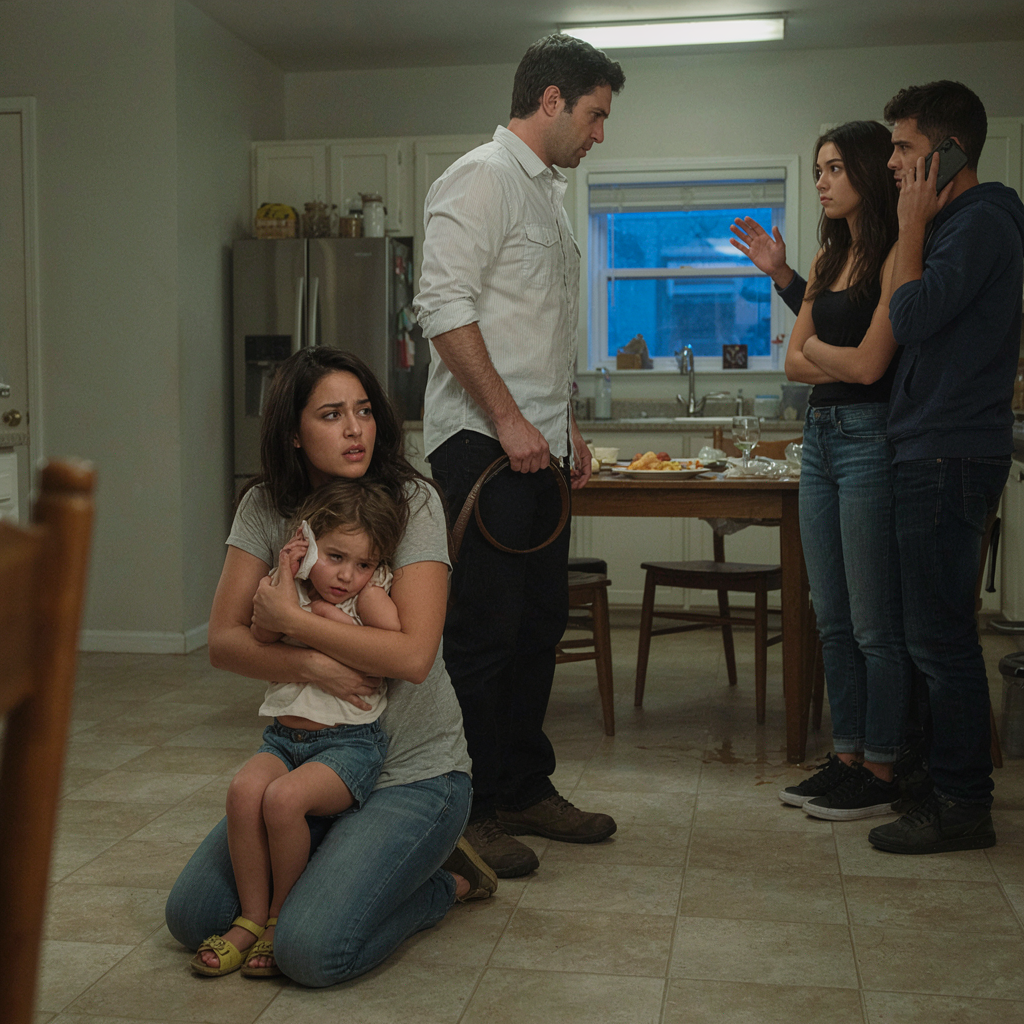
My father yanked off his belt to punish my three-year-old daughter, Camila, over a soda.As I cradled her after she slammed onto the kitchen tile, my mother looked at us and said, “She had it coming.”
Camila’s yellow sandal had slipped on a wet spot while she tried to run from him, and the crack of her head against the floor silenced the band outside.
I pressed a napkin to her injury and begged, “Cami, sweetheart, please look at Mommy. I’m here.”
My father still held the belt.My sister said someone had to teach Camila respect.
Then Diego stepped between my father and me, phone still pressed to his ear.“Police are on their way,” he said.The kitchen went completely silent.My father lowered the belt.
“What did you just say?”Diego looked directly at him.“I said the police are coming.”
My mother stood so quickly that her chair scraped against the floor.
“Diego, don’t you dare.”He didn’t move.
My daughter whimpered against my chest.
I could feel her little fingers clutching my shirt.
“Mommy…”“I’m here,” I whispered. “I’m right here.”
Her forehead was already swelling.
I looked down at her yellow sandal lying several feet away.
Then I looked at my father.
For the first time in my life, I wasn’t afraid of him.
I was furious.
And what happened next would uncover a family secret that had been buried for almost thirty years.
My name is Elena.
I was thirty-one years old, and Camila was the center of my entire world.
Her father, my ex-husband, had left before she was born.
He sent money occasionally, called even less frequently, and had convinced himself that being a distant father was somehow better than being an involved one.
So when my parents offered to let Camila and me stay in their house temporarily, I accepted.
It was supposed to be temporary.
Three months.
Maybe four.
I had recently started working full-time at a medical billing company, and I was saving enough to rent a small apartment.
My parents insisted I shouldn’t rush.
“Family takes care of family,” my mother had said.
I believed her.
That was my first mistake.
The second was believing that my father had changed.
He hadn’t.
He was sixty-two and had spent his entire life believing children needed fear more than affection.
When I was growing up, he had never hit me often.
He didn’t have to.
His voice was enough.
One look from him could make me drop a glass.
One raised eyebrow could make me apologize for something I hadn’t done.
He called it discipline.
I called it survival.
But Camila was different.
She was loud.
Curious.
Stubborn.
She asked questions constantly.
Why is the moon following us?
Why can’t dogs talk?
Why does Grandpa yell?
Why does Grandma cry in the laundry room?
That last question had made me uncomfortable.
Because I’d noticed it too.
My mother had become strangely quiet since we’d moved back.
She would sometimes disappear into the laundry room for ten or fifteen minutes.
When she came out, her eyes were red.
Whenever I asked what was wrong, she’d smile.
“Nothing, sweetheart.”
I never pushed.
Until the night of the belt.
The evening had started beautifully.
My parents were celebrating their wedding anniversary.
They had invited neighbors, relatives, and a few old friends.
There were string lights across the backyard.
Someone had hired a small band.
Food covered every table.
Camila wore a little blue dress and her favorite yellow sandals.
She danced between the adults while music played.
I remember looking at her and thinking how happy she seemed.
Then she asked for soda.
I poured a small amount into a plastic cup.
“Slowly,” I told her.
She nodded.
Five minutes later, the cup slipped from her hands.
Soda spilled across the kitchen floor.
It wasn’t much.
Maybe half a cup.
I immediately grabbed a towel.
“It’s okay, baby. Accidents happen.”
But my father had seen it.
He came storming into the kitchen.
“Who did that?”
Camila froze.
I stepped in front of her.
“She dropped her drink. I’ll clean it.”
My father pointed at her.
“Did you do it?”
Camila nodded.
“Say you’re sorry.”
“Sorry, Grandpa.”
He wasn’t satisfied.
“That’s not how you say it.”
I felt my stomach tighten.
“Dad, she’s three.”
“She needs to learn.”
“She already apologized.”
He walked toward her.
Camila stepped backward.
“Grandpa, no.”
His face hardened.
“Come here.”
She shook her head.
I reached for her.
“Dad, stop.”
Then he reached for his belt.
Everything happened in seconds.
The buckle came free.
Camila screamed.
I grabbed her hand.
“Run!”
She turned.
Her sandal slipped on the wet floor.
Her body flew backward.
Then—
CRACK.
Her head struck the tile.
The music outside stopped.
And so did my heart.
At the hospital, the doctor told us Camila had a concussion and a small scalp laceration.
She needed observation.
Thankfully, there was no skull fracture.
But the doctor asked me a question I’ll never forget.
“Did someone strike her?”
I looked at Diego.
He was standing beside the hospital bed.
He had been the one who called emergency services.
“No,” I said.
My voice sounded strange.
“She fell.”
The doctor studied me.
“And what caused her to fall?”
I swallowed.
“She was trying to get away from someone.”
The room went quiet.
Diego’s expression changed.
The doctor nodded slowly.
“I’m required to document suspected child abuse when there are circumstances suggesting intentional harm.”
My mother immediately protested.
“She wasn’t abused.”
The doctor looked at her.
“Ma’am, I wasn’t asking you.”
My mother stepped back.
For the first time, she looked frightened.
Not angry.
Frightened.
That was when I realized something.
My mother wasn’t afraid of the police.
She was afraid of what they might discover.
That night, while Camila slept, I sat beside her hospital bed.
Diego sat across from me.
He had barely spoken since we arrived.
Finally, he said, “You lied.”
I looked at him.
“I know.”
“Why?”
“Because he’s my father.”
“That isn’t an answer.”
I looked at Camila.
“She could have died.”
“I know.”
“I didn’t want to destroy my family.”
Diego leaned forward.
“Elena, your family was destroyed long before tonight.”
Those words stayed with me.
At 3:17 a.m., my phone buzzed.
It was my mother.
She had sent a message.
Please don’t tell the police everything. Your father will go to prison.
I stared at the screen.
Then another message appeared.
He didn’t mean to hurt her.
I typed:
He pulled off his belt.
Three dots appeared.
Then disappeared.
Finally:
You don’t understand.
I replied:
Then explain it.
She never answered.
The next morning, a social worker came to the hospital.
She interviewed me privately.
She asked about my father’s behavior.
I told her everything.
Not just about Camila.
About me.
About childhood.
About the shouting.
The threats.
The punishments.
The fear.
Then she asked:
“Has your father ever hurt another child?”
I hesitated.
“My sister.”
She looked up.
“Your sister?”
“My sister Rachel.”
Rachel was twenty-seven and still lived at home.
She had always defended my father.
I never understood why.
The social worker asked if Rachel would speak to her.
“I don’t know.”
But I did know.
Rachel wouldn’t.
Not willingly.
When we returned home three days later, my father was waiting in the driveway.
I stopped the car.
He walked toward me.
“Where is she?”
“Sleeping.”
He nodded.
“I want to see my granddaughter.”
“No.”
His face changed.
“You don’t tell me no in my own house.”
I stepped out of the car.
“It isn’t your house anymore.”
He laughed.
“What?”
“I’ve decided we’re leaving.”
My mother appeared behind him.
“Elena, don’t be dramatic.”
I looked at her.
“Dramatic?”
My daughter had a concussion because Dad chased her with a belt.
My mother’s eyes filled with tears.
“He was angry.”
“That’s your excuse?”
“He loves her.”
“Love doesn’t make a three-year-old afraid to look at her grandfather.”
My father stepped forward.
“You’ve always been ungrateful.”
Something inside me snapped.
“No.”
I shook my head.
“I’ve been obedient. There’s a difference.”
He stared at me.
I continued.
“I spent my whole childhood trying not to make you angry. I’m not doing that to my daughter.”
Then Diego stepped beside me.
“We’ll collect her things tomorrow.”
My father looked at him.
“You’re not part of this family.”
Diego answered calmly.
“No. But I’m part of the reason the police have a recording of what happened.”
My father’s face went pale.
I turned toward Diego.
“What recording?”
He looked at me.
“The security camera.”
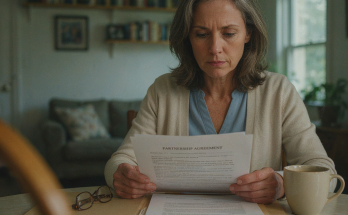
My parents had installed a camera near the kitchen months earlier.
My father claimed it was for security.
But he’d forgotten about it.
Diego hadn’t.
He had seen the tiny camera above the pantry.
And he’d called the police while pretending to be on another call.
The footage showed everything.
My father grabbing his belt.
My mother saying, “Teach her a lesson.”
Rachel saying, “She needs to learn respect.”
Camila backing away.
Me trying to protect her.
And my father moving toward us.
The footage also captured my father’s words after Camila fell.
“Maybe next time she’ll listen.”
I watched the recording once.
Then I stopped it.
I couldn’t watch again.
But there was something else.
Something in the background.
My mother had opened a drawer.
She took out a small envelope.
Then she looked directly at the camera.
She whispered something.
I couldn’t hear it.
I asked Diego to enhance the audio.
We listened.
My mother’s voice came through.
“Not again.”
Two words.
Not again.
I looked at her.
“What did you mean?”
She began crying.
My father shouted, “Enough!”
But my mother finally turned toward him.
“No.”
Her voice trembled.
“I’m done protecting you.”
That evening, my mother told me the truth.
Thirty years earlier, before I was born, my father had a younger brother named Daniel.
Daniel was nine.
My mother had been twenty-seven.
One night, Daniel had accidentally broken a bottle of soda in the kitchen.
My father, who was seventeen at the time, had been responsible for watching him.
He became angry.
He chased Daniel through the kitchen.
Daniel slipped.
His head struck the edge of a stone counter.
He died before the ambulance arrived.
My grandmother blamed herself.
My mother blamed my father.
But my father blamed Daniel.
“He wouldn’t listen,” he had said.
My mother had been terrified.
And my father convinced everyone to keep quiet about the circumstances.
The official report said it was an accident.
But my mother had kept something.
A letter.
Written by my father when he was seventeen.
In it, he admitted what happened.
He wrote that he had frightened Daniel on purpose.
He wrote that he wanted him to “learn respect.”
My hands went cold.
“Why did you never tell me?”
My mother cried.
“Because I was scared.”
“You let me grow up thinking Dad was just strict.”
“I know.”
“You let him treat me like that.”
“I know.”
“And now he almost did the same thing to Camila.”
My mother nodded.
“I know.”
She placed the old envelope in front of me.
“I’m sorry.”
I opened it.
Inside was the letter.
My father’s handwriting.
His confession.
And suddenly the belt wasn’t just a belt.
It was history repeating itself.
My father was arrested two weeks later.
The case involving Camila moved forward slowly.
The old case involving Daniel was more complicated.
There was no possibility of a murder charge after so many years, but the letter became evidence of a long-standing pattern of violent behavior.
My father insisted everything had been an accident.
He blamed the wet floor.
He blamed Camila.
He blamed me.
He blamed Diego.
He blamed everyone except himself.
Rachel initially defended him.
Then something happened.
She called me at midnight.
“Elena?”
“Yes?”
“I need to tell you something.”
“What?”
“I lied.”
My stomach tightened.
“About what?”
Rachel started crying.
“Dad has hit me too.”
I closed my eyes.
“How long?”
“Years.”
“Why didn’t you tell me?”
“Because he said you’d hate me for being weak.”
I felt tears run down my face.
“You weren’t weak.”
She whispered:
“I know that now.”
That call changed everything.
Rachel gave her own statement.
Then another woman came forward.
A former neighbor.
Then another.
The stories were similar.
My father had always believed fear was obedience.
And my mother had always believed silence was protection.
But silence had never protected anyone.
It had only protected him.
Six months later, my daughter was doing well.
She still hated the sound of belts being unbuckled.
She still became nervous when adults raised their voices.
But she laughed again.
She danced.
She ran.
She wore her yellow sandals.
One Saturday afternoon, we went to the park.
Camila was chasing bubbles when she suddenly stopped.
“Mommy?”
“Yes?”
“Can I ask you something?”
“Anything.”
“Grandpa still angry?”
I crouched beside her.
“I don’t know, sweetheart.”
“Is he coming back?”
“No.”
She thought for a moment.
Then she smiled.
“Good.”
I laughed softly.
“Why?”
“Because I don’t like him.”
There was no bitterness in her voice.
Just honesty.
I hugged her.
“You never have to be around someone who scares you.”
She wrapped her arms around my neck.
“Even if they’re family?”
I felt my throat tighten.
“Especially then.”
A year after the incident, my mother sold the house.
She moved into a small apartment.
Rachel moved out too.
For the first time, the three of us began rebuilding our lives separately.
It wasn’t easy.
There were arguments.
There were tears.
There were nights when my mother called me and said she missed the old days.
I would remind her gently:
“We don’t miss the old days. We miss the idea of what they should have been.”
She eventually understood.
My father was sentenced after pleading guilty to charges related to the assault on Camila.
He never apologized.
Not once.
Instead, he sent me a final letter.
It said:
You destroyed this family.
I read it.
Then I tore it in half.
Because I finally understood something.
I hadn’t destroyed my family.
I had stopped allowing it to destroy my daughter.
Three years later, Camila started kindergarten.
She was six years old.
Her teacher asked each child to draw a picture of their family.
When Camila came home, she handed me hers.
There were four people.
Me.
Her.
Rachel.
And my mother.
I smiled.
“You forgot someone.”
She shook her head.
“No.”
“Who?”
She pointed at the picture.
“This is my family.”
I kissed her forehead.
Then she added:
“But families can change, right?”
I nodded.
“Yes.”
She smiled.
“Good.”
That night, after Camila went to sleep, I sat on the balcony with my mother.
For a long time, neither of us spoke.
Finally, she said:
“Do you remember the night she fell?”
I did.
I would never forget it.
“I remember.”
My mother looked down at her hands.
“I thought that was the worst night of my life.”
I looked at her.
“And now?”
She smiled sadly.
“Now I think it was the night everything finally stopped.”
She reached for my hand.
“I should have protected you.”
“Yes.”
“I should have protected Rachel.”
“Yes.”
“And I should have protected Camila.”
I squeezed her fingers.
“Yes.”
She nodded.
“I can’t change that.”
“No.”
“But I can make sure I never stay silent again.”
I looked toward Camila’s bedroom.
A soft light glowed beneath the door.
“That’s enough for tonight.”
My mother smiled.
Then she whispered:
“Your daughter saved us.”
I shook my head.
“No.”
I looked toward the hallway.
“She didn’t save us.”
My voice cracked.
“She reminded us that children aren’t supposed to be afraid of the people who claim to love them.”
And that was the truth.
The belt had been my father’s weapon.
The silence had been my mother’s.
Fear had been our family’s inheritance.
But I refused to pass it to my daughter.
Camila would inherit something different.
A home where accidents were accidents.
Where apologies were enough.
Where a spilled soda meant a towel, not a belt.
Where children could run toward their mothers instead of running away from their grandfathers.
And where love was never measured by obedience.
Because the night my father raised that belt, he thought he was teaching my daughter respect.
Instead, he taught me something far more important.
Sometimes protecting your child means finally becoming the person you needed when you were one.
And sometimes the most powerful thing a mother can say isn’t “Please stop.”
It’s simply:
“You will never hurt my child again.”