MY MOTHER CALLED A FAMILY MEETING TO STEAL MY FATHER’S INHERITANCE — BUT WHEN FIVE LAWYERS SAT DOWN TO MAKE ME SIGN, I REVEALED WHO WAS REALLY WAITING OUTSIDE.
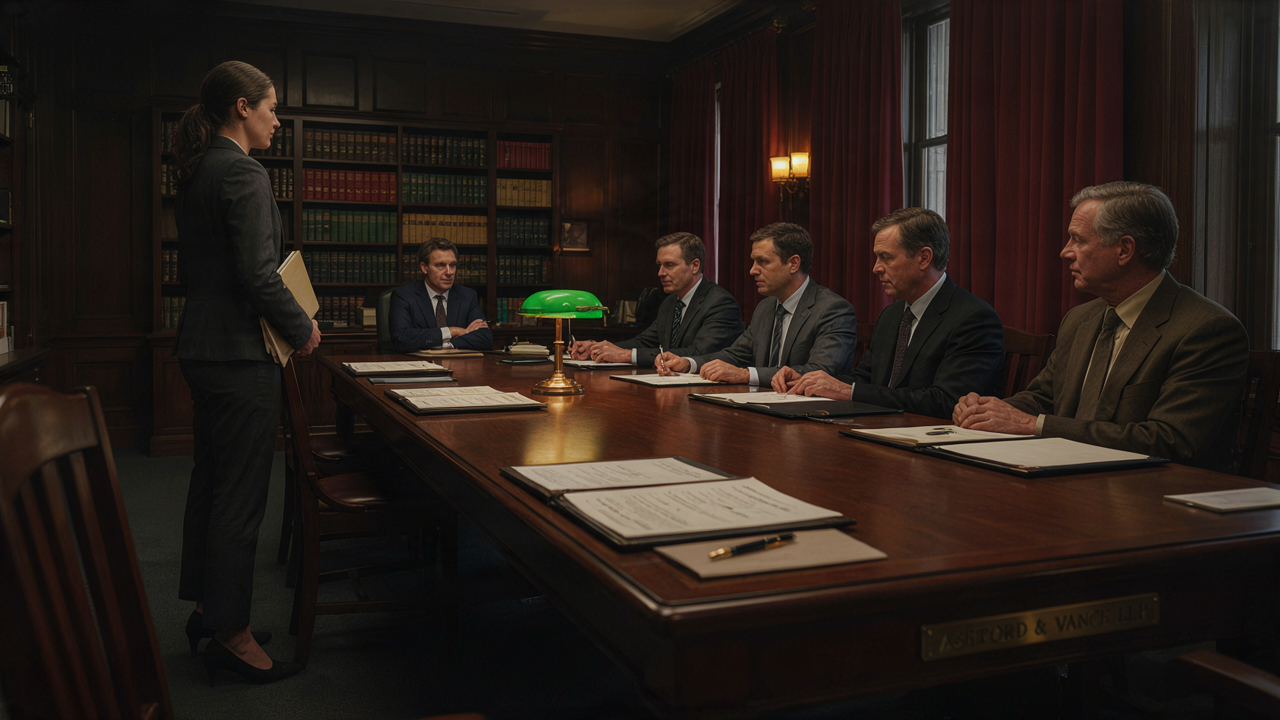
The first thing I noticed when I entered the conference room was the number of lawyers. Five. Five men and women sat around a long mahogany table, each with a leather folder, a laptop, and a carefully arranged stack of documents.
My mother, Evelyn, sat at the head of the table. She wore the pearl necklace my father had given her on their twentieth wedding anniversary.
Her hair was perfectly styled, and her expression carried the same practiced sympathy she used whenever she wanted someone to believe she was doing them a favor.
Beside her sat my older brother, Richard.
He was smiling. Not a friendly smile. A victorious one. “Finally,” Mother said, checking her watch. “You’re late.” I glanced at the clock. I was three minutes early. But I said nothing.
My name is Claire Bennett. I’m thirty-four years old, and three weeks earlier, my father, Thomas Bennett, had died after a short battle with pancreatic cancer.
He had been sixty-eight.
He was a businessman, a devoted father, and the founder of Bennett Industrial Holdings, a company he had spent nearly forty years building from a small workshop into a multimillion-dollar manufacturing business.
He had also been the only person in my family who never mistook my silence for weakness.
Apparently, everyone else had.
“Sit down, Claire,” Richard said, pointing toward the empty chair at the far end of the table. “We don’t have all day.”
I put my handbag beside the chair but didn’t sit immediately.
Instead, I counted again.
Five lawyers.
My mother.
My brother.
And me.
Eight people.
I wondered whether they had counted the person who hadn’t arrived yet.
“What’s this meeting about?” I asked.
Mother sighed dramatically.
“Claire, please. Don’t start. We’re here to settle your father’s estate. It’s been three weeks. We need to move forward.”
“I thought the estate attorney was handling everything.”
Richard laughed.
“That’s precisely why we’re here. We have professionals who understand these things. You don’t need to make this difficult.”
One of the lawyers, a gray-haired man with expensive glasses, pushed a thick document folder toward me.
“My name is Martin Hale,” he said. “I’m representing the family in the administration of your father’s estate.”
I looked at the folder.
“What family?”
His expression tightened.
“Your mother and brother, primarily.”
I slowly raised my eyes.
“Interesting.”
Mother folded her hands.
“Claire, your father and I discussed the future of the estate before he passed. He wanted Richard to take responsibility for the company. You know how business works. You’ve never been interested in those things.”
That was the first lie.
The second came immediately afterward.
“Your father also believed that I should retain control of the family property and financial assets. Richard will oversee the company, and I’ll manage the remaining estate.”
I looked at her.
“And what do I receive?”
Mother gave me a small, disappointed smile.
“We were hoping you’d understand that you’ve already received plenty over the years.”
I almost laughed.
Plenty?
I had spent the last six years helping my father with his company.
I had reviewed contracts, organized financial records, negotiated supplier agreements, and worked alongside his financial director during two major acquisitions.
Richard, meanwhile, had spent those same six years calling himself the future chairman while showing up to the office whenever there was a photographer.
But apparently, none of that mattered.
Martin opened his folder.
“Claire, this document is a family settlement agreement. It provides that you voluntarily relinquish any claim to the majority of your father’s business interests, investment accounts, and certain real estate holdings.”
“Voluntarily?”
“Correct.”
“How much am I giving up?”
He exchanged a quick glance with the lawyer beside him.
“Approximately seventy-eight percent of the estate’s disputed assets.”
I looked down at the papers.
Then I looked at my mother.
“You’re asking me to surrender seventy-eight percent of my father’s estate?”
“Don’t make it sound so ugly,” she replied. “You’re still his daughter. Nobody is throwing you out.”
Richard leaned back.
“You’re getting the lake house and some cash. That’s more than fair.”
I turned toward him.
“How generous.”
He smirked.
“Sign the papers, Claire. Let’s stop pretending you’re going to run a company.”
I finally sat down.
I opened the folder.
The first page contained my name.
The second contained a list of assets.
The third contained a declaration stating that I had been fully informed of my inheritance rights and was voluntarily surrendering them without coercion.
I stopped there.
Then I noticed something.
The document was dated four days before my father’s death.
My fingers rested on the paper.
“Why was this prepared before Dad died?”
Nobody answered immediately.
Mother finally spoke.
“Your father was very ill. We wanted to make sure everything was organized.”
“Did he sign it?”
Martin cleared his throat.
“This is a proposed settlement. Your signature is required to finalize it.”
I looked at the document again.
There was something else.
A clause stating that I would waive my right to challenge any previous transfers of company shares, property, or financial assets made during my father’s final six months.
That was interesting.
Very interesting.
Because my father had specifically warned me about that period.
He had told me something I hadn’t shared with anyone.
Something that changed everything.
I closed the folder.
“Before I sign anything, I’d like to ask a question.”
Richard groaned.
“Here we go.”
I ignored him.
“Who is the executor of Dad’s estate?”
Martin adjusted his glasses.
“Your mother has been acting as the primary family representative.”
“That’s not what I asked.”
His jaw tightened.
“Your father’s formal estate administration is still being reviewed.”
“So there is no confirmed executor?”
“Not at this time.”
I nodded slowly.
“Then why are you asking me to sign an agreement that transfers control of assets before the executor has even been confirmed?”
The room went quiet.
Mother’s smile disappeared.
“Claire, you’re not a lawyer.”
“No,” I replied. “But I can read.”
Richard slapped his palm against the table.
“Enough! We didn’t invite you here to interrogate everyone.”
I looked directly at him.
“Then why did you invite me?”
He leaned forward.
“Because Dad wanted the family to remain together, and you’re making that impossible.”
I smiled.
That was when I remembered the last conversation I’d had with my father.
Three weeks earlier.
In his hospital room.
He had been weak, but his mind was perfectly clear.
He had taken my hand and whispered:
“Claire, when I’m gone, your mother will call a meeting. She’ll bring lawyers. Richard will sit beside her. They’ll put papers in front of you.”
I had stared at him.
“How do you know?”
He closed his eyes for a moment.
“Because they’ve already started.”
Then he had looked at me again.
“Whatever happens, don’t sign anything until you hear three knocks.”
I had thought the medication was making him confused.
But he had squeezed my hand.
“Promise me.”
I promised.
And now, sitting in that conference room, I understood why.
I glanced toward the door.
Then back at the five lawyers.
“Good thing I didn’t come here alone.”
Richard laughed.
“Who did you bring? A friend?”
“No.”
“A lawyer you found online?”
I didn’t answer.
Mother looked irritated.
“Claire, this childish performance needs to stop. Sign the agreement.”
I leaned back.
“Let’s wait a moment.”
And then it happened.
A slow knock came from the front door.
One.
Two.
Three.
Every person at the table stopped moving.
Martin looked toward the hallway.
Mother’s face went pale.
Richard sat upright.
“Who is that?”
I smiled.
“Someone my father wanted you to meet.”
The conference room door opened.
And the man who walked in changed everything.
His name was Jonathan Pierce.
He was sixty-two, wore a dark navy suit, and carried a black leather briefcase.
I recognized him immediately.
He had been my father’s personal attorney for twenty-six years.
But he wasn’t alone.
Behind him stood a woman in a charcoal suit holding a thick document box.
And behind her was a uniformed court-appointed process server.
Jonathan looked around the room.
His eyes stopped at my mother.
“Good morning, Evelyn.”
Mother stood so quickly that her chair scraped against the floor.
“Jonathan? What are you doing here?”
He placed his briefcase on the table.
“That’s an interesting question. I was about to ask you the same thing.”
Martin Hale immediately stood.
“Mr. Pierce, this is a private family meeting.”
Jonathan calmly removed his glasses.
“Actually, Martin, this meeting concerns an estate for which I am the attorney of record. I wasn’t aware that you had been retained.”
Martin looked uncomfortable.
“We were asked to prepare a family settlement.”
“By whom?”
Mother answered quickly.
“By me.”
Jonathan nodded.
“Then perhaps you can explain why you’re attempting to obtain signatures on an agreement that contradicts the last executed estate documents.”
Silence.
Richard shook his head.
“That’s impossible. We have Dad’s latest will.”
Jonathan slowly turned toward him.
“No, Richard. You have a document that someone claims is your father’s latest will.”
My brother’s expression changed.
“What does that mean?”
Jonathan opened his briefcase.
“It means we have some things to discuss.”
He placed a sealed envelope in front of me.
My name was written across it in my father’s handwriting.
Claire.
Nothing else.
My hands trembled slightly as I opened it.
Inside was a single handwritten note.
My darling Claire,
If you’re reading this, then the people I warned you about have done exactly what I expected.
I know your mother will tell you that everything was arranged for the good of the family. I know Richard will tell you that he deserves what I built.
But there is something neither of them understands.
You were never the daughter I expected to inherit my money.
You were the daughter I trusted to protect what I built.
Listen to Jonathan. Ask him to show them the blue folder.
And remember: the truth does not need permission to enter a room.
Love, Dad.
I swallowed hard.
For a moment, the conference room disappeared.
I was twelve again, sitting beside my father in his workshop while he taught me how to read a balance sheet.
I was twenty-two, watching him negotiate his first major acquisition.
I was twenty-eight, sitting in his office at midnight while he explained why trust was more valuable than money.
And now he was gone.
But somehow, he had prepared for this moment.
I folded the letter and placed it in my handbag.
“Jonathan,” I said quietly. “Show them the blue folder.”
He nodded.
The woman behind him opened the document box.
Inside were several folders, each marked with a date.
Jonathan removed the blue one.
“Before we begin,” he said, “I want everyone to understand that this meeting is now being formally documented. Any claims made today may be relevant to the estate proceedings.”
Martin shifted in his chair.
“On what authority?”
Jonathan placed a document on the table.
“On the authority of the probate court’s existing filings and my appointment as counsel to the estate.”
He opened the folder.
“Let’s begin with the will.”
He placed a copy in front of everyone.
It was dated eleven months earlier.
My father’s signature appeared on the final page, witnessed by two independent individuals and notarized.
Mother stared at it.
“That’s not the will we were given.”
Jonathan looked at her.
“Exactly.”
Richard grabbed the document.
“Let me see that.”
He scanned the first page.
Then the second.
His face slowly lost color.
The will was straightforward.
My father had divided his personal estate into three portions.
One portion for my mother.
One portion for Richard.
And one portion for me.
But the company was different.
The majority voting shares had been transferred into a family trust eighteen months earlier.
The trust had a clear purpose: protecting the business from being divided, sold, or controlled through personal family disputes.
And I had been named its successor trustee.
Richard slammed the document down.
“That’s ridiculous!”
Jonathan didn’t react.
“Why?”
“Because I was supposed to run the company!”
“Running the company and owning its controlling shares are two different matters.”
“I’ve worked there!”
Jonathan glanced at his notes.
“Your employment records indicate that you were paid as a regional business development consultant.”
Richard’s face reddened.
“That’s not the point!”
“Then perhaps you should explain what the point is.”
Mother interrupted.
“Thomas was sick when he signed that. He wasn’t thinking clearly.”
Jonathan nodded.
“That is precisely why we have the independent medical assessment.”
He removed another document.
“This report was prepared by two physicians who examined Thomas Bennett during the period in question. Both confirmed that he was mentally competent to understand and execute his estate arrangements.”
Mother looked at Martin.
He didn’t look back.
Jonathan continued.
“Additionally, the signing was witnessed by two independent individuals who were not beneficiaries of the trust.”
Richard pushed his chair backward.
“So you’re saying Dad gave everything to Claire?”
“No,” Jonathan replied. “I’m saying your father made a legally documented succession plan.”
He turned toward me.
“Claire has been named successor trustee. She is not receiving the company as a personal gift. She is being entrusted with its protection and administration according to the terms of the trust.”
I looked at my brother.
For years, Richard had told people that I was only involved in the company because Dad felt sorry for me.
Now he was discovering that my father had trusted me with something much bigger than a job title.
But Jonathan wasn’t finished.
He reached into the folder again.
“Now we need to discuss the document Evelyn and Richard have been circulating.”
He placed a printed copy of the alleged newer will on the table.
I recognized the signature immediately.
It looked like my father’s.
Almost.
But not quite.
Jonathan pointed to the date.
“Three days before Thomas passed away.”
Mother folded her arms.
“That was his final instruction.”
“Then you won’t mind explaining why the document was never submitted through the attorney who had handled his estate for twenty-six years.”
Mother said nothing.
Jonathan continued.
“Nor why the two witnesses listed on the document have provided statements denying that they witnessed its execution.”
Richard’s expression changed.
“That’s not true.”
Jonathan removed two signed statements.
“They have both denied being present.”
Martin Hale slowly closed his notebook.
One of the other lawyers leaned toward him and whispered something.
I watched my mother.
For the first time that morning, she looked frightened.
“Thomas wanted Richard to have the company,” she insisted.
Jonathan’s voice remained calm.
“Then why did he establish the trust?”
“Because he changed his mind!”
“Then why did he reaffirm the trust six months later?”
She didn’t answer.
Jonathan placed another paper on the table.
“And why, Evelyn, did you attempt to transfer three commercial properties into your personal holding company eleven days after your husband’s death?”
I looked up.
Commercial properties?
I hadn’t known about that.
Mother stared at him.
“Those were family assets.”
“They belonged to the estate.”
“I was his wife!”
“That does not automatically make every estate asset your personal property.”
Richard stood.
“This is ridiculous. We’re leaving.”
The process server stepped forward.
“Sir, I have documents that need to be delivered to you.”
Richard turned.
“What documents?”
“A formal notice concerning the disputed transfers and preservation of estate records.”
Richard looked at my mother.
She was now staring at the table.
I realized something.
They hadn’t merely tried to take my inheritance.
They had already started moving things.
And my father had known.
Jonathan opened the second folder.
“This brings us to the financial records.”
He placed a series of statements on the table.
“Over the final fourteen months of Thomas’s life, approximately $2.4 million was transferred from company-related accounts into accounts associated with Evelyn Bennett and Richard Bennett.”
I stared at the numbers.
Two million four hundred thousand dollars.
“Where did that money go?” I asked.
Jonathan looked at me.
“That is currently being investigated.”
Richard laughed nervously.
“Those were legitimate payments.”
Jonathan nodded.
“Some were. Others appear to have been recorded as consulting fees, property expenses, and loans that were never approved by the board.”
Mother raised her voice.
“Thomas knew about everything!”
“Then the records should support that.”
He opened another document.
“Unfortunately, several authorization records appear to have been created after the transactions themselves.”
Martin finally spoke.
“Mr. Pierce, are you accusing my clients of fraud?”
Jonathan closed the folder.
“I’m telling you what the documents show. Whether the conduct constitutes fraud is a matter for the appropriate authorities and the court.”
Mother’s face had become almost colorless.
I looked at the bank statements.
Then at Richard.
“Did Dad know about the transfers?”
Richard avoided my eyes.
“Stay out of this.”
“Did he?”
Mother suddenly snapped.
“Your father was generous! He gave us money because we were family. You have no idea what it takes to maintain this family!”
I looked at her.
“I spent six years helping him maintain the business that paid for this family.”
She shook her head.
“You were never grateful.”
Something inside me finally settled.
Not anger.
Not revenge.
Clarity.
I understood why Dad had warned me.
This wasn’t simply about money.
It was about people who believed that being close to someone gave them permission to take whatever they wanted.
Jonathan reached for a final folder.
“The last matter concerns the company itself.”
He opened it.
Inside was a board resolution.
It had been signed by my father, the independent directors, and the company’s financial controller.
The resolution appointed me as interim chair of the family holding trust, subject to the trust’s terms and the necessary corporate procedures.
Richard stared.
“What?”
Jonathan slid the document toward him.
“Your father anticipated a leadership dispute. He therefore arranged for independent directors to oversee the transition.”
“That’s impossible!”
“Three of the five directors have already confirmed their participation.”
I looked at Jonathan.
“What happens to Richard?”
“That depends on the board’s decisions and the findings of the financial review. His employment and any company authority will be assessed separately from his inheritance rights.”
Richard turned toward me.
“You can’t do this to me.”
I held his gaze.
“I’m not doing anything to you.”
“You know I deserve that company!”
“You deserve whatever Dad legally left you. So do I.”
He laughed bitterly.
“You always thought you were better than me.”
“No, Richard. I just never thought being Dad’s son made you more entitled than his daughter.”
Mother stood.
“This is all because of you!”
I looked at her.
“Because of me?”
“You poisoned him against us!”
I shook my head.
“No. Dad made his decisions himself.”
She pointed toward the papers.
“He was confused. He was dying. You manipulated him!”
Jonathan immediately interrupted.
“That allegation is serious. We have extensive medical records, independent witnesses, and a complete execution history of the trust. If you wish to challenge those documents, you may do so through the court.”
Mother sank back into her chair.
Then she looked at me.
Her voice changed.
It became softer.
Almost pleading.
“Claire, sweetheart. We don’t need to do this.”
I said nothing.
“We’re family. Your father wouldn’t want us fighting.”
I looked at the unsigned settlement agreement.
The pen was still lying beside it.
For a moment, I thought about how easily I could have signed it.
How many people would have told me to avoid conflict.
How many times in my life I had been encouraged to keep the peace.
But peace built on surrender wasn’t peace.
It was simply silence.
I picked up the pen.
Richard’s eyes brightened.
“Finally.”
Mother relaxed.
I lifted the pen, looked at the document, and drew a single line through the signature section.
Then I wrote across the first page:
REJECTED. ALL RIGHTS RESERVED.
I placed the pen down.
“I’m not signing away my father’s wishes.”
Richard’s smile disappeared.
Jonathan collected the papers.
“That concludes the proposed settlement.”
But there was one more thing I needed to know.
I turned toward him.
“Dad said there was something else. Something about a final surprise.”
Jonathan looked at me for several seconds.
Then he nodded.
“Yes. There is.”
He reached into the bottom of the blue folder and removed a small envelope.
It was marked:
For Claire. Only after the family meeting.
My stomach tightened.
I opened it.
Inside was a photograph.
It showed my father standing in front of a small brick building, holding a set of keys.
Beside him stood a woman I had never seen before.
On the back, Dad had written:
The person who helped me understand what family really means.
I looked up.
“Who is she?”
Jonathan glanced toward the woman who had entered with him.
She stepped forward.
“My name is Margaret Lewis,” she said.
Her voice was gentle.
“I’m the former chief financial officer of your father’s company.”
I recognized the name.
Margaret Lewis had resigned four years earlier.
Richard had always said she left because she couldn’t handle the pressure.
Mother had said she was disloyal.
But Margaret looked directly at me.
“Your father asked me to keep something safe until this day.”
She placed a small silver key on the table.
“What does it open?” I asked.
“The records room beneath his old office.”
Richard suddenly looked alarmed.
“That’s private company property.”
Margaret turned toward him.
“Yes. And that’s why I was surprised when someone tried to access it last week.”
Jonathan looked at her.
“Did you bring the access log?”
She nodded.
Then she removed a printed report from her briefcase.
“Someone attempted to open the room using a copied access card. The system recorded the date, time, and identification number.”
I looked at the report.
The attempted entry had happened five days after Dad’s funeral.
The access card belonged to Richard.
My brother stood abruptly.
“That’s not proof of anything!”
Margaret remained calm.
“I didn’t say it was.”
She pointed to the next page.
“But the room’s security camera recorded the person entering the corridor.”
Jonathan turned the page.
A photograph appeared.
It showed Richard outside the records room.
And he wasn’t alone.
The woman beside him was my mother.
I looked at them.
“What were you looking for?”
Mother’s lips trembled.
“Nothing.”
Margaret shook her head.
“Your father left instructions that the room should remain sealed until the successor trustee arrived.”
I looked at Jonathan.
“Can we open it?”
He nodded.
“With the appropriate company authorization, yes.”
I glanced at Richard.
He was no longer smiling.
And suddenly, I understood that the documents on the conference table were only the beginning.
The following morning, I arrived at Bennett Industrial Holdings at 8:15 a.m.
The building looked exactly as it had when Dad was alive.
The same glass entrance.
The same bronze company sign.
The same receptionist who had worked there for twenty years.
But something felt different.
Employees stopped talking when I walked past.
Some smiled.
Others looked nervous.
Word had already spread about the family meeting.
I went directly to my father’s old office.
Jonathan was waiting with Margaret and two members of the independent board.
The silver key opened a small door behind the filing cabinets.
Inside was a narrow staircase leading to the basement.
At the bottom was a steel door.
Margaret entered a code.
I inserted the key.
The lock turned.
The door opened.
The room smelled of paper, dust, and old furniture polish.
Metal filing cabinets lined the walls.
There were boxes labeled with years, financial statements, property records, and company correspondence.
On a small table sat a wooden box.
My name was written on it.
I opened it.
Inside were three items.
A USB drive.
A sealed envelope.
And a small voice recorder.
I picked up the recorder.
Margaret looked at me.
“Your father made that recording two weeks before he passed.”
I pressed play.
For several seconds, there was only static.
Then Dad’s voice filled the room.
“Claire, if you’ve reached this room, then everything happened as I feared.”
My eyes began to sting.
“I want you to understand something. I didn’t establish the trust because I loved Richard less or because I wanted to punish your mother. I established it because I discovered that the company was being used for purposes it was never intended to serve.”
There was a pause.
“I gave your brother opportunities. I gave him money. I gave him authority. But I couldn’t give him responsibility he wasn’t willing to accept.”
I closed my eyes.
Dad continued.
“Margaret knows where the original transaction records are. Jonathan has copies of the legal documents. Together, they can explain everything.”
The recording ended.
I looked at Margaret.
“What exactly happened?”
She opened one of the cabinets.
“Your father discovered that company funds had been used to secure a private property development. The project was controlled by a business registered under Richard’s name.”
She placed several statements on the table.
“The company had advanced money through a series of loans. Those loans were never properly approved. When the development failed, the losses were hidden through accounting adjustments.”
“How much?”
“Approximately $3.1 million.”
I stared at the papers.
“Was Dad aware?”
“He discovered the arrangement fourteen months ago.”
“And what did he do?”
“He tried to resolve it privately. He asked Richard to repay the money and correct the records.”
I looked at the next document.
There was a repayment agreement.
It had been signed by Richard.
But the payments had never been made.
Margaret continued.
“Your father didn’t want to destroy his relationship with his son. He gave him time. Unfortunately, the situation became worse.”
I picked up the USB drive.
“What is this?”
“Emails. Original accounting files. Correspondence between the people involved in the property development.”
Jonathan stepped closer.
“Those records are being preserved for the independent investigation. We won’t make accusations until everything is verified.”
I nodded.
That was exactly what Dad would have wanted.
Then I opened the final envelope.
Inside was another letter.
Claire,
There is one more thing you need to know.
The company is not your inheritance because it has a large number attached to its name.
It is your inheritance because thousands of people depend on it.
The employees who have worked here for decades. The families who depend on their salaries. The suppliers who trusted us. The customers who believed our promises.
When you take responsibility, remember that you are not protecting a fortune.
You are protecting people.
If you ever have to choose between making more money and doing the right thing, choose the right thing.
Money can be rebuilt.
Trust cannot always be repaired.
I love you, Claire.
I sat down.
For the first time since his funeral, I allowed myself to cry.
Not because of the money.
Not because of my mother or brother.
But because I missed him.
I missed his voice.
His terrible jokes.
The way he would call me into his office just to ask what I thought about something.
And I missed the one person who had always seen me clearly.
The next six weeks were difficult.
The independent review confirmed that several transactions had been improperly recorded.
The board suspended Richard’s financial authority while the investigation continued.
My mother was required to provide records relating to the attempted property transfers.
The questionable settlement document was formally challenged.
Martin Hale and the other lawyers who had prepared it were asked to explain the authority under which they had acted.
Some withdrew from the matter.
Others continued representing their clients.
I didn’t celebrate.
There was nothing satisfying about watching your family fall apart.
But I also refused to pretend that nothing had happened.
During that time, I learned something unexpected.
My father had left me more than documents.
He had left me a company full of people who believed in what he built.
The factory manager, Mr. Collins, came to see me one afternoon.
He had worked for Dad for thirty-one years.
“Your father always said you understood the business better than anyone gave you credit for,” he told me.
I smiled.
“He used to say that?”
“All the time.”
He hesitated.
“Are we going to be okay?”
I looked at him.
“Yes. We’re going to protect the jobs, review the finances, and rebuild whatever needs rebuilding.”
He nodded.
“Your father would have liked that answer.”
Three months later, the board formally confirmed my appointment as chair of the holding trust.
The company remained operational.
The independent investigation continued.
Richard eventually agreed to a settlement requiring repayment of certain improperly documented advances, subject to the final findings and legal proceedings.
My mother moved out of the family house.
For a while, we didn’t speak.
Then, one rainy Thursday evening, she called.
“Claire?”
Her voice sounded smaller than I remembered.
“Yes?”
“Can we talk?”
I looked through the window at the rain.
“About what?”
“Your father.”
I was silent.
She took a breath.
“I found something in his desk. A letter. It has your name on it, but I think you should know what it says.”
My heart tightened.
“What letter?”
“I don’t want to read it over the phone.”
I agreed to meet her the following afternoon.
When I arrived at her house, she was sitting in the living room with a small envelope in her hands.
She looked older.
The pearls were gone.
Her hair was tied back.
She handed me the envelope.
“I should have given you this earlier.”
I opened it.
It was a letter Dad had written nearly a year before his death.
Evelyn,
I know you are angry with me. I know you believe I am choosing Claire over Richard.
But I am not choosing one child over another.
I am choosing honesty over appearances.
You have spent years protecting Richard from the consequences of his decisions. I understand why. You love him.
But love cannot mean allowing someone to destroy everything around him.
Claire may be quiet, but she is not weak. She may not demand attention, but she notices everything.
If I am no longer here, please don’t mistake her patience for permission.
And please, Evelyn, don’t make our children fight over what we built.
I lowered the letter.
Mother was crying.
“He knew,” she whispered.
I looked at her.
“He knew what?”
“That I was helping Richard move the money.”
I didn’t respond.
She wiped her cheeks.
“I thought we could put everything back before anyone noticed. Richard promised me the development would recover. He said your father would never understand.”
I felt a cold weight settle in my stomach.
“Why did you do it?”
She looked down.
“Because Richard was my son. I thought he needed help. I thought your father would forgive us if he found out.”
“And what about me?”
She looked up.
“What?”
“Did you ever think about what this would do to me? You invited me into a room with five lawyers and expected me to surrender everything Dad had left me. Did you ever consider that I was his daughter too?”
Her lips trembled.
“No.”
That one word hurt more than all the arguments.
She continued.
“I thought you would sign. You always did what I asked.”
I folded the letter carefully.
“That’s because I wanted a family, Mother. Not because I didn’t know when I was being treated unfairly.”
She covered her face.
For a long time, neither of us spoke.
Finally, she asked:
“Can you forgive me?”
I looked at the woman who had raised me.
I still loved her.
But love didn’t erase what had happened.
“I don’t know yet,” I said honestly. “Maybe one day. But forgiveness doesn’t mean pretending nothing happened.”
She nodded slowly.
“I understand.”
I stood to leave.
At the door, she called my name.
“Claire?”
I turned.
“Your father was right about you.”
I waited.
“You weren’t weak.”
I gave her a small nod.
“No, Mother. I wasn’t.”
Then I walked outside.
One year after my father’s death, we held a memorial ceremony at the company’s main factory.
There were no expensive decorations.
No politicians.
No elaborate speeches.
Just employees, their families, and a photograph of Dad standing in front of the original workshop where everything had begun.
I stood at the microphone.
“I want to thank everyone who helped keep this company alive during a difficult year,” I began.
I looked around.
“Some people think an inheritance is simply money, property, or ownership. But my father taught me that what we inherit is also responsibility.”
I paused.
“He didn’t leave me a perfect company. He left me a company worth protecting. He didn’t leave me a perfect family. He left me the chance to decide what kind of person I would become.”
I looked at Dad’s photograph.
“And I hope I’ve made him proud.”
The employees applauded.
Afterward, I returned to his old office.
His chair was still there.
His books were still arranged on the shelves.
And his old fountain pen rested beside the desk calendar.
I picked it up.
Then I noticed a small note tucked beneath the pen.
I recognized his handwriting immediately.
Claire,
If you’ve made it this far, remember something.
The biggest victory isn’t proving people wrong.
It’s refusing to become like the people who wronged you.
Build something good.
And never let anyone convince you that your kindness is a weakness.
I smiled through my tears.
Outside, the factory was running.
Machines were humming.
Employees were working.
Life was continuing.
My mother had called me to a family meeting expecting a frightened daughter who would sign away her inheritance.
My brother had expected an easy victory.
Five lawyers had arrived prepared to make me surrender.
But they had forgotten one thing.
My father had spent years preparing me for the responsibility they were trying to steal.
And when the door opened that morning, I hadn’t brought someone to fight my family.
I had brought the truth.
The inheritance was never just about who received the money.
It was about who could be trusted with what my father had spent his entire life building.
And in the end, the most valuable thing he left me wasn’t the company, the properties, or the millions.
It was the courage to sit at a table surrounded by people who expected me to surrender…
Look them in the eyes…
And say no.
Because sometimes the quietest person in the family is the one who knows exactly where every secret is buried.