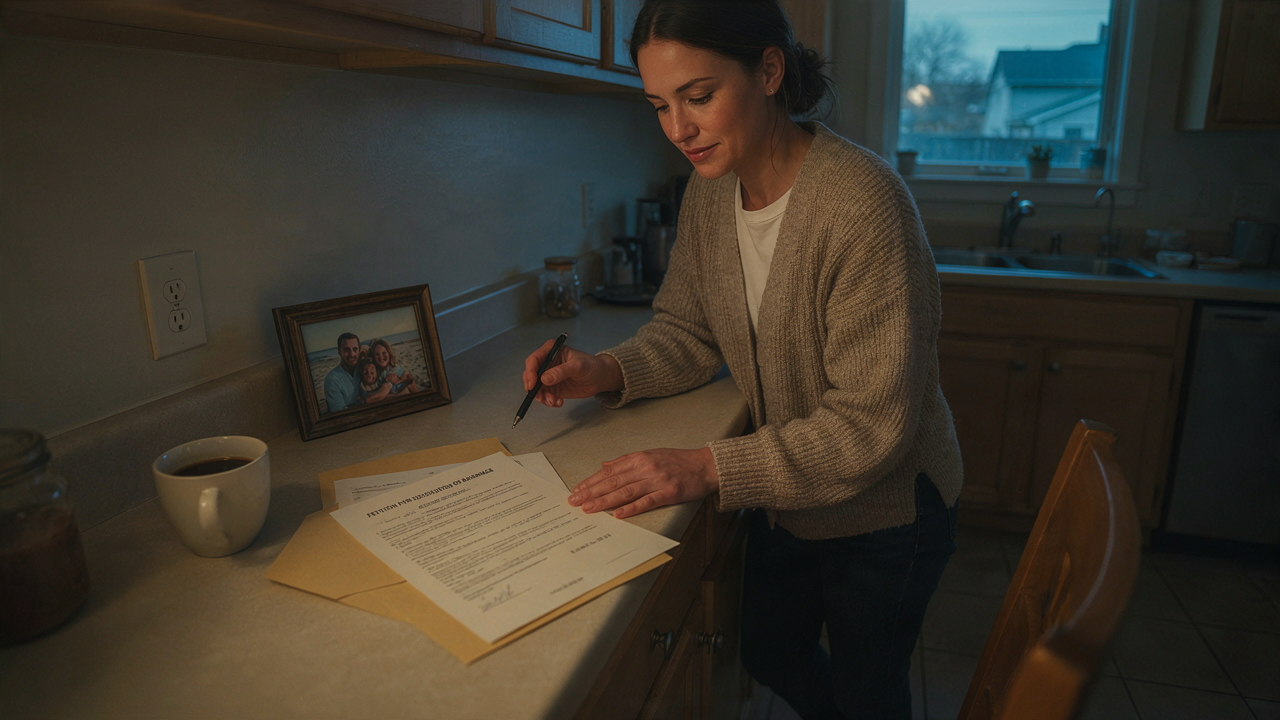
My husband dropped divorce papers on the kitchen counter and said, “I’m taking everything. The house. The money. Even the kids.” So I signed before he could finish, let him celebrate for two full weeks, and stayed quiet while he told everyone he had already won—because there was one thing he forgot to check before walking out of my life.
“Mr. Whitmore,” my attorney said calmly, “are you familiar with First Meridian Business Account ending in 4821?”
Scott shifted in his chair.
“I have several business accounts.”
“That wasn’t my question.”
He glanced toward his lawyer.
“Yes. I know the account.”
My attorney, Rebecca Hayes, adjusted her glasses.
“Who owns it?”
“My company.”
“Which company?”
“Whitmore Consulting Group.”
She nodded.
“And who is the sole owner of Whitmore Consulting Group?”
“I am.”
Rebecca opened another document.
“Then perhaps you can explain why your financial disclosure lists this account as having a balance of $3,842.”
Scott relaxed slightly.
“Because that’s approximately what was in there.”
“On the date you completed your disclosure?”
“Yes.”
Rebecca looked toward the judge.
“Your Honor, may I approach the witness with Exhibit Seventeen?”
The judge nodded.
Scott accepted the document.
His expression changed.
I watched it happen.
The confidence disappeared first.
Then the color drained from his cheeks.
Rebecca waited until he finished reading.
“Mr. Whitmore, is that a bank statement from the same account?”
He swallowed.
“Yes.”
“And does it show a transfer of $186,000 into that account eleven days before you filed for divorce?”
Scott cleared his throat.
“That was business revenue.”
“Revenue from which client?”
He hesitated.
“I’d have to check.”
Rebecca nodded.
“That’s interesting, because the description identifies the funds as proceeds from the sale of a commercial property held by Whitmore Holdings LLC.”
Scott looked toward his attorney again.
Rebecca continued.
“And Whitmore Holdings LLC is another company you own, correct?”
“Yes.”
“Then why wasn’t that company listed on your financial disclosure?”
Scott stared at the paper.
For the first time in seventeen years of marriage, I watched my husband struggle to find an explanation.
And I didn’t rescue him.
***
My name is Dana Whitmore.
I’m forty-two years old, and until two weeks before that hearing, I had been married to Scott for seventeen years.
We lived in a four-bedroom house outside Indianapolis.
Our son, Ben, was fourteen.
Our daughter, Ellie, was eleven.
I worked part-time as a bookkeeper for a small medical equipment distributor while managing most of the responsibilities at home.
Scott ran a consulting business.
At least, that’s what he called it.
When people asked what he did, he usually gave them a long explanation involving commercial property investments, business development, and strategic partnerships.
I used to joke that he needed twenty minutes to explain a job that mostly involved talking on the telephone.
He never laughed.
Scott liked appearing important.
He liked expensive watches, polished shoes, and restaurants where the waiters addressed him as sir.
He leased a luxury SUV and referred to it as a business necessity.
He once spent $1,800 on a weekend conference in Chicago and complained for three days because I’d bought Ben a new baseball glove.
For years, I told myself that was simply his personality.
Ambitious.
Competitive.
Driven.
But somewhere along the way, those qualities became excuses for treating me like an employee who didn’t deserve to see the company’s financial records.
Whenever I questioned a large expense, he’d say, “Dana, you don’t understand business.”
Whenever I asked about our savings, he’d tell me to stop worrying.
And whenever I suggested putting more money into the children’s college accounts, he’d remind me that he was the one earning the serious income.
It was a strange thing to hear, considering I handled our household budget, paid our bills, organized our tax documents, and had spent years helping him prepare invoices when his business was small.
But Scott had a talent for making ordinary conversations feel like arguments I had already lost.
Eventually, I stopped asking questions where he could hear them.
I never stopped paying attention.
***
The first suspicious transfer appeared in February.
It was $14,500.
Money leaving our joint checking account and entering a business account I didn’t recognize.
I asked Scott about it while we were making dinner.
He barely looked up.
“Tax planning.”
“What kind of tax planning?”
“Company stuff.”
“That’s a lot of money.”
He sighed.
“Dana, please. I don’t interrogate you every time you buy groceries.”
I looked at him.
There were three grocery bags on the counter.
I’d spent $87.
He’d transferred nearly fifteen thousand dollars.
But I knew how the conversation would end.
He’d raise his voice.
I’d try to explain.
Then he’d accuse me of creating unnecessary stress.
So I said nothing.
Three weeks later, another transfer appeared.
$22,000.
Then $9,800.
Then $31,000.
Each time, the money moved through one of the accounts Scott claimed belonged exclusively to his business.
By June, I had started quietly saving copies of statements.
I didn’t know what I was looking for.
I only knew that money was disappearing from accounts we’d spent years building.
And Scott was becoming increasingly protective of his laptop.
He changed the password.
Started taking calls outside.
Stopped leaving his phone on the kitchen counter.
At first, I thought he was hiding an affair.
I was right.
But the affair turned out to be the least expensive secret he’d been keeping.
***
The woman was named Vanessa Cole.
She was thirty-five, worked in commercial real estate, and lived in a luxury apartment downtown.
I discovered her existence through a restaurant receipt.
Scott had told me he was attending a client dinner in Cincinnati.
But the receipt was from an Indianapolis steakhouse.
Two meals.
Two cocktails.
One bottle of expensive wine.
A total of $486.
The date was our wedding anniversary.
I’d spent that evening helping Ellie finish a school project while Scott texted that his meeting was running late.
I remember staring at the receipt and feeling strangely numb.
For years, I’d imagined discovering an affair would make me scream.
Instead, I folded the paper.
Put it in my blue file box.
And made the children breakfast.
I didn’t confront him.
Not because I was afraid.
Because I was finally beginning to understand that the truth was larger than one dinner.
***
In July, Scott announced that his company was restructuring.
He said he needed to simplify several accounts.
He asked me to sign some paperwork.
“Just routine business documents,” he said.
I read the first page.
It described a transfer of ownership interests in Whitmore Holdings LLC.
I looked up.
“Why is my name listed here?”
Scott frowned.
“Because we’re married. They have to include certain information.”
“Am I giving up an ownership interest?”
He laughed.
“Dana, you don’t own any part of my company.”
I looked at the document again.
“Then why does it say spousal consent?”
His face hardened.
“Because lawyers put unnecessary language in everything.”
I set down the pen.
“I’d like someone to explain it before I sign.”
Scott stared at me.
Then he snatched the papers from the table.
“Forget it. I’ll handle it myself.”
He didn’t speak to me for the rest of the evening.
Two weeks later, I found a copy of the executed agreement in a folder connected to our shared printer.
My name appeared on the signature page.
But I hadn’t signed it.
I stared at the scanned document.
Then I enlarged the signature.
It looked like mine.
Almost.
Except the letter D curved the wrong way.
And whoever had copied my name had forgotten the small loop I always put beneath the final a.
I printed the page.
Placed it in my file box.
And called an attorney.
That was how I met Rebecca Hayes.
***
Rebecca didn’t tell me to divorce Scott.
She didn’t tell me to confront him.
She asked questions.
Lots of them.
How long had we been married?
What property did we own?
Did I have access to our bank records?
Were there trusts?
Business interests?
Joint debts?
Retirement accounts?
Had Scott ever threatened me?
I told her about the financial transfers.
The suspicious signature.
And the woman I believed he was seeing.
Rebecca listened carefully.
Then she said, “Dana, we need to separate suspicion from evidence.”
I nodded.
“Do you think he’s hiding money?”
“I think there are enough inconsistencies to justify a thorough review.”
I handed her the documents.
She examined them.
Then looked up.
“Have you signed anything recently that affects your ownership rights?”
“No.”
“Good. Don’t sign anything else without understanding it.”
I swallowed.
“What if he files for divorce?”
She looked at me.
“Then we respond through the legal process.”
I sat quietly.
For years, Scott had made me believe that he controlled everything because he earned more money.
Rebecca explained that Indiana’s property division rules were more complicated than his version.
Assets and debts could be part of the marital estate regardless of whose name appeared on a particular account.
Business ownership didn’t automatically make an interest untouchable.
And custody decisions were based on the children’s best interests, not on whichever parent earned the larger salary.
I remember sitting there feeling as though someone had opened a window in a room I’d been trapped inside for years.
I wasn’t powerless.
I had simply been listening to the wrong person explain my rights.
***
When Scott dropped the divorce papers on the kitchen counter that August night, I’d already met Rebecca twice.
I’d already provided her with copies of financial records.
And I’d already learned that the papers Scott wanted me to sign weren’t the final agreement he claimed they were.
They included an acknowledgment of receipt and a proposed settlement that required proper legal review and court approval.
I signed to acknowledge receiving the petition.
Then initialed the separate page indicating I had received his proposal.
I did not agree to surrender the house, the money, or custody of the children.
Scott never looked closely enough to understand the difference.
He simply saw my signature.
And assumed I had surrendered.
That was the first reason I stayed quiet.
The second was that Rebecca needed time to obtain the financial records Scott had been hiding.
***
Back in the courtroom, Rebecca placed another bank statement before my husband.
“Mr. Whitmore, let’s return to the $186,000 transfer.”
Scott shifted.
“I already told you it was business revenue.”
“Yes. And I asked which client paid it.”
He looked irritated.
“I don’t remember every transaction.”
Rebecca nodded.
“Then perhaps this will help.”
She handed him another document.
“This is the closing statement from the sale of a commercial property on East Washington Street. Correct?”
Scott looked down.
His jaw tightened.
“Yes.”
“And the property sold for $412,000?”
“Approximately.”
“After the mortgage and closing expenses, the net proceeds were $186,000?”
“Yes.”
Rebecca paused.
“Who owned the property?”
“Whitmore Holdings.”
“And who owned Whitmore Holdings?”
Scott said nothing.
Rebecca waited.
Finally, he answered.
“I did.”
She looked toward the judge.
“Then why did your sworn financial disclosure omit both the company and the sale proceeds?”
Scott’s lawyer stood.
“Your Honor, these matters require additional context. The witness has not been given an opportunity to review the underlying accounting records.”
The judge nodded.
“Counsel, keep your questions focused on establishing the relevant facts. We will not resolve a complex valuation dispute based on one statement.”
Rebecca agreed.
Then asked a simpler question.
“Mr. Whitmore, did you disclose the existence of Whitmore Holdings LLC to your wife before filing for divorce?”
Scott looked at me.
For one second, I saw the old expression.
The warning.
The one that meant I was supposed to stop making trouble.
Then he looked away.
“No.”
Rebecca sat down.
And the courtroom fell silent.
***
The hearing wasn’t a final divorce trial.
It was an early hearing involving temporary financial arrangements, preservation of assets, and parenting issues.
Rebecca had requested additional disclosures and protective orders because the available records suggested substantial transfers between related businesses.
The judge did not declare Scott guilty of anything that morning.
Instead, the court directed the parties to preserve relevant assets and records, provide detailed financial information, and refrain from certain transactions without proper notice or authorization.
It wasn’t the dramatic victory I’d imagined while sitting on the garage floor.
But it was the first time Scott couldn’t simply refuse to answer my questions.
And that mattered.
When we left the courtroom, he caught up with me near the elevators.
“Dana.”
I kept walking.
“Dana, stop.”
Rebecca stepped closer.
“Mr. Whitmore, any discussion about the pending financial issues should go through counsel.”
He ignored her.
“You went through my business records?”
I stopped.
“I reviewed records I was lawfully entitled to access.”
His face reddened.
“You had no right.”
I looked at him.
“Scott, you put my signature on a document I never signed.”
He froze.
Rebecca watched him carefully.
For several seconds, he said nothing.
Then he whispered, “You don’t understand what you’re doing.”
I thought about the seventeen years I’d spent hearing those words.
And for the first time, I didn’t feel small.
“Then explain it to your lawyer,” I said.
I stepped into the elevator.
The doors closed.
And I finally let myself breathe.
***
That evening, Ben was waiting in the kitchen when I got home.
He sat at the table with his homework open.
But he wasn’t writing.
“Mom?”
I set down my purse.
“Hey, buddy.”
“Did you go to court today?”
I stopped.
“Yes.”
He looked down.
“Dad said you were trying to take his company.”
I felt something twist inside my chest.
I sat across from him.
“Ben, your father and I are working through some financial disagreements. That’s adult business.”
He frowned.
“Is he going to lose everything?”
“I don’t know exactly how things will be divided.”
Ben stared at his notebook.
“Dad said he might have to move away because of you.”
I closed my eyes.
Scott had promised to take the children.
Now he was telling them I was responsible for his problems.
I reached across the table.
“Ben, listen to me.”
He looked up.
“Neither you nor Ellie caused this divorce. And neither of you has to choose between your parents.”
His eyes filled.
“Are we going to have to move?”
“We don’t know all the answers yet. But I’ll do everything I can to keep your life as stable as possible.”
He swallowed.
Then asked, “Do you still love Dad?”
I stared at him.
That question hurt more than anything Scott had said in court.
“I care about your father,” I answered carefully. “But sometimes adults can’t stay married.”
Ben nodded slowly.
Then whispered, “I wish he’d stop talking about money.”
I reached for his hand.
“So do I, sweetheart.”
***
Ellie reacted differently.
She became quiet.
Not the ordinary quiet she’d inherited from me.
The kind that made her teachers call home.
She stopped inviting friends over.
Stopped asking about weekend plans.
One evening, I found her sitting on the floor of her bedroom, surrounded by photographs.
Wedding pictures.
Family vacations.
Christmas mornings.
She looked up.
“Mom, did Dad stop loving us?”
I sat beside her.
“No, honey.”
“Then why did he leave?”
I took a breath.
“Because your father and I have problems we haven’t been able to solve.”
She looked down.
“Did I do something?”
I pulled her into my arms.
“No. Absolutely not.”
She began crying.
“I heard him say he was taking us away.”
My chest tightened.
“When?”
“The night he gave you the papers.”
I closed my eyes.
I had thought the headphones protected her.
Apparently, they hadn’t.
I held her tighter.
“Ellie, neither parent gets to simply decide that the other one disappears from your life. There are rules, and there are people helping us make decisions that are best for you.”
She looked up.
“Promise?”
I kissed her forehead.
“I promise I’ll keep showing up for you.”
That was the only promise I could make honestly.
And I intended to keep it.
***
The financial investigation took almost four months.
Scott’s business interests were complicated.
There were legitimate accounts.
Legitimate debts.
Equipment leases.
Property investments.
And transactions that required careful explanation.
I learned that not every transfer I had questioned was improper.
Some were routine business expenses.
Some involved loan repayments.
Others were ordinary tax-related movements.
But several transactions raised serious concerns.
The largest involved the sale of the commercial property.
According to the records obtained through discovery, Scott had moved the sale proceeds through two companies before transferring a substantial amount into an account associated with Vanessa Cole.
When Rebecca explained that finding, I felt physically sick.
“Vanessa?”
She nodded.
“That’s the name on the receiving account.”
I stared at her.
“How much?”
“One hundred and twenty thousand dollars.”
For a moment, I couldn’t speak.
One hundred and twenty thousand.
While I’d been buying generic cereal and postponing repairs to our washing machine.
While Ben needed braces.
While Ellie wanted to take art classes.
While Scott complained about the price of school supplies.
He had transferred a six-figure amount into an account connected to the woman he’d been seeing.
Rebecca leaned forward.
“Dana, we still need to understand the legal basis claimed for that transfer. It may be described as a loan, investment, or payment for services.”
I nodded.
“But it isn’t automatically beyond examination simply because he moved it.”
I looked down.
“What happens now?”
“We ask for the supporting documents.”
***
Scott claimed the money was a legitimate business investment.
Vanessa’s company supposedly provided consulting services related to commercial property development.
But the records presented a problem.
There was no detailed contract showing the scope of the work.
No clear project schedule.
No corresponding deliverables accounting for the full amount.
And the transfer had occurred shortly before Scott filed for divorce.
Rebecca requested additional records.
Scott’s attorney objected to some requests as overly broad.
The court resolved those disputes in stages.
Depositions followed.
Documents were exchanged.
An independent financial expert reviewed the relevant transactions.
The process was exhausting.
There were days when I regretted looking inside the blue file box.
Days when I wished I could simply walk away and never hear Scott’s name again.
But then I’d look at Ben and Ellie.
And remember why I needed the full financial picture.
Their future mattered.
Their stability mattered.
And I wasn’t going to accept Scott’s word that there was nothing left to divide.
***
The next revelation came from an unexpected place.
Scott’s former business partner, Michael Trent.
I’d met Michael several times over the years.
He was quiet, serious, and had worked with Scott on commercial property transactions before they ended their partnership.
One afternoon, Rebecca called me.
“Dana, Michael Trent’s attorney has contacted us.”
I frowned.
“Why?”
“He has records related to Whitmore Holdings.”
My stomach tightened.
“What kind of records?”
“Ownership agreements, transaction histories, and correspondence.”
I sat down.
“Is he willing to cooperate?”
“Through the proper legal process, yes.”
Two weeks later, his deposition took place.
Michael explained that Whitmore Holdings had originally been formed as a joint venture.
He and Scott each owned an interest.
But several years earlier, Scott arranged to purchase Michael’s share.
The purchase was financed partly through a loan secured by business assets.
That was ordinary enough.
Then Michael described the issue that had ended their partnership.
Scott had begun transferring assets between companies without providing complete documentation.
Michael objected.
Their relationship deteriorated.
Eventually, they separated their interests.
During questioning, Rebecca asked whether Michael recognized the signature on the ownership transfer document I’d discovered months earlier.
He examined the page.
Then frowned.
“That’s Dana’s name.”
“Yes.”
“She signed this?”
I felt my chest tighten.
Michael looked directly at Rebecca.
“I don’t know. But Scott told me Dana had refused to sign anything involving his business.”
The room became quiet.
Rebecca continued.
“When did he tell you that?”
“About three weeks before this document was executed.”
I stared at Scott.
He looked down.
Michael added something else.
“Scott said he’d find another way to handle it.”
Rebecca wrote it down.
And I realized the suspicious signature hadn’t been an isolated detail.
It was part of a much larger problem.
***
A handwriting expert later examined the disputed signature.
The expert identified differences between the questioned signature and known samples of mine, but could not conclusively determine authorship from the available copy.
That limitation mattered.
Rebecca was careful not to claim we had proved forgery.
Instead, she focused on what was established.
I denied signing the document.
Scott knew I’d refused to sign related paperwork.
And the circumstances surrounding its execution required further examination.
The court was not going to make findings based on my suspicions alone.
I appreciated that.
I wanted the truth.
Not a story that sounded satisfying.
***
Meanwhile, Scott’s behavior toward the children became increasingly difficult.
He bought Ben an expensive gaming console.
Took Ellie shopping.
Promised weekend trips.
Then complained that I was preventing him from spending enough time with them.
I wasn’t.
We had a temporary parenting schedule.
I followed it.
But Scott frequently changed plans at the last minute.
Sometimes he canceled visits.
Other times he arrived late.
Once, he forgot Ellie’s school concert entirely.
She sat in the auditorium afterward holding her program.
Trying not to cry.
I found her near the stage.
“Where’s Dad?” she asked.
I looked at my phone.
No message.
“I don’t know, sweetheart.”
She stared at the floor.
“He promised.”
I hugged her.
“I know.”
When Scott finally called the next morning, he said he’d been tied up with an important client.
I asked whether he’d contacted Ellie.
He sighed.
“Dana, she’s eleven. She’ll get over it.”
I closed my eyes.
That was the moment I understood something.
Scott wanted custody as a symbol of victory.
But parenting wasn’t about winning.
It was about showing up when nobody was applauding.
***
By December, the temporary custody arrangements had become more stable.
The children spent most school nights with me, with scheduled parenting time with Scott.
We were both expected to support their relationship with the other parent.
The court considered the children’s needs, routines, school situation, and the evidence presented.
Scott’s threats that I’d never see them again had not become reality.
Nor had I taken them away from him.
I wanted my children to have a healthy relationship with their father.
But I also wanted him to understand that being a father required more than making demands in a courtroom.
During one parenting conference, Scott complained that I was turning the children against him.
The professional facilitating the discussion asked him whether he’d discussed the divorce or financial issues with Ben and Ellie.
Scott hesitated.
Then admitted he’d told them I was trying to ruin his business.
The facilitator explained that involving children in adult disputes could harm them.
Scott looked irritated.
But for once, he listened.
I hoped something would change.
***
The final settlement negotiations began in February.
Scott’s attorney had reviewed the financial expert’s findings.
There were disagreements over business valuation, debt allocation, and the treatment of several transfers.
The $120,000 payment connected to Vanessa remained a central issue.
The financial records showed that Scott had transferred money out of a business he controlled during the breakdown of our marriage.
The legal question involved how those funds should be accounted for in the division of the marital estate.
Rebecca approached the matter carefully.
She didn’t claim every dollar belonged to me.
She argued that the transfers should be properly disclosed and considered rather than omitted from the financial picture.
Eventually, after extensive negotiation, the parties reached terms that addressed the disputed assets.
Scott wasn’t happy.
Neither was his attorney.
But the alternative was continued litigation, additional costs, and the risk of an unfavorable ruling.
For the first time, Scott seemed interested in resolving things.
***
The day before we signed the settlement agreement, he called me.
I was folding laundry.
Ben was doing homework.
Ellie was upstairs practicing a song for school.
Scott’s name appeared on my phone.
I almost let it ring.
Then I answered.
“Hello.”
“Dana.”
His voice sounded tired.
“Hello, Scott.”
There was a pause.
Then he said, “Can I ask you something?”
I kept folding towels.
“What?”
“Did you know about Vanessa before I filed?”
I stopped.
For several seconds, I didn’t answer.
Then I said, “Yes.”
He exhaled.
“How long?”
“Months.”
Silence.
“You never said anything.”
“No.”
“Why?”
I looked toward the kitchen counter.
The same counter where he’d dropped the divorce papers.
The same place where he’d threatened to take everything.
“Because I was trying to understand what was happening before I made decisions.”
He gave a bitter laugh.
“So you were planning all this?”
I set down the towel.
“Scott, you were the one who walked into our kitchen and announced that you were taking the house, the money, and the children.”
He didn’t answer.
“You told me I had no choice.”
A long silence followed.
Then he said, “I didn’t think you’d fight.”
I closed my eyes.
There it was.
Seventeen years reduced to one sentence.
He hadn’t expected me to understand my rights.
He hadn’t expected me to review financial records.
He hadn’t expected me to ask questions.
He’d expected me to accept whatever he put in front of me.
I took a breath.
“I know.”
He was quiet.
Then he asked, “Do you hate me?”
I considered the question.
“No.”
He sounded surprised.
“Really?”
“I hate some of the choices you made. I hate what those choices did to our family. But I don’t want to spend the rest of my life hating you.”
He swallowed.
“Then why won’t you give us another chance?”
I looked around my kitchen.
At Ben’s backpack.
Ellie’s artwork on the refrigerator.
The dinner I’d started preparing.
The ordinary life Scott had treated as something I couldn’t possibly manage without him.
“Because trust isn’t something you can demand back after you destroy it.”
He said nothing.
I continued.
“I hope you become a better father. I hope you learn to be honest. But I don’t want to be married to you anymore.”
He breathed out slowly.
“Okay.”
For the first time since the divorce began, he didn’t argue.
***
The divorce was finalized in early spring.
The financial settlement divided the marital property after accounting for the business interests, debts, and disputed transactions.
I retained the family home under the agreed terms, subject to the financial obligations assigned to me.
Scott retained certain business interests and other property.
The settlement addressed the transfers that had been omitted from his original disclosures.
Neither of us walked away with everything.
That was never a realistic outcome.
But I no longer had to accept his claim that everything belonged to him.
The parenting plan preserved the children’s relationships with both parents while prioritizing stability.
There were clear schedules.
Responsibilities.
Procedures for resolving disagreements.
It wasn’t perfect.
But it was workable.
And most importantly, it gave Ben and Ellie a chance to stop living in the middle of a fight.
***
The first evening after the divorce became final, I sat alone at the kitchen table.
The house was quiet.
Ben was at basketball practice.
Ellie was visiting a friend.
I had a cup of tea.
A stack of mail.
And an unfamiliar feeling.
I wasn’t waiting for Scott to come home.
I wasn’t wondering what mood he’d be in.
I wasn’t rehearsing how to ask him about an expense without making him angry.
I wasn’t preparing to defend a purchase I’d made for the children.
I simply sat there.
In my own kitchen.
And breathed.
Then I started crying.
Not because I wanted him back.
Because I was beginning to understand how much of myself I’d spent trying to keep him comfortable.
***
Life didn’t become easy overnight.
I returned to full-time work.
Reorganized our household budget.
Learned more about investments and retirement planning.
Made mistakes.
Called Rebecca with questions I probably should’ve known the answers to.
And slowly built a life that felt like mine again.
Ben adjusted first.
He began spending more time with friends and seemed relieved that the arguments had stopped.
Ellie took longer.
She missed having both parents in the house.
Sometimes she’d ask whether I thought Scott and I would ever get back together.
I answered honestly.
“No, sweetheart. We’re not going to be married again.”
She would look sad.
Then I’d remind her that she didn’t have to stop loving either of us.
Eventually, she stopped asking.
Not because she didn’t care.
Because she began to feel safe enough to believe the new routine would last.
***
One Saturday in May, Scott came to pick up the children.
He stood on the porch holding a small bag of their belongings.
He looked tired.
Older.
Not like the man who’d swaggered into our kitchen wearing a navy blazer and announcing he’d won.
Ben ran past him toward the car.
Ellie stopped to hug me.
“Love you, Mom.”
“Love you too.”
They climbed into Scott’s vehicle.
He remained on the porch.
“Dana.”
I looked at him.
“Yes?”
He hesitated.
“I wanted to say something.”
I waited.
“I shouldn’t have threatened you with the kids.”
My throat tightened.
He looked down.
“That was wrong.”
I didn’t speak.
He continued.
“And I shouldn’t have hidden things from you.”
I watched him carefully.
“I know.”
He swallowed.
“I don’t expect you to forgive me.”
I thought about that.
Then said, “I don’t know what forgiveness will look like yet.”
He nodded.
“Fair enough.”
For a moment, we stood in silence.
Then he said, “You always were better with the paperwork.”
I almost laughed.
He gave a sad smile.
“I guess I forgot that.”
I looked at him.
“No, Scott. You didn’t forget.”
His expression changed.
“You just never thought it mattered.”
He lowered his eyes.
Then nodded.
“You’re right.”
He walked toward the car.
And drove away with our children.
I stood on the porch until the vehicle disappeared.
Then I went inside.
***
A year after Scott dropped those divorce papers on the kitchen counter, I found the original manila folder while cleaning out a drawer.
The paper had yellowed slightly along the edges.
I opened it.
There was his proposed settlement.
His demands.
The language about the house.
The money.
The business.
And the custody arrangement he’d written as though Ben and Ellie were furniture he could divide.
I stared at my signature.
Dana Whitmore.
I remembered how frightened I’d been.
How Scott had mistaken my calm for surrender.
How I’d signed the acknowledgment and watched him celebrate for two weeks.
I remembered sitting on the garage floor with cold coffee, sorting bank statements while the children slept.
I remembered the first suspicious transfer.
Then the second.
Then the account ending in 4821.
And I smiled.
Not because I’d destroyed him.
I hadn’t.
Not because I’d taken everything.
I hadn’t done that either.
But because I’d finally stopped allowing him to decide what I was capable of understanding.
For seventeen years, Scott had convinced himself that because I didn’t argue loudly, I wasn’t paying attention.
He believed that because I managed lunchboxes and school forms, I couldn’t understand a business.
He believed that because I avoided conflict, I wouldn’t defend myself.
And when he walked into our kitchen threatening to take everything, he never imagined that the woman standing across from him had already begun protecting her future.
But that wasn’t the most important thing he’d overlooked.
Not the account.
Not the LLC.
Not the property sale.
Not the signature that didn’t match.
The most important thing he’d forgotten to check was whether the woman he was threatening still believed she had to obey him.
She didn’t.
***
That summer, Ellie and I planted flowers along the front walkway.
Yellow marigolds.
Purple petunias.
A little row of lavender near the porch.
Ben helped dig the holes, then complained that gardening was harder than basketball.
We laughed.
Afterward, we ate sandwiches on the patio.
The evening was warm.
The sky turned pink.
For a moment, everything felt ordinary.
And beautiful.
Ellie leaned against my shoulder.
“Mom?”
“Yes, sweetheart?”
“Are you happy now?”
I thought about the question.
There were still difficult days.
Bills.
Work stress.
School schedules.
Occasional disagreements with Scott about parenting.
I missed parts of my old life.
Not the arguments.
Not the secrecy.
But the idea of the family I’d believed we were building.
Still, I looked around the yard.
At Ben laughing.
At Ellie resting against me.
At the house I’d worked so hard to keep.
And I smiled.
“Yes,” I said.
“I am.”
She nodded.
“Good.”
Then she picked up her sandwich and went back to eating.
I watched the sunlight settle across the garden.
And thought about the small scratch of a pen on paper.
The sound that had started everything.
Scott believed that signature meant he’d won.
But he had misunderstood what I was signing.
I wasn’t signing away my life.
I was acknowledging that the marriage was ending.
And that was something I’d eventually come to accept.
Not because I was weak.
Not because he had defeated me.
But because I no longer wanted to spend my future proving my worth to a man who had spent seventeen years refusing to see it.
I leaned back in my chair.
The house was peaceful.
The children were safe.
And my future belonged to me.
For the first time in a very long while, I wasn’t afraid of what came next.