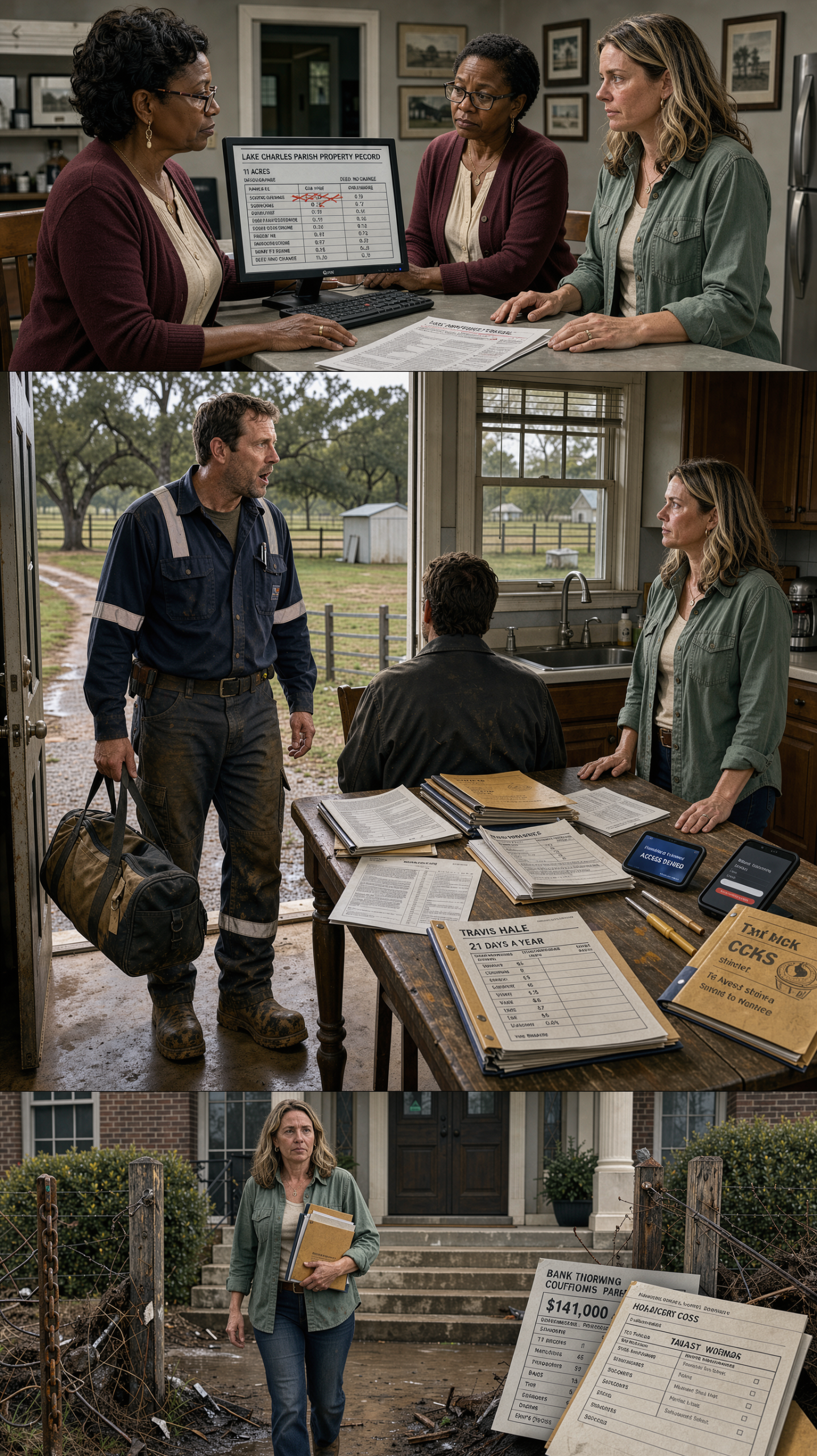
My Husband Locked Me Out of Our Bank Accounts, Then Laughed—But 17 Days Later, He Came Home to Find Someone Waiting at Our Kitchen Table
My husband secretly locked me out of every bank account we shared, then laughed when I confronted him. “I earn the money, so I decide who touches it.” I looked him straight in the eyes and said, “Okay.”
He smiled like he’d just won a war. He had no idea that the war had already started.
And he had no idea what I had discovered at the parish tax office that morning.
My name is Rebecca Hale. I’m 39 years old, and for nine years, I believed my marriage was a partnership.
My husband, Travis Hale, was 43. He earned $141,000 a year working offshore in the oil industry. His schedule was usually 21 days on a rig followed by 21 days at home. People thought we were fortunate.
We owned an 11-acre property outside Lake Charles, Louisiana, with a beautiful two-story house, a detached workshop, a small pond, and enough land to give us privacy.
We had two vehicles, savings accounts, retirement investments, and what I thought was a secure future.
But there was something people didn’t see.
For nine years, I had been the person keeping everything together. When Travis went offshore, I handled everything. I paid the mortgage, property taxes, electricity, insurance, groceries, repairs, and every unexpected expense.
When a storm damaged our roof, I found the contractor. When our septic system failed, I spent three days arranging repairs.
When the tractor broke down, I negotiated with the mechanic.
When the insurance company refused to cover water damage in our workshop, I spent weeks fighting them until they finally paid.
Travis worked hard, and I respected that. But I worked hard too. The difference was that my work never came with a paycheck.
I had a small bookkeeping business that I operated from home, but I gradually reduced my clients because Travis preferred having someone available to manage the property while he was offshore.
He always called it our arrangement. “We’re a team, Rebecca,” he used to say. I believed him.
Until the Monday morning that changed everything.
It began with a declined debit card.
I was standing at the grocery store checkout with a cart full of supplies when the cashier handed my card back.
“Sorry, ma’am. It says transaction declined.” I tried again. Declined. I opened my banking app. A message appeared.
ACCESS TEMPORARILY RESTRICTED. PLEASE CONTACT YOUR FINANCIAL INSTITUTION.
I assumed it was a security issue.
I called the bank from the parking lot.
After verifying my identity, the representative paused.
“Mrs. Hale, I’m seeing that your online access was removed four days ago.”
“Removed by whom?”
“An authorized account holder.”
“That’s impossible. I’m an authorized account holder.”
“Yes, ma’am. But the account access permissions have been changed.”
I felt my stomach tighten.
“Can you tell me who requested that?”
There was a pause.
“Mr. Travis Hale.”
My husband.
I called him immediately.
He answered after the third ring.
“What’s up?”
“Travis, did you change our bank accounts?”
Silence.
Then a chuckle.
“Oh. You noticed.”
I couldn’t believe what I was hearing.
“You removed my access?”
“I reorganized things.”
“Why?”
“Because I’m tired of you spending money without asking.”
I stared through the windshield.
“Travis, I pay the bills. I manage everything.”
“And that’s exactly the problem.”
His voice had changed.
It was cold, almost amused.
“I earn the money, Rebecca. I decide who touches it.”
I felt something inside me go still.
“Are you serious?”
“Completely. If you need something, send me a message. I’ll decide whether it’s necessary.”
“What about the mortgage? The property taxes? The electricity?”
“I’ll handle those.”
“You aren’t even home. You’re offshore!”
“Then you better learn to manage without controlling my money.”
I wanted to scream.
Instead, I took a breath.
“Okay.”
He laughed.
“That’s better. Maybe now you’ll understand how things work.”
Then he hung up.
I sat in the parking lot for almost twenty minutes.
I wasn’t crying.
I was trying to understand how the man I had married could suddenly treat me like a stranger asking for an allowance.
That evening, I opened my laptop and reviewed the accounts I could still access.
My personal savings account had been closed.
Our joint checking account had been converted to an arrangement I couldn’t access online.
The emergency savings account was nearly empty.
And a transfer of $38,500 had been made three days earlier.
I couldn’t see where it went.
I called the bank again.
They couldn’t disclose every transaction detail, but they confirmed that Travis had initiated several transfers.
I wrote everything down.
Then I remembered something.
The property.
Our 11 acres had originally belonged to Travis’s grandfather. When his grandfather died, Travis inherited it.
But when we built the house, I contributed $47,000 from an inheritance my mother had left me.
I also paid for the new fencing, driveway, drainage system, and workshop foundation.
I had always assumed that because we were married, we were protected by the same financial interests.
Now I wasn’t so sure.
The next morning, I drove to the Calcasieu Parish tax office.
I wasn’t looking for a fight.
I wanted to understand what was happening.
A clerk named Denise had helped me several times over the years.
When she saw me, she smiled.
“Rebecca! How are you?”
“Honestly? I’m not sure.”
I explained that I wanted to review the property records.
She typed something into her computer.
“The deed hasn’t changed,” she said.
I exhaled.
“Okay. That’s good.”
But she didn’t smile.
“There’s something else you need to see.”
She turned her monitor slightly.
I leaned forward.
A document appeared on the screen.
It was an application connected to a property transaction.
My husband’s name was listed.
So was our property address.
“What is that?” I whispered.
Denise looked at me carefully.
“It appears your husband has been trying to use the property as collateral for a commercial loan.”
My mouth went dry.
“How much?”
She clicked another document.
“$285,000.”
I gripped the edge of the desk.
“What?”
“That’s what the filing indicates. It looks like a lender requested supporting documentation.”
I stared at the screen.
There was another document.
A property valuation.
An authorization form.
And a signature.
My signature.
Except I had never signed it.
I leaned closer.
The signature looked almost identical to mine.
Almost.
But the letter R was wrong.
I knew because I had signed my name thousands of times on tax documents and business records.
Someone had copied it.
“Denise,” I whispered, “does this mean the property has already been used as collateral?”
She shook her head.
“The deed hasn’t changed, and I can’t determine the final status of the loan from these records. But I strongly recommend you speak with an attorney immediately.”
I couldn’t breathe.
Then I saw another name.
A company called Hale Coastal Holdings LLC.
I had never heard of it.
The application listed Travis as its managing member.
And beneath his name was another person.
Derek Voss.
Travis’s older brother.
Derek had been around our family for years, but he had never been someone I trusted with money.
He had started several businesses.
A trucking company.
A marine equipment company.
A small construction operation.
Every one of them had eventually failed.
Travis always defended him.
“He’s just unlucky,” he’d say.
Now I was looking at a document that connected my husband, his brother, and a $285,000 loan tied to our property.
I asked Denise to print copies of the public records.
She did.
Before I left, she lowered her voice.
“Rebecca, I don’t want to alarm you, but there was another inquiry about this property last month.”
“From whom?”
“A title company.”
My heart sank.
“Why would a title company be interested?”
She shook her head.
“I can’t tell you more than what’s in the record.”
I thanked her and walked outside.
The Louisiana sun felt unusually bright.
I sat in my car and read the documents again.
Then I made a decision.
I wasn’t going home to argue with Travis.
I was going to the courthouse.
At the courthouse, I found the public records department and requested copies of every filing connected to our property and the newly formed company.
I also called an attorney recommended by a woman who had once been my bookkeeping client.
Her name was Margaret Ellis.
She specialized in property disputes, financial fraud, and family law.
Her office was less than ten minutes from the courthouse.
When I arrived, I placed the documents on her desk.
She read silently.
The longer she read, the more serious her expression became.
Finally, she looked up.
“Does your husband know you’ve seen these?”
“No.”
“Good. Don’t tell him yet.”
“Margaret, what am I looking at?”
She tapped the authorization form.
“Possibly an attempt to obtain financing using your property and a forged consent document. We need to verify exactly what was submitted and whether any loan funds were disbursed.”
“What happens if he borrowed the money?”
“That depends on the documents, the lender, the title status, and applicable Louisiana law. But if your signature was forged, that’s a serious matter.”
I swallowed.
“Could they take my house?”
“Don’t panic. We need facts before drawing conclusions. But we should move quickly.”
She asked me several questions.
Had I signed anything recently?
Had Travis ever asked for copies of my identification?
Had I given him access to my email?
Did I know anything about Hale Coastal Holdings?
I answered everything.
Then I remembered something from three months earlier.
Travis had asked me to send him a photograph of my driver’s license.
He said the company needed it for insurance paperwork.
I had sent it without thinking.
Margaret wrote something down.
“That may explain how someone obtained the information needed to prepare the application.”
Then she asked another question.
“Rebecca, do you know why your husband needs $285,000?”
I shook my head.
“Not yet.”
She leaned back.
“Then we need to find out.”
Before I left, she gave me a list of things to do.
Change the passwords to my personal email and bookkeeping accounts.
Secure my identification documents.
Obtain copies of every available financial statement.
Do not sign anything Travis sends me.
And, most importantly, do not confront him about the suspected forged signature.
I followed every instruction.
That evening, I opened an old filing cabinet in our home office.
I had kept years of paperwork because I was the person who managed our household finances.
Mortgage statements.
Tax returns.
Insurance policies.
Contractor invoices.
Bank correspondence.
And a folder marked PROPERTY IMPROVEMENTS.
Inside were receipts showing my contributions to the property.
The $47,000 inheritance.
The $18,600 driveway.
The $12,400 fencing.
The $9,800 drainage system.
The workshop foundation.
Everything.
Then I found something unexpected.
A letter from a company called Gulf Meridian Capital.
It had arrived six weeks earlier.
I remembered placing it in the filing cabinet because I assumed it was junk mail.
I opened it.
The letter was addressed to Travis.
It mentioned an outstanding business obligation connected to Derek Voss.
The amount was $196,000.
My hands began shaking.
There was a sentence near the bottom that made my blood run cold.
“Additional security may be required should the borrower fail to satisfy the outstanding obligation.”
I read it again.
Then I called Margaret.
She told me to photograph the letter and send it to her.
“Don’t contact the company yourself yet,” she said. “I’ll handle that.”
I spent the rest of the evening reviewing every financial document I could find.
Around midnight, I discovered something else.
A bank statement from an account I didn’t recognize.
It had been mailed to our home but addressed to Hale Coastal Holdings LLC.
The balance was $4,217.
But the transaction history showed that nearly $200,000 had moved through the account over several months.
I didn’t understand what the company was doing.
But I understood one thing.
Travis wasn’t simply trying to control our household money.
He was hiding a financial crisis.
And he was trying to use our home to solve it.
The next morning, Margaret called.
“Rebecca, I found something important.”
“What?”
“I contacted the lender through the appropriate channels. They confirmed that an application was submitted for a commercial loan. The application included a document representing that you consented to the use of the property.”
“Was the loan approved?”
“Not yet. There are outstanding verification issues.”
I closed my eyes.
“Can they tell us who submitted it?”
“Your husband and his company are identified as applicants. We’re requesting the complete application file.”
Then she said something that changed everything.
“There’s another problem. The lender has information suggesting that the business has already received money from another source.”
“How much?”
“Approximately $196,000.”
The same amount from the letter.
“Where did it go?”
“That’s what we’re investigating.”
I sat down.
Margaret continued.
“Rebecca, I want you to think carefully. Has Travis ever asked you to transfer money, sign a document, or approve a financial transaction without explaining it?”
I thought about the previous year.
A weekend when Travis had come home unexpectedly.
He had asked me to sign a stack of papers.
“Just routine business documents,” he had said.
I remembered refusing because I wanted to read them first.
He had become irritated.
“Why do you make everything so difficult?”
Eventually, he had taken the papers back.
I told Margaret.
“Do you remember what the documents looked like?”
“One was several pages. I remember seeing the words guarantor and liability.”
There was a pause.
“That’s important,” she said.
Then I remembered something even more disturbing.
A few weeks before he went offshore, Travis had asked me whether I would be willing to put the property in a trust.
He said it was for estate planning.
I had told him I wanted to speak with an attorney first.
He became unusually angry.
“Why do you always assume I’m trying to cheat you?”
I had apologized.
Now I wished I hadn’t.
Over the next three days, Margaret gathered records and contacted the lender.
She also advised me to document every communication with Travis.
I began keeping a notebook.
Every phone call.
Every text.
Every threat.
Every financial detail.
Meanwhile, Travis continued behaving as though nothing unusual had happened.
On Wednesday, he texted me.
Travis: Did you pay the electric bill?
I replied.
Me: I can’t access the account.
Travis: Then call me before doing anything.
A few minutes later, another message arrived.
Travis: And stop asking questions about the bank. I’ve already explained everything.
I didn’t answer.
On Thursday, he called.
“Rebecca, I need you to do something for me.”
“What?”
“There’s a document coming to the house. Sign it and send it back.”
“What document?”
“Just an authorization.”
“For what?”
He sighed loudly.
“God, Rebecca. It’s business paperwork.”
“Then send it to Margaret Ellis.”
Silence.
For several seconds, I heard only the faint sound of machinery behind him.
Then his voice dropped.
“Why are you talking to a lawyer?”
I didn’t answer.
“Rebecca?”
“I have questions about the property.”
He laughed.
“What property? My grandfather left that land to me.”
I felt my fingers tighten around the phone.
“Our house is on that land. I contributed to it. I’ve paid for years of improvements.”
“You paid household expenses. Don’t confuse that with ownership.”
“I didn’t say I owned the land.”
“Then stop acting like you do.”
I took a breath.
“Travis, what is Hale Coastal Holdings?”
The silence that followed was different.
It wasn’t confusion.
It was fear.
“Who told you that name?”
“I found some paperwork.”
“Where?”
“At home.”
He exhaled sharply.
“Listen carefully. You don’t understand business. Derek and I are handling something. It has nothing to do with you.”
“Then why is our property on the loan application?”
He didn’t answer.
Instead, he said something I would never forget.
“Because somebody has to protect what I’ve built.”
“What have you built, Travis?”
He hung up.
On Friday, Margaret called with an update.
She had obtained additional information from the lender.
The $196,000 wasn’t a normal business loan.
It was a debt connected to Derek’s failed marine equipment venture.
Travis had personally guaranteed part of it.
And when Derek stopped making payments, the lender began demanding repayment.
Travis had apparently tried to refinance the debt through Hale Coastal Holdings.
But the company had almost no legitimate operating income.
The lender wanted collateral.
That’s when Travis turned to our property.
“Why didn’t he just tell me?” I asked.
Margaret’s answer was simple.
“Because he may have believed you would refuse.”
I looked at the kitchen window.
The land stretched beyond it, green and peaceful.
Nine years of work.
Nine years of trust.
All of it suddenly felt fragile.
Then Margaret told me something else.
The bank records showed that Travis had transferred approximately $38,500 from our joint savings into an account connected to his brother.
The money had been used to cover overdue business obligations.
I felt sick.
“That’s our emergency fund.”
“I know.”
“That’s the money we saved for storms, medical expenses, repairs.”
“I understand.”
I wiped my eyes.
“Can we get it back?”
“We’ll investigate the transfer and determine what remedies may be available. But I need you to understand something. We cannot assume every dollar is automatically recoverable.”
I nodded, even though she couldn’t see me.
Then she said:
“Rebecca, I want you to come to my office tomorrow. Bring every document you have.”
Saturday morning, Margaret placed three folders on her conference table.
The first contained the property records.
The second contained the loan application.
The third contained financial transactions connected to Hale Coastal Holdings.
She turned the second folder toward me.
“Look at page seven.”
I read the document.
It was a statement claiming that I had reviewed and approved the proposed use of our property as collateral.
At the bottom was my forged signature.
But something else caught my attention.
The date.
It was dated two weeks before Travis left for his offshore shift.
That meant he had prepared everything before locking me out of the accounts.
He hadn’t made a sudden decision.
He had planned it.
Margaret pointed to another page.
“Look at this.”
It was an email printed from the lender’s file.
The sender was Travis.
The subject line read:
SPOUSAL CONSENT — FINAL DOCUMENTATION
The message said:
“Rebecca is aware of the arrangement and has agreed. She prefers not to be involved in business discussions, so please communicate directly with me.”
I stared at it.
I had never agreed.
I had never even heard about the loan.
Then I read the next email.
It was from Derek.
“Once the property is secured, we can settle the old debt and move forward. Rebecca won’t interfere if Travis handles the household money.”
I felt a wave of anger so intense that I had to put the paper down.
They had discussed me like I was an obstacle.
Like I was a problem they could solve by taking away my access to money.
Margaret closed the folder.
“We have enough reason to challenge the application and formally dispute the signature. I’ll also advise you about appropriate protective filings and notifications.”
“Can I stop the loan?”
“We can seek to prevent the property from being used without valid authorization. We need to act quickly.”
I nodded.
“Do it.”
That afternoon, Margaret filed the necessary legal notices and contacted the lender with a formal dispute regarding the alleged forged consent.
She also advised me to preserve the original documents and avoid making any public accusations until the evidence had been reviewed.
I followed her advice.
But something unexpected happened that evening.
I received a text from Travis.
Travis: Derek says you contacted the bank.
I stared at the message.
Another arrived.
Travis: You have no idea what you’re doing.
Then:
Travis: If this deal falls apart, you’re going to regret it.
I took screenshots.
Sent them to Margaret.
And went to bed.
For the first time in nine years, I didn’t feel obligated to explain myself.
By Monday, the lender had temporarily suspended its review of the collateral application pending investigation.
Margaret also received confirmation that the disputed consent document was being examined.
But the biggest surprise came Tuesday.
A woman named Elaine Parker called me.
She introduced herself as a financial investigator working with the lender.
“Mrs. Hale, I understand you’ve disputed a signature on a loan application.”
“Yes.”
“Have you ever authorized your husband to pledge the property as security for Hale Coastal Holdings?”
“No.”
“Have you ever agreed to guarantee the company’s debts?”
“No.”
“Have you ever signed a document dated October 3 authorizing the transaction?”
“No.”
She paused.
“Thank you. I need to ask one more question. Are you aware that your husband listed you as an officer of Hale Coastal Holdings?”
I nearly dropped the phone.
“What?”
“The application identifies you as the company’s financial administrator.”
“I’ve never worked for that company.”
“Did you receive compensation?”
“No.”
“Did you authorize any business transactions?”
“Absolutely not.”
Elaine told me she would document my answers and communicate with the lender’s legal department.
After the call, I contacted Margaret.
She was silent for a moment.
Then she said:
“Rebecca, that may be the most important discovery yet.”
On Wednesday, I found an old laptop in the workshop.
It belonged to Travis.
He had used it before buying his newer computer, and I had forgotten it was there.
I wasn’t interested in snooping through personal messages.
But it contained financial documents related to the property, and Margaret had advised me to preserve anything relevant.
I turned it on.
The desktop was filled with folders.
One was labeled BUSINESS.
Another was labeled DEREK.
Inside the Derek folder, I found spreadsheets, invoices, and emails.
Then I found a PDF.
Its name was:
PROPERTY EXIT PLAN.
My hands went cold.
I opened it.
The document outlined a proposed transaction involving our 11 acres.
The plan was to obtain financing using the property as collateral, settle Derek’s outstanding debt, and then arrange a sale or transfer of the property through a separate company.
There was a projected sale value of $625,000.
The document also listed estimated proceeds after outstanding obligations.
At the bottom was a note.
“Rebecca should remain unaware until financing is completed. Her access to the household accounts must be restricted to prevent interference.”
I read it twice.
Then I saw another line.
“Once the transaction closes, Travis can relocate and establish the new residence.”
Relocate?
I scrolled further.
There was a proposed apartment lease in Lafayette.
A budget for furniture.
A payment schedule.
And a name attached to the apartment application.
Not mine.
A woman named Kendra Mills.
I recognized the name.
Kendra was a woman Travis had introduced to me at a company gathering the previous year.
He had described her as an administrative assistant who helped coordinate offshore contractors.
I remembered how she had looked at him.
How she had laughed at everything he said.
How Travis had insisted on driving her home after the event.
At the time, I hadn’t thought much about it.
Now I was looking at an apartment budget listing both their names.
I closed the laptop.
My hands were shaking.
This wasn’t only about money.
Travis had been planning a future that didn’t include me.
He had been preparing to use our home, our savings, and possibly my identity to finance his escape.
And he had expected me to remain quiet.
I called Margaret.
She told me to preserve the laptop without altering anything and arrange for proper forensic review.
“Do not confront him,” she repeated.
I promised.
But I knew something else.
Travis was coming home in a few days.
And I wanted him to see exactly what he had done.
Thursday morning, Margaret called.
“Rebecca, I have an update.”
I sat at the kitchen table.
“What happened?”
“The lender has received the disputed signature and supporting documentation. The application is now under formal review. The company cannot proceed with the proposed collateral transaction while these issues remain unresolved.”
I exhaled.
“Does Travis know?”
“He has been notified.”
I looked at my phone.
There were already three missed calls from him.
Then Margaret continued.
“We’ve also learned that the property was being marketed privately through a broker.”
My stomach tightened.
“Without my knowledge?”
“Yes. The broker has been provided with the documents, and we’ve requested preservation of all communications.”
I remembered Denise mentioning the title company inquiry.
Everything was connected.
“Margaret, what happens now?”
“We continue protecting your position, establish the facts, and let the legal process take its course.”
I nodded.
Then she said:
“One more thing. I have arranged for a meeting tomorrow with a representative from the lender and an independent property specialist. I think you should attend.”
“Why?”
“Because they have questions about the transaction, and your testimony about the disputed authorization is important.”
I agreed.
That afternoon, I received a call from Travis.
I answered.
“What have you done?” he shouted.
I held the phone away from my ear.
“What are you talking about?”
“The loan is frozen!”
“Maybe you should ask your lender.”
“Don’t play games with me, Rebecca.”
I said nothing.
“Do you understand what you’ve cost me?”
“What did I cost you, Travis?”
He hesitated.
Then he shouted:
“Everything!”
I closed my eyes.
For nine years, I had heard that man talk about sacrifice.
His sacrifice offshore.
His sacrifice working long shifts.
His sacrifice missing holidays.
But he had never once acknowledged what I had sacrificed to make his life easier.
“Travis,” I said quietly, “you locked me out of our accounts.”
“Because I needed control!”
“You used my signature without permission.”
“I was handling business!”
“You listed me as an officer of a company I’ve never worked for.”
“Because it made the application easier!”
“And you planned to sell the property without telling me.”
He went silent.
Then he said:
“You’re making a huge mistake.”
I almost laughed.
“No, Travis. I think the mistake was believing you.”
I ended the call.
Friday’s meeting was held in Margaret’s office.
Present were Margaret, the lender’s investigator, Elaine Parker, and an independent property specialist named Thomas Reed.
Thomas had reviewed the documents and the proposed collateral transaction.
He placed a thick folder on the table.
“Mrs. Hale, I want to explain what we found.”
He opened the folder.
“The loan application contained several representations about the property, the company’s finances, and your involvement.”
He showed me the signature again.
“We’ve received your statement that this is not your signature. The lender is investigating the document’s origin.”
He turned another page.
“The application also represented that you were a financial officer of Hale Coastal Holdings.”
I shook my head.
“I’ve never been employed by that company.”
“Understood.”
Then he showed me the property valuation.
The estimated market value was $625,000.
I recognized the figure from Travis’s exit plan.
“Was the property going to be sold?”
Thomas exchanged a glance with Elaine.
“The documents indicate that a sale or transfer was being considered as a possible next step. We cannot yet say exactly how far those arrangements progressed.”
Margaret leaned forward.
“And the outstanding debt?”
Elaine answered.
“The $196,000 obligation is connected to Mr. Voss’s previous business. Mr. Hale appears to have become involved in attempts to refinance or restructure it.”
I looked down.
“Why would my husband risk our home for his brother’s debt?”
Nobody answered.
Because the answer was obvious.
Travis had decided his brother’s problems mattered more than my security.
Then Thomas pulled out another document.
It was a printed email.
From Derek to Travis.
The date was September 18.
The message contained one sentence.
“Once Rebecca is out of the picture, everything becomes easier.”
I felt my throat tighten.
Margaret read it carefully.
Then she looked at me.
“Rebecca, are you okay?”
I nodded.
But I wasn’t.
Not really.
I had spent nine years believing my husband and I were building a life together.
Now I was learning that while I was fixing fences, paying taxes, and managing repairs, he was quietly planning how to remove me from the very life I had helped maintain.
Saturday morning, I received a call from Travis.
His voice was strangely calm.
“Rebecca, we need to talk.”
“About what?”
“Everything.”
I didn’t respond.
“I’ve been under a lot of pressure. Derek’s situation got complicated. I made some decisions.”
“You locked me out of our bank accounts.”
“I was trying to protect the money.”
“You transferred $38,500 to your brother.”
“That was temporary.”
“You submitted a document with my forged signature.”
“I didn’t forge anything.”
“Then explain why it isn’t mine.”
He went quiet.
Finally, he said:
“Listen. When I get home, we’ll sit down and work this out.”
“With Margaret?”
“No lawyers.”
“Then there’s nothing to discuss.”
His voice sharpened.
“Rebecca, I’m your husband.”
I looked at the wedding photograph on the shelf.
Nine years earlier, I had stood beside him and promised to build a life together.
I wondered whether he had ever meant it.
“That used to mean something,” I said.
Then I hung up.
On Sunday afternoon, Margaret called.
“Rebecca, I have an update about the lender’s review.”
I sat down.
“What is it?”
“The lender has confirmed that the disputed application will not proceed in its current form. They have referred the suspected misrepresentation for further review.”
I closed my eyes.
“Does that mean the property is safe?”
“It means the proposed financing has been stopped for now. We still need to resolve the underlying property and financial issues, but the lender is not moving forward with the application as submitted.”
I thanked her.
Then she added:
“There’s something else. The investigator has requested a meeting with your husband.”
I looked at the calendar.
Travis was scheduled to return home the following day.
“Will he know about the meeting?”
“Yes.”
I felt a strange calm settle over me.
For seventeen days, I had been gathering documents, making calls, and learning things about my marriage that I never wanted to know.
Now the waiting was almost over.
I didn’t know whether Travis would apologize.
I didn’t know whether he would become angry.
But I knew I wouldn’t be the woman who stood silently in the kitchen while he explained why she wasn’t allowed to touch her own money.
Monday arrived.
At 8:14 a.m., Travis texted me.
Travis: Flight landed. I’ll be home around noon.
I read it without replying.
At 10:30, I drove to Margaret’s office.
She handed me a folder.
Inside were copies of the disputed loan application, the financial records, the lender’s correspondence, and the documents showing the proposed property transaction.
There was also a letter requesting that Travis attend a formal meeting regarding the application.
“Are you sure you want to be there when he arrives?” Margaret asked.
I nodded.
“Yes.”
“Then remember that you don’t have to argue. You don’t have to explain. Let the documents speak.”
At 11:45, I returned home.
I cleaned the kitchen.
Made coffee.
Placed four glasses on the table.
Then I sat down.
Beside me was Margaret.
Across from her sat Elaine Parker, the lender’s investigator.
Thomas Reed, the property specialist, was seated near the window.
A fourth person was waiting in the living room.
His name was Detective Aaron Miller.
He had been assigned to review the suspected document fraud after the lender referred the matter to the appropriate authorities.
No one was there to threaten Travis.
No one was there to punish him before the facts were established.
We were there because the documents required answers.
At 12:07, I heard a vehicle pull into the driveway.
The familiar sound of Travis’s truck.
A door slammed.
Footsteps crossed the porch.
Then the front door opened.
“Rebecca?”
He stepped inside with his travel bag.
His eyes moved across the room.
First, Margaret.
Then Elaine.
Then Thomas.
Finally, he saw Detective Miller.
His face changed.
“What is this?”
Nobody answered immediately.
He looked at me.
“What the hell is going on?”
I stood.
“Welcome home, Travis.”
He dropped his bag beside the door.
“Who are these people?”
Margaret spoke calmly.
“Mr. Hale, I’m Margaret Ellis. I’m representing Rebecca in matters involving the property and the disputed financial documents.”
Travis stared at her.
“She’s hired a lawyer?”
“Yes.”
He turned toward me.
“You’ve got to be kidding.”
I didn’t respond.
Elaine introduced herself.
“I’m with the lender’s investigation team. We need to discuss the commercial loan application submitted by Hale Coastal Holdings.”
Travis’s jaw tightened.
“That’s a business matter.”
“It involves a property transaction connected to your marital residence,” Elaine replied.
He looked at Detective Miller.
“And you?”
“I’m reviewing a referral concerning a disputed authorization document.”
Travis’s face lost color.
He turned to me.
“Rebecca, what have you done?”
I pointed to the chair across from me.
“Sit down.”
He laughed nervously.
“You’re giving me orders now?”
“No. I’m asking you to sit down so we can finally talk about the truth.”
He didn’t move.
Then his eyes fell on the folder in front of Margaret.
He recognized the first page.
I saw it happen.
His expression changed.
He knew exactly what was inside.
Margaret opened the folder.
“Mr. Hale, we’d like to discuss the authorization bearing your wife’s name, the $285,000 financing application, and the transfer of funds connected to your brother’s outstanding business debt.”
Travis looked at Elaine.
“That application wasn’t completed.”
“That’s correct,” she said. “It was suspended pending verification.”
“Then there’s no problem.”
Thomas spoke.
“That’s not accurate. The property was represented as available collateral, and the application included a document claiming your wife’s consent.”
Travis rubbed his forehead.
“It was a misunderstanding.”
I finally spoke.
“A misunderstanding?”
He looked at me.
“Rebecca, please.”
“Did I sign that document?”
He didn’t answer.
“Did I agree to put our property at risk?”
Silence.
“Did I agree to become an officer of your company?”
He stared at the table.
“Did you transfer our emergency savings to Derek?”
His voice rose.
“I was trying to save my family!”
I leaned forward.
“Which family, Travis? The one you married into, or the one you were secretly building with your brother and Kendra?”
His head snapped up.
“What?”
I opened the folder and placed the apartment budget on the table.
His eyes widened.
“Where did you get that?”
“The laptop.”
“You had no right to go through my computer!”
I looked at him.
“You used my identity, locked me out of our accounts, and planned to sell the property I helped maintain. And you’re worried about a laptop?”
He looked toward Margaret.
“This is ridiculous.”
Margaret didn’t move.
“Mr. Hale, I suggest you answer the questions put to you through the appropriate process.”
Travis looked at me again.
For the first time in nine years, I saw something in his expression I had never seen before.
Fear.
Not anger.
Not arrogance.
Fear.
He pulled out the chair and sat down.
For the next hour, the documents spoke.
Elaine explained the lender’s findings.
Thomas described the proposed transaction.
Margaret presented the property records and my financial contributions.
Detective Miller asked Travis several questions about the disputed signature.
Travis denied forging it.
He said he had believed I would approve the application.
But when asked why he had told the lender that I had already signed and consented, he couldn’t provide a clear explanation.
Then came the email from Derek.
“Rebecca won’t interfere if Travis handles the household money.”
Travis stared at the page.
“That’s out of context.”
Margaret asked:
“What context makes that statement accurate?”
He said nothing.
Then Detective Miller placed another document on the table.
It was a copy of the company registration.
“Mr. Hale, can you explain why your wife is listed as a financial administrator of this company?”
Travis swallowed.
“It was for paperwork.”
“Did she authorize that appointment?”
“I assumed she wouldn’t mind.”
I felt something break inside me.
Not because he had lied.
Because he still believed my permission was something he could assume.
I spoke quietly.
“You didn’t ask me because you knew I’d say no.”
He looked at me.
“Rebecca, I was trying to fix things.”
“You were trying to fix Derek’s debt with my life.”
He shook his head.
“You don’t understand what he was going through.”
I stared at him.
“And what about me?”
He opened his mouth.
Nothing came out.
I continued.
“For nine years, I paid the bills. I maintained the property. I managed everything while you were offshore. When the roof leaked, I fixed it. When the insurance company refused to pay, I fought them. When the workshop flooded, I handled it. I never asked you to send me a paycheck for doing your half of our life.”
My voice trembled.
“And the moment I asked why my bank card stopped working, you laughed.”
Travis looked down.
I wiped my eyes.
“You said you earned the money, so you decided who could touch it.”
He whispered:
“I was angry.”
“No. You were comfortable.”
The room became silent.
“You were comfortable believing I would always stay quiet. You were comfortable believing that because I loved you, I would let you make every decision. And you were comfortable believing that if you took away my access to money, I would have nowhere to go.”
I looked him directly in the eyes.
“But you forgot something.”
He raised his head.
“I had nine years of records.”
The meeting ended shortly afterward.
Travis was advised to direct further responses through the appropriate legal channels.
Detective Miller made it clear that the investigation was ongoing and that no final determination had yet been made.
Elaine confirmed that the lender would not proceed with the disputed collateral application.
Thomas left with copies of the property-related documents.
Margaret remained.
Travis stood in the doorway, looking at me.
“Rebecca, can we talk alone?”
I shook my head.
“Not today.”
“Please. I’m your husband.”
I looked at him for a long moment.
“You’re the man who locked me out of our bank accounts and laughed.”
He lowered his eyes.
Then he said:
“I made a mistake.”
I answered quietly.
“You made a plan.”
He had no response.
He picked up his travel bag and walked upstairs.
I heard the bedroom door close.
For the first time in nine years, the house felt peaceful.
The following weeks were difficult.
Travis moved into a temporary apartment.
Margaret filed the necessary divorce proceedings and continued addressing the property and financial issues.
The lender’s review uncovered additional inconsistencies in the application, and the suspected misuse of my signature remained under investigation.
Derek called me twice.
The first time, he said I was destroying his brother’s life.
The second time, he asked whether I would consider withdrawing my complaint.
I told him to contact Margaret.
He never called again.
Kendra also disappeared from the picture.
I later learned that the apartment arrangement had never been finalized.
Travis had apparently promised her a fresh start after the property transaction.
He had promised me a secure future, too.
Apparently, he had become very good at promising things.
The $38,500 transfer became part of the financial dispute. Some of the funds were traced to payments toward Derek’s business obligations, and Margaret worked to establish what could legally be recovered.
The house remained at the center of the property proceedings.
Because the land had originally been inherited by Travis, the legal position was more complicated than I had once imagined. My contributions did not automatically make me the owner of the land, but the records of my inheritance, payments, and improvements mattered in determining the financial issues between us.
I was grateful I had kept everything.
Every receipt.
Every statement.
Every invoice.
Every tax document.
My bookkeeping habit had saved me from losing the truth.
Three months later, Travis asked to meet me at Margaret’s office.
He arrived looking exhausted.
His expensive offshore work jacket was wrinkled, and he had dark circles beneath his eyes.
He sat across from me.
“Rebecca, I want to apologize.”
I waited.
“I know I hurt you.”
He looked at his hands.
“I thought if I controlled the accounts, I could keep everything from falling apart.”
“By keeping me in the dark?”
“I was ashamed.”
“Of what?”
“Derek’s debt. The business. The money. Everything.”
I looked at him.
“Why didn’t you tell me?”
He shook his head.
“Because I knew you wouldn’t agree to the loan.”
He was finally telling the truth.
“And you thought that gave you the right to use my signature?”
“No.”
“To list me as an officer of a company I didn’t know existed?”
“No.”
“To plan a sale of the property without telling me?”
He swallowed.
“I thought I could fix it before you found out.”
I leaned back.
“That’s what people say when they want forgiveness without accepting responsibility.”
His eyes filled with tears.
“I still love you.”
For a moment, I felt the old instinct to comfort him.
The old Rebecca would have reached across the table.
She would have told him everything would be okay.
She would have found another way to make his problems smaller.
But that woman had spent nine years carrying responsibilities that weren’t hers.
I wasn’t going to become her again.
“I loved you too, Travis,” I said. “But love doesn’t mean giving someone permission to destroy your security.”
He wiped his eyes.
“Is there any chance we can start over?”
I looked at the man sitting across from me.
I remembered our wedding.
Our first house.
The nights I stayed awake waiting for his offshore calls.
The storms we survived.
The years I spent believing that being a good wife meant never making his life more difficult.
Then I remembered his laughter.
“I earn the money, so I decide who touches it.”
I shook my head.
“No, Travis. There isn’t.”
Six months later, the divorce was finalized through a negotiated settlement.
The property and financial matters were resolved based on the legal findings, the available records, and the applicable Louisiana rules.
I received a financial settlement that recognized my documented contributions and resolved the disputed household assets.
The proposed $285,000 loan never closed.
The property was not transferred through the scheme described in the documents.
The investigation into the suspected forged authorization continued separately.
I moved into a smaller home outside Lake Charles.
It had three bedrooms, a little porch, and a backyard with two enormous oak trees.
It wasn’t 11 acres.
It didn’t have a workshop or a pond.
But every key belonged to me.
I restarted my bookkeeping business and took on new clients.
Within four months, I had more work than I could comfortably handle.
One afternoon, while organizing my new office, I found an old photograph.
It showed Travis and me standing in front of our first house.
We were both smiling.
I studied the photograph for a long time.
I didn’t hate him.
That surprised me.
I had expected anger to stay forever.
Instead, I felt something quieter.
Relief.
I placed the photograph in a drawer and returned to work.
One year after Travis locked me out of our accounts, I received an unexpected email.
The sender was Elaine Parker.
She informed me that the lender’s review had concluded that the application contained material misrepresentations, including the disputed spousal authorization.
The matter had been referred to the relevant authorities for further action.
She also thanked me for cooperating.
I closed the email.
Then I walked outside.
It was a beautiful Louisiana morning.
The air smelled like wet grass, and sunlight filtered through the oak trees.
My phone rang.
It was an unknown number.
I answered.
“Hello?”
A familiar voice spoke.
“Rebecca?”
Travis.
I almost hung up.
But something made me wait.
“I heard the investigation is moving forward,” he said.
“Yes.”
“I never wanted things to end this way.”
I looked at the little house around me.
“You should have thought about that before you used my name.”
He was silent.
Then he asked:
“Do you ever miss us?”
I thought about the question.
I missed the man I thought I had married.
I missed the future I thought we were building.
I missed the version of our marriage that existed before I discovered the truth.
But I didn’t miss being controlled.
“I miss who I thought you were,” I said.
Then I ended the call.
I stood on my porch for several minutes, listening to the birds.
And I finally understood something.
For nine years, Travis had believed that because he earned the larger paycheck, he held all the power.
He thought the person bringing home the money was the person who mattered.
He never understood that the person keeping the entire household running had been holding everything together.
He had locked me out of the bank accounts.
He had tried to use my signature.
He had planned a future without me.
But the one thing he couldn’t take away was the truth.
And the truth was sitting in those folders long before he came home.
The day Travis opened our front door and saw four people waiting at the kitchen table, he thought he was walking into an argument with his wife.
He was actually walking into the consequences of nine years of believing she would never fight back.
I had said “Okay” when he told me he controlled the money.
And for seventeen days, he believed that meant I had surrendered.
He was wrong.
I hadn’t surrendered.
I had simply stopped asking permission to protect myself.