My Mother Told Me Not to Ruin My Sister’s Wedding Over a Little Paperwork—Then the Bank Revealed Who Had Stolen My Identity
The call came while my sister was opening gifts at her bridal shower. I was standing in my aunt’s laundry room, holding a paper cup of lemonade, when an unfamiliar number appeared on my phone.
Normally, I ignored calls from numbers I didn’t recognize. But something made me answer.
“Hello?” “Good afternoon. May I speak with Megan Carter?”
“This is Megan.”
“My name is Rebecca. I’m calling from the fraud prevention department at First National Bank. I’m contacting you about a transaction that requires immediate verification.” I frowned. “What transaction?”
There was a brief pause. “Did you authorize a charge of $14,860 to Bellweather Hall?”
I stopped breathing for a moment. Bellweather Hall.
I knew that name.
It was the elegant wedding venue my younger sister, Allison, had chosen for her upcoming wedding. The place had marble floors, enormous crystal chandeliers, a private garden, and a ballroom that looked like something from a royal palace.
It was also incredibly expensive. “No,” I answered. “I didn’t authorize anything.”
“Are you familiar with the merchant?”
“Yes. It’s my sister’s wedding venue. But I don’t have an account with your bank, and I certainly didn’t pay for her wedding.”
Another pause. “Ms. Carter, according to our records, the transaction was made using a credit account opened in your name approximately six weeks ago.” My stomach tightened. “That’s impossible. I’ve never opened an account with First National.”
“That’s why we’re calling. The account was opened online, and the application passed our initial identity verification. However, several details have triggered a fraud alert.”
“What details?” “Before I disclose those, I need you to confirm that you did not submit the application.”
I opened my mouth.
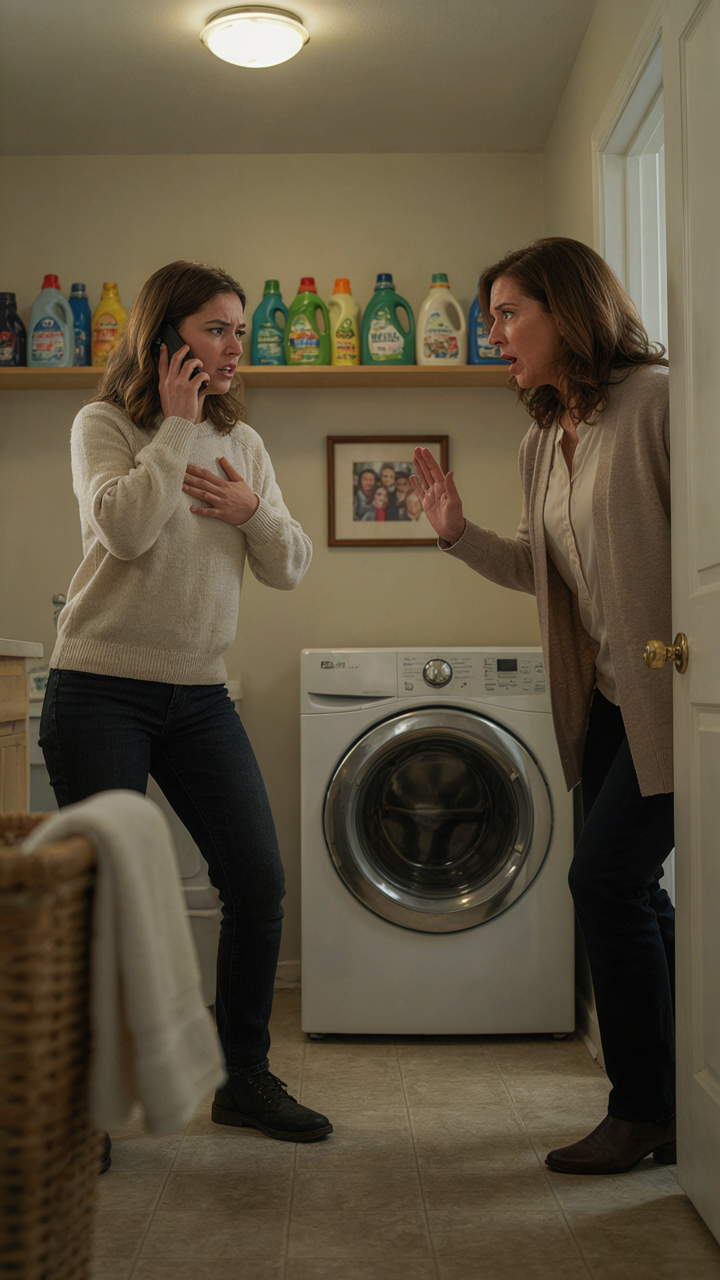
But before I could answer, the laundry room door swung open.
My mother, Denise, stepped inside.
She glanced at my phone, then at my face.
Something changed in her expression.
She closed the door behind her.
“Who are you talking to?” she whispered.
I covered the phone.
“The bank.”
Her face went pale.
Then she hissed, “Megan, don’t you dare ruin your sister’s wedding over a little paperwork.”
For several seconds, I couldn’t move.
I stared at her.
“What?”
She approached me and lowered her voice.
“Just tell them everything is fine. Allison has enough stress right now.”
The woman on the phone was still speaking.
“Ms. Carter? Are you there?”
I looked at my mother.
Then I asked the question that would change everything.
“Mom, how do you know what this call is about?”
She didn’t answer.
Instead, she reached for my phone.
And that was when I finally understood.
My mother knew something.
Something she desperately didn’t want me to discover.
I pulled the phone away.
“Ma’am,” Rebecca said, “I need a clear answer. Did you authorize this account?”
I looked directly at my mother.
“No,” I said. “I did not.”
My mother’s face hardened.
And just like that, the perfect family picture began to fall apart.
My name is Megan Carter.
I was thirty-four years old, worked as an accountant for a medical supply company, and had spent most of my adult life trying to be the responsible daughter.
My younger sister, Allison, was thirty-one.
She was beautiful, charming, and had a talent for making everyone feel like they were the most important person in the room.
Growing up, Allison was the golden child.
She got the bigger bedroom.
She got the new clothes.
She got the expensive birthday parties.
When she wanted something, my mother found a way to provide it.
When I wanted something, I was told to be understanding.
“You’re the older one, Megan.”
That sentence followed me everywhere.
If Allison broke something, I was supposed to forgive her.
If she borrowed my clothes and ruined them, I was supposed to understand.
If she needed money, I was supposed to help.
My father, Robert, had been different.
He loved both of us, but he never pretended we were treated equally.
Before he died eight years earlier, he once told me something I never forgot.
“Being the responsible one doesn’t mean you should spend your whole life cleaning up everyone else’s mess.”
I had smiled at the time.
I didn’t understand how important those words would become.
After Dad died, my mother leaned on me even more.
I helped with household bills.
I paid for repairs to her car.
I covered Allison’s rent twice when she was between jobs.
I even paid off a $6,200 credit card balance after she promised she would repay me.
She never did.
Whenever I brought it up, Mom would sigh.
“She’s your sister, Megan. Don’t make everything about money.”
So I stopped asking.
I thought I was buying peace.
I didn’t realize I was teaching them that my boundaries could always be ignored.
Then Allison met Brandon.
Brandon was a successful real estate agent who drove a black luxury SUV and wore expensive watches.
He proposed after eleven months of dating.
Allison announced the engagement on social media with a photograph of a diamond ring and the words:
Finally getting the wedding I’ve always dreamed of.
My mother immediately began planning.
The venue was Bellweather Hall.
The guest list had more than two hundred people.
There would be a live band, imported flowers, a designer wedding dress, and a five-tier wedding cake.
I was happy for Allison.
At least, I tried to be.
But three weeks before the bridal shower, she called me with an unusual request.
“Megan, can you send me your Social Security number?”
I laughed.
“Why?”
“It’s for a wedding vendor application.”
“What kind of vendor needs my Social Security number?”
She hesitated.
“Mom said you might be able to help us qualify for something.”
I felt uncomfortable.
“Allison, I’m not signing up for anything.”
“Oh my God, Megan. It’s just a form.”
“Then use your information.”
She sighed dramatically.
“Forget it. You’re always making things difficult.”
I thought that was the end of it.
Apparently, it wasn’t.
The bridal shower was held at my aunt Patricia’s house on a sunny Saturday afternoon.
My aunt had a beautiful garden, a spacious kitchen, and a large laundry room where she stored extra decorations and folding tables.
There were pink balloons everywhere.
A white banner read:
BRIDE TO BE — ALLISON CARTER
Women were gathered around the dining table, opening gifts and drinking champagne.
Allison sat in the center wearing a pale pink dress.
Brandon stood beside her, smiling as relatives handed her expensive gifts.
My mother was practically glowing.
Everything looked perfect.
Except I was standing in a laundry room listening to a fraud specialist explain that someone had opened a credit account in my name.
“Ms. Carter,” Rebecca continued, “we found several concerning details.”
I leaned against the washing machine.
“What details?”
“The application used your full legal name, date of birth, Social Security number, and a previous residential address.”
I swallowed.
“Where was the account opened?”
“Online. The application was submitted using an email address that appears to be associated with a family member.”
My eyes moved toward my mother.
“Can you tell me the email address?”
Rebecca read it aloud.
It was an old email address my mother had used for years.
I felt something cold settle in my chest.
“Was there a phone number attached?”
“Yes. The number ends in 4419.”
My mother’s phone.
I looked at her.
She was now shaking her head slightly, silently warning me to stop.
“Please freeze the account,” I told Rebecca. “And flag the transaction.”
“Certainly. We’ll also send you the fraud affidavit and application details. We recommend that you report the identity theft.”
“Thank you.”
Before ending the call, Rebecca said something that made my stomach drop.
“There’s one more thing, Ms. Carter.”
“What?”
“The account has a credit limit of $25,000. The $14,860 payment to Bellweather Hall is not the only transaction.”
I closed my eyes.
“What else?”
“Three smaller transactions totaling $2,740 were made over the past month. Two were at jewelry retailers, and one was at a luxury department store.”
I felt dizzy.
“Jewelry?”
“Yes. The merchants are listed here as separate purchases.”
I knew immediately.
Allison’s engagement ring.
Her bridal jewelry.
The designer handbag she had proudly shown me two weeks earlier.
I had assumed Brandon had purchased those things.
Apparently, someone else had paid.
“Please send me everything,” I whispered.
“We will.”
The call ended.
For a moment, I stood completely still.
Then my mother spoke.
“You didn’t have to do that.”
I turned toward her.
“Do what?”
“Make it sound like someone committed a crime.”
I stared at her.
“Someone opened a credit account in my name.”
“Don’t be dramatic.”
“Someone spent nearly eighteen thousand dollars using my identity.”
“It was for Allison.”
I actually laughed.
Not because anything was funny.
Because I couldn’t believe what I was hearing.
“Mom, you just admitted you know about it.”
Her eyes filled with tears.
“Your sister needed help.”
“Then why didn’t she ask me?”
“Because you would have said no.”
The words landed harder than a slap.
I looked at her for several seconds.
Then I asked quietly:
“Did you use my information?”
She turned away.
That was answer enough.
I walked out of the laundry room.
The party was still going.
Allison was holding up a silver picture frame while everyone applauded.
My aunt Patricia noticed me first.
“Sweetheart, are you okay? You look pale.”
“I’m fine.”
My mother came out behind me.
She immediately approached Allison and whispered something in her ear.
Allison’s smile disappeared.
She placed the gift down and walked toward me.
“What did you do?”
I looked at her.
“Excuse me?”
“You called the bank?”
I felt my jaw tighten.
“How do you know about the bank?”
She glanced at Mom.
That single glance told me everything.
“Allison,” I said slowly, “did you know someone opened a credit account in my name?”
She rolled her eyes.
“Oh my God. It’s not what you think.”
“Then explain it.”
She lowered her voice.
“Brandon and I needed to secure the venue. Mom said you could help us temporarily.”
“By opening a credit card in my name?”
“You’re making it sound terrible.”
“It is terrible.”
Her face turned red.
“We were going to pay it back!”
“With whose money?”
“Brandon has commissions coming in.”
“When?”
“Why are you interrogating me?”
I took a breath.
“Because my name is on the account.”
She crossed her arms.
“You have a good job. You have savings. You don’t even have children. You don’t have the expenses I have.”
For a moment, I couldn’t believe she had said that.
Then she continued.
“You can afford to help.”
I looked at my mother.
She was standing behind Allison, nodding.
As if my sister had just made a reasonable argument.
I realized then that they hadn’t seen what they did as theft.
They had seen it as redistribution.
They believed my money, my credit, and my future were family resources available whenever Allison wanted something.
And I had helped create that belief by never saying no strongly enough.
“Listen carefully,” I said.
“I am not paying for this wedding. I am not accepting responsibility for this account. And I will not lie to the bank.”
Allison’s eyes widened.
“You’re going to destroy my wedding?”
“No. I’m refusing to let you destroy my credit.”
She started crying.
My mother stepped forward.
“How can you be so selfish?”
I looked at her.
“How can you be so comfortable stealing from your own daughter?”
The room went silent.
A cousin stopped pouring champagne.
My aunt Patricia slowly put down the gift she was holding.
Allison covered her mouth.
Mom looked around, horrified that other people had heard me.
“Not here,” she whispered.
I picked up my purse.
“You’re right. Not here.”
Then I walked outside.
That evening, I sat at my kitchen table with my laptop open.
I had received an email from First National Bank.
Attached were copies of the credit application, the transaction history, and the electronic authorization records.
I opened the application first.
My full name.
My birth date.
My Social Security number.
My former address.
Everything was accurate.
But the signature field contained a digital signature that wasn’t mine.
It was a typed version of my name.
The email address belonged to my mother.
The phone number belonged to her.
The application had been submitted from an internet connection registered to my mother’s house.
I downloaded everything.
Then I opened the transaction history.
ACCOUNT ACTIVITY — FIRST NATIONAL BANK
Wedding venue deposit
$14,860
Jewelry retailer
$1,180
Department store
$1,060
Online luxury retailer
$500
Total unauthorized spending
$17,600
I stared at the screen.
Then I noticed something else.
The account had been opened six weeks earlier.
But the wedding venue charge had been made only four days ago.
That meant someone had been using the account long before the bridal shower.
I scrolled through the documents.
There was a second attachment.
A copy of the original credit application verification.
It included a recorded verification call.
I clicked play.
A woman’s voice came through the speakers.
“Hello, this is Megan Carter.”
I froze.
It sounded like me.
Not exactly, but close enough that someone unfamiliar with my voice might have believed it.
The recording continued.
“Yes, I understand the account terms. I authorize the application.”
I stopped the recording.
My hands were shaking.
Someone hadn’t simply stolen my information.
Someone had attempted to imitate my voice.
I called the fraud department again.
Rebecca answered.
“I received the documents,” I said. “There’s a recorded verification call. That isn’t my voice.”
“We noticed that during our review. We have escalated the account to our identity theft investigation team.”
“Can you tell where the call came from?”
“That information will be reviewed by our investigators. We can preserve the recording and related records.”
“Please do.”
After the call, I sat in silence.
Then my phone rang.
Allison.
I ignored it.
She called again.
Then a text appeared.
You need to fix this before Monday.
Another message followed.
Mom says you’re overreacting.
Then:
Brandon already paid the wedding planner based on the venue confirmation.
I stared at the message.
She was worried about the wedding planner.
Not my stolen identity.
Not the $17,600.
Not the fact that I could spend years repairing my credit.
The wedding.
I put my phone facedown.
For the first time in my life, I wasn’t going to rush to rescue my sister.
The next morning, I drove to my mother’s house.
I wanted to hear the truth directly.
She opened the door wearing her robe.
“Megan? What are you doing here?”
“We need to talk.”
She sighed and stepped aside.
I walked into the living room.
On the coffee table were wedding magazines, floral samples, and a stack of printed invoices.
I placed my bank documents on top.
“Tell me exactly what happened.”
She looked at the papers.
Then she sat down.
“Your sister was short on money.”
“How short?”
“About twenty thousand.”
“Why?”
She rubbed her forehead.
“Brandon’s business had a difficult quarter. They had already booked the venue, and the final deposit was due.”
“So you opened a credit account in my name.”
She looked away.
“I didn’t think it would become a problem.”
“Did Allison ask you to do it?”
She hesitated.
“She knew I was trying to help.”
“That’s not an answer.”
My mother finally looked at me.
“Yes. We discussed it.”
I felt my stomach turn.
“Both of you?”
“She was desperate, Megan.”
“And what about the jewelry purchases?”
Mom looked uncomfortable.
“Those were necessary.”
“Necessary?”
“She needed wedding accessories. And Brandon wanted to make sure she had something beautiful.”
I stared at her.
“So you used my identity to buy her a handbag and jewelry?”
“You’re making it sound worse than it was.”
I leaned forward.
“Mom, did you record that verification call?”
She said nothing.
“Did you imitate my voice?”
Her face crumpled.
“I was trying to help.”
I stood up.
“You’re my mother.”
“I know.”
“You’re supposed to protect me.”
She began crying.
For a moment, I felt the old instinct rise inside me.
The instinct to comfort her.
To apologize.
To make everything easier.
But then I remembered Dad’s words.
Being responsible doesn’t mean spending your life cleaning up everyone else’s mess.
I picked up my documents.
“Don’t contact the bank on my behalf. Don’t use my information again. And don’t ask me to lie.”
She grabbed my wrist.
“Megan, please. If this gets out, Allison’s wedding will be ruined.”
I gently pulled away.
“Then you should have thought about that before you used my name.”
On Monday, I met with an attorney named Daniel Brooks.
He specialized in identity theft and financial fraud.
After reviewing the documents, he leaned back in his chair.
“This is serious.”
“I know.”
“Your mother appears to have had access to your personal information. Your sister may have benefited from the transactions. But we need to establish who actually submitted the application and who authorized the purchases.”
“Will I be responsible for the debt?”
“Not if you can establish that the account was fraudulently opened. We will work with the bank, preserve the evidence, and make the appropriate reports.”
I nodded.
He continued.
“Have you ever shared your Social Security number with your family?”
I thought for a moment.
“My mother had copies of some of my documents when I was younger. She also helped me with tax paperwork years ago.”
“That may explain access. It doesn’t give her permission to use your identity.”
He explained the next steps.
I filed an identity theft report.
I placed fraud alerts with the major credit bureaus.
I froze my credit.
Daniel sent a formal notice to First National requesting preservation of all account records, including the recorded verification call, application data, device information, and transaction authorization details.
Then he asked me something unexpected.
“Have you received any other unusual financial correspondence?”
I shook my head.
“Not that I know of.”
“Check your credit reports carefully.”
That evening, I did.
And I found something even worse.
There were two credit inquiries from other financial institutions.
One had occurred three weeks before the First National application.
The other had occurred just two days afterward.
Neither account had been opened, but both applications appeared to have used my personal information.
Someone had been testing the waters.
I forwarded the reports to Daniel.
He called me the following morning.
“Megan, I want you to look at something.”
He sent me a document.
It was a payment authorization associated with Bellweather Hall.
At the bottom was a name.
Denise Carter — Financial Guarantor.
My mother had signed her own name on a separate venue document.
That meant she wasn’t merely trying to help Allison.
She had knowingly entered into a financial arrangement involving my stolen identity while presenting herself as the person coordinating payment.
And there was another detail.
The venue had listed my email address as the billing contact.
I had never received those emails because the application had used an address with one extra letter in my name.
Someone had created a look-alike email account.
I called Daniel.
“Does this mean they planned to keep me from finding out?”
He was quiet.
“That’s one possible explanation. We’ll need the full records before reaching a conclusion.”
I looked at the document again.
Then I remembered something.
Six weeks earlier, my mother had visited my apartment.
She said she wanted to borrow my laptop to print a photograph of Dad.
I had left her alone in my office for almost twenty minutes.
At the time, I thought nothing of it.
Now I wondered what else she had accessed.
Three days later, Allison showed up at my apartment.
She was wearing sunglasses and carrying a designer handbag.
The same handbag that appeared in the transaction history.
She walked inside without waiting for an invitation.
“Are you happy now?”
I closed my laptop.
“What?”
“Mom is having panic attacks. Brandon is furious. The venue wants additional payment confirmation.”
I looked at her handbag.
“Is that the one purchased with my stolen credit account?”
Her face changed.
“Don’t call it stolen.”
“What would you call it?”
“Mom said you would help.”
“I never agreed.”
She dropped onto the sofa.
“Megan, listen. The wedding is in three weeks. Everything is booked. The flowers, the photographer, the band. We can’t just cancel everything.”
“Then find another way to pay.”
“We don’t have another way.”
“That’s not my problem.”
She stared at me as if I had spoken a foreign language.
“You’ve always been the one who helps.”
“That’s exactly the problem.”
She crossed her arms.
“Brandon says you’re doing this because you’re jealous.”
I almost smiled.
“Jealous of what?”
“My wedding. My life. Everything.”
I stood up.
“Allison, I have worked for everything I own. I paid my bills. I built my savings. I didn’t ask you to finance my life.”
She rolled her eyes.
“You always think you’re better than everyone.”
“No. I just think my identity belongs to me.”
She stood abruptly.
“Fine. But when the wedding falls apart, don’t expect me to forgive you.”
She walked toward the door.
Then she turned around.
“Mom told me you used to keep copies of your tax returns in the old filing cabinet at her house.”
My blood ran cold.
“What?”
“Nothing.”
“Why are you asking?”
She hesitated.
Then she said something that changed the entire situation.
“Because Mom said she might need another document to prove the account was yours.”
I stared at her.
“What document?”
Allison looked suddenly nervous.
“I don’t know.”
“Allison.”
She opened the door.
“Just leave it alone.”
And she left.
I immediately called Daniel.
I told him exactly what she had said.
His response was simple.
“Do not confront either of them about any additional documents. Preserve that statement and let us investigate.”
For the first time, I understood that the wedding charge might be only one part of a much larger problem.
The following week, Bellweather Hall contacted me.
The venue manager, a woman named Elaine, left a voicemail.
“Ms. Carter, we’re calling regarding the outstanding balance associated with the Carter wedding reservation. Our records show that you’re listed as the primary financial contact. We need confirmation of the remaining payment arrangements.”
I called her back.
“I’m not the person who booked the wedding.”
There was a pause.
“But your name is on the financial agreement.”
“That agreement was created using my identity without my permission.”
Her voice became cautious.
“Are you saying this is a fraudulent reservation?”
“I’m saying I did not authorize any payment, guarantee, or credit application.”
She asked me to send the bank’s fraud reference number.
I did.
Later that afternoon, she called again.
“Ms. Carter, we’ve reviewed the documents you provided. We have placed the disputed financial arrangement under review.”
“Thank you.”
“However, there’s something you should know.”
“What?”
“The original reservation was made by your mother. Your sister was listed as the bride. The financial guarantee was signed by your mother, but the credit account information was submitted separately under your name.”
I closed my eyes.
“Is there anything else?”
“Yes. Your mother contacted us twice asking whether the payment arrangement could be changed to your name permanently.”
I felt sick.
“Did you agree?”
“No. We required additional documentation, which was never completed.”
That explained why the account had been opened.
My mother had wanted to shift the wedding expenses onto me.
Not temporarily.
Permanently.
I thanked Elaine and ended the call.
Then I forwarded the information to Daniel.
He called me within twenty minutes.
“Megan, I think we’re getting closer to understanding what happened.”
The next major revelation came from a place I hadn’t expected.
My aunt Patricia called me.
“Megan, sweetheart, I need to tell you something.”
Her voice sounded uneasy.
“What is it?”
“Your mother came to my house the day before the bridal shower.”
I sat down.
“Why?”
“She asked whether I still had those old documents your father kept.”
“What documents?”
“The financial papers from when he was alive. She specifically mentioned your name.”
I frowned.
“Why would she ask you for Dad’s documents?”
“She said she needed proof of family financial support for Allison’s wedding.”
I felt my pulse quicken.
“Did you give her anything?”
“No. I told her I didn’t have permission to release your father’s papers.”
Then Aunt Patricia paused.
“There’s something else.”
“What?”
“Your mother seemed angry when I refused. She said you were supposed to be helping Allison and that your father had left enough money for both of you.”
I stared at the wall.
Dad had left a small inheritance for each daughter.
Mine had been placed in an account that I managed myself.
Allison’s had been distributed years earlier.
But there was something my mother had never mentioned.
Dad had also left me a locked document box containing original financial records and a letter.
I had kept it in my apartment.
Why would Mom need those documents?
I called Daniel.
He asked me to bring the box to his office.
The following morning, I did.
Inside were tax returns, old insurance records, investment statements, and Dad’s handwritten letter.
Daniel carefully examined the documents.
Then he stopped.
“What’s this?”
He held up a folded sheet of paper.
It was a copy of a financial authorization dated twelve years earlier.
My mother had been listed as an emergency contact, but the document clearly stated that she had no authority to borrow money, open accounts, or sign financial agreements in my name.
Daniel looked at me.
“This is useful.”
I frowned.
“Why?”
“Because it establishes that your father specifically limited your mother’s financial authority. It also helps explain that any assumption she could act on your behalf would have been incorrect.”
I looked at the signature.
Dad’s handwriting.
His careful, deliberate letters.
Suddenly, I remembered his final months.
He had been worried about something.
He had asked me to keep my financial documents private.
At the time, I thought he was simply being cautious.
Now I wondered whether he had noticed something about my mother that I had been too young to understand.
Two days later, the bank’s investigation team requested a formal recorded statement.
Daniel attended with me.
Rebecca was also present by video conference.
They explained that the application had been submitted using information linked to my mother’s household.
The recorded verification call was being analyzed.
They had also identified a pattern of online access from a device that had previously been associated with the family email account.
I answered every question truthfully.
Then Rebecca played the recording again.
This time, she slowed it down.
I listened carefully.
There was something familiar about the voice.
Not because it sounded like me.
Because I recognized the background noise.
A television was playing.
A familiar commercial.
And then, faintly, a voice said:
“Allison, turn that down.”
I froze.
That was my mother’s voice.
I looked at Daniel.
He didn’t react.
Rebecca paused the recording.
“We cannot identify a person from this alone, but the recording will remain part of the investigation.”
I nodded.
The bank also confirmed that the $14,860 venue payment had been placed on hold after the fraud alert.
The jewelry purchases were being disputed as well.
I felt a small sense of relief.
But Rebecca wasn’t finished.
“There’s one more transaction-related document we need to discuss.”
She shared her screen.
It was an internal payment instruction.
The account holder’s name was mine.
But the contact email was my mother’s.
Below it was a note.
If the cardholder calls, explain that the charges are family wedding expenses and were approved verbally.
I stared at it.
“Who wrote that?”
Rebecca answered carefully.
“We’re still investigating the source of the instruction. The note was entered into the account communication record.”
I felt my throat tighten.
My mother hadn’t simply made a mistake.
Someone had prepared an explanation in case I discovered what happened.
They had anticipated my objection.
And they had planned to make it sound as though I was the unreasonable one.
The wedding was now ten days away.
My mother called every evening.
Sometimes she cried.
Sometimes she shouted.
Sometimes she sounded like the woman who had raised me.
“Megan, I need you to think about your sister.”
Other times, she sounded like someone I barely recognized.
“You’re going to embarrass this family.”
One evening, she said something that finally ended my hesitation.
“Your father would be ashamed of you.”
I sat silently.
Then I answered.
“Don’t use Dad to defend what you did.”
She hung up.
I didn’t call back.
The next morning, I received a message from Brandon.
It was the first time he had contacted me directly.
Megan, I don’t know what happened between you and Denise, but Allison is devastated. We were told you had agreed to help with the wedding. If there is a misunderstanding, please resolve it privately.
I read it twice.
Then I replied:
I did not agree to any credit account or wedding payment. My identity was used without authorization. The bank is investigating.
He responded almost immediately.
Denise told us you had given permission.
I stared at the screen.
Then I sent him a screenshot of the application showing my mother’s email and phone number.
He didn’t reply.
Three hours later, he called.
His voice was different.
“Did you really not know about the account?”
“No.”
“Allison told me you had offered to cover the venue deposit.”
“I didn’t.”
There was a long silence.
Then he said:
“Denise told me the money was a family loan.”
I closed my eyes.
“Brandon, I don’t know what they told you. But I never agreed to this.”
He sighed.
“I need to talk to Allison.”
“That’s between you two.”
He hung up.
That evening, Allison sent me a message.
You had no right to involve Brandon.
I didn’t respond.
For once, I wasn’t going to argue with someone who was determined to misunderstand me.
Three days before the wedding, my mother made one final attempt.
She arrived at my apartment carrying a folder.
I opened the door but didn’t invite her inside.
“Megan, please.”
“What is it?”
She held out the folder.
“Just sign this.”
I looked down.
It was a financial acknowledgment form.
The document stated that I had voluntarily agreed to provide a family loan of $20,000 for Allison’s wedding.
I almost laughed.
“You’re asking me to sign a false statement?”
“It’s just to keep everyone calm.”
“No.”
She stepped closer.
“Megan, listen to me. If you sign this, the bank will understand that the money was intended for the wedding.”
“That’s not how fraud works.”
Her eyes filled with tears.
“You’re going to destroy your sister’s future over a few signatures.”
I stared at her.
“Mom, you used my identity. You opened an account. You bought things. You created a fake authorization. And now you want me to sign a document saying I agreed?”
She looked down.
Then she said quietly:
“I didn’t think you’d find out.”
The words were barely audible.
But I heard them.
I felt something inside me break.
Not because I was surprised.
Because I finally knew.
She had done it.
She had known exactly what she was doing.
I stepped back.
“Leave.”
“Megan—”
“Leave.”
She placed the folder on the floor and walked away.
I picked it up.
Then I called Daniel.
He told me not to sign anything and to send him photographs of the document.
I did.
Within an hour, he had sent a formal response to my mother through the appropriate legal channels.
The next morning, she called me.
I let it go to voicemail.
Her message lasted almost four minutes.
She cried.
She apologized.
Then she blamed Allison.
Then she blamed Brandon.
Then she blamed me.
By the end, she was saying that she had only wanted to give her daughter a beautiful wedding.
I deleted nothing.
I saved the voicemail.
The wedding day arrived.
I had no intention of attending.
But at 9:15 that morning, Aunt Patricia called.
“Megan, I think you should come.”
“Why?”
“Because something is happening here.”
I hesitated.
“What kind of something?”
“Brandon’s parents have arrived. They’re asking questions about the wedding payments. Your mother is upset. Allison is crying.”
I closed my eyes.
“I don’t want to be involved.”
“Sweetheart, I understand. But I think you should know what’s happening.”
I drove to Bellweather Hall.
The venue was even more beautiful than I remembered.
White roses lined the entrance.
A fountain shimmered in the courtyard.
Staff members were carrying decorations into the ballroom.
Guests were beginning to arrive.
I walked toward the lobby.
And immediately saw my mother.
She was speaking to a venue manager, waving her hands.
Allison stood nearby in her wedding dress.
Her makeup was perfect, but her eyes were red.
Brandon was standing several feet away, talking to his father.
When Allison saw me, she marched toward me.
“What are you doing here?”
“I came to see Aunt Patricia.”
“You shouldn’t be here.”
I looked at her.
“Then why did you invite me?”
“I didn’t.”
“Exactly.”
My mother approached.
Her expression changed when she noticed me.
“Megan, please don’t start anything.”
“I’m not here to start anything.”
She leaned closer.
“Then leave.”
Before I could answer, a man in a dark suit approached.
It was the venue’s financial manager.
“Mrs. Carter?”
My mother turned.
“Yes?”
He glanced at the documents in his hand.
“We need to clarify the outstanding payment arrangement.”
“Not now.”
“I’m afraid we must.”
He looked toward Allison.
“Your reservation is still active, but the disputed payment cannot be treated as verified funding. We need an alternative payment method before the final vendor settlement.”
My mother’s face went white.
Allison looked at Brandon.
“Didn’t you say your father would help?”
Brandon didn’t answer.
His father stepped forward.
“Allison, we need to talk about this.”
The atmosphere changed.
Guests began noticing the commotion.
My mother looked at me with pure anger.
“This is because of you.”
I didn’t respond.
Then Brandon spoke.
“Denise, you told me Megan had agreed to pay.”
My mother froze.
Brandon continued.
“You showed me a message saying she had approved the account.”
I looked at him.
“What message?”
He pulled out his phone.
It was a screenshot of a text conversation.
The sender name was Megan.
The message read:
I’ll take care of the venue deposit. Just don’t tell Allison until everything is arranged.
I stared at it.
“I never sent that.”
Brandon looked at my mother.
“Then who did?”
She didn’t answer.
Allison began crying.
“Mom, tell them.”
My mother looked around.
For the first time, she had no prepared explanation.
Then the venue manager said:
“There’s another issue.”
Everyone turned toward him.
“The bank has formally notified us that the payment was disputed as unauthorized. We cannot accept the remaining balance from that account.”
My mother whispered:
“Please.”
But the manager continued.
“We also received a request from the bank to preserve the original payment documents. We have complied.”
The room fell silent.
Allison looked at me.
“You did this.”
I shook my head.
“No, Allison. I didn’t open the account. I didn’t submit the application. I didn’t buy the jewelry. I didn’t create fake messages.”
I paused.
“I simply stopped pretending I had.”
What happened next was not the dramatic scene my mother had imagined.
No one was arrested in the ballroom.
No police officers stormed the building.
There was no shouting match in front of two hundred guests.
Instead, there was something much more painful.
Consequences.
Brandon’s father refused to cover the disputed expenses until he understood exactly what had happened.
Brandon asked Allison to explain the messages and the credit account.
She couldn’t.
My mother tried to claim she had misunderstood the bank’s requirements.
But the documents told a different story.
The wedding ceremony was postponed.
The venue allowed the family to reschedule after the outstanding charges were resolved, but the original arrangements could not continue without payment.
Some guests left.
Others stayed in the garden, confused and whispering.
I found Aunt Patricia near the entrance.
She hugged me.
“I’m sorry.”
I held her tightly.
“I know.”
She looked toward the ballroom.
“Your father would have wanted you to stand up for yourself.”
For the first time that day, I cried.
Not because of the wedding.
Because I missed him.
I missed the one person who had always understood that love didn’t require me to surrender everything.
The investigation continued for several months.
First National Bank ultimately confirmed that the credit account had been opened fraudulently.
The $17,600 in disputed transactions was removed from my responsibility, and the account was closed.
The fraudulent credit inquiries were addressed.
My credit report was corrected.
The bank also preserved the application records and provided information to the appropriate authorities.
My attorney helped me submit the necessary documentation and respond to further inquiries.
My mother and Allison faced serious questions about their involvement.
The exact legal consequences were handled through the investigation and proceedings that followed.
But the financial consequences were already real.
The venue deposit remained disputed.
The jewelry purchases were returned where possible.
The handbag was sold.
Brandon eventually ended the engagement.
I heard about that from Aunt Patricia.
Apparently, he had discovered that Allison had also misrepresented several other expenses.
He wasn’t willing to begin a marriage built on financial deception.
My mother blamed me for the breakup.
She sent me a long letter.
In it, she wrote that she had spent her entire life trying to give her daughters everything.
She said she had made one mistake because she wanted Allison to have a beautiful wedding.
She said she hoped I could forgive her.
But there was one sentence that stood out.
I never thought you would choose a bank over your own family.
I read it three times.
Then I wrote back.
I didn’t choose a bank over my family. I chose not to let my family steal from me.
I mailed the letter.
And I didn’t send another.
Six months later, I was cleaning out a drawer when I found a photograph of my father.
He was sitting on the porch of our old house, holding a cup of coffee.
I remembered the afternoon it had been taken.
I was twenty-six.
He had been sick, but he still insisted on sitting outside.
I had complained about Allison borrowing money again.
Dad had listened quietly.
Then he said:
“Megan, one day you’ll learn that people can love you and still treat you badly. Don’t confuse the two.”
I had forgotten that sentence.
Or perhaps I had simply spent years trying not to believe it.
I sat on the floor with the photograph in my hands.
Then my phone buzzed.
It was a message from Allison.
I know you probably don’t want to hear from me. I just wanted to say I’m sorry.
I stared at it for a long time.
Another message appeared.
I should never have let Mom use your information. I knew something wasn’t right, but I wanted the wedding so badly that I ignored it.
Then:
I lost Brandon. I lost the wedding. Mom and I aren’t speaking much anymore. I know none of that is your fault.
I put the phone down.
I wasn’t ready to forgive her.
But I was finally ready to stop carrying responsibility for her choices.
A week later, we met for coffee.
Allison looked different.
She wore ordinary clothes and no expensive jewelry.
She apologized without asking me for anything.
For the first time, she didn’t say I was overreacting.
She didn’t mention the wedding.
She didn’t ask me to help pay a bill.
She simply said:
“I was selfish, Megan. And I let Mom convince me that because you were doing well, what happened to you didn’t matter.”
I looked at her.
“Do you understand what you did?”
She nodded.
“I do now.”
I took a breath.
“Then don’t ever do it again.”
She began crying.
I didn’t hug her immediately.
I didn’t tell her everything was forgiven.
I simply let her sit with the truth.
That was something neither of us had learned how to do before.
A year after the bridal shower, I received a final letter from First National Bank.
The investigation had been completed.
The fraudulent account had been permanently closed.
My credit file had been corrected.
There was no outstanding balance attached to my name.
I placed the letter in the same document box that held my father’s papers.
Then I went outside.
The afternoon sun was warm.
For the first time in years, I felt as if I could breathe without waiting for someone in my family to need something from me.
My mother eventually sent another message.
She said she missed me.
She said she regretted what happened.
She said she hoped we could start over.
I didn’t hate her.
But I no longer confused being her daughter with being obligated to absorb the consequences of her decisions.
I replied:
I hope we can have a relationship someday, but it has to be built on honesty. I won’t share financial information, sign documents, or take responsibility for debts that aren’t mine. If you want me in your life, those boundaries have to be respected.
She didn’t respond immediately.
And for once, I didn’t chase her.
I had spent thirty-four years believing that keeping my family together was my responsibility.
Now I understood something my father had tried to teach me.
A family isn’t held together by the person who sacrifices the most.
It’s held together by people who respect one another.
My sister eventually rebuilt her life.
She found a new job, moved into a smaller apartment, and began paying off her own debts.
We speak occasionally.
My mother and I are still working through what happened.
Some wounds take longer to heal than others.
But one thing will never change.
I will never again hand someone the keys to my financial future just because they share my last name.
And sometimes, when I think about that afternoon in my aunt’s laundry room, I remember the exact words my mother whispered:
“Megan, don’t you dare ruin your sister’s wedding over a little paperwork.”
She was right about one thing.
It was paperwork.
A credit application.
A fake signature.
A recorded phone call.
A handful of transactions.
But those little pieces of paperwork revealed something enormous.
They showed me who my family believed I was.
Someone whose identity could be borrowed.
Someone whose savings could be spent.
Someone who would always stay quiet to keep everyone else happy.
They were wrong.
Because the moment I said no, I didn’t destroy my sister’s wedding.
I stopped letting my family use my life as the price of making hers look perfect.
And that was the most important thing I ever signed my name to.