I was smiling when my husband broke my heart.
That’s the part I remember most clearly.
Not the smell of his mother’s pot roast or the rain tapping against her kitchen window. Not even the sudden weight of our daughter shifting beneath my ribs.
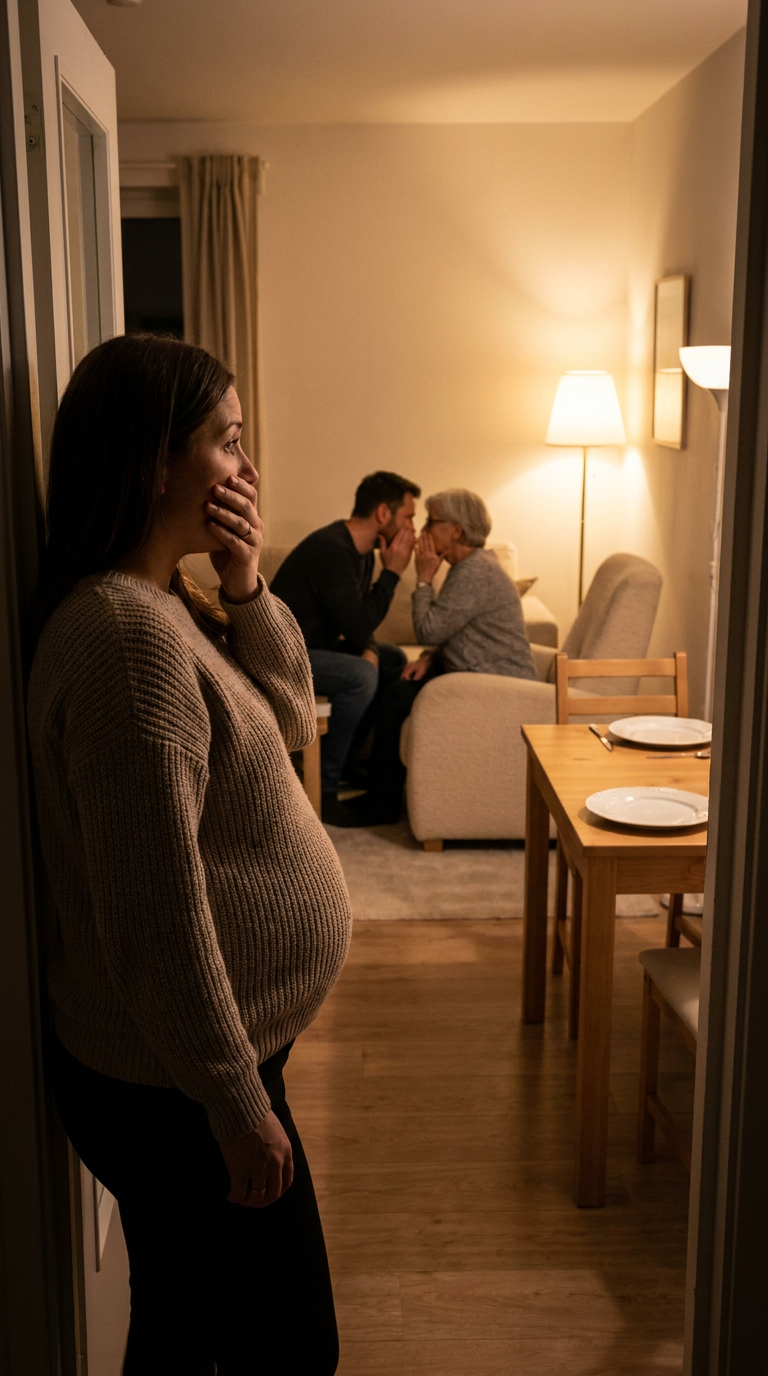
I remember standing in the hallway, one hand resting on my seven-month belly, smiling because I had just heard the man I loved say he couldn’t wait to become a father.
“I’m already head over heels for our little girl,” Ethan told his mother.
For a second, I wanted to walk into the living room and kiss him.
Then his voice dropped.
“But I’ll hate it if she turns out like Claire.”
My name.
Said with a weariness I had never heard when he spoke to me.
I stopped breathing.
His mother, Diane, answered immediately.
“Well, that’s why you have to start early.”
I stood perfectly still beside the hallway mirror. In it, I could see half my face and the tiny yellow flower embroidered on my maternity dress.
“What do you mean?” Ethan asked.
“Don’t let her mother make her timid. All that apologizing. All that worrying whether people like her. A girl needs a backbone.”
My fingers tightened around the doorframe.
Ethan sighed.
“Exactly. Claire cries over everything. She can’t make a decision without checking with someone. Sometimes I feel like I’m already raising a child.”
There was a soft clink as someone set down a cup.
Then his father spoke.
“Ethan.”
One word. A warning.
But Ethan continued.
“I love her. Obviously. She’s kind. She’ll be a good mother in that way. I just don’t want our daughter growing up thinking being weak is normal.”
Weak.
I looked down at the hand spread across my stomach.
That hand had held his through two layoffs. It had cleaned his father’s bathroom after hip surgery. It had signed overtime sheets so we could keep our apartment while Ethan retrained for a better job.
Apparently, it belonged to a weak woman.
Diane lowered her voice further.
“Once the baby comes, you’ll need to be firm. You know how she gets when she’s overwhelmed.”
“I know,” he said. “That’s why I want you staying with us.”
They had already discussed it.
With me, Ethan had called it an idea.
Behind my back, it was a plan.
I backed away before they could hear me. In the bathroom, I locked the door and sat on the closed toilet lid.
For several minutes, I stared at a basket of folded hand towels.
Our daughter kicked.
“Hi, sweetheart,” I whispered.
My voice sounded so ordinary that I started crying.
—
When I returned to the living room, Ethan stood and helped me into my cardigan.
“You okay? You’ve been gone a while.”
“Just tired.”
He kissed my forehead.
Diane handed me a container of leftovers.
“Make sure you eat properly tomorrow. The baby needs more than those little lunches you make.”
Usually, I would have smiled and thanked her twice.
That night, I thanked her once.
On the drive home, Ethan talked about buying a rocking chair.
“Mom thinks we should put it by the nursery window.”
I watched streetlights slide across the windshield.
“What do you think?” I asked.
“About the chair?”
“About where it should go.”
He shrugged. “Wherever you want, babe.”
The answer should have comforted me.
Instead, I wondered how many decisions he offered me casually, then criticized when I struggled to make them.
At home, he knelt beside the sofa and pressed his cheek against my belly.
“Daddy loves you, little bean.”
I nearly told him then.
But I couldn’t bear to hear him explain why what I’d heard wasn’t really what he meant.
Not yet.
—
The next morning, I opened a blank document on my laptop.
At the top, I typed:
What happened.
I wrote down the conversation as accurately as I could. Whenever I wasn’t certain of a word, I marked it.
By noon, I had stopped crying.
That frightened me more than the tears.
I called my older sister, Nora.
We weren’t estranged, but we had become less close since my marriage. Ethan found her “intense.” Diane thought she was rude. Nora had once asked why Ethan needed his mother’s approval to buy a dishwasher.
After that, inviting her over always seemed complicated.
“Can I come see you?” I asked.
“What’s wrong?”
“Nothing.”
She waited.
Then I began crying so hard I couldn’t finish a sentence.
Twenty minutes later, Nora was at my door with bread, soup, and her overnight bag.
She listened without interrupting.
When I finished, I said the thing that had been circling in my head all morning.
“Maybe he’s right about some of it.”
Nora set down her spoon.
“About what?”
“I do apologize too much. I get nervous making decisions.”
“Do you remember choosing your college?”
“Yes.”
“Your first apartment?”
“Yes.”
“The job you stayed in after your manager tried to take credit for your work?”
I nodded.
“You weren’t afraid of decisions then.”
“That was different.”
“How?”
I didn’t answer.
Nora leaned forward.
“Claire, when did you start thinking every choice you made was probably wrong?”
I looked toward the kitchen.
The curtains were gray because Ethan had laughed at the green ones I liked.
Our wedding had been in October because Diane said June weddings were inconvenient.
We had stopped seeing my friend Leah regularly after Ethan complained that her husband made him feel unsuccessful.
Each thing, alone, had seemed too small to argue about.
“I don’t know,” I whispered.
But I was beginning to.
—
I didn’t confront Ethan that evening.
I told him I needed a few nights with Nora because I wasn’t sleeping well.
He frowned.
“Why can’t she stay here?”
“I want to stay with her.”
“Okay, but you don’t need to make it sound serious.”
There it was again: my tone becoming the problem before he had asked about my pain.
At Nora’s apartment, I slept six uninterrupted hours.
The next morning, I booked an appointment with a counselor.
I also asked Ethan to meet me there.
His reply came quickly.
Couples counseling? Claire, seriously? We’re having a baby. Can we not invent a crisis?
I stared at the message.
Then I wrote:
I heard you speaking with your mother on Sunday.
The typing bubble appeared.
Disappeared.
My phone rang.
I let it ring.
His next message said:
You weren’t supposed to hear that.
I read it three times.
He hadn’t said it wasn’t true.
—
We met two days later in a quiet counseling office.
Ethan arrived holding flowers.
I wished he hadn’t. They made me feel like I was expected to forgive him before we began.
Our counselor, Marisol, asked why we were there.
I read from my notes.
Ethan shifted beside me.
“Okay, hearing it repeated like that sounds terrible.”
“It sounded terrible the first time,” I said.
“I was venting.”
Marisol asked, “What were you frustrated about?”
He looked at me.
“She’s been emotional lately.”
“I’m pregnant.”
“I know, but even before that. Everything becomes a discussion. She asks what I think, then gets upset if I disagree.”
“Give me an example,” I said.
He rubbed his forehead.
“The nursery.”
I waited.
“You wanted those woodland animals. Mom suggested something more classic. You got quiet for the whole afternoon.”
“Because you both laughed at the wallpaper sample.”
“We didn’t laugh at you.”
“You called it a pediatric dentist’s waiting room.”
He glanced at Marisol.
“It was a joke.”
She let the silence sit.
Then she asked, “When Claire is hurt by a joke, what usually happens?”
Ethan looked down.
“She gets upset.”
“And what do you do?”
“I try to explain.”
“Do you ever apologize without explaining why she shouldn’t be hurt?”
He opened his mouth.
Closed it.
I stared at the flowers between us.
Finally, he said, “I didn’t mean she was a bad person.”
I turned toward him.
“You said you would hate it if our daughter became like me.”
His eyes filled.
“I know.”
“What exactly should she avoid? My kindness? My work? The way I take care of people?”
“No.”
“Then what?”
He had no answer that didn’t injure me further.
—
For the next week, Ethan called every evening.
Some conversations were tender.
Others ended with him saying, “How long am I supposed to keep paying for one mistake?”
Meanwhile, Diane left three voicemails.
In the first, she said I had misunderstood.
In the second, she said every husband complained sometimes.
In the third, she said separating a father from his unborn child was cruel.
I saved them and stopped listening.
Then Ethan’s father, Robert, called.
“May I come by Nora’s?” he asked. “Just me.”
He arrived with the blue folder I had left at their house months earlier. It contained some medical receipts and an ultrasound picture.
But he hadn’t come only to return it.
“I should have said more Sunday,” he told me.
I sat across from him at Nora’s little kitchen table.
“You said his name.”
“I did. Then I let the conversation move on.”
He turned his wedding ring with his thumb.
“For years, I’ve told myself keeping things peaceful was helping. Mostly, I’ve let Diane decide whose feelings matter.”
I didn’t know what to say.
He looked at my stomach.
“I don’t want my granddaughter learning that from me.”
Before he left, he asked a practical question.
“Do you have everything you need for the baby?”
“Most things.”
“The crib?”
“Ethan hasn’t assembled it.”
Robert nodded.
“If you’d like, I can.”
He didn’t tell me where it ought to go.
—
At thirty-four weeks, I returned home while Ethan was at work.
I needed clothes, my insurance paperwork, and the quilt my grandmother had made.
The nursery door was open.
The wallpaper samples were gone.
A large white recliner stood by the window. On the dresser sat a stack of washed baby clothes I didn’t recognize.
Inside the closet, my carefully labeled baskets had been rearranged.
There was a suitcase in the guest room.
Diane’s suitcase.
I called Ethan.
“Why is your mother’s luggage here?”
He exhaled sharply.
“She brought some things over.”
“Why?”
“For when she stays.”
“I told you I wasn’t comfortable with that.”
“She’s trying to help.”
I held the phone away from my ear for a moment.
When I brought it back, he was still talking.
“Once the baby gets here, you’ll appreciate having someone experienced around.”
“Someone who thinks I’m too weak to raise my own daughter?”
“Claire, please.”
I looked into the nursery we had planned together.
“When were you going to ask me?”
“I thought we could discuss it when you calmed down.”
My daughter moved against my ribs.
For the first time since that dinner, I knew exactly what I wanted to say.
“I’m calm now. The answer is no.”
—
I moved into a furnished apartment twelve minutes from Nora.
It wasn’t dramatic. There were no suitcases thrown into the street, no triumphant speeches.
There were forms, deposits, a borrowed van, and the miserable task of deciding which kitchen utensils I needed.
I consulted a family lawyer so I could understand my options. I checked my finances. I arranged maternity leave.
Then I bought the woodland wallpaper.
Nora helped me hang it crookedly above a secondhand dresser.
We stood back and studied the uneven seam.
“It’s noticeable,” I said.
“Only if the baby’s an inspector.”
I laughed so hard I had to sit down.
It was the first time I’d laughed without feeling guilty in weeks.
Ethan hated the apartment.
“You’ve already decided to leave me.”
“I’ve decided where I can rest.”
“You’re making me sound dangerous.”
“I’m telling you I’m unhappy.”
He sat on the edge of the sofa.
“I don’t know how to fix this.”
For once, he sounded honest.
“Stop asking me to make your mother comfortable while I’m hurting.”
He stared at his hands.
Then he nodded.
—
Two weeks later, we returned to counseling.
This time, Ethan came without flowers.
He brought a notebook.
“I’ve been trying to figure out why I said it,” he began.
I braced myself.
“Mom talks about people that way. Like being sensitive is something shameful. I started doing it too.”
Marisol watched him.
“Does that explain it completely?”
“No.”
He swallowed.
“Sometimes Claire makes me feel selfish.”
I looked at him.
“She does things I wouldn’t think to do. Remembers birthdays. Checks on people. Notices when somebody’s left out. And instead of admitting I could do better, I tell myself she’s excessive.”
The room went quiet.
He turned toward me.
“I made you smaller so I wouldn’t have to feel small next to you.”
I cried then.
Not because everything was repaired.
Because, finally, he had named something I had been living inside for years.
“I don’t know if I can come home,” I said.
He nodded, though it clearly cost him.
“I know.”
It was the first time he had heard a painful answer without trying to change it.
—
Our daughter arrived eleven days early.
My water broke while I was eating toast over the sink.
I called Nora first.
Then Ethan.
“I’m going to the hospital,” I told him. “I want you there. But I need you to follow my lead.”
“I will.”
He arrived with my bag, which he had collected from the apartment, and the worn socks I’d forgotten on the chair.
For hours, he did exactly what I asked.
Water.
Quiet.
Pressure against my lower back.
When I changed my mind about pain relief, he called the nurse without commentary.
Sometime after midnight, his phone began ringing.
His mother.
He silenced it.
It rang again.
“You can answer,” I said between contractions.
He stepped into the hallway.
I could hear only fragments.
“No, Mom.”
“Because Claire said no visitors.”
A pause.
“No. That isn’t a negotiation.”
I closed my eyes.
A boundary should not have sounded so extraordinary.
But it did.
At 3:18 in the morning, our daughter was placed against my chest.
She was furious, slippery, and impossibly beautiful.
Ethan cried openly.
“Hello, Lucy,” he whispered.
Her hand opened against my skin.
I looked down at her tiny face and wondered how anyone could meet a daughter and immediately begin listing the women she must never become.
I kissed her damp forehead.
“You get to be yourself,” I told her.
—
Three days later, Diane arrived at my apartment uninvited.
Ethan was there bringing groceries.
I watched through the doorway as he spoke to her in the corridor.
“I only want to see my granddaughter.”
“You need to arrange visits.”
“With my own family?”
“Yes.”
She looked past him at me.
“This is what I was afraid of. She’s making you choose.”
My old instinct rose immediately.
Explain. Soothe. Invite her in so nobody would be upset.
Lucy stirred in my arms.
I stayed where I was.
Ethan shook his head.
“Claire didn’t tell you to leave. I am.”
Diane stared at him.
Then she said, “After everything I’ve done for you.”
“I’m grateful for a lot of it,” he replied. “You still can’t come over uninvited.”
It wasn’t a grand speech.
His voice shook.
But he closed the door.
Afterward, he stood in my kitchen looking pale.
“I should have done that years ago.”
“Yes,” I said.
He nodded.
Then he put away the groceries.
—
The months that followed were harder than any ending I had once imagined for us.
Ethan attended individual counseling. We continued meeting together.
He took parenting classes, learned Lucy’s feeding routine, and spent evenings walking her around the apartment when she wouldn’t settle.
Some days, I saw the man I had hoped I married.
Other days, I heard a familiar sigh when I asked a question, and my whole body tightened.
He began noticing.
“I sounded impatient,” he would say. “You didn’t do anything wrong.”
I appreciated it.
I still didn’t move home.
At six months, Lucy learned to laugh at the sound of tearing paper.
At seven months, she reached for Ethan when he entered the room.
At eight months, I told him I wanted a divorce.
He sat very still.
“Is there someone else?”
“No.”
“Then why now? We’re doing better.”
“We are.”
He looked bewildered.
I struggled to explain without giving him false hope.
“I believe you’re changing. I’m glad Lucy will know that version of you. But I spend our time together checking whether it’s safe to speak. I don’t want to keep being married while I wait for that feeling to go away.”
He cried.
So did I.
Neither of us tried to turn it into an argument.
—
We settled the practical matters slowly.
There were difficult conversations about money, holidays, and parenting time. Sometimes we needed help to finish them.
Diane blamed me.
Robert kept showing up.
He fixed a loose cabinet hinge, attended Lucy’s first birthday, and brought a little wooden chair he had sanded himself.
On the underside, he had written her name.
Nothing about being brave.
Nothing about being tough.
Just her name and the date.
Nora ran a finger over it and smiled.
Ethan remained in counseling.
I didn’t ask for reports. I watched how he treated our daughter.
When she cried, he comforted her.
When she hesitated, he waited.
Once, at a park, another father told him Lucy was going to be “too soft” because she was upset about a crushed beetle.
Ethan crouched beside her.
“She noticed something got hurt,” he said. “I’m okay with that.”
I stood a few feet away, holding her jacket.
For the first time, the progress belonged to him without requiring anything from me.
—
Lucy was three when I overheard another conversation.
I had brought her forgotten rabbit to Ethan’s house and found the front door open. They were in the kitchen, making pancakes.
“I cried at school,” she told him.
“What happened?”
“My tower fell down.”
“That sounds disappointing.”
“Milo said babies cry.”
There was a pause.
Then Ethan said, “Grown-ups cry too.”
“Mommy cries at movies.”
“She does.”
“Is that silly?”
“No,” he answered. “Your mommy feels things deeply. She’s always been good at caring about people.”
I stood in the hallway with the rabbit tucked under my arm.
Three years earlier, I had stood outside another room and learned what my husband thought of me.
This time, I heard what our daughter would learn.
I stepped into the kitchen.
Lucy ran toward me, flour on her nose.
“Mommy! Daddy says you’re good at caring!”
Ethan looked up.
He knew I’d heard.
I handed Lucy her rabbit and kissed the top of her head.
“Your pancake’s burning,” I told him.
He turned quickly toward the stove.
Lucy laughed.
And I laughed with her.