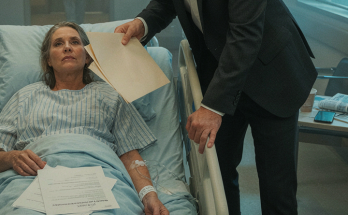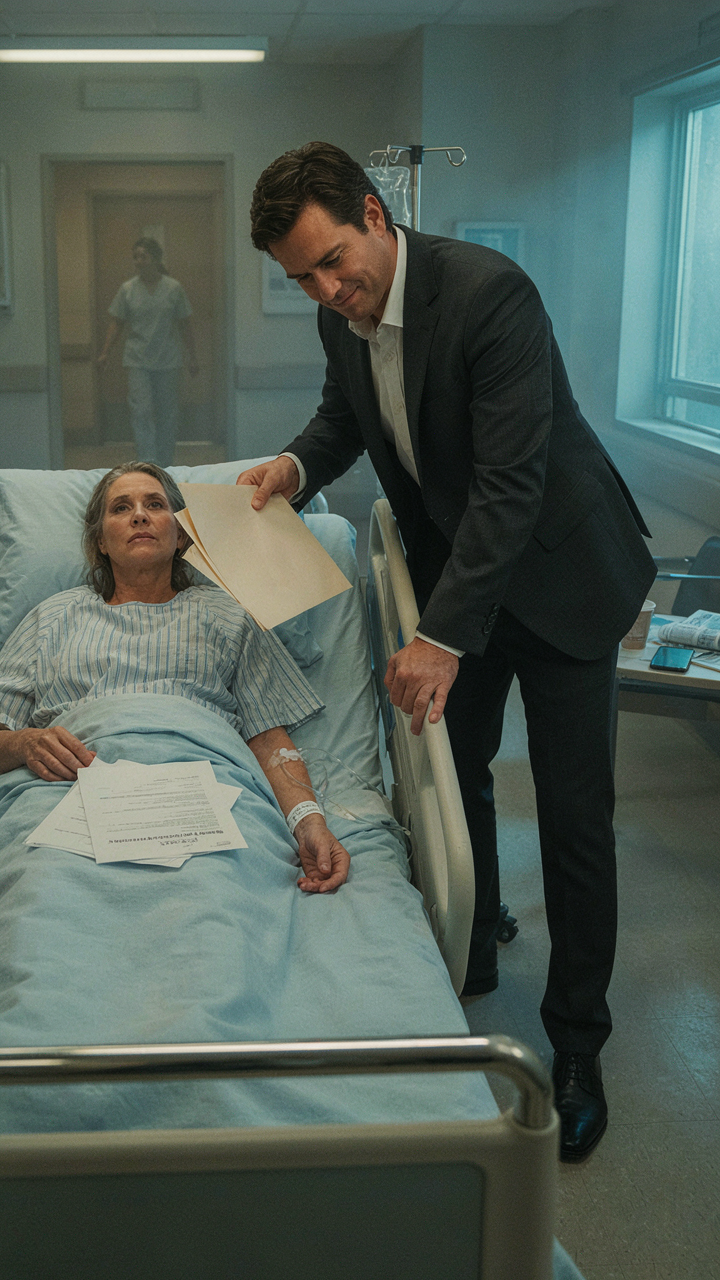
The first thing my husband took was the chair.He pulled it away from my hospital bed and sat beyond my reach, as though whatever had put me there might spread through touch.
Then he dropped the divorce papers onto my lap.The corner struck the incision beneath my gown. I flinched.Mark smiled.
“I’m taking the house, the cars, and the accounts,” he said. “You can keep your little freelance gig. I’m moving on.”
My mouth tasted of medication. Six days earlier, a surgeon had removed a tumor and part of my bowel. I still needed help reaching the bathroom.
“Now?” I whispered.“There’s never a good time with you.”His phone lit up. A blonde woman appeared on the screen, holding a cocktail beside a swimming pool.Twenty-four. Her name was Brianna.
I knew because three weeks earlier, her earrings had fallen out of his gym bag.Mark stood.
“My attorney’s number is on the front. Don’t make this expensive.”
After he left, a nurse named Denise found me staring at the papers.
She set them on the windowsill.“Those can wait,” she said.
I cried then. Denise stayed until I could breathe normally again.
What Mark didn’t know was that the freelance gig he had sneered at had earned me $530,000 the previous year.
And the woman lying in that hospital bed had finally stopped hoping he would become someone else.
I hadn’t set out to keep my income a secret.
When Mark and I married twelve years earlier, I designed websites for local businesses. He sold commercial equipment and considered himself the serious professional in the marriage.
He called my work “computer crafts.”
At dinner parties, people would ask what I did.
“She plays around online,” he would answer before I could speak.
Eventually, I let him.
That was something I would later have to explain to myself: how being interrupted often enough could teach a person to stop beginning.
Five years into our marriage, I designed a scheduling tool for a small chain of physical therapy clinics. The owner wanted fewer missed appointments and less time spent calling patients.
I built it from our kitchen table.
Then another clinic asked to license it.
Then twelve more.
I hired a developer, rebuilt the system, and formed a company called Clearpath Practice Systems.
Mark knew about the company. He signed documents acknowledging it during a financial agreement we made after his first business collapsed.
He simply never believed it would amount to anything.
My grandmother’s inheritance had supplied the startup money. Our separate attorneys had helped us establish which assets and future business earnings each of us would retain, while identifying what we owned jointly.
Mark had been enthusiastic.
At the time, he expected to become rich selling restaurant equipment.
“Good fences,” he’d said, signing.
For years afterward, I offered to show him my annual business summaries.
“Spreadsheets give me a headache,” he would say.
But whenever the household needed money, the little freelance gig became useful.
A new furnace.
A deposit on his next business venture.
A vacation he announced before asking how we would pay.
I transferred the agreed amount into our joint account and kept working.
By the previous December, Clearpath served eighty-seven clinics. My salary and distributions totaled $530,000.
Mark still thought I made around thirty thousand.
I had allowed that misunderstanding to remain because discussing success with him always ended with him finding something he needed.
It wasn’t a healthy marriage. I knew that before the hospital.
I just hadn’t known how thoroughly I had disappeared inside it.
My friend Lena drove me home.
Mark had already cleared his closet. His good watch was gone, along with the espresso machine, two televisions, and the framed photograph from our honeymoon.
He had left the photograph facedown in the trash.
On the refrigerator was a note.
Please keep communication through attorneys. Brianna doesn’t need stress.
Lena read it twice.
“Does he know you’ve just had surgery?”
“He drove me there.”
She put the note in a drawer before I could keep staring at it.
Two weeks after the hospital visit, Mark vanished from ordinary contact. His calls went unanswered. His work email returned an automatic response.
Then his sister sent me a photograph.
Mark and Brianna stood beneath white flowers on a beach. She wore a short ivory dress. He wore the linen shirt I had bought for our anniversary.
They actually did it, his sister wrote.
The caption called it a wedding.
Our divorce wasn’t even close to final.
For one miserable minute, I zoomed in on his face.
He looked happy.
Then Lena took the phone from me and called my attorney.
Judith Hale had a voice so calm it made other people’s panic seem unnecessary.
At our first meeting, I told her I didn’t want to fight Mark in court.
She folded her hands.
“Do you mean you want a settlement, or do you mean you want to give him everything so he’ll leave?”
I stared at her.
“I’m not sure.”
“Then we’ll work that out before you sign anything.”
We reviewed the house, the loans, the cars, the accounts, and our earlier financial agreement.
The house looked impressive from the street. Behind its white columns were a large mortgage, an expensive roof repair, and years of spending Mark had called investments.
One car was leased. The other carried a loan.
Our joint savings were modest because Mark repeatedly found urgent uses for them.
“You can afford to keep the house,” Judith said.
I pictured the dining room where he had corrected my stories. The kitchen where I had worked while he asked when dinner would be ready.
“I don’t want it.”
That surprised me more than anything else I said that day.
Judith made a note.
“And your company?”
“I want to keep the people who work for me paid. I want to get well. That’s all I can manage right now.”
“That’s plenty.”
We disclosed what the process required. There were account statements, business records, valuations, and questions.
My income appeared plainly in the documents.
Mark’s attorney received them.
Mark apparently paid as much attention to those records as he had to my work.
His proposals kept arriving with the same demand: the house, both vehicles, and the joint accounts.
In exchange, he offered to waive claims against my business and asked that neither of us seek support.
Judith refused to let the wording stay vague. The eventual agreement identified debts, refinance deadlines, sale provisions, and what would happen if he failed to follow through.
She also insisted that any transfer of my interest in the house happen through the agreed closing process.
I didn’t attend a dramatic hearing.
There was no speech, no folder slammed onto a table.
I signed a negotiated settlement from a small office overlooking a parking lot, wearing trousers with an elastic waist because my incision still hurt.
The day the divorce became final, I bought a sandwich and sat beside the river.
For the first time in years, nobody expected me home.
Mark legally married Brianna soon afterward.
His sister clarified that the beach ceremony had been “symbolic.”
I stopped asking questions.
By spring, I had rented a bright apartment with an elevator, wide windows, and a balcony barely large enough for two chairs.
Lena helped me choose a yellow sofa.
Mark had always hated yellow.
My recovery was slow. Some mornings, taking a shower used up all the energy I had. My team covered meetings. My operations manager, Priya, made me take actual leave.
“You built a company that can survive without you for six weeks,” she told me. “Let us prove it.”
I started walking to a bakery three blocks away.
At first, I had to rest halfway there.
Then I could reach it without stopping.
Then I could carry my own coffee home.
Small things became achievements again.
Meanwhile, Mark posted photographs of restaurant meals, shopping bags, and weekend flights.
Under one picture, he wrote:
Finally with someone who appreciates ambition.
I muted him.
Not because I was above looking.
Because I kept looking, and it hurt.
The first crack in his new life arrived through an email addressed to my company.
Priya forwarded it with one sentence.
I believe this needs your attention.
A regional clinic group wanted Clearpath to integrate with a new patient financing platform called Meridian Bridge.
The pitch deck attached to the message listed Mark as chief commercial officer.
I sat very still.
During our marriage, he had talked about entering healthcare technology. I had assumed it was another idea that would disappear after a week.
Now he was offering clinics a system that, according to his presentation, already worked with Clearpath.
It did not.
There was more.
One slide described Clearpath as a “founding technology partner.”
Another included a photograph of me speaking at a small industry conference.
Underneath it:
Technical leadership supporting seamless deployment.
I called Priya.
“Have we had any contact with Meridian?”
“No.”
“Any agreement?”
“Absolutely none.”
I sent the deck to our company attorney.
Then I went for my walk, got as far as the first bench, and sat down shaking.
Mark had spent years acting as though my work was imaginary.
Now he was selling it.
Our attorney’s first letter was short.
Meridian had no partnership with Clearpath. It had no permission to use our name, photograph, or claimed technical support. It needed to correct those representations.
For two days, nothing happened.
On the third, Mark called.
I let it go to voicemail.
He called again.
Then came a message.
Why are your people interfering with my business?
I read it aloud to Lena.
She looked up from the soup she was putting in my freezer.
“Your people?”
Apparently, the little freelance gig had acquired people.
I answered by email.
Please direct all questions to the attorney named in the letter.
He arrived at my apartment building the following evening.
The front desk called before letting him upstairs.
For a moment, old instinct took over. I almost said yes because making him wait had always caused trouble.
Then I looked around my quiet apartment.
“No,” I said. “Please tell him to leave.”
My phone rang immediately.
This time, I answered.
“You’re making me look dishonest,” he snapped.
“You listed a partnership we don’t have.”
“It was preliminary.”
“You used my photograph.”
“You’re my wife.”
The silence afterward was so complete I could hear traffic through the balcony door.
“Former wife,” I said.
He exhaled hard.
“Fine. Can we discuss a licensing arrangement?”
“Through counsel.”
“Claire, don’t be difficult.”
I ended the call.
My hands were trembling, but I hadn’t agreed to anything.
That evening, I made toast, burned it, and cried at the kitchen counter.
Then I made another piece.
The money revelation came a week later.
Mark’s attorney contacted Judith about an unrelated settlement deadline. During that conversation, he apparently mentioned that Mark was struggling to secure financing for the house.
Mark began complaining about my “tiny income” and how easily I could rent somewhere cheap.
His attorney reminded him that my earnings had been disclosed months earlier.
Judith called to warn me that I might hear from him.
I did.
At 9:14 that night.
“You make five hundred and thirty thousand dollars?”
No greeting.
“That was last year’s income.”
“You hid it.”
“It was in the financial disclosures.”
“You let me give up any claim to your company.”
“You had an attorney.”
“You knew I wouldn’t read all that.”
I stood beside the yellow sofa, looking at the place where Lena had spilled tea and insisted the cushion could be turned over.
“I offered to explain my business to you for years, Mark.”
“This is different.”
“Yes,” I said. “Now you’re interested.”
He demanded that we reopen negotiations. He said I had manipulated him. He said a decent woman would have told him she could afford to help.
Then his voice changed.
“Brianna’s pregnant.”
I closed my eyes.
Whatever else had happened, a child was coming into this.
“I hope she’s well.”
“We need stability.”
“You need to speak with your attorney.”
“You’re really going to leave us struggling?”
I remembered the hospital chair beyond my reach.
I remembered the papers pressing against my stitches.
But what finally made my answer easy was smaller: all the ordinary evenings when I had been tired, and he had decided his tiredness mattered more.
“I’m going to end this call.”
And I did.
Meridian’s investors began asking questions.
I knew because their attorney contacted ours, requesting confirmation of whether any partnership had ever existed.
We answered accurately and supplied the relevant correspondence.
I did not call anyone to ruin Mark.
I did not need to.
His own presentation had traveled farther than his explanations could follow.
One investor withdrew. A clinic group paused negotiations. Meridian removed my photograph and our company name from its materials.
Then Mark missed the refinancing deadline.
Under our settlement, the house had to be listed.
He accused me of forcing a sale.
Judith sent the clause his attorney had helped negotiate.
The sale produced less than he expected after the mortgage, costs, and other agreed obligations were paid.
The house he had bragged about taking had never been the fortune he imagined.
He had wanted the shape of wealth.
He had never wanted to study what held it up.
Brianna contacted me in July.
Her message came through my business website because I had blocked her social accounts months earlier.
I know you probably hate me. There’s something you should see.
I nearly deleted it.
Then I opened the attachment.
It was a loan application.
My name appeared under proposed guarantor.
My company’s name appeared underneath.
There was no signature, but several documents had been gathered for the application: an old scan of my driver’s license, a company registration certificate, and financial information taken from the divorce disclosures.
My stomach turned.
I forwarded everything to counsel before responding.
Where did you get this?
Brianna answered within a minute.
He asked me to organize his paperwork. I asked when you agreed. He said you always came around.
I stared at that sentence.
Then she sent another.
He told me you were still business partners. He said the divorce was mostly about your illness and that you wanted to be alone.
For months, I had imagined her knowing everything.
Perhaps she had known enough to bear responsibility. Perhaps there were things she had chosen not to ask.
But there were also lies I recognized.
They had once worked on me.
We spoke the following afternoon.
Her voice sounded younger without the photographs.
“I’m not asking you for money,” she said quickly.
“Good.”
“I’m asking whether anything he told me was true.”
We talked for forty minutes.
I answered what I knew. When I didn’t know, I said so.
At the end, she began crying.
“He told me you never supported him.”
I looked toward the balcony, where my basil plant was somehow still alive.
“I did,” I said. “For a long time.”
Our attorney notified the prospective lender that I had authorized nothing and would guarantee nothing.
The lender confirmed that the application would not proceed with my involvement. My attorney advised me on documenting the misuse of my information, and I followed through.
Meridian’s board removed Mark from his role while it reviewed the representations he had made.
He called from unfamiliar numbers.
Sometimes furious.
Sometimes affectionate.
Once, he left a message saying he missed the way I understood him.
I saved it with the others.
Brianna moved in with her mother before her baby was born.
I learned that from her, not from watching Mark.
She sent one final message.
I’m sorry I believed him without ever wondering what it cost you.
I didn’t know how to answer.
After a day, I wrote:
Take care of yourself and your child.
It was the most honest kindness I could manage.
Nearly a year after the surgery, I returned to the hospital for follow-up tests.
My doctor smiled when she entered.
Everything looked good.
I sat in the parking garage afterward with both hands on the steering wheel and cried harder than I had when the divorce became final.
Then I called Lena.
“Good news?” she asked before I spoke.
“Good news.”
That night, she and Priya came over with dinner.
We ate around the small table I had assembled badly enough that it still wobbled.
Priya folded a piece of cardboard beneath one leg.
“There,” she said. “Enterprise solution.”
I laughed until my side ached.
Later, after they left, the front desk called.
Mark was downstairs.
He said it was important.
I considered refusing.
Then I realized I wanted to hear him without wondering afterward what he might have said.
I met him in the lobby.
He looked ordinary. That surprised me. For years, I had experienced him as someone enormous.
Now he was simply a tired man holding an envelope.
“The last settlement paperwork,” he said.
He could have mailed it.
We both knew that.
“Thank you.”
He glanced around the lobby.
“You’ve done well.”
“I’m getting there.”
He rubbed his thumb along the envelope.
“If I’d known what you were earning—”
He stopped.
I waited.
“If I’d understood how successful you were, things might have been different.”
For a moment, I could almost see the life he was imagining: the house kept, the business funded, himself beside a successful wife whose work he would finally allow people to hear about.
I took the envelope.
“I needed you when you thought I had nothing.”
He looked down.
There was no answer that could change that.
I went upstairs.
On my kitchen counter sat two folders. One held the final divorce documents. The other contained a plan Priya and I had spent months developing: an employee ownership program for the people who had kept Clearpath running while I learned to walk three blocks again.
In the morning, I would sign it.
Mark had always assumed money was the secret I had kept from him.
But standing in my quiet apartment, with dinner dishes drying by the sink, I understood something I hadn’t known in that hospital bed.
I had people who would come when I called.
I had work I was proud of.
I had another morning.
I placed his envelope in a drawer, turned off the kitchen light, and went to bed.