Four months after my sister married my wealthy ex-husband, he died at forty-three.
At his funeral, Vanessa wore a black dress that still had a pale thread where the price tag had been. She cried whenever someone approached, then checked her phone when they walked away.
I stood near the back.
After twelve years of marriage, I no longer knew where I belonged among the people mourning Daniel.
His mother had died years earlier. His father had never been around. We had no children. Most of the men carrying his casket had met him after he became rich.
I remembered the boy who once counted quarters on our kitchen floor so we could buy groceries.
That boy would have hated the gold handles.
Six days later, Vanessa called.
“The attorney says you have to attend the estate meeting.”
“Why?”
“How would I know? Maybe Daniel left you his old coffee mug.”
Then she laughed.
I nearly refused.
But the attorney, Martin Hale, called that afternoon himself.
“Daniel specifically requested your presence, Claire.”
Something in his voice made me put the appointment on my calendar.
Vanessa arrived twelve minutes late.
She swept into the conference room carrying a white designer handbag and sat beside Martin as though she were his business partner.
“Let’s get this over with,” she said. “I have somewhere to be.”
I sat across from her in the navy dress I wore to job interviews.
Daniel’s business partner, Owen, occupied the chair near the window. He nodded at me, looking older than he had at the funeral.
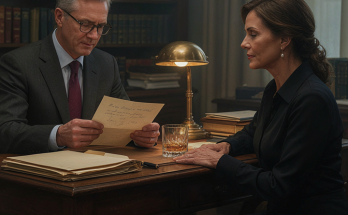
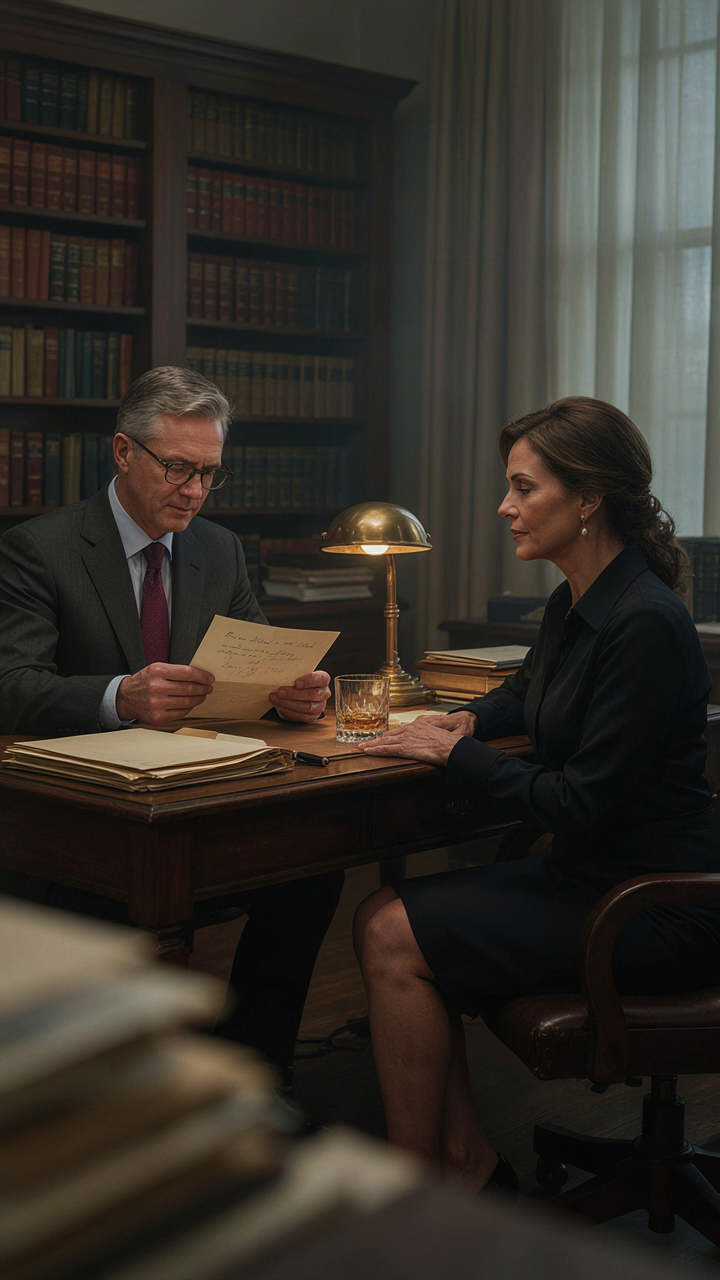
Martin placed a thick folder on the table.
“Before we discuss the estate documents, Daniel asked that I read a personal letter.”
Vanessa uncapped her pen.
“Fine.”
Martin lifted a sealed envelope.
I recognized Daniel’s handwriting before he opened it.
He had always pressed too hard with a pen.
“To my former wife,” Martin began, “the one person who loved me before I had money.”
Vanessa stopped tapping her pen.
My hands went cold.
“If Claire is sitting in this room, she is probably wondering why I have put her through another difficult afternoon. She has already endured enough of those because of me.”
“Is this necessary?” Vanessa asked.
Martin looked up.
“Yes.”
Then he continued.
“Claire, there are things I need you to know. Some are apologies. One is an explanation. None of them entitles me to your forgiveness.”
For the first time since Daniel died, I could hear his voice clearly.
And suddenly I was twenty-four again, standing in a courthouse hallway while he tried to straighten a borrowed tie.
We married before there was a company.
Daniel repaired commercial kitchen equipment. I worked at a dental office and took bookkeeping classes at night.
He had an idea for software that could predict when restaurant equipment needed maintenance. I understood almost none of the technical details.
I understood him.
So when he asked whether we could live on my salary for a year, I said yes.
One year became three.
We rented an apartment above a laundromat. Daniel coded at our kitchen table while I did freelance accounts after work. When his laptop failed, I sold my grandmother’s sapphire ring to replace it.
I told him the stone had always caught on my sweaters.
He knew I was lying.
He cried anyway.
By our eighth anniversary, his company had thirty employees.
By our tenth, we lived in a house with six bathrooms, and I occasionally went an entire day without hearing him laugh.
Success did not change him all at once.
First, he missed dinners.
Then birthdays.
Then he began treating every concern as a problem I should solve without taking up his time.
My younger sister had always been beautiful in a way people mentioned immediately. As children, I was dependable. Vanessa was dazzling.
When she lost another job, I persuaded Daniel to hire her in corporate events.
“She needs a chance,” I told him.
He gave her one.
Then he gave her things I did not know about.
The affair lasted nine months before I found the hotel confirmation.
When I confronted him, he did not deny it.
That was almost worse.
Vanessa arrived at our house the following evening. She stood in the kitchen where I had taught her to make pancakes and said, “We didn’t plan this.”
I waited for an apology.
Instead, she added, “Sometimes people meet the right person at the wrong time.”
Daniel stared at the countertop.
I left with two suitcases.
During the divorce, I was exhausted enough to accept less than my attorney recommended. I wanted my own apartment, enough money to start again, and no reason to answer Daniel’s calls.
Vanessa told relatives I had received a fortune.
What I received bought a modest condominium and paid off the debt I had quietly accumulated trying to keep our marriage looking healthy.
They married fourteen months after the divorce.
Four months later, Daniel collapsed in a hotel gym.
A sudden cardiac event, the family announcement said.
I read those words six times.
I had spent so long imagining a future without him that I had never considered a world in which he no longer existed.
Martin turned the page.
“Claire, I told myself you had stopped understanding me. The truth is that you understood me well enough to notice what I was becoming. I resented you for noticing.”
Vanessa pushed back her chair.
“I’m not sitting through an insult.”
“You’re free to step outside,” Martin said.
She stayed.
“Six weeks before my death,” he continued, “I learned that a medical condition I had minimized was more serious than I had allowed anyone to believe. My physicians recommended treatment. I began it. I also started putting my affairs in order.”
I looked at Owen.
He lowered his eyes.
Daniel had known he was ill.
He had gone to appointments, heard frightening words, returned home, and told almost nobody.
For a moment, all I wanted was to ask whether he had been afraid.
Then Martin read the next sentence.
“In reviewing old financial records, I discovered that Claire had never received a letter I wrote during our separation.”
Vanessa’s face changed.
It was slight.
But I had spent thirty-three years watching my sister.
I saw it.
“Daniel gave me that letter to deliver,” Owen said quietly.
Vanessa turned toward him.
“What?”
He looked at me.
“He asked whether I would leave it with your things at the house. You were coming that Saturday to collect the rest.”
I remembered that Saturday.
Daniel had been away. Vanessa had waited beside the front door while movers carried out my books.
She told me not to take the blue ceramic bowl because Daniel liked it.
I had made that bowl.
“Vanessa said she would put the envelope with your boxes,” Owen continued. “I thought she had.”
“That was years ago,” Vanessa snapped.
“Twenty months,” he said.
Martin withdrew a copy from the folder.
“Daniel retained a draft.”
I could hardly breathe.
“What did it say?”
Martin glanced down.
“It acknowledged the affair. It asked whether you would consider speaking with him privately before the divorce became final.”
Vanessa folded her arms.
“You were already done. You said so yourself.”
I remembered the message I sent after that Saturday.
Please stop sending things through Vanessa. If you have something to say, say it yourself.
Daniel had replied:
I understand. I won’t contact you again.
At the time, I thought he was relieved.
Now I could see how he might have read my words differently.
Still, one letter would not have erased what he had done.
I said that aloud.
Martin nodded.
“Daniel wrote much the same thing.”
He returned to the final letter.
“I have no right to imagine that an honest conversation would have saved our marriage. I had already betrayed it. But I learned that Vanessa had prevented even the possibility of that conversation, and I confronted her.”
Vanessa stood.
“This is ridiculous.”
“Sit down,” I said.
She stared at me.
It was the first time I had interrupted her in years.
“Please finish,” I told Martin.
Daniel had discovered the missing letter while searching an old email account for company records.
There was a message from Vanessa, sent during the separation.
She read it. She laughed. She said you should save your speeches for somebody who still cares.
I had never seen the letter.
I had never laughed.
“When I asked Vanessa about it,” Martin read, “she first said she could not remember. Later, she said she had done what was best for everyone.”
My sister grabbed her handbag.
“You don’t get to put all of this on me. He was the one who cheated.”
“Yes,” I said. “He was.”
That stopped her.
“He made his choices,” I continued. “You made yours.”
For a moment, nobody moved.
Then Martin placed the letter flat on the table.
“There is more, but we should address the documents now.”
Vanessa sat slowly.
At last, she looked uncertain.
The fortune everyone had been discussing was worth approximately thirty-one million dollars, most of it in company shares.
Vanessa’s expression steadied when Martin mentioned the figure.
She still believed money would restore the room to its proper order.
“Daniel established an estate plan before his recent marriage,” Martin explained. “He amended portions of it afterward. The operative documents are here, together with the marital agreement signed by both spouses.”
“I know what I signed,” Vanessa said.
“Then these provisions should be familiar.”
They were not.
I could tell from the way she gripped her pen.
Daniel had left her the house they lived in, subject to its mortgage, her personal property, and a cash bequest of five hundred thousand dollars.
She stared at Martin.
“And the company?”
“His controlling interest passes to the employee ownership trust described in these documents.”
Owen closed his eyes.
I looked at him.
“You knew?”
“Only that he was considering it.”
Martin explained that Daniel had spent years receiving offers from larger competitors. The latest buyer intended to move development overseas and eliminate much of the local staff.
Daniel had refused.
His final arrangement allowed the company to continue under its existing leadership while employees gradually acquired ownership.
The people who had worked beside him would benefit from what they had built.
I thought of the first programmer he hired, a single father who brought his daughter to our apartment during weekend emergencies.
I thought of the receptionist who had stayed when payroll arrived late.
For the first time that afternoon, I smiled.
Vanessa did not.
“What about the investments?”
Martin turned toward me.
“A separate trust, funded with approximately eight million dollars in liquid assets, names Claire as its beneficiary.”
I heard the air conditioner click off.
Everything became terribly quiet.
“No,” Vanessa said.
Martin waited.
“No. Absolutely not. She divorced him.”
“Yes,” he said.
“She took her money.”
“This bequest is separate from the divorce settlement.”
Vanessa looked at me as though I had reached across the table and stolen her handbag.
“What did you do?”
I could barely find my voice.
“Nothing.”
And that, somehow, enraged her most.
I did not feel victorious.
I felt sick.
Eight million dollars sat between us like something alive.
Daniel could no longer call to explain himself. I could not ask why he had waited until death to become generous with honesty.
Martin slid the remaining pages toward me.
“There is a personal item as well.”
He placed a small velvet box on the table.
Inside lay my grandmother’s sapphire ring.
For several seconds, I did not touch it.
The stone had a tiny chip beside one prong. As a child, I used to run my thumbnail over it while sitting on my grandmother’s lap.
There it was.
The same chip.
The same narrow band.
“How?”
“Daniel traced it through the jeweler who bought it,” Martin said. “It took some time.”
I picked it up.
Underneath was a folded note.
I should have brought this home before I brought anything else.
My eyes blurred.
Vanessa leaned forward.
“Oh, please. He bought you a ring, and suddenly he’s a saint?”
I closed the box.
“No.”
She blinked.
“He hurt me. This doesn’t undo that.”
“Then refuse it.”
Her answer came too quickly.
I looked at her.
She leaned closer, lowering her voice.
“If you really have moved on, you don’t need his money.”
I recognized the tone.
It was the same one she used when she wanted my bedroom as a child, my car as a teenager, my help when another landlord demanded overdue rent.
Make me prove I was good.
Make giving in feel noble.
I placed the ring in my purse.
“I’m not making any decisions today.”
Martin nodded.
“That would be wise.”
Vanessa followed me into the parking garage.
Her heels struck the concrete behind me.
“Claire.”
I stopped beside my car.
“He was my husband.”
“I know.”
“You weren’t there when he died.”
“Neither were you.”
I regretted it immediately, though it was true. She had been at a spa with friends. Daniel had traveled for a meeting.
Her eyes filled.
For the first time, I could not tell whether the tears were deliberate.
“He was pulling away,” she whispered.
I said nothing.
“After the wedding. He started sleeping in the guest room. He kept asking questions about things that didn’t matter anymore.”
“The letter mattered.”
She looked down.
Then she said something I had never expected.
“I thought once we were married, I’d stop being afraid.”
“Of what?”
“That he’d realize.”
I waited.
“That he only wanted me because I wasn’t you.”
The garage seemed to grow colder.
For years, Vanessa had made me feel like the dull outline around her brighter life.
I had never imagined she spent her time measuring herself against mine.
“You helped destroy my marriage,” I said.
“I know.”
“And then you married him.”
“I know.”
There was no useful answer left.
She wiped her cheek.
“Are you going to take everything?”
I looked at the expensive car behind her, the handbag tucked against her side.
“You’ve been left a home and more money than most people ever receive.”
“It isn’t what he promised.”
“What did he promise?”
She opened her mouth.
Then closed it.
I got into my car.
For once, I did not stay to help her finish the conversation.
Two weeks later, Martin asked whether I wanted the rest of Daniel’s letter.
I had left before he finished reading.
We met without Vanessa.
He handed me the original and gave me the room.
The final pages were less polished.
Words had been crossed out. A sentence trailed off halfway through.
I keep trying to explain why I did it, Daniel wrote. Every explanation sounds like an excuse when I read it back.
I sat by the window.
You used to leave a light on when I worked late. After you left, I bought timers for the lamps. For a while, I pretended that solved the problem.
I pressed a hand over my mouth.
I am leaving you money because you helped create it, and because accepting less during the divorce did not make your contribution smaller. You do not owe me grief in exchange. You do not owe me a foundation with my name on it. Buy something foolish. Keep teaching your bookkeeping classes. Help someone if you want to. Please let the choice be yours.
At the bottom, in smaller handwriting, he had added:
I remember the laundromat apartment as the happiest place I ever lived. I’m sorry I made you remember it alone.
I cried then.
For the young man at the kitchen table.
For the woman who had believed in him.
For all the ordinary evenings we had wasted once we could afford anything.
When Martin returned, I asked whether Daniel had suffered.
“He was receiving care,” he said gently. “He believed he had more time.”
Of course he had.
We both had.
Vanessa challenged parts of the estate plan.
I let my attorney handle it.
There were meetings, letters, and months of waiting. The documents had been carefully prepared, and eventually a settlement resolved the dispute without changing the company’s future or my inheritance substantially.
Vanessa and I did not reconcile.
Our mother tried to arrange a Christmas dinner.
“You only have one sister,” she said.
“I know,” I answered. “That’s why it hurt.”
For once, she did not ask me to be the bigger person.
I stayed in my condominium for another year.
I kept working.
Some mornings, the money felt unreal. Other mornings, I woke expecting to discover that everything had been a strange dream.
The ring helped.
I wore it while washing dishes, grading bookkeeping assignments, carrying groceries upstairs.
Eventually, I bought a small storefront and opened an accounting service for people starting businesses. We offered evening workshops at a price they could afford.
On the first night, a young couple arrived carrying a laptop held together with silver tape.
The woman had come straight from work.
The man apologized three times for not understanding the registration form.
I brought them coffee.
Then I sat beside them and began with the first question.
A year later, Owen invited me to the company’s employee ownership celebration.
There were no gold decorations. Someone’s children had made paper signs. The receptionist hugged me so hard my glasses slipped.
Near the entrance hung a photograph from the company’s first office.
Daniel stood beside a folding table, grinning.
I was at the edge of the picture, holding a box of cables.
For years, copies of that photograph had been cropped just before my shoulder.
This one showed the whole room.
Owen came to stand beside me.
“He asked us to use the original.”
I looked at the young woman in the photograph.
She was tired. Her hair needed cutting. She had no idea what was coming.
But she was there.
At last, everyone could see it.