Forty Years at the Piano—Then They Erased My Name. On Easter Sunday, I Walked Back Into the Church and Changed Everything.
The first time I noticed my name was missing, I thought someone had made a mistake.
It was a Sunday morning in Des Moines, Iowa, and I was standing in the church foyer with my coat folded over one arm, holding the bulletin I had picked up from the greeter.
I had played the piano at Grace Fellowship Church for forty years.
Forty years.
Since 1985, I had sat at that same polished black piano through weddings, funerals, Christmas Eve services, Easter celebrations, baptisms, and ordinary Sunday mornings when only a handful of people showed up.
I had played while mothers cried in the front pews, while nervous brides walked down the aisle, and while families said goodbye to the people they loved most.
I had played for children who grew up, moved away, married, and returned with babies of their own.
And I had never accepted a dollar.
Not once.
Yet there I stood, staring at the printed list of musicians for that morning’s service.
The new music director’s name appeared in bold letters.
Below it were the names of three young singers, a guitarist, and a keyboard player I had never met.
My name was nowhere.
I checked the previous page.
Then the next.
I even turned the bulletin upside down, as if the years of my life might somehow be hiding in the fold.
Nothing.
“Is something wrong, Margaret?”
I looked up.
Daniel Price, the new music director, stood beside the welcome table. He was perhaps thirty-two, with neatly styled brown hair, a fashionable navy suit, and the kind of smile that made people feel he was being polite even when he was about to disappoint them.
I held up the bulletin.
“I think my name was accidentally left off the music list.”
His smile tightened for just a moment.
“Oh, no. That was intentional.”
The words landed harder than I expected.
“Intentional?”
He glanced toward the sanctuary, where several families were settling into their seats.
“We’re trying to move the church in a new direction,” he explained. “We’re looking for a sound that appeals to younger families. Something contemporary. Something that feels fresh.”
I waited.
Surely there was more.
Surely he would mention that I had played here since 1985. That I knew every hymn in the church’s worn red hymnal. That I had accompanied the choir through three pastors, two building renovations, and one devastating flood that had forced us to hold services in the school gymnasium.
But Daniel simply adjusted his cuff.
“I hope you understand.”
Younger families.
I was sixty-eight years old. My hands were not as quick as they had been at thirty, and I sometimes needed reading glasses to decipher the smaller print in my sheet music.
But I could still play.
I could still hear the difference between a congregation singing confidently and one singing because it was afraid of silence.
And I could still remember every musical arrangement I had learned during forty years of service.
I looked down at the bulletin once more.
Then I folded it carefully.
“Understood,” I said.
Daniel appeared relieved.
“I’m glad we’re on the same page. We really do appreciate everything you’ve contributed.”
Everything I’d contributed.
Past tense.
I nodded once.
Then I walked into the sanctuary, sat at the piano, and looked at the instrument that had been part of my life longer than some marriages lasted.
The polished lid reflected the stained-glass windows.
For a moment, I could almost see my younger self sitting there in 1985: twenty-eight years old, nervous, newly married, and terrified of making a mistake in front of a congregation that seemed to know every hymn by heart.
I remembered my first Sunday.
I remembered the elderly pastor who had welcomed me with a handshake and told me, “A church needs someone who can help people find their voices.”
I remembered the first wedding I played, the first funeral, the first Christmas Eve when snow covered the church parking lot and people arrived with frozen eyelashes.
And I remembered the promise I had made to myself when I accepted the position.
I would serve faithfully.
I would never make money the reason I played.
But somewhere along the way, I had mistaken being willing to serve for being impossible to replace.
I lowered the piano lid.
The click sounded strangely final.
Then I picked up my music folder and walked out through the quiet sanctuary.
I did not slam the door.
I did not argue.
I did not cry until I reached my car.
And even then, I cried only for a few minutes.
Because what Daniel Price did not know was that I had been keeping something for forty years.
Something that had nothing to do with the piano.
Something that would become very important three weeks later.
But before I tell you what happened that Easter Sunday, you need to understand why that church had meant so much to me.
And why I had given it nearly half my life.
Forty Years of Sundays
My name is Margaret Ellis.
I grew up in a small Iowa town where music was considered less of a talent than a responsibility.
My mother played the piano at our local church. My father repaired farm equipment and sang hymns in a voice that sounded like gravel being poured into a bucket.
Neither of them had much money.
But our house always had music.
When I was seven, my mother placed my fingers on the keys and taught me how to play “Amazing Grace.”
When I was twelve, she made me practice scales before I could ride my bicycle.
When I was sixteen, I won a small scholarship to study piano at a college in Des Moines.
And when I was twenty-eight, I accepted a job as the church pianist at Grace Fellowship.
Back then, Grace Fellowship was a modest brick building with a white steeple, a small congregation, and a congregation hall that smelled permanently of coffee and cinnamon rolls.
The piano was old even then.
Its black finish had scratches near the keyboard, one pedal squeaked, and the highest notes occasionally sounded a little thin.
But I loved it.
My husband, Thomas, used to tease me that I spent more time with that piano than I did with him.
“At least the piano doesn’t ask me to take out the trash,” I would reply.
He would laugh and kiss my forehead.
Thomas died eleven years ago.
A sudden heart attack, on a Tuesday afternoon, while he was fixing a loose cabinet hinge in our kitchen.
One minute, he was complaining that I had bought the wrong screws.
The next, he was gone.
After the funeral, I returned to Grace Fellowship the following Sunday.
I wasn’t ready to play.
My hands trembled, and every hymn reminded me of the songs Thomas had hummed while making breakfast.
But the pastor stood beside me before the service and said, “Margaret, you don’t have to be strong today. Just play one note at a time.”
So I did.
One note at a time.
That was how I learned to live without my husband.
And that was one of the reasons the church became more than a place where I worked.
It became the place where I learned how to keep going.
Over the years, I developed a routine.
Every Saturday evening, I reviewed the hymns for the next day’s service. I marked the pages with small yellow tabs, checked the choir’s arrangements, and practiced transitions until my fingers could move without conscious thought.
On Sunday mornings, I arrived before sunrise.
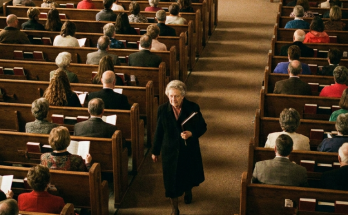
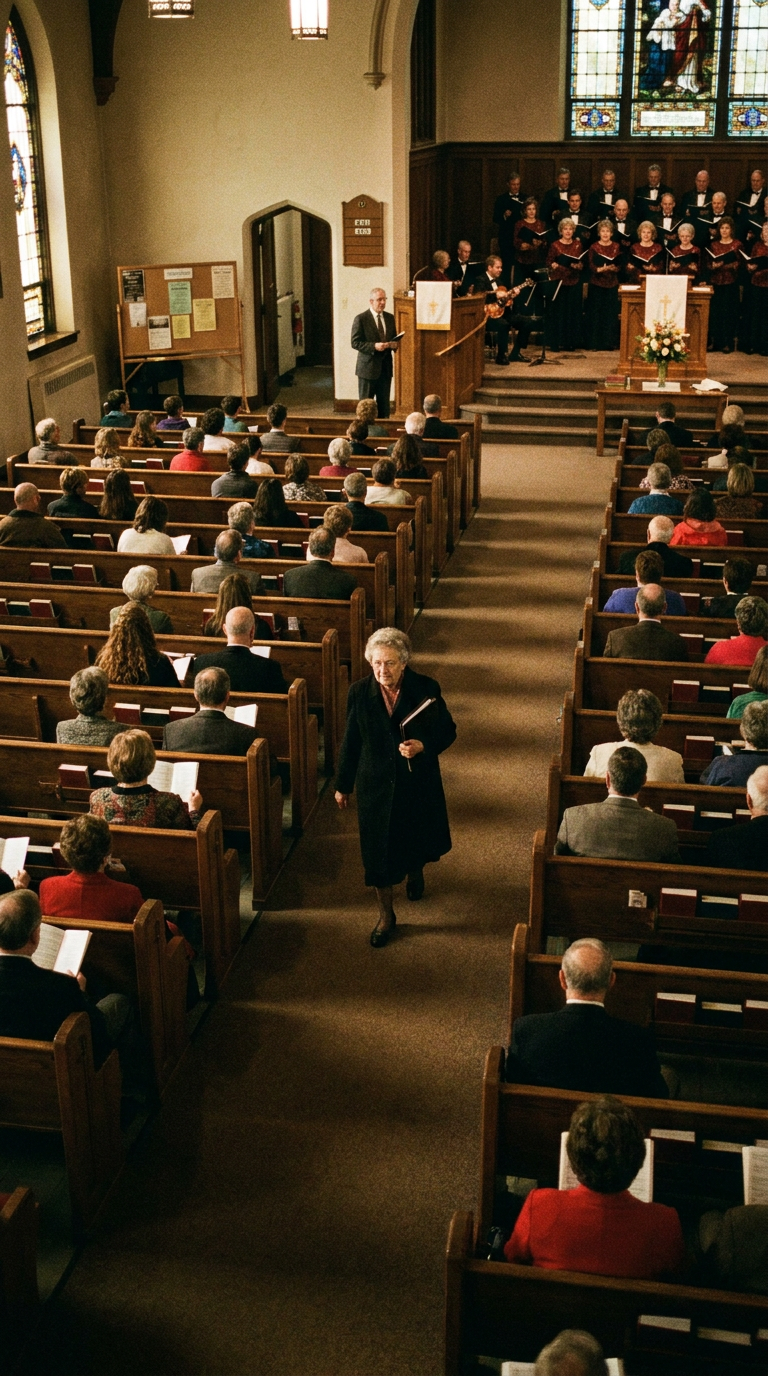
I unlocked the side door, switched on the sanctuary lights, and walked down the center aisle while the building was still quiet.
Sometimes, I would sit at the piano for a few minutes without playing.
I liked the silence.
It reminded me that not every moment needed to be filled with sound.
Then I would begin.
For years, no one asked me to keep track of how many hours I worked. No one handed me a contract. No one explained the monetary value of my time.
I never asked.
I was happy to serve.
When the church couldn’t afford a choir director, I helped organize the choir.
When a new pastor arrived and couldn’t read music, I taught him the melodies before his first Christmas service.
When a teenage girl named Emily lost her mother, I stayed after rehearsals to play the songs she remembered singing with her.
And when the church’s roof began leaking during a spring storm, I donated money toward the repairs.
I wasn’t wealthy.
I worked part-time at a local library for twenty-two years and saved carefully. Thomas and I had bought our house when interest rates were high, and we paid the mortgage off a little at a time.
After he died, I lived on my pension and savings.
But whenever Grace Fellowship needed help, I gave what I could.
Sometimes money.
Sometimes time.
Sometimes simply showing up when nobody else wanted to.
I never kept a tally.
That was not why I served.
Still, over the years, the church had become accustomed to my presence.
People stopped noticing how early I arrived.
They stopped asking how long I had practiced.
They assumed the piano would be ready, the hymns would be played, and the choir would have someone to follow.
I had become part of the building’s rhythm.
Like the clock above the fellowship hall.
Like the creaking third pew.
Like the stained-glass window depicting Jesus with a lamb.
And perhaps that was the problem.
People sometimes confuse something dependable with something permanent.
They assume that because a person has always been there, that person will always be there.
Until one Sunday, they look around and discover an empty chair.
The New Music Director
Daniel Price arrived in early March.
He was hired after our previous music director retired following twenty-three years at Grace Fellowship.
Daniel had impressive credentials.
He had studied music ministry at a respected university, directed a contemporary worship group in another state, and posted videos online that attracted thousands of views.
The church leadership was excited.
Attendance had been declining, particularly among young adults. Several families had moved away, and the congregation was aging.
Daniel promised he could help us reach a new generation.
At his first meeting with the choir, he spoke passionately about reinvention.
“We have to stop asking people to come into our world,” he said. “We need to create a world they want to enter.”
Everyone applauded.
I applauded, too.
I had no objection to change.
I had played contemporary arrangements before. I had accompanied jazz singers, learned new chords, and adapted hymns to different musical styles.
A church should grow.
Music should grow.
I simply believed that growth did not require pretending the past had never happened.
During Daniel’s first two Sundays, he allowed me to play the opening hymn while his musicians handled the rest.
After the second service, he approached me near the piano.
“Margaret, you have a wonderful touch.”
“Thank you.”
“But I think we need to modernize the entire service.”
“I understand.”
“We’ll probably use a digital keyboard, some backing tracks, maybe a small band.”
“That sounds interesting.”
He studied my face, perhaps searching for resistance.
I offered him a genuine smile.
“If you need help adapting any of the hymns, I’d be happy to assist.”
“That’s kind of you.”
He said it the way people speak to someone who has offered to help carry a box they have already decided to throw away.
A week later, I learned that the choir rehearsal schedule had changed.
Nobody had told me.
The new schedule appeared in an email sent to the choir members, but I was not included in the recipient list.
When I asked Daniel about it, he apologized and said the omission was accidental.
Then came the Sunday bulletin.
Then came the conversation about younger families.
And finally came the closed piano lid.
For three weeks, I did not return to Grace Fellowship.
I still attended church, but I visited a small congregation across town where an elderly pastor welcomed me without asking about my résumé or my musical style.
The first Sunday, I sat near the back.
The pianist was a college student who played beautifully but struggled with the old hymns.
I found myself quietly fingering the melody against my knee.
When the service ended, the pastor approached me.
“I’m sorry,” he said. “You look like someone who knows those songs.”
“I do.”
“Would you consider helping our pianist sometime?”
I almost laughed.
For forty years, I had assumed that Grace Fellowship was the only place where my music belonged.
It had never occurred to me that other people might need it, too.
“I’d be happy to,” I said.
And for the first time since Daniel had removed my name from the bulletin, I felt something other than hurt.
I felt free.
The Thing I Had Kept for Forty Years
There was another reason I did not return to Grace Fellowship immediately.
A week after leaving, I received a phone call from a woman named Ruth Bennett.
Ruth was seventy-six and had been the church secretary for nearly thirty years before retiring.
She had also been my closest friend at Grace Fellowship.
“Margaret,” she said, “I heard what happened.”
“News travels quickly.”
“It shouldn’t have happened.”
I looked out my kitchen window at the bare maple tree in my backyard.
“Perhaps Daniel is right. Maybe the church needs something different.”
“Different isn’t the same as better.”
I smiled sadly.
“Sometimes it is.”
There was a long silence.
Then Ruth asked, “Do you still have the old music books?”
I knew exactly what she meant.
In 1985, when I first began playing at Grace Fellowship, the church had very little money. The choir shared a handful of hymnals, and the music library consisted of two boxes of battered sheet music.
The previous pianist had left behind several binders of arrangements, most of them handwritten.
I spent years organizing those pages.
I copied missing parts, transcribed old melodies, and created arrangements for weddings, funerals, and special services.
Whenever someone requested a song we didn’t own, I found the music and prepared it myself.
Over time, I built a collection of more than six hundred arrangements.
Some were traditional hymns.
Others were instrumental pieces I had composed or adapted.
Many included notes about tempo, transitions, and the particular verses a family wanted sung during a funeral or wedding.
I kept everything in a set of blue folders.
When Grace Fellowship renovated its sanctuary in 2002, the church board asked me to organize the music archive. I volunteered to do it.
Ruth helped me label the boxes.
We worked for weeks.
When we finished, I created a catalog listing every arrangement, its source, and the person who had prepared or donated it.
The church received a printed copy.
I kept the originals of my handwritten arrangements at home.
Not because I wanted to own the church’s music.
But because the arrangements were mine.
I had written them with my own hands, often late at night, after working all day at the library.
They were the musical record of my life.
“Yes,” I told Ruth. “I still have them.”
“All of them?”
“Every folder.”
She exhaled.
“Then you should know something.”
I straightened in my chair.
“What?”
“Daniel asked the board to approve a new Easter concert. He wants a professional production. New lighting, guest musicians, a contemporary choir, the whole thing.”
“That sounds expensive.”
“It is.”
“How expensive?”
“Thirty-eight thousand dollars.”
I nearly dropped the phone.
“Thirty-eight thousand?”
“The church is paying for most of it from its music and building reserve. The rest is coming from donations.”
I rubbed my forehead.
“That seems like a lot for one concert.”
“It is. And there’s something else. Daniel wants to use some of your arrangements.”
I stared at the blue folders stacked on my bookshelf.
“How did he get them?”
“Some were scanned into the church’s old computer system years ago. He found the files and assumed they were part of the church’s public music collection.”
“Did he know I wrote them?”
“I don’t think he bothered to check.”
I felt the old hurt returning, but this time it was mixed with something else.
Not anger.
Clarity.
“Ruth, I don’t want a fight.”
“I know.”
“And I don’t want the church to fail.”
“I know that, too.”
“But if he is using my arrangements, someone should at least tell him where they came from.”
Ruth was quiet for a moment.
“Would you come to the Easter concert if I asked you?”
I glanced toward the blue folders.
“Why?”
“Because I think something needs to happen before this is over.”
I didn’t understand what she meant.
Not then.
But I agreed to attend.
I told myself I would sit in the back, listen politely, and leave when the concert ended.
I had no intention of making a scene.
I had no intention of humiliating Daniel.
And I certainly had no intention of playing the piano.
At least, that was what I believed.
Easter Sunday
The Easter concert was scheduled for seven o’clock in the evening.
By six-thirty, the parking lot at Grace Fellowship was full.
Cars lined the surrounding streets. Families arrived in bright spring dresses and pressed suits. Children ran through the foyer while volunteers handed out programs.
The church looked beautiful.
Fresh flowers stood beside the altar. White ribbons decorated the pews. The stained-glass windows glowed in the fading daylight.
For the first time in weeks, I felt a familiar ache in my chest.
I had helped decorate that sanctuary for Easter for forty years.
I knew where the extension cords were stored, which candles needed replacing, and which flower arrangements had to be moved because they blocked the view of the pulpit.
I knew the small imperfections that made the building feel like home.
But I was no longer part of the preparations.
I stood outside for a moment, holding my coat.
Then I walked through the main doors.
A young usher handed me a program.
“Welcome! Are you here for the concert?”
“I am.”
He smiled.
“You’re in for a treat. Mr. Price has put together something really special.”
“I’m sure he has.”
I opened the program.
The music list included modern worship songs, instrumental pieces, and a dramatic arrangement of “Amazing Grace.”
The last item caught my attention.
It was one of mine.
I recognized the title immediately.
Amazing Grace: A Journey Through Four Generations.
I had written that arrangement in 2007 for the funeral of a beloved church member named Eleanor Whitmore.
Eleanor had been eighty-nine when she died.
Her children wanted a version of the hymn that began softly, built gradually, and ended with a simple melody that the congregation could sing without accompaniment.
I had spent three nights arranging it.
The piece began with a single piano note, followed by a quiet melody in the right hand. The left hand gradually introduced a flowing pattern, creating the feeling of a steady heartbeat.
In the final verse, the accompaniment fell away entirely.
The congregation sang alone.
Then the piano returned for a gentle closing.
It was not flashy.
It was not modern.
It was simply honest.
I looked at the program again.
My name did not appear beside the arrangement.
The piece was credited to Daniel Price.
For a moment, the foyer seemed to tilt.
I read the line twice.
Then I folded the program.
I could have walked out.
I could have found Daniel and demanded an explanation.
Instead, I went into the sanctuary and took a seat in the last row.
The concert began promptly at seven.
Daniel stood beneath the stage lights, looking confident and pleased.
“Tonight,” he announced, “we celebrate the power of music to bring generations together. Our church has a rich history, and we are excited to build upon that foundation with a fresh sound for the future.”
The audience applauded.
I sat very still.
The opening number featured a young singer, a drummer, and a guitarist. The musicians were talented. Their voices filled the sanctuary, and the congregation responded enthusiastically.
I could not deny their skill.
The second number was even better.
For a while, I allowed myself to enjoy the music.
Then Daniel introduced “Amazing Grace: A Journey Through Four Generations.”
He explained that he had created the arrangement as a tribute to the church’s history.
The audience applauded again.
My fingers curled around the program.
He had not simply forgotten my name.
He had placed his own name where mine belonged.
The musicians began.
A single piano note rang through the sanctuary.
Then came the melody.
My melody.
The same sequence of notes I had written at my kitchen table eighteen years earlier, with Thomas sitting nearby, reading the newspaper and occasionally asking whether I wanted more tea.
I remembered the night I finished it.
I remembered crying when I played the final verse because I could hear Eleanor’s children singing it in my imagination.
And now I sat in the back row while a stranger introduced my work as his own.
The music continued.
The arrangement was technically correct, but something was missing.
Daniel had added a dramatic percussion section and a soaring vocal line. He had made the piece louder, bigger, and more complicated.
But he had removed the silence before the final verse.
He had removed the moment when the congregation was supposed to sing without being led.
I closed my eyes.
There were many things in life that could be improved by adding more.
But some things became meaningful only when you knew what to leave out.
The final chord crashed through the sanctuary.
The audience rose to its feet.
People applauded enthusiastically.
Daniel bowed.
And then the lights dimmed for the next piece.
That was when I stood up.
I walked down the aisle.
One step at a time.
The audience began turning to look at me.
I could hear whispers spreading through the pews.
“Isn’t that Margaret?”
“She used to play here.”
“Where has she been?”
Daniel noticed me when I reached the front.
His smile faltered.
I continued toward the stage.
A volunteer moved as if to stop me, but Ruth appeared from the side aisle and gently touched his arm.
“Let her through,” she whispered.
I climbed the two steps to the stage.
Daniel approached me with a strained smile.
“Margaret. What a surprise. We’re in the middle of the concert.”
“I can see that.”
“Perhaps we can talk afterward.”
“I think we should talk now.”
The audience fell silent.
Daniel glanced toward the congregation.
“This isn’t really the time.”
I looked at him.
“Then perhaps you should have thought of that before putting your name on my music.”
A murmur moved through the sanctuary.
His face changed.
“I’m sorry?”
I held up the program.
“This arrangement was written by me in 2007. I created it for Eleanor Whitmore’s funeral. I have the original handwritten score at home, along with the drafts and notes from the week I composed it.”
Daniel’s mouth opened.
Then closed.
I continued.
“I don’t mind people performing my music. I’ve always been happy to share it. But I do mind being erased from my own work.”
No one moved.
The silence was so complete that I could hear the ventilation system humming above the stage.
Daniel’s voice hardened.
“Margaret, this is a church concert, not a courtroom.”
“No,” I replied. “It is a church concert. Which is exactly why I hoped we could be honest with one another.”
I turned toward the congregation.
“I have played music in this church since 1985. I have played for weddings, funerals, baptisms, Christmas Eve services, and Sunday mornings when three people showed up in the snow. I never asked to be paid, and I never expected anyone to applaud me.”
My voice trembled, but I kept going.
“I did it because I believed that music was a form of service. And I still believe that.”
I looked at the piano.
“But service does not mean that a person has no name. And age does not mean that a person’s contribution suddenly becomes worthless.”
Someone in the front row began to cry.
I recognized her.
It was Emily, the young woman whose mother had died when she was sixteen. She was now a mother herself, with two children sitting beside her.
I remembered playing her mother’s favorite hymn while she clutched a tissue in the front pew.
Emily stood.
Then another person rose.
An elderly man named Frank, whose wife had been buried from that sanctuary four years earlier.
Then a woman who had married in the church in 1992.
Then the pastor who had baptized my goddaughter.
Within seconds, dozens of people were standing.
Not because I had asked them to.
Because they remembered.
Daniel looked toward the congregation, and for the first time that evening, he seemed unsure of what to do.
Then Ruth walked onto the stage carrying a thick blue folder.
“Margaret,” she said, “I think it’s time.”
She handed me the folder.
I stared at it.
The cover was worn at the edges, and the handwritten label had faded.
Grace Fellowship Music Archive — Original Arrangements, 1985–2025.
I knew that folder.
I had created it.
But I had never seen it outside my house.
“What’s this?” I asked.
Ruth turned toward the audience.
“Before Margaret left the church three weeks ago, I asked the board to review the history of our music ministry. I thought people should know what she had contributed over the years.”
Daniel looked alarmed.
“Ruth, this is not the time for administrative matters.”
“No,” Ruth replied calmly. “It’s the time for the truth.”
She opened the folder.
Inside were copies of the original catalog, photographs, old concert programs, and letters from families who had received music from me over the years.
There was a photograph of me at the piano in 1985.
Another from a Christmas Eve service in 1994.
A picture of me sitting beside a little girl who had sung her first solo at age seven.
There were letters from parents thanking me for helping their children overcome stage fright.
There were notes from families who had lost loved ones.
And there was a document I had almost forgotten.
A donation record.
In 2002, when the church’s sanctuary renovation had gone over budget, Thomas and I had contributed twenty-two thousand dollars toward the remaining construction costs.
We had never announced it.
We had asked the treasurer to record it as an anonymous gift.
Thomas had insisted that if we gave money to the church, it should be because the building needed it, not because we wanted our names on a wall.
The record had been included in the archive because Ruth had helped the treasurer organize the renovation documents.
She held up the page.
“Margaret and her husband contributed twenty-two thousand dollars toward the renovation of this sanctuary. They also gave countless hours to the church, including the preparation of more than six hundred musical arrangements.”
A shocked murmur spread through the room.
I felt my cheeks grow hot.
“Ruth, you didn’t have to do that.”
“Yes,” she said softly. “I did.”
She turned another page.
“And here is a letter from our former pastor, written when Margaret completed twenty years of service.”
Ruth read aloud.
“‘A congregation may forget the hands that prepare the music, but it should never forget the heart that gives it life. Margaret has helped this church sing through joy, grief, uncertainty, and hope. Her work is not merely a contribution to our services. It is part of our history.'”
Ruth lowered the letter.
Then she looked directly at Daniel.
“You wanted a sound that appealed to younger families. That’s fine. We all want this church to grow. But you don’t build a future by pretending the people who brought you here never existed.”
For a long moment, nobody spoke.
Then the pastor stood.
He was a quiet man who rarely raised his voice.
“Daniel,” he said, “did you know Margaret wrote the arrangement we just heard?”
Daniel looked down.
“I found the score in the church’s music files. I assumed it was a traditional arrangement.”
“Did you check?”
“No.”
“Did you ask who wrote it?”
Daniel swallowed.
“No.”
The pastor waited.
“And when Margaret’s name was removed from the music schedule, did you speak with her about the decision?”
Daniel hesitated.
“I explained that we were changing the direction of the music program.”
“You explained the decision after you had already made it.”
Daniel’s shoulders lowered.
The pastor turned toward the congregation.
“I believe we owe Margaret an apology.”
The entire sanctuary remained silent.
Then the pastor walked toward me.
“Margaret, on behalf of this church, I am sorry.”
He took my hand.
“We should have treated your forty years of service with more care and respect.”
My eyes filled with tears.
For three weeks, I had told myself that I was old enough not to need recognition.
That I had done what I had done for the right reasons.
That I could accept being replaced without feeling wounded.
But standing there, surrounded by people who remembered, I realized something.
I had never needed a standing ovation.
I had simply needed someone to remember that I had been there.
Daniel stepped forward.
“Margaret,” he said quietly, “I’m sorry.”
I looked at him.
He seemed younger than he had three weeks earlier.
“I thought I was helping the church move forward,” he continued. “I wanted to make a good impression. I wanted people to see what I could do.”
He glanced at the program in my hand.
“I should have checked the arrangements. I should have spoken with you. And I shouldn’t have removed your name without a conversation.”
I studied his face.
I could have told him that he had hurt me.
I could have reminded him that he had mistaken my quietness for weakness.
But I had already said what I needed to say.
“Daniel,” I told him, “wanting to make something better is not wrong. But you have to be careful not to destroy something valuable simply because it isn’t new.”
He nodded.
“I understand.”
“I hope you do.”
I looked toward the congregation.
“Now, if you’ll excuse me, I think there is one more song we should play.”
The pastor smiled.
“Which song?”
I turned toward the piano.
“Amazing Grace.”
The audience began to applaud, but I raised my hand.
“Not the way we just heard it.”
I sat at the piano bench.
My hands trembled slightly as I lifted the lid.
For three weeks, I had told myself that I was finished playing for Grace Fellowship.
But as I placed my fingers over the keys, I felt the familiar shape of the keyboard beneath them.
The piano was not perfect.
Neither was I.
But we had both survived a great deal.
I began with a single note.
Then the melody emerged, quiet and clear.
No drums.
No backing track.
No dramatic lighting.
Just a piano, a familiar hymn, and a room full of people who knew the words.
When the second verse began, I softened the accompaniment.
When the third verse arrived, I lifted my hands from the keys.
The congregation sang alone.
Hundreds of voices rose together.
Some were strong.
Some were shaky.
Some were broken by tears.
But every voice belonged.
I watched Emily singing beside her children.
I watched Frank close his eyes.
I watched the pastor stand with his hands folded.
And in the front row, I saw Daniel.
He was not smiling.
He was listening.
When the final verse ended, I played the closing melody exactly as I had written it eighteen years earlier.
Softly.
Simply.
Then I let the last note fade.
For several seconds, nobody moved.
And then the entire congregation stood.
The applause filled the sanctuary.
I bowed my head, overwhelmed.
But what happened next was something I could never have anticipated.
An elderly woman rose from the third pew.
Her name was Helen Whitmore.
She was Eleanor’s daughter.
I had not seen her in years.
Helen walked slowly toward the stage, holding a small envelope.
“Margaret,” she said, “I have been waiting for the right moment to give you this.”
I stepped down from the piano bench.
“What is it?”
She placed the envelope in my hand.
“Something my mother wanted you to have.”
Inside was a letter dated eighteen years earlier, written in Eleanor’s shaky handwriting.
I unfolded it.
Dear Margaret,
If you are reading this, I am probably no longer here to tell you how much your music has meant to me.
When my husband died, I stopped singing. When my son moved away, I stopped going to church. When the doctors told me my heart was failing, I thought the rest of my life would be nothing but waiting.
Then you played the piano at church.
You never asked me why I cried during the hymns. You never told me to be brave. You simply played the songs I remembered from when I was young.
And somehow, those songs made me feel that my life had not become smaller just because I was getting older.
You gave me back a piece of myself.
I cannot repay you for that.
But I hope you will remember this: music is not valuable because it sounds new. It is valuable because it helps people remember who they are.
With love and gratitude,
Eleanor.
I could no longer see the page clearly.
Helen put her hand on my shoulder.
“My mother kept talking about you until the day she died,” she whispered. “She wanted you to know that.”
I folded the letter carefully and held it against my chest.
For the first time that evening, I cried without trying to hide it.
Not because I had been replaced.
Not because my name had been removed from a bulletin.
But because I finally understood that forty years of music had reached places I would never be able to measure.
And no one could erase that.
Not a new director.
Not a new program.
Not even time.
The Morning After
The next morning, I received eleven phone calls.
By lunchtime, I had received twenty-three.
People wanted to apologize.
Some had heard about the concert from friends. Others had been there and wanted to tell me what the music had meant to them.
One woman said her husband had been so moved by the final hymn that he had asked to return to church for the first time in six months.
A young father told me his daughter had asked whether I could teach her piano.
And Emily called to say that her children had spent the entire ride home asking why I no longer played at Grace Fellowship.
I didn’t know what to tell them.
At two o’clock, the pastor called.
“Margaret, could we meet?”
I agreed.
When I arrived at the church that afternoon, he was waiting in his office with Daniel and three members of the church board.
On the desk was a folder.
Inside was a letter of apology from the music committee.
They acknowledged that I had been removed from the music schedule without consultation and that the decision had been handled poorly.
They also corrected the Easter concert program online to credit the original arrangements to me.
The pastor asked whether I would consider returning to the music ministry.
I looked at the letter.
For forty years, I would have accepted immediately.
I would have said yes before he finished asking.
But something had changed.
I had learned that being needed and being respected were not the same thing.
“I appreciate this,” I said. “But I need to ask a question.”
“Of course.”
“If I return, will I be expected to pretend the last three weeks never happened?”
The pastor shook his head.
“No.”
“Will I be expected to accept decisions about my work without being consulted?”
“No.”
“Will the music ministry have room for traditional hymns, contemporary music, and the musicians who can bring them together?”
He glanced at Daniel.
“That is what we should have been doing from the beginning.”
Daniel nodded.
“I agree.”
I studied him for a moment.
“Then I have one condition.”
Everyone waited.
“I don’t want to be brought back as a symbol. I don’t want a special Sunday where everyone applauds and then forgets me again. And I don’t want to play simply because people feel guilty.”
The pastor leaned forward.
“What do you want?”
I thought about Eleanor’s letter.
I thought about the young families Daniel had wanted to reach.
I thought about the elderly members who sat alone in the pews, afraid that the world was moving too quickly for them to keep up.
“I want a music program where no generation has to disappear for another one to belong.”
Daniel’s expression changed.
For the first time, he looked genuinely interested rather than defensive.
“What would that look like?” he asked.
I smiled.
“Why don’t we find out together?”
A Different Kind of Music Ministry
The church board approved a new plan two weeks later.
Daniel remained the music director, but his responsibilities were expanded to include collaboration with the choir, volunteer musicians, and a newly established music committee.
I agreed to return as a volunteer pianist and music mentor.
Not because I needed the position.
Not because I wanted my name restored to a bulletin.
But because I believed the church could learn something from what had happened.
We began by inviting musicians of different ages to share their ideas.
A college student taught us how to use digital arrangements.
A retired teacher brought in a collection of folk hymns.
A young father introduced a guitar arrangement of “Be Thou My Vision.”
And I showed them how to accompany a congregation without drowning out its voices.
We started a monthly music workshop for children and adults.
Some participants had never touched an instrument.
Others had played for decades but had never felt comfortable performing in public.
We gave them a place to learn.
Daniel apologized to the choir personally.
He also began checking the history of the music he selected.
When he discovered that an arrangement had been written by a church member, he contacted that person or their family whenever possible.
It was a small change.
But it mattered.
The first Sunday I returned to the piano, there was no special announcement.
No speech.
No applause.
The bulletin simply listed:
Piano: Margaret Ellis.
I arrived early, as I always had.
I unlocked the side door, switched on the sanctuary lights, and walked down the center aisle.
The building was quiet.
The stained-glass windows were dark in the early morning.
The piano waited beneath its familiar lamp.
I sat down.
For a moment, I rested my hands in my lap.
Then I opened the hymnal.
The first song was “Great Is Thy Faithfulness.”
I began to play.
And this time, I did not think about the forty years behind me.
I thought about the people who would come after me.
The children learning their first notes.
The teenagers discovering that music could carry feelings they couldn’t yet explain.
The young parents who needed a moment of peace.
The elderly members who wanted to hear the melodies that had accompanied their lives.
There was room for all of them.
There had always been room.
We simply needed to remember.
The Final Surprise
Six months later, Grace Fellowship held another concert.
This time, it was not a grand production.
There were no expensive lighting effects, no elaborate stage decorations, and no professional advertising campaign.
Instead, the concert featured the church’s own musicians.
Children played simple melodies.
Teenagers sang contemporary worship songs.
The choir performed traditional hymns.
A retired farmer played the harmonica.
And Daniel arranged a new version of “Amazing Grace” that combined guitar, piano, and a small choir.
He called it “The Song That Carries Us.”
Before the final piece, he stepped to the microphone.
“I want to thank someone who taught me an important lesson,” he said.
I sat at the piano, looking down at my music.
“Three weeks before Easter, I made a decision that I thought would help this church move forward. I believed that changing the sound meant changing the people who created it.”
He paused.
“I was wrong.”
The audience became quiet.
“Margaret Ellis has served this congregation for forty years. But what I learned from her is that service is not about how long someone has been in a position. It’s about what they give to the people around them.”
He turned toward me.
“Margaret, thank you for reminding us that a church’s future should never require it to erase its past.”
I felt tears gathering in my eyes.
Then Daniel added something I had not expected.
“When I began researching the music archive, I discovered that Margaret had written more than six hundred arrangements. Many of them have been performed at churches across Iowa, but her name was never included in several of the collections because the original files were copied without their credits.”
A murmur moved through the audience.
Daniel continued.
“With Margaret’s permission, we have begun documenting her work and contacting the publishers and churches that may have copies. We want her music to be properly credited and preserved for future generations.”
I stared at him.
I had not known he was doing that.
The project was not finished, and there was no guarantee that every old copy could be traced.
But someone had finally decided that my work deserved to be treated with care.
Daniel stepped away from the microphone.
The musicians took their places.
I placed my hands on the keys.
Then I looked toward the congregation.
“Before we begin,” I said, “I would like to dedicate this song to everyone who has ever been made to feel that they are too old, too quiet, too ordinary, or too late to matter.”
The room fell silent.
“Your life is not less valuable because someone else has arrived. Your work is not meaningless because people have stopped noticing it. And your place in this world does not disappear just because someone forgets to write your name down.”
I glanced at Daniel.
He nodded.
I began to play.
The guitar entered softly.
Then the choir joined in.
And for the first time in forty years, I was not carrying the music alone.
When the final chord faded, the congregation stood.
But I did not look at the applause.
I looked at the piano.
At the worn keys.
At the small scratches along the edge.
At the instrument that had accompanied me through four decades of joy, grief, loneliness, and hope.
I thought about my mother teaching me “Amazing Grace.”
I thought about Thomas sitting at our kitchen table while I wrote arrangements late into the night.
I thought about Eleanor’s letter.
And I finally understood something I wished I had learned years earlier.
I had spent forty years believing that my faithfulness meant I had to keep showing up, no matter how little anyone noticed.
But faithfulness does not require you to disappear.
Love does not require you to accept disrespect.
And being willing to serve does not mean you must allow others to erase your contribution.
Sometimes, the most important thing you can do is close the piano lid, pick up your music folder, and walk away.
Not to punish anyone.
Not to make someone regret losing you.
But to remind yourself that your life belongs to you, too.
That evening, as people left the sanctuary, a little girl approached me.
She couldn’t have been older than eight.
“Mrs. Ellis?”
“Yes, sweetheart?”
“My mom says you used to play here a long time ago.”
I smiled.
“Your mother is right.”
“Are you going to keep playing?”
I looked toward the piano.
Then I looked back at her.
“Yes,” I said. “As long as I can.”
She beamed.
“Could you teach me?”
I knelt so that we were eye to eye.
“Of course.”
She took my hand and led me toward the piano as if she were afraid I might change my mind.
I sat beside her on the bench.
She placed one small finger on a key.
“Which note is this?”
“Middle C,” I told her.
She pressed it.
A single note rang through the nearly empty sanctuary.
She laughed.
I laughed, too.
And suddenly, I was back in 1985, sitting beside my mother, learning that one small note could become something beautiful when someone took the time to teach you what came next.
Outside, the evening light faded over Des Moines.
Inside, the little girl pressed another key.
Then another.
And I knew that the music would continue.
Not because my name appeared in a bulletin.
Not because a church board had apologized.
Not because a new director had finally understood what he had almost thrown away.
The music would continue because it had never belonged to one person, one generation, or one season of life.
It belonged to everyone willing to listen.
And as I guided that little girl’s fingers across the keyboard, I made myself a promise.
I would keep playing.
I would keep teaching.
I would keep sharing the songs that had carried me through forty years.
But I would never again confuse being taken for granted with being called to serve.
Because forty years of music could disappear from a bulletin in a single afternoon.
But forty years of love could never be erased by a missing name.