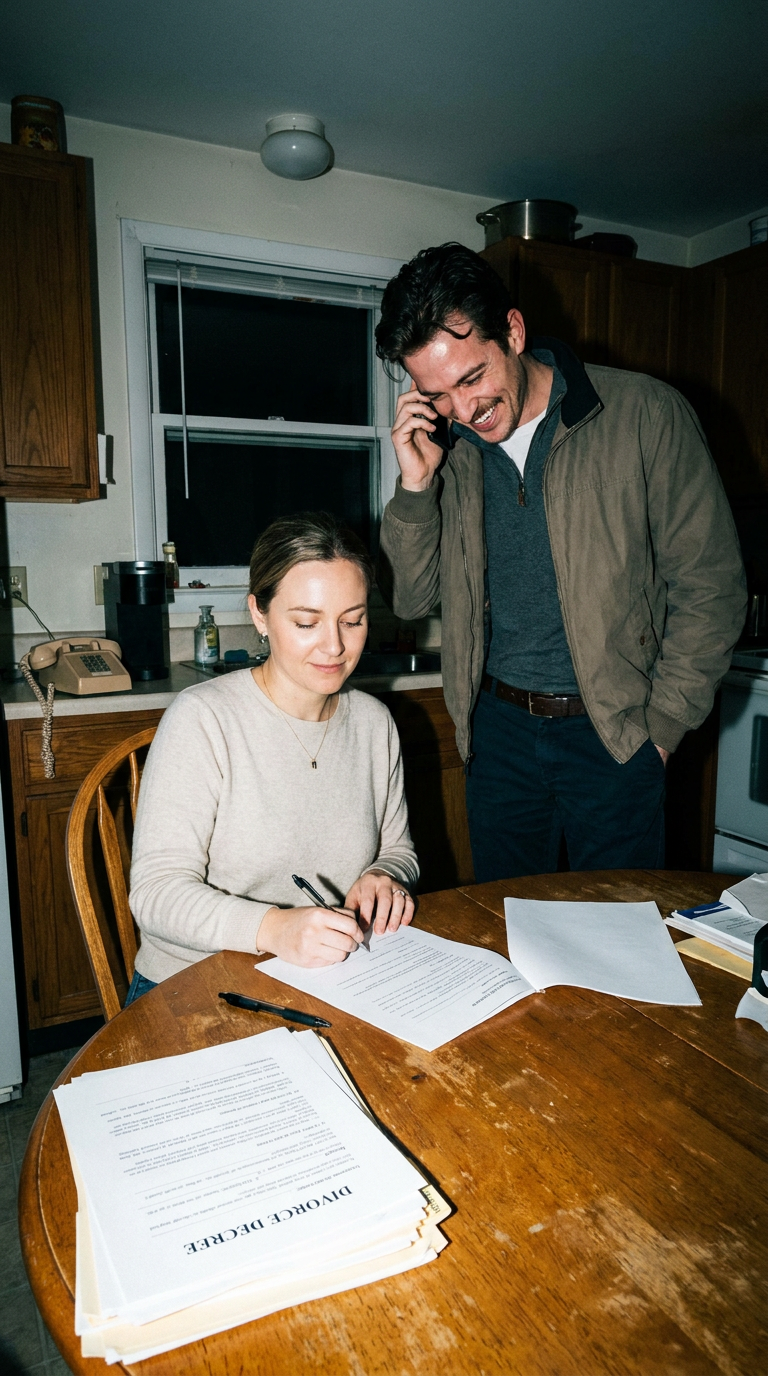
My Husband Inherited $800 Million and Told Me to Leave Before He Got Home. Three Days Later, His Family Begged Me to Answer the Phone…
The call came at 10:17 on a Tuesday morning.
I remember the exact time because I was standing beside the office coffee machine, holding a paper cup that had already gone cold, when my husband’s name appeared on my phone.
For twelve years, Daniel Whitmore had been the person I called when life became difficult. He was the man who held my hand through my father’s funeral, who promised me that we would grow old together, and who once told me that even if we lost everything, we would still have each other.
So when I answered and heard his voice, I expected him to tell me something ordinary.
Instead, he said, “My uncle just died.”
I stopped stirring my coffee.
“Oh, Daniel. I’m so sorry. I know how much he meant to you.”
“Listen carefully, Emily. I need you to pack your things and be out of the apartment before I get home.”
For a moment, I thought I had misunderstood him.
“What?”
“My uncle left me his entire fortune. Eight hundred million dollars, Emily. Do you understand what that means?”
I leaned against the counter.
“Daniel, your uncle was sick. We talked about this last month. Are you okay?”
“I’m better than okay.”
His voice had changed.
The man speaking to me sounded nothing like the husband who had kissed my forehead that morning before leaving for work.
“I’m rich,” he continued. “Ridiculously rich. I’m talking private jets, estates, investments, everything. And I’m not spending the rest of my life dragging someone behind me who doesn’t belong in that world.”
Someone.
Not his wife.
Not the woman who had stood beside him for twelve years.
Someone.
I swallowed hard.
“Daniel, what are you saying?”
“I’m saying this marriage is over. I’ve already spoken to a lawyer. The papers are on the kitchen counter. Sign them, pack your things, and leave your keys on the table.”
I stared at the coffee machine as if it might somehow explain what was happening.
“You’re divorcing me because you inherited money?”
“Don’t make this more humiliating than it needs to be.”
I almost laughed at that.
Humiliating?
He was ordering his wife out of their home as if she were a delivery driver who had arrived at the wrong address.
“Daniel,” I whispered, “we built a life together.”
“No, Emily. We built a life I can finally afford to outgrow.”
Then he hung up.
I stood motionless for nearly a minute.
Around me, my coworkers moved through their morning routines. Someone laughed at a joke. A printer started humming. A woman from accounting asked whether anyone had seen her water bottle.
The world continued as if my marriage hadn’t just been dismantled in less than three minutes.
I placed my coffee in the sink.
Then I returned to my desk, told my supervisor I wasn’t feeling well, and drove home.
I didn’t cry in the car.
I didn’t cry in the elevator.
And when I opened the apartment door, I didn’t cry there either.
Because what I saw on the kitchen counter made one thing painfully clear.
Daniel hadn’t made this decision that morning.
He had been planning it for a long time.
And the money had simply given him permission to stop pretending.
Chapter One: The Papers on the Kitchen Counter
Our apartment overlooked a small park in downtown Chicago.
It wasn’t luxurious, but it was ours—or at least, I had believed it was.
We had chosen the curtains together. We had argued over the color of the kitchen cabinets. We had spent an entire Saturday assembling the dining table, laughing whenever Daniel accidentally put a screw in backward.
On the wall above the sofa hung a photograph from our tenth anniversary.
Daniel had his arms around me, his forehead pressed against mine, and his eyes were closed.
I had once thought that photograph captured the safest moment of my life.
Now I wondered whether he had already been imagining a future without me when it was taken.
The divorce papers sat in a neat stack beside a black fountain pen.
A yellow sticky note covered the top page.
Please don’t make this difficult.
I read the sentence twice.
Then I sat down.
The first document was a petition for dissolution of marriage. The second outlined our assets. The third contained provisions regarding our shared accounts, household belongings, and personal property.
Daniel had already hired an attorney.
He had already prepared the paperwork.
And he had already arranged for the apartment to be inspected by someone who apparently believed my belongings could be sorted and removed in an afternoon.
A small envelope lay beneath the documents.
Inside was a cashier’s check for $25,000.
For one ridiculous second, I stared at it and wondered whether Daniel had mistaken me for someone he had hired to clean his house.
Twelve years of marriage.
Twelve years of birthdays, hospital waiting rooms, holiday dinners, bills, disappointments, and promises.
And apparently, my price was twenty-five thousand dollars.
I placed the check back in the envelope.
Then I opened the document folder.
Several pages were marked with yellow tabs. Others contained instructions for where I should sign. The proposed agreement stated that Daniel would retain certain assets and that I would waive claims to specified property.
Some of the provisions were confusing. Others seemed deliberately one-sided.
I wasn’t a lawyer, but I wasn’t stupid either.
I knew that signing divorce papers could affect my rights, and I had no intention of surrendering those rights simply because my husband had discovered a fortune.
But something else stopped me.
At the bottom of the final page was a statement declaring that I had entered the agreement voluntarily and had received an opportunity to seek independent legal advice.
I hadn’t received legal advice.
I had received a phone call telling me to disappear.
I picked up my phone and took photographs of every page.
Then I scanned the documents and sent them to a private email account Daniel didn’t know about.
Only after I had preserved everything did I take a closer look at the apartment.
My passport was in the bedroom drawer. My grandmother’s ring was in the jewelry box. My laptop was on the desk. The blue ceramic bowl my mother had given me sat beside the refrigerator.
Those were the things I wanted.
Not the television.
Not the expensive couch Daniel had insisted we buy.
Not the collection of wine glasses he used to impress his colleagues.
I packed my clothes, my documents, my jewelry, and a few personal photographs.
I left the furniture.
I left the kitchen appliances.
And I left the $25,000 check exactly where I had found it.
At 1:42 p.m., I called a divorce attorney.
Her name was Margaret Ellis, and a friend from work had recommended her years earlier when another colleague went through a difficult separation.
I explained the situation.
She listened without interrupting.
When I finished, she asked, “Have you signed anything?”
“No.”
“Good. Don’t sign anything else until I’ve reviewed the documents. An inheritance isn’t automatically marital property, and whether you have a claim depends on the circumstances, the governing law, and how the money is handled. We need to understand exactly what your husband is trying to get you to waive.”
I looked at the stack of papers.
“He wants me gone before he gets home.”
“Then leave if that’s what makes you feel safest. But don’t confuse leaving the apartment with giving up your legal rights.”
That sentence changed everything.
For the first time that day, I felt something other than shock.
I felt steady.
I hired Margaret for an initial consultation and emailed her the documents.
Then I called my best friend, Rachel.
She answered on the second ring.
“Emily? What’s wrong?”
I looked around the apartment I had thought would be my home forever.
“Daniel inherited eight hundred million dollars,” I said.
There was a pause.
“That’s… good news?”
“He’s divorcing me.”
Another pause.
Then Rachel said something I will never forget.
“I’m coming to get you. Don’t you dare sit in that apartment alone.”
Chapter Two: The Woman He Thought Was Worth Nothing
Rachel arrived forty minutes later with two suitcases in the trunk of her car and enough anger to fuel an entire city.
She found me sitting on the bedroom floor, folding sweaters into a cardboard box.
“Where is he?”
“At work, I think.”
“Good. Because if I see that man right now, I’m going to say something that will get me arrested.”
I almost smiled.
Rachel had known Daniel since our wedding. She had defended him when he was difficult, excused him when he was selfish, and reminded me that every marriage went through rough seasons.
She had believed in him almost as much as I had.
Now she looked at the divorce papers and shook her head.
“He gave you a check?”
“Twenty-five thousand dollars.”
Rachel stared at me.
“For twelve years?”
“Apparently.”
She sat beside me.
“Emily, do you remember when he lost his job in 2018?”
I nodded.
Daniel had been laid off from a financial consulting firm. He had spent months searching for another position, growing increasingly frustrated as interviews failed to lead anywhere.
I had paid the rent from my salary as a project manager at a medical equipment company. I had covered groceries, utilities, and his health insurance. When his car broke down, I paid for the repairs.
I never kept a record of those expenses.
We were married. I thought we were building a future together.
Rachel continued.
“You took extra shifts. You canceled that trip to Italy you had saved for. You helped him prepare for interviews. You even paid for that certification course he said would change everything.”
“I remember.”
“And now he thinks you’re beneath him?”
I lowered my eyes.
“I guess I was useful when he needed me.”
The words hurt more than I expected.
Because that was the truth I had been avoiding.
Daniel had always been ambitious.
There was nothing wrong with ambition. I had admired it when we met. He worked hard, dreamed big, and wanted to give his future family a comfortable life.
But over the years, his dreams had slowly become a measurement of everyone around him.
He began judging restaurants by the people who ate there. He criticized friends who still rented apartments. He made jokes about my modest salary, even though I earned enough to pay our bills and maintain a comfortable life.
Whenever I suggested saving for a house, he said we needed to invest in his career first.
Whenever I asked about starting a family, he said we should wait until he had achieved something substantial.
And whenever I complained that he was becoming distant, he promised things would improve once he reached the next milestone.
The next promotion.
The next bonus.
The next investment.
There was always a next thing.
Then his uncle, Arthur Whitmore, died.
Arthur was the younger brother of Daniel’s father and one of the wealthiest people in the family.
He had built a commercial property empire over several decades. His investments stretched across hotels, office buildings, technology companies, and private equity funds.
He was also a deeply private man.
Daniel had visited him a handful of times over the years, usually during holidays or when he wanted advice about investments.
I had met Arthur only six times.
He was polite but reserved, a tall man with silver hair, an old-fashioned watch, and an extraordinary habit of asking questions that made people uncomfortable.
At our last family dinner, he had asked Daniel, “If you lost your money tomorrow, who would still answer your calls?”
Daniel had laughed.
“Hopefully everyone who matters.”
Arthur had looked at me.
“And you, Emily?”
I had thought about the question.
“My answer wouldn’t depend on what Daniel owned.”
Arthur had studied me for several seconds before nodding.
At the time, I hadn’t understood why the conversation mattered.
Now I remembered it with uncomfortable clarity.
Rachel helped me carry the last box to her car.
Before leaving, I walked through the apartment one final time.
I looked at the dining table, the curtains, the little marks on the hallway wall from when we had moved in.
Then I placed my apartment key beside the divorce papers.
I didn’t leave a letter.
I didn’t leave an angry message.
I simply walked out.
At 4:06 p.m., Daniel sent me a text.
Good. I hope you made the smart decision. I’ll have someone collect anything else you left behind.
I read it.
Then I put my phone away.
He had mistaken my silence for surrender.
He had no idea what I was about to discover.
Chapter Three: The First Call
I spent that night in Rachel’s guest room.
Sleep came in short, uncomfortable stretches.
Every time I closed my eyes, I heard Daniel’s voice.
We built a life I can finally afford to outgrow.
By morning, I had stopped asking myself what I had done wrong.
Instead, I began asking a more useful question.
What had Daniel known before he called me?
The inheritance was enormous. Eight hundred million dollars wasn’t the kind of money a person casually received without professional advice, legal arrangements, and careful planning.
Arthur’s estate would have an executor. There would be a will or trust documents. There might be taxes, liabilities, restrictions, and disputes.
Daniel had spoken as though the money were already sitting in his personal bank account.
That seemed strange.
I mentioned it to Margaret during our appointment.
She adjusted her glasses and said, “An inheritance of that size is almost never as simple as someone saying, ‘It’s mine.’ We need the actual estate documents before drawing conclusions.”
“Do you think he could have lied?”
“About receiving an inheritance? Possibly. About its terms? Certainly. But we don’t need to speculate. We need evidence.”
That afternoon, I received a call from an unfamiliar number.
I answered cautiously.
“Hello?”
“Mrs. Whitmore?”
The man sounded older, with a calm, measured voice.
“Yes.”
“My name is Jonathan Pierce. I’m the attorney representing the estate of Arthur Whitmore.”
My heart began beating faster.
“I see.”
“I’m calling because your husband has requested an immediate distribution of funds from the estate, and there are some matters I need to clarify.”
I sat upright.
“I’m sorry, but why are you calling me?”
There was a pause.
“Because Mr. Whitmore’s will contains provisions that may affect you directly.”
I looked at Rachel, who was standing in the kitchen doorway.
She mouthed, Who is it?
I held up a finger.
“What kind of provisions?”
“I’m not comfortable discussing the details over an initial telephone call. However, I would like to arrange a meeting with you and your attorney. Your husband’s legal team has already been notified that the estate’s administration will proceed according to the governing documents.”
I felt a chill move through me.
“Does Daniel know you’re calling me?”
“Yes.”
“Did he ask you to?”
“No, Mrs. Whitmore. I called because the executor’s office believes you should understand your position before any further action is taken.”
I gripped the phone.
“Can you tell me one thing? Is the inheritance really eight hundred million dollars?”
“The estate has been valued at approximately that amount, subject to administration, liabilities, and other adjustments. That figure does not necessarily represent the amount immediately available to your husband.”
That was the first crack in Daniel’s perfect story.
“What happens next?”
“I’d prefer to explain that in person. Please ask your attorney to contact my office.”
After the call ended, I sat quietly.
Rachel lowered herself into the chair opposite me.
“Emily,” she said, “what exactly did that man just tell you?”
I repeated the conversation.
When I finished, Rachel leaned forward.
“Do you think there’s something in that will?”
“I don’t know.”
“But he called you, not Daniel.”
I stared at the phone.
“Yes.”
And for the first time since my husband had ordered me out of our home, I wondered whether Daniel had made a terrible mistake.
Not because he had left me.
But because he had assumed he understood the inheritance before reading the entire story.
Chapter Four: The Family Meeting
Daniel’s family gathered at his parents’ house on Thursday evening.
I wasn’t invited.
I knew about the meeting because Daniel’s younger sister, Olivia, called me.
We had never been especially close, but we had always been civil. Olivia was thirty-two, worked as a marketing director, and had a habit of staying out of family conflicts until they became impossible to ignore.
“Emily,” she said, sounding anxious, “I need to ask you something.”
“Go ahead.”
“Did Jonathan Pierce contact you?”
“Yes.”
“What did he say?”
“That he wanted me to meet with him and my attorney.”
Olivia exhaled sharply.
“Oh, God.”
“What happened?”
“Daniel told everyone the estate was releasing the money next week. He said he’s buying a house in Lake Forest and planning to start a private investment company.”
I said nothing.
“He also said you signed the divorce papers.”
“I signed the pages he gave me, but my attorney is reviewing the agreement. I haven’t agreed to anything beyond what I’ve been advised to sign.”
That was the safest and most accurate way to describe it.
Olivia went quiet.
Then she said, “He told Mom and Dad that you were thrilled about the money and that the divorce was mutual.”
I closed my eyes.
Of course he had.
“What else did he tell them?”
“That you wanted to leave because you couldn’t handle his success.”
I almost laughed.
The absurdity was breathtaking.
“Olivia, your brother told me to pack my things and leave before he got home. He left a check on the kitchen counter. He had the divorce papers prepared before he told me about the inheritance.”
She didn’t respond immediately.
Finally, she whispered, “That’s not what he said.”
“I know.”
“I’m sorry.”
It was the first sincere apology I had received from anyone in Daniel’s family.
Then Olivia said something that made my stomach tighten.
“There’s another thing. Uncle Arthur’s attorney asked Dad whether Daniel had ever discussed his marriage with Arthur. Dad said Daniel told Uncle Arthur you were separated.”
I felt the room go still.
“Separated?”
“Apparently, Daniel said you were living apart and had already agreed to divorce.”
I stared at the wall.
We had never separated.
We had argued, certainly. We had experienced difficult months. We had even attended three marriage counseling sessions the previous year.
But we had always lived together.
We had celebrated our anniversary six weeks earlier.
Daniel had bought me flowers.
He had kissed me in the kitchen and told me that the next year would be better.
If he had told Arthur that our marriage was already over, then the lie had begun long before the inheritance.
“Olivia,” I said carefully, “did Arthur know we were still married?”
“I don’t know.”
“Did Daniel tell him anything else?”
She hesitated.
“There’s a letter. Dad says Uncle Arthur left instructions that the family must read it before the first major distribution.”
“What does it say?”
“No one knows. Jonathan has it.”
I thought of Arthur’s question at that final family dinner.
If you lost your money tomorrow, who would still answer your calls?
Then I remembered how he had looked at me.
Perhaps he had noticed more than I realized.
“Olivia,” I said, “I need to ask you something. Did your uncle ever say anything about me?”
She was quiet for a long moment.
Then she replied, “He told Dad that you were the only person at the table who didn’t look at Daniel as if he were a future millionaire.”
I had no idea what to say.
After the call, I told Margaret everything.
She listened carefully and made several notes.
“That’s useful context,” she said, “but we’ll let the documents speak for themselves. If he misrepresented the status of your marriage to the estate, that could matter. We need to know what Arthur actually wrote and whether the will imposes any conditions.”
The next morning, Jonathan Pierce scheduled a meeting for Friday at eleven.
Daniel would be there.
So would his parents, his sister, and two attorneys representing the estate.
Margaret agreed to accompany me.
For the first time in days, I felt no urge to hide.
If Daniel wanted a public performance, he was about to discover that I could sit through it without applauding.
Chapter Five: The Man Who Inherited a Fortune
The estate attorney’s office occupied the thirty-second floor of a glass building overlooking the Chicago River.
When Margaret and I arrived, Daniel was already seated at the conference table.
He wore a charcoal suit, a white shirt, and a watch I had never seen before.
His father sat beside him.
His mother, Patricia, was on his other side, clutching a leather handbag.
Olivia sat near the window.
Daniel looked at me and smiled.
It was the same smile he used when he believed he had won an argument before the other person had spoken.
“Well,” he said, “you came.”
“I was invited.”
He glanced at Margaret.
“Of course you brought a lawyer.”
“Of course,” Margaret replied pleasantly.
Jonathan Pierce entered the room carrying a thick folder.
He was in his early sixties, with neatly combed gray hair and the kind of expression that suggested he had heard every possible excuse wealthy people could invent.
He introduced himself, confirmed everyone’s identity, and began explaining the estate.
Arthur Whitmore’s assets included commercial properties, investment funds, shares in private companies, and several charitable foundations.
The estimated gross value was approximately $800 million.
However, the estate was not a suitcase filled with cash.
Some assets were held through trusts. Some were subject to debt, operating agreements, or transfer restrictions. Some distributions required approvals and compliance with the will’s conditions.
Daniel leaned back.
“We understand that,” he said. “I’d like to focus on the distribution schedule.”
“We will get to that,” Jonathan replied. “First, we need to address a matter concerning the circumstances under which your uncle prepared his final estate plan.”
Daniel’s smile faded slightly.
Jonathan opened the folder.
“Mr. Whitmore executed his final will and a related trust agreement approximately eighteen months ago. Those documents contain specific instructions regarding the administration of his estate and the distribution of certain assets.”
He placed copies on the table.
“Mr. Daniel Whitmore is the principal beneficiary of the estate, subject to the terms of the trust and the obligations described in these documents.”
Daniel nodded impatiently.
“Fine. So when do I get the money?”
“Not until the conditions for distribution are satisfied.”
“What conditions?”
Jonathan looked directly at him.
“The will contains a provision concerning your marriage.”
The room became silent.
Daniel sat forward.
“My marriage?”
“Yes.”
Jonathan turned a page.
“Your uncle was concerned that you might make significant personal and financial decisions immediately after receiving the inheritance. He therefore established a mechanism requiring an independent review of certain representations you made to him regarding your personal circumstances.”
Daniel’s father frowned.
“What does that mean?”
“It means Arthur did not want his fortune distributed on the basis of information he believed might be false.”
Daniel’s face began to redden.
“This is ridiculous. Uncle Arthur knew me.”
“He did,” Jonathan said. “And he also knew that people sometimes tell different stories to different audiences.”
Daniel turned toward his father.
“Dad, this is a misunderstanding.”
Jonathan continued.
“Before his death, Arthur received information suggesting that your marriage to Emily had already ended or that you were living separately under an agreed arrangement.”
Patricia slowly turned toward her son.
“Daniel?”
He didn’t look at her.
Jonathan placed another document on the table.
“Your uncle specifically instructed the estate’s legal team to verify those statements before any unrestricted distribution of the inheritance.”
Daniel’s voice sharpened.
“I don’t see what my marriage has to do with my inheritance.”
“That is a question of the terms of the trust, not my personal opinion.”
“Then release the money. I’m his nephew. I’m the beneficiary.”
Jonathan folded his hands.
“Mr. Whitmore, the trust does not authorize an unconditional immediate transfer simply because you are named as a beneficiary.”
Daniel stared at him.
Then he laughed.
It was a short, ugly sound.
“You’re telling me my uncle left me eight hundred million dollars and I can’t touch it because of some paperwork about my wife?”
“I’m telling you that the estate must follow the documents your uncle signed.”
Daniel looked at me.
For the first time since he had called me at work, he seemed uncertain.
I said nothing.
Jonathan turned another page.
“And that brings us to the provision that must be understood before we proceed.”
Chapter Six: The Tiny Detail
Jonathan removed a sealed envelope from the folder.
Arthur’s name was written across the front in his own unmistakable handwriting.
The attorney explained that the letter had been placed with the estate documents and was to be read at the first formal meeting concerning the inheritance.
He broke the seal.
Then he began to read.
To Daniel,
If you are hearing this letter, then I am gone, and you have received news that will change your life.
I hope the money I leave you gives you the freedom to build something meaningful. But I am not leaving it to you because you are my nephew, nor because I believe blood alone makes someone worthy of trust.
I am leaving it to you because I have watched you for years, and I have hoped that you would eventually understand the difference between possessing wealth and possessing character.
Daniel shifted in his chair.
Jonathan continued.
I have watched you measure people by their usefulness. I have watched you become kinder when you needed something and colder when you believed you no longer did.
I have also watched Emily.
My throat tightened.
She has never asked me for money. She has never tried to impress me. When you were struggling financially, she stood beside you without turning your difficulties into a public humiliation.
When I asked you whether your marriage was still intact, you told me you and Emily were separated and preparing to divorce.
Daniel suddenly sat upright.
“That is not what happened.”
Jonathan stopped reading.
“Would you like me to pause?”
“No. Keep going.”
But Daniel’s voice had lost its confidence.
Jonathan resumed.
I asked you directly because I wanted to know whether you valued your marriage or merely valued what it could do for you.
You told me the relationship was finished.
I later learned that Emily had not been told this.
Patricia covered her mouth.
Daniel shook his head.
“This is insane.”
Jonathan continued reading.
Therefore, I have instructed the trustees to place the inheritance under independent administration until the representations I relied upon have been examined and the conditions of distribution have been satisfied.
The principal is not an unrestricted personal gift payable immediately upon my death. It is to be administered through a trust, and the trustees are required to act according to its terms.
If Daniel has knowingly misrepresented his marital circumstances in order to influence my estate planning, the trustees must obtain legal advice and determine the consequences under the trust agreement before authorizing any discretionary distributions.
Daniel, I am not asking you to remain married to a woman you no longer love.
I am asking you not to lie about her to obtain money.
Jonathan lowered the letter briefly.
Daniel’s face had gone pale.
But the letter wasn’t finished.
The attorney continued.
There is one final instruction.
If Emily has been asked to surrender her legal rights, sign a document under pressure, or leave her home because Daniel believes the inheritance makes him superior to her, the trustees must immediately review the proposed distribution and all relevant circumstances.
No discretionary payment is to be made until that review is complete.
The room was so quiet I could hear the faint hum of the ventilation system.
Jonathan placed the letter on the table.
“The trust contains additional provisions concerning the trustees’ authority and the circumstances in which discretionary distributions may be withheld or redirected. Any decision will be made according to the actual terms of the instrument and applicable law.”
Daniel stared at him.
“You can’t do this.”
“I’m not doing anything, Mr. Whitmore. Your uncle established the trust.”
“I am the beneficiary!”
“Yes.”
“Then give me my money!”
Jonathan’s expression did not change.
“The estate will not release funds until the trustees have completed their review.”
Daniel turned toward me.
His eyes were full of fury.
“You knew about this!”
“No,” I said calmly. “I didn’t.”
“You talked to him. You must have said something to him.”
“I met your uncle six times. I never asked him for money. I never discussed his will with him.”
“Liar!”
Margaret placed a hand on the table.
“Please address my client respectfully.”
Daniel ignored her.
He leaned toward me.
“You think you’ve won something? You think this makes you important?”
I looked at the man I had loved for twelve years.
“No, Daniel. I think it makes you responsible for your own choices.”
His father stood abruptly.
“Daniel, did you tell your uncle you were separated?”
Daniel opened his mouth.
Then closed it.
Patricia’s eyes filled with tears.
“Were you already planning to divorce Emily?”
He looked away.
And in that moment, his family began to understand what I had learned from the divorce papers.
The inheritance hadn’t transformed Daniel into a different person.
It had simply revealed the person he was willing to become when he believed there would be no consequences.
Chapter Seven: The Calls Began
The meeting ended without a distribution date.
Jonathan explained that the trustees would review the relevant correspondence, the estate documents, and the circumstances surrounding Daniel’s statements.
He made no promises about the final outcome.
Margaret and I left the office together.
In the elevator, she turned to me.
“Now we know why he was in such a hurry.”
“Because he thought the money was already his.”
“More than that. He may have believed he could finalize the divorce before the trustees examined his statements. We still need to establish exactly what he signed, what he represented, and whether the agreement he gave you was fair or enforceable.”
I nodded.
“Does that mean I get part of the inheritance?”
“Not necessarily. Arthur’s letter doesn’t automatically make you a beneficiary, and his instructions don’t automatically give you a claim to money held in trust. Your rights in the divorce are a separate question. We’ll pursue them based on the facts and applicable law.”
It wasn’t the dramatic answer I might once have wanted.
But it was honest.
And I was beginning to prefer honesty to promises.
By Friday afternoon, Daniel had called me seventeen times.
I didn’t answer.
He sent texts.
We need to talk.
You need to tell Pierce this was a misunderstanding.
You are destroying my relationship with my family.
Call me immediately.
Then, at 6:38 p.m., a new message appeared.
Emily, please. I need you to help me fix this.
I read it twice.
Not I’m sorry I hurt you.
Not I shouldn’t have treated you that way.
Not even Are you okay?
He wanted me to fix the consequences.
I put the phone down.
That evening, Olivia called.
“Mom and Dad are devastated,” she said.
“I can imagine.”
“Daniel says the trustees are treating him like a criminal.”
“They’re reviewing the terms of the estate. That’s not the same thing.”
“I know. I told him that.”
She hesitated.
“Emily, I need to tell you something. He had already been talking to a woman named Vanessa.”
I felt my stomach tighten.
“What woman?”
“A woman he met through a business contact. She works in luxury property sales. He said they were discussing investment opportunities.”
I closed my eyes.
“When did this begin?”
“I’m not sure. But at the family dinner two weeks ago, he was showing Dad photographs of houses. One of them was a property Vanessa had listed.”
“Did he say anything about me?”
Olivia’s voice softened.
“He said you wouldn’t fit into his new life.”
I sat motionless.
There it was.
The replacement.
The future Daniel had already imagined while I was still making dinner, paying bills, and believing we were a team.
“Thank you for telling me,” I said.
“I’m sorry.”
After we hung up, I walked to Rachel’s kitchen window and watched the lights across the street.
I had spent twelve years trying to be the kind of wife who made a marriage work.
I had believed that loyalty meant patience, that love meant compromise, and that commitment meant staying when things became difficult.
But I had confused commitment with tolerating disrespect.
Daniel had wanted me to disappear quietly so he could begin his new life without carrying the weight of the old one.
I had done exactly what he asked in one respect.
I had left.
But I had not surrendered my dignity.
And I would not surrender my rights.
Chapter Eight: The Woman Named Vanessa
On Saturday morning, Daniel appeared outside Rachel’s apartment.
Rachel saw him through the window and immediately called me into the living room.
“He’s here.”
I looked through the curtain.
Daniel stood beside his black SUV, wearing a navy sweater and carrying a bouquet of white roses.
For a second, I felt a familiar ache.
Those were my favorite flowers.
He had remembered.
Or perhaps he had simply remembered that flowers were useful when he wanted something.
Rachel folded her arms.
“Do you want me to tell him to leave?”
I considered it.
Then I shook my head.
“I’ll speak to him. Outside.”
Rachel looked unconvinced but accompanied me to the entrance.
Daniel turned when I approached.
“Emily.”
“What do you want?”
He held out the flowers.
“I thought we could talk.”
“I don’t want the flowers.”
His hand dropped slightly.
“Fine. Can we at least speak privately?”
“No.”
He glanced at Rachel.
“Can you give us a minute?”
“She stays,” I said.
He exhaled sharply.
“Emily, this is getting ridiculous.”
I stared at him.
“You told me to pack my things and leave before you got home. You left divorce papers on the counter. You offered me a check like I was someone you wanted to pay off. What exactly is ridiculous about my reaction?”
“I was under pressure.”
“From whom?”
“My uncle. My family. The estate. Everyone is asking questions.”
“And that’s my fault?”
“No, but you could help.”
I almost laughed.
There it was again.
The assumption that I would always step in to rescue him.
“What do you want me to do?”
“I need you to tell Jonathan that our marriage had been in trouble for a long time. That we were basically separated emotionally. That I didn’t deliberately mislead anyone.”
“Were we separated?”
He hesitated.
“No, not legally.”
“Did I agree to a divorce before your phone call?”
“No.”
“Did you have divorce papers prepared before you called me?”
He looked away.
“Yes.”
“Then what would you like me to tell him?”
Daniel’s jaw tightened.
“You know what I mean.”
“I know exactly what you mean. You want me to help you rewrite what happened.”
He lowered his voice.
“Emily, this could cost me everything.”
“The estate is worth approximately eight hundred million dollars. The trustees will determine what happens under the documents. I didn’t write the trust, Daniel.”
“You could still help me.”
“I could. But I won’t lie for you.”
He stared at me for several seconds.
Then his expression changed.
The softness disappeared.
“You’re enjoying this.”
“No.”
“You think you’re finally getting revenge because I wanted to move on.”
“I didn’t want revenge. I wanted a husband who respected me.”
He shook his head.
“You always make yourself sound like the victim.”
I felt a surprising sense of calm.
“Daniel, I hope you eventually get the life you want. But I will not pretend you treated me well simply because you’re afraid of losing money.”
He stepped closer.
“If I lose that inheritance, you’ll regret this.”
Rachel moved between us.
“That’s enough.”
Daniel looked at her, then back at me.
“You’re making a mistake.”
“No,” I replied. “I made one twelve years ago when I believed loving you meant I had to keep proving my worth.”
I turned and walked inside.
He called after me, but I didn’t turn around.
That evening, a message arrived from an unknown number.
This is Vanessa. Daniel says you’re refusing to cooperate with his divorce. I don’t know what happened between you, but you need to stop interfering with his future.
I stared at the screen.
Then I typed a reply.
I haven’t contacted you, and I’m not responsible for Daniel’s inheritance. Please direct any questions about his divorce to his attorney.
I sent it.
Then I blocked the number.
I didn’t know Vanessa.
I didn’t hate her.
But I finally understood that I didn’t need to compete with another woman for a man who had already decided my value depended on what he could gain from me.
Chapter Nine: The Truth Behind Arthur’s Decision
Three weeks later, Jonathan Pierce contacted Margaret with an update.
The trustees had reviewed the available evidence and concluded that further investigation was necessary before any discretionary distributions could be considered.
They had also discovered correspondence between Daniel and Arthur from the months before Arthur’s death.
Margaret arranged a meeting.
This time, I attended without fear.
Jonathan placed several letters on the table.
One was an email Daniel had sent his uncle seven months earlier.
In it, Daniel described his marriage as effectively over. He said he and I were living separate lives and that a formal divorce was merely a matter of timing.
Another email, sent two months later, referred to Vanessa as a potential business partner who understood the kind of lifestyle Daniel expected to lead after his inheritance.
But the most important document was a letter Arthur had written to his attorney.
I do not want to punish Daniel for ending a marriage. People have the right to leave relationships that no longer work.
What concerns me is his belief that he can alter the truth whenever the truth becomes inconvenient.
If he has already decided to leave Emily, he should have the courage to tell her directly. If he has not, he should not describe himself as a single man when discussing the future of his estate.
I will not allow my fortune to become a reward for deception.
I read the letter twice.
Arthur had understood the distinction.
He wasn’t trying to force Daniel to remain married to me.
He was trying to determine whether Daniel could be trusted with the responsibilities attached to the fortune.
Jonathan explained that the trustees were examining the documents under the terms of the trust. They had not made a final decision about the ultimate distribution, and they would not make one simply because I had been mistreated.
I appreciated that.
Then he showed us one more page.
It was a memorandum written after Arthur’s final conversation with Daniel.
Daniel appears to believe that the value of a person increases with the size of the person’s bank account. Emily appears to believe that a person’s value exists before any money is counted.
I hope my nephew learns the difference.
My eyes burned.
I had barely known Arthur.
Yet this man, who had spent decades building an empire, had noticed something I had struggled to name throughout my marriage.
Daniel had slowly begun treating me as if I were an investment that had stopped producing returns.
I had spent years trying to prove that I was worth the effort.
Arthur had seen that I never should have needed to.
Margaret touched my arm.
“You don’t need to make any decisions based on guilt or pressure,” she said. “The divorce will proceed separately. We’ll negotiate a fair settlement based on the actual marital assets and the applicable law.”
I nodded.
For the first time, I wasn’t waiting for the inheritance to determine what happened next.
I had a job I was good at.
I had friends who loved me.
I had my health, my independence, and the chance to build a life that no longer revolved around Daniel’s approval.
The trustees could do whatever the trust required.
My future was no longer waiting for someone else to decide my worth.
Chapter Ten: The Final Decision
The next two months were difficult.
Daniel’s attorneys argued that the proposed divorce agreement should be enforced.
Margaret challenged the circumstances under which I had been asked to sign it and negotiated on my behalf.
We reviewed our financial records, including the savings accounts, retirement contributions, and other assets acquired during the marriage.
Some assets were straightforward.
Others required valuations and careful documentation.
Daniel’s inheritance remained under the estate’s administration while the trustees considered the relevant provisions and evidence.
He did not receive the immediate, unrestricted fortune he had expected.
But it would be inaccurate to say that he automatically lost everything.
The trust did not work that way.
The trustees were obligated to follow the actual documents, not punish Daniel because his marriage had ended.
And I was determined not to let anyone turn my divorce into a spectacle in which my dignity depended on whether he received eight hundred million dollars.
Eventually, we reached a settlement concerning our marital assets.
The details were private, but it was enough for me to establish a home of my own, maintain my savings, and move forward without financial dependence on Daniel.
I did not receive a share of his uncle’s fortune simply because I had been his wife.
I did not need to.
The day the settlement was finalized, I signed the last document in Margaret’s office.
She reviewed the pages, checked the signatures, and closed the folder.
“It’s finished,” she said.
I sat quietly.
For twelve years, I had believed that the end of my marriage would feel like a door slamming shut.
Instead, it felt like a room becoming quiet after years of noise.
Margaret smiled gently.
“How are you feeling?”
I thought about it.
“Sad,” I admitted. “But not confused anymore.”
“That sounds like progress.”
“It is.”
I left her office and walked several blocks before stopping at a small café.
I ordered coffee and sat by the window.
Outside, people hurried through the afternoon with shopping bags, briefcases, and umbrellas.
Somewhere in the city, Daniel was still trying to figure out what his uncle’s fortune would mean for his future.
I was figuring out what mine meant for me.
My phone rang.
Daniel.
I watched it vibrate until the call ended.
Then another call came.
His mother.
I answered that one.
“Emily,” Patricia said, her voice trembling. “Please, can we talk?”
“About what?”
“Daniel is in a terrible state.”
I closed my eyes briefly.
“I hope he’s getting the support he needs.”
“He says the trustees are being unfair. He says you’re refusing to help him.”
“Patricia, I haven’t interfered with the trust. I’ve been handling my divorce through my attorney.”
“I know, but he thinks you could make a statement that would help.”
“I’m not going to make a statement that isn’t true.”
She began to cry.
“He’s my son.”
“I understand.”
“I don’t know how he became this person.”
I looked out the window.
“I think you knew more than you realized. We all did, in different ways. We just hoped he would change.”
She fell silent.
Then she whispered, “I’m sorry we didn’t stand up for you.”
That apology meant more than I expected.
“Thank you,” I said.
We spoke for a few minutes before saying goodbye.
I didn’t promise to help Daniel.
I didn’t promise to forgive him.
But I didn’t wish him harm either.
I wanted something much simpler.
I wanted the freedom to stop carrying the consequences of his choices.
Chapter Eleven: Three Days That Changed Everything
Although the investigation continued for months, the first three days after our meeting had been enough to shatter Daniel’s certainty.
On the first day, he learned that the inheritance would not be released immediately.
On the second, his family discovered that he had described his marriage as over while still living with me.
On the third, the calls began.
Olivia called to apologize.
Patricia called to ask questions.
Daniel’s father called to tell me he was disappointed in his son.
Even two distant relatives I had met only at Christmas contacted me, suddenly concerned about whether I was all right.
But the call I remember most came from Daniel himself on the third evening.
I answered because I wanted to hear what he would say.
“Emily,” he began, “I need you to listen.”
“I’m listening.”
“I’ve been thinking about everything.”
I waited.
“I know I handled things badly.”
Handled things badly.
As if he had missed a meeting or forgotten an appointment.
“You humiliated me,” he continued. “You let my family think I’m a liar.”
“I didn’t tell them what you wrote to your uncle. The documents did.”
“You could have defended me.”
“Against the truth?”
He exhaled.
“That’s not fair.”
“No, Daniel. It wasn’t fair to tell me to leave our home because you thought money made me disposable.”
For several seconds, neither of us spoke.
Then he said, “I made a mistake.”
I looked at the coffee cup beside me.
“Which one?”
“What?”
“Which mistake are you talking about? Preparing the divorce papers before telling me? Lying to your uncle? Offering me money to leave? Or assuming I would help you hide all of it?”
His breathing grew uneven.
“I was overwhelmed.”
“So was I.”
“I didn’t think you’d leave without fighting.”
There it was.
Not remorse.
Surprise.
He had expected tears, arguments, desperate questions, and perhaps a negotiation in which he could convince me to accept less than I deserved.
He had expected me to fight for the marriage while he stood safely outside it.
Instead, I had signed the documents I was advised to sign, protected my legal rights, and walked away.
“Emily,” he said quietly, “I thought you would always be there.”
“I thought you would always love me.”
His voice broke slightly.
“I did love you.”
“Maybe you did.”
“I still—”
“Daniel, love isn’t just what you feel when everything is going your way. It’s also what you choose to do when someone is vulnerable and you have the power to hurt them.”
He didn’t respond.
I continued.
“You had the chance to tell me the truth. You could have said you were unhappy. You could have asked for a divorce without humiliating me. You could have ended our marriage honestly.”
“I know.”
“But you waited until you thought you were untouchable.”
“I know,” he repeated.
For the first time, he sounded less angry than exhausted.
Then he asked the question I had been expecting.
“If the inheritance hadn’t happened, would you have stayed with me?”
I considered the question carefully.
“Before that phone call, I probably would have kept trying. I would have believed we could fix things. But after hearing how little you thought of me, I don’t know whether our marriage could have survived the truth.”
He began to cry.
I had heard Daniel cry only twice before: when his father underwent emergency surgery and when his childhood dog died.
The sound stirred old tenderness in me.
But tenderness was not the same as obligation.
“I hope you learn something from this,” I said.
“Can we start over?”
“No.”
The answer was quiet.
It was also final.
“I can’t go back to being the person who keeps waiting for you to treat me well.”
He whispered my name.
I ended the call.
Then I sat in silence for a while.
I didn’t feel victorious.
I felt grief for the life I had imagined, for the years I had invested, and for the man I had once believed Daniel could become.
But beneath the grief was something stronger.
Relief.
I no longer had to convince someone to see my worth.
Chapter Twelve: What the Money Couldn’t Buy
Six months later, I moved into a modest two-bedroom apartment near Lincoln Park.
The living room had large windows, hardwood floors, and enough space for the books I had accumulated over the years.
I bought a blue sofa.
I hung my grandmother’s photograph above the mantel.
And in the kitchen, I placed my mother’s ceramic bowl beside the refrigerator.
The first evening I spent there, I ordered takeout, opened a bottle of sparkling water, and sat on the floor because I hadn’t bought a dining table yet.
I laughed.
Not because anything particularly funny had happened.
Because I could.
Because the silence in my apartment belonged to me.
I began traveling again, taking the vacation days I had postponed for years. I reconnected with friends I had stopped seeing because Daniel didn’t enjoy their company. I started a volunteer program through my workplace that helped women returning to employment after long career breaks.
My life wasn’t suddenly perfect.
There were lonely evenings.
There were mornings when I woke up and instinctively reached for the phone to tell Daniel something.
There were moments when I missed the man I had loved before money became the center of his identity.
But I no longer confused missing someone with needing them back.
As for the inheritance, the trustees continued administering Arthur’s estate according to the trust documents. After completing their review, they determined the next steps under the terms of the instrument. Daniel did not receive the immediate, unrestricted fortune he had imagined, and the estate’s administration remained subject to its legal obligations.
I never asked for a copy of the final financial statements.
I never tried to discover exactly how much Daniel would eventually control.
That was no longer my concern.
One afternoon, Olivia called to tell me that Daniel had moved into a smaller apartment while his financial affairs were being sorted out.
“He’s different,” she said.
“Different how?”
“Quieter. He’s stopped talking about buying private jets. He says he’s trying to figure out what he actually wants.”
I smiled faintly.
“I hope he finds out.”
“Do you ever think about going back?”
“No.”
She paused.
“Can I ask why?”
I looked around my apartment.
Because I had spent years waiting for him to choose me.
Because I had believed that if I loved him enough, supported him enough, and forgave him enough, he would eventually understand what we had.
Because I had mistaken the endurance of my love for proof that the relationship was healthy.
And because the moment he believed he had eight hundred million dollars, he had treated me as though I were worth nothing.
“Because I don’t want a life where someone loves me only when they believe I have something to offer,” I finally said.
Olivia was quiet.
Then she replied, “I understand.”
After we hung up, I made myself a cup of tea.
My phone buzzed with a message from an unknown number.
Emily, it’s Daniel. I know I don’t deserve your time, but I wanted you to know that I finally understand what Uncle Arthur was trying to teach me. Money doesn’t make someone important. It only gives them more opportunities to reveal who they are.
I read the message slowly.
Then I placed the phone on the counter.
I didn’t answer.
Not because I wanted him to suffer.
Not because I was waiting for him to beg.
But because his understanding was no longer something I needed in order to move forward.
Perhaps he meant every word.
Perhaps he would change.
I sincerely hoped he would.
But I didn’t need to stand beside him while he figured it out.
Epilogue: The Fortune I Kept
A year after Daniel’s phone call, I received a letter from Jonathan Pierce.
It wasn’t about money.
It wasn’t a request to testify or participate in another estate meeting.
It was a personal letter he had been asked to forward to me.
Arthur had written it several months before his death, apparently intending for it to be delivered after the estate’s initial review.
I sat at my kitchen table and opened it carefully.
Dear Emily,
If you are reading this, something has probably happened that you never expected.
I hope it is something good. But if it is not, I want you to remember one thing.
Never allow another person’s wealth, success, or approval to become the measure of your own worth.
I have met people who could buy buildings, companies, and entire blocks of a city but could not purchase a single hour of genuine affection.
I have also met people with very little money who made every room they entered feel richer.
When I asked you whether your answer would change if Daniel lost everything, you answered without hesitation.
I believe you meant it.
I hope that, whatever happens, you remember to ask the same question of the people who claim to love you.
Not whether they will stay when you are successful.
Whether they will treat you with kindness when they believe you have nothing left to offer.
That answer will tell you more than any bank statement ever could.
Arthur.
I placed the letter on the table.
For several minutes, I simply sat there.
I had never received the eight hundred million dollars.
I had never expected to.
The fortune had belonged to Arthur, and the trust would be administered according to his wishes and the law.
But his letter gave me something I had been searching for long before Daniel’s inheritance.
It gave me permission to stop measuring my value through someone else’s eyes.
I folded the letter and placed it in a drawer beside my grandmother’s ring.
Then I walked to the window.
The park below was full of people enjoying the afternoon. A father pushed a stroller along the path. Two elderly women sat on a bench, sharing a bag of pastries. A little girl ran after a dog while her mother called her name.
Ordinary lives.
Ordinary moments.
The kind of wealth no inheritance could guarantee.
My phone rang.
For a split second, I thought it might be Daniel.
But it was Rachel.
“Dinner tonight?” she asked. “My treat.”
I smiled.
“Only if I get to choose the restaurant.”
“Fine. But you’re paying for dessert.”
We laughed.
And just like that, the day continued.
I never learned whether Daniel eventually received every dollar he had expected from his uncle’s estate. That was his story to live, not mine.
What I learned was far more valuable.
The morning he inherited eight hundred million dollars, my husband believed he had become untouchable.
He thought he could dismiss his wife, erase twelve years of marriage, and purchase a clean beginning with a check left on a kitchen counter.
He thought I would beg him to stay.
He thought my life would collapse without him.
And he thought signing those papers meant he had won.
But three days later, when his family began calling, he discovered that his uncle’s fortune came with a condition he had never truly understood.
He could inherit an empire, but he could not force the people administering it to ignore the truth.
And I discovered something even more important.
I didn’t need his money to prove he had been wrong about me.
I didn’t need revenge to rebuild my life.
And I didn’t need him to regret losing me before I could recognize what I was worth.
The day Daniel told me to leave, I thought I had lost my future.
In reality, I had finally stopped handing it to someone who believed he owned it.
He inherited eight hundred million dollars.
I inherited my freedom.
And for the first time in twelve years, I was rich in a way no one could take away.