Seven Months After My Mother Died, My Father Married Her Best Friend. I Hated Them Both for Nearly a Decade—Until She Showed Me One Photograph That Changed Everything.
Seven months after my mother died, my father married her closest friend.
I was fifteen years old when I watched them stand beneath a white wedding arch, smiling as though the world had not just shattered around me.
My mother had been gone for barely seven months.
Seven months since I had held her cold hand in a hospital room and begged her not to leave me.
Seven months since she had whispered, “Take care of your father, sweetheart,” before closing her eyes for the last time.
And now, there stood my father, Daniel, holding the hands of Margaret Ellis—the woman who had sat beside my mother during chemotherapy, the woman who had cried with us at the funeral, the woman who had promised me that nothing would ever replace my mother.
I remembered the day Margaret first visited us after the funeral.
She had brought a casserole, flowers, and a small box of my mother’s favorite tea.
She had hugged me tightly and whispered, “Your mom loved you more than anything in this world.”
I had believed her.
I had trusted her.
That was what made the wedding feel like a second betrayal.
When my father announced their engagement, I threw my dinner plate against the kitchen wall.
“You can’t marry her!” I screamed.
My father stood frozen beside the table.
Margaret began to cry.
But I didn’t care.
“You were Mom’s best friend!” I shouted at her. “You held her hand while she was dying! How could you do this to her?”
Margaret opened her mouth, but no words came out.
My father finally spoke.
“Your mother is gone, Emily. I can’t spend the rest of my life alone.”
I stared at him.
“Then be alone! You don’t get to replace her with the person who knew her best!”
I ran upstairs and locked my bedroom door.
That night, I heard them arguing downstairs.
I heard Margaret say my name.
I heard my father tell her that I needed time.
And then I heard something that made me hate them both even more.
Margaret whispered, “She’ll understand someday.”
I pressed my hands over my ears.
“No,” I said to the darkness. “I will never understand.”
And for nearly ten years, I kept that promise.
But I didn’t know that the woman I blamed for destroying my family had been carrying a secret so painful that it had nearly destroyed her, too.
I didn’t know that my mother had left something behind.
And I certainly didn’t know that three weeks before my wedding, the truth would be placed in my hands in the form of an old photograph.
A photograph that would change everything I believed about the woman who gave birth to me.
And the woman I had spent a decade hating.
Chapter One: The Woman Who Knew My Mother Best
Before everything fell apart, my childhood was ordinary in all the ways that mattered.
We lived in a blue house on a quiet street lined with maple trees. My father worked as an architect, and my mother, Susan, was a high school English teacher who believed that books could solve almost any problem.
Our kitchen always smelled of coffee, cinnamon, or something baking.
My mother sang while washing dishes. My father complained about her singing but always smiled when he thought she wasn’t looking.
And Margaret was almost always there.
She and my mother had been friends since college.
They met during their first year at university when Margaret accidentally spilled orange juice on my mother’s essay. Instead of apologizing, Margaret laughed so hard that my mother started laughing, too.
They remained inseparable for more than twenty-five years.
Margaret was the kind of person who remembered birthdays, carried emergency sewing kits, and knew exactly how much sugar everyone wanted in their coffee.
She was also the only person who could convince my mother to leave the house when she was stressed.
When I was little, I called her Aunt Maggie.
She taught me how to make pancakes, helped me choose my first school dance dress, and once drove forty minutes through a thunderstorm because I’d forgotten my favorite stuffed rabbit at her apartment.
She wasn’t just my mother’s best friend.
She was part of our family.
When my mother was diagnosed with breast cancer, Margaret became even more present.
She drove us to appointments, cooked meals, and sat with me in the waiting room while my father spoke to doctors.
When my mother lost her hair, Margaret shaved her own head.
I still remember the moment she walked into our living room wearing a scarf and a brave smile.
My mother burst into tears.
“You didn’t have to do that,” she said.
Margaret sat beside her and took her hand.
“I know,” she answered. “That’s why I wanted to.”
For a while, I thought nothing could break the bond between them.
Then my mother’s condition worsened.
The cancer spread.
The hospital became a second home.
My father stopped sleeping properly, and I began counting every breath my mother took.
Sometimes, when she was in pain, she asked everyone to leave except Margaret.
I didn’t understand why.
I thought it was because Margaret was good at making her laugh.
I didn’t realize there were things my mother was trying to tell her.
Things she hadn’t told me.
Things she hadn’t told my father.
On a rainy Thursday in November, my mother died.
I was fifteen years old.
My father held me in the hospital corridor while I screamed into his coat.
Margaret stood several feet away, crying silently.
After the funeral, our house became unbearably quiet.
My mother’s slippers remained beside the bed.
Her reading glasses stayed on the kitchen counter.
Her favorite mug sat in the cupboard, untouched.
For weeks, I couldn’t bring myself to move any of her things.
My father tried to keep working, but he often sat at the kitchen table staring at his hands.
Margaret came by several times a week.
She brought groceries, folded laundry, and sometimes sat with me without saying anything.
I began to depend on her.
Then, seven months after the funeral, my father told me he was going to marry her.
And the person who had helped me survive my mother’s death suddenly became the person I believed had betrayed her.
Chapter Two: The Wedding I Could Never Forget
I learned about the engagement on a Sunday morning.
I was eating cereal when my father placed his coffee cup on the table and said, “Emily, Maggie and I have something we’d like to tell you.”
Margaret sat beside him.
She was wearing the pearl earrings my mother had given her for her fortieth birthday.
That detail made my stomach turn.
“We’ve decided to get married,” my father said.
For a moment, I thought I’d misunderstood him.
Then Margaret reached for my hand.
I pulled it away.
“How long?” I asked.
My father frowned. “How long what?”
“How long have you been together?”
Neither of them answered quickly enough.
My chest tightened.
“Was it happening while Mom was sick?”
“No,” Margaret said immediately.
Her voice was so urgent that it frightened me.
“No, sweetheart. Never. Your mother was alive, and she was my best friend. I would never have done that to her.”
“Don’t call me sweetheart!”
She flinched.
My father stood up.
“That’s enough.”
I turned toward him.
“You’re marrying Mom’s best friend seven months after she died, and you think I’m supposed to be happy?”
“I’m not asking you to be happy,” he replied. “I’m asking you to give us a chance.”
“A chance to do what? Pretend Mom never existed?”
Margaret began crying.
I remember how angry that made me.
She was always crying.
At the hospital, at the funeral, at our kitchen table.
I wanted her to stop crying and admit that what she was doing was wrong.
Instead, she whispered, “Your mother wanted you to be loved.”
I stood so quickly that my chair fell backward.
“Don’t you dare use my mother to justify this!”
I ran upstairs.
For the next three months, I barely spoke to either of them.
When Margaret called me for dinner, I pretended not to hear.
When she bought me a winter coat, I left it hanging in the closet.
When she tried to help with my homework, I told her she wasn’t my mother.
My father eventually stopped asking me to be polite.
He said I was hurting Margaret.
I told him that she had hurt me first.
The wedding took place in June.
I attended because my grandmother begged me not to abandon my father completely.
I wore a black dress.
My father asked me to wear blue because my mother had always loved blue.
I refused.
Margaret walked down the aisle holding a small bouquet of white roses.
She looked beautiful.
That made me angrier.
How could she look beautiful on a day that felt so ugly?
During the vows, she cried.
My father kissed her.
Everyone applauded.
I sat in the third row with my hands clenched in my lap.
When the ceremony ended, Margaret approached me.
“Emily,” she said softly, “I know you don’t want me here. I know I can’t replace your mother.”
“Then why are you doing this?”
She looked at my father, then back at me.
“Because sometimes life asks us to do things we never imagined.”
I laughed bitterly.
“That sounds like something people say when they don’t want to admit what they’ve done.”
Her face went pale.
For a second, I thought she might tell me something.
Instead, she lowered her eyes.
I leaned closer and whispered the words I would regret for years.
“You took Mom’s place. I hope you’re happy.”
Margaret didn’t answer.
She simply nodded, tears running down her cheeks.
Then she turned away.
I left before the reception dinner.
That night, I packed a suitcase and called my maternal grandmother, Helen.
She lived two hours away.
She agreed to let me stay with her for the summer.
My father drove me there the next morning.
We barely spoke during the journey.
When we reached the house, he helped carry my suitcase to the porch.
“Emily,” he said, “I love you.”
I stared at the ground.
“I love your mother, too.”
“Then you shouldn’t have married her best friend.”
He looked as if I’d struck him.
For a moment, he seemed ready to say something important.
Instead, he hugged me.
I stood stiffly in his arms.
Then I watched him drive away.
I didn’t know it would be the last time I’d let him hug me for almost four years.
Chapter Three: Ten Years of Silence
My grandmother never asked me to forgive my father.
She understood grief better than anyone.
She had buried her own husband twenty years earlier, and she knew that telling someone to move on rarely made the pain disappear.
But she also refused to let me turn my anger into my entire personality.
“Your father made a decision you don’t understand,” she told me one evening.
“He chose Margaret.”
“He chose not to be alone.”
“He could have chosen anyone.”
“Yes,” she said gently. “And you may never agree with his choice.”
I stared out the window.
“Then why are you defending him?”
“I’m not defending him, darling. I’m reminding you that people can hurt us without being the monsters we imagine them to be.”
I hated that sentence.
I hated it because part of me wondered whether she was right.
So I buried that thought.
I finished high school in my grandmother’s town and earned a scholarship to a university three states away.
I studied interior design.
I made friends.
I learned how to laugh again.
But whenever someone asked about my family, I changed the subject.
My father sent birthday cards.
At first, I threw them away unopened.
Later, I left them in a drawer.
Margaret sent letters, too.
They were always short.
I hope your exams went well.
Your grandmother says you are enjoying university.
Your mother would have been proud of you.
That last sentence always made me furious.
I never answered.
When I turned eighteen, my father called.
I let the phone ring.
When I turned twenty-one, he sent flowers.
I donated them to the nursing home down the street.
When I graduated at twenty-two, I saw him standing at the back of the auditorium.
Margaret stood beside him.
They didn’t approach me.
They simply watched as I received my diploma.
I pretended not to see them.
That night, I cried in my apartment for two hours.
I told myself it was because I missed my mother.
But the truth was more complicated.
I missed my father, too.
I missed the man who used to carry me on his shoulders at the county fair.
I missed Saturday breakfasts and his terrible jokes.
I missed the way he used to sit beside my bed when I was sick and read stories until I fell asleep.
But every time I imagined reaching out to him, I saw him kissing Margaret beneath that white wedding arch.
So I stayed away.
By the time I was twenty-four, I had built a life that looked successful from the outside.
I had a job at an architecture and design firm.
I rented a beautiful apartment.
I had a boyfriend named Michael who loved me with a patience I didn’t always understand.
We met at a friend’s birthday party.
Michael was a civil engineer with warm brown eyes and an annoying habit of asking questions I didn’t want to answer.
When he asked why I never visited my father, I told him the story.
He listened without interrupting.
When I finished, he asked, “Did your mother ever tell you what she wanted for your father after she died?”
I stared at him.
“What kind of question is that?”
“A simple one.”
“She wanted him to take care of me.”
“And what about himself?”
I stood up and walked into the kitchen.
“I don’t want to talk about this.”
Michael didn’t push.
But weeks later, he said something I couldn’t forget.
“You don’t have to forgive your father today. You don’t even have to forgive him tomorrow. But don’t let the worst day of your life decide what every day after it will look like.”
I pretended not to hear him.
Then, at twenty-five, Michael proposed.
I said yes.
And three weeks before our wedding, I received a phone call that would force me to face everything I’d spent ten years avoiding.
Chapter Four: The Woman Who Asked for One Hour
It was a Tuesday afternoon when my phone rang.
I was at work, reviewing fabric samples for a hotel project.
The number was unfamiliar.
I nearly ignored it.
Then I heard a voice I hadn’t heard in months.
“Emily?”
I froze.
It was Margaret.
For several seconds, neither of us spoke.
Finally, I said, “How did you get this number?”
“Your grandmother gave it to me. I hope that’s all right.”
I closed my eyes.
“What do you want?”
She inhaled shakily.
“I know your wedding is coming up.”
My stomach tightened.
Michael had invited my father to the wedding despite my objections.
I had told him that he could invite whoever he wanted, but I wasn’t promising to speak to my father.
I hadn’t expected Margaret to call.
“I won’t cause any problems,” she said quickly. “I promise. I just need to speak with you.”
“About what?”
“Your mother.”
I nearly dropped the phone.
For ten years, Margaret had sent letters mentioning my mother, but she had never asked to discuss her.
“Don’t do this,” I whispered.
“Please, Emily. Just one hour. That’s all I’m asking.”
I should have hung up.
Instead, I asked, “Why now?”
There was a long silence.
Then she said, “Because you’re about to get married, and there is something you deserve to know before you begin your own marriage.”
My heart began pounding.
“What does that mean?”
“I can’t explain it over the phone.”
I looked at the clock.
I had a meeting in twenty minutes.
“Tomorrow,” I said. “There’s a coffee shop near the old library. Ten in the morning.”
“Thank you.”
I hung up.
For the rest of the afternoon, I couldn’t concentrate.
I replayed her words again and again.
Something you deserve to know.
I imagined a thousand possibilities.
Perhaps my mother had left a letter.
Perhaps my father had hidden something.
Perhaps Margaret wanted to confess that she’d been in love with him long before my mother died.
That last possibility made me sick.
I considered canceling.
But at ten the following morning, I found myself standing outside the coffee shop, staring through the window.
Margaret was already inside.
She sat at a table near the back, wearing a gray cardigan and no makeup.
She looked older than I remembered.
Her hair had turned almost completely silver.
When she saw me, she stood so quickly that her chair scraped against the floor.
“Emily.”
I didn’t hug her.
I didn’t even sit down immediately.
“Tell me what this is about.”
She nodded and motioned toward the chair opposite her.
I sat.
For a few seconds, she simply looked at me.
Then she began to cry.
Not the quiet tears I’d seen at my mother’s funeral.
These were desperate, shaking sobs that seemed to come from somewhere deep inside her.
She covered her mouth with one hand.
“I’ve rehearsed this conversation for years,” she whispered. “I’ve imagined telling you a hundred different ways.”
“Then tell me.”
She tried to speak, but her voice broke.
“Your mother didn’t want you to hate your father.”
I pushed back my chair.
“If that’s all you called me here to say—”
“No!” Margaret reached across the table. “Please. There’s more.”
She wiped her cheeks with a napkin.
“Your mother knew she was dying. And before she died, she asked me to promise her something.”
I sat very still.
“What did she ask you to promise?”
Margaret looked directly into my eyes.
“She asked me to marry your father.”
The coffee shop seemed to tilt around me.
I stared at her.
“What?”
“Your mother asked me to marry Daniel after she was gone.”
I shook my head.
“No.”
“Emily—”
“No. That’s a lie.”
“I wish it were.”
I stood so quickly that my chair fell backward.
People turned to look at us.
Margaret didn’t move.
She simply sat there, crying.
“You expect me to believe that my mother asked her best friend to marry her husband?”
“Yes.”
“Why?”
Margaret reached into her handbag.
Her hands were trembling so badly that she struggled to open it.
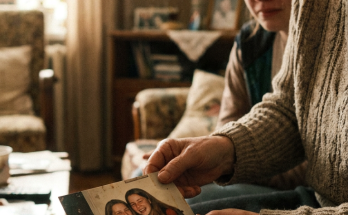
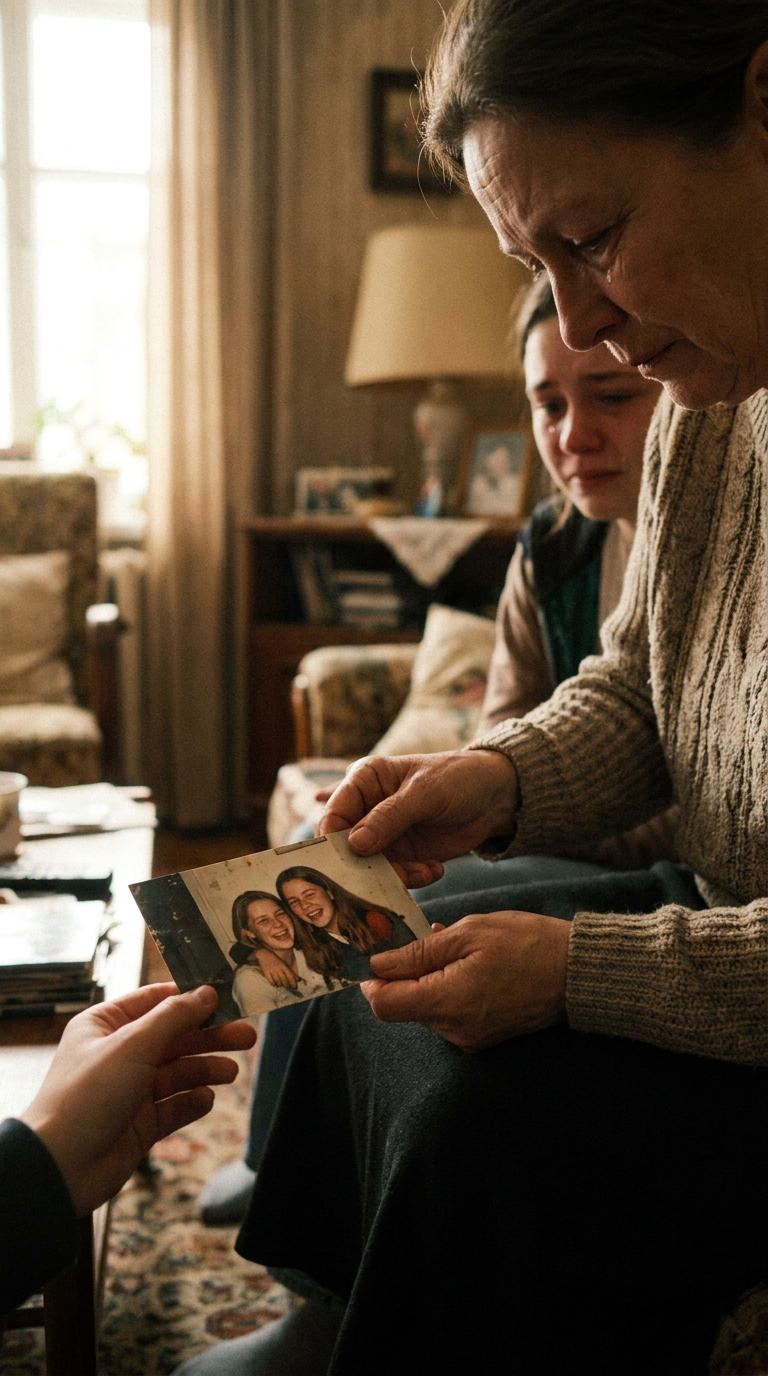
Then she pulled out an old photograph.
The edges were yellowed.
The surface was scratched.
It showed my mother sitting on a hospital bed, wearing a pale blue headscarf.
Margaret sat beside her, holding her hand.
My father stood behind them.
All three were smiling.
But it wasn’t the photograph itself that made my body go numb.
It was the handwriting on the back.
I recognized my mother’s handwriting immediately.
She had written a date and one sentence.
For Emily, when she is old enough to understand what love sometimes asks of us.
I stared at the words.
My lips parted, but no sound came out.
Margaret pushed the photograph toward me.
Then she whispered the sentence that shattered everything I thought I knew.
“Your mother knew something about your father that neither you nor I understood at the time.”
I looked up.
“What are you talking about?”
Margaret drew a shaky breath.
“Your father had been diagnosed with a heart condition two years before your mother died. He never told you. He barely told anyone. And when your mother’s cancer became terminal, his condition worsened because he stopped taking care of himself.”
I shook my head.
“That doesn’t explain a marriage.”
“No,” she said. “It doesn’t. But it’s part of the truth.”
She reached for a second envelope.
And suddenly, I understood that the photograph was only the beginning.
Chapter Five: The Promise My Mother Made Me Wait to Understand
Margaret slid the envelope across the table.
It was sealed with a strip of faded blue tape.
My name was written across the front.
I recognized the handwriting immediately.
My mother’s.
My hands began shaking.
“Where did you get this?”
“She gave it to me three days before she died.”
“Why didn’t you give it to me then?”
Margaret looked down.
“Because she asked me not to.”
I stared at her.
“You’re telling me my mother left me a letter, and you kept it from me for ten years?”
“Yes.”
The simplicity of her answer was almost unbearable.
I wanted to scream.
I wanted to throw the envelope at her.
Instead, I opened it.
Inside were four sheets of paper, folded carefully.
The first sentence made my eyes fill with tears.
My beautiful Emily, if you’re reading this, then I’m no longer there to answer all the questions I know you’ll have.
I pressed the paper against the table.
For a moment, I couldn’t continue.
Margaret waited quietly.
Finally, I read on.
I know you are angry. I know that if I leave you now, you will feel as though the world has taken everything you love.
I wish I could stay. I would give anything to watch you grow up, to meet the person you fall in love with, to see your wedding dress, and to hold your children if you choose to have them.
A tear fell onto the paper.
But I need you to understand something about love.
Love is not always the person who stays beside you forever. Sometimes love is the person who carries a promise when you can no longer carry it yourself.
I stopped reading.
My throat hurt.
Margaret whispered, “Take your time.”
I wanted to hate her for saying that.
But I kept reading.
Your father is a good man, Emily. He is frightened, though he would never admit it. He has spent his entire life believing that he must be strong for everyone else.
When I became sick, he stopped thinking about himself. He forgot his medication. He barely ate. Some nights, I woke up and found him sitting in the hallway because he was afraid that if he fell asleep, I might need him and he wouldn’t hear me.
I remembered those nights.
I remembered my father sitting beside my mother’s bed, holding her hand.
I remembered him falling asleep in a chair and waking with a start whenever she moved.
I’d thought he was being brave.
I’d never considered how terrified he might have been.
The letter continued.
Margaret has been my friend for more than twenty-five years. She knows your father. She knows his stubbornness, his fears, and his terrible habit of pretending he is fine when he is falling apart.
I asked her to promise me that she would help him keep living after I am gone.
I swallowed hard.
I did not ask her to replace me. No one could. I asked her to make sure that the people I love do not disappear into grief.
My vision blurred.
Then came the sentence that made me lower the letter.
I know you may one day believe that your father and Margaret betrayed me. Please don’t make that judgment until you know the whole story.
I read that sentence twice.
Then a third time.
I looked at Margaret.
“Why didn’t you tell me?”
She folded her hands in her lap.
“Because your mother knew that you might misunderstand. She told me to let you be angry if you needed to be angry.”
“That’s not an answer.”
“No,” Margaret said softly. “It isn’t.”
She stared at the photograph between us.
“Your mother made me promise to protect your father. But she also made me promise something else.”
“What?”
“That I would never use her request to force you to accept me.”
I felt a strange pressure in my chest.
Margaret continued.
“When Daniel asked me to marry him, I refused at first. I told him that it was too soon and that you would be hurt. He agreed. We waited because we hoped that time would make things easier.”
“Seven months isn’t time.”
“I know.”
Her voice cracked.
“I know how it looked. I know what you saw. I know that no matter what your mother said, you were still a fifteen-year-old girl who had lost her mother. You needed your father to be only your father. You needed the world to stop changing.”
I stared at the envelope.
“And you married him anyway.”
“Yes.”
“Why?”
She looked at me through tears.
“Because I loved him. Not the way I loved your mother. Not as a replacement for her. I loved him as the man he was becoming after losing the person he loved most.”
She paused.
“And because I was afraid that if I walked away, he would stop trying to live.”
Chapter Six: The Secret My Father Never Told Me
I left the coffee shop with the photograph and the letter.
I didn’t hug Margaret.
I didn’t tell her I forgave her.
I didn’t even say goodbye.
I walked to my car, sat behind the wheel, and cried until my head hurt.
Then I called my grandmother.
She answered on the second ring.
“Emily?”
“Did you know?”
There was silence.
“Know what, darling?”
“That Mom asked Margaret to marry Dad.”
My grandmother exhaled slowly.
“Yes.”
I closed my eyes.
“Everyone knew except me?”
“No. Not everyone. Your father didn’t want you to know while you were still a child.”
“I’m twenty-five now!”
“I know.”
“Why did nobody tell me?”
“Because your mother asked us to let you come to the truth in your own time.”
I gripped the steering wheel.
“That sounds like an excuse.”
“Perhaps it is,” my grandmother admitted. “Perhaps we should have trusted you with more. But we were trying to protect you.”
“From what?”
“From believing that your mother had been forgotten.”
I couldn’t answer.
My grandmother continued.
“Your mother knew how much you loved her. She also knew how fiercely you would defend her memory. She didn’t want you to spend your life believing that loving someone new meant abandoning someone you had lost.”
I hung up.
For the first time in ten years, I wondered whether my anger had been protecting me from something other than betrayal.
Perhaps it had been protecting me from grief.
Perhaps hating Margaret had been easier than admitting that my mother was gone and that nobody—not even the people who loved me most—could bring her back.
That evening, I called my father.
He answered so quickly that I wondered whether he had been holding his phone.
“Emily?”
“Did Mom ask Margaret to marry you?”
Silence.
Then I heard him exhale.
“Yes.”
I closed my eyes.
“Why didn’t you tell me?”
“Because I was a coward.”
The answer startled me.
My father continued.
“I told myself you were too young. I told myself you needed time. I told myself that one day, when you were older, I would explain everything.”
“Ten years, Dad.”
“I know.”
“You let me believe you betrayed Mom.”
“I know.”
“Why didn’t you stop me?”
His voice broke.
“Because every time I tried to explain, I looked at you and saw the little girl who had watched her mother die. I couldn’t bear to make you hurt more.”
I pressed my hand over my mouth.
He continued.
“Your mother asked Margaret to help me. But she also asked me to let you grieve in your own way. When you told us you hated us, I thought the kindest thing I could do was give you space.”
“You should have told me the truth.”
“Yes,” he whispered. “I should have.”
For several seconds, neither of us spoke.
Then he said something that made my heart ache.
“Your mother wasn’t the only person I lost that year, Emily.”
I swallowed.
“What do you mean?”
“I lost the life I thought I would have. I lost the woman I planned to grow old with. And for a while, I lost the ability to imagine a future.”
He paused.
“Margaret didn’t make me forget your mother. She helped me remember how to get out of bed in the morning.”
I started crying.
My father was crying, too.
“I never stopped loving your mother,” he whispered. “Not for one day.”
I looked down at the photograph.
Three people stood together in that hospital room.
My mother.
My father.
Margaret.
They looked frightened, exhausted, and impossibly brave.
For the first time, I didn’t see a woman waiting to take my mother’s place.
I saw a woman holding her friend’s hand.
And I realized that perhaps she had never stopped doing that.
Chapter Seven: The Part of the Story I Had Never Heard
Two days later, I drove to my father’s house.
I hadn’t been there in almost five years.
The blue paint had faded.
The maple tree in the front yard was taller.
But when I stepped inside, I smelled cinnamon.
My mother used to make cinnamon rolls on Sundays.
I stood in the doorway, suddenly unable to move.
Margaret appeared from the kitchen.
She looked startled.
“Emily.”
I nodded.
“Is Dad home?”
“He’s in the garden.”
I walked past her without saying anything.
My father was kneeling beside a flower bed, pulling weeds.
His hair had turned gray at the temples.
He looked older than I remembered.
When he saw me, he slowly stood up.
For a moment, neither of us moved.
Then he whispered, “Hi, sweetheart.”
I broke.
I crossed the garden and threw my arms around him.
He held me tightly.
I cried into his shoulder, and he buried his face in my hair.
“I’m sorry,” I whispered.
He shook his head.
“No, Emily. I’m sorry.”
We stood there for a long time.
When we finally went inside, Margaret had placed three cups of tea on the kitchen table.
She sat across from me.
I noticed that my mother’s favorite mug was in front of her.
My anger flickered.
Then I looked more carefully.
The mug had a small crack near the handle.
I remembered that crack.
My mother had made it herself when she dropped the mug on the kitchen floor years earlier.
She’d refused to throw it away.
I looked at Margaret.
“Why do you still use that?”
Margaret glanced down.
“Because your mother loved it.”
She ran her thumb over the crack.
“I don’t use it every day. Sometimes I take it out when I miss her.”
I looked away.
My father sat beside me.
For the next two hours, they told me things I’d never known.
They told me that my mother had been afraid of dying.
She had worried about leaving me before I was ready to live without her.
She had worried about my father becoming isolated.
And she had worried that Margaret, who had spent most of her adult life caring for others, would forget to care for herself.
“She asked me to look after both of you,” Margaret said.
“Not because she thought you were weak. Because she knew you loved each other so much that you might forget how to live when she was gone.”
I stared at my hands.
“Did you ever think about leaving?”
Margaret nodded.
“Many times.”
My father looked at her.
She continued.
“After you left for your grandmother’s house, I spent months wondering whether I had made the biggest mistake of my life.”
“Then why did you stay?”
“Because every time I thought about leaving, I remembered what your mother said.”
Margaret looked at me.
“She told me that if you hated me, I should never punish you for it. She said you were allowed to love her in whatever way you needed.”
My throat tightened.
“She knew I would hate you?”
“She knew you might.”
Margaret smiled sadly.
“Your mother understood you better than anyone.”
Then she reached into a drawer and pulled out a small notebook.
It was my mother’s journal.
I recognized the faded blue cover immediately.
Margaret placed it on the table.
“She gave this to me shortly before she died. There are pages she wrote for you. I’ve never read them. I’ve been waiting for you to decide whether you wanted them.”
I touched the cover.
For years, I’d imagined that the people around me had kept secrets because they didn’t trust me.
Now I began to understand that some secrets had been kept because everyone was afraid of hurting me.
That didn’t make every decision right.
But it made the story more complicated than the one I’d told myself for ten years.
And perhaps that was the beginning of forgiveness.
Chapter Eight: Three Weeks Before My Wedding
My wedding was three weeks away.
Michael had spent months helping me plan it.
We had chosen a small garden venue with white roses, wooden chairs, and strings of warm lights.
I had imagined my mother walking beside me.
I had imagined her helping me choose my dress.
I had imagined her crying when I said my vows.
For years, those thoughts had made me miserable.
Now, for the first time, they made me feel something other than pain.
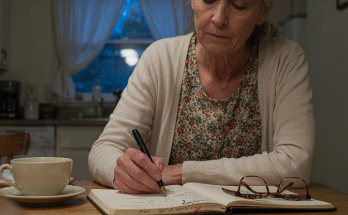
The night before the wedding, I sat at my kitchen table reading my mother’s journal.
One entry was dated two weeks before she died.
Today, Emily asked whether I would always be her mother, even when she was grown.
I told her that being a mother is not something death can take away.
She seemed satisfied, but I could see the fear in her eyes.
I am afraid, too.
I wiped my cheeks.
The next paragraph was about Margaret.
Maggie came today and brought soup. She pretended not to notice when I cried.
I told her that I was afraid Daniel would disappear into his grief.
She said she would look after him.
I asked her to promise that if he ever found happiness again, she would not feel guilty for accepting it.
I stopped reading.
Then I turned the page.
I also asked her to remember that Emily is still a child. She will not understand everything now. She may be angry. She may say cruel things. She may push away the people who love her most.
I hope she learns that grief is not a competition. Loving someone new does not erase the love that came before.
I pressed the journal against my chest.
For the first time in ten years, I cried for my mother without feeling that I needed to defend her from the people who had survived her.
The next morning, I called Margaret.
“Would you come to the wedding rehearsal?”
She was silent.
“Are you sure?”
“No,” I admitted. “But I want you there.”
She began crying.
I laughed through my own tears.
“You cry a lot, you know.”
She let out a shaky laugh.
“I know.”
Then I said the words I’d spent a decade refusing to say.
“I’m sorry I told you that you took Mom’s place.”
Margaret was quiet for a long time.
Finally, she whispered, “You don’t owe me an apology for being a grieving child.”
“But I’m not a child anymore.”
“No,” she said. “You’re not.”
I swallowed.
“I still miss her.”
“So do I.”
“I don’t know if I’ll ever stop wishing things had been different.”
“You don’t have to.”
I looked at the photograph on my desk.
“Can I ask you something?”
“Anything.”
“Did you ever feel like you were betraying her by marrying Dad?”
Margaret took a shaky breath.
“Every day for the first year.”
“Then how did you stop?”
“I didn’t stop missing her. I stopped believing that missing her meant I had to stop living.”
Her words settled over me.
Before we hung up, she asked, “Emily, would you like to know what your mother said to me the last time I saw her?”
I closed my eyes.
“Yes.”
Margaret’s voice softened.
“She said, ‘When Emily is ready, tell her that I never wanted my death to become the reason she stopped trusting love.’”
I couldn’t speak.
Margaret continued.
“She told me to give you time. She told me to let you be angry. And she told me that someday, when you stood beside the person you loved, you might understand a little of what she was trying to say.”
I wiped my face.
“I think I’m beginning to understand.”
Chapter Nine: The Wedding Day
On the morning of my wedding, I placed my mother’s photograph inside a small silver frame.
I set it on a table beside the entrance to the garden.
In the photograph, she was smiling from her hospital bed, one hand resting on Margaret’s shoulder.
My father stood behind them.
Three people who had loved each other before grief changed everything.
I stared at the photograph for a long time.
Then I touched the frame and whispered, “I wish you were here, Mom.”
A breeze moved through the garden.
For a moment, I imagined hearing her voice.
I’m always with you, sweetheart.
I knew it was only my memory.
But that morning, my memory was enough.
The guests began arriving.
Michael stood near the garden arch, looking nervous in his dark suit.
When he saw me, his face softened.
“You look beautiful,” he whispered.
I smiled.
“I’m terrified.”
He took my hands.
“That’s allowed.”
Then he glanced toward the entrance.
“Your father is here.”
I looked over his shoulder.
My father stood beside Margaret.
He wore a navy suit and a white rose pinned to his lapel.
Margaret wore a pale blue dress.
For one brief moment, I saw my mother in the color.
My father approached me.
“May I walk you down the aisle?”
I looked at him.
Ten years earlier, I would have refused.
I might have told him that he had lost the right.
Instead, I took his arm.
“Yes, Dad.”
His eyes filled with tears.
We began walking.
Every step brought back memories.
My mother’s laughter.
Her hands smoothing my hair before school.
Her voice reading bedtime stories.
But as I reached the end of the aisle, I realized something important.
I could miss my mother and still be happy.
I could wish she were there without wishing that the people who loved her had stopped living.
And I could forgive my father without pretending that the past had never hurt me.
When Michael took my hand, I glanced toward the front row.
Margaret was crying.
Of course she was.
But this time, I didn’t feel angry.
I smiled at her.
She smiled back.
Then the ceremony began.
During our vows, Michael promised to stand beside me when life became difficult.
He promised to tell me the truth even when it was uncomfortable.
He promised that love would never be something I had to earn by hiding my pain.
I promised to do the same.
And when we exchanged rings, I felt something inside me loosen.
Not disappear.
Not vanish.
Simply loosen.
For the first time in ten years, my mother’s death no longer felt like a locked door between me and the people I loved.
It felt like a wound that had finally been allowed to breathe.
After the ceremony, my father hugged me.
I hugged him back.
Margaret approached slowly.
“I don’t want to intrude,” she said.
I looked at her.
Then I stepped forward and hugged her, too.
She held me as though she had been waiting ten years for permission.
“I missed you,” she whispered.
I closed my eyes.
“I missed you, too.”
We stood together beneath the garden lights, crying and laughing at the same time.
For a moment, I imagined my mother standing beside us.
Not as a ghost.
Not as a memory that demanded we remain unhappy.
But as the woman who had loved us enough to hope that we would keep living.
Chapter Ten: The Final Photograph
Later that evening, after most of the guests had left, my father asked me to sit with him beneath a maple tree at the edge of the garden.
He held a small envelope.
“I wanted to give you this before you left,” he said.
Inside was another photograph.
This one was older than the first.
It showed my mother and Margaret in their twenties, sitting on the hood of an old car beside a lake.
They were laughing.
My mother had one arm around Margaret’s shoulders.
On the back, my mother had written:
For Maggie. Thank you for being the sister I got to choose.
I stared at the words.
My father sat quietly beside me.
“She wrote that after Margaret helped her through a difficult time in college,” he said. “Your mother always said that friendship was one of the greatest forms of love.”
I ran my finger over the handwriting.
Then I noticed something tucked inside the envelope.
A small folded note.
My father looked surprised when I opened it.
“I’ve never seen that before,” he said.
The note was written in my mother’s hand.
It was addressed to both of them.
Daniel and Maggie,
If you’re reading this together, then I hope you have found a way to be happy without feeling guilty about me.
I know you will miss me. I know there will be days when you wish I were still there to laugh with you, argue with you, or tell you that you’re both being ridiculous.
Please do not turn my memory into a punishment.
Tell Emily about me. Tell her the funny stories. Tell her about the mistakes I made. Let her remember that I was a real person, not someone who must be protected from every difficult truth.
And when she falls in love, remind her that love is not a chair with only one seat.
There is room for the people who came before, the people who are here now, and the people who have yet to arrive.
If she is angry, love her.
If she needs distance, give her space.
And if she returns, open the door.
I love you both.
Susan.
I read the letter twice.
Then I handed it to my father.
He covered his mouth.
For several minutes, neither of us spoke.
Finally, I whispered, “She knew.”
My father nodded.
“She knew you would hurt.”
“She knew I might leave.”
“Yes.”
I looked toward the garden, where Margaret was helping the venue staff collect flowers.
“Did she know I’d come back?”
My father smiled sadly.
“I think she hoped.”
I looked at the note again.
Love is not a chair with only one seat.
For ten years, I’d believed that accepting Margaret meant giving something away.
That if I allowed her to become part of my life, I would be betraying the mother who had died.
But my mother had never asked me to choose.
I had been the one who turned love into a competition.
I had been the one who believed that grief required loyalty expressed through suffering.
And now, standing at the beginning of my own marriage, I finally understood what my mother had tried to teach me.
Love could change shape without becoming less real.
My father could love my mother and still love Margaret.
Margaret could cherish my mother without trying to become her.
And I could carry my mother’s memory into my future without leaving everyone else behind.
I folded the letter carefully and placed it inside my purse.
Then I stood up and walked toward Margaret.
She turned when she saw me.
“Is everything all right?”
I nodded.
“I found another letter.”
Her eyes widened.
“From Susan?”
I handed her the photograph.
She recognized it immediately.
“Oh,” she whispered.
Then she began to cry again.
I smiled through my tears.
“Mom would tell you to stop crying.”
Margaret laughed shakily.
“She would.”
I reached for her hand.
“She’d probably tell me to stop being stubborn, too.”
“She definitely would.”
We laughed together.
Then I looked at the woman who had been my mother’s closest friend, the woman I had once considered my enemy, and the woman who had waited nearly a decade for me to understand her.
“I can’t give you back those ten years,” I said.
Margaret shook her head.
“No.”
“And I can’t promise I’ll never feel angry about what happened.”
“You don’t have to.”
“But I don’t want to lose any more time.”
Her face crumpled.
“Oh, Emily.”
I hugged her.
This time, there was no hesitation.
No bitterness.
No need to prove that I loved my mother more than anyone else could.
There was only a woman who had lost her mother, a woman who had lost her closest friend, and two people who had spent years trying to protect a memory they both treasured.
And finally, there was room for all of us.
Epilogue: Ten Years Later
Ten years after that wedding, I became a mother myself.
My daughter was named Susan.
When she was old enough to understand photographs, I showed her the picture of my mother, my father, and Margaret in the hospital room.
“Who is that lady beside Grandma?” she asked.
“That’s Margaret,” I told her. “She was Grandma’s best friend.”
“Was she your friend, too?”
I smiled.
“She is now.”
Margaret became one of the most important people in my daughter’s life.
She taught Susan how to make pancakes, just as she had taught me.
She bought her books.
She attended school performances and clapped too loudly.
Sometimes, when Susan asked about my mother, Margaret told her stories.
She told her about the time my mother accidentally locked herself out of the house in her pajamas.
She told her about my mother’s terrible singing.
She told her about the way my mother always cried at the end of romantic movies, even when she had seen them a dozen times.
And she told her that my mother had been brave, funny, stubborn, and imperfect.
She told her that she had loved deeply.
One afternoon, when Susan was six, she found the old photograph in my bedroom.
She brought it to me.
“Mommy, why are Grandma and Margaret holding hands?”
I sat beside her on the bed.
“Because they loved each other.”
“Like you love Dad?”
“Not exactly the same way,” I said. “But just as deeply.”
She studied the picture.
“Do you miss Grandma?”
Every time, I still did.
“Every day.”
She wrapped her little arms around my waist.
“Does it make you sad?”
“Sometimes.”
“Then why do you smile when you talk about her?”
I thought about the question.
Then I pulled her into my lap.
“Because missing someone and being happy aren’t opposites, sweetheart. You can do both at the same time.”
She seemed satisfied with that answer.
Then she ran off to play.
I remained on the bed, holding the photograph.
For years, I had believed that my father’s second marriage had taken something away from me.
Now I understood that the greatest loss had not been his marriage to Margaret.
It had been the years I spent believing that forgiveness meant forgetting.
My mother had never needed me to hate anyone on her behalf.
She had never asked me to protect her memory by closing my heart.
She had simply wanted the people she loved to keep living.
And they had tried, imperfectly, to do exactly that.
My father and Margaret had made choices that hurt me. They had waited too long to explain. They had mistaken silence for protection.
But they had also loved me through my anger.
They had left the door open.
And when I finally returned, they welcomed me home.
Sometimes I still look at that old photograph and imagine the conversation I would have with my mother if I could see her one more time.
I’d tell her about my husband.
I’d tell her about my daughter.
I’d tell her that I finally understood why she trusted Margaret with the promise she had made.
And I’d tell her that I was sorry it took me so long.
But perhaps she already knew.
Perhaps that was why she’d written the letter.
Not to force me to forgive.
Not to make me agree with every decision the adults in my life had made.
But to remind me that love was never meant to become a prison built from the past.
The woman I once accused of taking my mother’s place had never wanted that place.
She had only wanted to help the people my mother loved survive losing her.
And the photograph she placed in my hands three weeks before my wedding didn’t erase the pain of those ten years.
It gave that pain a different meaning.
I had spent nearly a decade believing my stepmother was the reason my family had changed.
But the truth was that our family had changed because someone we loved had died.
And no amount of anger could bring her back.
What I could do was remember her.
Love her.
Tell her stories.
And allow myself to build a future that included the people who had loved her, too.
Because in the end, my mother hadn’t left me a lesson about betrayal.
She had left me a lesson about love.
Real love doesn’t demand that we stop missing the people we’ve lost. It teaches us how to keep loving the people who remain.