THE 47 ENVELOPES IN THE FREEZER: THE 82-YEAR-OLD WOMAN’S SECRET THAT LED POLICE TO A GRAVEYARD OF MISSING CHILDREN
My neighbor died alone at eighty-two.
No husband. No children. No relatives who came to claim her belongings. When the county announced that her house would be auctioned, most people in our neighborhood barely noticed.
Her name was Eleanor Whitmore.
For twenty-three years, I had lived three houses away from her. I knew her as the quiet old woman who watered her roses before sunrise, bought the same brand of tea every Tuesday, and never invited anyone inside her home.
She rarely spoke to anybody.
She never celebrated Christmas with visitors. She never received birthday cards. And whenever children passed her house on their way to school, she watched them from behind her curtains until they disappeared around the corner.
Some neighbors thought she was lonely.
Others thought she was strange.
I never thought much about her at all.
That changed when I bought her house for $187,000.
I was forty-six, recently divorced, and looking for a place where I could start over without being reminded of everything I’d lost. Eleanor’s property was old but solid, with a wide backyard, peeling white paint, and a garden filled with rose bushes that seemed to have been growing there for generations.
The house needed work, but I liked its quietness.
I imagined turning the upstairs bedroom into an office, replacing the kitchen cabinets, and spending peaceful evenings on the back porch.
I had absolutely no idea that the house contained a secret someone had spent twenty-three years protecting.
Or that by the time I uncovered it, I would wish I had never turned the key in the front door.
The first three days of cleaning were ordinary.
I threw away expired food, donated old clothes, and boxed up furniture that could be salvaged. Eleanor had lived simply, but she had kept almost everything. There were stacks of newspapers in the hallway, jars of buttons in the sewing room, and dozens of notebooks filled with handwriting so small I needed a magnifying glass to read it.
Then, on Thursday morning, I opened the freezer.
I was looking for the power cord to an old refrigerator when I noticed a loose panel at the bottom of the freezer compartment.
It looked like someone had installed a false floor.
I removed the plastic tray, reached underneath, and felt the edge of a cardboard box.
I pulled it out.
Inside were identical cream-colored envelopes, each sealed with a narrow strip of yellowing tape.
I counted them.
Forty-seven.
Every envelope had a date written on the front.
The earliest was dated October 14, 2001.
The latest was dated October 14, 2023.
Twenty-three years.
Twenty-three dates.
The dates were almost exactly one year apart.
I sat on the kitchen floor, surrounded by dust and the smell of old cardboard, wondering why an eighty-two-year-old woman would hide envelopes in her freezer.
Then I opened the first one.
Inside was a stack of fifty-dollar bills totaling $5,000.
Beneath the money was a Polaroid photograph of a little girl.
She looked about six years old. She had brown hair tied into two uneven ponytails and wore a yellow sweater with a tiny white rabbit stitched over the pocket.
On the back of the photograph, someone had written a name.
LUCY. AGE 6. OCTOBER 14, 2001.
I opened the second envelope.
Another $5,000.
Another photograph.
This time, it was a boy with dark skin, a missing front tooth, and a blue baseball cap.
The third envelope contained the same amount of money and a photograph of a red-haired child standing beside a school bus.
Different children.
Different dates.
Different handwriting on the backs of the photographs.
I opened six envelopes before I realized I was trembling.
Every single one contained $5,000 and a Polaroid of a child.
The dates stretched across twenty-three years.
The children ranged from toddlers to teenagers.
Some smiled at the camera. Others looked frightened. One little boy held a stuffed dinosaur so tightly that his knuckles appeared white.
None of the photographs looked like ordinary family snapshots.
They were too carefully composed.
The children stood against plain walls or in front of unfamiliar buildings. Several wore clothes that looked expensive, while others appeared to have been photographed moments after crying.
I reached the fifteenth envelope.
A photograph slipped out and landed faceup on the kitchen floor.
The girl in the picture had pale skin, black hair, and a small crescent-shaped birthmark beneath her left eye.
On the back were three words.
EMILY. AGE 9.
There was no last name.
No address.
No explanation.
I stared at that photograph for a long time.
Then I did something I should probably have done much earlier.
I called the police.
Detective Marcus Reed arrived forty minutes later.
He was in his early fifties, with gray at his temples and the tired expression of someone who had spent too many years looking at things other people preferred not to see.
I showed him the envelopes.
He examined the money, the dates, and the photographs without saying much.
When I explained that Eleanor had no children, he stopped turning the pages.
“How do you know that?” he asked.
“Because she lived alone for decades. The neighbors knew her. Nobody ever visited. There wasn’t a husband, and I never saw a son or daughter.”
“Did she have any friends?”
“Not that I knew of.”
He looked again at the photographs.
“Did you touch anything else in the freezer?”
“Only the box.”
“Have you moved anything in the house?”
“Almost everything. Why?”
He took out his phone and made a call.
Within an hour, the kitchen was full of officers.
They photographed every envelope, recorded the serial numbers on the cash, and carefully collected the Polaroids. One officer asked me to leave the room while another searched the freezer for fingerprints.
Detective Reed stayed with me in the living room.
“There’s something about this collection that bothers me,” he said.
“What?”
“The dates.”
He placed three photographs on the coffee table.
“Look at these children’s ages. Six. Seven. Nine.”
I looked at them.
“Okay.”
“Now look at the dates. October 14, 2001. October 14, 2002. October 14, 2004.”
He tapped the photographs.
“Some of these children appear to have been photographed on the same day. But others may have been photographed years apart. We don’t know whether the dates refer to when the pictures were taken or when the envelopes were prepared.”
He paused.
“And there’s another problem. We ran the first names against our preliminary missing-person records. At least two of these photographs may correspond to children reported missing.”
My stomach tightened.
“May?”
“We need more information before we can say for certain.”
He gathered the photographs into a folder.
“Don’t touch anything else. If you remember anything about Eleanor, no matter how insignificant it seems, call me.”
As he walked toward the front door, I remembered something.
“Detective?”
He turned.
“Eleanor used to buy flowers every October.”
“What kind of flowers?”
“White roses. Always white roses. She planted them along the back fence.”
He glanced toward the backyard.
“Did she ever explain why?”
“No.”
He said nothing for several seconds.
Then he asked, “When did she die?”
“Three weeks ago.”
“And you bought the house when?”
“Last Monday.”
For the first time, his expression changed.
“Interesting.”
“What’s interesting?”
He looked toward the kitchen.
“She may have known the house would end up in someone else’s hands.”
Then he left.
I barely slept that night.
Every time I closed my eyes, I saw the children’s faces.
I kept wondering whether their parents had searched for them. Whether they were still alive. Whether someone had taken them, hidden them, or hurt them.
And why had Eleanor kept their photographs?
The money made even less sense.
Forty-seven envelopes containing $5,000 each meant $235,000.
That was more than I had paid for the house.
Had Eleanor been paying someone?
Had she been receiving payments?
Or had she been saving the money for the children?
At 2:17 a.m., I got out of bed and went downstairs.
The kitchen was empty.
The freezer stood open because the police had removed its contents.
I stared at the empty compartment, then noticed a small rectangular piece of paper beneath the refrigerator.
It must have fallen from the cardboard box when I pulled it out.
I picked it up.
It was a faded label with a number written in black ink.
48.
Nothing else.
I took a photograph of it and sent it to Detective Reed.
He called me back within five minutes.
“Where did you find that?”
“Under the refrigerator.”
“Don’t throw it away. Don’t move anything else. I’ll be there in twenty minutes.”
When he arrived, he held the label beneath a flashlight.
Then he looked at me.
“Did you tell me there were forty-seven envelopes?”
“Yes.”
He slowly nodded.
“Then this may be the most important thing you’ve found.”
The next morning, Detective Reed returned with a search warrant and two investigators.
They searched the kitchen, the pantry, the basement, and the bedrooms. They removed drawers and checked behind cabinets. They even examined the old refrigerator itself.
Nothing.
By noon, I was beginning to think the number was meaningless.
Then one of the investigators called from upstairs.
“Detective! You need to see this.”
We found him in Eleanor’s bedroom.
He was kneeling beside an antique dresser, examining a thin gap between the bottom drawer and the wooden frame.
Behind the drawer was a narrow compartment.
Inside lay a single cream-colored envelope.
Number 48.
Unlike the others, it was not sealed with tape.
It was addressed to me.
Not to the new homeowner.
Not to the buyer of the property.
To me.
My full name was written across the front in Eleanor’s distinctive, slanted handwriting.
I felt the room tilt.
“How is that possible?” I whispered.
Detective Reed carefully photographed the envelope before opening it.
Inside was no money.
There was a handwritten letter and a folded piece of paper.
The letter began:
To the person who buys my house,
If you are reading this, then I am gone, and the county has sold the property. I hope you have found the envelopes in the freezer.
If you have, you have already seen forty-seven faces.
There should have been forty-eight.
Detective Reed stopped reading.
He looked at me.
“Keep going,” I said.
He continued.
For twenty-three years, I have kept a record of children who disappeared from the world while the adults responsible for protecting them looked away.
Some were stolen. Some were sold. Some were hidden by people who knew exactly how to make a child disappear without leaving a trace.
I was involved in what happened to them.
My mouth went dry.
The detective lowered the letter.
“What does that mean?” I asked.
“I don’t know yet.”
He continued reading.
I was not the person who took them. But I helped people who did. I signed papers I should never have signed. I accepted money I should have refused. I told myself that I was saving children from worse fates.
For a long time, I believed that lie.
Then I discovered what was really happening.
The next paragraph was written in a shakier hand.
I spent the rest of my life trying to correct what I had done. I could not undo the past. I could only preserve evidence and wait for someone who might finally bring it into the light.
The forty-seven envelopes contain money taken from the people who profited from those children’s disappearances. I kept the photographs because I refused to let their faces be forgotten.
The forty-eighth envelope contains the name of the person who made all of it possible.
My heart pounded.
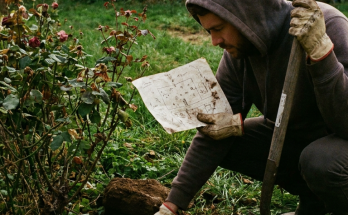
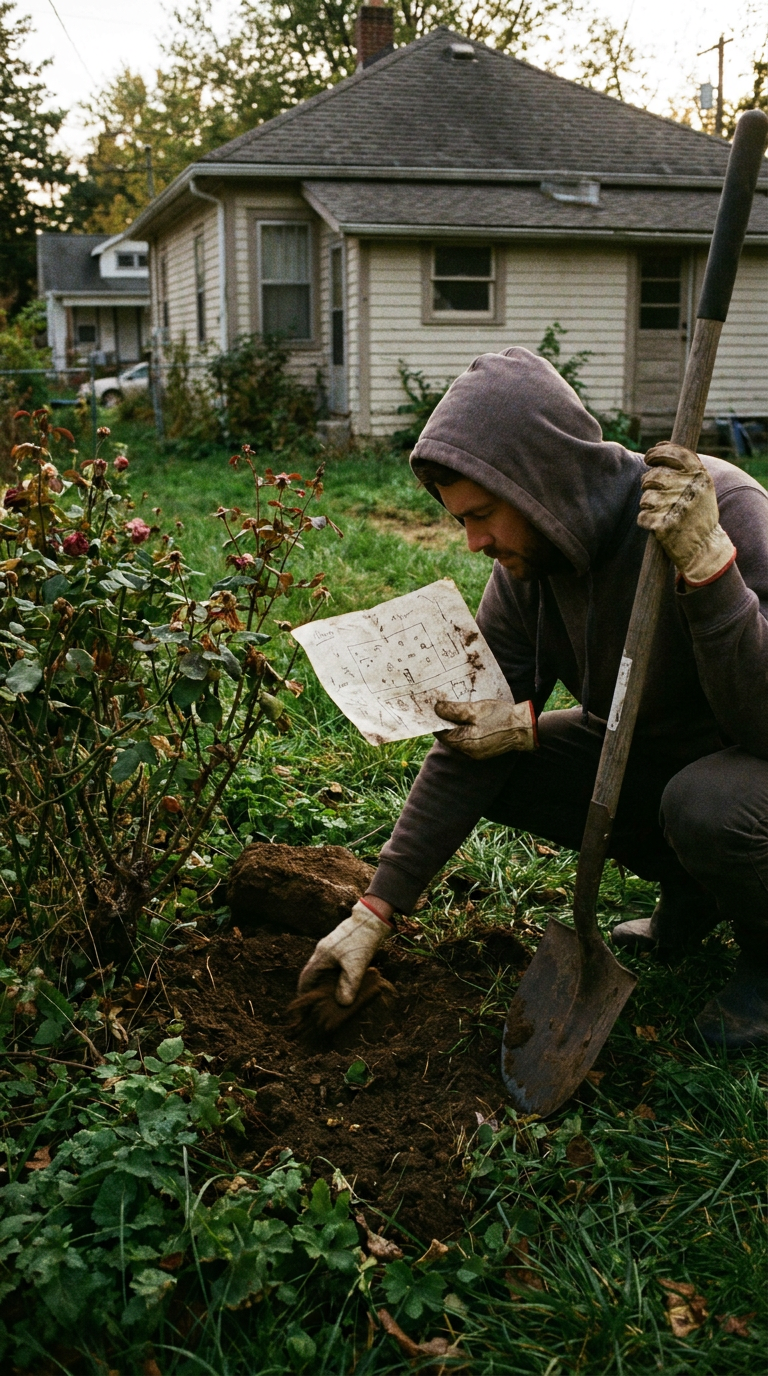
The detective unfolded the map.
It showed Eleanor’s backyard, including the old shed, the back fence, and the rows of rose bushes.
Six large X marks had been drawn across the garden.
Beneath the map was one final sentence.
Start digging where the roses are. What you’ll find there is the truth I was too afraid to tell while I was alive.
But before you dig, understand this: one of the people responsible is still looking for what I buried.
And that person knows your name.
The room fell silent.
I looked at Detective Reed.
“Why would she write this to me?”
He folded the letter.
“I don’t know.”
“Did she know me?”
“Apparently, she knew enough about you to address this letter to you.”
“That’s not an answer.”
“No,” he admitted. “It isn’t.”
Then his phone rang.
He listened for several seconds.
His expression hardened.
“What do you mean, the records match?”
He looked at the photographs spread across the bed.
“How many?”
He closed his eyes.
“All right. Nobody touches the garden until I get there.”
He ended the call and turned to me.
“We’ve identified several of the children.”
“Who are they?”
“Children reported missing in five different states. Some cases are more than twenty years old.”
He pointed at the map.
“And one of those children was officially declared dead.”
The police spent the next two days examining Eleanor’s records.
They discovered that she had worked for a private adoption agency in the late 1990s and early 2000s.
The agency, called Bright Futures Placement Services, had appeared legitimate. It had offices in three states and worked with foster families, social workers, and prospective adoptive parents.
Eleanor had been its records manager.
She had access to children’s files, medical records, placement documents, and court orders.
She also had access to the agency’s financial records.
The investigators found that Bright Futures had closed abruptly in 2004 after a state audit uncovered irregularities.
Its director, a man named Richard Vale, had died in 2011.
Two former employees had moved overseas.
One had disappeared.
Another had become a respected consultant who advised private adoption agencies on compliance and child welfare.
His name was Graham Sloane.
Detective Reed told me this while standing in my kitchen, where the freezer had been taken away for forensic examination.
“Graham Sloane is seventy-one,” he said. “He lives about forty miles from here. He’s never been charged with a crime.”
“Do you think he’s the person Eleanor was talking about?”
“We think it’s possible.”
“Then arrest him.”
“We need evidence, not suspicion.”
He placed the map on the table.
“We also need to understand why Eleanor chose you.”
I had been asking myself the same question.
I was an ordinary woman with an ordinary job. I worked as a bookkeeper for a small construction company. I had never worked in adoption, foster care, or social services.
I had no criminal connections.
I had no money beyond my savings and retirement account.
And I had never spoken to Eleanor for more than a few minutes at a time.
At least, that was what I believed.
Detective Reed asked me to search through my own belongings for anything that might explain the connection.
That evening, I opened a box of photographs I had brought from my old apartment.
Most were ordinary pictures of my childhood, my parents, and my younger brother, Daniel.
Then I found one that made my hands go numb.
It showed me at about five years old, standing beside a woman in a white cardigan.
The photograph had been taken in front of a brick building.
I remembered the building.
I remembered the woman.
But I couldn’t remember why I was there.
On the back was a date.
OCTOBER 14, 1985.
I turned the photograph over again.
The woman beside me was Eleanor Whitmore.
She was younger, with dark hair and a smile I had never seen on her face.
I called Detective Reed immediately.
When he arrived, I placed the photograph on the table.
He studied it for a long time.
“Do you remember this day?”
“No.”
“Do you remember Eleanor?”
“Only as my neighbor.”
He looked at the date.
“How old were you in 1985?”
“Five.”
“Where were your parents living?”
I told him.
He wrote down the address.
Then he asked a question that changed everything.
“Did you have a sibling who was adopted?”
I shook my head.
“No. My parents had two children. Me and my brother.”
“Are you sure?”
“Of course I’m sure.”
He didn’t argue.
Instead, he asked me to call my mother.
My mother lived in assisted living two hours away. She was seventy-six, and her memory had become unreliable over the past few years.
When I told her about the photograph, she fell silent.
Then she began to cry.
“Mom? What’s wrong?”
“Oh, sweetheart.”
Her voice trembled.
“There are things your father and I never told you.”
I gripped the phone.
“What things?”
She took a long breath.
“You had a sister.”
I couldn’t speak.
“What?”
“Her name was Anna.”
I sat down.
My mother explained that Anna had been born eighteen months before me.
She had died, my parents had always said, from complications after birth.
There had been a funeral, but I was too young to remember it.
My mother said they had never wanted to discuss the tragedy because it had destroyed their marriage for a time.
My father had died six years earlier.
I had never questioned the story.
But now I remembered something from childhood.
A small wooden rocking horse in the attic.
A photograph of a baby in a silver frame.
And a name my mother had once whispered in her sleep.
Anna.
“Why is Eleanor in this photograph?” I asked.
My mother cried harder.
“She was the social worker.”
The room seemed to disappear around me.
“What social worker?”
“The woman who helped us after Anna was born.”
My mother’s voice became barely audible.
“Your sister was not dead when they told us she was.”
Detective Reed arranged for a specialist to speak with my mother the following morning.
At first, she insisted she had been confused.
Then, slowly, fragments began to emerge.
My parents had struggled financially after Anna’s birth. My father had been unemployed, and my mother had suffered complications that left her unable to care for two small children without help.
A social worker had approached them with an offer.
A temporary placement.
A family who could provide medical care and support until they recovered.
My parents had signed papers.
They believed Anna would be returned within weeks.
Instead, they received a death certificate.
They were told their daughter had died in a hospital several states away.
They were never shown her body.
My mother had questioned the paperwork, but the agency assured her that everything was legitimate.
My father, overwhelmed by grief and financial pressure, had accepted the explanation.
For decades, they had believed their daughter was dead.
When Detective Reed showed my mother the photograph of Eleanor, she recognized her immediately.
“She told me Anna was safe,” my mother whispered. “She promised me.”
“Did you ever see her again?” he asked.
“No.”
“Did Eleanor contact you after that?”
My mother shook her head.
“Not until years later.”
She reached for her purse and removed a small envelope.
“I received this in 2004. I never opened it. I couldn’t bear to.”
The envelope contained a letter from Eleanor.
It was short.
I am sorry for what happened to your daughter. I have spent years trying to find her. I believe she is alive.
If I can prove it, I will contact you.
Please forgive me for waiting so long.
There was no signature beyond Eleanor’s name.
No address.
No further explanation.
My mother had kept the letter for twenty-two years.
She had never told me because she had convinced herself it was a cruel mistake.
Detective Reed took the letter for examination.
Then he made another call.
This time, he requested a search warrant for Eleanor’s backyard.
The digging began at 8:00 the next morning.
Six X marks.
Six locations.
The first was beneath a rose bush near the back fence.
The second was beside the old garden shed.
The third was beneath a stone path.
At each location, the investigators used ground-penetrating equipment before removing any soil.
I watched from the back porch, wrapped in a blanket, unable to make myself go inside.
The first three locations revealed nothing except old gardening tools, broken pottery, and a rusted metal box containing receipts.
The fourth yielded a plastic container filled with documents.
Inside were copies of birth certificates, adoption records, financial ledgers, and correspondence between Bright Futures employees.
The fifth location contained a small metal safe.
It had been wrapped in plastic and sealed against moisture.
Inside were dozens of photographs and a notebook with names, dates, and addresses.
Detective Reed opened the notebook with gloved hands.
He read one page.
Then another.
Finally, he looked up at me.
“We found the records.”
“What records?”
“The children.”
He turned the notebook so I could see the pages.
Forty-eight names.
Each name had a date beside it.
Some had notes indicating where a child had been placed.
Others had a series of initials and dollar amounts.
Beside Anna’s name, there was a single sentence.
TRANSFERRED OCTOBER 14, 1985. PAYMENT RECEIVED.
I covered my mouth.
My sister had not died in a hospital.
She had been transferred.
Someone had paid for her.
The sixth X was near the center of the garden, beneath the oldest rose bush.
The investigators approached it carefully.
The bush had thick roots and pale blossoms that had begun to wilt in the autumn air.
They cleared the soil around it.
Then one of the officers called for Detective Reed.
Something had been buried beneath the roots.
It was a small wooden box.
Inside was a child’s silver bracelet.
A name had been engraved on it.
ANNA MARIE.
My knees nearly gave way.
I recognized the bracelet from the photograph in my childhood attic.
It had belonged to my sister.
Beneath it lay a second object: a folded letter inside a waterproof sleeve.
Detective Reed read it privately first.
Then he came to the porch and sat beside me.
“Your sister was not buried here,” he said gently.
I started crying before he finished.
“The bracelet was kept as evidence. Eleanor apparently buried it with the records because she believed someone might come looking for it.”
“What does the letter say?”
He hesitated.
“It says Eleanor discovered that Anna had been sent to an illegal adoption network. She tried to report it, but the director threatened her. He told her that if she spoke, several children would be moved again, and the people involved would destroy the records.”
“She could have told my parents.”
“Yes.”
“She could have gone to the police.”
“Yes.”
“She let us believe Anna was dead.”
His eyes lowered.
“Yes.”
For a moment, I hated Eleanor more than I had ever hated anyone.
I hated her quiet garden.
I hated the roses.
I hated the fact that she had lived three houses away from me for twenty-three years, knowing that my family had been robbed of a daughter and a sister.
And I hated that she had died before she could answer a single question.
But the letter contained something else.
A name.
A name that appeared beside every one of the forty-eight children.
Graham Sloane.
The police located Graham Sloane at his home the following afternoon.
He lived in a large house surrounded by carefully trimmed hedges, with a driveway long enough to accommodate several expensive cars.
He was seventy-one, silver-haired, and well dressed.
When Detective Reed arrived with officers, Sloane greeted them at the front door with a smile.
Then he saw the warrant.
His smile vanished.
During the search, investigators discovered old agency files, bank statements, and correspondence connected to Bright Futures.
They also found a locked cabinet containing photographs of children.
Several matched the Polaroids from Eleanor’s freezer.
Sloane claimed the photographs were legitimate records from his years in social services.
He denied knowing anything about illegal adoptions.
He denied receiving money from prospective parents.
And he denied ever meeting Eleanor outside work.
Then the investigators showed him the notebook.
For the first time, he stopped speaking.
Beside each child’s name was a payment record.
Beside each payment was a code.
And beside the code was Sloane’s signature.
He asked for a lawyer.
The investigation expanded over the following weeks.
Authorities identified children who had been taken from their biological families under false pretenses, children whose identities had been changed, and children who had been placed with families that believed the adoptions were legal.
Some had grown up without knowing their origins.
Others had spent years searching for their birth parents.
A few had never been found.
The money in Eleanor’s freezer had been withdrawn from accounts connected to the old agency. Investigators believed she had preserved it as evidence of payments, though they could not immediately establish the source of every dollar.
The photographs were the key.
They linked names to dates, and dates to the missing-person cases.
The letters and ledgers provided corroborating evidence.
Sloane was arrested on suspicion of multiple serious offenses connected to the trafficking and unlawful transfer of children.
The legal process would take months, perhaps years.
But the investigation had finally begun.
And still, one question haunted me.
Why had Eleanor addressed the forty-eighth envelope to me?
Why had she left the final clues in a house she knew would be auctioned?
Why had she waited until after her death to tell the truth?
The answer arrived in the form of a second letter.
It was discovered inside the metal safe, hidden beneath the notebook.
This one was dated six months before Eleanor died.
It was addressed to my mother.
Detective Reed allowed us to read it together.
Dear Margaret,
I have spent twenty-three years trying to find Anna.
I failed you. I failed your husband. I failed every family whose children passed through that agency.
I was afraid. That is the truth, and there is no excuse for it.
But I eventually discovered that Anna had survived the transfer.
The last reliable record places her with a family in Oregon. The name on the paperwork was different, and the adoption was arranged through a private intermediary.
I believe she grew up believing that her adoptive parents were her biological parents.
I have not been able to locate her with certainty.
I kept the records because I feared that the people involved would destroy them if they knew what I had found.
If I cannot find Anna before I die, I hope someone will continue looking.
Your daughter deserves the truth.
And so do you.
My mother held the letter against her chest and wept.
I took her hand.
For the first time in my life, I understood that the grief she had carried for decades was not simply the grief of losing a child.
It was the grief of never knowing whether she had truly lost her.
Three weeks later, Detective Reed called me at work.
“We have a possible match,” he said.
I stood up so quickly that my chair rolled backward.
“Anna?”
“We found a woman in Oregon whose birth records were altered. Her adoptive parents are deceased. She’s forty-two years old, and her original paperwork contains a reference to Bright Futures.”
“Does she know?”
“Not yet. We’re working with investigators there to confirm her identity.”
I pressed a hand against my mouth.
“How sure are you?”
“Not sure enough to make promises.”
“Please tell me when you know.”
“I will.”
The next six days were the longest of my life.
I told my mother that investigators were looking into a possible lead, but I did not give her the details.
I was afraid to offer her hope that might collapse.
Then, on a Tuesday afternoon, Detective Reed called again.
“We have a confirmed DNA match.”
I sat down.
“She’s Anna?”
“Yes.”
My mother began crying before I even finished explaining.
Anna was alive.
She had grown up in Oregon under another name. She had become a nurse, married, and raised two children. She had never known that her biological family had been searching for her because she had never been told that she was adopted.
Her adoptive parents had given her a stable, loving home.
They had not known about the illegal transfer.
They had believed the paperwork was legitimate.
When investigators contacted her, she initially thought they had made a mistake.
Then they showed her the records.
They showed her the bracelet.
They showed her the photograph of Eleanor.
And they told her that she had a mother and a younger sister who were still alive.
Anna agreed to meet us.
We chose a small conference room at the police station.
My mother arrived early, carrying an old photograph of a baby wrapped in a yellow blanket.
She held it in both hands throughout the wait.
At 10:14 a.m., the door opened.
A woman stepped inside.
She had brown hair, tired eyes, and a small scar near her chin.
She looked nothing like the baby in the photograph.
But when she saw my mother, she stopped.
Neither of them moved.
My mother stood slowly.
“Anna?”
The woman covered her mouth.
“Is that really my name?”
My mother began to cry.
“Yes, sweetheart. It always was.”
Anna crossed the room.
They embraced so tightly that I thought they might never let go.
I stood nearby, crying silently, while my mother touched Anna’s face as if she were afraid her daughter might disappear again.
Then Anna turned toward me.
“You’re my sister?”
I nodded.
“I’m Claire.”
She looked at me for a long moment.
Then she smiled through her tears.
“I always wanted a sister.”
I laughed and cried at the same time.
“So did I.”
We spent hours together.
Anna asked about our father. I told her about his terrible jokes, his love of old movies, and the way he used to burn every Thanksgiving turkey.
She laughed at that.
Then she asked why Eleanor had kept the bracelet.
I explained what we knew.
Anna listened without interrupting.
When I finished, she stared at the table.
“I don’t know what to feel about her,” she said.
“Neither do I.”
“She helped take me away from my family.”
“Yes.”
“But she also kept the records.”
“Yes.”
Anna rubbed her eyes.
“Does that mean she was good or bad?”
I thought about Eleanor’s silent house, the money hidden in the freezer, and the garden where she had buried the truth.
“I don’t think we have to choose one,” I said. “She did something terrible. Then she spent years trying to make it right. But she never gave you back the time she took from us.”
Anna nodded slowly.
“I don’t know if I’ll ever forgive her.”
“You don’t have to.”
For the first time since I bought the house, I felt that something inside me had settled.
Not healed.
Not forgotten.
But understood.
The investigation continued for more than a year.
The forty-eight children became the center of a national effort to trace their identities and locate surviving relatives.
Some reunions were joyful.
Others were painful.
Several children had died before their families could be found. In those cases, investigators helped relatives learn what had happened and recover records that had been hidden for decades.
The case against Graham Sloane eventually went to trial.
The prosecution presented financial records, altered birth certificates, testimony from former employees, and the photographs recovered from Eleanor’s home.
They also presented evidence that Sloane had used intermediaries to arrange illegal transfers of children and conceal their identities.
The jury found him guilty of multiple offenses.
When the verdict was announced, I sat beside my mother and Anna in the courtroom.
My mother held Anna’s hand.
Anna held mine.
None of us cheered.
We simply cried.
Because justice could punish the people responsible, but it could not return the years we had lost.
It could not give my mother back the childhood she had imagined for Anna.
It could not let my father meet the daughter he had spent decades believing was dead.
And it could not erase the fact that Eleanor had known the truth while living just three houses away from us.
After the trial, the county transferred the remaining evidence to the authorities handling the reunification cases.
The money recovered from Eleanor’s freezer was traced as far as possible, and the authorities worked to determine whether any of it could be returned to affected families or used to support survivors.
The house remained mine.
I could have sold it.
For a while, I considered doing exactly that.
Every room reminded me of the secrets hidden inside its walls. Every time I walked into the kitchen, I remembered the envelopes. Every time I looked out at the garden, I saw the six X marks on Eleanor’s map.
But Anna asked me to keep it.
“Not because of Eleanor,” she explained. “Because this is where the truth finally came out.”
So I stayed.
I repaired the kitchen, painted the bedrooms, and replaced the old freezer.
I kept the garden.
But I removed the dead roses and planted new ones along the fence.
White roses.
Not as a tribute to Eleanor.
As a reminder that something beautiful can grow in a place where terrible things once happened.
Almost a year after Anna’s return, I received a package in the mail.
There was no return address.
Inside was a small notebook, a photograph, and a letter.
The handwriting on the envelope was Eleanor’s.
I recognized it immediately.
The letter had been written before her death, but it had apparently been left with a lawyer who had instructions to send it after the trial.
I sat at the kitchen table and began reading.
Claire,
If this letter has reached you, then the records have been found, and at least some of the children have been identified.
I cannot ask you to forgive me.
I know what I did to your family. I know what I did to Anna.
When I first joined Bright Futures, I believed I was helping children find homes. I believed the people who ran the agency were doing important work.
Then I discovered the falsified records.
I told myself that reporting the truth would make things worse. I told myself I could gather evidence quietly and find a way to return the children without exposing them to further danger.
Every year, I found another reason to wait.
That is how cowardice works. It rarely announces itself as cowardice. It disguises itself as caution, patience, and good intentions.
I stopped reading.
My eyes were burning.
I continued.
When I realized that I might never be brave enough to come forward, I began preserving everything I could.
I put the money in the envelopes because I wanted it to remain evidence. I put the photographs with it because I could not bear the thought of those children becoming nothing more than names in a ledger.
I chose your house as the final resting place for the records because I knew you lived nearby.
You were the only person I had watched grow from a child into an adult without ever being able to tell you why I knew your face.
I recognized you the day you moved into the neighborhood.
You had your father’s eyes.
I wanted to tell you about Anna. I wanted to tell your mother. But each time I came close, I imagined the consequences, and I stepped back.
I cannot repair the years I stole from you.
I can only leave you the truth.
Please do not let my fear become another generation’s silence.
Eleanor.
I sat motionless for several minutes.
Then I opened the notebook.
It contained a list of people who had worked for Bright Futures, along with dates and short notes about their involvement.
Some names had been crossed out.
Others had question marks beside them.
On the final page was a name I did not recognize.
Beneath it, Eleanor had written:
THE PERSON WHO KEPT THE ORIGINAL RECORDS WAS NEVER CHARGED.
I felt a chill crawl up my arms.
Graham Sloane had been convicted.
Richard Vale was dead.
The other employees had been investigated.
Who was this person?
I photographed the page and sent it to Detective Reed.
He called within minutes.
“Where did you get that notebook?”
“In the package. Eleanor’s letter was inside too.”
“Don’t contact anyone listed in it.”
“Why?”
“Because we have reason to believe one of the original records was removed before the investigation began.”
I stared at the final page.
“Are you saying someone else was involved?”
“I’m saying we never found every record Eleanor believed existed.”
He paused.
“Claire, do you still have the map?”
“Yes.”
“Look at the bottom-right corner. Does it contain anything besides the six X marks?”
I fetched the original map from the evidence copies the police had returned to me.
At the bottom-right corner, almost invisible beneath a fold, was a tiny drawing.
A circle.
Inside it was a number.
49.
I called Detective Reed back.
He was silent when I told him.
Then he said, “We’re coming over.”
The police arrived twenty-five minutes later.
Detective Reed brought the original evidence photographs and the recovered notebook. Together, we examined the map under a magnifying lamp.
The number 49 had been written in the same ink as the X marks.
But unlike the six locations in the garden, the circle was drawn outside the property boundary.
It pointed toward the narrow lane behind Eleanor’s backyard.
The lane connected our street to an abandoned railway depot nearly half a mile away.
Detective Reed stared at the map.
“Did Eleanor ever go there?”
“I don’t know.”
“Did you ever see anyone visiting her from that direction?”
I thought back through the years.
Then I remembered a man.
He had visited Eleanor twice when I was a teenager. He drove a dark green sedan and always parked behind the house rather than in front.
I had assumed he was a relative.
He was tall, thin, and wore a brown coat.
I had never seen his face clearly.
“Could you recognize him?” Reed asked.
“I’m not sure.”
He photographed the map.
“We’ll investigate.”
The following week, police searched the abandoned depot.
They found no bodies, no graves, and no evidence of recent activity.
But inside an old maintenance office, behind a false wall, investigators discovered a locked metal cabinet.
It contained original agency files, handwritten correspondence, and a set of photographs that had never appeared in Eleanor’s collection.
One file was marked with a single name.
Anna Marie.
Another contained my own birth records.
And the last file was labeled with a name that made Detective Reed call me personally.
CLAIRE WHITMORE.
I had never been adopted.
My identity had never been changed.
But someone had opened a file on me when I was five years old.
Inside was a photograph of me standing beside Eleanor in front of the brick building.
The same photograph I had found in my family album.
Beneath it was a typed note.
Subject’s family has not been informed of the second transfer.
I read the sentence three times.
“What second transfer?” I asked.
Detective Reed’s voice was grave.
“We don’t know yet.”
“Does it mean I was almost taken too?”
“We’re investigating.”
He paused.
“But there’s one more thing you need to know.”
“What?”
“The person who signed the file was not Graham Sloane.”
“Who was it?”
He told me the name.
It belonged to a respected former county official who had overseen child welfare contracts in the 1980s.
A man who had died peacefully in his own home only two years earlier.
And according to the records in the cabinet, he had been the person who approved the transfer of Anna.
He had also signed a document authorizing Eleanor to take custody of me for forty-eight hours in October 1985.
My mother had never told me about that.
The records didn’t explain why.
They didn’t explain why Eleanor had returned me to my parents.
They didn’t explain why my family had never learned the truth about Anna.
But they proved that the case had begun long before the first envelope appeared in the freezer.
The forty-eight envelopes had not been the whole story.
They had been the beginning of it.
And somewhere, someone had kept the original records because they believed the truth would never come out.
Six months later, Anna and I returned to the house together.
We stood in the backyard beneath the new roses.
The garden was quiet.
The old shed had been removed, and the six places marked on Eleanor’s map had been restored. The soil had settled. Fresh flowers covered the ground where investigators had worked.
Anna held the silver bracelet.
She had decided to keep it.
“I used to wonder why I never felt that my childhood photographs told the whole story,” she said.
“What do you mean?”
“I have pictures of my adoptive parents, my birthdays, my first day of school. But there are no pictures of me as a baby. No hospital photographs. No stories about the day I was born.”
She looked at the bracelet.
“I thought it was just something my parents didn’t care about keeping.”
I stood beside her.
“Maybe they didn’t know.”
“They didn’t.”
She looked toward the fence.
“I believe that part. I know they loved me.”
For a while, neither of us spoke.
Then Anna asked, “Do you think Eleanor ever regretted what she did?”
I thought about the letter.
The envelopes.
The photographs.
The twenty-three years she had spent preserving evidence while avoiding the one thing that might have mattered most: telling the families the truth.
“Yes,” I said. “But regret isn’t the same as courage.”
Anna nodded.
“And courage doesn’t erase what happened.”
“No.”
We stood there until the sun began to set.
Before leaving, Anna placed a small white rose beside the garden gate.
“For everyone who never made it home,” she said.
I placed another beside it.
Then we walked back into the house.
The forty-seven envelopes had once looked like a collection of strange, frightening secrets.
Now I understood that each one represented a child whose identity someone had tried to erase.
The money was evidence.
The photographs were witnesses.
The map was a confession.
And the forty-eighth envelope had been Eleanor’s final attempt to make sure the truth survived her.
I still don’t know whether I will ever forgive her.
Some days, I think she deserves no forgiveness at all.
Other days, I remember that without the records she preserved, Anna might never have found us.
Both things can be true.
What I do know is that the house I bought for $187,000 was never simply a house.
It was a place where forty-eight children had been reduced to files, photographs, and payments.
A place where a woman spent decades hiding the truth because she was afraid to reveal it.
And a place where, at last, someone opened the freezer.
Sometimes I still think about the first photograph I found.
A little girl in a yellow sweater, smiling at a camera, unaware that her picture would one day help reunite families separated by lies.
I wonder where she grew up.
Whether she ever learned her real name.
Whether she found her parents.
Whether she is still alive.
I hope she is.
I hope all of them are.
Because the most frightening part of Eleanor’s secret was never the money, the hidden compartments, or the map buried beneath the roses.
It was how easily the world had allowed those children to disappear.
And how long everyone had waited for someone else to look for them.
If you had discovered those forty-eight envelopes, would you have forgiven Eleanor for keeping the truth hidden for twenty-three years—or would you have believed that some secrets are too terrible to forgive?