RESPONSE 1
I was twenty-eight years old when my father poured red wine over my dress in front of nearly three hundred guests.People always imagine humiliation as something loud—a scream, a slap, a dramatic scene that stops a room cold.
But real humiliation is quieter.It’s the sound of crystal glasses clinking while people pretend not to stare.
It’s the nervous laughter.
The whispers.
The way people suddenly become very interested in the flowers on the table instead of looking you in the eyes.
And in that moment, standing beneath a chandelier worth more than my first apartment, wearing a gown that had taken me six months to save for, I understood something:
My family had spent my entire life teaching people that I was the problem.
The difficult daughter.
The embarrassing one.
The disappointment.
And tonight, at my sister Vanessa’s five-million-dollar wedding, they believed they were going to prove it one final time.
They were wrong.
Because my father had no idea who I had just called.
And he had no idea that thirty years of lies were about to collapse around him.
The wedding was being held at the Grand Regent Hotel in Chicago.
Crystal chandeliers.
Imported white roses from Ecuador.
A twelve-piece orchestra.
Celebrity chefs.
Even the wedding invitations had arrived in velvet boxes with gold lettering.
My sister Vanessa loved telling people how much everything cost.
“The flowers alone were two hundred thousand dollars,” she had announced proudly the week before.
As if money were a personality.
As if luxury could hide ugliness.
My mother, Eleanor, adored Vanessa.
Always had.
Vanessa was beautiful, polished, charming.
I was quieter.
More serious.
I asked questions.
And in my family, questions were dangerous.
Especially questions about the past.
Especially questions about my uncle Daniel.
My father’s older brother.
The brother nobody spoke about.
The brother whose photographs disappeared from albums.
The brother whose name caused sudden silence at holiday dinners.
When I was ten years old, I once asked my grandmother why Uncle Daniel never visited.
She had looked at me strangely.
Then my father interrupted.
“Daniel betrayed this family,” he said coldly.
That was all.
No explanation.
No details.
Only silence.
Years later, I stopped asking.
But I never stopped wondering.
By twenty-eight, I had built a life away from them.
I worked as an investigative journalist.
I rented a small apartment.
I paid my own bills.
I had learned that distance was the only way to survive my family.
Still, when Vanessa invited me to her wedding, I went.
Because despite everything, some part of me still hoped.
Maybe people change.
Maybe families heal.
Maybe fathers learn.
I should have known better.
The trouble started before the ceremony.
I overheard my mother speaking to guests.
“This is our successful daughter, Vanessa,” she said proudly.
Then, gesturing toward me:
“And this is Claire. She writes articles.”
The way she said it made journalism sound like unemployment.
People smiled politely.
I smiled back.
I was used to it.
Then dinner began.
Champagne flowed.
Speeches started.
Vanessa thanked everyone except me.
My father stood to speak.
He raised his glass.
“To family,” he said.
Everyone applauded.
Then his eyes found mine.
“And to those who know how to honor it.”
The room laughed softly.
I felt the familiar sting.
The old wound.
Not enough.
Never enough.
Then it happened.
I was walking back to my table when my father stepped in front of me.
He held a full glass of red wine.
He smiled.
A small smile.
Cruel.
Deliberate.
Then he tipped the glass.
The wine cascaded down my dress.
Dark red.
Cold.
Staining silk.
Gasps filled the room.
My mother laughed.
Vanessa covered her mouth, trying not to smile.
And my father leaned close enough for only me to hear.
“Look at yourself,” he sneered.
“You always find a way to humiliate us.”
For one second, the little girl inside me wanted to cry.
Wanted to run.
Wanted to disappear.
Then I remembered the envelope in my purse.
The documents.
The records.
The truth.
I wiped the wine from my cheek.
Reached into my purse.
Pulled out my phone.
And made one call.
“It’s time,” I said.
“Bring him inside.”
Then I ended the call.
That was all.
Six words.
My father smirked.
He thought I was bluffing.
He thought he still controlled the story.
He had no idea.
Three minutes later, four men in dark suits entered the ballroom.
Quiet.
Professional.
They positioned themselves by the exits.
Guests began whispering.
My father frowned.
“What is this?” my mother asked.
I said nothing.
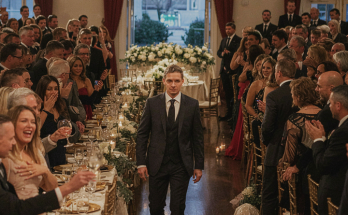
Then the ballroom doors opened.
And a man walked inside.
Tall.
Gray-haired.
Seventy years old.
Walking slowly with a cane.
My father turned pale.
Because he knew exactly who the man was.
Uncle Daniel.
The brother who had vanished thirty-two years earlier.
The brother everyone believed had abandoned the family.
The brother my father had spent decades destroying.
The room fell silent.
Vanessa stared.
My mother looked like she might faint.
And my father whispered:
“No.”
But Uncle Daniel kept walking.
Until he stood in the center of the ballroom.
And looked directly at my father.
“You told them I betrayed the family,” Daniel said quietly.
My father said nothing.
“You told them I stole from our parents.”
Silence.
“You told them I disappeared.”
Daniel reached into his jacket.
Removed a folder.
Yellowed papers.
Old documents.
Then he looked around the room.
“The truth,” he said, “is that your father stole everything.”
Gasps echoed through the ballroom.
My father’s face turned white.
It had started in 1992.
Their father—my grandfather—owned a manufacturing company worth millions.
He intended to leave equal shares to both sons.
Daniel and my father, Richard.
But Richard had debts.
Huge debts.
Bad investments.
Secret loans.
And he was desperate.
Daniel discovered financial records proving Richard had been taking money from the company.
When Daniel confronted him, Richard begged.
Promised to stop.
Promised to fix things.
Instead, Richard forged documents.
Transferred assets.
Manipulated records.
And when Daniel threatened to expose him, Richard did something worse.
He convinced the family that Daniel was unstable.
A liar.
A thief.
Even my grandmother eventually believed it.
Daniel left.
Not because he was guilty.
Because no one would listen.
And Richard inherited everything.
The business.
The money.
The reputation.
A fortune built on lies.
“How do you know this?” Vanessa demanded.
I looked at her.
“Because I investigated it.”
Two years earlier, while researching corporate fraud for an article, I had discovered old legal records.
Strange transactions.
Missing files.
Hidden settlements.
I kept digging.
And eventually, I found Uncle Daniel.
Living quietly in Oregon.
Working as a high school history teacher.
Never married.
Never had children.
He showed me letters.
Bank records.
Court filings.
Proof.
Decades of proof.
And one question haunted me:
How different would our lives have been if someone had listened to him?
My father laughed suddenly.
A desperate sound.
“This is nonsense.”
Then I opened my purse.
Pulled out another folder.
“Forensic accounting reports,” I said.
“Original bank documents.”
I looked around the room.
“And the settlement agreement from 1995.”
People stared.
I continued.
“The agreement where Grandfather paid millions to avoid criminal charges against the company.”
My father looked terrified.
Because he knew.
He knew I had everything.
Vanessa sat down slowly.
My mother began crying.
“No,” she whispered.
“No.”
But truth does not disappear because people dislike it.
Then Uncle Daniel said something I never forgot.
He looked at my father and said:
“For thirty-two years, you let your daughter grow up believing lies.”
Then he looked at me.
“And for thirty-two years, they taught her to carry shame that belonged to someone else.”
I felt something break inside me.
Not painfully.
Peacefully.
Like chains falling away.
All my life, I thought there was something wrong with me.
Too sensitive.
Too serious.
Too difficult.
But maybe I had simply been the one person willing to see what others refused to see.
Guests began leaving quietly.
The wedding orchestra stopped playing.
The expensive flowers suddenly looked ridiculous.
Five million dollars could create beauty.
But it could not buy truth.
Vanessa cried.
Not because of the wedding.
Because she realized our entire family history had been built on a lie.
My mother sat silently.
A woman who had spent decades defending the wrong person.
And my father—
For the first time in my life—
Looked small.
Not powerful.
Not frightening.
Just a man whose secrets had finally found daylight.
That night changed everything.
Vanessa and I did not speak for months.
She needed time.
My mother wrote letters.
Apologies.
Regrets.
Some wounds heal slowly.
My father disappeared from public life.
The company board launched investigations.
Old records resurfaced.
Truth has patience.
It waits.
And eventually, it arrives.
As for Uncle Daniel—
We had breakfast every Sunday after that.
He told me stories about my grandfather.
About family recipes.
About childhood memories.
All the things that had been stolen from us.
And slowly, I realized something:
Families are not only built by blood.
They are built by honesty.
By courage.
By the people who stay when truth becomes uncomfortable.
A year later, Uncle Daniel walked me down the aisle at my wedding.
Not because my father was gone.
But because family is earned.
As we stood together before the ceremony, Daniel smiled and said:
“You know what your greatest mistake was?”
“What?” I asked.
“You spent years trying to prove your worth to people who had already decided not to see it.”
I laughed softly.
He squeezed my hand.
“But you know what your greatest strength was?”
I looked at him.
“You never stopped searching for the truth.”
And in that moment, I understood something that took me thirty years to learn:
The people who call you difficult are often the people most afraid of what you know.
And sometimes, the most powerful thing you can do is stay calm, make one phone call, and let the truth walk through the door.
Because lies can survive for years.
Sometimes decades.
But eventually—
The ballroom doors open.
And everyone sees.
RESPONSE 2
The first drop of wine hit my shoulder.
Cold.
Sticky.
Red.
For one strange second, I thought someone had stumbled.
Then the rest of the glass came crashing over me.
The deep burgundy liquid spread across my pale blue gown, soaking the fabric from my collarbone to my waist, dripping onto the marble floor of the Grand Regent Ballroom.
Nearly three hundred guests fell silent.
A violin stopped mid-note.
Forks froze in the air.
And my father smiled.
“Look at yourself,” he said loudly enough for everyone to hear. “You always find a way to humiliate this family.”
A few people laughed nervously.
My mother covered her mouth, pretending to hide a smile.
My younger sister, Vanessa—the bride in her five-million-dollar custom gown—actually giggled.
It was the same laugh she had when we were children and she knew I was about to get blamed for something she had done.
At thirty-four years old, I should have been immune to that sound.
I wasn’t.
For a moment, I stood there in silence while red wine slid down my skin.
I could feel hundreds of eyes on me.
Waiting.
Waiting for me to cry.
Waiting for me to run.
That was how the story always went in my family.
I was the disappointment.
Vanessa was the princess.
And my father, Richard Holloway, was king.
Or at least, that was what everyone believed.
I reached into my purse.
Pulled out my phone.
Made one call.
When the person answered, I said only six words.
“It’s time. Bring him inside.”
Then I hung up.
My father laughed.
“What now?” he asked. “Calling someone else to rescue you?”
I looked at him.
“No,” I said quietly.
“I’m calling someone who knows the truth.”
His smile faltered for just a second.
Then the music started again.
People returned to talking.
My mother leaned close and whispered, “Please don’t ruin your sister’s wedding.”
Ruin it.
The irony almost made me laugh.
Because this wedding had been built on lies.
And those lies had started thirty years earlier.
Thirty years earlier, my father was not rich.
He wasn’t powerful.
He wasn’t the famous real estate developer everyone admired.
He was a struggling man with debt, bad business ideas, and a family inheritance he was about to lose.
The person who saved him was my grandfather.
My mother’s father.
Edward Whitmore.
A quiet man with sharp eyes and old-fashioned values.
He owned land.
Lots of land.
Most people thought my father built the Holloway empire.
He didn’t.
Grandfather financed everything.
Every office building.
Every apartment complex.
Every hotel.
Millions and millions of dollars.
But Grandfather had one rule.
Everything was to be divided equally between his grandchildren one day.
Vanessa.
And me.
Fifty-fifty.
I learned that when I was eleven years old.
I wasn’t supposed to hear it.
I had hidden behind Grandfather’s study door while he argued with my father.
“Equal means equal, Richard,” Grandfather said.
“You favor Emily,” my father snapped.
“Because Emily listens,” Grandfather replied.
“Because Emily cares about people. Vanessa only cares about appearances.”
I remember standing there, confused.
I didn’t understand then.
But my father never forgot those words.
And from that day on, everything changed.
Vanessa got horseback lessons.
Private schools.
Luxury cars.
Designer clothes.
I got criticism.
“You aren’t graceful enough.”
“You talk too much.”
“You embarrass people.”
“You’ll never understand business.”
When I was sixteen, my father told me something I never forgot.
“You were born to support your sister,” he said.
“Not compete with her.”
At twenty-two, I left home.
I built my own life.
I became an attorney.
Not because my father believed in me.
Because he didn’t.
Years passed.
I attended family holidays.
Birthdays.
Events.
But I remained an outsider.
Then Grandfather died.
And everything changed.
The will reading took place in a quiet office downtown.
I remember my father’s confidence.
Vanessa’s smile.
My mother’s satisfaction.
Then the attorney opened the documents.
Grandfather had left detailed instructions.
Properties.
Investments.
Trusts.
And something else.
A sealed letter.
Addressed to me.
Only me.
Inside was a single sentence.
If Richard ever tries to deny you your inheritance, show them the truth.
Attached to the letter was a key.
A storage unit key.
I didn’t understand.
Not then.
A week later, I opened the unit.
Inside were boxes.
Old records.
Documents.
Photographs.
Audio tapes.
Business agreements.
And one thick folder labeled:
FOR EMILY.
I spent three days reading everything.
And when I finished…
I understood why my grandfather had looked so sad in his final years.
My father had stolen.
Not money.
Something worse.
Identity.
History.
Truth.
You see, thirty-five years earlier, my father had a business partner.
A man named Daniel Mercer.
Daniel was brilliant.
Architectural genius.
Investor.
Visionary.
Most of the ideas credited to Richard Holloway actually belonged to Daniel.
Then Daniel disappeared.
Official story?
He sold his shares and moved overseas.
Real story?
My father manipulated contracts.
Forged signatures.
Destroyed evidence.
And took everything.
Daniel fought back.
For years.
Then suddenly stopped.
No one knew why.
Except my grandfather.
And now…
Me.
Because inside the boxes were letters.
Proof.
Bank transfers.
Witness statements.
And one more thing.
A DNA report.
I stared at it for a long time.
Then read it again.
And again.
Because it said something impossible.
Daniel Mercer wasn’t just my father’s former partner.
He was my biological father.
My hands shook.
I thought it had to be fake.
It wasn’t.
My mother had confessed everything to my grandfather years earlier.
She had loved Daniel.
But when Daniel lost everything, Richard stepped in.
Powerful.
Wealthy.
Convenient.
And when Daniel vanished…
The secret vanished with him.
Or so everyone thought.
I confronted my mother.
She cried.
My father denied everything.
Vanessa called me insane.
And then…
The lawsuits began.
Quietly.
Carefully.
I hired investigators.
Forensic accountants.
Legal experts.
The evidence grew.
And grew.
And grew.
Which brings us back to the wedding.
Vanessa’s wedding.
Five million dollars.
Flowers flown in from Europe.
Crystal chandeliers.
Celebrity chef.
Magazine photographers.
My father wanted perfection.
One final image of the perfect family.
But perfection is fragile.
Especially when built on lies.
Five minutes after my call, four men in dark suits entered the ballroom.
Security.
Guests whispered.
My father frowned.
Then the doors opened.
And a man walked in.
Older now.
Gray hair.
Straight posture.
Sharp eyes.
Daniel Mercer.
My father turned pale.
“No,” he whispered.
Around the room, people gasped.
Because Daniel wasn’t dead.
He wasn’t gone.
He was alive.
And he had come back.
Daniel walked slowly across the ballroom.
The music stopped.
Every eye followed him.
He stopped in front of my father.
For a long moment, no one spoke.
Then Daniel said quietly:
“Thirty-five years, Richard.”
My father swallowed hard.
“You shouldn’t be here.”
Daniel smiled sadly.
“Neither should you.”
The silence felt enormous.
Then Daniel turned.
And looked at me.
For the first time in my life, I saw my own eyes looking back at me.
Same shape.
Same color.
Same expression.
He nodded once.
Not dramatically.
Not emotionally.
Just a small nod.
But it felt like a lifetime of answers.
Vanessa stood up.
“What is this?” she demanded.
Daniel looked at her kindly.
“The truth.”
Then my attorney entered carrying folders.
One for every major investor.
One for every board member.
One for every journalist present.
My father’s face drained of color.
Because this wasn’t revenge.
This was exposure.
Inside the folders:
Business fraud.
Forged documents.
Financial misconduct.
Evidence.
Years of evidence.
People began reading.
Whispering.
Standing.
Leaving tables.
Phones came out.
Calls were made.
The room shifted.
Power shifted.
And for the first time in my life…
My father looked afraid.
“You planned this,” he said.
“No,” I answered.
“Grandfather planned it.”
I held up the old key.
“He knew someday the truth would matter more than appearances.”
My mother began crying.
Vanessa sat down slowly.
As if her world had tilted.
And perhaps it had.
Because sometimes the hardest thing is learning that the story you’ve been told your entire life isn’t true.
Daniel spoke quietly.
“I never wanted revenge.”
He looked around the room.
“I wanted acknowledgment.”
Then he looked at me.
“And I wanted to know my daughter.”
I felt tears in my eyes.
Not because of what we lost.
Because of what we had found.
My father sank into a chair.
For the first time in forty years…
He looked small.
Not powerful.
Not important.
Just old.
An old man surrounded by consequences.
People often ask if I hated him.
The answer is complicated.
I hated what he did.
I hated the years I believed I wasn’t enough.
I hated every moment I thought I deserved less love than my sister.
But hate is heavy.
And I had carried enough weight.
That night, I walked out of the ballroom beside Daniel.
The night air felt cool.
Fresh.
Free.
He looked at me and smiled.
“You don’t have to call me Dad,” he said softly.
I laughed through tears.
“Good,” I replied.
“Because I think we should start with coffee.”
He laughed too.
And for the first time in my life…
I heard my own laugh echoed back.
Months later, investigations began.
Companies changed hands.
Boards resigned.
Truth spread.
Some people lost fortunes.
Others found peace.
Vanessa and I spoke only once.
She asked me one question.
“Why didn’t you tell me sooner?”
I thought about that.
Then answered honestly.
“Because you never wanted to hear anything that threatened the story you loved.”
She cried.
I cried too.
Because families are complicated.
Love is complicated.
Truth is complicated.
But lies?
Lies are simple.
And eventually…
Simple things break.
One year later, Daniel and I stood together at my grandfather’s grave.
I placed fresh flowers beside the stone.
And whispered:
“You kept your promise.”
The wind moved softly through the trees.
And for the first time in thirty-four years…
I finally understood something.
Family is not built by power.
Or money.
Or appearances.
Family is built by truth.
And truth, no matter how deeply buried, always finds a way back into the light.