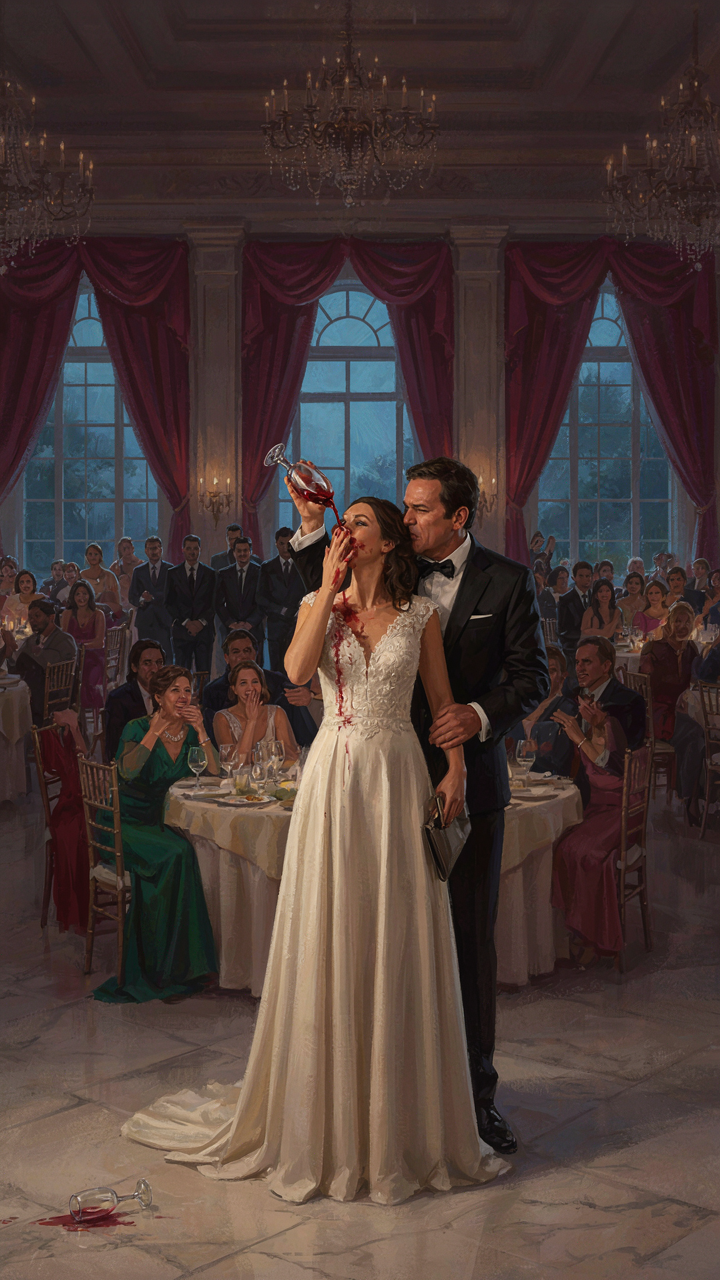
My Father Ruined My Dress at My Sister’s $5 Million Wedding—But He Had No Idea Who I Had Just Called
“Look at yourself,” my father sneered. “You always find a way to humiliate us.”
Then he tipped an entire glass of red wine over my white gown.
Nearly 300 guests watched as the wine spread across the silk, dripping from my waist to the floor. A few people gasped. Others whispered. Someone near the head table actually laughed.
My mother covered her mouth, pretending to be shocked, although the smile in her eyes gave her away.
My sister, standing beside her five-million-dollar wedding cake, giggled.
And my father, Richard Whitmore, looked positively delighted with himself.
For thirty-two years, he had made sure I understood one thing.
In our family, I was the disappointment.
My sister, Victoria, was the princess.
She had the expensive education, the designer clothes, the beautiful engagement ring, and now a wedding that had reportedly cost more than most people earned in a lifetime.
I had a modest apartment, a career my father never bothered to understand, and a reputation in my family for being difficult whenever I refused to obey.
But that evening, standing in the middle of the most extravagant ballroom I’d ever seen, I finally understood something.
My father had mistaken my silence for weakness.
And he had absolutely no idea what was about to happen.
I calmly wiped the wine from my cheek.
Then I reached into my purse and pulled out my phone.
My father raised an eyebrow.
“Calling someone to come rescue you? How embarrassing.”
I didn’t answer.
I dialed one number.
When the person on the other end picked up, I said six words.
“It’s time. Bring him inside.”
Then I ended the call.
My father laughed.
“Who exactly do you think you’re summoning? Your imaginary friends?”
I looked directly at him.
“No, Dad. Someone you know.”
His smile remained, but something in his eyes shifted.
He didn’t know what I’d arranged.
Not yet.
And then, exactly four minutes later, the ballroom doors opened.
Four men in dark suits entered first.
They moved quietly, positioning themselves beside the exits without disturbing the guests.
The music stopped.
Conversations faded.
My father straightened his jacket.
“What is this supposed to be?”
Then a fifth man walked through the doors.
And my father’s face turned completely white.
Because the man standing in the doorway wasn’t a stranger.
He was the one person Richard Whitmore had spent twenty-two years making sure nobody in our family ever spoke about.
His name was Daniel Mercer.
And he was my father’s former business partner.
The man my father had told everyone was dead.
1. The Daughter Who Never Belonged
My name is Eleanor Whitmore.
I’m thirty-two years old, and until that evening, I had spent most of my life trying to earn my father’s approval.
Richard Whitmore was a wealthy property developer in Connecticut. He owned commercial buildings, luxury apartments, and several businesses that appeared successful enough to impress anyone who looked at the numbers.
He was charming in public.
He donated generously to charity, shook hands with politicians, and gave speeches about family values at business dinners.
At home, however, he operated by a different set of rules.
His word was final.
His reputation mattered more than anyone’s feelings.
And if you embarrassed him, he made sure you regretted it.
My sister Victoria was his favorite because she understood those rules.
She knew when to smile, when to agree, and when to pretend not to notice his cruelty.
I never learned how to do that.
When I was twelve, I questioned why our housekeeper had been fired without receiving her final paycheck.
My father told me to stop asking questions.
When I was seventeen, I refused to lie to my grandmother about why my father had sold her investment property.
He didn’t speak to me for three weeks.
And when I graduated from college with a degree in forensic accounting, he laughed.
“Accounting? You could have joined the family business and actually accomplished something.”
I remember sitting at our dining table while my mother, Patricia, arranged flowers for a charity luncheon.
Victoria was sixteen then, already receiving driving lessons in a brand-new Mercedes.
My father looked at my diploma and said, “You have absolutely no ambition.”
I didn’t tell him that I had already received a job offer from a respected financial investigations firm.
I simply took my diploma upstairs.
That was the beginning of my disappearance from his expectations.
I stopped asking him for advice.
I stopped attending unnecessary family business dinners.
And eventually, I stopped telling him anything important about my life.
What he never realized was that my career had taken me somewhere he couldn’t control.
I specialized in tracing complex financial transactions, uncovering concealed ownership structures, and investigating suspicious corporate transfers.
My clients included banks, law firms, investors, and occasionally government agencies.
I was good at my job.
Very good.
But to my father, I was still the girl who had chosen the wrong degree.
And that was exactly how I wanted him to see me.
Because the less he thought of me, the less carefully he watched me.
2. The Wedding Invitation
Victoria’s wedding invitation arrived six months before the ceremony.
It came in a thick ivory envelope with gold lettering and a wax seal.
Inside was an invitation to marry Alexander Hayes, the son of a prominent investment banker.
The ceremony would take place at the Sterling Grand Estate, a historic property overlooking the Connecticut River.
The guest list included executives, investors, attorneys, celebrities, and several people whose names regularly appeared in financial publications.
The estimated wedding cost was five million dollars.
Victoria’s dress alone reportedly cost $180,000.
My father had personally arranged the flowers, imported the champagne, and hired a famous orchestra.
He wanted the wedding to become the social event of the year.
He also wanted everyone to believe he had paid for everything himself.
But I knew that wasn’t true.
Three months before the wedding, my father had called me.
It was unusual.
He rarely called unless he wanted something.
“Eleanor,” he said, “I need you to come to the office.”
“Why?”
“Because I have a financial matter that requires your expertise.”
I almost laughed.
For years, he’d dismissed my profession.
Now suddenly he needed an accountant.
When I arrived at Whitmore Development, he was waiting in his glass-walled office.
He slid a folder across his desk.
Inside were documents concerning a company called Mercer Holdings.
I recognized the name immediately.
Daniel Mercer.
The former business partner.
The man whose disappearance had been a forbidden subject in our family.
My father watched my face.
“You remember him?”
“Yes.”
“Good. Then you’ll understand why this needs to stay confidential.”
I opened the folder.
There were property transfers, old partnership agreements, bank statements, and a series of corporate resolutions.
Some documents were more than twenty years old.
Others had been created recently.
One transaction caught my attention.
A substantial commercial property portfolio had been transferred from a company jointly owned by Richard Whitmore and Daniel Mercer into a new corporation controlled entirely by my father.
The transfer supposedly occurred after Daniel’s death.
But there was a problem.
The supporting documentation didn’t match.
Several signatures appeared inconsistent.
Some dates contradicted other records.
And one document appeared to have been notarized in a state where Daniel hadn’t been physically present.
I closed the folder.
“What happened to Daniel?”
My father leaned back.
“He died.”
“How?”
“An accident.”
“When?”
“Twenty-two years ago.”
“Then why are you transferring properties now?”
His expression hardened.
“Because there are old records that need correcting.”
I looked at him for several seconds.
“Are you asking me to certify these transactions?”
“I’m asking you to review them.”
“And if they’re inaccurate?”
He smiled without warmth.
“Then you’ll help me make them accurate.”
I pushed the folder back toward him.
“I won’t certify anything that I can’t independently verify.”
For a moment, he stared at me.
Then he laughed.
“You really are your mother’s daughter. Always making everything unnecessarily complicated.”
I stood.
“Find another accountant.”
He let me reach the door before speaking again.
“Your sister’s wedding is coming up. You wouldn’t want to create problems for the family right before such an important occasion.”
I turned.
“Is that a threat?”
“It’s advice.”
I left without answering.
But I took one thing with me.
The name Daniel Mercer.
And the suspicion that my father had been lying about something much bigger than a wedding.
3. The Secret in the Records
I didn’t investigate my father because I wanted revenge.
At least, that’s what I told myself.
Initially, I simply wanted to understand the documents he’d placed in front of me.
I contacted an attorney I trusted, a woman named Margaret Ellis.
She had represented several clients in financial disputes involving complicated corporate ownership structures.
I showed her copies of the documents.
She didn’t react dramatically.
She simply read everything twice.
Then she asked one question.
“Where did you get these?”
“My father.”
She removed her glasses.
“Eleanor, do you understand what you’re looking at?”
“An apparently improper transfer of assets.”
“Possibly. But there’s something else.”
She pointed to a clause in the original partnership agreement.
If Daniel Mercer died without descendants, his ownership interest would pass according to a specific succession arrangement.
But if he survived, his rights remained intact unless he voluntarily transferred them.
I frowned.
“What are you suggesting?”
“I’m suggesting that we need to verify the circumstances surrounding his reported death.”
Margaret began making inquiries through appropriate legal channels.
I didn’t contact my father.
I didn’t confront my mother.
And I certainly didn’t tell Victoria.
Instead, I concentrated on my work and waited.
Three weeks later, Margaret called.
“Eleanor, I think you should come to my office.”
When I arrived, she had a thick envelope waiting.
Inside was a certified copy of an old court filing.
Daniel Mercer had been declared missing after a boating accident twenty-two years earlier.
But he had never been legally confirmed dead through the evidence my father had described.
There had been no recovered body.
No definitive identification.
And, most importantly, there had been a sealed settlement concerning the partnership.
The settlement was unusual.
It contained a provision requiring both parties to disclose certain financial records if the missing partner ever reappeared.
My father had apparently continued operating the business as though Daniel were dead.
Margaret looked at me.
“Do you know where Daniel Mercer is?”
“No.”
“Neither did I.”
She slid another document across the desk.
It was a recent letter from Daniel’s attorney.
Daniel Mercer was alive.
And he wanted his business records restored.
I stared at the page.
For a long time, I couldn’t speak.
The man my father had declared dead was alive.
And he had been trying to resolve the matter through lawyers.
Margaret explained that Daniel had been living overseas for years, recovering from serious injuries and dealing with the legal aftermath of the accident.
He had only recently learned the full extent of the corporate transfers.
His attorney had contacted my father repeatedly.
The responses had been dismissive.
Then they had stopped.
Daniel had decided to pursue the matter formally.
He wasn’t asking for a dramatic confrontation.
He wanted his ownership rights recognized, the records preserved, and the disputed transactions examined.
I asked Margaret one question.
“Why did my father tell everyone Daniel was dead?”
She didn’t pretend to know.
“That’s something Daniel can answer. Or your father can.”
I left her office feeling as though the floor had shifted beneath me.
For twenty-two years, my father had controlled the story.
Now someone else had the documents.
And that person was coming home.
4. The Invitation I Almost Refused
Two weeks before the wedding, Victoria called me.
“Are you coming?”
“To what?”
She sighed.
“Don’t be difficult, Eleanor. My wedding.”
“I received the invitation.”
“Then answer the question.”
“Yes. I’ll be there.”
“Good. And please wear something appropriate.”
I looked down at the black trousers and blouse I was wearing.
“What does that mean?”
“It means don’t show up looking like you’re attending a funeral.”
I almost laughed.
“Wouldn’t dream of it.”
There was a pause.
Then she said, “Dad wants you to behave.”
“I’m thirty-two, Victoria.”
“Exactly. It’s time you started acting like it.”
I let that comment pass.
Then she added, “And don’t talk about the business.”
My fingers tightened around the phone.
“What business?”
“You know what I mean.”
“No, I don’t.”
“Eleanor, Dad has enough stress. The wedding has cost a fortune. The last thing he needs is you bringing up old problems.”
I said nothing.
She interpreted my silence as agreement.
“Thank you. I knew you’d understand.”
Then she hung up.
I should have declined the invitation.
I should have sent a gift and stayed home.
But there was one thing I needed to do.
Daniel Mercer had asked to attend the wedding.
Not as a guest seeking attention.
As a person who had been deliberately erased from the family’s public history.
His attorney had informed Margaret that Daniel intended to appear in person if my father continued refusing to acknowledge him.
Margaret advised against an unplanned confrontation.
But Daniel had a different idea.
He wanted to give Richard Whitmore one final opportunity to address the matter privately.
And he wanted the wedding to proceed without a public disruption if possible.
I agreed to help coordinate the meeting.
Not because I believed my father deserved another chance.
But because I wanted everything documented, witnessed, and handled lawfully.
We arranged for Daniel to arrive at the venue after the ceremony, when the reception was underway.
His attorney would accompany him.
Several legal representatives would also be present.
And if my father refused to acknowledge the documents, the attorneys would proceed with the next formal steps.
I thought I was prepared.
I wasn’t.
Because I had underestimated just how far my father would go to humiliate me.
5. The Red Wine
The wedding ceremony was beautiful.
I had to admit that.
The Sterling Grand Estate looked like something from a movie.
White roses covered the entrance.
Hundreds of candles illuminated the ballroom.
A massive crystal chandelier hung above the dance floor.
Victoria wore her custom gown and walked down the aisle beneath an arch of imported flowers.
My mother cried.
My father looked proud.
And Alexander, my new brother-in-law, smiled as though he’d just won the greatest prize of his life.
For a few hours, I almost forgot everything.
Then the reception began.
I wore a simple ivory silk gown.
It was elegant, understated, and completely appropriate for a formal wedding.
I had chosen it because I wanted to feel comfortable.
Not because I wanted attention.
But my father noticed me immediately.
He approached during the cocktail hour.
“Interesting choice.”
“What?”
“The dress.”
I glanced down.
“Is something wrong with it?”
“It’s white.”
“It’s ivory.”
He gave a short laugh.
“Of course it is.”
I looked at him.
“Dad, I’m not trying to compete with Victoria.”
“Then why do you insist on making everything about yourself?”
I felt my stomach tighten.
“I came to celebrate her wedding.”
“Then act like it.”
He walked away.
I should have known he wasn’t finished.
An hour later, after the speeches and the first dance, I was standing near the edge of the ballroom when my father approached with a glass of red wine.
He was already several drinks into the evening.
“Eleanor.”
I turned.
“Congratulations,” I said quietly. “The wedding is beautiful.”
He ignored the compliment.
“Your sister deserves a better family than the one you keep trying to create.”
I stared at him.
“What are you talking about?”
“You know exactly what I’m talking about.”
“No, Dad. I don’t.”
He leaned closer.
“You’ve been making inquiries about Daniel Mercer.”
My heart skipped.
I kept my expression neutral.
“I haven’t discussed that with you.”
“Because you know you’re wrong.”
“Wrong about what?”
He glanced toward the guests.
Several people were watching us.
Then he smiled.
That terrible, familiar smile.
“You think you’re clever because you have a little accounting degree?”
I didn’t answer.
“You think you can embarrass me at my daughter’s wedding?”
“I’m not trying to embarrass anyone.”
He lifted his glass.
“Look at yourself.”
And before I could move, he tipped the wine directly over my gown.
The liquid splashed across my chest, soaked the silk, and ran down the front of the dress.
Some struck my cheek.
I heard someone gasp.
Then my mother laughed.
It was a short, unmistakable laugh.
Victoria covered her mouth.
Her shoulders shook.
My father stepped back to admire his work.
“Now you look exactly like what you are.”
A few guests looked away.
Others stared.
My face burned.
But I didn’t cry.
I didn’t scream.
I didn’t slap him.
I simply reached for a napkin and wiped my cheek.
Then I pulled out my phone.
My father watched me with amusement.
“Who are you calling?”
I dialed the number.
And when the person answered, I spoke six words.
“It’s time. Bring him inside.”
I ended the call.
My father laughed again.
“That’s adorable.”
But the ballroom doors were already opening.
6. The Man Who Wasn’t Dead
The first man through the doors was Margaret’s colleague.
Behind him came three security professionals hired by the venue to assist with the arrival of the legal party.
They didn’t threaten anyone.
They didn’t raise their voices.
They simply positioned themselves discreetly near the entrances while the venue manager asked the orchestra to pause.
Then Daniel Mercer walked into the ballroom.
He was sixty-one years old.
His hair was silver.
He wore a dark suit and carried a slim leather folder.
He walked with a slight stiffness in his left leg, a lasting consequence of the accident.
But his eyes were clear.
And when he looked across the room, they stopped on Richard Whitmore.
My father went pale.
His wineglass slipped from his fingers.
It shattered on the floor.
For a few seconds, nobody moved.
Then my mother whispered, “Oh, my God.”
Victoria’s smile disappeared.
Alexander looked between the two men.
“Who is that?”
Daniel stopped several feet away from my father.
“Hello, Richard.”
My father opened his mouth.
Nothing came out.
Daniel continued.
“It’s been a long time.”
Someone near the head table whispered, “Isn’t that Daniel Mercer?”
Another guest immediately recognized the name.
A third looked toward my father.
Suddenly, the ballroom was filled with murmurs.
My father finally found his voice.
“This is a private event.”
Daniel nodded.
“I’m aware.”
“You weren’t invited.”
“Neither was I invited to watch you transfer my assets into your own companies.”
My father’s jaw tightened.
“Get out.”
Daniel didn’t move.
“I came here because your daughter asked me to give you one final opportunity to resolve this matter without further litigation.”
My father turned toward me.
His expression was no longer amused.
“What have you done?”
I held his gaze.
“I invited someone you said was dead.”
He looked as though I’d struck him.
Then he turned back to Daniel.
“You have no business being here.”
Daniel opened his folder.
“Actually, Richard, I have quite a lot of business here.”
He removed a document.
It was a copy of the original partnership agreement.
Then another.
And another.
The ballroom had gone completely silent.
Daniel spoke clearly enough for the guests nearest us to hear.
“Twenty-two years ago, we built Whitmore-Mercer Properties together. We signed an agreement giving each of us an equal ownership interest in the original company.”
My father interrupted.
“You abandoned the business.”
“No. I was injured in an accident, and you told everyone I had died.”
Daniel’s voice remained calm.
“You used that false claim to consolidate control of the company. You transferred assets. You altered records. And when I recovered, you refused to recognize my ownership.”
My father looked around the ballroom.
He was searching for support.
But the faces surrounding him had changed.
People who had spent years admiring him were now watching him with uncertainty.
He pointed at Daniel.
“You can’t prove any of that.”
Daniel turned slightly.
“That’s why my attorney is here.”
Margaret stepped forward.
She carried a second folder.
“Mr. Whitmore, we’ve provided formal notice of the disputed transfers. The relevant documents are preserved, and the matter is proceeding through the appropriate legal channels.”
My father stared at her.
Then he looked at me.
“You did this.”
I shook my head.
“No, Dad. I read the documents.”
7. The Secret Everyone Knew
The strangest part of the evening wasn’t Daniel’s arrival.
It was watching people recognize the truth.
Some guests had known Daniel personally.
Others had heard rumors over the years.
A former employee approached the edge of the crowd.
“I thought you were dead,” he whispered.
Daniel nodded.
“That’s what Richard wanted everyone to believe.”
The man looked at my father.
Then he looked away.
Another guest, a retired attorney who had once worked with both partners, approached Margaret.
“Is the original settlement still valid?”
Margaret answered carefully.
“That is one of the issues currently being reviewed.”
The attorney nodded.
Then he stepped back.
My father looked increasingly desperate.
“Everybody needs to leave.”
But nobody moved.
He turned toward the venue manager.
“End this. Now.”
The manager hesitated.
“This is a private matter, sir. We can provide a separate room if the parties wish to speak.”
My father snapped, “I said end it!”
Daniel closed his folder.
“I didn’t come to ruin Victoria’s wedding.”
Victoria flinched.
Daniel continued.
“I came because Richard has refused to acknowledge my existence for years. I have a legal right to pursue the matter, and I will.”
My father laughed bitterly.
“You’re going to destroy my family over money?”
Daniel looked at him for a long moment.
“No, Richard. You did that yourself.”
My mother suddenly stepped forward.
“Daniel, please. We didn’t know.”
Daniel turned toward her.
“Patricia, you signed the documents.”
Her face drained of color.
My father whipped around.
“Don’t.”
But Daniel continued.
“You signed the declaration supporting the transfer. You also signed the statement saying you had received confirmation of my death.”
My mother began shaking her head.
“I was told it was true.”
Daniel’s expression softened slightly.
“Then perhaps you should explain that to the investigators.”
My mother looked at me.
For the first time in my life, she seemed frightened of what I might say.
I didn’t say anything.
Because I remembered something.
When I was ten years old, Daniel had visited our house for dinner.
He’d brought me a book about numbers and puzzles.
He’d told me I was curious and that curiosity was a valuable thing.
My father had been irritated when I spent the entire evening asking Daniel questions about his work.
Years later, when Daniel disappeared, I asked where he was.
My father said he’d died.
My mother told me never to mention him again.
I had believed them.
And now I was standing in front of the man who had once encouraged me to ask questions.
I felt a strange mixture of anger and sadness.
Not because my father had lied about Daniel.
But because he’d built an entire family culture around the idea that questions were dangerous.
8. My Sister’s Question
Victoria finally approached me.
Her wedding dress rustled as she walked.
Her face was flushed.
“What is happening?”
I looked at her.
“Daniel is alive.”
“I can see that!”
“Then you understand.”
“No, I don’t!”
She glanced toward my father.
“Why would you do this today?”
I looked down at the ruined gown.
“Ask Dad.”
Her mouth opened.
Then she noticed the wine stains.
For the first time that evening, she seemed genuinely uncomfortable.
“Eleanor…”
I waited.
“I’m sorry about your dress.”
It was the first apology I’d heard from her in years.
But it wasn’t enough to erase what had happened.
I nodded.
“Thank you.”
She looked toward Daniel.
“Is this about the company?”
“Yes.”
“Then why couldn’t you wait until tomorrow?”
I stared at her.
“Because Dad wouldn’t answer the letters.”
“He’s under pressure!”
“So am I.”
She looked genuinely confused.
And then she said something that explained almost everything.
“Eleanor, you don’t understand what this wedding means to our family.”
I almost laughed.
“What do you think it means to me?”
She didn’t answer.
“This wedding is important to you. I know that. But my entire life has been important to me, too. And for years, Dad has treated me like I don’t deserve a place in this family.”
Victoria looked away.
I continued.
“You laughed when he poured wine on me.”
Her eyes filled with tears.
“I didn’t know he was going to do that.”
“But you laughed.”
“I was nervous!”
“You laughed.”
She began crying.
For a moment, I wanted to comfort her.
It was an old reflex.
The same reflex that had kept me apologizing whenever my father hurt me.
But I stopped myself.
Victoria was thirty years old.
She could take responsibility for her own actions.
And I didn’t have to make her feel better just because she was uncomfortable.
“I hope you have a wonderful marriage,” I said quietly.
Then I walked away.
9. The Evidence
The legal meeting took place in a private conference room adjacent to the ballroom.
Daniel’s attorney was present.
Margaret was present.
My father’s attorney, who had been attending the wedding as a guest, was summoned from the reception.
My father arrived furious.
My mother followed him.
I remained outside until Margaret asked me to join them.
On the table lay copies of the original partnership agreement, disputed transfer documents, bank records, and correspondence.
Daniel explained that he had not been able to pursue the matter immediately after the accident.
He had suffered significant injuries.
His recovery had taken years.
Then, when he finally attempted to contact the business, he discovered that his name had effectively disappeared.
The company had been reorganized.
The properties had been transferred.
And his former partner was publicly presenting himself as the sole founder.
Daniel had tried to negotiate.
He had tried mediation.
He had tried sending formal notices.
But Richard had refused to engage.
My father insisted the transactions were legitimate.
He claimed Daniel had voluntarily surrendered his interest.
Daniel produced a letter.
It was dated twenty-two years earlier.
The letter appeared to bear Daniel’s signature.
But Daniel had already submitted evidence disputing its authenticity.
An independent document examiner had identified several irregularities.
My father dismissed the examination.
Then Margaret presented a bank record.
A transfer had been made from an account connected to the original partnership shortly after Daniel’s accident.
The recipient company was controlled by my father.
Another payment had been made to an individual who later signed a declaration supporting the disputed transaction.
My father’s attorney leaned forward.
“Richard, I need to ask you something.”
My father glared at him.
“What?”
“Did you personally authorize these transfers?”
My father hesitated.
That hesitation changed the room.
His attorney removed his glasses.
“Richard, don’t answer until we’ve reviewed the documents.”
But my father was already losing control.
“This is ridiculous. Daniel abandoned everything.”
Daniel’s attorney spoke calmly.
“Then the records should support that explanation.”
My father slammed his hand on the table.
“You all think you’re so clever!”
Nobody responded.
Then he turned toward me.
“You little traitor.”
I felt the familiar sting.
But it didn’t control me anymore.
“You asked me to review these documents,” I said. “I refused to certify them because they didn’t match the evidence.”
“You could have come to me!”
“I did.”
“You should have trusted your father!”
I looked directly at him.
“You told me Daniel was dead.”
Silence.
“You told me the company was yours.”
Silence.
“You asked me to approve documents I couldn’t verify.”
His expression hardened.
“And you chose him over your own family.”
I shook my head.
“No. I chose the truth over a lie.”
10. The Wedding That Stopped
By the time we returned to the ballroom, the wedding reception had effectively ended.
Some guests had left.
Others remained in small groups, whispering about Daniel’s return.
The orchestra had stopped playing.
The enormous wedding cake remained untouched.
Victoria sat at the head table with Alexander beside her.
Her mascara had begun to run.
My father walked directly toward the microphone.
“Ladies and gentlemen,” he announced, “there has been an unfortunate misunderstanding.”
The room fell quiet.
“My former business partner has chosen this evening to make false accusations. I will not allow these malicious claims to overshadow my daughter’s wedding.”
Daniel stood near the side of the room.
He didn’t interrupt.
My father continued.
“This family has worked hard to build a reputation. We have always valued loyalty, integrity, and honesty.”
I almost couldn’t believe what I was hearing.
Then he said my name.
“Unfortunately, some people are willing to sacrifice their own family for attention.”
Every head turned toward me.
I stood near the entrance.
My dress was still stained.
My cheek still smelled faintly of wine.
But I didn’t move.
My father pointed toward me.
“Eleanor has made a terrible mistake.”
For years, those words would have destroyed me.
I would have cried.
I would have tried to explain.
I would have begged him to understand.
But that evening, something inside me had finally become quiet.
I stepped forward.
“Dad.”
He looked irritated.
“What?”
“Tell them why Daniel was declared dead.”
His face tightened.
“Not now.”
“Tell them why you refused to answer his attorney.”
“Eleanor, stop.”
“Tell them why you asked me to certify the transfers.”
He lowered the microphone.
“You will not speak to me like that.”
I looked at the guests.
Then I looked at my father.
“I didn’t come here to ruin my sister’s wedding. I came because I was invited. I congratulated her. I stayed out of the business discussion until Dad decided to make me part of it.”
My father started to interrupt.
I continued.
“He poured wine on me because he believed humiliating me would silence me.”
I looked down at my ruined gown.
“He was wrong.”
Then I stepped away from the microphone.
I didn’t need to say anything else.
The evidence was already on the table.
The legal process would continue.
And my father’s reputation would now have to withstand scrutiny from people who had previously accepted his version of events without question.
11. The Daughter He Couldn’t Control
I left the ballroom just after midnight.
Margaret walked with me.
Outside, the night air was cold.
The estate’s gardens were illuminated by rows of small golden lights.
I could still hear faint voices coming from inside.
My phone buzzed.
A message from Victoria.
Please don’t leave like this.
I stared at it.
Then another message arrived.
I know I laughed. I’m sorry.
I didn’t respond immediately.
Instead, I looked at the ruined gown.
It had been expensive.
But the money didn’t matter.
What mattered was the feeling of standing in front of nearly three hundred people while my father deliberately tried to reduce me to nothing.
And the even worse feeling of realizing that some of them had been willing to watch.
Margaret touched my shoulder.
“You did the right thing by refusing to certify those records.”
“I know.”
“You also did the right thing by keeping the meeting documented and letting the attorneys handle the dispute.”
I nodded.
Then I asked the question I’d been avoiding.
“What happens now?”
“Now the legal process continues. There may be negotiations. There may be court proceedings. Nobody can promise you how quickly this will be resolved.”
“And my father?”
“He’ll have to answer the allegations through the appropriate channels.”
I looked back at the ballroom.
For the first time, I wasn’t afraid of what my father might do next.
Not because I believed he couldn’t hurt me.
But because I no longer needed him to approve of my life.
I had my own work.
My own home.
My own friends.
And a career built on the very thing he had tried to suppress.
The ability to question what didn’t make sense.
12. The Phone Call the Next Morning
At 8:17 the next morning, my phone rang.
It was my mother.
I almost let it go to voicemail.
But I answered.
“Eleanor.”
Her voice sounded exhausted.
“Mom.”
“Your father hasn’t slept.”
I said nothing.
“He’s furious.”
“I imagine he is.”
“He says you betrayed him.”
I closed my eyes.
“Mom, did you know Daniel was alive?”
Silence.
Then a quiet answer.
“Yes.”
My stomach tightened.
“How long?”
“Not at first. But eventually…”
“How long?”
She started crying.
“Several years.”
I gripped the phone.
“Several years?”
“He contacted us. Your father said it was a legal trick. He said Daniel wanted money.”
“And you believed him?”
“I didn’t know what to believe.”
“But you signed the declaration.”
She sobbed.
“Your father said it was necessary.”
I felt something break inside me.
Not because I hadn’t suspected it.
But because hearing her admit it made the betrayal real.
“Mom, you watched Dad pour wine on me last night.”
“I know.”
“And you laughed.”
“I shouldn’t have.”
“No. You shouldn’t have.”
She cried harder.
Then she said, “I want us to go back to how things were.”
I looked out my apartment window.
The city was beginning to wake.
Cars moved along the street.
A delivery truck stopped outside the bakery downstairs.
The world was continuing.
But I wasn’t going back.
“Mom,” I said quietly, “things weren’t good before.”
She didn’t answer.
“I just spent years pretending they were.”
Then I ended the call.
13. The Truth About the Wedding Money
Three days later, I received an unexpected email from Alexander.
He asked if we could meet.
I hesitated.
Then I agreed.
We met at a quiet café.
He looked exhausted.
His wedding suit had been replaced by jeans and a sweater.
He ordered coffee and sat across from me.
“I owe you an apology,” he said.
“For what?”
“For not stopping what happened.”
I looked at him.
“You didn’t pour the wine.”
“No. But I watched.”
He rubbed his forehead.
“I knew Richard could be cruel. I didn’t realize how far it went.”
I didn’t respond.
Then he said, “There’s something else you should know.”
He explained that the wedding had been financed through a mixture of family funds, loans, and contributions from several businesses.
The financial arrangements were more complicated than Victoria had told me.
My father had repeatedly assured the Hayes family that the Whitmore business was stable.
But after Daniel’s legal claims became known, Alexander’s father had begun asking questions.
Some of the properties used to support the wedding financing were connected to the disputed ownership structure.
Alexander wasn’t accusing anyone of a crime.
He was simply concerned about the possibility that the wedding’s funding arrangements could become entangled in the dispute.
I listened carefully.
Then I asked, “Why are you telling me this?”
“Because Victoria thinks you caused all of this.”
“And you?”
He looked down at his coffee.
“I think the problems existed long before you made that call.”
That was the first time anyone from my sister’s new family had acknowledged the obvious.
The wedding hadn’t created the problem.
It had merely exposed it.
14. The Letter
A week after the wedding, a handwritten letter arrived at my apartment.
The envelope was cream-colored.
My name was written across the front in my father’s unmistakable handwriting.
I almost threw it away.
Instead, I opened it.
Eleanor,
I have spent the last several days thinking about what happened.
You embarrassed me in front of people who matter.
I stopped reading.
Then I forced myself to continue.
I recognize that pouring wine on you was inappropriate. I was angry, and I allowed the situation to get out of hand.
I read that sentence twice.
He hadn’t apologized.
He had described an action.
Then he blamed anger.
The rest of the letter was worse.
He accused me of being disloyal.
He suggested that Daniel had manipulated me.
He complained about the damage to his reputation.
And finally, he wrote:
If you want to remain part of this family, you need to make it clear that you acted without understanding the full situation.
I folded the letter.
For a few minutes, I simply sat at my kitchen table.
Then I opened my laptop.
I wrote a reply.
It was only four sentences.
Dad,
I will not make a false statement to protect your reputation.
I hope you cooperate with the legal process and provide the records requested.
If you ever want a relationship with me that is based on honesty and respect, you know where to find me.
I signed my name.
And sent it.
For the first time, I didn’t spend an hour wondering whether he’d be angry.
I already knew.
And his anger was no longer my responsibility.
15. The Final Reveal
Six weeks after the wedding, Daniel’s attorneys contacted Margaret.
They had uncovered another document.
It was a letter written shortly before the accident.
Daniel had addressed it to my father.
The letter described a proposed restructuring of their business.
But the most important part was the final paragraph.
Daniel had written that if anything happened to him, his share of the company should be preserved for his daughter.
His daughter.
I stared at the document.
Daniel had a daughter?
Margaret explained that Daniel had been married before the accident.
His daughter, Sophie, had been only six years old when he disappeared.
After the accident, Daniel’s recovery and legal difficulties had separated him from much of his former life.
He had eventually reunited with Sophie.
She was now twenty-eight.
And she had recently become involved in reviewing the family’s original business records.
I asked Margaret whether Sophie knew about me.
“She knows you helped Daniel locate the relevant documents.”
“Does she know my father?”
Margaret nodded.
“She knows the history.”
A few days later, I met Sophie.
She was warm, thoughtful, and remarkably calm.
We sat together in Margaret’s office while Daniel joined us by video call.
Sophie looked at me.
“There’s something my father wants you to know.”
I waited.
“He remembers you from when you were a little girl.”
I smiled faintly.
“I remember him.”
“He says you were the only person in your family who kept asking questions.”
I looked down.
Then Sophie continued.
“He also says he hopes you understand something.”
“What?”
“He doesn’t blame you for what happened.”
My eyes filled with tears.
I hadn’t realized how badly I needed to hear that.
For years, I’d been treated as though questioning my father was a betrayal.
Now the person who had been most harmed by my father’s actions was telling me that asking questions wasn’t wrong.
It was necessary.
Daniel smiled through the screen.
“Your father taught you to stay quiet, Eleanor. But you didn’t.”
I wiped my eyes.
“No,” I whispered.
“I didn’t.”
16. What Happened to My Father
The legal dispute continued for months.
There were document reviews, depositions, negotiations, and formal requests for financial records.
I didn’t participate beyond providing the information and materials relevant to my professional review.
Daniel pursued his claims through his attorneys.
My father denied wrongdoing.
His legal team disputed the interpretation of several documents.
The case remained complicated, and nobody could predict its final outcome.
But something had already changed.
People stopped treating my father’s version of events as unquestionable.
Several former business associates asked for independent reviews of their own agreements.
Some clients paused new projects.
And the Whitmore company began facing questions about its historical records.
My father was no longer the only person telling the story.
As for Victoria, she called me twice.
The first time, she apologized for laughing.
The second time, she asked whether I would attend a dinner with her and Alexander.
I declined.
Not because I wanted to punish her.
But because I needed time.
She seemed disappointed.
Then she said, “I understand.”
I hoped she meant it.
My mother sent a birthday card.
There was no money inside.
No elaborate explanation.
Just a short handwritten note.
I am sorry I didn’t protect you.
I kept it.
Not because it repaired everything.
But because it was the first time she’d acknowledged what she’d done without blaming my father.
And my father?
He never apologized for the wine.
Not once.
He apologized for the consequences.
He apologized for the embarrassment.
He apologized for the legal trouble.
But he never apologized for treating his daughter like she was disposable.
That told me everything I needed to know.
17. The Dress
I kept the ruined gown.
For months, it hung in the back of my closet.
The wine stains had set into the silk.
A professional cleaner managed to lighten them, but the fabric would never look the same.
One evening, while cleaning my apartment, I took it out.
I stared at the damaged front.
And unexpectedly, I smiled.
Not because the night had been funny.
It hadn’t.
But because the dress reminded me of the exact moment I stopped begging my father to see my worth.
I folded it carefully and placed it in a box.
Then I wrote a note and tucked it inside.
October 1.
The night I stopped confusing obedience with love.
I closed the box.
And put it away.
Not as a trophy.
Not as a reminder to hate my family.
But as evidence of a decision I had finally made for myself.
I could love people without allowing them to control me.
I could forgive without pretending nothing happened.
And I could walk away from a relationship that demanded I betray my own judgment.
18. The Last Conversation
Almost a year after the wedding, my father called.
I hadn’t heard his voice in months.
For a moment, I considered ignoring the call.
Then I answered.
“Hello, Dad.”
There was a long silence.
Finally, he said, “I heard you’ve been doing well.”
“I have.”
“Your firm received a major contract.”
“Yes.”
“Congratulations.”
“Thank you.”
Another silence.
Then he said, “I suppose you think you’ve won.”
I closed my eyes.
“No.”
“Then what do you think happened?”
I looked toward the box in my closet.
I remembered the ballroom.
The wine.
My mother’s laughter.
Victoria’s giggle.
Daniel walking through the doors.
And the strange peace I’d felt when my father finally realized he couldn’t control the story anymore.
“I think I stopped losing,” I said.
He was quiet.
Then he asked, “Do you really believe I wanted to hurt you?”
I considered the question.
“I believe you wanted to humiliate me.”
He exhaled sharply.
“That wasn’t my intention.”
“Then what was?”
Another silence.
Finally, he said, “You made me look weak.”
I almost laughed.
There it was.
After all that time.
He still couldn’t see me as his daughter.
He saw me as a threat to his reputation.
I spoke carefully.
“Dad, you didn’t look weak because Daniel came into the ballroom.”
He said nothing.
“You looked weak because you were afraid of what the documents might reveal.”
His breathing changed.
I continued.
“And you didn’t lose my respect because I questioned you. You lost it because you expected me to lie for you.”
He didn’t answer.
For several seconds, neither of us spoke.
Then I said the one thing I’d spent my entire life wishing I could say.
“I wanted a father I could trust.”
His voice became quieter.
“And now?”
I looked out the window.
The evening sunlight was fading over the city.
“Now I have to live without expecting you to become someone you’re not.”
I heard him swallow.
Then he said, “Goodbye, Eleanor.”
“Goodbye, Dad.”
The call ended.
And this time, I didn’t cry.
19. The Man Who Walked Through the Doors
A few months later, I attended a small dinner hosted by Daniel and Sophie.
There were no enormous chandeliers.
No imported flowers.
No celebrity guests.
Just a long wooden table, homemade food, and people who seemed genuinely happy to be together.
Daniel sat beside me.
At one point, he raised his glass.
“To Eleanor.”
I laughed.
“Please don’t.”
“To the woman who reminded everyone that documents matter.”
Sophie smiled.
“And to asking questions.”
Everyone raised their glasses.
I felt something warm spread through my chest.
For so long, I’d thought my greatest achievement would be making my father proud.
I had spent years collecting qualifications, promotions, and accomplishments, imagining the day he’d finally look at me and say I was enough.
But sitting at that table, I realized I’d been measuring my life with the wrong person’s approval.
I didn’t need my father to validate my intelligence.
I didn’t need my mother to defend me before I deserved protection.
And I didn’t need my sister to stop laughing before I could recognize my own dignity.
The truth had been there long before the wedding.
I was capable.
I was worthy.
And I had never needed to earn the right to be treated with respect.
Daniel looked at me.
“Are you all right?”
I smiled.
“Yes.”
And for the first time in a very long time, I meant it.
Because the night my father poured wine over my dress, he thought he was teaching me a lesson.
He thought I would cry.
He thought I would apologize.
He thought I would disappear.
Instead, I made one phone call.
And the man he had erased from our family walked through the doors.
But the biggest revelation wasn’t that Daniel Mercer was alive.
It wasn’t even that my father had spent years hiding the truth.
It was that the daughter he had spent thirty-two years trying to silence had finally learned to speak.
And she no longer needed an audience to know her voice mattered.