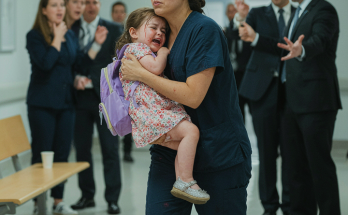
My Fifteen-Year-Old Daughter Said, “I Quit Telling Dad Because He Never Believes Me.” The Next Day, the Doctor Discovered Something That Changed Our Family Forever.
The first time my daughter told me something was wrong, I thought she was just tired.
The second time, I noticed she hadn’t finished dinner.
By the third week, I was watching her push food around her plate, her face pale beneath the kitchen lights, while my husband, Robert, insisted she was being dramatic.
But the sentence that finally broke my heart came on a Tuesday night.
Maya was standing in the doorway of my bedroom, wearing her oversized gray sweatshirt and holding her stomach with one hand.
“Mom?”
I looked up from folding laundry.
“What’s wrong, sweetheart?”
She hesitated.
“Can I tell you something without you getting mad?”
I immediately put the clothes down.
“Of course.”
She stared at the carpet for several seconds before whispering, “I quit telling Dad because he never believes me.”
Those words hurt more than I could explain.
Maya was fifteen. She was normally outspoken, funny, and stubborn in the way teenagers sometimes are when they know exactly what they want.
She used to argue with Robert about everything from music to curfews.
But lately, she’d become quiet.
She stopped asking him to drive her places. She stopped telling him about school. And whenever he entered a room, she seemed to make herself smaller.
I had noticed the changes.
I just hadn’t understood how serious they were.
“What do you mean he doesn’t believe you?” I asked.
Maya swallowed.
“When I tell him my stomach hurts, he says I’m exaggerating. When I say I feel dizzy, he says I haven’t been drinking enough water. When I tell him I’m too tired to eat, he says I’m looking for attention.”
My throat tightened.
“How long has this been happening?”
“Almost a month.”
“Why didn’t you tell me it was this bad?”
She looked at me with exhausted eyes.
“I did.”
And suddenly, I remembered.
The little comments at breakfast.
The afternoon she asked to lie down instead of going shopping.
The night she left almost all her pasta untouched.
Every time, Robert had offered an explanation.
Teenagers get stomachaches.
She’s growing.
She’s staying up too late.
She’s stressed about school.
And because he sounded so certain, I’d allowed myself to believe that perhaps he was right.
I reached for Maya’s hand.
“Sweetheart, we’re going to get you checked.”
She immediately shook her head.
“Dad will be angry.”
“Your health comes first.”
“But he’ll say I’m making him look like a bad father.”
I felt something cold settle in my chest.
“You’re not responsible for protecting anyone’s feelings when you’re hurting.”
She started crying.
Not loudly.
Not dramatically.
Just quiet tears slipping down her cheeks as she finally admitted how frightened she’d been.
That night, I lay awake listening to the rain tapping against our bedroom window.
Robert slept beside me.
And for the first time in fifteen years of marriage, I wondered whether keeping the peace in our home had come at the expense of my daughter’s safety.
The next morning, I made a decision.
I wasn’t going to wait for Robert’s permission.
I wasn’t going to wait for another argument.
And I certainly wasn’t going to wait until Maya collapsed.
The following afternoon, I signed her out of school and drove straight to the hospital.
I had no idea that within an hour, a doctor would make a phone call that would expose just how much we didn’t know about what was happening to our daughter.
And I had no idea that the most difficult conversation of my life was still waiting for me at home.
1. The Examination Room
The hospital smelled like disinfectant and coffee.
Maya sat beside me in the examination room, her knees pulled together and her fingers twisting the sleeves of her sweatshirt.
A nurse had already checked her temperature, blood pressure, and weight.
When she read the number on the scale, her eyebrows lifted.
“Have you lost weight recently, Maya?”
Maya nodded.
“How much?”
“I don’t know. Maybe twelve pounds.”
The nurse stopped writing.
“Twelve pounds?”
“Approximately,” I answered. “Over the last month.”
She exchanged a glance with me.
“Has she been eating normally?”
“No,” Maya whispered.
The nurse gently asked her a series of questions.
How often did she feel dizzy?
Did she have nausea?
Was the pain constant or intermittent?
When had she last eaten a complete meal?
Maya answered honestly, although every answer seemed to make her more uncomfortable.
Then the doctor arrived.
Her name was Dr. Elaine Foster.
She was in her early forties, with short brown hair, a calm voice, and the kind of expression that made you feel she was actually listening.
She reviewed the nurse’s notes and turned toward Maya.
“Tell me about the pain in your own words.”
Maya looked at me.
I squeezed her hand.
“It’s okay. Tell her everything.”
“It started as cramps,” Maya explained. “But now it’s different. Sometimes it feels like someone’s twisting something inside me.”
“Where exactly?”
Maya pointed to her lower abdomen.
“Here. Mostly on this side, but sometimes it spreads.”
“Does it hurt when you walk?”
“Sometimes.”
“Have you ever felt like you might faint?”
“Yes.”
Dr. Foster continued asking questions.
She didn’t rush.
She didn’t interrupt.
And when Maya admitted she’d been afraid to tell her father, the doctor didn’t dismiss the statement or change the subject.
Instead, she asked, “Do you feel safe telling your parents when you’re sick?”
Maya’s eyes filled with tears.
“I feel safe with my mom.”
The doctor nodded.
“Thank you for telling me.”
Then she asked Maya to lie back on the examination table.
The paper beneath her crackled as Dr. Foster carefully pressed along her abdomen.
At first, Maya barely reacted.
Then the doctor’s hand moved toward the lower right side.
Maya suddenly sucked in a breath and grabbed my wrist.
“Ow!”
Dr. Foster immediately stopped.
“Okay. I’m stopping. Don’t move for a moment.”
Maya’s breathing became shallow.
The doctor watched her carefully, then pulled her stool closer.
She looked at me.
And reached for the phone on the wall.
“Please get the ultrasound team down here as soon as possible,” she said. “And I need blood work started immediately.”
My stomach dropped.
“Doctor?”
She turned toward me.
“I don’t want to alarm you unnecessarily, but I’m concerned about what I’m finding.”
“Is it appendicitis?”
“It’s one possibility. There are others, and we need to investigate urgently.”
Maya’s fingers tightened around mine.
“Am I going to die?”
Dr. Foster immediately leaned toward her.
“No, sweetheart. We’re going to take this seriously and find out what’s happening. You’re in the right place.”
But I noticed something in the doctor’s expression.
She was concerned.
Very concerned.
And as the nurse returned with equipment, I realized the worst thing I could do was pretend everything was fine.
Within minutes, blood samples had been collected.
An intravenous line was placed.
And Maya was taken for an ultrasound.
I waited in the hallway, staring at the closed doors.
My phone buzzed.
Robert.
Where are you? Maya’s school called. Why did you sign her out?
I stared at the message.
Then another arrived.
You better not be taking her to the doctor over another imaginary stomachache.
My hands began shaking.
I wanted to call him.
I wanted to scream.
Instead, I typed one sentence.
We’re at the hospital. The doctor is concerned. I’ll call when I know more.
His response came almost immediately.
You are making a huge mistake.
I turned my phone facedown.
For once, I wasn’t going to spend my energy convincing Robert to take our daughter’s pain seriously.
I was going to stay focused on Maya.
And then the ultrasound technician came out and asked me to follow her.
The look on her face made my heart pound.
2. The Phone Call That Changed Everything
Maya was lying on her side when I returned to the examination room.
Dr. Foster was standing beside the computer, studying the ultrasound images.
She didn’t look up immediately.
“Mrs. Bennett, I want to explain what we’re seeing.”
I moved closer.
“Please.”
“There’s an abnormality in the lower abdomen. We can see a significant amount of inflammation, and there’s a complex mass near the right ovary.”
I blinked.
“A mass?”
“Yes. We don’t yet know exactly what it is. It could be a complicated ovarian cyst, an infection, or another condition. We need additional imaging and a specialist to evaluate her.”
Maya looked terrified.
“Does that mean cancer?”
Dr. Foster shook her head gently.
“Not necessarily. There are many possible explanations, and we aren’t going to jump to conclusions. Right now, the important thing is that we’re investigating it.”
I felt my knees weaken.
“Could this explain why she’s been losing weight?”
“It could contribute, especially if she’s been experiencing persistent pain, nausea, and difficulty eating. But we need to establish the cause.”
Then Dr. Foster asked Maya a question that made my blood run cold.
“Maya, have you ever told anyone about the pain being this severe?”
Maya shook her head.
“I told Dad.”
“When?”
“Lots of times.”
“What did he say?”
Maya stared at the ceiling.
“He said I was being ridiculous.”
The doctor looked at me.
I couldn’t speak.
Maya continued.
“He told me that if I kept complaining, he would take away my phone. He said I was pretending because I didn’t want to go to school.”
Dr. Foster’s expression became serious.
“Did anyone else know you were experiencing these symptoms?”
“The school nurse.”
“What happened?”
“She called Dad.”
I felt a wave of anger so powerful that I had to sit down.
“What did he say?”
Maya’s voice became almost inaudible.
“He told her I was fine and that she shouldn’t encourage me.”
Dr. Foster paused.
Then she explained that, given Maya’s symptoms and examination, she needed to remain at the hospital for further evaluation.
She also said that because Maya was fifteen, the medical team would speak with her privately about certain health questions.
I understood.
Maya needed to feel safe enough to explain everything without worrying about either parent’s reaction.
When the doctor asked me to step outside briefly, I kissed Maya’s forehead.
“I’ll be right here.”
She caught my hand.
“Don’t let Dad take me home.”
I looked directly into her eyes.
“I won’t let anyone interrupt your medical care.”
Outside, Dr. Foster spoke quietly.
“Has your husband been involved in her care?”
“He’s her father. But he keeps saying she’s exaggerating.”
“Has he prevented her from receiving medical attention?”
I hesitated.
“He hasn’t physically stopped me from taking her to a doctor. But he’s repeatedly discouraged it. And Maya says he’s threatened to punish her for complaining.”
The doctor nodded.
“Please tell us if you’re concerned about how he might react when he learns she’s here. Our priority is her safety and medical treatment.”
I looked through the glass at my daughter.
She was lying still, staring at the ceiling, looking far younger than fifteen.
And I finally understood something.
This wasn’t simply about Robert being stubborn.
It was about a child who had learned that telling the truth about her pain would get her punished.
I promised myself that would never happen again.
3. The Diagnosis
The next several hours passed in a blur.
Maya underwent additional blood tests and a more detailed scan.
The hospital’s pediatric specialist, Dr. Samuel Reed, came to speak with us.
He was careful with his words.
The imaging showed a large, complicated ovarian cyst with signs of possible twisting, a condition called ovarian torsion.
The twisting could compromise the blood supply to the ovary.
“Is that why she’s hurting so badly?” I asked.
“It is a likely explanation for at least some of her symptoms. We can’t be certain about the duration of the twisting, but the findings make this urgent.”
“Can you save her ovary?”
“That’s our goal. We need to operate promptly to untwist it and assess the tissue. Sometimes the ovary recovers once blood flow is restored. Sometimes the damage is too extensive.”
Maya’s face went white.
“Are you going to take it out?”
Dr. Reed pulled a chair beside her.
“We’re going to do everything we reasonably can to preserve it. But I need you to understand that we can’t promise the outcome before surgery.”
Maya started crying.
I climbed onto the edge of the bed and wrapped my arms around her.
“I’m here, sweetheart.”
She buried her face in my shoulder.
“I told him, Mom. I told him it hurt.”
“I know.”
“I told him I couldn’t eat.”
“I know, baby.”
“Why didn’t he believe me?”
That question had no answer I could give her that would make things better.
I could have said Robert was stressed.
I could have said he didn’t understand.
I could have said he was afraid of hospitals and didn’t want anything to be wrong.
But none of those explanations would change what Maya had experienced.
So I told her the truth.
“You deserved to be believed. And I’m sorry I didn’t realize how badly things had gotten sooner.”
She pulled away.
“You believed him, too.”
The words landed like a slap.
“Sometimes,” I admitted. “I thought maybe he was right because he sounded so certain. I should have listened more carefully to you.”
Maya wiped her cheeks.
“Are you mad at me?”
“Never.”
“Even if the surgery is expensive?”
I stared at her.
“Sweetheart, I would sell everything we own before I let you think your health is a burden.”
For the first time that afternoon, she gave me the smallest smile.
Then the surgical team arrived.
They explained the procedure, answered our questions, and obtained the necessary consent.
As the nurses prepared to take Maya to the operating room, she reached for me.
“Mom?”
“Yes?”
“Please don’t let Dad tell everyone I made this up.”
I bent down and kissed her forehead.
“He won’t get to rewrite what happened.”
Then they wheeled her away.
And I was left standing in a hallway with a hospital bracelet on my wrist, my phone vibrating in my pocket, and the terrifying realization that my daughter might have lost an ovary because the adults responsible for protecting her hadn’t acted soon enough.
4. Robert Arrives
Robert arrived forty minutes after Maya went into surgery.
I recognized his footsteps before I saw him.
He was walking quickly down the hallway, his jaw tight, his expensive watch flashing beneath the fluorescent lights.
“Where is she?”
“In surgery.”
He stopped.
“What?”
“They found a large ovarian cyst. Her ovary may have twisted. The doctors are operating to try to save it.”
His face changed.
But instead of asking how Maya was, he immediately became defensive.
“Why didn’t you call me before you brought her here?”
“I did call you.”
“You sent me a text!”
“Because Maya was being examined, and the doctor was concerned.”
“You could have waited for me.”
I stared at him.
“Waited for what, Robert? Your permission?”
He lowered his voice.
“Don’t start this here.”
I almost laughed.
Our daughter was undergoing emergency surgery, and he was worried about an argument.
“You told me she was pretending.”
“She said her stomach hurt. Teenagers complain.”
“The doctor found an emergency.”
“Well, nobody told me it was serious!”
“Maya told you.”
He opened his mouth.
Then closed it.
I continued.
“She told you she was losing weight. She told you she was dizzy. She told you she couldn’t eat. The school nurse called you. And you dismissed every single one of them.”
Robert looked around the hallway.
“Keep your voice down.”
“No.”
“People are listening.”
“Good.”
His expression hardened.
“You’re making me look like a terrible father.”
I stepped closer.
“You did that yourself when you refused to listen to your daughter.”
He stared at me as if he couldn’t believe I was speaking to him that way.
Then he tried a different approach.
“She’s fifteen. She doesn’t know how to explain things. You know how dramatic she can be.”
I felt my stomach turn.
“She’s not dramatic, Robert. She’s sick.”
He rubbed his forehead.
“Fine. What do you want me to do?”
“Right now? Nothing. The surgeons are doing their job. You can sit down and wait.”
He looked toward the operating-room doors.
For a moment, I thought he might finally break down.
Instead, he pulled out his phone.
“I’m calling my mother. She needs to know what’s going on.”
I immediately felt dread.
Robert’s mother, Patricia, had always believed that children should obey their parents without question.
She also believed that most medical complaints could be solved with rest, discipline, and a little common sense.
I knew exactly what she would say.
And I was right.
Within ten minutes, Robert’s phone was on speaker.
“What’s all this nonsense?” Patricia demanded.
Robert explained the surgery.
She gasped.
“An ovarian cyst? At fifteen?”
“That’s what they found.”
“Well, how did she get that?”
I closed my eyes.
Even now, the questions were about blame.
Then Patricia asked, “Wasn’t she complaining about her stomach because she didn’t want to go to school?”
Robert glanced at me.
“That’s what I thought.”
I couldn’t stay silent.
“She was in pain, Patricia. The doctors found a serious medical problem.”
There was a pause.
Then Patricia said, “Well, you know teenagers. Sometimes they exaggerate.”
I looked at Robert.
He didn’t correct her.
That was when I realized this wasn’t an isolated problem.
He had learned to dismiss discomfort from a family where being sick was treated as weakness.
And now Maya was paying the price.
I ended the call.
Robert stood up.
“Don’t hang up on my mother.”
“Then stop putting her on speaker while we’re waiting for our daughter to come out of surgery.”
He looked furious.
But for once, I didn’t care.
5. The Truth Maya Had Been Afraid to Tell
The surgery lasted nearly two hours.
When Dr. Reed finally appeared, I stood so quickly that my chair fell backward.
“How is she?”
He smiled gently.
“She’s stable. We were able to untwist the ovary, and the tissue showed signs of recovering after blood flow returned.”
I covered my mouth.
“She’s going to be okay?”
“She’s doing well. We’ll monitor her closely, but we were able to preserve the ovary.”
I began crying.
Not the quiet kind of crying I’d done in the bathroom earlier.
This was the kind that came from finally being able to breathe after holding your breath for hours.
Robert sat down and covered his face.
For several seconds, neither of us spoke.
Then Dr. Reed added something important.
“We also found evidence of a significant cyst. We’ll continue monitoring it and discuss follow-up care. She’ll need time to recover, and we’ll give you instructions about warning signs.”
I nodded repeatedly.
“Thank you.”
When Maya woke up in recovery, she was groggy and frightened.
“Mom?”
“I’m here.”
“Did they take it?”
“No, sweetheart. They saved your ovary.”
Her eyes filled with tears.
“Really?”
“Really.”
She cried again, and I kissed her forehead.
Robert stood on the other side of the bed.
“Hey, princess.”
Maya turned her face toward the wall.
He froze.
“Maya?”
She didn’t answer.
He looked at me.
“What’s wrong with her?”
I didn’t respond.
Because Maya had already answered that question.
She had stopped telling him because he never believed her.
Later that evening, a hospital social worker came to speak with us.
She explained that the team wanted to understand Maya’s experience, particularly because she’d reported being discouraged from seeking help.
The conversation was calm and professional.
Maya spoke privately with the social worker and a member of the medical team.
I waited outside.
When they finished, the social worker explained that the hospital would document the history Maya had shared and assess whether additional support was appropriate.
She also encouraged us to arrange follow-up counseling if Maya wanted it.
I agreed immediately.
When Maya returned to her room, she looked exhausted.
But something had changed.
She seemed relieved.
For the first time in weeks, she had told the whole story without someone interrupting her or explaining why she was wrong.
That night, while Robert slept in the chair beside her bed, Maya whispered something to me.
“Mom?”
“Yes?”
“I wasn’t just scared of the pain.”
I brushed her hair away from her forehead.
“What else were you scared of?”
She looked toward her father.
“I was scared he’d get mad if the doctor said nothing was wrong.”
I felt my heart crack.
She continued.
“And I was scared he’d get mad if the doctor said something was wrong, too.”
I had to turn away for a moment.
Because she was describing a situation in which there was no answer that felt safe.
If she was healthy, she was accused of lying.
If she was sick, she feared she’d be blamed for causing trouble.
I held her hand.
“You don’t have to manage Dad’s emotions. You don’t have to prove you’re sick enough to deserve help.”
She closed her eyes.
“Can I stay with you for a while?”
“Of course.”
And for the first time, I understood that Maya needed more than surgery.
She needed to know that her voice mattered.
6. The Message That Changed Robert’s Expression
The next morning, Maya was resting when Robert asked me to step into the hallway.
He looked terrible.
His shirt was wrinkled, his eyes were red, and he’d barely touched his coffee.
“I want to talk about yesterday.”
I folded my arms.
“Go ahead.”
“I didn’t know it was that serious.”
“She told you.”
“I thought it was stress.”
“She told you she was losing weight.”
He looked down.
“Yes.”
“She told you she was dizzy.”
“I know.”
“The school nurse called you.”
He rubbed his face.
“Okay. I understand.”
“No, Robert. You understand now because a surgeon operated on our daughter. You didn’t understand when she was begging you to listen.”
He didn’t respond.
Then he said something I hadn’t expected.
“I think I owe her an apology.”
I stared at him.
“An apology isn’t going to fix everything.”
“I know.”
“She needs to feel safe telling you when something is wrong. Not just today. Every day.”
He nodded slowly.
Then his phone buzzed.
It was a message from Patricia.
He read it, and his expression tightened.
“What?” I asked.
He hesitated.
“Mom thinks you’re turning Maya against me.”
I felt an exhausted laugh escape my mouth.
“Of course she does.”
“She says you should have called me before taking Maya to the hospital.”
“I did call you. And even if I hadn’t, our daughter needed medical care.”
“She says I should have been allowed to make the decision as her father.”
I stepped closer.
“Robert, you had already made your decision. You decided she was exaggerating.”
He stared at his phone.
Then he said, quietly, “I don’t know how to fix this.”
For the first time, I believed he might actually be asking.
But I wasn’t going to give him an easy answer.
“You start by listening. You stop calling her dramatic. You stop punishing her for telling you she’s in pain. And you accept that she may not trust you immediately.”
He swallowed.
“Will she ever forgive me?”
“That’s her decision.”
He looked through the glass at Maya.
She was asleep, one hand resting over her blanket.
“I nearly lost her,” he whispered.
“Yes.”
He began to cry.
But I didn’t comfort him.
Not because I wanted him to suffer.
Because for months, Maya had been the one carrying the fear, and I wasn’t going to shift the emotional responsibility back onto her just because her father was finally upset.
7. The Conversation We Should Have Had Months Earlier
Maya remained in the hospital for observation.
By the third day, her pain was improving, and the doctors were satisfied with her recovery.
Before discharge, Dr. Reed reviewed her medication, activity restrictions, follow-up appointments, and the symptoms that would require immediate medical attention.
He also explained that the cyst would need monitoring.
I wrote everything down.
Maya listened carefully.
Robert sat quietly beside us.
When the doctor finished, Maya asked a question.
“Can I go back to school when I feel better?”
“Eventually, yes,” Dr. Reed replied. “We’ll discuss timing with you and your mother based on your recovery.”
Maya nodded.
Then, after a long silence, she looked at Robert.
“Dad?”
He immediately leaned forward.
“Yes, sweetheart?”
“Can I tell you something?”
“Of course.”
She took a breath.
“I don’t want you to tell me I’m being dramatic anymore.”
Robert’s eyes filled.
“I won’t.”
“And I don’t want you to say I’m making things up when I’m sick.”
“I won’t.”
“And if I tell you something hurts, I want you to listen before you decide I’m lying.”
He swallowed hard.
“You’re right.”
Maya looked down at her blanket.
“You said I was trying to get attention.”
Robert’s voice cracked.
“I was wrong.”
“You said I was lazy because I didn’t want to eat.”
“I was wrong.”
“You told the nurse not to encourage me.”
He lowered his head.
“I was wrong, Maya.”
She didn’t say anything.
Then she asked the question that had been haunting me since the first night.
“Why didn’t you believe me?”
Robert stared at his hands.
For a long time, he said nothing.
Finally, he admitted that he’d been under tremendous pressure at work and had convinced himself Maya’s complaints were related to school stress.
He’d also grown up in a family where children were expected to endure discomfort without complaining.
His mother had always called him weak whenever he was sick.
He thought he was teaching Maya resilience.
But he’d confused resilience with silence.
“I thought I was helping you become stronger,” he said.
Maya looked at him.
“You made me afraid to tell you when I was hurting.”
Robert began crying again.
“I know.”
She turned toward the window.
“I don’t know if I can trust you yet.”
He nodded.
“I understand.”
And that was the first answer he’d given her that didn’t try to control her feelings.
8. The Rule That Changed Our Home
When Maya came home, I made one thing clear.
Her recovery would not be treated as an inconvenience.
She needed rest, medical follow-up, and time to regain her confidence.
We arranged counseling, and I made sure she knew she could speak honestly without worrying about disappointing me.
Robert also began attending family counseling sessions.
At first, he was defensive.
He wanted to explain his intentions.
He wanted everyone to understand that he hadn’t deliberately tried to hurt his daughter.
But the counselor repeatedly brought the conversation back to the same question.
“What did Maya experience?”
Not what Robert intended.
Not what he believed.
Not what his mother thought.
What Maya experienced.
And slowly, he began to understand that being a parent wasn’t simply about having authority.
It was about being someone your child could turn to when the world became frightening.
The biggest change came several weeks later.
Maya was doing homework at the kitchen table when Robert walked in.
She looked pale.
He immediately noticed.
“Are you feeling okay?”
Maya hesitated.
“My stomach feels a little strange.”
Robert stopped.
I watched him carefully.
The old Robert would have said she’d eaten too much, stayed up too late, or worried herself unnecessarily.
Instead, he pulled out a chair.
“Tell me where it hurts.”
Maya explained.
He listened.
“Do you want Mom?”
She nodded.
“Okay. Let’s get her.”
He didn’t complain.
He didn’t roll his eyes.
He didn’t tell her she was overreacting.
We followed her medical team’s instructions and contacted the appropriate clinician for guidance.
Thankfully, it turned out to be a temporary digestive issue.
But the important thing wasn’t that it was minor.
The important thing was that Robert had finally listened before deciding what her pain meant.
That evening, Maya came into my room.
“Mom?”
“Yes, sweetheart?”
“Dad listened today.”
I smiled.
“I noticed.”
She sat beside me.
“I still feel weird around him sometimes.”
“That’s okay.”
“What if I don’t trust him again?”
I brushed her hair behind her ear.
“Trust isn’t something you owe someone just because they’re family. It’s something they build through their actions.”
She leaned against me.
Then she whispered, “I think I want to give him a chance.”
I kissed her forehead.
“That’s your choice, baby.”
And for the first time since the hospital, she looked genuinely hopeful.
Not because everything was suddenly perfect.
But because she finally understood that she had a voice in what happened next.
9. The Apology He Couldn’t Take Back
Two months later, Robert asked Maya if she’d be willing to have dinner with him.
Just the two of them.
She agreed, although she asked me to stay nearby.
They went to a small Italian restaurant she’d loved since childhood.
When they returned, Robert looked thoughtful.
Maya went upstairs to finish her homework.
I was washing dishes when he approached me.
“She asked me something tonight.”
“What?”
“She asked whether I would have believed her if she’d been seriously ill enough to die.”
I stopped washing.
“What did you say?”
He looked devastated.
“I told her I didn’t know. And that the fact she even had to ask me that question was my failure.”
He leaned against the counter.
“She told me she used to practice what she was going to say before coming downstairs. She’d think about how to explain the pain so I wouldn’t accuse her of making it up.”
I closed my eyes.
Robert continued.
“She said sometimes she’d decide not to tell me at all because being ignored hurt less than being called a liar.”
I couldn’t speak.
“She was my little girl,” he whispered. “And she was afraid to tell me she was hurting.”
He covered his face.
For a moment, I saw the man I’d married.
But I also remembered the father he’d been during those frightening weeks.
Both things were true.
He had the opportunity to change.
But he couldn’t demand that Maya forget what had happened simply because he regretted it.
That night, he wrote her a letter.
He didn’t ask her to forgive him.
He didn’t make excuses.
He acknowledged what he’d done, apologized for dismissing her symptoms, and promised to take her concerns seriously in the future.
He left the letter on her desk.
The next morning, Maya read it before school.
She didn’t say anything about it at breakfast.
But when Robert drove her to school that afternoon, she didn’t ask me to come along.
It was a small step.
And I learned to appreciate small steps.
10. What Maya Taught Me
Six months after the hospital visit, Maya was back to her normal activities.
She had regained some of the weight she’d lost, was keeping up with school, and had started laughing more often.
Her medical team continued monitoring her recovery.
And our family continued working through the damage that had been done.
Robert wasn’t suddenly perfect.
Sometimes he still became impatient.
Sometimes Maya still withdrew when she thought he might criticize her.
But there was one rule in our house that never changed.
When someone said they were hurting, we listened.
Not because every complaint meant something serious.
Not because fear should control every decision.
But because nobody should have to prove they’re suffering before they’re treated with compassion.
One evening, Maya and I were sitting on the porch when she suddenly spoke.
“Mom?”
“Yes?”
“Do you remember what I said before you took me to the hospital?”
I nodded.
“I remember every word.”
She looked down at her hands.
“I thought you might tell me to stop worrying, too.”
My chest tightened.
“Why?”
“Because everyone kept saying I was fine. After a while, I started wondering if maybe I really was making everything up.”
I reached for her hand.
“I’m sorry you felt that way.”
She squeezed my fingers.
“But you listened that night.”
“I should have listened sooner.”
She nodded.
Then she looked toward the living room, where Robert was helping her younger brother with a puzzle.
“He’s trying.”
“Yes, he is.”
“I think I can see that.”
We sat quietly for a while.
Then Maya said something I’ll never forget.
“Mom, I don’t need Dad to believe everything I say.”
I turned toward her.
“What do you mean?”
“I just need him to believe that I’m telling him the truth about how I feel.”
I hugged her.
Because that was the heart of everything.
Children don’t always have the vocabulary to explain what’s happening inside their bodies.
They don’t always know which symptoms matter.
They don’t always understand when something is an emergency.
But they know when they’re frightened.
They know when they’re hurting.
And they know when the people they depend on refuse to hear them.
That night, after Maya went upstairs, I stood in the doorway of her bedroom for a long time.
She was asleep, her favorite blanket pulled up to her chin.
I remembered the girl who had stood in my doorway months earlier and whispered that she’d stopped telling her father because he never believed her.
I wished I could go back and protect that frightened version of my daughter.
I couldn’t.
But I could make sure the rest of her childhood was different.
And I could remind her, every single day, that she never had to earn the right to be heard.
The most painful part of our experience wasn’t simply that Maya had needed emergency surgery.
It was that she’d been suffering in silence while the people who loved her believed they already knew what was happening.
The doctor had recognized the urgency in one examination.
But Maya had been trying to tell us for weeks.
And I’ll carry that lesson for the rest of my life:
Sometimes the most important thing a parent can do isn’t to have the answer. It’s to believe their child deserves to be listened to before the answer is known.