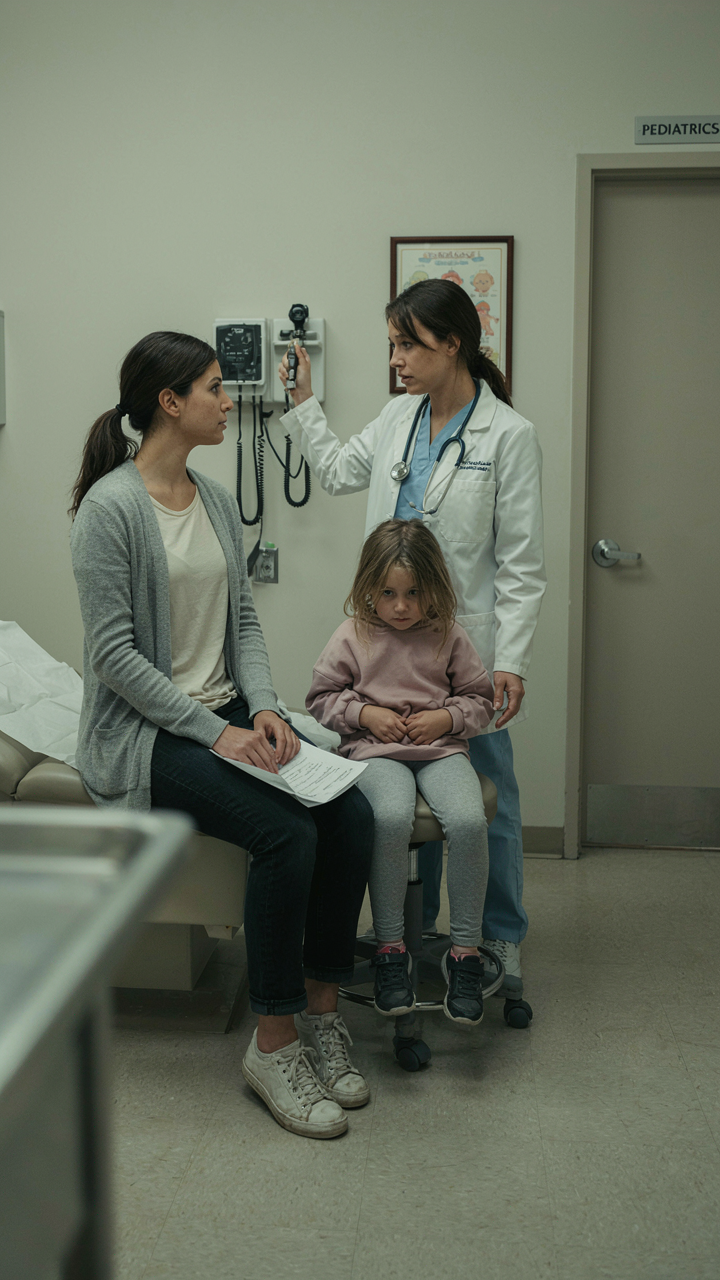
The Doctor Stopped Examining My Daughter When She Grabbed My Wrist—Then She Reached for the Phone
The next afternoon, I signed my daughter out of school without telling my husband and drove her straight to the hospital.
I knew Robert would be furious.
But I was more afraid of what might happen if I kept listening to him.
For nearly a month, my fourteen-year-old daughter, Maya, had been losing weight, skipping meals, getting dizzy, and clutching her lower stomach whenever she thought nobody was watching.
Every time I asked her what was wrong, she gave me the same answer.
“I’m fine, Mom.”
But she wasn’t.
Her jeans had become loose around her waist. Her once-bright eyes looked tired, and she had started wearing oversized sweatshirts even when the house was warm.
At dinner, she’d push food around her plate until Robert finally snapped.
“Stop being dramatic, Maya. You’re not going to starve yourself in this house just to get attention.”
She would lower her head.
And I would sit there, feeling something inside me twist.
I was her mother. I should have protected her.
But Robert had a way of making every concern sound ridiculous.
When I suggested taking Maya to the doctor, he laughed.
“She’s fourteen. Girls her age get emotional. It’s probably hormones.”
When Maya nearly fainted in the kitchen, he accused her of deliberately skipping breakfast.
When the school nurse called and said Maya needed a medical evaluation, Robert told me the school was interfering in our parenting.
“Don’t let them turn her into a sick child,” he warned.
I wanted to believe him.
Robert was my husband of eleven years. He was confident, successful, and charming whenever other people were around.
Our neighbors adored him.
Maya’s teachers described him as involved.
But at home, his temper could change the atmosphere of an entire room.
And lately, Maya had become terrified of making him angry.
I just hadn’t understood why.
Not yet.
That afternoon, when the doctor pressed gently against Maya’s abdomen, my daughter suddenly sucked in a sharp breath and grabbed my wrist.
“Mom.”
Her fingers were ice-cold.
The doctor immediately stopped.
“Don’t move, sweetheart,” she said softly.
Then she pulled her stool closer, examined Maya’s face, and looked at me.
Something in her expression changed.
She reached for the phone on the wall.
“Mrs. Bennett,” she said quietly, “I need to ask you something. And I need you to answer honestly.”
My heart started pounding.
“Of course.”
“Has Maya told you that she’s afraid to go home?”
I stared at her.
“What?”
The doctor didn’t look away.
“Has anyone at home threatened her, hurt her, or prevented her from getting medical care?”
Maya’s grip tightened around my wrist.
And then, for the first time in weeks, my daughter began to cry.
Not the quiet tears of a girl embarrassed in front of a doctor.
These were the desperate, shaking sobs of someone who had been holding something terrible inside for far too long.
“Mom,” she whispered, “please don’t let him take me home.”
My entire body went cold.
“Who, Maya?”
She looked at the door.
“Robert.”
And suddenly, every strange thing that had happened during the previous month began to look different.
The unfinished dinners.
The locked bathroom door.
The way she’d flinch whenever his footsteps approached.
The mysterious bruises she’d hidden beneath her sleeves.
I opened my mouth to ask what she’d done to deserve any of it.
Then I realized how horrifying that question would sound.
Because my daughter hadn’t done anything.
She was frightened.
And I had been too busy trying to keep the peace to understand what she was trying to tell me.
The doctor picked up the phone.
“Please stay with your daughter,” she told me. “I’m contacting our hospital’s safeguarding team. We’re going to make sure she’s safe before we discuss anything else.”
Maya buried her face against my shoulder.
And I held her as tightly as I could.
But the worst part wasn’t what the doctor said next.
It was what Maya whispered into my ear while we waited.
“Mom, he told me that if I ever told you, he’d make sure you lost me forever.”
1. The Secret She Had Been Carrying
For several seconds, I couldn’t speak.
“What do you mean, he’d make me lose you?”
Maya shook her head violently.
“Please don’t make me say it.”
I looked at the doctor, who had moved closer to the door and was speaking quietly to another member of the hospital staff.
Then I looked back at my daughter.
“Sweetheart, you’re not in trouble. Nobody is going to punish you for telling the truth.”
She wiped her cheeks with the back of her hand.
“You promise?”
“I promise.”
She stared at me as if she wanted to believe me but couldn’t afford to.
Then she whispered, “He said he’d tell everyone I was crazy. He said he’d have you committed if you believed me. And he’d tell the judge you were a terrible mother.”
My stomach dropped.
“Why would he say that?”
Maya looked down at her hands.
“Because I found something.”
“What did you find?”
She hesitated.
Then she told me about the previous month.
It had started on a Tuesday evening when Robert asked her to bring his laptop from his home office.
She’d opened the door and noticed a folder sitting on the desk.
Her name was written on it.
MAYA — SCHOOL AND MEDICAL.
She thought it might contain her school records.
But when she opened it, she found printed emails, photographs, and documents she didn’t understand.
There were notes about her behavior.
Dates when she’d cried.
Times she’d argued with Robert.
And a list of things he intended to discuss with her pediatrician.
“He wrote that I was unstable,” Maya whispered. “He said I was becoming manipulative and that I was lying about things.”
I felt sick.
“What things?”
“That he scares me. That he gets angry. That I don’t feel safe when you’re not home.”
She swallowed.
“Then I saw an email from someone at his office. They were talking about how he could get you to agree that I needed treatment.”
I stared at her.
Robert worked in corporate management. He was used to dealing with contracts, lawyers, and difficult negotiations.
But this?
This was my daughter.
And he had apparently been documenting her distress as if it were evidence against her.
Maya continued.
“I didn’t know what to do. I thought maybe I misunderstood. But then he came in.”
“What happened?”
“He got really angry.”
Her voice became smaller.
“He asked why I was looking through his things. I told him I was just trying to find the school papers.”
She paused.
“He said I was a little liar.”
My hands curled into fists.
“He grabbed my arm and told me that if I ever mentioned the folder, he’d make sure nobody believed me.”
“Did he hurt you?”
Maya didn’t answer immediately.
Then she slowly pushed up the sleeve of her hospital gown.
There were faint yellowish marks near her wrist.
I had seen bruises like those before.
I had asked her about them.
And she had said she’d bumped into the kitchen counter.
I had accepted the explanation because it was easier than questioning the man I had married.
“How long has this been happening?” I whispered.
Maya began crying again.
“I don’t know.”
That answer hurt more than anything else.
Because it meant she’d stopped counting.
The doctor returned with another woman, who introduced herself as a hospital social worker.
Her name was Karen.
She spoke gently to Maya and explained that they would ask questions, but nobody expected her to tell everything at once.
Karen also explained that the hospital needed to follow safeguarding procedures because Maya was a minor and had described feeling unsafe at home.
I nodded, barely hearing her.
Then Karen asked whether Robert had access to Maya’s school records, medical information, or phone.
Maya looked at me.
“He checks everything.”
Even her phone?
She nodded.
“He reads my messages. He says I’m too young to have secrets.”
I remembered the night Maya had asked me to change her phone password.
Robert had laughed when I suggested it.
“Why does she need privacy from her own parents?”
And I had laughed, too.
I felt ashamed.
Karen asked if Maya had somewhere safe to stay that evening.
I opened my mouth.
But before I could answer, my phone began ringing.
Robert.
2. The Phone Call That Changed Everything
I stared at his name on the screen.
Maya immediately grabbed my hand.
“Don’t answer.”
The phone kept ringing.
Karen watched me carefully.
“Would you like us to help you handle the call?”
I nodded.
She suggested I avoid discussing Maya’s disclosures or making promises about what would happen next.
I stepped into the hallway, keeping the exam-room door open.
Then I answered.
“Where are you?”
Robert’s voice was sharp.
“At the hospital.”
“Why?”
“Maya wasn’t feeling well.”
There was a brief silence.
Then he laughed.
“You’re kidding me.”
“No.”
“Did you take her to the emergency department because she had a stomachache?”
“The doctor is examining her.”
“Put her on the phone.”
“She’s with the medical team.”
“Put. Her. On. The. Phone.”
I felt my pulse pounding in my ears.
“Robert, she’s being evaluated. Let the doctors do their job.”
His voice suddenly became quiet.
That was always worse.
“Listen carefully. I know what’s going on here.”
I gripped the phone.
“What?”
“She’s playing you. She’s been doing this for weeks. She’s trying to turn you against me.”
I closed my eyes.
For the first time, I could hear exactly what he was doing.
He wasn’t asking whether his daughter was okay.
He was worried about what she might say.
“Robert, the doctor needs to speak with us.”
“Fine. Give me the doctor’s number.”
“I’ll let them contact you.”
His breathing changed.
“You’re making a serious mistake.”
Then he hung up.
I stood in the hallway for several seconds, staring at my phone.
When I returned to the room, Maya was watching my face.
“What did he say?”
I sat beside her.
“He wants to talk to the doctor.”
She began shaking.
“He’ll come here.”
Karen stepped forward.
“We can discuss visitor restrictions with the care team. Maya’s safety is our priority.”
I looked at her.
“Can he take her home?”
Karen explained that the hospital would follow the applicable safeguarding and legal procedures. They would assess the immediate risks and coordinate with the appropriate authorities before making a discharge plan.
Then she asked me a question I wasn’t prepared for.
“Mrs. Bennett, do you feel safe returning home with your husband?”
I opened my mouth.
Nothing came out.
Because suddenly I understood that the question wasn’t only about Maya.
It was about me, too.
Robert had never hit me.
At least, not in the way people usually meant when they asked that question.
But he had punched walls.
He had thrown objects.
He had blocked doorways during arguments.
He had once taken my car keys because he said I was too emotional to drive.
And whenever I challenged him, he would remind me that he paid most of the bills.
I had called it marriage.
I had called it stress.
I had called it a difficult personality.
But sitting in that hospital room, watching my daughter tremble at the sound of a hallway door opening, I finally recognized the pattern.
“Honestly?” I whispered.
Karen nodded.
“I’m afraid of what he’ll do when he realizes I believe her.”
Maya started crying again.
I took her hand.
“But I’m more afraid of what will happen if I don’t.”
3. The Truth Behind Her Stomach Pain
The medical examination continued.
The doctor ordered blood tests, imaging, and additional evaluations because Maya had lost weight, experienced dizziness, and complained of persistent abdominal pain.
I sat beside her throughout the process.
She kept looking at the door.
Every time someone entered, her shoulders tightened.
Finally, the doctor returned with the results available at that point.
She explained that Maya was dehydrated and had lost a concerning amount of weight.
Her symptoms needed continued medical investigation.
The doctor also said that stress could affect appetite and physical well-being, but nobody should assume that stress explained everything before completing the evaluation.
Then she looked directly at me.
“Her pain is real. Her weight loss is real. And she needs proper follow-up.”
I nodded.
“Of course.”
The doctor paused.
“There’s something else I’d like to discuss privately.”
My stomach tightened.
Maya looked frightened.
“Is it bad?”
“We’re not finished evaluating you,” the doctor said gently. “But you haven’t done anything wrong.”
She explained that Maya’s description of her home life, together with her symptoms and the marks she’d shown us, required a careful safeguarding assessment.
The hospital would document her statements and any relevant examination findings.
They would also coordinate with trained professionals rather than expect Maya to repeat her story unnecessarily.
I asked whether she needed to stay overnight.
The doctor said that decision would depend on her medical needs and the safety assessment.
Then Maya suddenly spoke.
“Can I tell you something else?”
The doctor pulled her chair closer.
“Of course.”
Maya looked at me.
“Please don’t get mad.”
“I won’t.”
“Robert makes me eat things even when I feel sick.”
I frowned.
“What things?”
“Whatever he says I have to finish.”
She explained that when she started feeling nauseated, Robert accused her of being difficult.
He would stand over her at the table and insist she finish everything.
If she couldn’t, he’d accuse her of disrespecting him.
Sometimes he would keep her sitting there long after everyone else had finished.
Other times, he’d tell her she wasn’t allowed to leave until she apologized.
“That’s why I started skipping meals,” she whispered. “I thought if I didn’t eat in front of him, he couldn’t make me.”
My heart broke.
She hadn’t been trying to get attention.
She’d been trying to avoid another confrontation.
“And the dizziness?”
“I was afraid he’d get angry if I asked you to take me to the doctor.”
I stared at her.
“You could always ask me.”
She looked at me with an expression I would never forget.
“Mom, you always told me not to make things harder for you.”
The words landed like a physical blow.
I remembered saying them.
Not exactly like that, perhaps.
But close enough.
When Robert and I argued, I’d often tell Maya to be patient.
When Robert criticized her, I’d ask her to ignore him.
When she cried, I’d tell her that he was under pressure at work.
I’d thought I was protecting her from conflict.
Instead, I’d taught her to endure it quietly.
“I’m sorry,” I whispered.
Maya looked away.
“I thought you wouldn’t believe me.”
I moved closer.
“You should never have had to prove that you were frightened before I listened.”
4. Robert Arrived at the Hospital
At 6:18 p.m., my phone lit up with a message.
ROBERT: I’m downstairs. Bring Maya out.
A second message followed.
ROBERT: We are not doing this ridiculous performance in front of strangers.
Then another.
ROBERT: If you don’t come down in five minutes, I’m calling my attorney.
I showed Karen.
She immediately notified the appropriate hospital staff.
Maya had gone completely silent.
“Is he here?” she whispered.
“Yes.”
Her breathing became rapid.
“Mom, please don’t let him see me.”
I put my arms around her.
“He won’t come in here without the hospital knowing.”
But I didn’t know whether that was true.
I didn’t know what Robert would do.
And that uncertainty frightened me almost as much as his anger.
A few minutes later, someone knocked.
A hospital security officer stood in the doorway.
“Mrs. Bennett? Your husband is asking to speak with you.”
I looked at Maya.
She shook her head.
Karen suggested that if I chose to speak with him, I should do so away from Maya and with hospital staff aware of the situation.
I agreed.
In the hallway, I saw Robert standing beside the nurses’ station.
He wore his charcoal business suit, the one he always wore when he wanted to look particularly respectable.
His hair was perfectly combed.
His expression was controlled.
To anyone passing by, he looked like a concerned father waiting for news about his sick child.
Then he saw me.
“What the hell are you doing?”
I kept my voice low.
“She’s being evaluated.”
“By whom?”
“Her doctor.”
“Why didn’t you call me?”
“Because I needed to get her medical attention.”
His jaw tightened.
“Don’t give me that nonsense.”
He stepped closer.
“Did she tell you something?”
I didn’t answer.
His eyes narrowed.
“She did, didn’t she?”
I felt my hands trembling.
Robert glanced toward the exam-room door.
“What did she say?”
“She’s frightened.”
He actually smiled.
“Of me?”
I didn’t respond.
He shook his head.
“Unbelievable. She’s been manipulating you for weeks, and now you’re participating.”
I looked at him.
“She has been sick for almost a month.”
“Because she’s refusing to eat.”
“She says she’s afraid to eat in front of you.”
His expression changed.
Only for a second.
But I saw it.
Then he laughed.
“That’s absurd.”
“She says you threatened her.”
“Children say all kinds of things when they don’t get their way.”
“She showed the doctor bruises.”
His smile disappeared.
“What bruises?”
“On her wrist.”
He stared at me.
Then he lowered his voice.
“Listen to me. You have absolutely no idea what you’re doing.”
For eleven years, that sentence had been enough to make me question myself.
Not that time.
“Maybe I don’t,” I said. “But I know my daughter is scared.”
Robert looked toward the nurses’ station.
Then he leaned closer.
“You have one chance to fix this before you destroy our family.”
I stepped back.
“Our family isn’t being destroyed because I took our daughter to the hospital.”
His face hardened.
“You’re choosing her over me.”
I stared at him.
And for the first time, I understood how he saw the world.
Not as a family where everyone deserved to feel safe.
But as a place where everyone was supposed to obey him.
I looked him in the eye.
“I’m choosing to protect my child.”
His expression became frighteningly still.
Then he said something that made my blood run cold.
“Fine. Let’s see how long you can afford to keep playing the hero.”
He turned and walked away.
I watched him disappear around the corner.
Then I returned to Maya’s room.
She looked at me immediately.
“Did he say I was lying?”
I sat beside her.
“He said a lot of things.”
“Are you going to believe him?”
I took both her hands.
“No.”
And this time, I meant it.
5. The Folder in His Office
That evening, Karen helped us begin making a plan for the next steps.
The hospital was documenting Maya’s disclosures and coordinating with the appropriate child-protection professionals.
I also spoke with a staff member about preserving any relevant messages and records without putting Maya at further risk.
Then I remembered the folder.
The one Maya had found in Robert’s office.
“She mentioned documents,” I told Karen. “A folder with her name on it.”
Karen advised me not to confront Robert about it or attempt to obtain anything in a way that might create additional danger.
But I couldn’t stop thinking about it.
What had he been planning?
Why had he collected those records?
And who had he been communicating with?
Maya was resting when I finally sat down beside her bed.
“Sweetheart, do you remember anything else about that folder?”
She nodded.
“There was a paper with a date on it.”
“What date?”
“Next Friday.”
My stomach tightened.
“What was happening next Friday?”
She hesitated.
Then she said, “I think he was planning to take me somewhere.”
“Where?”
“I don’t know.”
She explained that she’d seen a printed email mentioning a residential program.
There had been references to an assessment, an admission process, and a recommendation letter.
She hadn’t understood everything.
But she’d recognized one sentence.
The mother is likely to agree once the behavior becomes difficult enough.
I felt a chill travel down my spine.
“Did you see who wrote it?”
Maya shook her head.
“Not clearly.”
“Did Robert tell you anything about it?”
She nodded slowly.
“He said I needed to learn that actions have consequences.”
I swallowed.
“Did he say he was going to send you away?”
“He said I would thank him later.”
I held her hand.
“Why didn’t you tell me?”
She looked at me.
“Because he said you already agreed.”
The room seemed to tilt.
Robert had told her I wanted her to leave?
Maya nodded.
“He said you were tired of dealing with me. He said you wanted a normal family again.”
I closed my eyes.
For weeks, my daughter had believed that her own mother was preparing to abandon her.
And Robert had used that fear to keep her silent.
I leaned forward and pressed my forehead against her hand.
“I’m so sorry.”
She stroked my hair awkwardly.
“It’s okay, Mom.”
“No, it isn’t.”
I lifted my head.
“You don’t have to forgive me tonight. You don’t have to make me feel better. We’re going to focus on you.”
She stared at me for a long time.
Then she asked the question that mattered most.
“Are you going to stay with me?”
I kissed her forehead.
“Yes.”
“Even if Robert gets angry?”
“Yes.”
“Even if he says I’m lying?”
“Yes.”
“Even if he tries to make you choose?”
I squeezed her hand.
“Especially then.”
6. The Evidence He Didn’t Expect
The following morning, a child-protection professional met with Maya in a quiet room.
I wasn’t present for the interview.
The team explained that trained professionals needed to hear her account directly and without pressure.
I waited outside.
Every minute felt like an hour.
When the interview ended, Maya looked exhausted.
But she also seemed lighter.
As if she’d finally put down a burden she’d been carrying alone.
The safeguarding team continued its assessment and discussed the next steps with us.
Meanwhile, I contacted my sister, Elena.
I hadn’t told her much about the problems in my marriage.
Robert had always insisted that family disagreements should remain private.
But Elena had noticed things.
She’d once asked why Maya seemed so nervous around him.
I’d told her she was being oversensitive.
Now I called her and told her everything.
She was silent for a long moment.
Then she said, “Bring Maya here if the professionals say it’s safe and appropriate. You can both stay with me.”
I started crying.
“Thank you.”
“Don’t thank me. Just make sure she’s protected.”
Later that afternoon, I remembered something else.
Six months earlier, Robert had asked me to sign several documents.
He’d said they were routine forms related to school administration and medical consent.
I had been busy preparing dinner and had barely read them.
One document had mentioned an assessment.
I remembered asking him about it.
He’d said it was a precaution.
At the time, I hadn’t thought much about it.
Now I was terrified of what I’d signed.
I contacted an attorney who specialized in family matters and explained the situation.
She advised me to obtain copies of the documents and review them carefully.
She also told me not to assume that any one form automatically gave Robert authority to make every decision about Maya.
The actual legal position would depend on the documents, applicable law, and the circumstances.
I agreed to send her copies as soon as I could obtain them safely.
That evening, Robert emailed me.
The subject line read:
URGENT — FAMILY MATTER.
His message was short.
You have made a serious error in judgment.
I have spoken with my attorney.
You are interfering with my relationship with my daughter and encouraging false accusations.
I expect you to cooperate immediately.
Then came the final sentence.
You should also understand that I have records documenting your own emotional instability.
I read that sentence three times.
Then I forwarded the email to my attorney.
For the first time, Robert’s threats weren’t making me panic.
They were becoming part of a record.
And I was beginning to understand that the truth didn’t need to be delivered in a shouting match.
Sometimes it needed to be documented, protected, and presented to the right people.
7. The Night Maya Finally Told Me Everything
Two days later, Maya was medically stable enough for the team to discuss a safe discharge plan.
Her evaluation wasn’t finished, and she would need follow-up care.
But she was no longer facing the immediate uncertainty of going straight back into the environment she’d described.
The professionals involved helped coordinate a temporary arrangement with my sister while the safeguarding and legal questions were addressed.
Before we left, Maya asked whether she could speak to me alone.
We sat together beside the hospital window.
Outside, the afternoon sun reflected off the neighboring buildings.
She looked at me.
“Mom, can I tell you what happened the first time he grabbed me?”
My heart sank.
“Yes, sweetheart.”
She took a deep breath.
“It was after you went to visit Grandma.”
I remembered that weekend.
Robert had told me Maya was being difficult and needed to learn some discipline.
Maya explained that she’d refused to eat dinner because she felt nauseated.
Robert accused her of embarrassing him.
When she tried to leave the table, he grabbed her wrist.
She pulled away.
He told her never to walk away while he was speaking.
Then he’d threatened to tell me she was becoming dangerous and needed professional help.
“After that,” she whispered, “I tried to be good.”
She’d stopped arguing.
Stopped asking questions.
Stopped telling me when she was uncomfortable.
She’d even stopped inviting friends over because she was afraid Robert might become angry.
And every time he raised his voice, she’d wonder whether she’d done something wrong.
I couldn’t bear hearing it.
But I knew she needed to be heard.
“I’m sorry,” I whispered.
Maya looked down.
“Sometimes I thought you knew.”
That sentence nearly broke me.
“Why?”
“Because you always told me to apologize to him.”
I nodded slowly.
She was right.
I had repeatedly asked her to smooth things over.
I had taught her that keeping the house peaceful was more important than expressing how she felt.
I had confused silence with safety.
I took her hands.
“I can’t change what happened before today.”
She looked at me.
“But I can make different choices now.”
She didn’t answer.
Then she leaned against my shoulder.
And for the first time in weeks, she fell asleep without watching the door.
8. Robert’s Last Attempt
A week later, Robert requested a meeting.
My attorney advised me not to meet him alone.
We arranged communication through appropriate professional channels instead.
Robert sent another email.
This one was longer.
He accused me of turning Maya against him.
He claimed her symptoms were caused by teenage rebellion.
He insisted that the hospital had overreacted.
And he described himself as the victim of a family conspiracy.
But there was one sentence that stood out.
I have always been the only person willing to make the difficult decisions for this family.
I read it twice.
Then I looked at the photograph on Elena’s kitchen table.
Maya was sitting beside her aunt, eating toast and laughing at something on television.
Her face still looked tired.
But she was smiling.
I thought about the first time Robert had called her manipulative.
The first time he’d dismissed her pain.
The first time I’d told her to stop making things difficult.
And I realized that Robert’s greatest advantage had never been his money, his confidence, or his ability to intimidate people.
It had been my willingness to doubt myself.
That was changing.
My attorney helped me understand the available legal options and the importance of keeping communications factual and preserving relevant records.
The safeguarding professionals continued their work.
And I stopped trying to persuade Robert to understand why his behavior had frightened his daughter.
My responsibility wasn’t to win an argument with him.
It was to protect Maya and cooperate with the people handling her case.
That distinction changed everything.
9. The Photograph on the Refrigerator
Three weeks later, Maya was eating breakfast at Elena’s kitchen table.
Not a perfect breakfast.
Not a huge one.
Just toast, fruit, and a glass of water.
But she was eating because she wanted to.
Nobody was standing over her.
Nobody was criticizing the way she held her fork.
Nobody was threatening to punish her if she couldn’t finish.
When she was done, she carried her plate to the sink.
Then she stopped.
“Mom?”
“Yes?”
“Can I have something else?”
I smiled.
“Of course.”
She opened the refrigerator and looked inside.
Then she laughed.
It was such a small sound.
But I hadn’t heard it in so long that I nearly cried.
Later that afternoon, she asked me to help her print a photograph.
It was a picture of the two of us at the beach when she was eight.
Her hair was tangled from the wind.
My sunglasses were crooked.
We were both laughing.
She handed me the photograph.
“Can we put this somewhere?”
“Where would you like it?”
“On the refrigerator.”
I found a magnet and attached it to the door.
Maya stood beside me, looking at the picture.
Then she said something I’ll never forget.
“That’s what I want to feel like again.”
I wrapped my arms around her.
“We’ll take it one day at a time.”
She nodded.
And for once, she didn’t look afraid of what tomorrow might bring.
10. The Truth I Finally Understood
Months passed.
The medical follow-up continued.
Maya began working with appropriate professionals to address what she’d experienced.
The legal and safeguarding processes took time, and there were difficult conversations I couldn’t avoid.
Robert continued to dispute the allegations.
I couldn’t control what he said.
I couldn’t control how quickly the authorities or courts would reach decisions.
But I could control what I did next.
I could listen when Maya spoke.
I could take her symptoms seriously.
I could stop treating fear as a personality problem.
And I could refuse to make her responsible for maintaining peace between adults.
One evening, Maya and I sat together on Elena’s porch.
The sky was turning orange.
She was doing homework while I drank tea.
Suddenly, she put down her pencil.
“Mom?”
“Yes?”
“Do you think I was stupid for not telling you sooner?”
I felt my throat tighten.
“No.”
“Even though it went on for so long?”
“Especially then.”
She looked at me.
“Why?”
I took a deep breath.
“Because you were a child trying to survive a situation you didn’t know how to handle. You shouldn’t have had to figure everything out by yourself.”
She was quiet.
Then she asked, “Do you think you’ll ever trust yourself again?”
I stared at the sunset.
For a long time, I’d believed that being a good wife meant keeping my marriage together.
I’d believed that being a good mother meant keeping my child out of trouble.
I’d believed that a peaceful home was one where nobody argued.
But I had been measuring the wrong things.
A peaceful home isn’t one where a child is too frightened to speak.
A loving family isn’t one where someone has to earn the right to feel safe.
And protecting a marriage should never require sacrificing a child’s well-being.
“I think,” I told her, “I’m learning.”
Maya smiled faintly.
Then she returned to her homework.
A few minutes later, she reached across the table and took my hand.
I held it.
And I thought about that afternoon in the hospital.
The crackling paper beneath her.
The doctor’s tightened expression.
The sudden silence.
And the moment Maya grabbed my wrist and begged me not to let Robert take her home.
I had driven to the hospital because I thought my daughter might have a medical problem.
I hadn’t realized she was also asking me to recognize the danger she’d been living with.
The doctor had reached for the phone because she understood that this was bigger than an ordinary examination.
And that call had forced me to confront something I’d spent years avoiding.
Sometimes the most important thing a parent can do isn’t to have all the answers.
It’s to recognize when a child is asking for help.
And when Maya finally found the courage to tell me the truth, the question wasn’t whether I could prove every detail that very moment.
The question was whether I would listen, take her seriously, and act to keep her safe.
This time, I did.
And when she squeezed my hand that evening, I knew something had begun to heal.
Not everything.
Not all at once.
But enough for us to take the next step together.