My name’s Jacob. I’m 29. And last year, my life changed when my parents passed away and left me their ranch, 80 acres of rolling hills, stables, and a house that had been in our family for three generations.
To most people, it was just a property worth about $1.2 million. But to me, it was the last piece of my parents that I could hold on to.
I grew up here. I learned to ride horses before I could even ride a bike. I still remember the sound of my dad’s boots on the wooden porch in the early mornings and the way my mom used to stand at the kitchen window looking out at the pasture like she could see the future in it.
I wasn’t prepared for how complicated things would get after the funeral.
At first, my sister Clare acted like she was supportive, hugging me, crying with me, telling me we’d get through this together. But Clare and I have always been different. She’s 3 years older, a lawyer, and used to getting her way.
She moved out years ago and has lived in the city ever since, barely coming around unless there was a holiday or a reason to take Instagram pictures with the horses.
I stayed behind, working the land with dad and helping keep the place running.
When the wheel was red and the ranch was left entirely to me, Clare congratulated me through a tight smile that didn’t quite reach her eyes.
At first, I thought I was imagining it. Maybe it was just grief making everything feel heavier, but little comments started to slip out.
She’d joke about how much money the place must be worth or how lucky I was to get the golden ticket.
Once over dinner at my aunt’s house, she leaned back in her chair and said, “I mean, it’s only fair. Jacob needs a place to stay after all.”
Everyone laughed except me.
I tried to let it slide. I told myself she was just coping in her own way. That grief makes people weird.
But then she started dropping by the ranch more often.
At first, she’d come unannounced and just check in. Then she began making suggestions, rearranging furniture, saying which rooms could be repurposed, hinting that I could rent the place out to make more money.
One day, she showed up with her fiance and casually mentioned where they’d put the nursery if they ever moved in.
I laughed it off, but something about the way she said it made my stomach twist.
That night, I sat in dad’s old chair on the porch, the crickets buzzing in the dark, and thought about how fast things were shifting.
The ranch felt less like a home and more like a chessboard with pieces slowly moving into place, and I wasn’t sure I liked where they were heading.
Two weeks later, Clare came over with papers in hand and that same tight smile.
“Just some routine estate stuff,” she said, sliding them across the kitchen table.
I picked them up and immediately noticed the language: transfer agreements, title adjustments.
My gut told me this was more than routine.
I didn’t sign a single thing.
Instead, that night, I stayed up until 3:00 a.m. researching, calling a friend who works in real estate law.
And by the end of the week, I had quietly transferred the entire ranch into an LLC under my name.
It wasn’t something I ever thought I’d have to do to protect what my parents left me, but something told me I’d be glad I did.
I didn’t have to wait long.
A month later, Clare walked in with a smug look and a man in a suit, her lawyer.
She didn’t even say hello before announcing, “The deed is in my name now. Pack your bags.”
I just leaned back in dad’s chair and smiled.
“Good luck with that,” I said.
Her eyes narrowed, but she said nothing.
2 days later, she came back, this time with movers.
But the second they saw who was standing at the gate with a stack of legal papers, her smile vanished.
Clare didn’t say a word that day when she saw the legal papers, not in front of her movers anyway. She just turned on her heel, snapped her fingers for them to follow, and left without looking back.
But I could feel it.
This wasn’t over.
If anything, that moment just lit a fire in her.
The next week was quiet. Too quiet.
No surprise dropins, no texts, no fake cheerful phone calls.
I tried to enjoy the silence, but the whole time I felt like a man standing on a train track, waiting for the distant rumble to turn into a headlight.
It didn’t take long.
The first sign was the mailbox.
One morning, I went out to grab the mail and found an envelope addressed to tenant.
Inside was a notice from a property management company informing me that the owner had decided to raise the rent by 60% effective immediately.
There was no rent to raise.
I own the place outright, but the message was clear.
Clare was playing a different kind of game now. One where she thought intimidation would get me to fold.
I called the number on the notice and sure enough, Clare answered.
Not the property manager, Clare.
“Just a misunderstanding,” she said sweetly.
But her tone was mocking.
“But you might want to start thinking about your options, Jake. It’s not really sustainable for you to keep this whole place up on your own, is it?”
I hung up without replying.
I could practically hear her smirk through the phone and it burned.
Then came the visits.
She started coming by with her fianceé, walking around the property without asking, taking photos like they were planning a renovation.
Once I caught them measuring the kitchen counters.
When I confronted her, she acted innocent.
“Oh, relax,” she said, flipping her perfectly straight hair over her shoulder. “We were just curious. It’s not like we’re hurting anything.”
I wanted to yell.
I wanted to tell her to stay off my land, but part of me was afraid that giving her that satisfaction, letting her see she was getting under my skin, would make things worse.
Instead, I started keeping a journal.
Not because I wanted to vent, but because I knew I needed a paper trail, dates, times, every little thing she did or said.
My friend in real estate law told me to stay calm and document everything.
“You don’t win these fights by screaming louder,” he said. “You win by being smarter.”
Still, it was exhausting.
One Saturday, I was out fixing the fence near the back pasture when I heard voices.
Claire’s SUV was parked near the barn, and she was standing with two men in suits.
I stayed out of sight, listening.
“Once we get this signed over, we can flip it for triple,” she was saying. “It’s just a matter of forcing him to comply.”
Flip it like the ranch was just a house. She could paint white and sell to the highest bidder.
That night, I sat on the porch and stared out at the hills.
I could feel anger buzzing under my skin like static.
This place wasn’t just dirt and wood.
It was my childhood. My parents’ sweat and love poured into every fence post, every tree they planted, and Clare wanted to cash it out like a stock.
Things got worse at Thanksgiving.
We all went to Aunt Linda’s house, and Clare made sure everyone knew she’d soon be making some big changes on the ranch.
She said it with this little smirk, like she already owned it.
My cousins congratulated her.
My uncle even raised a glass.
I sat there smiling tightly, my fork frozen halfway to my mouth.
After dinner, Clare cornered me in the hallway.
“You know, you’re making this a lot harder than it needs to be,” she said. “You could just sign everything over and be done with it. We’d even let you stay for now.”
I couldn’t help it.
I laughed.
Not a happy laugh, but a bitter one.
“You don’t get to let me do anything,” I said.
Her smile faltered just for a second.
Then she leaned in close.
“You think this LLC will protect you? You think you’re clever? Lawyers eat through things like that all the time. You’ll be out of there by spring.”
She left before I could answer.
That night, I couldn’t sleep.
I lay in bed listening to the wind rattle the windows and thinking about what she said.
Was she right?
Could she really tear through all the legal protections I put in place?
The next morning, I called my lawyer friend again.
He reassured me that I’d done everything by the book, but he also warned me that people like Clare could make life miserable in other ways.
“She can tie you up in court, drag things out for months,” he said. “She can make it expensive, make it stressful. Sometimes that’s all they want.”
And he was right.
Over the next month, I got hit with every nuisance tactic she could think of.
False complaints about unsafe conditions on the property, surprise visits from county inspectors, even a noise complaint after I mowed the field at 10:00 a.m.
She was relentless, and every time I thought maybe she’d back off, she found a new angle.
The final straw came in the middle of a stormy night.
I woke up to headlights in the driveway.
By the time I grabbed a flashlight and went outside, Claire’s fiance was standing by the porch with a clipboard.
“We’re serving notice,” he said flatly, holding out a stack of papers.
Rain was dripping off his jacket, and my boots were sinking into the mud as I took the papers from him.
He didn’t wait for me to respond, just turned and left.
Inside, I read every page carefully.
It wasn’t an eviction notice, not exactly, but it was clear she was trying to challenge my claim of ownership through some obscure legal loophole.
I sat at the kitchen table, the papers spread out in front of me, and felt something shift inside me.
I wasn’t scared anymore.
I wasn’t even angry.
Not in the same way.
I was just done.
Done waiting for her to stop.
Done hoping she’d come to her senses.
Done playing defense.
And that’s when I started thinking about what I could do, really do, to end this once and for all.
The notice sat on my kitchen table for days, each page daring me to panic.
I didn’t.
I spent that week quietly meeting with my lawyer friend, gathering every bit of paperwork, the LLC filings, the property deed, every receipt showing that I’d been maintaining the land since dad died.
We built a case so airtight it felt bulletproof.
I felt calmer than I had in months, but also more focused.
Then Clare made her move.
It was a Tuesday afternoon, gray skies and a steady drizzle.
I was out by the stables feeding the horses when I heard the sound of an engine.
Not just one, but several.
When I walked up toward the house, I saw them.
Two moving trucks and three cars pulling into the driveway.
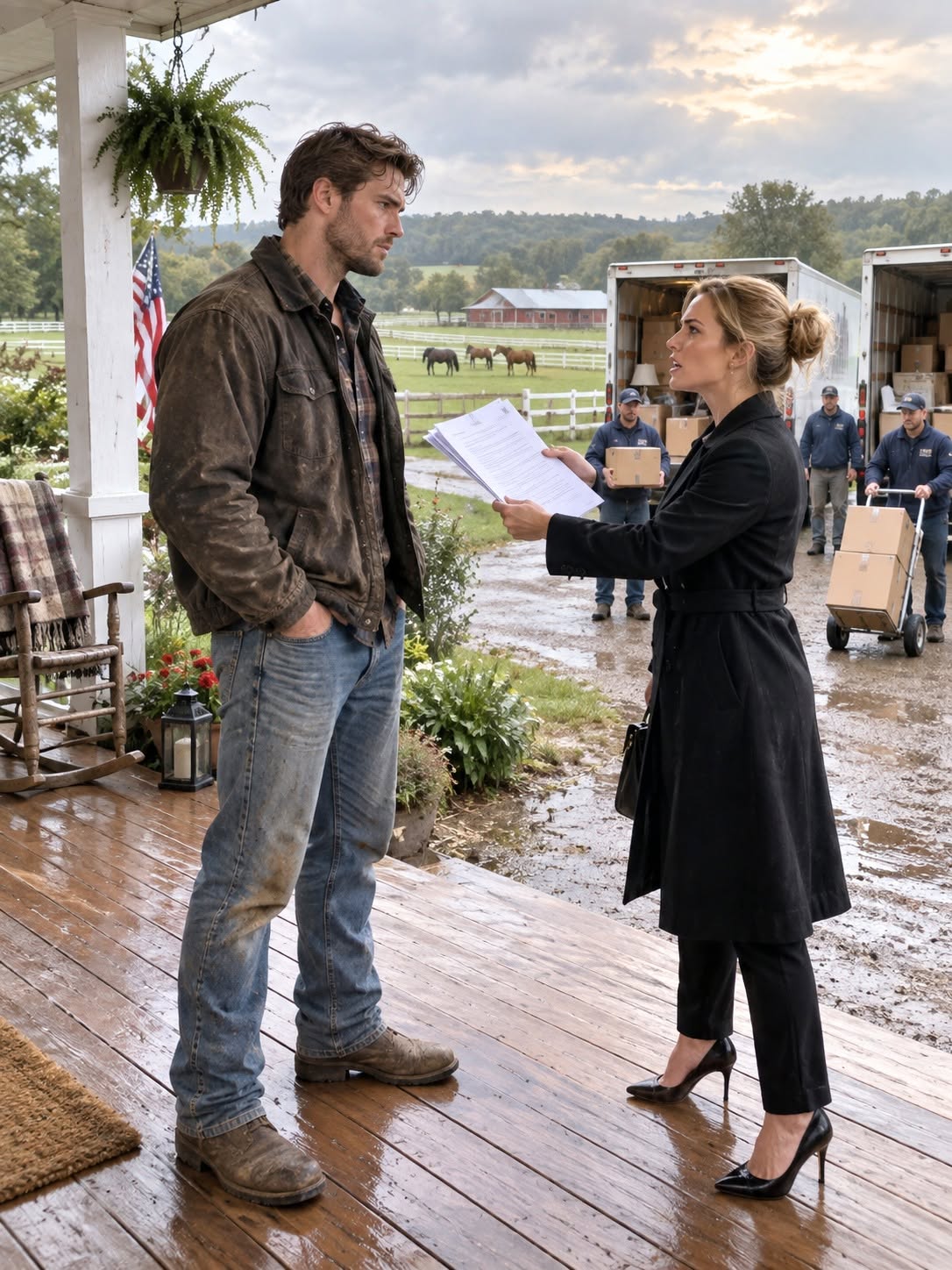
Clare was in the lead car, stepping out in a sharp black coat, holding an umbrella like she was starring in some courtroom drama.
Her fiance trailed behind her, smirking.
“Jacob,” she called out, voice bright but edged like glass. “We’re here to get started.”
I froze.
“Started on what?”
She gestured to the trucks.
“Packing. Renovations begin next week. You should have your stuff out by then, but don’t worry, we’ll put the rest in storage for you.”
For a moment, I just stared at her, rain dripping down my hat brim.
“You’re not serious,” I said finally.
Clare’s smile widened.
“Perfectly serious. You’ve been dragging this out long enough. It’s time for this place to be put to better use.”
Behind her, the movers were already unloading dollies and boxes.
Something inside me snapped.
“Get them off my property,” I said, my voice low.
Her fianceé laughed.
“You don’t get to order anyone around, man. You’ve had your free ride. It’s over.”
I could feel my pulse pounding in my ears, but I didn’t yell.
Instead, I walked up the steps and blocked the porch.
“Nobody moves a thing until my lawyer sees this,” I said.
Clare rolled her eyes and pulled out a folder from her bag.
“You can call whatever lawyer you want,” she said, thrusting the papers toward me. “But this is already signed by the judge. The deed transfer went through. This property is legally mine.”
The words hit me like a physical blow.
I took the papers from her and scanned them right there on the porch, my fingers trembling.
Sure enough, they bore a court stamp, but I could tell immediately what she had done.
She had filed for a transfer claiming equal distribution of inheritance under a rarely used clause, arguing that keeping the entire ranch in my name was unfair.
The worst part, she hadn’t done this quietly.
As I flipped through the pages, I saw letters of support from several relatives, my uncle, a couple of cousins, all backing her claim that I was taking more than my fair share and excluding the family from its legacy.
I felt something hot rising in my throat.
These were the same people who had stood next to me at the funeral and told me how proud dad would have been that I was taking care of the ranch.
The same people who had eaten at my table and laughed with me while we watched sunsets from the porch.
And now they were signing letters behind my back, siding with Clare, acting like I was some kind of thief.
I looked up at her.
“You went behind my back. You went to everyone. You dragged our whole family into this.”
Clare tilted her head, unbothered.
“Of course I did. You weren’t listening. Someone had to be reasonable.”
I wanted to scream, to slam the papers down in the mud, but I didn’t.
I just stood there gripping them until the edges curled.
She stepped closer, lowering her voice.
“Here’s how this is going to go. You have until Friday to move your things out. After that, we changed the locks. I’ll be nice and let you keep the truck. You’ll get a check for your share once we sell. That’s more than generous.”
I don’t even remember what I said back.
Something sharp enough to make her shrug and turn away.
She snapped her fingers and the movers started up the steps until I planted myself in the doorway and told them they were trespassing on private property.
That was when Clare played her trump card.
She reached into her bag again, this time pulling out her phone, and hit play on a recording.
At first, I didn’t understand what I was hearing.
Then my own voice came through the speaker.
A recording from months ago when I’d been venting to my friend about how hard it was keeping the place running.
“Sometimes I think it’d be easier just to sell it all and walk away,” my voice said.
Clare looked at me with a victorious smile.
“See, even you said you don’t want it.”
I felt cold all over.
She had taken a private conversation, one moment of frustration, and twisted it into a weapon.
“You were recording me?” I asked, my voice barely a whisper.
“Of course,” she said lightly, as if it were obvious. “You never think things through, Jacob. Someone has to be prepared.”
That was it.
That was the moment the switch flipped in me.
It wasn’t just about the ranch anymore.
It wasn’t even about the money.
It was about betrayal.
Deep personal betrayal from the one person who was supposed to stand beside me as family.
I didn’t fight her that day.
I didn’t argue or plead.
I just stepped back inside, closed the door, and sat at the kitchen table staring at those court papers until the rain stopped.
I could hear the movers outside, frustrated, packing back into their trucks when Clare finally told them to go.
Her SUV drove away a few minutes later, gravel crunching under the tires.
The house felt too quiet when they were gone.
I walked through every room slowly, my boots echoing against the floorboards, and felt like I was saying goodbye to something.
Not the ranch, but to the idea that Clare and I could ever come back from this.
That night, I sat on the porch with dad’s old hat in my hands, turning it over and over.
I thought about everything.
The years I spent working beside him.
The promises he made that the ranch would always be mine.
The pride in his voice the day he added my name to the deed.
And now my own sister had thrown it all away like it was nothing.
Something in me hardened.
This wasn’t going to end with me packing boxes and cashing a pity check.
If Clare wanted a fight, she was going to get one, and she wouldn’t see it coming.
The next few days felt like moving through molasses.
I woke up before sunrise out of habit, but instead of feeling ready to tackle the day, I just sat at the kitchen table, staring out the window as the fog rolled over the hills.
The ranch looked exactly the same, but everything felt different.
I barely touched the coffee I brewed.
I barely ate.
The horses still needed to be fed.
The fence still needed to be fixed, but I went through the motions like a ghost.
My mind stuck on those court papers and Clare’s smug face on the porch.
I kept hearing that recording in my head, my own voice saying it would be easier to sell everything and walk away.
It had been a private moment, one I’d barely even meant, but now it was stamped into my brain like a confession.
I thought about Dad, how hard he had worked to keep this place going, and felt ashamed.
What if Clare was right?
What if I wasn’t strong enough to hold it all together?
A few relatives stopped by that week, not to check on me, but to see how I was handling things.
I could tell they were just fishing for drama.
My cousin Lydia actually had the nerve to pat my shoulder and say, “It’s probably for the best. You’ll be happier once you’re not tied down to this place.”
I didn’t reply.
I didn’t trust myself, too.
That night, after everyone left, I sat alone in the living room with the fire burning low and let myself finally feel it.
The anger, the hurt, the sense of betrayal so sharp it made my chest ache.
I thought about calling Clare, screaming at her, telling her exactly what I thought of her.
I thought about marching into the city, finding that judge, and demanding answers.
But I didn’t do any of that.
Instead, I got quiet.
It was strange.
Once I stopped fighting the storm in my head, I started thinking more clearly.
I pulled out my dad’s old ledger, the one where he kept every record of repairs, feed purchases, and property taxes for the last 20 years.
I flipped through the pages slowly, running my fingers over his careful handwriting.
There was something grounding about it, seeing proof of all the work that had gone into this land, proof that this place had never been a free ride.
I had been part of it for years.
I had earned it.
The next morning, I drove into town and met with my lawyer friend again.
We sat in his office for 3 hours going over every detail of Clare’s filing.
He was calm but honest with me.
Yes, she had gotten the transfer approved, but it wasn’t as airtight as she thought.
There were ways to challenge it, to delay it, maybe even to reverse it entirely if we played it smart.
“Jacob,” he said at one point, leaning back in his chair, “you have more leverage than you think. She’s counting on you to panic. Don’t give her that.”
I nodded, but I didn’t feel ready to fight just yet.
When I got back to the ranch, I didn’t go inside.
I walked the entire property line instead, boots crunching in the frost, hands shoved into my jacket pockets.
I checked every fence post, every gate, every path through the pasture.
It was something Dad used to do whenever he had a big decision to make.
“Walk the land,” he called it.
By the time I made it back to the house, the sun was setting and my fingers were numb.
But my head felt clearer.
That night, I went through every file in the house.
The will, the trust documents, the LLC paperwork.
I built a binder with everything I would need if this went to court.
It was slow, tedious work, but it gave me something I hadn’t felt since Clare showed up with those movers.
Control.
I also started reaching out quietly to people I trusted.
An old friend who works in accounting, another who knew someone in the county clerk’s office.
I didn’t tell them everything, just enough to get advice.
Piece by piece, I started understanding what Clare had really done and where the cracks were in her plan.
But even as I worked, I felt the weight of it all pressing down on me.
The house was too quiet at night.
The porch felt emptier without dad sitting beside me.
I caught myself looking at mom’s old rocking chair and wondering what she would say if she could see us now.
Her two kids tearing each other apart over the land she loved so much.
For the first time, I started thinking about what would happen if I just left.
If I packed my things, signed the buyout papers, and walked away from all of it.
One night, I even loaded my truck with a few boxes just to see what it would feel like.
I sat in the driver’s seat for a long time, staring at the headlights, casting beams across the yard.
But I couldn’t turn the key.
Instead, I unloaded everything, one box at a time, and put it all back exactly where it had been.
Walking back into the house that night, I realized something.
Clare had already taken so much from me.
She had taken my trust, my peace of mind, even my sense of family.
But she wasn’t going to take the one thing that still tied me to my parents.
That was the night I decided I wasn’t going to leave.
Not quietly, not on her terms.
I was going to stay.
And if she wanted this fight, I was going to give it to her, but not recklessly.
Not by yelling on the porch or throwing papers in the mud.
No, I was going to do it the way dad would have.
Steady, patient, and absolutely unshakable.
The next morning, I made a pot of coffee, sat at the table, and wrote down everything I knew about Clare’s plan, every move she’d made, every conversation we’d had.
Then, I started writing down my own plan.
It wasn’t revenge yet.
Not exactly.
It was survival.
But even as I wrote, I could feel something darker taking shape beneath the surface.
Clare thought she’d broken me.
She had no idea what she had just woken up.
The first morning after I decided to stay, the ranch felt different.
Not lighter exactly.
The weight was still there, but steadier, like the ground under my boots wasn’t shifting anymore.
I started with the small things, mending the fences properly, fixing that leaky section of the barn roof, clearing out the old tack room that had been cluttered since dad passed.
There was something healing about putting my hands on the land again.
Not just to keep it afloat, but to make it stronger.
It was slow work, but every day I crossed something off the list.
The knot in my chest loosened just a little.
I also started learning, really learning.
I spent evenings pouring over books and articles about land management, property law, and even LLC structures.
I called my lawyer friend every few days with new questions until he started joking that I could sit for the bar exam myself.
One night while reading about agricultural tax exemptions, I realized there were programs I hadn’t even tapped into.
Grants for soil conservation, credits for keeping part of the land open for grazing.
I filed every application I could find.
2 weeks later, I got my first approval letter and with it a small but significant check that I immediately used to repair the front gate.
Word must have spread in town that I was putting in work because neighbors who had kept their distance since the drama began started coming by to help.
Mr. Harlland from down the road brought his tractor one afternoon to clear some fallen trees after a storm.
“Your dad would have done it for me,” he said with a shrug.
Even my aunt Linda, who had signed one of those letters backing Clare’s claim, stopped by one morning with a pie and an awkward apology.
“I didn’t think she’d go this far,” she admitted, shaking her head. “I just thought she wanted to say in things, but this…”
She looked around the ranch inside.
“This was always meant to be yours, Jacob. Everyone knows it.”
Her words hit harder than I expected.
They didn’t erase the herd of her siding with Clare, but they reminded me that not everyone was against me.
By the end of that month, the ranch looked better than it had in years.
The fences were straight, the barn smelled fresh, the horses had new bedding.
I even painted the front porch myself, a fresh coat of white that gleamed in the sun.
And as the ranch got stronger, so did I.
I started waking up with energy again.
I ate proper meals.
I went into town more often, not just to run errands, but to be seen, to remind everyone that I was still here, that I wasn’t rolling over and disappearing.
I also started building my case more aggressively.
I worked with my lawyer to file a motion challenging Clare’s transfer, citing my years of contribution to the ranch and the original wording of the will.
We didn’t file it right away.
Timing mattered, but we had it ready to go.
Quietly, I began gathering witness statements from neighbors, feed suppliers, and even a few distant cousins who had been around enough to know the truth.
I had been running this place long before my parents passed.
The more I worked, the more I realized that I wasn’t just defending something anymore.
I was rebuilding it in my own name.
One weekend, I drove into the city to meet with a financial adviser.
Together, we set up a separate account tied to the LLC so that all ranch income, small as it was, flowed directly into it.
I started keeping meticulous books, something dad had always done by hand.
Every feed purchase, every gallon of gas, every repair logged and documented.
It felt good, empowering even to know that if Clare ever tried to argue I wasn’t pulling my weight, I had a mountain of proof that I was not just keeping the ranch alive, I was improving it.
And then something unexpected happened.
The ranch started to pay me back.
A local riding school asked if they could rent the pasture for weekend lessons.
A nearby wedding planner called about using the property for rustic photo shoots.
I said yes to both.
The first check I got from those side deals was small, but it felt like a victory.
Proof that this place could thrive under my watch, that it wasn’t just a burden.
Claire, of course, wasn’t staying quiet.
Every week or two, I get some new passive aggressive text or email, friendly reminders about my upcoming moveout date, or suggestions for where I might relocate.
I didn’t respond to a single one.
Instead, I waited.
Every time I fixed something on the ranch, every time I added a page to the binder, every time I deposited a check into the LLC account, I felt the balance shifting.
Slowly, quietly, but undeniably.
One evening, as the sun dipped below the hills, I stood on the porch with a cup of coffee and realized I wasn’t scared anymore.
For the first time since this nightmare started, I felt ready.
Not just ready to defend myself, but ready to take the fight to her if I had to.
The thought didn’t fill me with dread like it used to.
It filled me with something else.
A calm, steady determination.
Clare had made this personal, and now I had something personal to fight for.
Not just the ranch, but my name, my dignity, my place in this family.
And as I stood there watching the last light fade over the pastures, I made myself a promise.
The next move wouldn’t come from her.
It would come from me.
The shift happened so gradually, I almost didn’t notice it.
One morning, as I sip coffee on the porch and watched the mist lift off the pastures, it hit me.
I wasn’t just surviving anymore.
I was getting ready.
Everything I had done in the past few months, fixing fences, repainting, keeping meticulous records, had built me into someone different, someone sharper, calmer, harder to knock off balance.
But now it was time to go beyond maintenance.
I started with the paper trail.
My binder was already full, but I wanted more than just receipts.
I wanted leverage.
So, I went to the county clerk’s office and spent an entire afternoon digging through property records, not just for the ranch, but for every asset that had been in my parents’ estate.
That’s when I found it.
A copy of the original will that my parents had signed years before they passed in a newer cautisole, a legally binding addendum that dad had added just a few months before his death.
It reaffirmed in writing that the ranch was to go solely to me, citing my continuous contribution to its maintenance and operation.
I had known about the will, but I hadn’t realized Dad had gone back to make it even clearer.
That document was gold.
I made certified copies, filed them where they couldn’t be touched, and handed one to my lawyer friend, who whistled low when he read it.
“This is good,” he said. “Really good. It strengthens your case 10fold. If this goes to court, she’s going to have a hard time spinning it as unfair.”
But I didn’t stop there.
I started calling around, not just family, but old neighbors, ranch hands who had worked here years ago, anyone who could testify about my role in keeping the ranch running.
Most were more than willing to help, especially when they heard what Clare was trying to do.
Some of them even had old photos.
Me and dad fixing the roof, me bailing hay in the middle of July, me helping birth a fo when I was 17.
I collected them all, building a timeline that stretched back more than a decade.
Every piece of evidence went into the binder, which had now grown into two full binders, neatly tabbed and indexed.
I started keeping one copy at the house and another offsite just in case.
But gathering evidence wasn’t enough.
I needed to make sure that no matter what happened, Clare couldn’t bulldoze her way onto the property again.
That’s when I reached out to a security company in town.
They came out and installed cameras at every gate, motion lights around the barn, and even a discrete keypad lock on the house.
It wasn’t about fear.
It was about control.
The last time she showed up with movers, I’d been caught off guard.
That wasn’t going to happen again.
I also made a few quiet upgrades to the ranch’s business side.
My financial adviser helped me restructure the LLC into a multi-member setup with protections that made it much harder for anyone outside of it to force a sale.
He even suggested adding a poison pill clause, basically a legal booby trap that would make it financially unattractive for Clare to try to take over.
When I signed those documents, I felt something shift inside me.
This was no longer just about holding on to what was mine.
I was building a fortress legally, financially, and physically.
Then came the information that turned everything on its head.
One night, I was in town having dinner at the local diner when an old family friend, Mr. Collins, slid into the booth across from me.
He’s one of those people who always seems to know everything before anyone else does.
“I heard your sister’s been talking to developers,” he said, stirring his coffee.
I frowned.
“What kind of developers?”
“The kind who build golf resorts,” he said. “They’ve been sniffing around this county for a while, buying up land cheap. Word is she’s been in talks to sell them your ranch, or at least part of it.”
The idea made my stomach twist.
If Clare succeeded, the pastures where I grew up riding horses could be bulldozed into a fairway.
The barn could become a clubhouse.
But then Collins leaned closer.
“She’s overextended,” he said. “Word is she and her fiance are in deep on a condo project that’s bleeding cash. If she doesn’t close a big deal soon, they’re sunk.”
That was when everything clicked.
Clare wasn’t just doing this out of spite.
She needed the ranch.
Not for sentimental reasons, but because it was her ticket out of whatever financial mess she’d gotten herself into.
Suddenly, the smug smile, the movers, the pressure to sell, it all made sense.
I thanked Collins, paid for my dinner, and drove back to the ranch with my mind racing.
That night, I stayed up late running numbers, thinking about every possible angle.
If Clare was desperate, that gave me leverage.
If she was planning to sell to developers, I could preempt her, maybe even strike a deal that would leave her out completely.
Over the next few weeks, I did just that.
I met with a land use attorney, found out what restrictions I could place on the property, and even explored conservation easements, legal tools that could permanently protect the land from being developed.
The more I learned, the more power I had.
And then, almost as if the universe was on my side, I got a letter from the state confirming that my application for agricultural preservation status had been approved.
It meant the ranch now had tax benefits, and it also meant that any attempt to develop it would have to go through a mountain of red tape.
I put that letter in the front of the binder, smiled for the first time in weeks, and poured myself a drink.
Clare thought she had me cornered.
She had no idea that I had just taken away the one thing she wanted most, the ability to flip the ranch for a quick profit.
But I wasn’t going to tell her that yet.
No, I was going to wait.
I was going to let her think she was still winning.
Let her keep pushing, keep overplaying her hand because when I finally made my move, I wanted it to be devastating.
I waited until late January to make my move.
By then, the ranch looked better than ever.
My binders were overflowing with documentation, and my lawyer had every filing prepped and ready.
I could have pulled the trigger sooner, but timing was everything.
I wanted Clare confident, cocky, thinking she had already won.
She gave me that chance herself.
One Friday afternoon, just as the sun was dipping low and painting the hills gold, I saw her SUV come down the drive again.
This time, there were no movers, just her and her fiance, both looking smug.
She stepped out without a word and handed me another letter.
This one giving me a final notice of my moveout deadline.
I read it slowly, taking my time, then folded it neatly, and set it on the porch railing.
“Thanks,” I said calmly. “That’ll make a nice exhibit.”
Her smile faltered.
“Exhibit?”
I nodded toward the house.
“In court, where I’ll be filing a motion first thing Monday morning to have your transfer overturned.”
Her fiance laughed like it was the funniest thing he’d heard all week.
“You can try,” he said.
“Oh, I will,” I said evenly. “And I’ll win.”
Clare crossed her arms.
“You’re bluffing.”
I didn’t say another word.
Instead, I walked inside, came back with one of my binders, and opened it right there on the porch.
I flipped through the tabs, photographs, affidavit, copies of the cautisle dad signed, tax records, income logs, witness statements.
Claire’s eyes darted across the pages, and for the first time, I saw a real doubt flicker across her face.
“This is airtight,” I said quietly. “You think a judge is going to side with someone who hasn’t set foot here in years over the person who has been maintaining it, improving it, and keeping it profitable? You think they’ll ignore dad’s written wishes? You don’t have a case, you have a mess.”
Her fiance started to say something, but I held up a hand.
“And before you even think about selling it to your developer friends, don’t bother. The ranch is now under a conservation easement. That means it can’t be turned into condos or golf courses or whatever cash grab you’re dreaming up. This land is protected permanently.”
“The only thing you can do now is try to force a sale. And good luck convincing a court that bulldozing my home for a resort is in the public interest.”
I closed the binder with a soft thud.
Clare’s face had gone pale.
“You’re lying,” she said finally, but her voice lacked its usual bite.
“Am I?”
I reached into my pocket and handed her a copy of the state approval letter.
“Read it yourself.”
She snatched it, scanned it, and her expression changed as she realized what it meant.
“This isn’t fair,” she hissed. “You’re ruining everything.”
I step closer, my voice low and calm.
“No, Claire, I’m protecting everything. The difference is that I’m doing it legally, transparently, and with respect for what mom and dad wanted. You came onto my property, tried to trick me into signing it over, dragged the whole family into your scheme, and even recorded me without my consent, and you thought I was just going to roll over?”
Her fianceé put a hand on her arm.
“Let’s go,” he muttered.
But she shook him off.
“No,” she said, glaring at me. “You think this is over?”
“Oh, it’s just getting started,” I said, smiling for the first time. “On Monday, my lawyer is filing a counter suit for legal fees, damages, and an injunction preventing you from stepping foot on this property without my permission. The sheriff will serve you the papers by the end of the week.”
Her fiance swore under his breath, but I didn’t react.
I just turned and walked back into the house, leaving them standing on the porch.
That night, I sat at the kitchen table, the binder in front of me, and felt a strange calm settle over me.
For months, I had been on the defensive, waiting for her next move.
Now, for the first time, I was the one dictating the terms.
Monday morning, we filed everything.
My lawyer was practically giddy.
He said it was one of the cleanest cases he’d ever seen.
The court date was set for 3 weeks out, but the temporary injunction went through immediately.
That afternoon, a sheriff’s deputy came by to post the notice on the front gate.
No unauthorized entry.
I didn’t have to wait long to see the effect.
2 days later, Clare showed up again, this time with two men carrying clipboards.
But before she could even reach the porch, the deputy who had been stationed at the gate stopped her and handed her the official order.
I watched from the porch as she read it, her face draining of color, her hands trembling.
Then she looked up and saw me standing there, calm and steady, and something in her expression cracked.
She wasn’t smug anymore.
She wasn’t even angry.
She was scared.
She turned back to her car without a word.
The men following her and drove away.
That night, I didn’t celebrate.
Not yet.
This wasn’t the end.
There was still the court case, still the fallout with the family, still the possibility that she’d try something else.
But for the first time since this started, I slept soundly because now the ranch wasn’t just protected, I was protected, and Clare knew it.
The court date arrived on a chilly February morning.
I wore Dad’s old watch and a clean button-down shirt, feeling strangely calm as I walked into the courthouse.
My lawyer was confident, binder in hand, while Clare and her fianceé sat across the aisle whispering furiously.
When the judge entered, the room went silent.
We presented everything, the will, the cautisle, the LLC filings, the documentation of all my contributions to the ranch.
Witness statements were read, photos were displayed, and even my aunt Linda spoke up, apologizing for backing Clare and affirming that I had always been the one running the ranch.
When it was Clare’s turn, her lawyer tried to argue that she was entitled to equal distribution of assets.
But the judge flipped through the cautisle, frowned, and asked, “You do realize this document explicitly names Jacob as the sole heir of the ranch, correct?”
Clare’s lawyer stammered.
Clare just sat there, her face stiff.
The judge ruled in my favor almost immediately.
The transfer Clare had filed was reversed.
The deed restored fully to me.
Not only that, but the judge granted my request for damages and legal fees, ordering Clare to pay a significant sum for what the court described as a frivolous and malicious claim.
Clare’s fiance swore under his breath, earning a sharp look from the baoof.
When it was over, I walked out of the courthouse into the bright winter sun, feeling like I could finally breathe again.
My lawyer clapped me on the back.
“That’s it,” he said with a grin. “She’s done.”
But the fallout didn’t stop there.
A week later, word spread through the family about the judgment.
Some of my relatives who had backed Clare called me to apologize.
Others stayed quiet, too embarrassed to admit they’d chosen the wrong side.
Clare, meanwhile, didn’t take the news well.
She sent me one final message, a long bitter rant about how I had humiliated her and destroyed her future.
I didn’t reply.
Not long after, I heard through the grapevine that she and her fianceé had to sell their condo at a loss to cover the legal fees and debts from their failed development deal.
She moved back to a small apartment in the city and stopped showing up at family gatherings altogether.
For months, there was tension in the air whenever her name came up.
Some relatives blamed me, saying I’d been too harsh.
Others said I’d done exactly what had to be done.
I didn’t argue with anyone.
I didn’t need to because every time I walked the property line at sunset, I knew I had done right by my parents.
I threw myself into the ranch completely.
After that, I expanded the riding school partnership, hosted a few community events, and even set up a small scholarship fund in my parents’ names using part of the damages payment.
It felt good to turn something so bitter into something that gave back.
One evening, months later, I was sitting on the porch with a cup of coffee when I saw Claire’s SUV pull into the driveway.
For a moment, I tensed, old habits, but she didn’t get out of the car right away.
When she finally did, she walked slowly up to the porch, looking smaller, somehow more tired.
“I came to say, I’m sorry,” she said quietly, not meeting my eyes. “I… I shouldn’t have done any of it. I thought I could fix everything by getting the money, but I just made things worse.”
I let her words hang in the air.
“I don’t expect you to forgive me,” she added. “I just… I didn’t want to leave things like they were.”
For a long moment, neither of us spoke.
The sun was setting behind the hills, bathing everything in gold.
Finally, I nodded.
“I can’t forget what happened,” I said. “But I hope you figure out what you really want out of life. Because this ranch, it’s not just dirt and wood. It’s home. And I’m not going to let anyone take that away again.”
She nodded, tears in her eyes, and left without another word.
I sat there until the last light faded, the porch quiet except for the crickets.
And for the first time since this all began, I felt at peace.
I looked out over the pasture, the horses grazing in the distance, and whispered to myself, almost like I was saying it to dad, “It’s safe now. We’re safe.”