Three days after I let my son David and his wife Sarah move into my four-bedroom home rent-free, Sarah stood in my kitchen, lifted her iced latte, and calmly told me I had until eleven o’clock to empty my own bedroom.
David backed her up.
He actually looked me in the face and told me to “show some respect.”
So at 9:15 that morning, I made a decision.
Something was definitely going to be moved out of my house before eleven.

It just wasn’t going to be me.
My name is Kimberly Porter.
I’m sixty-four years old, and for twenty years, the brick house at the end of Maple Hollow Drive had been the safest place in my world.
My late husband, Frank, and I bought it when David was still in middle school.
The carpet upstairs was different then.
The kitchen didn’t have granite countertops.
The backyard was mostly weeds and one stubborn maple tree that Frank swore would eventually become beautiful.
He was right.
By the time he died seven years ago, that tree shaded nearly half the patio.
I still sat beneath it some evenings with a glass of iced tea and imagined him across from me, complaining that I had trimmed the hydrangeas too aggressively.
The house wasn’t extravagant.
But it was mine.
Every mortgage payment had been earned.
Every repair had a story.
Every room carried something from the life Frank and I built together.
That was why David’s phone call a month earlier hit me so hard.
“Mom, our lease renewal is insane,” he said.
I could hear traffic in the background.
Sarah was talking somewhere beside him.
“We’re not going to make it another year there.”
I immediately asked the question every mother asks even when she already knows the answer.
“What do you need?”
David hesitated.
“We were wondering if we could stay with you for a little while.”
“How long is a little while?”
“Maybe a month.”
Then Sarah’s voice came faintly through the phone.
“Two at most.”
David repeated it.
“Two months, max.”
I had three empty bedrooms.
David was my only child.
And despite all the small disappointments that had collected between us over the years, he was still the boy whose fever I had sat beside at three in the morning, the teenager whose broken heart I had listened to through his bedroom door, the young man whose first car Frank and I helped him buy.
So I said yes.
No rent.
No utilities.
No grocery contribution.
Save your money, I told them.
Catch your breath.
Find a place you actually like instead of rushing into another expensive lease.
Sarah had sounded delighted.
“You’re seriously saving us.”
Three days after they arrived, she ordered me out of my bedroom.
The morning started normally.
I woke at 6:30, made coffee, fed the cat, and opened the curtains above the kitchen sink.
David and Sarah had been sleeping in the guest room at the end of the hall.
It was not a small room.
It had a queen bed, two nightstands, a six-drawer dresser, a reach-in closet, and a private bathroom across the hall.
Frank and I had renovated it years earlier because his sister stayed with us often.
But apparently it wasn’t good enough for Sarah.
She entered the kitchen wearing cream-colored lounge clothes that looked too expensive to call pajamas.
Her hair was pulled into a loose knot.
In one hand was an iced latte she had driven fifteen minutes to buy.
She stood beside the island and watched me dry a plate.
“Kimberly, we need to change the room situation.”
I glanced at her.
“What room situation?”
She took a sip.
“The master.”
I waited.
She didn’t smile.
“We’re going to take it.”
I thought I had misunderstood.
“You’re going to take what?”
“Your bedroom.”
She said it with the casual confidence of someone discussing a delivery time.
“The guest room is too small, and there’s no walk-in closet.”
I put the plate down.
“You’ve been here three days.”
“I know.”
“And the guest room was fine when you arrived.”
“It was fine temporarily.”
I stared at her.
She continued.
“I work from home, so I need more space, and David has nowhere to put his things.”
“You have an entire bedroom.”
She sighed.
Not angrily.
Worse.
Patiently.
Like I was an elderly customer having trouble understanding instructions.
“The movers are bringing the rest of our bedroom furniture this morning.”
“The movers?”
“At eleven.”
“You arranged movers?”
“Yes.”
“For furniture I never agreed to have brought here?”
She shrugged.
“It’s already scheduled.”
Then David walked in.
He was looking at his phone.
“Morning.”
I turned toward him.
“Did you know about this?”
His thumb stopped moving.
That told me enough.
“About what?”
“Sarah says you’re taking my bedroom.”
He avoided my eyes.
“Mom…”
There are certain tones adult children use when they want to make their parents feel unreasonable before they have even explained themselves.
That was one of them.
“David.”
He exhaled.
“The guest room isn’t practical.”
“For two months?”
Sarah crossed her arms.
“It may take longer than two months.”
I looked at David.
“That isn’t what you told me.”
He rubbed the back of his neck.
“We don’t know what the market is going to do.”
“So now how long are you staying?”
Neither answered.
Something cold moved through me.
“David.”
“We’re figuring it out.”
That was not an answer.
I looked at Sarah.
She lifted her drink again.
“I’ve already decided.”
Those four words changed everything.
I’ve already decided.
In my house.
About my bedroom.
I folded the damp dish towel carefully and placed it beside the sink.
“No.”
Sarah blinked.
“No?”
“The arrangement was that you use the guest room while you save money and find another place.”
Her expression tightened.
“And I’m telling you the guest room isn’t sufficient.”
“It doesn’t have to be sufficient forever.”
David finally looked at me.
“Mom, Sarah needs the space.”
I couldn’t believe what I was hearing.
“The guest room has more square footage than the apartment bedroom you just moved out of.”
“That’s not the point.”
“What is the point?”
He looked toward Sarah before answering.
“The point is we’re a couple.”
“And?”
“And you’re one person.”
There it was.
The math of entitlement.
Two mattered more than one.
Need mattered more than ownership.
Their convenience mattered more than my boundaries.
Then David said the sentence that stayed with me long after that morning ended.
“Just show some respect and let us have the master.”
For a moment, I thought I had misheard him.
“Show some respect?”
He shifted his weight.
“You know what I mean.”
“No, I don’t.”
Sarah stepped closer to the counter.
“Kimberly, nobody is trying to upset you.”
“You just told me to empty my bedroom.”
“Because we need it more.”
“You need my bedroom more than I do.”
“Yes.”
She didn’t even hesitate.
That was when I understood this had not been invented over coffee that morning.
They had discussed it.
Probably the night before.
Maybe even before moving in.
I suddenly remembered something from their second evening.
Sarah had wandered into my bedroom while I was downstairs folding laundry.
She claimed she was looking for an extra towel.
At the time, I didn’t think much of it.
Now I realized she had probably been measuring.
David picked up his keys.
“We need to run out before the movers come.”
I looked at him.
“You’re still letting movers come here?”
“We already paid the deposit.”
“I didn’t authorize it.”
“Mom, don’t turn this into a huge thing.”
Sarah grabbed her purse.
“Please have the room cleared by eleven.”
Then she walked toward the garage.
David followed.
At the doorway, he looked back.
“Just do this one thing for us.”
I almost laughed.
One thing.
As if opening my home hadn’t counted.
As if covering every utility bill hadn’t counted.
As if the groceries disappearing twice as fast hadn’t counted.
As if I had not already given them exactly what they said they needed.
The garage door opened.
Their silver SUV backed down the driveway.
Then the house became quiet.
I stood in the kitchen for almost a full minute.
My hands were shaking.
Not because I was afraid.
Because I was furious.
The kind of fury that tells you to do something fast and dramatic.
Frank used to say anger was useful only after you made it sit down.
So I made tea.
Not coffee.
Tea forced me to wait for the water to boil.
I carried the mug to the breakfast table and sat down.
At 9:15, I looked at the clock.
Then I made my decision.
Something would be moved before eleven.
I went upstairs.
My bedroom door was open.
The king bed Frank and I bought on our fifteenth anniversary sat beneath the windows.
His old reading chair remained in the corner.
A faded blue blanket was folded across the foot of the bed.
On the dresser stood a photograph of us at David’s college graduation.
I touched the frame.
Then I walked straight past everything.
I opened the guest-room door.
Sarah’s belongings had multiplied in seventy-two hours.
Skincare bottles covered the dresser.
Shoes lined the wall.
Shopping bags filled one corner.
David’s shirts hung beside jackets I had never seen.
Three suitcases were open on the floor.
I stood there and thought about the phrase Sarah had used.
I’ve already decided.
So had I.
I pulled the largest suitcase onto the bed.
Then I started packing.
Carefully.
That part mattered to me.
I didn’t want anger to give them an excuse to rewrite the story.
No broken makeup.
No torn clothes.
No missing electronics.
No smashed picture frames.
Sarah’s silk blouses were folded neatly.
Her cosmetics went into a zippered toiletry bag.
Her shoes went into boxes where possible.
David’s socks were paired.
His laptop charger was wrapped and placed beside the computer case.
The bathroom was next.
Toothbrushes.
Hair products.
Razors.
Medication.
Everything went into waterproof bags.
It took a little over an hour.
By 10:27, I had four suitcases, three cardboard boxes, a garment bag, and two reusable shopping totes lined up in the hallway.
I carried them downstairs one by one.
My knees complained.
My back complained more.
But with every trip, I felt lighter.
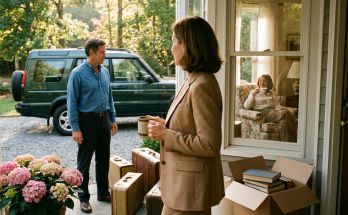
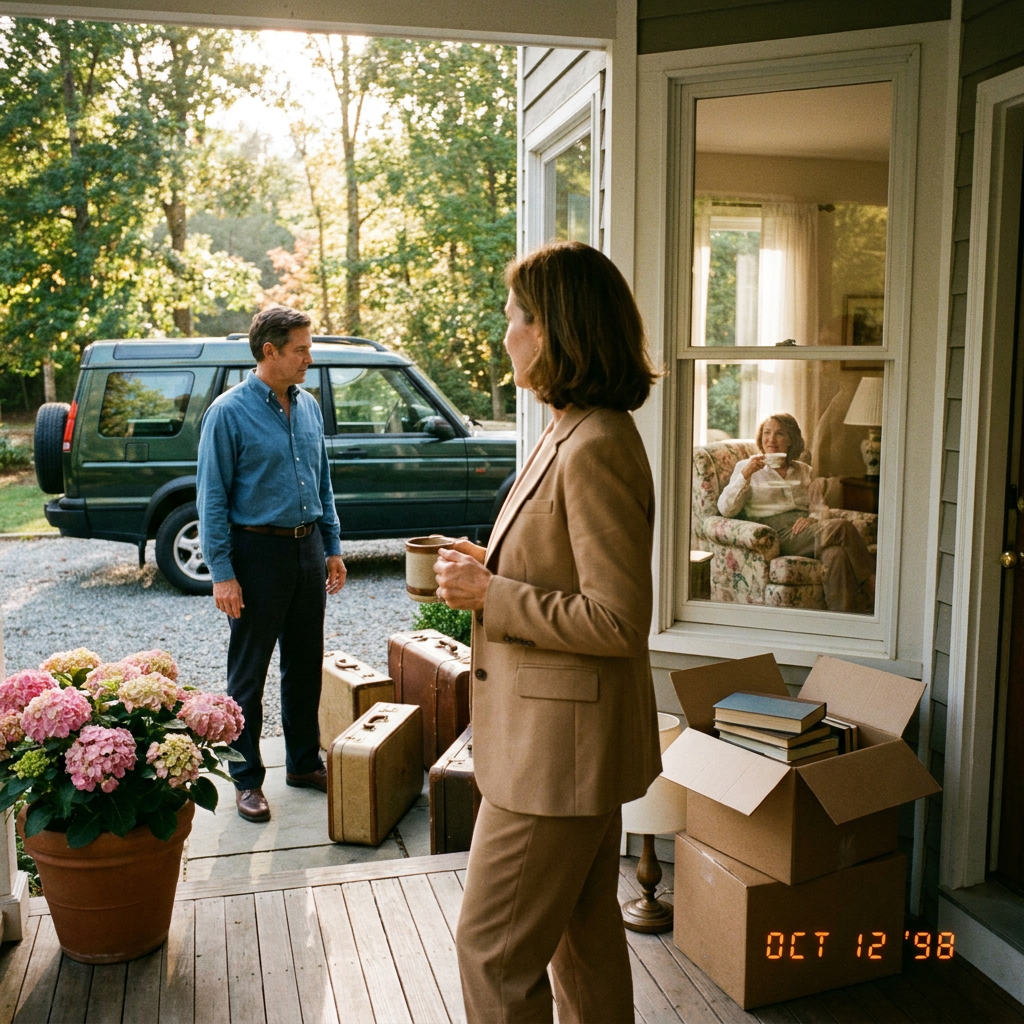
At 10:41, everything they had brought into my house was sitting neatly beneath the covered front porch beside my geraniums.
Then I went back inside.
I locked the door.
And I called the moving company.
A cheerful dispatcher answered.
“BrightLine Moving, this is Monica.”
“My name is Kimberly Porter. I’m the homeowner at 118 Maple Hollow Drive.”
“Yes, ma’am.”
“I understand a delivery is scheduled here for eleven.”
Keys clicked.
“Yes. Porter-Hayes residence?”
“No.”
A pause.
“Excuse me?”
“This is not the Porter-Hayes residence. It is my private home. David Porter and Sarah Hayes are guests. I am not authorizing delivery or entry.”
Another pause.
Then Monica’s voice became more careful.
“Understood.”
“They may meet your truck elsewhere, but nothing is to be brought inside this property.”
“I’ll note that immediately.”
“Thank you.”
Then I called a locksmith.
Not because David didn’t have a key.
Because I knew what happened when entitlement met embarrassment.
People who believed boundaries were insults often tested them.
At 10:55, their SUV turned into the driveway.
Sarah stepped out laughing into her phone.
She took three steps.
Then stopped.
Her laughter vanished.
David got out from the driver’s side.
He followed her stare.
Four suitcases.
Three boxes.
Two bags.
All waiting beside my flowers.
I watched from my chair by the window.
Sarah ended her call.
Then she marched toward the porch.
She tried her key.
The lock had not been changed yet, but I had engaged the deadbolt from inside.
She knocked.
Then knocked harder.
“Kimberly!”
I stayed where I was.
David came up behind her.
“Mom?”
I stood and walked to the door.
I did not open it.
Through the glass, Sarah’s face was flushed.
“What is this?”
“Your things.”
She stared at me.
“I can see that.”
“Then why did you ask?”
David frowned.
“Mom, open the door.”
“No.”
His face changed.
“What?”
“You ordered me out of my bedroom.”
“I didn’t order—”
“Yes, you did.”
Sarah slapped her palm against the door.
“We live here.”
“No.”
Her eyes widened.
“You invited us.”
“I invited you to stay temporarily in my guest room.”
“You can’t just kick us out.”
I looked at her through the glass.
“I can end permission for guests to stay in my home.”
David stepped closer.
“Mom, this is insane.”
“No, David. Insane was believing I would move out of my own bedroom because your wife wanted a bigger closet.”
His jaw tightened.
“You’re humiliating Sarah.”
That nearly made me laugh.
“Your wife gave me a deadline to evacuate my bedroom.”
“She didn’t mean it like that.”
Sarah spun toward him.
“Yes, I did.”
David closed his eyes.
For one brief second, I almost felt sorry for him.
Then he looked back at me.
“Where are we supposed to go?”
It was the first useful question either of them had asked all morning.
“I don’t know.”
“I thought you wanted us to save money.”
“I did.”
“So you’re just throwing us out?”
“I’m ending an arrangement you stopped respecting.”
Sarah folded her arms.
“We have rights.”
There it was.
I had expected that.
“You may call whoever you need to call.”
Her confidence flickered.
She hadn’t expected me to say that.
The moving truck appeared at the end of the street.
Sarah smiled suddenly.
“Good. At least the movers are here.”
The truck slowed.
Then continued past the driveway.
Her smile disappeared.
She turned.
“What?”
I said nothing.
Her phone rang.
She answered sharply.
“Yes?”
I could hear only her side.
“What do you mean cancelled?”
Pause.
“She had no right.”
Another pause.
Sarah’s eyes lifted toward me.
Then she ended the call.
“You called them.”
“Yes.”
She laughed once without humor.
“This is unbelievable.”
“No. This is my house.”
David sat down on one of the suitcases.
He suddenly looked exhausted.
“Can we just reset?”
The word surprised me.
“Reset?”
“We all got heated.”
“I didn’t.”
Sarah shot him a look.
He ignored it.
“Mom, let us back in. We’ll stay in the guest room.”
Sarah turned toward him.
“No, we won’t.”
He whispered, “Sarah.”
“No. She doesn’t get to treat us like criminals.”
I opened the inner door but left the storm door locked.
“Sarah, nobody has called you a criminal.”
“You packed my belongings and put them outside.”
“Yes.”
“You violated my privacy.”
“You instructed me to clear my bedroom by eleven because movers were bringing furniture into my home without my permission.”
Her mouth opened.
Nothing came out.
Then a white van pulled into the driveway.
The locksmith.
David looked at it.
Then at me.
“Seriously?”
“Very.”
Sarah stepped toward the van.
“You are not changing those locks.”
The locksmith stopped halfway up the walk.
I opened the storm door.
“Yes, he is.”
She pointed at me.
“This is David’s childhood home.”
I nodded.
“It is.”
“So he has a right to be here.”
David didn’t say anything.
I looked at him.
“Your father and I raised you here.”
His expression softened slightly.
Then I continued.
“That does not mean you own it.”
The softness disappeared.
Sarah started pacing.
“This is why David has issues with you.”
That one landed.
She knew it would.
There are things people learn about a family after marriage.
Old wounds.
Private insecurities.
Statements that can be sharpened into weapons later.
I looked at David.
He still said nothing.
So I asked him something simple.
“Do you believe I owe you this house?”
His eyes moved toward the driveway.
“Mom…”
“Yes or no.”
He took a long breath.
“I think family helps family.”
“So do I.”
“Then why are you doing this?”
“Because helping someone is not the same as surrendering to them.”
Sarah scoffed.
I ignored her.
“I offered you a free place to live.”
“I know.”
“I offered you time to save.”
“Yes.”
“I never told you to pay rent.”
“No.”
“I never demanded money for food, utilities, or anything else.”
“No.”
“And after three days, you told me to leave my own bedroom.”
David rubbed both hands over his face.
“When you say it like that—”
“That is exactly how it happened.”
The locksmith waited silently near his van.
I almost apologized to him.
Then Sarah’s phone rang again.
She glanced at the screen.
Her expression shifted.
“Your mother,” she told David.
He looked up.
“My grandmother?”
“No. Your aunt.”
She answered.
Within seconds, I understood what had happened.
Sarah had posted online.
Of course she had.
The story was already moving through the family before noon.
By twelve-thirty, I had received six calls.
My sister-in-law said I was being harsh.
My cousin said Sarah was “difficult” but thought I should reconsider for David’s sake.
A neighbor texted to ask whether everything was okay because she had seen luggage outside.
Then my younger sister, Rachel, called.
She didn’t ask whether Sarah was crying.
She didn’t ask why I was being cruel.
She asked one question.
“What did they do?”
That nearly made me cry.
I told her.
All of it.
There was silence.
Then Rachel said, “Good.”
I blinked.
“Good?”
“You finally stopped rescuing David from consequences.”
I didn’t answer.
She continued.
“You know this isn’t about the bedroom.”
I knew.
But hearing it from someone else hurt.
Rachel reminded me of things I had spent years minimizing.
The credit card I paid off for David at twenty-five.
The car repair I covered after he ignored the warning light for three months.
The loan for the wedding photographer.
The emergency deposit when he and Sarah moved apartments.
The “temporary” help that became normal because I almost never said no.
Frank had worried about it.
Not because he didn’t love David.
Because he did.
“He needs to know you can love him without fixing everything,” Frank once told me.
I thought I was giving my son stability.
Maybe I had also taught him that my resources were simply another room in the family house he could enter whenever he wanted.
By one o’clock, the locks were changed.
David and Sarah had moved their luggage into their SUV.
The rest went into a storage unit David rented after several angry phone calls.
They spent that night in a hotel.
I know because David texted me the receipt.
It was a photo.
No message.
Just the amount.
I stared at it for a moment.
Then deleted it.
The next morning, he called.
“Can we talk without Sarah?”
That surprised me.
We met at a diner fifteen minutes from my house.
He looked tired.
For the first time in years, I saw Frank in his face.
Same crease between the eyebrows.
Same way of stirring coffee when uncomfortable.
He sat across from me.
“I’m sorry.”
I waited.
He looked up.
“I mean it.”
“For what?”
He frowned.
“For yesterday.”
“That’s broad.”
He sighed.
“For telling you to leave your room.”
“And?”
“For acting like we could decide things in your house.”
“And?”
His mouth tightened.
“Mom.”
“If we’re going to repair this, I need you to understand what happened.”
He stared down at the table.
“For not stopping Sarah.”
That was closer.
Then he added, “And for saying you should show respect.”
I felt something in my chest loosen slightly.
“Do you know why that hurt?”
“Yes.”
“Tell me.”
He looked embarrassed.
“Because you were helping us.”
“That too.”
He waited.
“Because I am your mother, David, but I am also an adult person with a home, privacy, and limits.”
He nodded.
“I know.”
“No. I don’t think you did.”
His eyes filled unexpectedly.
That almost broke me.
But love is not proved by ending every uncomfortable conversation the moment someone you love begins to cry.
So I stayed quiet.
He wiped his face.
“I think I got used to you always saying yes.”
There it was.
The truth.
Simple.
Ugly.
Useful.
I took a sip of coffee.
“Sarah says you hate her.”
“I don’t hate Sarah.”
“She thinks you never accepted her.”
“I let her move into my home rent-free.”
He gave a weak laugh.
“Fair.”
“Is she sorry?”
He didn’t answer immediately.
That was an answer.
“She thinks you overreacted.”
“Then Sarah and I are not ready to have a conversation.”
He nodded.
We sat there for almost an hour.
I did not offer him money.
I did not offer to pay for the hotel.
I did not offer the guest room back.
That was harder than changing the locks.
Before he left, David asked, “So what happens now?”
“You find a place.”
“That could take weeks.”
“Then you find a short-term rental.”
He looked toward the window.
“We’ll have to cut back.”
“Yes.”
“We might have to sell Sarah’s car.”
“Maybe.”
“We may not be able to take the vacation we booked.”
“Then don’t take it.”
He stared at me.
I could almost see the old expectation waiting for the sentence that never came.
I’ll help.
It didn’t come.
Two weeks passed.
The family gossip faded.
Sarah sent me one message.
It was long.
She accused me of humiliating her, undermining her marriage, and creating unnecessary financial hardship.
Near the end she wrote, “Family should make sacrifices.”
I read that sentence twice.
Then I replied with one question.
“What sacrifice were you making when you told me to leave my bedroom?”
She never answered.
A month later, David called again.
They had found an apartment.
Smaller than the one they lost.
No luxury gym.
No rooftop lounge.
No walk-in closet.
They could afford it.
Barely.
“We signed the lease,” he said.
“I’m glad.”
“We move Saturday.”
“That’s good.”
He hesitated.
“Can I come get the rest of my childhood stuff from your attic?”
“Of course.”
He came alone.
We spent two hours going through boxes.
Baseball cards.
School yearbooks.
A plastic trophy from a seventh-grade soccer tournament.
At the bottom of one container, we found a photograph of Frank teaching him how to ride a bicycle.
David sat down on the attic floor.
“I miss Dad.”
“So do I.”
He ran his thumb across the photograph.
“Would he be mad at me?”
The question hurt.
I sat beside him.
“He would love you.”
“That’s not what I asked.”
“No.”
He looked at me.
I smiled sadly.
“He would probably tell you that being loved doesn’t mean being protected from every mistake.”
David gave a small laugh.
“That sounds like him.”
“Yes.”
Then he surprised me.
“I think I owe you more than an apology.”
“You don’t owe me rent from those three days.”
“That’s not what I mean.”
He looked around the attic.
“I treated the house like it was eventually mine anyway.”
I stayed quiet.
“I think I always assumed someday it would be.”
“Maybe that made it feel like yours already.”
He nodded.
“Yeah.”
He looked ashamed.
“I’m sorry.”
That apology felt different.
Not because it was longer.
Because there was no request attached to it.
No loan.
No room.
No favor.
Just accountability.
Sarah took longer.
Almost four months.
Then one Sunday afternoon, my doorbell rang.
I checked the camera first.
Old habits.
Sarah stood on the porch holding a small pot of geraniums.
I nearly laughed at the coincidence.
I opened the door.
She looked uncomfortable.
“These are for you.”
I accepted them.
“Thank you.”
She looked behind me.
I did not invite her in immediately.
That mattered.
A boundary means very little if you erase it because enforcing it feels impolite.
Sarah swallowed.
“I owe you an apology.”
I waited.
She looked at the porch floor.
“What I did was disrespectful.”
“Yes.”
She nodded.
“I thought because you had so much space and because David grew up here, it was… different.”
“It wasn’t.”
“No.”
She gave a small embarrassed smile.
“It really wasn’t.”
I leaned against the doorframe.
She continued.
“I was scared.”
That surprised me.
“Of what?”
“Of failing.”
She told me their finances had been worse than David admitted.
They had spent too much.
Saved too little.
Her work hours had been reduced.
David had been embarrassed.
Moving into my house felt humiliating to her, so she had tried to make the space feel like hers as quickly as possible.
It didn’t excuse anything.
She knew that.
“I think taking your room was my way of pretending we weren’t guests.”
That was the first thing she said that made me understand her, even though it did not make her behavior acceptable.
“I needed control,” she said.
“So you tried to take mine.”
She nodded.
“Yes.”
We stood there for a while.
Then I opened the door wider.
“Would you like coffee?”
Her eyes lifted.
“Yes.”
That was not forgiveness in one dramatic moment.
Real forgiveness rarely works that way.
It was simply the beginning of a different relationship.
One with doors.
One with locks.
One where permission mattered.
A year has passed since that morning.
David and Sarah still live in the smaller apartment.
They renewed their lease.
David has started saving automatically from every paycheck.
Sarah changed jobs and now makes more than she did before.
They come for dinner twice a month.
Sometimes they bring groceries.
The first time David showed up carrying a bag and said, “I’ve got dinner tonight,” I had to turn toward the sink so he wouldn’t see my eyes fill.
Not because of the food.
Because for the first time in years, he had arrived thinking about what he could contribute instead of what he needed.
My master bedroom is exactly where it always was.
Frank’s reading chair still sits in the corner.
His photograph remains on the dresser.
The geraniums Sarah brought me now grow beside the ones that sat next to her suitcases that morning.
Sometimes I look at them and think about how strange families are.
We spend years believing peace means avoiding conflict.
Sometimes it does.
But sometimes peace begins when somebody finally says no.
David once asked whether I regretted putting their belongings on the porch.
I told him the truth.
“No.”
He laughed.
“Not even a little?”
“Not even a little.”
Then I told him something I wish I had understood years earlier.
Helping your children does not require surrendering yourself to them.
Love can be generous without being unlimited.
A home can be welcoming without becoming available for someone else to control.
And respect does not mean quietly giving people whatever they demand simply because they call themselves family.
That morning, Sarah told me to empty my bedroom by eleven.
She expected me to move my bed.
My clothes.
My memories.
My life.
Instead, I moved four suitcases, three boxes, two bags, and one very important boundary.
The furniture stayed exactly where it belonged.
So did I.