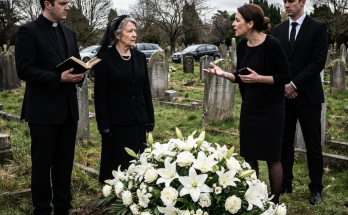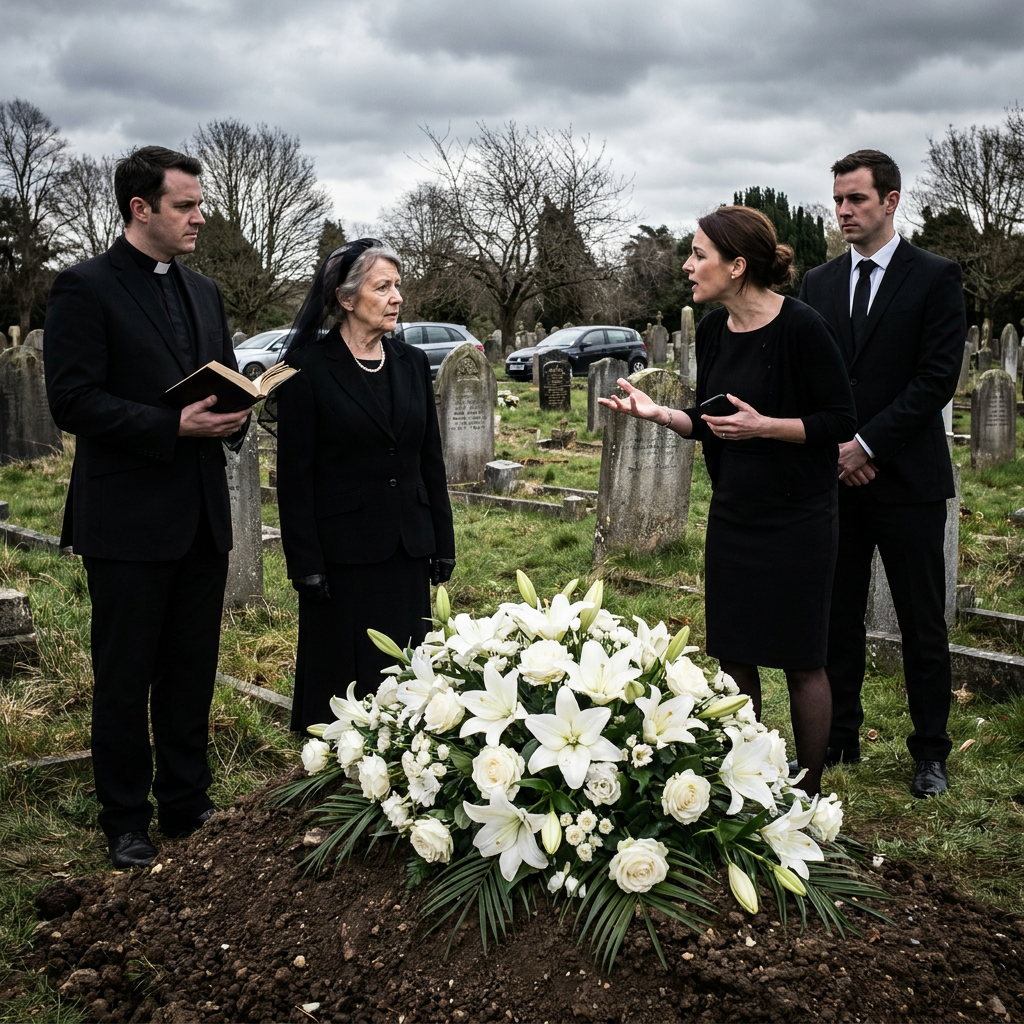
My husband had been in the ground for less than five minutes when my daughter-in-law asked how soon she could have his money.
Behind us, champagne glasses clinked in the cemetery parking lot.
Someone had music playing through an open car window.
A bass line drifted between the headstones while the pastor brushed damp soil from his fingers.
I stared at the mound covering Harold’s coffin.
Thirty-eight years of marriage, and I couldn’t remember whether I had kissed him goodbye that last morning.
“Stop being dramatic, Shirley.”
Addison’s designer heels sank slightly into the grass beside me.
She looked annoyed about that, too.
“The lawyer is waiting.”
“Can’t this wait?
I just buried my husband.”
She checked her watch.
“Harold is gone.
We have urgent matters to discuss.”
Behind her, my oldest son, Michael, studied his shoes.
David stood with his wife, Sarah, near the path.
My grandchildren clustered farther away, their faces turned toward their phones.
“What could possibly be that urgent?”
Addison gave me the patient smile people reserve for difficult children.
“
The eight million dollars.
”
I waited for Michael to object.
I had raised that boy through fevers and heartbreaks.
Once, at seven, he had carried an injured sparrow home inside his winter hat because he couldn’t bear to leave it alone.
Now he wouldn’t even look at me.
David finally stepped forward.
“Dad showed us the will last year.
Everything gets divided among the family.”
“I haven’t read it.”
An uncomfortable silence followed.
Apparently, I was the only person Harold hadn’t shown.
The pastor touched my elbow.
“Take all the time you need, Mrs.
Patterson.”
Addison sighed.
From the parking lot came a burst of laughter.
Earlier, I had heard her discussing a European vacation she wanted to take next month.
I bent down and placed a white rose on the earth.
“Goodbye, sweetheart,” I whispered.
But for the first time in thirty-eight years, I wasn’t sure who I had been married to.
At home, Addison began pricing my belongings before I had removed my funeral shoes.
“The china should be appraised,” she said, trailing one manicured finger along the dining table.
“And those paintings.”
Michael carried a notebook.
David paused in each doorway, surveying the rooms.
Twenty-three years earlier, Harold and I had painted the kitchen yellow because I wanted sunlight even in winter.
Beneath the wallpaper in the hallway were pencil marks recording our sons’ heights.
Now they walked through it all like prospective buyers.
My phone buzzed.
Addison was standing ten feet away.
Stop being dramatic about everything.
This is urgent business.
The lawyer expects you tomorrow at 9:00 sharp.
Don’t make this harder than it needs to be.
I looked up from the message.
She was examining the silver candlesticks my mother had given me.
That night, I held Harold’s pillow against my chest and listened to the refrigerator humming downstairs.
During his final weeks, he had gripped my hand with surprising strength.
“Don’t worry, Shirley.
I’ve made sure you’ll be taken care of.
They can’t hurt you.”
I had thought he was comforting me.
Now I wondered why he had sounded afraid.
Mr.
Henderson’s office smelled of furniture polish and old paper.
Addison opened a leather portfolio before the rest of us sat down.
Michael checked his phone.
David leaned forward, elbows on the mahogany table.
“The will you’re referring to was drafted last year,” Henderson began.
“However, there have been some developments.”
Addison’s pen stopped.
“What developments?”
“Harold made changes to his estate planning during his final weeks.”
Michael’s head snapped up.
“What kind of changes?”
“We’ll address the documents at our meeting next week, once everything has been assembled and verified.”
“Dad was heavily medicated,” David said.
Henderson removed his glasses.
“Your father was quite clear about his instructions.”
I noticed Michael and David exchange a look.
It lasted barely a second.
It was enough.
Back home, they resumed cataloging possessions.
“This is my house,” I said.
“And Harold’s gone,” Addison answered.
“We need to be practical.”
That evening, she announced that she and Michael would stay in the guest room.
She never asked.
Later, I heard their voices rising through the heating vent.
“She’s too emotional,” Addison said.
David answered, “Grief can affect judgment.”
“What are you suggesting?”
Michael asked.
“Someone should help her make important decisions.”
I sat upright, gripping the blanket.
They spoke more softly after that.
I stayed awake until dawn, afraid to sleep in a house where my own children were planning my future without me.
At breakfast, Addison placed coffee in front of me.
“We’ve come up with a reasonable arrangement.”
I didn’t touch the cup.
“We manage the estate.
Michael has his MBA.
David understands the business.
I’ve worked with estate paperwork.
You keep the house and receive a comfortable allowance.”
“An allowance?”
“Harold always protected you from financial stress.”
I looked at her across the table.
When Harold started his company, I had done the payroll after putting the boys to bed.
I had answered the telephone, chased overdue invoices, and brought sandwiches to muddy construction sites.
Somewhere along the way, everyone had forgotten that.
Including, perhaps, me.
“I’ll wait for the meeting.”
Her smile hardened.
“Think about what’s best for everyone.”
That afternoon, they left on “estate errands.”
I went into Harold’s study.
His reading glasses rested beside a magazine.
His coffee mug still carried a brown crescent at the bottom.
Seeing those ordinary things nearly brought me to my knees.
Then I noticed a white corner beneath the desk blotter.
A business card.
Rebecca Morrison, Attorney at Law.
On the back, in Harold’s handwriting:
For Shirley only.
Tell no one.
I sat in his chair.
Harold had another lawyer.
That evening, Michael mentioned condominiums that would be “more manageable.”
Yesterday, I could keep my house.
Today, they were already moving me out.
The card stayed in my pocket.
The next morning, after their car disappeared down the street, I locked the study door and called.
“My name is Shirley Patterson.
I found your card in my husband’s desk.”
Silence.
Then the woman’s voice softened.
“Mrs.
Patterson, I’ve been expecting your call.”
Rebecca’s office occupied the second floor of a brick building above a bakery.
Nothing about it resembled Henderson’s expensive suite.
There were plants on the windowsill and a child’s watercolor beside her law degree.
She offered me water.
Then she placed a sealed envelope on the desk.
Inside was a letter.
Shirley, if they’ve started deciding what you’re allowed to keep, then I was right to worry.
My eyes filled.
“How did he know?”
“During his illness, your sons asked him to sign documents transferring control of the company,” Rebecca said.
“They told him you supported the arrangement.”
“I knew nothing about it.”
“He suspected that.”
She slid another folder toward me.
Before I could open it, my phone vibrated.
Addison.
Then Michael.
Then a message.
Where are you?
We found something in Harold’s study.
Call us NOW.
Rebecca watched my face.
“Does anyone know you’re here?”
“No.”
Another message appeared.
Whatever that woman tells you, don’t sign anything.
My mouth went dry.
Rebecca read it, then reached for a small recording device.
“Harold wanted you to hear this before we discussed the documents.”
She pressed play.
For a moment, there was only the faint scrape of fabric.
Then my husband’s voice filled the room.
“Put it on the table, Michael.”
“I’m trying to protect what you built, Dad,” Michael said on the recording.
“You’re asking me to give you control while I’m still alive.”
“You can barely get out of bed.”
A cough.
A long, painful breath.
Then David spoke.
“Mom won’t understand any of this.
You know that.”
Rebecca watched me carefully.
On the recording, Harold asked, “What happens to her?”
“She’ll be comfortable,” Michael said.
“And the house?”
A pause.
Addison answered.
“It’s too much for one woman.
Selling it would free up capital.”
“You told me she could stay.”
“We need flexibility.”
Harold’s breathing rasped through the speaker.
Then came his voice, quieter.
“Get out.”
“Dad—”
“Leave the papers.
Get out.”
The recording ended.
I stared at the little machine.
My children had discussed selling my home while their father lay dying upstairs.
Rebecca gave me a moment before speaking.
“He recorded that conversation in his study.
He brought it here himself, along with the proposed documents.”
“Can they force me out?”
“From what I’ve reviewed, they have no authority to make those decisions.
But I want an independent attorney representing only you to review everything as well.”
“Only me?”
“Harold was my client.
You deserve someone whose sole responsibility is protecting your interests.”
I nodded, although the words seemed far away.
“Why did he wait until he was dying?”
Rebecca folded her hands.
“There’s more.”
Something in her face frightened me more than the recording.
“More than that?”
“Yes.”
She glanced at the closed folder.
“Before we go further, I need you to understand that Harold didn’t bring me here only because of your sons.”
I couldn’t face the rest that morning.
Rebecca didn’t push.
She helped me arrange a consultation with an independent attorney, Ellen Brooks, and gave me copies of the documents she could release.
Then she asked one practical question.
“Do you feel safe going home?”
I thought of Addison’s coffee.
Michael’s notebook.
Their voices through the vent.
“They won’t hit me.”
“That isn’t the only way someone can make you feel unsafe.”
I called my neighbor, Ruth.
She arrived wearing gardening shoes, took one look at my face, and asked no questions until we were in her car.
Then she said, “Whose knees do I need to kick?”
I laughed.
It came out sounding like a sob.
Ruth drove me home and stayed while I packed an overnight bag.
Addison met us in the hallway.
“Where have you been?”
“Out.”
“We’ve been worried sick.”
Ruth looked at her.
“You could have started by asking how she was.”
Michael emerged from the study.
“Mom, we need to talk.”
“Tomorrow.”
Addison stepped in front of my suitcase.
“You’re making this unnecessarily hostile.”
I looked down at her hand on the handle.
“Let go.”
She did.
It was the first instruction I had given her all week that she obeyed.
At Ruth’s kitchen table, I told the story from the cemetery onward.
She listened without interrupting.
Then she asked, “What’s in the folder?”
“I don’t know.”
“Do you want me to sit with you while you look?”
I opened it.
The first pages concerned company ownership.
The next pages were bank records.
Then I saw my mother’s name.
Evelyn Mercer.
My mother had died thirty-four years earlier, when David was still in diapers.
For a few terrible months afterward, I could barely get through breakfast without crying.
Her estate had included her little house, savings, and a commercial parcel outside town that my father bought decades before.
Harold had handled everything.
He told me debts had consumed most of it.
We had received enough to replace our old car.
That was what he said.
Now I held a sale statement for the commercial land.
The proceeds were $214,000.
The money had been deposited into an account bearing my name.
Three days later, nearly all of it had moved into Patterson Construction.
Attached was a document carrying what appeared to be my signature.
I looked at it for a long time.
Ruth touched my wrist.
“Shirley?”
“That isn’t how I write my S.”
I met Ellen the next morning.
She wore red glasses and had the calm, direct manner of someone who didn’t need to raise her voice to win an argument.
She had already spoken with Rebecca, with my permission.
“Some of this will take time to investigate,” she said.
“But the records are substantial.”
“Did my husband steal my inheritance?”
She didn’t hide behind a complicated answer.
“The documents indicate that he diverted the money and misrepresented what you received.
Harold also left a written acknowledgment.”
I gripped the arms of my chair.
“Why?”
Ellen passed me a copy.
His explanation was brutally simple.
The company was failing.
Payroll was due.
He believed he could repay me before I noticed.
Then business improved.
Then he bought equipment.
Then we needed a larger house.
Then admitting it would have meant admitting he had lied for years.
“He never repaid it?”
“Not in a way he disclosed to you.”
I thought of every dinner where someone praised the company Harold built from nothing.
Every anniversary when he said, “Look how far I’ve brought us.”
Every time I thanked him for making us secure.
My mother had helped build that security.
My husband had erased her from the story.
Ellen let me cry.
When I could speak again, I asked, “What did my sons know?”
Her expression changed.
“We need to look closely at the dates.”
That afternoon, my granddaughter Lily knocked on Ruth’s back door.
She was seventeen, Michael and Addison’s oldest, still wearing her school backpack.
At the funeral, I had thought she was staring at her phone because she was bored.
Now she stood twisting the strap until her knuckles whitened.
“Grandma, please don’t tell Mom I came.”
Ruth quietly left us alone.
Lily put her phone on the table.
“Grandpa asked me to scan some old records last winter.
His hands were shaking too badly.”
“What records?”
“Your mother’s.”
I stopped breathing.
“He cried,” she said.
“I’d never seen him do that before.”
“Did you tell your father?”
She nodded.
“I thought Dad would help.”
“What happened?”
“They had a fight.
Then Dad said Grandpa was confused and I shouldn’t upset you.”
Her voice cracked.
“I believed him.”
She opened a saved email.
Michael had sent it to David.
Attached were the same bank records now sitting in Ellen’s office.
The message was dated eleven months earlier.
If Mom learns where the startup money came from, this becomes a lot more complicated.
Dad needs to leave the ownership structure alone.
Below it was David’s reply.
Then make sure she doesn’t find out.
I read the exchange without moving.
Lily began crying.
“I should’ve told you.”
I pulled her into my arms.
“No, sweetheart.”
“But I knew something was wrong.”
“You were a child asking your father for help.”
She buried her face in my shoulder.
For the first time since Harold died, someone in my family held me without wanting anything.
The next few days passed in a blur of meetings and memories.
An accountant Ellen recommended traced the transfers.
Rebecca provided Harold’s written confession and the records he had gathered.
The company’s current ownership documents were real.
So were the changes Harold made before his death.
But they were more complicated than simply leaving me everything.
He had transferred his controlling interest to me during his lifetime, with supporting documents explaining the history and his intended restitution.
He had also arranged for money from his personal investments to fund a separate settlement.
Ellen warned me that my sons might challenge things.
“We have strong documentation,” she said.
“That doesn’t mean nobody will fight.”
I appreciated her honesty.
For thirty-eight years, people had reassured me while deciding what I was allowed to know.
I was tired of reassurance.
I wanted facts.
Meanwhile, Addison’s messages changed.
First came outrage.
Then concern.
Then photographs of the grandchildren when they were little.
Harold would hate seeing his family divided.
I stared at that one for a while.
Then I forwarded it to Ellen and put down my phone.
At night, grief caught me without warning.
I missed the sound of Harold clearing his throat before telling a joke.
I missed his warm feet under the blankets.
Then I remembered the forged signature.
Loving him and being furious with him occupied the same terrible space inside me.
The evening before the estate meeting, Michael came to Ruth’s house alone.
He stood on the porch holding a paper bag from my favorite diner.
Chicken potpie.
He remembered.
For one foolish second, that nearly undid me.
“I thought you might not be eating,” he said.
Ruth stayed within sight of the kitchen doorway.
Michael sat across from me.
“Mom, this has gotten out of hand.”
“What has?”
“All these lawyers.”
“Your father had lawyers.
You didn’t object to his.”
He rubbed his face.
“Dad wasn’t perfect.”
“Did you know about my mother’s money?”

He looked at the bag between us.
I waited.
Finally, he said, “It was a long time ago.”
Something inside me became very still.
“You knew.”
“He used it for us.”
“He lied to me.”
“He gave you a good life.”
I thought of the years I had spent believing my own contributions were small.
“I gave him one, too.”
Michael’s eyes filled, but his next words weren’t an apology.
“David has loans.
I have tuition payments coming.
There are people depending on this.”
“On my money?”
“On the family.”
I stood.
He stared at me as if he had never seen me rise from a chair before.
“You need to leave.”
“Mom—”
“You brought my favorite dinner because you wanted me soft enough to agree.”
His face crumpled.
I wished he would deny it.
He didn’t.
The following morning, I wore a navy dress Harold had once said made me look severe.
For years, I had left it in the back of the closet.
Ruth zipped it for me.
“You look like somebody who reads before signing.”
At Henderson’s office, Addison was already seated beside Michael.
David paced near the window.
Sarah sat with both hands folded tightly in her lap.
Lily waited outside with Ruth.
Ellen took the chair beside me.
Addison looked at her.
“Who’s this?”
“My attorney.”
“We already have an attorney.”
“You do,” I said.
Henderson cleared his throat.
Before he began, Michael leaned toward me.
“There’s still time to handle this privately.”
“We are handling it privately.”
“Mom, please.”
I looked at my son.
“Did you ever intend to tell me?”
He sat back.
Henderson began with the estate documents.
The old will was no longer the controlling instrument.
The company shares my sons expected to inherit were no longer Harold’s at his death.
David stopped pacing.
“What do you mean?”
Rebecca, attending at Henderson’s request, placed copies of the transfer records on the table.
“Your father completed a transfer of his controlling interest.”
“To whom?”
I watched David read my name.
Addison reached for his copy.
“No.”
It was almost a whisper.
Then louder:
“No.
He was dying.
You can’t seriously expect this to stand.”
Ellen answered evenly.
“You’re welcome to have counsel review the documentation.”
Michael stared at Rebecca.
“You promised him you’d keep this contained.”
Every face turned toward him.
He closed his eyes.
There it was: the first honest thing he had said all week.
Rebecca opened the next folder.
“Harold requested that the explanation accompany these documents.”
She described my mother’s inheritance.
The transfer into the business.
The signature I had never written.
Nobody interrupted.
Sarah turned slowly toward David.
“You knew?”
He looked at Michael.
She pulled her chair away from his.
Addison recovered first.
“Whatever happened decades ago, that doesn’t justify punishing everyone now.”
“Punishing you?”
I asked.
“We’ve built our lives around certain expectations.”
“And I built mine around things I believed were true.”
She pressed her lips together.
David leaned across the table.
“Mom, Dad paid for everything.”
“No,” I said.
“He handled the accounts.
Those aren’t the same thing.”
For a moment, I could see him struggling with that distinction.
Then Henderson explained the remaining estate provisions.
Certain personal items went to family members.
Funds had been set aside for the grandchildren’s education under independent management.
Michael and David would receive specific cash bequests, far smaller than they expected.
There was no fortune waiting for Addison.
She closed her portfolio with a sharp snap.
“This is unbelievable.”
But Rebecca hadn’t finished.
She placed one last envelope in front of me.
“Harold asked that you receive this after everyone understood the financial arrangements.”
My name was written across it.
Inside was another letter.
I unfolded it.
The first sentence made the room tilt.
Shirley, I need to tell you why I finally confessed, and it isn’t because I became a better man.
I read on.
Lily found the records.
She asked me why your signature looked different.
I told her things were done differently then.
She asked me whether you knew.
I couldn’t answer.
Across the room, Michael stared at the envelope.
Harold’s handwriting grew uneven farther down the page.
She gave me a week to tell you.
I told her I would.
Instead, I called Michael.
He told me not to destroy the family over an old mistake.
For a few days, I was relieved.
Then I heard myself coming out of my son’s mouth.
I lowered the letter.
Outside the glass wall, Lily sat beside Ruth, hands tucked between her knees.
Harold hadn’t discovered his conscience alone.
A seventeen-year-old girl had dragged it into daylight.
There was more.
I hired Rebecca because Lily said she would find someone herself if I didn’t.
I asked for secrecy because I was ashamed, and because I still wanted you to love me while I was alive.
That was another selfish thing.
Tears blurred the page.
I told myself protecting you meant keeping difficult things from you.
The truth is that I was protecting the version of me you trusted.
The final lines were barely legible.
The money is yours.
What happens next must be yours, too.
You do not owe me forgiveness because I am dead.
I folded the letter carefully.
For years, I had believed Harold was the brave one.
He negotiated contracts.
Borrowed money.
Took risks.
Yet the bravest person in our family had been a teenage girl asking a question nobody wanted answered.
I looked at Michael.
“You tried to stop your daughter.”
His voice broke.
“I thought I was saving everything.”
“You were.”
I touched the folder holding my mother’s records.
“Everything except me.”
Addison stood.
“We should go.”
Michael didn’t move.
For once, she had to wait for him.
David asked whether we could talk later.
“Through Ellen for now,” I said.
“Mom, we’re your sons.”
“I know.”
That was the part that hurt.
After they left, I asked Lily to come inside.
She stopped when she saw the letter in my hand.
“Are you mad?”
I stood and wrapped my arms around her.
“No.”
“I made Grandpa promise he’d fix it.
I didn’t know whether he really had.”
“He began fixing it.”
Her shoulders shook.
“I was scared you’d hate him.”
I kissed her hair.
“You don’t have to carry what he did.”
She cried harder then, with the exhausted relief of someone finally putting down something too heavy.
I held her until she could breathe.
There was no magical afternoon when everything became easy.
My sons hired an attorney.
Ellen answered him.
Documents were examined, signatures checked, valuations reviewed.
The independent records and Harold’s admissions mattered more than anyone’s outrage.
Eventually, an agreement was reached.
I kept the house and the controlling shares.
The grandchildren’s education funds remained protected.
My sons accepted their bequests.
Their disappointment was not a debt I owed.
I asked for a proper introduction to the company I had unknowingly helped finance.
At the first staff meeting, I recognized faces from Christmas parties and hospital visits.
Men and women who had spent decades making Harold’s promises real.
I told them I wasn’t going to pretend I could run a construction company alone.
Then I hired experienced leadership and began learning what ownership actually required.
Later, with professional guidance, we established a plan through which longtime employees could earn an ownership stake.
It wasn’t charity.
They had built something, too.
At home, I changed the locks and kept the yellow kitchen.
Addison’s belongings were packed and returned.
Michael began calling without asking about money.
Sometimes I answered.
David wrote a letter that started with an apology and contained no excuses.
I read it three times before replying.
Nothing was repaired quickly.
But for the first time, repair required something from them instead of silence from me.
Six months after the funeral, I returned to Harold’s grave alone.
I brought a white rose.
For a long time, I stood there listening to the trees.
“I miss you,” I said.
It was true.
“You hurt me.”
That was true, too.
I didn’t offer forgiveness I hadn’t reached.
I left the flower and walked back to my car.
Lily was waiting at my house with Ruth.
We were making dinner together, and my granddaughter had volunteered to attempt my mother’s apple pie.
She had flour on her cheek when I arrived.
“Grandma, where do you keep the recipe?”
“In the little blue box.”
She opened it and lifted out a faded card.
Then she paused.
“What?”
She held it beside a photocopy of the old company document I had brought home from Ellen’s office.
My mother’s handwritten recipe.
My supposedly handwritten signature.
Lily looked up.
“This is how I knew,” she said.
“Grandpa said the signature was yours.”
She pointed to the looping capital S on the recipe card.
“But it wasn’t even his handwriting.”
I stared.
The false signature had been copied from my mother’s careful script.
For years, Harold had kept that recipe card in his desk before returning it to my kitchen box.
He hadn’t merely taken her money.
He had used a piece of her to do it.
My hands went cold.
Then Lily turned the card over.
On the back, beneath a butter stain, my mother had written a note I had forgotten.
For my Shirley, who always thinks she needs someone else to tell her she’s ready.
You don’t, sweetheart.
I sat down.
Ruth took the card gently and read it.
Then she put her hand over mine.
Through the kitchen window, late sunlight spread across the table.
For thirty-four years, I had mourned a mother who supposedly left me almost nothing.
In truth, she had given me the foundation of an entire life.
And now, when I needed her most, she had left me the words to begin another.
I looked at Lily.
“Get another bowl,” I said.
“We’re making two.”
One pie would stay with us.
The other would go to the office the next morning, where the new company sign was being installed.
I had approved it the week before.
Mercer Construction.
My mother’s name.
At last.