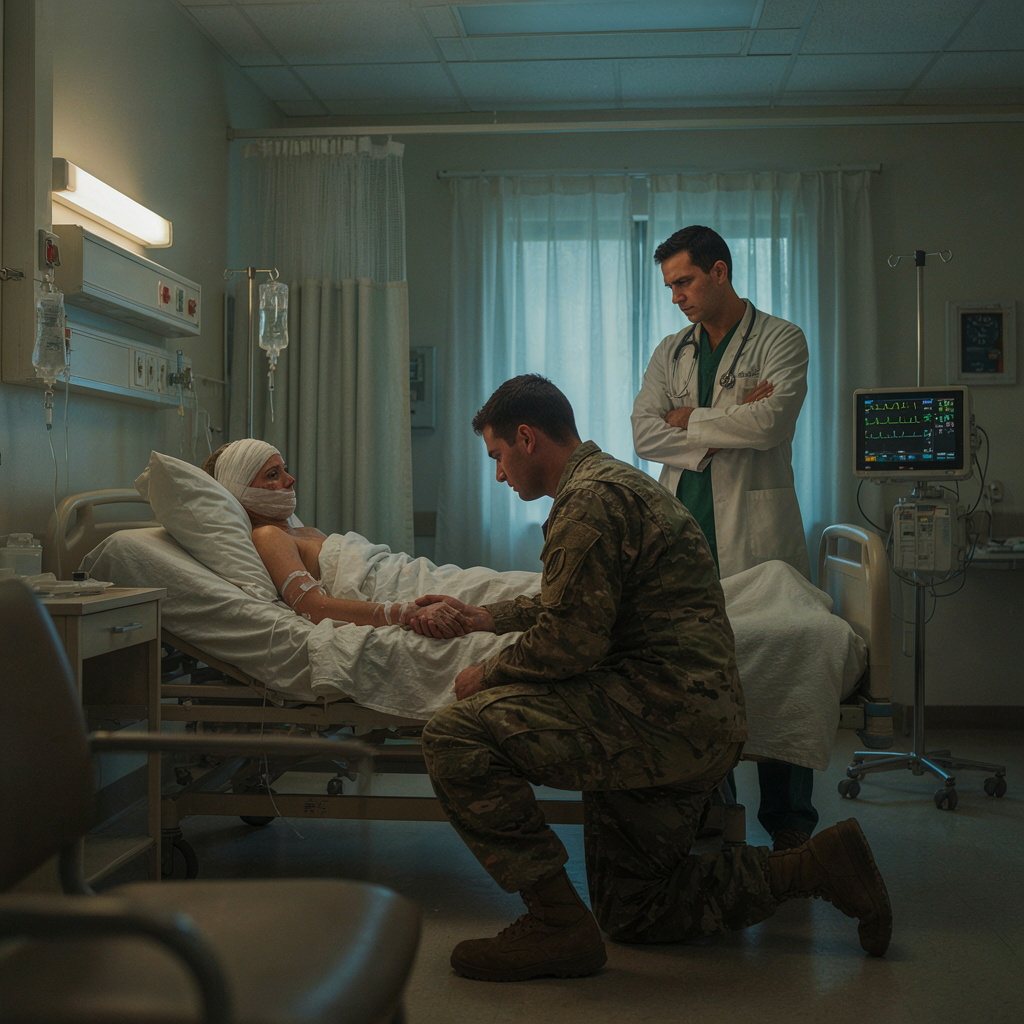
Dr. Nathan Keller.
Mid-fifties.
Calm eyes.
The careful voice doctors use when they already know a family’s life is about to change.
He placed the X-rays on the viewing panel.
The damage looked like broken branches inside her face.
“How bad?”
Dr. Keller pointed to several areas.
“Six separate fractures.”
I stared.
“Six?”
“One near the mandibular hinge. Two along the body of the lower jaw. Multiple fracture lines through the opposite side.”
He continued explaining.
I stopped hearing most of it.
All I could see was Lily as a little girl.
Missing front teeth.
Running through the backyard.
Laughing while I tried to teach her to ride a bicycle.
Now I was staring at an image of that same jaw broken into pieces.
“Will she recover?”
“We expect a good recovery, but she’ll need reconstructive surgery. Possibly more than one procedure. Her jaw will have to remain immobilized during part of the healing process.”
I nodded slowly.
Then I asked the question that had been tearing through me.
“Who did this?”
Dr. Keller hesitated.
“I don’t know.”
“What do you mean?”
“Campus security found her unconscious near the science building.”
“On campus?”
“Yes.”
“At Bradley?”
“Yes.”
My confusion turned into anger.
“Security cameras?”
“They’re reviewing them.”
“Witnesses?”
He said nothing.
That silence told me more than an answer would have.
“You’re telling me someone nearly killed a student beside a university building and nobody saw it?”
“I’m telling you what I’ve been told.”
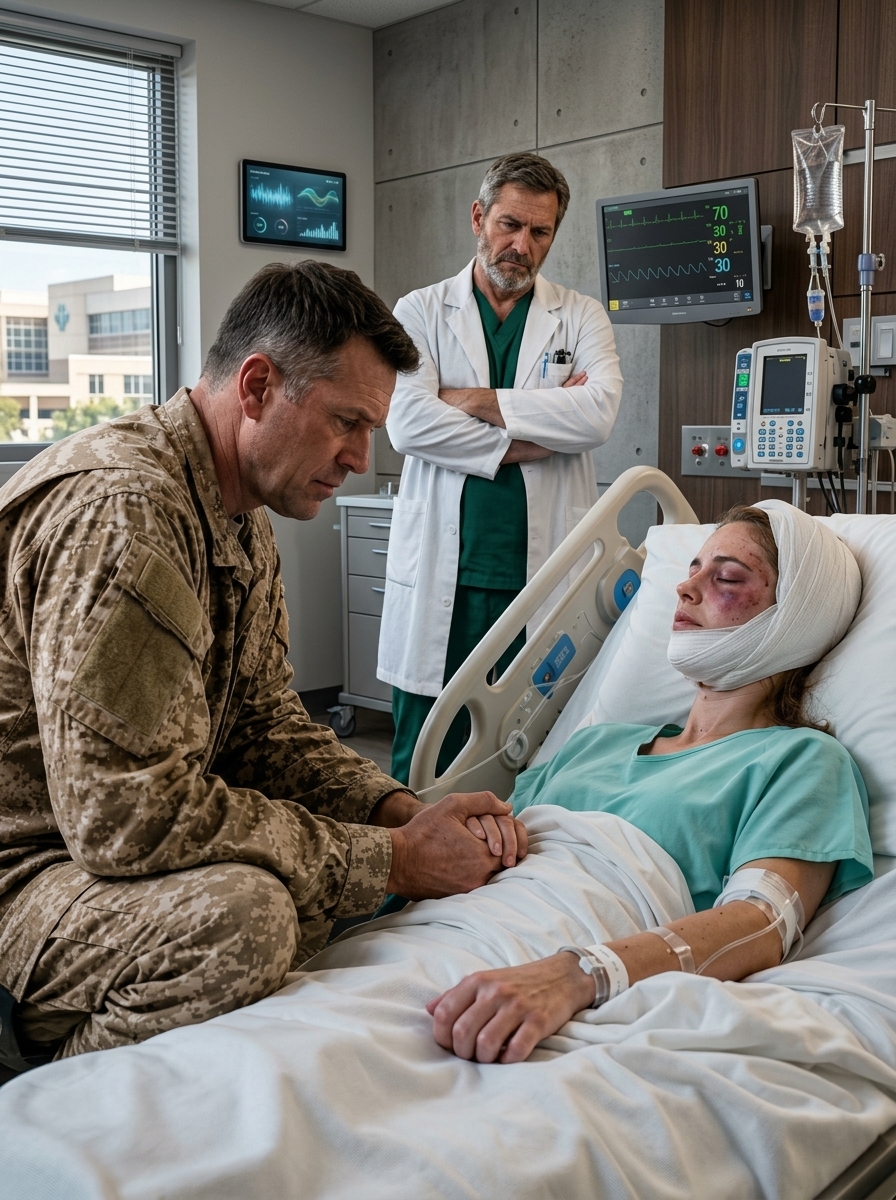
I looked at Lily.
She had closed her eye.
But her hand was still locked around mine.
Something was wrong.
Campuses are crowded.
Students walk everywhere.
Cameras sit on buildings.
Phones are everywhere.
And people talk.
Someone had seen something.
The question was why they weren’t talking.
Around one in the morning, a police officer arrived.
Detective Elena Ruiz.
She introduced herself quietly.
She didn’t begin questioning Lily.
I appreciated that.
Instead, she asked me to step into the hall.
“What do we know?”
“Not much yet.”
“That’s not good enough.”
“No, it isn’t.”
Ruiz didn’t get defensive.
That made me listen.
“She was found at approximately ten fifty-eight behind the east side of Bell Science Hall.”
“By who?”
“A campus security officer.”
“Name?”
“Graham Ellis.”
“What was he doing there?”
“Routine patrol.”
“Was Lily conscious?”
“No.”
“Her phone?”
“Missing.”
“Wallet?”
“Still in her backpack.”
That mattered.
“So robbery wasn’t the motive.”
“Probably not.”
“Anything else missing?”
“We don’t know yet.”
I looked through the glass at my daughter.
“When can she communicate?”
“The doctors say she may be able to write tomorrow.”
I turned back.
“Then tomorrow, we start getting answers.”
Ruiz studied me.
“You military?”
I looked at her.
“Retired.”
“I figured.”
“Why?”
“Most parents in this situation either collapse or start shouting. You’re doing neither.”
“That doesn’t mean I’m calm.”
“I didn’t say you were.”
The next morning, Lily woke more fully.
Her face was swollen worse than the night before.
A nurse gave her a small dry-erase board.
I sat beside the bed.
Detective Ruiz stood farther back.
“No pressure,” I told Lily. “Only if you want.”
She slowly lifted the marker.
Her hand trembled.
She wrote three words.
NOT RANDOM ATTACK.
Ruiz stepped closer.
I felt something cold move through my chest.
I asked, “You knew the person?”
Lily erased the board.
She wrote again.
THREE PEOPLE.
Ruiz and I exchanged a look.
“Three attackers?”
Lily nodded.
“Students?”
Another nod.
“Do you know their names?”
She froze.
Her breathing changed.
I put a hand on her arm.
“Lily.”
Her eye filled with fear.
Then she wrote one name.
EVAN HALBROOK.
Detective Ruiz went very still.
It was subtle.
Most people wouldn’t have noticed.
I did.
“You know him,” I said.
Ruiz hesitated.
“I know the name.”
“Tell me.”
“Evan Halbrook is a senior at Bradley.”
“And?”
She exhaled.
“His father is Charles Halbrook.”
The name meant nothing to me.
“Should I care?”
“Charles Halbrook is one of the university’s largest donors.”
There it was.
The first crack.
May you like

I looked at Lily.
“Why would Evan Halbrook attack you?”
Lily erased the board.
Slowly, carefully, she wrote:
I SAW SOMETHING.
Ruiz moved closer.
“What did you see?”
Lily’s hand began shaking so badly the marker squeaked across the board.
She stopped.
I told Ruiz, “Give her a minute.”
But Lily shook her head.
Then wrote two more words.
A GIRL.
I frowned.
“What girl?”
She wrote:
LAST MONTH.
Then:
MAYA BENNETT.
Ruiz inhaled sharply.
This time I caught it.
“Who is Maya Bennett?”
Ruiz didn’t answer immediately.
That made me angry.
“Detective.”
“Maya Bennett is another Bradley student.”
“Is?”
“She withdrew from school three weeks ago.”
“Why?”
“Officially? Personal reasons.”
“Unofficially?”
Ruiz looked at Lily.
Then at me.
“Her parents filed a police report.”
“What kind of report?”
Ruiz lowered her voice.
“Maya claimed she was assaulted after a private party connected to members of an exclusive student organization.”
I felt my jaw tighten.
“Was Evan Halbrook named?”
“No formal accusation identified him.”
“That wasn’t what I asked.”
Ruiz stayed silent.
That was enough.
Lily began writing again.
I FOUND VIDEO.
Everything stopped.
“What video?”
She wrote:
MAYA’S PHONE.
Then:
LAB COMPUTER.
Piece by piece, the story emerged.
Lily worked part time as a student assistant in one of the science department computer labs.
Three days earlier, while clearing abandoned devices from a study room, she found a damaged phone plugged into a charging station behind a monitor.
The screen was broken.
The device wouldn’t fully boot.
Lily, curious and good with technology, connected it to a lab computer to see whether she could identify the owner.
Most of the phone was corrupted.
But one video opened.
A short video.
Less than two minutes.
Recorded inside a large house near campus.
Students drinking.
Music.
People laughing.
And then Maya Bennett in the background.
Unsteady.
Trying to leave.
A young man blocked the doorway.
Evan Halbrook.
Lily knew him by sight.
Everyone did.
Popular.
Wealthy.
Student leadership.
Photographed beside university officials.
The kind of student whose last name appeared on plaques.
In the video, Maya told him to move.
He didn’t.
Another man took her phone.
Then the camera fell sideways.
The video continued recording from the floor.
Voices were captured.
Arguments.
Maya saying, “Don’t touch me.”
Someone laughing.
Someone saying, “Her dad can’t do anything.”
And one sentence Lily remembered clearly.
“If she talks, Halbrook will bury it.”
I felt sick.
“What did Lily do with the video?”
Ruiz asked.
Lily wrote:
COPIED IT.
“To where?”
CLOUD.
“Did you tell anyone?”
Lily hesitated.
Then wrote:
DEAN PORTER.
Ruiz’s expression changed again.
“Who is Dean Porter?” I asked.
“Associate dean of student affairs.”
“You reported it to him?”
Lily nodded.
“What did he do?”
The marker moved.
TOLD ME DELETE IT.
The room seemed to shrink.
I stared at those words.
“Say that again.”
Lily underlined them.
TOLD ME DELETE IT.
According to Lily, she had gone to Dean Richard Porter the next morning.
She expected help.
She expected an adult to take responsibility.
Instead, he closed his office door.
Asked whether anyone else had seen the video.
Asked where she had copied it.
Then told her that damaged files could be “misleading.”
That accusations could “ruin lives.”
That Charles Halbrook had given millions to the university.
And that Lily should erase the copy before she became involved in something she didn’t understand.
Lily refused.
Porter became angry.
That evening, someone slipped a note under Lily’s dorm-room door.
DELETE IT.
She ignored it.
The following morning, her bicycle tires had been slashed.
She still ignored it.
Thursday afternoon, she received a message from an unknown number.
WE KNOW WHERE YOU KEEP IT.
She decided to go to campus security.
She never made it.
At 10:41 that night, while walking past Bell Science Hall, three students surrounded her.
Evan Halbrook.
A fraternity member named Tyler Crane.
And another student Lily only knew as Mason.
Evan demanded access to the cloud account.
Lily refused.
He grabbed her backpack.
She fought back.
Tyler held her arms.
Lily kicked him.
Then Evan hit her.
Once.
Twice.
She fell.
And then someone kicked her in the face.
Again.
And again.
The last thing she remembered was Evan crouching beside her and saying:
“You should have deleted it.”
I could feel my heartbeat in my teeth.
Detective Ruiz had stopped taking notes.
She was staring at the board.
“Lily,” she said, “are you certain?”
Lily looked directly at her.
Then wrote:
100%.
Within two hours, Ruiz requested warrants.
By afternoon, officers were searching Evan Halbrook’s off-campus house.
But the university moved faster.
At four fifteen, Bradley University issued a statement.
I read it on my phone.
The statement described Lily’s assault as an “isolated interpersonal incident.”
No mention of three attackers.
No mention of Evan.
No mention of the video.
No mention of Maya.
No mention of Dean Porter.
They encouraged students to “avoid speculation.”
I stared at the screen.
Then laughed once.
Not because anything was funny.
Because I understood.
They weren’t trying to discover what happened.
They were trying to control what everyone believed had happened.
That evening, Charles Halbrook appeared on television outside the university administration building.
He said his family was “deeply concerned for the injured student.”
He called rumors involving his son “reckless internet misinformation.”
Then he said something that made my blood run cold.
“Evan has always believed deeply in protecting vulnerable members of the university community.”
Lily saw the clip from her hospital bed.
Her heart monitor immediately accelerated.
I switched the television off.
“No more.”
She reached for the board.
WROTE:
THEY WILL ERASE IT.
I leaned close.
“No.”
Her eye met mine.
I pointed toward the board.
“They already tried.”
Then I took her hand.
“And they failed.”
The cloud account became everything.
Lily had enabled two-factor authentication.
Her phone was missing.
But a backup recovery key was stored inside a notebook in her dorm room.
Detective Ruiz obtained access with Lily’s authorization.
At 8:32 p.m., the video was recovered.
I wasn’t allowed to watch the full evidence.
Ruiz watched it.
When she came back into the hospital room, her face had changed.
She sat down.
“It’s real.”
I said nothing.
“It shows enough to support Lily’s statement and to reopen questions around Maya Bennett’s complaint.”
“What about the attack on Lily?”
“We also found messages on Evan Halbrook’s laptop.”
“What messages?”
Ruiz looked at Lily.
Then at me.
“A group chat.”
Three participants.
Evan.
Tyler Crane.
Mason Burke.
The third attacker.
My stomach twisted.
“What did it say?”
Ruiz spoke carefully.
“They discussed confronting Lily.”
“Confronting?”
“That’s how they phrased it.”
“Try again.”
She looked directly at me.
“One message from Evan reads, ‘Scare her until she unlocks it.’”
I felt every muscle in my body tighten.
“Anything after?”
“Yes.”
“What?”
“Tyler wrote, ‘You broke her bad.’”
The room went silent.
Then Ruiz added:
“Evan replied, ‘Good. Maybe she’ll learn.’”
I looked at my daughter.
Her eyes closed.
Not from weakness.
From pain.
From knowing that somewhere, while she lay bleeding on wet pavement, the people who did it had congratulated themselves.
By the following morning, Tyler Crane had been arrested.
Mason Burke was taken into custody shortly afterward.
Evan Halbrook disappeared.
His lawyer claimed he was “temporarily unavailable.”
That phrase lasted six hours.
Police found Evan at his father’s private property outside Peoria.
He was arrested just before sunset.
Students recorded officers leading him toward a patrol car.
For the first time, the campus started talking.
Posts exploded online.
Students shared screenshots.
A girl named Rachel Kim posted that she had seen Evan following Lily outside the library earlier that week.
A janitor came forward and reported hearing shouting near Bell Science Hall.
Two students admitted they had seen a body on the pavement but fled after recognizing Evan.
One of them told police:
“Everybody knows you don’t cross the Halbrooks.”
That sentence spread everywhere.
Everybody knows.
That was the real disease.
Not only one violent student.
Fear.
Silence.
Power.
And the belief that certain families existed beyond consequences.
Then Maya Bennett came forward.
She appeared at the police station beside her parents.
Twenty years old.
Pale.
Nervous.
But standing.
Her statement confirmed the video.
She had reported the incident to the university weeks earlier.
Dean Porter had encouraged her to “consider how a formal accusation might affect her academic future.”
Her parents were advised that the university preferred “internal resolution.”
Within days, rumors appeared claiming Maya had fabricated everything.
She withdrew.
The university called it a personal decision.
It wasn’t.
She had been pushed out.
And Lily had found the evidence proving it.
Three days after Lily’s attack, Dean Richard Porter was placed on administrative leave.
The university insisted it was “standard procedure.”
Twenty-four hours later, investigators obtained his emails.
That was when the story stopped being about one rich student.
There were messages between Porter and Charles Halbrook.
Not one.
Not two.
Dozens.
One from the night Maya’s complaint was filed.
Porter wrote:
WE CAN CONTAIN THIS IF THE PHONE ISN’T RECOVERED.
Another message, sent after Lily reported the video:
STUDENT ASSISTANT FOUND A COPY. I ADVISED DELETION. SHE IS RESISTING.
Charles Halbrook replied:
THEN MAKE HER UNDERSTAND WHAT IS AT STAKE.
That line changed everything.
Charles claimed he had only meant the university’s reputation.
Investigators weren’t convinced.
Neither was I.
Lily underwent her first surgery on Monday.
Metal plates were inserted.
Her jaw was stabilized.
I sat beside her while she slept.
At one point, I looked out the hospital window and saw reporters gathering outside.
Three news vans.
Two satellite trucks.
Camera crews.
A story the university had tried to bury was now everywhere.
When Lily woke, she reached for the board.
She wrote:
IS MAYA OK?
Even after everything that had happened to her, that was her first question.
Not Evan.
Not prison.
Not revenge.
Maya.
I nodded.
“She’s okay.”
Lily wrote again.
DID SHE TALK?
“Yes.”
A tiny expression appeared in Lily’s visible eye.
Relief.
I realized then that this was why my daughter had refused to delete the video.
It hadn’t been about bravery.
Not exactly.
It had been about refusing to become another person who looked away.
The following week, Bradley University held an emergency campus forum.
Students demanded answers.
The auditorium overflowed.
Hundreds stood outside.
University President Dr. Martin Hale walked onto the stage expecting to deliver prepared remarks.
He barely made it through the first paragraph.
A student shouted:
“Why did you call Lily’s attack an isolated incident?”
Another shouted:
“How many complaints disappeared?”
Then another:
“Did donors get special treatment?”
The noise became overwhelming.
Until something unexpected happened.
Maya Bennett entered the auditorium.
The room slowly fell silent.
She walked down the center aisle beside her parents.
Students moved aside.
No applause.
No shouting.
Just silence.
Then, from another entrance, Lily appeared.
I was beside her.
Her jaw was still immobilized.
Bruises remained beneath her eyes.
She moved slowly.
But she was walking.
The entire auditorium stood.
Not because she was famous.
Not because anyone had asked them to.
They stood because every person in that building understood what she had paid for refusing to stay silent.
Lily looked uncomfortable.
She hated attention.
I leaned toward her and whispered:
“You wanted college to be memorable.”
Her eyes narrowed at me.
Even with her jaw wired, I could tell exactly what she was thinking.
Not funny, Dad.
For the first time in days, I almost smiled.
Detective Ruiz later told me the investigation had expanded beyond Lily’s assault.
More students came forward.
Some had stories involving parties.
Others described complaints ignored by administrators.
Some spoke about intimidation.
Some admitted they had stayed quiet because they believed nothing would happen.
I asked Ruiz how far it went.
She answered:
“Farther than anyone expected.”
Charles Halbrook was eventually questioned regarding possible obstruction and his communications with university officials.
Dean Porter resigned before disciplinary proceedings concluded.
The university board opened an independent investigation.
Security policies changed.
Reporting procedures changed.
Several administrators were removed from positions pending review.
None of that repaired Lily’s jaw.
None of it erased the terror she felt waking up in that hospital room.
None of it gave Maya back the weeks she had spent believing nobody would help her.
But silence had finally become more expensive than truth.
Months later, Lily returned to Bradley.
I offered to let her transfer.
Actually, I offered approximately thirty-seven times.
She refused every time.
“I’m not leaving because they wanted me gone,” she eventually told me after the wires were removed.
Her speech was still careful.
Her voice sounded different.
But it was hers.
On her first day back, I drove her to campus.
She complained the entire way.
“Dad, normal college students do not have their father escort them to class.”
“Normal college students answer their phones.”
“I answer.”
“Four hours later.”
“That still counts.”
“No.”
We reached the parking lot near Bell Science Hall.
For a moment, neither of us spoke.
That was where they had found her.
Rainwater.
Blood.
Broken teeth.
A blue hoodie.
For me, that patch of pavement would never be ordinary again.
Lily stared toward the building.
I watched her hands.
They trembled slightly.
“Want me to walk with you?”
She shook her head.
I didn’t argue.
She opened the door.
Then paused.
“Dad?”
“Yeah?”
“Thank you.”
“For what?”
“For believing me before you knew everything.”
I looked at her.
“Lily, there was never a version of this where I didn’t believe you.”
She nodded.
Then she stepped out.
Students were moving across the quad.
Some recognized her.
A few whispered.
Others simply smiled.
Lily adjusted her backpack and started walking.
She had scars beneath her jaw now.
Small ones.
Permanent ones.
I hated them.
She didn’t.
A few weeks later, she told me something I will never forget.
“Every scar means they failed.”
I asked what she meant.
She touched the side of her face.
“They wanted to scare me into becoming quiet.”
She looked across the campus.
“But everybody knows now.”
That was true.
The video survived.
Maya spoke.
Students spoke.
Police found the messages.
The cover-up cracked.
And the family name everyone had been afraid to say out loud became the name investigators were asking about publicly.
Evan Halbrook had believed Lily was alone that night.
Three against one.
Power against a college sophomore.
Money against a nineteen-year-old girl.
Fear against truth.
For a few minutes behind Bell Science Hall, maybe it even seemed like he was right.
He broke her jaw in six places.
He took her phone.
He left her unconscious in the rain.
He assumed violence had solved his problem.
But he misunderstood my daughter.
Lily had already uploaded the evidence.
And more importantly, he misunderstood what happens when people finally stop being afraid together.
One student spoke.
Then another.
Then another.
Until the same campus that had once lowered its eyes became impossible to silence.
I spent years believing courage was something I had learned in the military.
I was wrong.
Sometimes courage is a nineteen-year-old girl sitting in a dean’s office while a powerful man tells her to erase evidence.
Sometimes it is refusing.
Sometimes it is lying broken on pavement and still remembering exactly who attacked you.
Sometimes it is waking up after surgery and asking whether another victim is safe.
And sometimes the strongest thing a person can do is simply refuse to look away.
They shattered my daughter’s jaw because they thought pain would make her silent.
Instead, the entire campus finally found its voice.