The night my family humiliated my six-year-old daughter, they had no idea that the little girl they were laughing at was already the most powerful person in the room.
And neither did I.
It started with a navy-blue dress, a cruel joke, and my sister Vanessa raising a champagne glass in front of forty relatives.
It ended with my father begging my eighty-two-year-old grandmother to keep a secret buried.
A secret involving millions of dollars, a betrayal fifteen years in the making, and my wife, who had been dead for three years.
But the most shocking revelation didn’t come from Grandma.
It came from an envelope my wife had left behind.
And when I finally understood what she had done, I realized that everything I believed about my marriage, my family, and the life I had built with my daughter was about to change forever.
“Daddy, why are they laughing?”
Lily’s tiny fingers tightened around mine.
I looked down at my daughter, who was standing beside me in the simple navy-blue dress she had chosen that morning.
She had spent twenty minutes twirling in front of her bedroom mirror.
“Do I look like a princess, Daddy?”
I had kissed the top of her head.
“You look like the most beautiful princess in the world.”
Now, standing inside my parents’ enormous dining room, she was staring at her shoes.
Across the room, my younger sister Vanessa swirled champagne in a crystal glass.
“Everyone!” she announced. “I’d like you to meet my stinky niece!”
Several relatives laughed.
Vanessa pointed at Lily’s dress.
“Look at those cheap clothes. I guess when you grow up without much money, you never learn how to dress properly.”
More laughter.
Then she delivered the comment that made my stomach twist.
“Well, at least she’s learning to deal with disappointment early. With clothes like that, what kind of future could she possibly have?”
I looked toward my parents.
My father was leaning back in his chair, grinning.
My mother was laughing so hard she had covered her mouth.
They weren’t embarrassed by Vanessa’s behavior.
They thought humiliating their own granddaughter was funny.
Lily tugged at my sleeve.
“Daddy?”
I crouched beside her.
“They’re just being silly, sweetheart.”
But she didn’t smile.
Instead, she whispered something that nearly broke me.
“Should I have worn my other dress?”
Before I could answer, Vanessa noticed my expression.
“Oh, relax, Daniel. It’s just a joke.”
I had heard those words my entire life.
Whenever Vanessa insulted me, it was a joke.
Whenever my parents criticized my modest home or my ordinary job, they were only trying to help.
Whenever I defended myself, I was being too sensitive.
But Lily was six.
She had already lost her mother.
And I was not going to let my family teach her that love had to be earned by wearing expensive clothes.
I took her hand.
“We’re going home, sweetheart.”
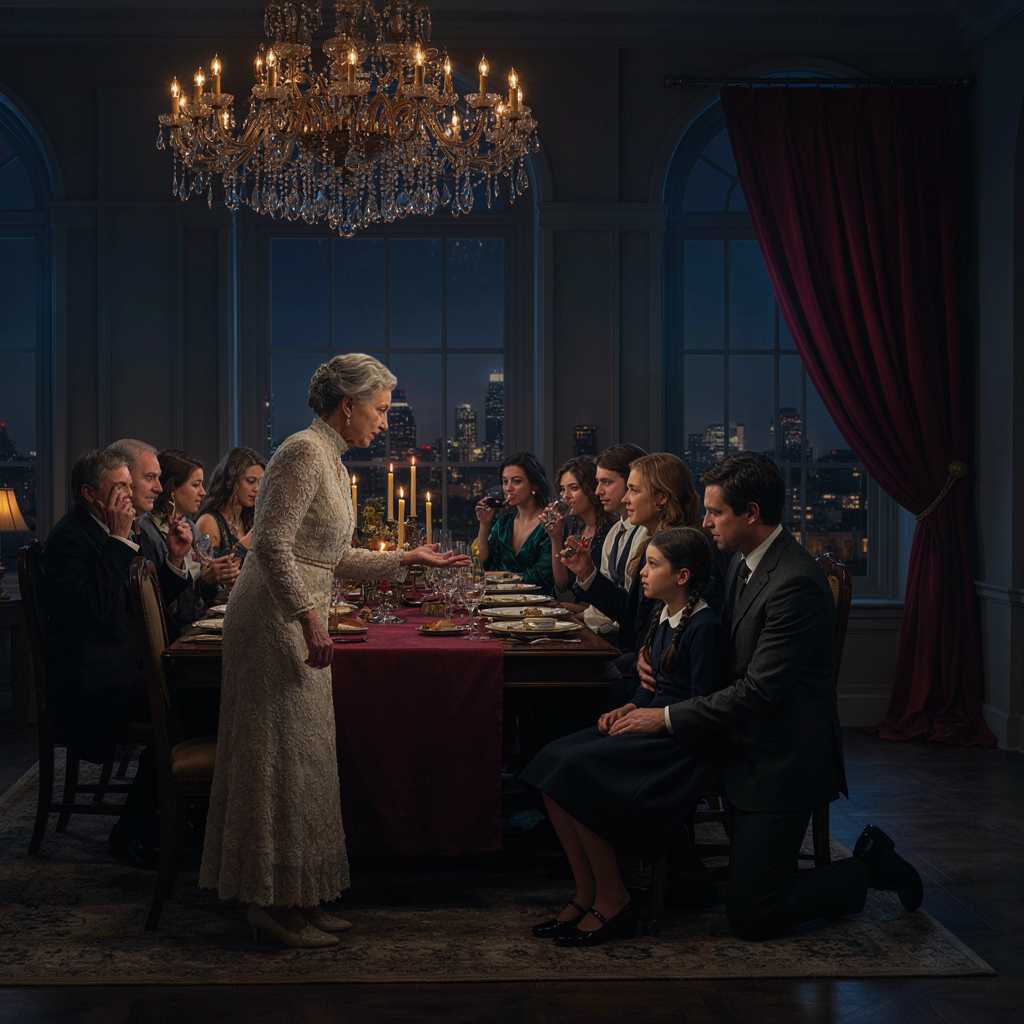
Then a chair scraped sharply across the marble floor.
Every conversation stopped.
At the far end of the table, my grandmother slowly stood up.
Grandma Eleanor was eighty-two years old, with silver hair, sharp blue eyes, and a voice that never needed to rise above a normal speaking volume.
She had built a medical technology company that was now worth hundreds of millions of dollars.
My father had spent most of his adult life expecting to inherit it.
Grandma set down her teacup.
“Well,” she said, “since Vanessa has decided to introduce my great-granddaughter tonight, I think it’s time to tell everyone who she really is.”
Vanessa’s smile faltered.
“Grandma?”
“Lily, sweetheart. Come here.”
My daughter looked at me.
I nodded.
She walked slowly toward Grandma, her little shoes tapping against the floor.
Grandma placed a gentle hand on her shoulder.
Then she looked around the room.
At Vanessa.
At my parents.
At everyone who had laughed.
“This little girl is the only person in this family who will inherit my company.”
Nobody moved.
My father’s smile disappeared.
My mother froze.
Vanessa blinked.
“What?”
Grandma continued calmly.
“Every share I own. Every property. Every dollar.”
The silence became almost unbearable.
Vanessa gave a nervous laugh.
“That’s not funny.”
Grandma looked directly at her.
“I never joke about business.”
My father straightened.
“Mother, perhaps we should discuss this privately.”
“Oh, I think everyone should hear it.”
Grandma reached for a leather folder beside her chair.
“I made this decision long before tonight. Your behavior simply confirmed that I made the right one.”
My father leaned forward.
Grandma removed a thick cream-colored envelope.
“The legal trust documents,” she explained.
Then she placed it in front of me.
“Until Lily turns twenty-five, Daniel will manage the trust on her behalf, with the assistance of my appointed financial and legal advisers.”
I stared at her.
“Me?”
Grandma nodded.
“You’re the only person here who never asked me for any of it.”
Vanessa’s face went pale.
My father looked as though someone had pulled the floor out from beneath him.
Then Lily returned to my side.
“Daddy,” she whispered, “did I do something wrong?”
I knelt in front of her and held both her hands.
“No, sweetheart.”
I looked up at my family.
“You did everything right.”
For the first time in my life, my father looked at me with something other than disappointment.
He looked afraid.
But I was about to discover that his fear had very little to do with Grandma’s inheritance.
Vanessa slammed her champagne glass onto the table.
“You can’t seriously let HIM control hundreds of millions of dollars!”
Grandma closed the folder.
“Why not?”
“He’s never managed anything bigger than his own bank account!”
I stood up.
“That is enough, Vanessa.”
She turned on me.
“Oh, please. You bring your daughter here in a department-store dress, and suddenly you’re entitled to everything Grandma worked for?”
Grandma’s expression hardened.
“Daniel didn’t ask for anything. You’re the one demanding my money.”
My father rose from his chair.
“Mother, I’ve spent thirty years preparing to take over your company.”
“Have you?”
His jaw tightened.
“You know I have.”
Grandma studied him for several seconds.
Then she reached into the folder again.
“I was hoping you wouldn’t force me to do this tonight, Richard.”
Something changed in my father’s expression.
It wasn’t anger anymore.
It was recognition.
Grandma removed a second envelope.
Unlike the first, this one was yellowed with age.
A date was written across the front.
October 14, fifteen years earlier.
My father took one step forward.
“Mother.”
Grandma ignored him.
“For fifteen years, I’ve kept something hidden from this family.”
My mother’s face lost its color.
“Eleanor, please.”
Grandma looked at her.
“You knew too, Margaret.”
I glanced between them.
“What are you talking about?”
My father reached for the envelope.
Grandma pulled it away.
“Don’t.”
His hand froze.
“Mother, whatever you’re planning, think carefully about what you’re doing.”
“I’ve spent fifteen years thinking about it.”
Then she looked at me.
“Daniel, there’s something you deserve to know about the year you left home.”
I felt a chill.
I had been twenty-four when I moved out.
I had recently graduated, and my father wanted me to join his business.
I wanted something different.
I wanted to work as an engineer, designing equipment that could make hospitals safer.
My father called it a ridiculous ambition.
He offered me a position in his company instead.
When I refused, he told me I was throwing away my future.
I left with two suitcases and eight hundred dollars.
For years, I believed the distance between us was simply the consequence of that decision.
Apparently, I had been wrong.
Grandma opened the envelope.
Inside were several documents, a bank statement, and a handwritten letter.
“Do you remember the investment proposal you brought to me that summer?” she asked.
I nodded slowly.
I had developed a prototype for a compact monitoring system that could alert hospital staff when certain medical devices malfunctioned.
It was primitive compared with modern technology, but I believed it had potential.
I had asked Grandma to look at my proposal.
She had never responded.
At least, that was what I thought.
Grandma placed a letter on the table.
“I did respond, Daniel.”
My mouth went dry.
“What?”
“I offered to fund your research.”
I stared at her.
“No. You didn’t.”
“I wrote to you three times.”
My father closed his eyes.
Grandma slid the letter toward me.
I recognized her handwriting immediately.
She had offered to provide laboratory space, introduce me to her company’s research team, and finance further development.
My hands began trembling.
“I never received this.”
“I know.”
I looked at my father.
He wouldn’t meet my eyes.
Grandma continued.
“Your father intercepted my letters. He told me you had rejected my offer.”
My mother whispered, “Richard was only trying to keep the family together.”
Grandma turned toward her.
“By lying to his own son?”
My father suddenly slammed his palm against the table.
“He was supposed to join my business!”
I stepped back.
Fifteen years.
For fifteen years, I had believed Grandma thought my ambitions were foolish.
I had struggled through rejected applications, temporary jobs, and projects that never received proper funding.
And all that time, she had been willing to help me.
“Why didn’t you tell me?” I asked her.
Her eyes filled with regret.
“I believed your father when he said you wanted no contact with the family. By the time I realized he had lied, you had already established your own life.”
“That didn’t mean you couldn’t tell me.”
“I know.”
For the first time that evening, Grandma looked old.
“I made a terrible mistake, Daniel. I thought keeping the peace was more important than confronting the truth.”
My father began arguing again.
But I barely heard him.
I was staring at the letter.
Then I noticed something written at the bottom.
A name.
A name I hadn’t expected to see.
Nora Bennett.
My wife’s name.
“Nora?” I whispered.
Grandma watched me carefully.
I looked up.
“Why is my wife’s name on this letter?”
Nobody answered.
My wife, Nora, had died three years earlier.
She had been thirty-four.
A sudden brain hemorrhage had taken her from us before I could even understand what was happening.
One morning, she was making pancakes with Lily.
By the following evening, I was sitting beside a hospital bed, holding her hand while machines breathed around her.
Nothing in my life had ever hurt like losing her.
For months afterward, I woke up reaching for someone who wasn’t there.
Lily had been three.
Sometimes she asked when Mommy was coming home.
Sometimes she simply carried Nora’s old cardigan around the house because it still smelled like her.
Now I was staring at my dead wife’s name on a document from fifteen years ago.
Three years before I had even met her.
“What does Nora have to do with any of this?”
Grandma pulled out a chair.
“Daniel, sit down.”
“No.”
My voice sounded strange.
“Tell me.”
Grandma glanced at Lily.
“Perhaps we should continue this conversation somewhere private.”
For once, my mother agreed.
“Yes. Please. There’s no reason to upset the child.”
I looked at her.
“The child you’ve all been laughing at?”
She lowered her eyes.
I turned to Lily.
“Sweetheart, would you like to sit in the library for a little while? Mrs. Carter can bring you some cookies.”
Mrs. Carter was Grandma’s longtime housekeeper.
Lily liked her.
After a moment, she nodded.
I walked her to the library and settled her on the sofa.
Before I left, she caught my hand.
“Daddy?”
“Yes, sweetheart?”
“Are we rich now?”
The question caught me completely off guard.
I sat beside her.
“Why do you ask?”
She looked down at her dress.
“Because Aunt Vanessa said people with cheap clothes don’t have good futures.”
I felt anger rising again.
But I kept my voice gentle.
“Lily, listen to me. Having money doesn’t make someone better than anybody else.”
She considered that.
“Then why is Grandma giving us so much?”
“I don’t know yet.”
“Do we have to buy expensive clothes?”
I smiled despite everything.
“No, sweetheart.”
She brightened.
“Good. Because I really like this dress.”
I hugged her.
“Then you should wear it whenever you want.”
When I returned to the dining room, several relatives had quietly left.
Only my parents, Vanessa, Grandma, and a few close family members remained.
Grandma was sitting at the head of the table.
The old envelope lay open in front of her.
I took a seat.
“Tell me about Nora.”
Grandma folded her hands.
“Fifteen years ago, your father came to me with a proposal. He wanted my company to invest in a private technology venture.”
My father stared at the floor.
“He told me the venture had developed a promising medical monitoring system.”
My heart began pounding.
Grandma continued.
“He showed me technical drawings, laboratory reports, and a financial projection.”
I looked at my father.
“Whose drawings?”
He said nothing.
“Dad. Whose drawings?”
Grandma answered for him.
“Yours.”
For a moment, I couldn’t breathe.
My father finally looked at me.
“You weren’t doing anything with them!”
I stared at him.
“You stole my work?”
“I was trying to turn your little project into something useful!”
“By taking my name off it?”
He looked away.
Grandma continued.
“Your father wanted me to invest eight million dollars. He claimed the venture owned all the necessary intellectual property.”
“And did you?”
“No.”
She touched the handwritten letter.
“Because a young engineer named Nora Bennett discovered that the technical work belonged to someone else.”
I felt the room tilt.
Nora.
My Nora.
She had been working as a junior engineer for a consulting firm that reviewed medical technology investments.
Her supervisor had assigned her to examine the proposal.
She noticed inconsistencies in the ownership records.
Then she discovered that several diagrams had been copied from a university research project.
My project.
Instead of ignoring the problem, she contacted Grandma directly.
She provided evidence that the company seeking the investment did not own the technology it claimed to own.
Grandma withdrew her funding offer.
My father’s venture collapsed.
And he never told me any of it.
I sat motionless.
Nora had saved my work before she even knew me.
But that wasn’t the part that made Grandma’s hands tremble.
“There is something else,” she said.
“Nora didn’t simply identify the problem. She discovered that your father had already used those same documents to obtain financing from another investor.”
My father stood abruptly.
“That was settled!”
Grandma looked at him.
“Yes. It was.”
She slid a bank statement toward me.
Eight million dollars had been transferred into an account controlled by my father.
He had used falsified ownership documents to secure the money.
The settlement had required him to repay the investor and surrender any claim to the technology.
But he didn’t have enough money.
So Grandma had stepped in.
She had paid the settlement from her personal funds.
And in return, my father had signed an agreement giving up any future claim to ownership or control of her company.
He had traded away his expected inheritance fifteen years earlier.
The thing he had spent decades telling everyone was rightfully his had been gone long before Lily was born.
Vanessa stared at him.
“Dad?”
He didn’t answer.
“You told me Grandma promised the company to us!”
Grandma gave a sad smile.
“Your father has been making promises with property that doesn’t belong to him.”
Vanessa slowly lowered herself into her chair.
But I wasn’t thinking about the company.
I was thinking about Nora.
“Did she know my father was involved?”
Grandma nodded.
“From the beginning.”
“Then why didn’t she ever tell me?”
Grandma’s expression softened.
“Because she wanted you to have the chance to decide who you were without your father’s mistakes defining you.”
I shook my head.
“That doesn’t make sense.”
“I know it doesn’t. Not yet.”
She reached into the folder.
“There’s more.”
Grandma removed a photograph.
It showed a laboratory filled with equipment.
Standing beside a workbench was a young woman with dark hair and a shy smile.
Nora.
She looked barely twenty.
I knew that smile.
It was the same smile she had given me across a crowded bookstore twelve years earlier.
The smile that had made me forget the title of the book I was holding.
I picked up the photograph.
“What was she doing in your laboratory?”
Grandma took a long breath.
“After exposing your father’s scheme, Nora continued working on medical monitoring systems. She was extraordinarily talented.”
I nodded.
I knew that much.
Nora had loved engineering, although she later became a high school science teacher.
She said teaching gave her more time with Lily.
She never cared about job titles or expensive things.
Our favorite evenings involved takeout food, old movies, and falling asleep together on the couch.
But Grandma was describing a life I had never known.
“Nora developed a system that could detect dangerous equipment failures before they became emergencies. She brought the technology to my company.”
I stared at the photograph.
“She worked for you?”
“Not exactly.”
Grandma looked toward the window.
“She became my business partner.”
My mouth fell open.
Grandma explained that Nora had created a patented monitoring platform capable of integrating with numerous types of hospital equipment.
It had taken years to develop.
But when the first major licensing agreements were signed, the technology transformed Grandma’s business.
Eventually, it became one of the company’s most profitable divisions.
I tried to remember every conversation I’d had with Nora about her work.
She had mentioned old engineering projects.
Sometimes she received calls from lawyers or accountants.
She had once told me she was helping an elderly friend with a business matter.
I hadn’t asked many questions.
We trusted each other.
Or at least, I had believed we told each other everything that mattered.
“Why didn’t she tell me?”
Grandma’s eyes glistened.
“She wanted to. Many times.”
“Then why didn’t she?”
“Because of what happened when she tried to protect your work.”
Grandma explained that my father had threatened Nora after the settlement.
He blamed her for destroying his venture.
He warned her that if she ever approached me, he would make sure I believed she had stolen my research.
Nora knew how damaged my relationship with my father already was.
She was afraid that revealing everything would drag me back into a conflict I had worked so hard to escape.
So she kept her distance.
Three years later, we met by chance in a bookstore.
I had no idea who she was.
She knew exactly who I was.
I remembered the afternoon.
She had been standing beside a display of engineering books.
I reached for the same book she did.
We laughed.
I asked if she wanted coffee.
She said yes.
And the rest of my life began.
I looked at Grandma.
“Our meeting wasn’t an accident?”
Grandma hesitated.
“Nora never told me she arranged it. She said she recognized you and finally found the courage to introduce herself.”
I pressed my hands against my face.
My wife had known my name before I ever learned hers.
She had protected my work.
She had built technology that helped save lives.
And she had kept an entire part of herself hidden.
I felt grief rising in my chest.
Not because I loved her any less.
Because I suddenly realized how much more there was to the woman I would never see again.
“Why didn’t you tell me after she died?”
Grandma lowered her head.
“Because Nora asked me to keep her business interests private until Lily was old enough to understand them.”
I stared at her.
“Business interests?”
Grandma looked toward my father.
Then back at me.
“Daniel, there’s something important you need to understand about the inheritance.”
She opened the first envelope again.
“My company is worth several hundred million dollars.”
“I know.”
“But I don’t own all of it.”
My father looked up sharply.
Grandma continued.
“For fifteen years, I’ve owned forty-nine percent.”
I felt my heart begin to race.
“Who owns the rest?”
Grandma’s voice softened.
“Your wife did.”
For several seconds, nobody spoke.
Then Vanessa burst out laughing.
“That’s impossible!”
Grandma didn’t look at her.
“Your sister-in-law owned fifty-one percent of the company through an investment trust established when she licensed her technology to us.”
My mother gripped the edge of the table.
“Are you saying Nora was wealthier than all of us?”
Grandma nodded.
“Considerably.”
I couldn’t move.
Nora had driven a twelve-year-old Honda.
She bought groceries with coupons.
She cried when I surprised her with a handmade anniversary gift.
She had once spent an entire Saturday repairing Lily’s favorite stuffed rabbit because she refused to throw it away.
And all that time, she had owned the controlling interest in a company worth hundreds of millions.
“Why?” I whispered.
Grandma looked at me.
“Because she understood something this family never did.”
She paused.
“Money is useful. But it isn’t a measure of a person’s worth.”
I thought about our little house.
The chipped kitchen table.
The nights Nora sat beside me, helping Lily draw pictures while I worked on engineering projects.
She could have lived anywhere.
She had chosen that life.
With us.
Grandma continued.
“Nora received her share of the business before you were married. Later, she placed it in an irrevocable trust for her future children.”
I looked up.
“Lily?”
“Yes.”
Grandma opened another document.
“When Nora died, Lily became the beneficiary of that trust. The shares have been held and professionally managed on her behalf.”
My voice came out barely above a whisper.
“Lily already owns fifty-one percent of your company?”
Grandma nodded.
“And tonight, I’ve transferred my remaining forty-nine percent into a separate trust for her.”
I looked at the cream-colored envelope.
The documents.
The signatures.
The enormous figures printed across the pages.
Grandma had not simply announced that my daughter would inherit her fortune someday.
She had already signed the transfer.
My six-year-old daughter now held the entire company through two protected trusts.
Vanessa made a strange choking sound.
My father sat perfectly still.
Then he reached for the papers.
Grandma placed her hand over them.
“No, Richard.”
His face darkened.
“Mother, this is insanity! The child can’t possibly understand what she’s been given!”
“She doesn’t need to understand it yet.”
“And Daniel can’t manage an organization of this size!”
“He won’t be running the company.”
Grandma explained that the existing executive team would continue managing the business.
Independent trustees, attorneys, and financial professionals would oversee the holdings.
I would have a defined role protecting Lily’s interests, with professional guidance.
Nobody expected a grieving father or a first grader to run a medical technology corporation.
Vanessa suddenly stood.
“We can challenge this!”
Grandma looked at her.
“On what grounds?”
“You’re eighty-two! You’re clearly not thinking rationally!”
Grandma smiled.
“That’s why the documents were prepared months ago, reviewed independently, and signed with my attorney and physician present.”
Vanessa opened her mouth.
Grandma continued.
“And the transfer of my shares was completed before this party began.”

My father’s face turned gray.
The room fell silent.
Then Grandma looked at me.
“Daniel, there’s one final thing Nora asked me to give you.”
She reached beneath the leather folder.
This time, she removed a small white envelope.
My name was written across the front.
I recognized the handwriting immediately.
My chest tightened.
It was Nora’s.
I held the envelope for a long time before opening it.
I had kept everything she left behind.
Her favorite sweater.
The little notes she used to leave in my lunch bag.
A grocery list written on the morning she died.
Sometimes I took that list out just to look at her handwriting.
Now there was a letter I had never seen.
A letter she had written knowing I might someday read it without her.
Grandma reached across the table.
“You can read it privately.”
I shook my head.
“It’s okay.”
But as I opened the envelope, I realized it wasn’t okay.
Nothing about that night was okay.
Inside were three folded pages.
The first sentence nearly destroyed me.
My dearest Daniel, if you’re reading this, then there are things I should have found the courage to tell you while I was alive.
I stopped.
My vision blurred.
I could almost hear her voice.
I remembered the way she used to sit cross-legged on our bed, reading novels with a pencil tucked behind her ear.
The way she laughed when Lily called her “the smartest mommy in the universe.”
The way she held my face in both hands whenever I doubted myself.
I wiped my eyes and continued.
Nora explained how she had discovered the stolen research.
How she had contacted Grandma.
How she had spent years developing her own technology.
She admitted that she’d known who I was when we met.
But she insisted that the decision to approach me had nothing to do with business.
She had seen me at a university engineering presentation.
I was demonstrating an inexpensive monitoring device designed for small rural hospitals.
An investor had asked why I wasn’t developing something more profitable.
I had answered that a hospital with limited resources deserved reliable equipment just as much as a wealthy one.
Nora wrote that she remembered those words.
She had wanted to meet the man who said them.
I laughed through my tears.
Of all the things I had said in my life, those were the words that brought her to me.
Then I reached the second page.
I didn’t tell you about the money because I was afraid it would bring the life you had escaped back to our doorstep.
She wrote that my father’s threats had frightened her when she was younger.
Even after we married, she worried that he would discover her ownership and use it to manipulate me.
She had intended to explain everything once we were settled.
Then Lily was born.
Our daughter changed her priorities.
Nora wanted Lily to grow up knowing the value of kindness, hard work, and ordinary happiness.
She didn’t want our daughter to believe that wealth made her special.
She wanted Lily to know she was special before she ever learned what money meant.
I reached the final page.
And that was when I found the sentence that made me put the letter down.
Daniel, if your family ever makes Lily feel ashamed of the life we gave her, please show her what I left behind.
I looked up at Grandma.
She was crying.
Nora had written that she wanted Lily to inherit her business interests when she was old enough.
But she had also prepared something else.
Something much more personal.
A small package.
Grandma pointed toward the library.
“It’s in there.”
I stood immediately.
“What is?”
“Something Nora made for Lily.”
When I entered the library, Lily was sitting on the sofa beside Mrs. Carter.
She had a cookie in one hand and a picture book in the other.
She looked up.
“Daddy!”
I crossed the room and sat beside her.
“Hi, sweetheart.”
She studied my face.
“Have you been crying?”
“A little.”
“Because you’re sad?”
I nodded.
“And because I’m remembering Mommy.”
Lily put down her cookie.
“I remember Mommy too.”
She leaned against my chest.
“She used to sing the princess song.”
I closed my eyes.
Nora had made up a silly song about a princess who refused to wear a crown because it gave her a headache.
Lily had insisted on hearing it every night.
I hadn’t thought about that song in years.
Grandma entered carrying a small wooden box.
It was painted pale blue, with tiny white flowers along the edges.
I recognized it.
Nora had kept it on a shelf in our bedroom.
After she died, I searched for it but couldn’t find it.
Grandma set the box on the coffee table.
“Your mommy asked me to keep this safe,” she told Lily.
My daughter immediately sat up.
“Mommy’s box?”
Grandma nodded.
Lily carefully lifted the lid.
Inside was a photograph of Nora holding her as a baby.
Beneath it lay a silver bracelet with a tiny star.
There was also a folded piece of paper.
And a small fabric pouch.
Lily opened the pouch first.
Inside was a silver charm shaped like a crown.
She smiled.
“A princess crown!”
Grandma gently unfolded the paper.
“Your mommy wrote you a letter, sweetheart. Would you like Daddy to read it?”
Lily nodded eagerly.
I took the page.
My hands were shaking.
My beautiful Lily,
If you’re reading this, I hope you know that you were the greatest gift your daddy and I ever received.
You don’t need a crown to be a princess. You don’t need an expensive dress to be beautiful. And you don’t need to be rich to be important.
Be kind when others are unkind. Be brave when you’re frightened. And remember that the people who truly love you will never make you feel small.
Whenever you wear your little crown, remember that your mommy loves you more than all the stars in the sky.
Love always, Mommy.
I couldn’t finish the last word without crying.
Lily put her arms around my neck.
“It’s okay, Daddy.”
I held her tightly.
Then she reached into the box again.
At the very bottom was a photograph.
It showed Nora sitting at our kitchen table, sewing a navy-blue dress.
I stared at it.
The same navy-blue dress Lily was wearing.
“Grandma?”
She smiled through her tears.
“Nora made it herself.”
I looked down at Lily’s dress.
The neat stitching.
The little bow.
The carefully sewn hem.
I remembered Nora working late one evening with fabric spread across our kitchen table.
She had told me she was making something special.
After she died, I found the dress in a sealed garment bag among her things.
I’d saved it until Lily was old enough to wear it.
That morning, when Lily chose the dress, I had told her Mommy made it.
But I hadn’t known about the photograph.
Or the letter.
Grandma touched the fabric gently.
“Nora asked me to give Lily the bracelet and the letter when she turned seven. I think tonight is the right time.”
Lily looked down at herself.
“Mommy made my dress.”
“Yes, sweetheart.”
She stroked the fabric with her little fingers.
Then she smiled.
“That’s why it’s my favorite.”
And suddenly, the entire evening became unbearable.
My sister had mocked a dress sewn by a dead mother for the daughter she would never see grow up.
My parents had laughed at a child wearing one of the few things she had left of her mommy.
They hadn’t merely insulted an inexpensive outfit.
They had tried to make my daughter ashamed of something made with love.
I hugged Lily so tightly that she giggled.
“Daddy, you’re squishing me!”
I kissed her forehead.
“I’m sorry, princess.”
She held up the silver crown.
“Can I wear this with my dress?”
I smiled.
“Of course.”
Then she asked a question I will remember for the rest of my life.
“Do you think Mommy knows I love it?”
I kissed her again.
“Sweetheart, I think she always knew.”
When I returned to the dining room, Lily was holding my hand.
She was wearing the silver bracelet and clutching her little crown.
Vanessa immediately looked at the charm.
“What’s that?”
I didn’t answer.
Grandma did.
“Something Lily’s mother left her.”
My father cleared his throat.
“Daniel, we need to discuss the company.”
I looked at him.
For fifteen years, he had hidden the truth about my research.
For twelve years, he had treated my wife as though she were an ordinary woman who had married beneath herself.
And for six years, he had watched his granddaughter grow up believing she was less important than her wealthy relatives.
Now he wanted to discuss the company.
“No,” I said.
He frowned.
“What?”
“We’re finished discussing money tonight.”
Vanessa scoffed.
“Easy for you to say. You just became the father of a billionaire!”
“Lily isn’t a billionaire, Vanessa.”
“She owns the entire company!”
“And she’s still a six-year-old girl who wanted to wear the dress her mother made.”
Grandma turned toward Vanessa.
“Did you hear that?”
Vanessa looked confused.
“Her dress?”
“Nora made it.”
For the first time that evening, my sister looked directly at Lily.
My daughter stood beside me, gently touching the bow at her waist.
Grandma continued.
“That dress you called cheap was one of the last gifts Lily’s mother made for her.”
My mother covered her mouth.
Vanessa stared at the floor.
My father said nothing.
Lily tugged at my sleeve.
“Daddy, can we go home now?”
I looked down.
“Absolutely, sweetheart.”
Before we reached the door, Grandma called my name.
“Daniel.”
I turned.
She stood beside the table, holding Nora’s letter.
“I can’t undo the years I lost with you. And I can’t bring Nora back.”
Her voice trembled.
“But I hope you’ll let me be part of Lily’s life.”
I walked toward her.
“You already are, Grandma.”
Then Lily ran into her arms.
And for the first time that night, Grandma cried openly.
Three months later, I was sitting in a conference room with Grandma’s attorneys when I learned the final truth about Nora’s fortune.
The company’s financial records confirmed that her technology had generated extraordinary profits.
But she had never used her wealth to buy mansions or luxury cars.
Instead, she had quietly funded medical equipment for rural hospitals, engineering scholarships for students from low-income families, and emergency grants for struggling parents.
Many of the donations had been anonymous.
One scholarship program immediately caught my attention.
It was named after a young engineer who had lost his first research opportunity because someone had stolen his work.
The program funded promising inventors who lacked wealthy connections.
I stared at its name.
The Daniel Bennett Innovation Fund.
My throat tightened.
Nora had established it nine years earlier.
She had been helping people like me long before I knew what she had accomplished.
Then the attorney handed me one final document.
It was a sealed instruction Nora had left for the trustees.
She had requested that, once Lily was old enough, she should be invited to choose a charitable project to support.
The decision would be hers.
No one would be allowed to pressure her.
And there was one additional condition.
The company was to preserve the engineering scholarship program regardless of who eventually managed its operations.
I looked at Grandma.
“She did all this without telling me.”
Grandma nodded.
“She never wanted you to feel indebted to her.”
I smiled through my tears.
“That’s exactly what she would say.”
That afternoon, I returned home and found Lily sitting at the kitchen table.
She was drawing a picture.
There were three people standing beneath a bright yellow sun.
A man.
A little girl.
And a woman with dark hair wearing a silver crown.
“Who’s that?” I asked, pointing at the woman.
“Mommy.”
I sat beside her.
“And what are we doing?”
Lily smiled.
“We’re building a hospital for people who don’t have enough money.”
I stared at the picture.
“Why a hospital?”
“Because Grandma said Mommy helped make hospitals safer.”
She looked at me seriously.
“And because sick people shouldn’t have to be rich to get help.”
I felt tears rising again.
Nora had spent years trying to make medical technology accessible to people who needed it most.
And somehow, without understanding anything about shares, trusts, or corporate ownership, our daughter had reached the same conclusion.
I kissed the top of Lily’s head.
“That sounds like a wonderful idea, sweetheart.”
She handed me a purple crayon.
“Then you can help me draw it.”
I sat beside her.
And together, we drew a hospital.
Six months after the party, Grandma invited us to a small family dinner.
Just the three of us.
No expensive decorations.
No champagne.
No relatives trying to impress one another.
Grandma had asked Mrs. Carter to make Lily’s favorite meal: spaghetti and meatballs.
We ate in the kitchen, laughing while Lily told Grandma about her first-grade class.
Then Grandma asked whether Lily wanted dessert.
“Chocolate cake!”
Grandma smiled.
“Excellent choice.”
After dinner, Lily ran into the living room to find her favorite picture book.
Grandma turned to me.
“Have you heard from your father?”
I nodded.
“He’s sent several letters.”
“And Vanessa?”
“She called twice.”
Grandma waited.
I looked toward the living room.
“I haven’t answered.”
She nodded slowly.
“That’s your decision.”
I had spent most of my life hoping my parents would finally be proud of me.
I had imagined that one day I’d achieve something impressive enough to earn their approval.
But losing Nora had changed me.
Raising Lily had changed me even more.
I no longer wanted to spend my life chasing people who only valued me when they thought I was worth something.
My father had apologized for taking my research.
My mother had admitted that she knew more than she had ever told me.
Vanessa had sent Lily an expensive designer dress with a handwritten card.
I returned it.
Not out of revenge.
Because Lily didn’t need another dress.
She needed adults who understood why their words had hurt her.
And none of them had shown me that they truly did.
Grandma reached across the table.
“I’m sorry I didn’t protect you when you were younger.”
I took her hand.
“You protected Lily.”
She smiled sadly.
“I should have protected both of you.”
I looked toward the living room.
Lily was singing the princess song.
The one Nora had made up.
And suddenly, I understood something.
I could spend the rest of my life mourning everything my family had taken from me.
Or I could use the time I had left to give my daughter something better.
I squeezed Grandma’s hand.
“We still have time.”
The following spring, Lily turned seven.
She wanted a birthday party in our backyard.
She didn’t ask for a princess castle or an expensive venue.
She wanted balloons, chocolate cupcakes, and a magician who could make a rabbit appear.
Grandma arrived carrying a small gift bag.
Inside was a children’s book about famous inventors.
On the first page, she had written:
To Lily, who already knows that the greatest things in life are made with love.
Lily hugged her.
Then she ran upstairs.
A few minutes later, she returned wearing her navy-blue dress.
It was getting a little short.
The sleeves were tighter than they used to be.
But she had refused to replace it.
She stood in front of me and twirled.
“Daddy, do I still look like a princess?”
I knelt beside her.
“You always will.”
She smiled.
Then she took the little silver crown from her pocket and pressed it into my hand.
“Mommy said I don’t need a crown.”
I nodded.
“That’s right.”
She placed it on Grandma’s head.
“Then Grandma can wear it today.”
Grandma burst out laughing.
And as I watched them together, I realized that the little girl my family had dismissed as having no future had already received something far more important than a fortune.
She knew she was loved.
But the final surprise came that evening, after the guests had left.
Lily brought me a folded piece of paper.
“Daddy, I made something for you.”
I opened it.
It was a drawing of our house.
There were flowers in the yard, a bright yellow sun, and three people standing beside the front door.
Me.
Lily.
And Nora.
Beneath the drawing, in Lily’s careful handwriting, were six words.
“This is what being rich means.”
I stared at the picture.
My eyes filled with tears.
For years, my family had measured success by money, possessions, and social status.
They had laughed at my choices.
They had mocked my daughter.
They had believed that our modest life meant we had failed.
But Nora had known better.
She could have lived in a mansion.
She could have filled her closet with designer clothes.
She could have told everyone how powerful and wealthy she was.
Instead, she chose an ordinary house, a kitchen full of laughter, and a little girl who believed her mother could make anything beautiful with a needle and thread.
And she had quietly built a future that would outlast all of us.
I folded Lily’s drawing and placed it beside Nora’s letter.
Then I picked up my daughter and carried her upstairs.
“Daddy?”
“Yes, princess?”
“Do you think Mommy would be proud of us?”
I looked at the little silver crown on her bedside table.
I thought about Nora’s handwritten letter.
About the company she had built.
About the hospitals she had helped.
And about the navy-blue dress she had sewn for a daughter she would never see turn seven.
I kissed Lily’s forehead.
“I think she’d be prouder of you than anything else in the world.”
She smiled and closed her eyes.
I turned off the bedroom light.
Then I stood in the doorway for a moment, watching her sleep.
My family had believed that Grandma’s announcement was the night my daughter’s future changed.
They were wrong.
Nora had already secured Lily’s financial future years before that party.
Grandma had simply revealed it.
And the woman my family had dismissed as an ordinary schoolteacher had quietly become the person whose work supported the company they were so desperate to inherit.
The greatest irony was that my father had spent fifteen years trying to claim a fortune built on the very technology he had once stolen from me.
But Nora had taken a different path.
She had created something better.
Something that belonged to her.
Something she could pass on to our daughter.
And she had done it without ever teaching Lily to look down on anyone.
I walked downstairs, opened the drawer beside our kitchen table, and took out the photograph of Nora sewing the navy-blue dress.
I placed it in a frame.
Then I set it beside Lily’s drawing.
For the first time in three years, I felt something stronger than grief when I looked at my wife’s face.
I felt peace.
Because I finally understood what Nora had been trying to teach me all along.
My daughter didn’t become valuable the moment she inherited hundreds of millions of dollars.
She had been priceless from the moment she was born.
And no amount of money, no cruel joke, and no expensive dress could ever change that.