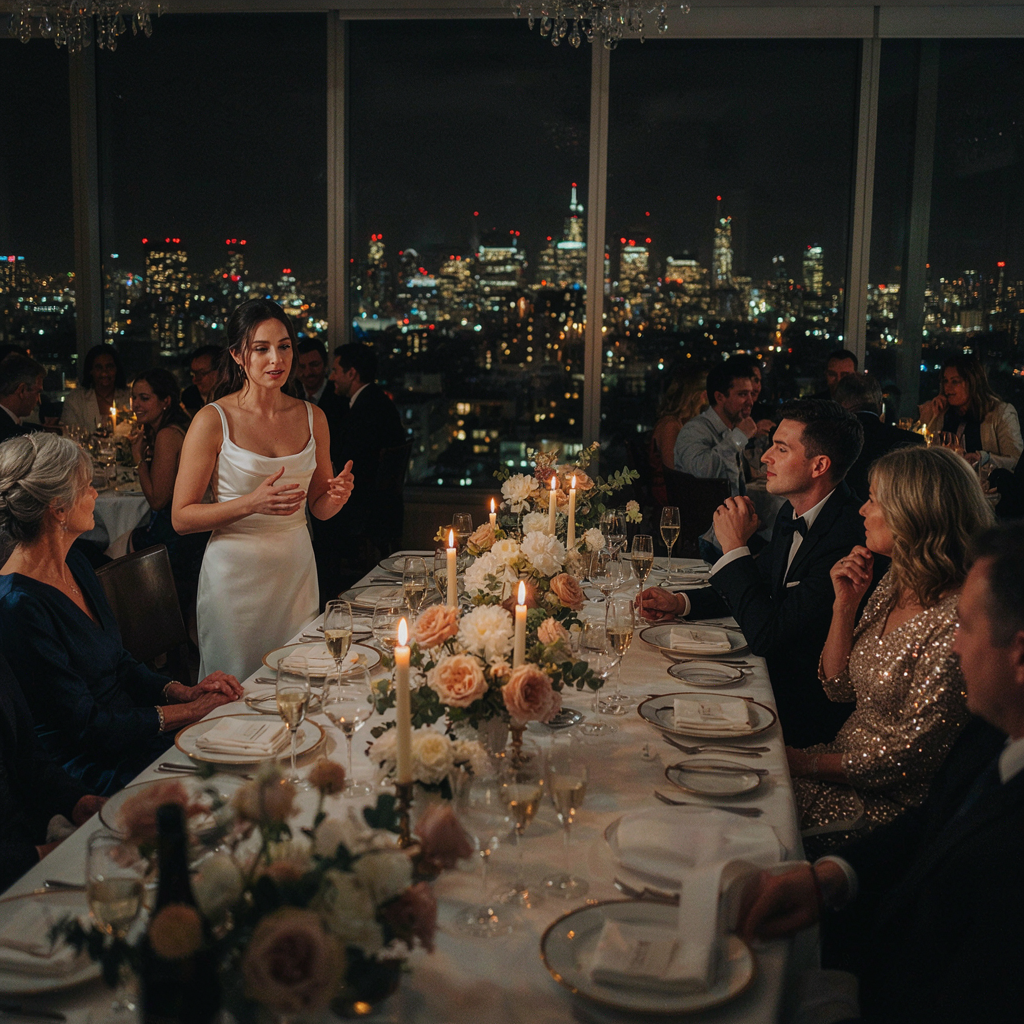
The moment my daughter’s future mother-in-law handed me a $5,217.86 restaurant bill, I realized I had been invited to an engagement dinner for one reason: to pay for a celebration I had never agreed to host.
But the money wasn’t what frightened me.
It was the way my daughter grabbed my wrist beneath the table and whispered, “Mom, please don’t make this worse.”
Her hands were trembling.
Across from us, Vivian Sutton sat beneath a crystal chandelier, smiling as though she had just performed an act of extraordinary generosity.
Twenty-three guests surrounded us, sipping expensive champagne and admiring the elaborate floral arrangements she had ordered without consulting anyone.
Then our waiter leaned toward me.
“Ma’am, could I speak with you privately?”
I assumed he wanted to discuss the outrageous bill.
Instead, he said something that made my stomach drop.
“Your daughter tried to leave before dinner started. She asked me if there was another way out.”
And suddenly, I understood that the woman sitting across from me hadn’t simply arranged an extravagant party.
She had created a situation my daughter was afraid to escape.
What I didn’t know was that the engagement dinner was only the beginning of Vivian’s plan.
And before the night was over, I would discover that my daughter’s wedding, my life savings, and the house my late husband had left us were all connected to a secret that had been carefully hidden from both of us.
The Dinner That Wasn’t Supposed to Happen
My name is Marilyn Bennett.
I’m fifty-eight years old, a widow, and the mother of one extraordinary daughter named Tessa.
My husband, Daniel, died six years ago after a sudden heart attack. Losing him was the kind of pain that divided my life into two parts: everything before that terrible morning and everything afterward.
Tessa was twenty-four when he died.
She had his dark brown eyes, his stubborn determination, and his habit of laughing at exactly the wrong moment.
After Daniel’s death, we became closer than ever.
I helped her through the difficult months when grief made ordinary things feel impossible. She helped me learn how to live in a house where every room held a memory of someone who was never coming home.
When she met Caleb Sutton three years later, I was genuinely happy for her.
Caleb was handsome, polite, and attentive. He worked in commercial real estate, remembered my birthday, and always brought flowers when he visited.
Most importantly, Tessa seemed happy.
But there was one thing about Caleb’s family that troubled me.
His mother, Vivian.
Vivian Sutton was the kind of woman who could turn a polite suggestion into a command without ever raising her voice.
She was elegant, wealthy-looking, and perfectly composed. Her silver-blonde hair was always styled, her clothes always expensive, and her smile always just warm enough to make refusing her feel impolite.
The first time I met her, she spent twenty minutes explaining why Tessa should stop wearing her hair naturally curly.
“Straight hair photographs so much better, sweetheart,” she had said.
Tessa laughed it off.
I didn’t.
But I told myself that every family had its difficult personalities.
Then came the engagement.
Caleb proposed during a weekend trip to Charleston. Tessa called me afterward, crying with happiness and holding her ring toward the camera.
I cried, too.
We agreed to celebrate with a small dinner.
Six people. Nothing elaborate.
Tessa had specifically requested something intimate because she wanted to enjoy the evening without turning it into a formal event.
Vivian offered to make the reservation.
That was our first mistake.
When I arrived at Marcellino’s, one of the most expensive restaurants in the city, I discovered that Vivian had reserved an entire private dining room.
There were twenty-three guests.
A long table glittered with crystal glasses, gold-rimmed plates, and enormous arrangements of white roses.
Custom menus displayed Tessa and Caleb’s names.
A decorative sign announced their wedding date.
Waiters circulated with champagne.
I recognized perhaps five people.
The others were Sutton relatives, Vivian’s friends, and acquaintances who appeared to know more about my daughter’s wedding than I did.
“Marilyn!” Vivian exclaimed when she spotted me.
She kissed the air beside my cheek.
“Isn’t it wonderful? I wanted to give the children a proper celebration.”
I looked toward Tessa.
She was standing beside Caleb, smiling weakly.
“Sweetheart,” I asked quietly, “did you know about all this?”
She shook her head.
Before I could ask anything else, Vivian swept us toward our seats.
For the next two hours, I watched my daughter become increasingly uncomfortable.
She barely touched her food.
Every time Vivian mentioned wedding arrangements, Tessa’s shoulders tightened.
Caleb repeatedly squeezed her hand, murmuring something I couldn’t hear.
I told myself they were simply overwhelmed.
Then dessert arrived.
And so did the bill.
Five Thousand Dollars and a Warning
The waiter placed a black leather folder beside Vivian.
She opened it, glanced at the total, and immediately slid it across the table toward me.
“Since this is for the bride,” she said sweetly, “I thought her family would want to take care of it.”
I opened the folder.
$5,217.86.
For several seconds, I genuinely believed there had been a mistake.
“Vivian,” I said, “you invited everyone here.”
“And you’re the mother of the bride.”
She delivered the sentence as though it explained everything.
I looked around the table.
A few guests pretended not to notice.
Others watched with the unmistakable interest of people witnessing an argument they would later discuss in their cars.
“I agreed to dinner for six,” I said.
Vivian tilted her head.
“Oh, Marilyn. Surely we aren’t going to make an issue of money on such a special evening.”
I felt heat rise into my face.
I was about to respond when Tessa caught my wrist.
“Mom, please.”
Her expression stopped me.
She wasn’t merely embarrassed.
She looked terrified of what might happen if I challenged Vivian.
Before I could ask why, our waiter approached.
His name tag read Luis.
“Ma’am, could I speak with you privately?”
I followed him into the hallway, assuming the restaurant had made some mistake with the bill.
But Luis didn’t mention money.
Instead, he told me Tessa had tried to leave before dinner.
“She came downstairs before most of the guests arrived,” he explained. “She asked if there was another exit.”
My heart began pounding.
“What did she say?”
Luis hesitated.
“She said, ‘I can’t do this tonight.’”
“Then what happened?”
“Her fiancé came looking for her. I heard him tell her they just needed to get through the evening.”
I closed my eyes.
That phrase sounded harmless.
But I knew my daughter.
Tessa was the kind of woman who could handle disappointment, awkward situations, and difficult people.
She didn’t search for emergency exits at her own engagement party.
“Why are you telling me this?” I asked.
Luis looked uncomfortable.
“Because everyone upstairs seems to be celebrating her.”
He paused.
“But she looked like someone who needed help.”
When I returned to the dining room, Vivian was laughing with the woman beside her.
Caleb stared into his water glass.
Tessa watched me anxiously.
I quietly placed my credit card inside the folder.
“Mom,” she whispered.
“It’s okay, sweetheart.”
I wasn’t paying because Vivian had won.
I was paying because I needed to get my daughter away from that table before I did anything else.
When Luis returned with my receipt, I signed it, tucked it into my purse, and turned to Tessa.
“Come downstairs with me.”
“Mom, please don’t start anything.”
“I’m not going to start anything.”
I reached for her hand.
“I just want to talk to my daughter.”
The Truth Beneath the Celebration
We found a quiet corner near the lobby.
Tessa stood with her arms wrapped around herself.
“Luis told me you tried to leave,” I said.
Her face went pale.
“He told you?”
“Yes.”
She looked away.
“I don’t want to talk about it here.”
“Then let’s go home.”
“No.”
“Why not?”
She glanced toward the stairs.
“Because then everyone will think I’m the problem.”
There it was.
The sentence that explained her trembling hands, her silence, and the fear in her eyes.
I took her gently by the shoulders.
“Tessa, what happened?”
She swallowed.
“Vivian announced we’re getting married at St. Matthews.”
I stared at her.
St. Matthews was the church where generations of Suttons supposedly married.
But Tessa and Caleb had been looking at outdoor venues.
They had visited a beautiful garden estate the previous weekend.
“I thought you wanted an outdoor ceremony,” I said.
“I do.”
“Did Caleb agree to the church?”
“He knew his mother wanted it.”
“What did he say when she announced it?”
Tessa laughed bitterly.
“Nothing.”
She explained that she had pulled Caleb downstairs before dinner and asked him to correct his mother.
Instead, he told her Vivian was excited and didn’t want to embarrass her.
Then he said the words Luis had overheard.
“Can we just get through tonight?”
Tessa’s eyes filled with tears.
“Mom, it’s always like that.”
And once she started talking, everything came pouring out.
Vivian had been making wedding decisions for months.
She wanted to expand the guest list, choose the florist, organize the bridal shower, approve the hotel arrangements, and select the rehearsal dinner menu.
She had strong opinions about Tessa taking the Sutton surname.
She assumed every future Thanksgiving would take place at her house.
Whenever Tessa objected, Caleb asked her to be understanding.
“She’s my mother,” he would say.
“She means well.”
“Can’t we compromise?”
Tessa wiped her eyes.
“He keeps saying he wants everyone to be happy.”
“What’s wrong with that?”
“Nothing. Except…”
Her voice broke.
“Everyone gets to be happy as long as I’m the one who gives up what I want.”
I pulled her into my arms.
For a moment, she was my little girl again, clinging to me after a nightmare.
Then she whispered something that hurt more than anything Vivian had done.
“I still love him, Mom.”
“I know.”
“He isn’t cruel. He doesn’t yell at me. He doesn’t tell me what I can wear or where I can go.”
She stepped back.
“He just keeps asking me to make myself smaller so his mother won’t be upset.”
I wanted to tell her to take off the ring.
I wanted to march upstairs and inform Vivian that she could organize her own life instead of everyone else’s.
But I remembered something Daniel used to say when Tessa was little.
“If you want her to become a strong woman, Marilyn, don’t make every difficult decision for her.”
So I took a breath.
“What do you want to do?”
“I don’t know.”
“Then you don’t have to decide everything tonight.”
She stared at me.
“You’re not going to tell me to call off the wedding?”
“No.”
“You’re not going to confront Vivian?”
“Not unless you want me to.”
I squeezed her hand.
“If you want to leave, we’ll leave. If you want to go upstairs and say nothing, I’ll sit beside you. If you want to correct that announcement, I’ll stand with you.”
Tessa looked toward the staircase.
Then she straightened her shoulders.
“I want to tell them the truth.”
The Toast That Changed Everything
When we returned upstairs, Vivian was standing with a champagne glass raised.
“Perfect timing!” she exclaimed.
Caleb looked relieved to see Tessa.
“To Caleb and Tessa,” Vivian began, “and to continuing our wonderful family tradition when they marry at St. Matthews!”
“Actually,” Tessa said.
She didn’t raise her voice.
She didn’t need to.
Every conversation stopped.
Vivian smiled.
“Yes, sweetheart?”
“We haven’t chosen St. Matthews.”
Vivian’s smile tightened.
“Of course, darling. There are still details to finalize.”
“No. We haven’t chosen a church at all.”
Caleb shifted uncomfortably.
“Tess…”
She turned toward him.
“How many times?”
“What?”
“How many times after we’re married are you going to ask me to just get through tonight?”
A woman at the far end of the table lowered her champagne glass.
Caleb flushed.
“I was trying not to embarrass my mother.”
Tessa nodded slowly.
“And what were you asking me to be?”
He couldn’t answer.
Vivian set down her glass.
“This is getting completely out of proportion. Our family has been married at St. Matthews for generations.”
“Then Caleb can marry there,” Tessa replied.
Several guests gasped.
“But if he wants to marry me, we’ll decide together.”
Vivian turned toward me.
“Marilyn, surely you understand that marriage requires compromise.”
Before I could respond, Tessa spoke.
“Compromise means sometimes I move toward Caleb, and sometimes he moves toward me.”
She looked directly at her fiancé.
“It doesn’t mean your mother chooses the direction and we both follow.”
Caleb lowered his head.
“Mom has always organized things. That’s just how our family works.”
Tessa stared at him.
“Then you need to decide whether you’re asking me to join your family or build one with me.”
The room fell silent.
I reached into my purse and removed the signed receipt.
I placed it in the center of the table.
Vivian looked down.
“What is that supposed to mean?”
“Dinner is paid for,” I said. “You invited these people. You organized this party. I paid the bill.”
Then I turned toward my daughter.
“So nobody here gets to say Tessa owes this table a wedding.”
Vivian opened her mouth.
I didn’t give her another argument.
“What happens next is Tessa’s decision.”
Then I stood and walked toward the lobby.
I wasn’t abandoning my daughter.
I was giving her the space to decide what she wanted without another parent speaking for her.
I had almost reached the staircase when I heard a chair scrape violently against the floor.
“Tessa, wait!”
Caleb’s voice echoed down the hallway.
Then he said something that made me stop.
“There’s something I need to tell you about what Mom and I planned.”
The Plan Behind the Perfect Dinner
I turned around.
Caleb had followed us into the hallway.
Tessa stood several feet behind him, her face unreadable.
“What plan?” she asked.
Caleb dragged a hand across his face.
“Please don’t look at me like that.”
“Then tell me what you’re hiding.”
He glanced toward the dining room.
His mother had appeared in the doorway.
“Caleb,” Vivian warned.
He looked at her.
“She deserves to know.”
“Not here.”
“Where, Mom? When?”
Vivian’s expression hardened.
Tessa folded her arms.
“Caleb, tell me.”
He took a shaky breath.
“Mom and I were going to announce that we’d booked St. Matthews for the wedding.”
“You already booked it?”
“Yes.”
Tessa stared at him.
“We hadn’t even chosen a venue.”
“I know.”
“When?”
“Three weeks ago.”
I watched my daughter’s face as the information sank in.
Caleb continued.
“The church had an opening next month. Mom thought it would be wonderful to have the ceremony sooner instead of waiting until next spring.”
“Next month?”
Tessa’s voice rose.
“We haven’t chosen invitations, a dress, or even our wedding party!”
“Mom said she could arrange everything.”
“Of course she did.”
Vivian stepped forward.
“There’s no need to be dramatic, Tessa. We’re trying to give you a beautiful wedding.”
My daughter ignored her.
She was staring at Caleb.
“You planned to announce a wedding date in front of twenty-three people before asking me?”
Caleb looked miserable.
“I thought if everyone was excited about it, you might see how special it could be.”
There it was.
The truth behind the dinner.
The guests, the custom menus, the champagne, the wedding sign.
Vivian hadn’t simply organized a celebration.
She had created an audience to make saying no feel impossible.
But Caleb wasn’t finished.
“There’s something else,” he said.
Vivian’s face changed.
“Caleb, enough.”
He shook his head.
“No, Mom. I’m tired of this.”
He looked at Tessa.
“After the wedding, Mom was planning to move into the guesthouse at your mother’s place.”
For a moment, nobody spoke.
Then I laughed.
Not because it was funny.
Because the statement was so outrageous that my mind refused to accept it.
“Excuse me?”
Caleb looked at me.
“Just temporarily.”
I stared at him.
“What guesthouse?”
“The little cottage behind your house.”
My backyard cottage.
The one Daniel had built with his own hands.
The one where Tessa used to paint when she was young.
The one I had converted into a small studio after my husband died.
“Why would Vivian move into my cottage?”
Caleb looked toward his mother.
And that was when she finally lost her composure.
“Because I need somewhere to live!”
The House They Had Already Chosen
Vivian’s declaration seemed to shake the entire hallway.
Tessa looked at her.
“What do you mean?”
Vivian lifted her chin.
“Robert and I are separating.”
Robert Sutton was Caleb’s father.
He had attended dinner but barely spoken all evening.
He was a quiet man with tired eyes who seemed to spend most of his time avoiding his wife’s attention.
I had assumed he was simply reserved.
Now I wondered how much he had been avoiding.
“Your father’s selling the house,” Vivian continued. “I’ll need somewhere suitable while we arrange the financial settlement.”
Tessa stared at Caleb.
“You knew about this?”
He nodded.
“For a few weeks.”
“And you thought my mother’s cottage was the solution?”
“Only temporarily.”
I felt something cold settle inside me.
“Did either of you consider asking me?”
Vivian gave an impatient sigh.
“Marilyn, it’s just sitting there. You live alone in that enormous house. Surely family should help family.”
I looked at her.
“My husband built that cottage.”
“And I’m sure he’d have wanted it put to good use.”
Her words struck something deep inside me.
Daniel had spent two summers building that little structure.
He had installed every window, laid every floorboard, and painted the walls himself.
He had wanted me to have a place where I could work on my watercolor paintings after retirement.
Vivian knew none of that.
To her, it was simply available space.
Tessa stepped between us.
“Mom’s cottage isn’t yours to offer, Caleb.”
“I didn’t offer it. Mom just thought—”
“Mom thought?”
My daughter looked at him.
“When exactly were you planning to ask what I thought?”
Caleb’s eyes filled.
“I don’t know.”
Vivian folded her arms.
“You’re all acting as though I want to move in permanently. It’s a temporary arrangement.”
“Then why didn’t you ask me?” I repeated.
She looked directly at me.
“Because I knew you’d make it difficult.”
I almost admired the honesty.
Almost.
“Then you already knew my answer.”
Vivian’s face flushed.
“You would really refuse to help your future family?”
Before I could respond, Tessa took my hand.
“Mom doesn’t have to explain herself.”
Caleb looked between us.
“Tessa, please. We can figure this out.”
She slowly removed her engagement ring.
For one terrible second, I thought she was about to hand it back.
But instead, she closed her fingers around it.
“I need you to tell me everything,” she said.
“Everything?”
“Yes.”
She looked toward Vivian.
“Because I don’t believe this dinner was just about a church and a cottage.”
The Envelope in Vivian’s Purse
Caleb looked down.
Vivian suddenly reached for her handbag.
“We’re leaving.”
“No,” Caleb said.
His mother froze.
“Excuse me?”
“I’m not leaving until I tell her.”
Vivian’s expression became frighteningly still.
“Caleb, remember what we discussed.”
He looked at Tessa.
Then at me.
“Mom has a problem with the bank.”
My heart began beating faster.
“What kind of problem?”
Caleb swallowed.
“The house is in foreclosure.”
Vivian’s face drained of color.
“That’s private.”
“Then you shouldn’t have involved Tessa.”
I stared at Caleb.
Robert was selling the house.
Vivian was moving into my cottage.
The wedding had suddenly been moved forward.
Nothing about those facts seemed accidental anymore.
“How much does she owe?” I asked.
Caleb hesitated.
“About two hundred and eighty thousand dollars.”
Tessa inhaled sharply.
“Caleb…”
“She took out a loan against the house after Dad retired. She invested in a business that failed. Then she borrowed more to cover the payments.”
Vivian turned away.
“I made investments. They didn’t work out. It happens.”
“Does Robert know?” I asked.
Caleb shook his head.
“He knows about some of it. Not all.”
Vivian spun around.
“That is enough!”
But something had changed in Caleb.
Perhaps he finally understood that the silence he had mistaken for loyalty was destroying the woman he loved.
He looked at his mother.
“Where’s the envelope?”
Vivian clutched her handbag.
“What envelope?”
“The one you brought for Marilyn.”
I felt the floor shift beneath me.
“For me?”
Caleb nodded.
“Mom was going to ask you to help us buy the house.”
I stared at him.
“What house?”
“Our house.”
He gestured helplessly.
“The house you live in now. The one Dad left you.”
For several seconds, the only sound I heard was the faint music coming from the restaurant.
I looked at Tessa.
She was as stunned as I was.
Caleb continued quickly.
“Mom thought if you sold your place, you could move into something smaller. We could use part of the money toward a down payment on a bigger house.”
“And Vivian would live there with you?” I asked.
He nodded miserably.
“Until she got back on her feet.”
I looked at Vivian.
“You planned to move into my cottage while arranging for my daughter and your son to use the money from selling my home?”
Vivian’s expression hardened.
“You’re making it sound ugly.”
“How would you describe it?”
“A sensible arrangement that benefits everyone.”
I felt an unfamiliar steadiness settle over me.
“And where would I live?”
Vivian hesitated.
“Somewhere smaller. Somewhere easier to maintain.”
I almost laughed again.
My home was a four-bedroom house on two acres.
Daniel and I had bought it when Tessa was a baby.
We had planted the maple trees along the driveway.
Every summer, we hosted family barbecues beneath the old oak tree.
I knew which stair creaked during winter and which window caught the morning sunlight.
That house was not an inconvenient piece of property waiting to be liquidated.
It was the place where my husband had loved us.
And Vivian Sutton had apparently decided that my memories were less important than her financial problems.
The Daughter Who Finally Said No
Tessa looked at Caleb.
“Did you know they wanted Mom to sell her house?”
He didn’t answer.
“Caleb.”
“Mom said you might eventually inherit it anyway.”
My daughter recoiled.
“Mom is fifty-eight years old!”
“I know.”
“She’s not dead!”
“I know, Tessa!”
His voice cracked.
“I know how terrible it sounds!”
Vivian stepped forward.
“Marilyn is perfectly capable of speaking for herself.”
“Then stop making plans with her property!” Tessa snapped.
Vivian stared at her.
It was the first time I’d ever heard my daughter raise her voice at that woman.
And for the first time, Vivian seemed genuinely uncertain what to say.
Tessa turned back to Caleb.
“Why didn’t you tell me?”
“I thought we could talk about it after the engagement dinner.”
“After everyone had celebrated the wedding you planned without me?”
Caleb covered his face.
“I thought I could keep everyone happy.”
My daughter shook her head.
“No. You thought you could keep your mother happy and convince me to accept the consequences.”
He lowered his hands.
“I love you.”
“I love you, too.”
For a moment, hope flashed across his face.
But Tessa wasn’t finished.
“And that’s what makes this so painful. Because loving you has somehow become a reason to stop loving myself.”
Caleb looked as though she had struck him.
She opened her hand and looked down at the engagement ring.
“I thought we were building a future together.”
“We are.”
“No. Your mother has been building our future, and you’ve been asking me to move into it.”
He reached for her.
She stepped back.
“Please don’t.”
His hand fell.
Vivian suddenly laughed.
It was a harsh, disbelieving sound.
“You’re really going to throw away a wonderful relationship over a house and a few wedding arrangements?”
Tessa looked at her.
“No.”
She slipped off the ring.
“I’m refusing to marry a man who can’t tell me the truth until his mother gives him permission.”
Then she placed the ring in Caleb’s palm.
I had imagined my daughter’s engagement ending with shouting, accusations, or tears.
Instead, it ended in silence.
Caleb stared at the diamond.
Vivian looked from one face to another, searching for someone who would restore the evening to the version she had carefully arranged.
Nobody did.
Tessa turned toward me.
“Mom, can we go home?”
I reached for her hand.
“Of course.”
But before we could leave, a quiet voice came from behind us.
“Marilyn?”
It was Robert Sutton.
And in his hands was the same cream-colored envelope Caleb had mentioned.
The Man Who Had Been Silent All Evening
Robert looked twenty years older than he had when dinner began.
His gray hair was disheveled, and his normally composed expression had collapsed into something I could only describe as exhaustion.
“There’s something you need to see,” he said.
Vivian immediately stepped between us.
“Robert, don’t.”
He looked at his wife.
“Move.”
It wasn’t loud.
But it was the first time I had ever heard him speak to her with authority.
Vivian stepped aside.
Robert held out the envelope.
“I found this in her handbag before dinner. I was going to ask her about it privately, but I think that’s no longer possible.”
I took it.
Inside was a neatly typed letter addressed to me.
At the top was the name of a real estate brokerage.
The letter described a preliminary offer to purchase my property.
My house.
My land.
My husband’s cottage.
Everything.
I stared at the figure printed halfway down the page.
$1,150,000.
Then I saw the line beneath it.
The proceeds were to be distributed toward a proposed joint property purchase involving Caleb Sutton and Tessa Bennett.
A smaller portion was designated for my future housing arrangements.
I read it twice.
Then a third time.
“Where did this come from?”
Caleb looked bewildered.
“Mom?”
Vivian’s lips pressed into a thin line.
“I asked an agent to prepare some possibilities.”
I turned the page.
There was a photograph of my house.
My front porch.
The maple trees.
The little cottage behind the garage.
Someone had taken photographs of my property without telling me.
“How did you get these?”
Vivian looked irritated.
“Caleb took them when he visited.”
Tessa slowly turned toward him.
“You took pictures of Mom’s house?”
He looked sick.
“Mom asked me to. She said she wanted to see whether the cottage would be suitable.”
I remembered that visit.
Caleb had come over one Saturday to help me move a heavy bookshelf.
He had wandered around the backyard afterward, telling me how beautiful the property looked.
I had been grateful for his help.
Now the memory made me feel physically ill.
Robert looked at his son.
“Did you know she was planning to sell Marilyn’s home?”
“No.”
Caleb looked at Vivian.
“You told me you wanted pictures of the cottage.”
Vivian threw up her hands.
“Because I was exploring options!”
Robert shook his head.
“You were exploring options with property that doesn’t belong to you.”
For a moment, nobody spoke.
Then Robert turned toward me.
“Marilyn, I’m sorry. I had no idea she had gone this far.”
I looked at the envelope again.
The house.
The money.
The wedding.
Suddenly, all of it made sense.
Vivian wasn’t simply trying to control her son’s future.
She was trying to solve her financial problems by making the rest of us surrender ours.
And she had nearly succeeded in making my daughter believe that resisting her would destroy the family.
The Last Secret in the Folder
Robert reached into the envelope again.
“There’s another page.”
Vivian lunged forward.
“Give me that!”
Robert stepped away.
“Why?”
“Because it’s none of their business!”
He removed a document bearing the letterhead of a private lending company.
I saw Vivian’s name.
Then Caleb’s.
Then a figure that made the restaurant bill seem almost laughable.
$312,000.
Robert’s hand trembled.
“What is this?”
Vivian didn’t answer.
Caleb took the page.
He read the first paragraph.
Then the second.
His face went white.
“Mom,” he whispered.
Tessa watched him.
“What is it?”
Caleb looked at his mother.
“You told me the foreclosure was for two hundred and eighty thousand.”
“It is.”
“Then what’s this?”
Vivian reached for the document.
Caleb held it away from her.
I stepped closer.
The page described a proposed private loan secured by the Sutton property, with repayment expected from an anticipated family property transaction.
I didn’t understand every legal term.
But I understood enough.
Vivian had approached a private lender.
She had represented the sale of my house as part of her expected financial arrangements.
And she had used the proposed marriage between our children to make the transaction appear plausible.
I looked at Robert.
“Can she do this?”
He shook his head.
“Not without your consent. This appears to be a proposal, not a completed loan.”
Vivian exhaled sharply.
“Exactly! Nothing has happened!”
“But you were planning to ask me to sign something tonight,” I said.
She didn’t answer.
Caleb looked at her.
“The envelope. You said it was just information for Marilyn.”
Vivian folded her arms.
“I needed to know whether the arrangement was possible.”
“Did you tell the lender Marilyn had agreed?”
Silence.
Robert read the document again.
Then his expression changed.
“Vivian, did you tell them this wedding was happening next month because you needed to close the loan before the foreclosure?”
She looked away.
That was answer enough.
Tessa stepped back.
The wedding date.
The church.
The twenty-three guests.
The expensive celebration.
Everything had been arranged to create the appearance of a marriage that would make Vivian’s financial rescue possible.
My daughter covered her mouth.
“You weren’t celebrating our engagement,” she whispered.

Vivian finally looked at her.
“Of course I was.”
“No.”
Tessa’s eyes filled.
“You needed us to get married.”
Vivian’s expression hardened.
“I needed my son to have a future.”
“And what about mine?”
Vivian said nothing.
I reached for my daughter’s hand.
But before I could lead her away, Robert spoke.
“There’s one more thing.”
He looked at Vivian.
And the expression on his face frightened me more than anything I had seen that night.
“Tell them what happened to the original money.”
The Money Nobody Knew Was Missing
Vivian closed her eyes.
“Robert, please.”
“No.”
His voice shook.
“I’ve spent eighteen months trying to protect this family from the consequences of your decisions. I’m not going to let you destroy another one.”
Caleb stared at his father.
“What original money?”
Robert looked at him.
“The trust your grandmother left you.”
Caleb’s expression changed.
“My trust?”
I glanced at Tessa.
She looked as confused as I felt.
Robert took a deep breath.
“When your grandmother died, she left money for you. The account was supposed to help you buy your first home.”
Caleb nodded slowly.
“I know. Mom said the investments lost value.”
Robert shook his head.
“That’s not what happened.”
Vivian whispered his name.
He ignored her.
“The money wasn’t lost in the market.”
Caleb stared at his mother.
“What did you do?”
Vivian’s eyes filled.
“I borrowed it.”
“How much?”
She didn’t answer.
“Mom. How much?”
Robert spoke quietly.
“One hundred and eighty thousand dollars.”
Caleb stumbled backward.
I caught the edge of a chair.
Tessa covered her mouth.
Vivian began talking quickly.
“It was supposed to be temporary. The business was struggling, and I couldn’t tell Robert how bad things had become. I thought I could replace the money before anyone noticed.”
Caleb looked devastated.
“You told me Grandma’s investments failed.”
“I was going to pay you back.”
“When?”
Vivian started crying.
It was the first time I had seen her look anything less than perfectly composed.
“I was desperate!”
Robert shook his head.
“Caleb’s grandmother left that money to him directly. Vivian was helping administer the account. When I discovered what had happened, I insisted she make arrangements to repay it.”
Caleb sank into a nearby chair.
For the first time, I saw something in him that reminded me of Tessa.
Not weakness.
Not cowardice.
A person realizing that the parent he had spent his life trying to please had been hiding the truth from him.
He looked at Vivian.
“You wanted me to marry Tessa so you could use her mother’s house to replace the money you took from me?”
Vivian shook her head.
“Not like that.”
“Then explain it.”
She looked toward Robert.
Then me.
Then Tessa.
Nobody rescued her.
Finally, she whispered, “I thought once everyone was settled, we’d all be happy.”
Caleb laughed bitterly.
“Everyone?”
He looked at Tessa.
Then at me.
“You were going to take her mother’s home to pay back money you took from your own son.”
Vivian began crying harder.
And for one brief moment, I almost felt sorry for her.
Almost.
Then I remembered my daughter’s trembling hands beneath the table.
And the sympathy vanished.
What My Daughter Did Next
Tessa stood beside Caleb’s chair.
He looked up at her.
“I’m sorry.”
She nodded.
“I know.”
“I didn’t know about the trust. I didn’t know about the lender.”
“I believe you.”
He reached for her hand.
For a moment, she let him hold it.
Then she gently pulled away.
“But you knew about the church,” she said.
He lowered his head.
“And the cottage.”
“Yes.”
“And you let me believe I was imagining things every time I said your mother was taking over our lives.”
Caleb’s eyes filled.
“I’m sorry.”
“I know.”
She looked at him for a long moment.
“Your mother lied to you. That’s terrible, and you didn’t deserve it.”
His lips trembled.
“But you also made choices, Caleb. You chose not to tell me things you knew would hurt me.”
He nodded.
“And I can’t build a marriage with someone who thinks keeping me in the dark is the same thing as protecting me.”
He looked down at the engagement ring.
“Is there any chance we can fix this?”
Tessa’s eyes filled again.
“I don’t know.”
She took a breath.
“But I’m not marrying you next month. And I’m not putting this ring back on tonight.”
Caleb closed his eyes.
Then he nodded.
“Okay.”
It was the first time I had heard him accept one of her decisions without immediately explaining how his mother might feel about it.
Vivian stood beside the wall, looking utterly defeated.
Robert approached her.
“We need to speak with the attorneys tomorrow.”
She looked up sharply.
“You’re really going to divorce me over this?”
Robert stared at her.
“No, Vivian.”
He paused.
“I’m divorcing you because you’ve spent years treating love as permission to make decisions for everyone else.”
Then he turned to Caleb.
“Son, I’ll help you understand what happened with your grandmother’s trust. We’ll find out what can be recovered.”
Caleb nodded silently.
Robert looked at me.
“Marilyn, please have your own attorney review whatever Vivian prepared. Your property shouldn’t have been involved in any of this.”
“I will.”
He hesitated.
“And I’m sorry about dinner.”
I looked toward the dining room.
Twenty-three guests were probably discussing the collapse of the perfect Sutton engagement.
I took the receipt from my purse.
“Believe me, Robert. Dinner was the cheapest lesson I’ll ever learn.”
Then Tessa and I left.
The Drive Home
We didn’t speak much in the car.
The city lights passed across Tessa’s face as she stared out the window.
I wanted to tell her she would be okay.
I wanted to promise that someday she would meet someone who loved her without conditions.
But I knew how empty those promises could sound when your heart was breaking.
So I simply drove.
When we reached home, Tessa looked toward the little cottage behind the garage.
The porch light was glowing.
Daniel had installed that light himself.
He used to leave it on whenever Tessa came home late from college.
She stared at it for a long moment.
Then she whispered, “Dad would have hated tonight.”
I smiled sadly.
“Your father would have spent the first twenty minutes trying to understand how dinner for six became dinner for twenty-three.”
Tessa laughed through her tears.
“And then?”
“He would have asked Vivian whether the champagne came with a mortgage.”
She laughed harder.
For the first time that night, the sound was genuine.
I unlocked the front door.
Inside, the house smelled faintly of lavender and the cinnamon candles I kept in the kitchen.
Tessa walked straight to the family photographs on the mantel.
She picked up one taken on her sixteenth birthday.
Daniel stood behind us, grinning, with his arms around both our shoulders.
She touched his face.
“I almost let them take this house away from you.”
I stepped beside her.
“No, sweetheart.”
“I didn’t even know what they were planning.”
“Neither did I.”
She looked at me.
“You paid five thousand dollars because you thought it would make things easier for me.”
I nodded.
“At the time, I thought the bill was the problem.”
She shook her head.
“Mom, you shouldn’t have had to pay.”
“No. I shouldn’t.”
I smiled faintly.
“But I would pay it again if it meant getting you out of that room.”
She put down the photograph and hugged me.
For a long time, we stood together in the house Daniel had built our lives around.
Then she whispered something I will never forget.
“I thought saying no meant I was destroying my future.”
I kissed her forehead.
“Sometimes saying no is how you save it.”
Six Months Later
The following months were difficult.
Robert filed for divorce.
Vivian retained an attorney, and the financial mess surrounding the Sutton property and Caleb’s inheritance became the subject of a long, complicated legal process.
My own attorney reviewed the documents Robert had given us.
Fortunately, the proposed property transaction had never been completed.
My house had not been sold, mortgaged, or legally committed to anything.
The photographs and preliminary paperwork were disturbing, but Vivian had no authority to transfer my property without my participation.
I changed my security codes anyway.
I also made it clear that nobody connected to Vivian was permitted to enter my property without my invitation.
Tessa took a break from wedding planning.
Then she took a break from Caleb.
He didn’t argue.
Instead, he started counseling, moved out of his parents’ house, and began untangling his finances from his mother’s.
He sent Tessa a letter.
Not a dozen messages.
Not flowers.
Not an expensive apology.
A handwritten letter acknowledging the specific things he had done wrong.
Tessa read it three times.
Then she placed it in a drawer.
“Are you going to answer?” I asked.
“Not yet.”
And I didn’t push.
Over the next several months, my daughter began returning to herself.
She started painting again.
She spent weekends in the cottage.
She went hiking with friends and accepted an exciting promotion at the architecture firm where she worked.
One Sunday morning, I found her sitting on the back porch with a cup of coffee.
“Mom,” she said, “I think I want to buy a place of my own.”
I smiled.
“Then let’s start looking.”
She shook her head.
“Not a house.”
“What, then?”
She pointed toward the cottage.
“Something like that.”
I laughed.
“Sweetheart, you practically grew up in that place.”
“I know.”
She smiled.
“And Dad always said that if I ever wanted to build something, I should start with the foundation.”
Something in her expression made me pause.
“What are you planning?”
She pulled a folded sheet of paper from her pocket.
It was a sketch.
A beautiful little building with wide windows, a covered porch, and a garden.
At the top, she had written a name.
The Second Beginning.
“It’s a studio,” she explained. “For women who are starting over. I want to teach weekend design workshops and help people create homes that feel like their own.”
I stared at the drawing.
Then at my daughter.
“You’ve been working on this?”
“For months.”
She smiled.
“I think I’m finally ready to build something that belongs to me.”
I hugged her.
But that wasn’t the last surprise waiting for us.
Not even close.
The Letter That Arrived on a Tuesday
Almost eight months after the engagement dinner, a letter arrived from a law firm.
It was addressed to me.
Inside was a cashier’s check for $5,217.86.
The exact amount of the dinner.
Attached was a brief note from Robert.
Marilyn, this is reimbursement for an expense you should never have been asked to pay. I hope you and Tessa are doing well.
I stared at the check.
For a moment, I considered returning it.
Robert hadn’t arranged the dinner.
He hadn’t handed me the bill.
But I knew what he meant.
He was trying to correct one small part of a much larger wrong.
I deposited the money.
Then I called Tessa.
“Guess what arrived today?”
When I told her, she laughed.
“Well, at least someone in that family understands how a bill works.”
I smiled.
“What should we do with it?”
“Whatever you want, Mom. It’s your money.”
I thought about that for a moment.
Then I remembered the sketch she had shown me.
“The Second Beginning,” I said.
“What?”
“Your studio. Let’s put the money toward it.”
There was a long silence.
“Mom, you don’t have to do that.”
“I know.”
I looked out the kitchen window toward Daniel’s cottage.
“That’s what makes it different. I’m choosing to.”
The Final Surprise
Three months later, Tessa and I attended a small gathering to celebrate the opening of her studio.
She had rented a beautiful little space near downtown, with exposed brick walls, large windows, and sunlight pouring across the wooden floors.
There were flowers, music, and trays of sandwiches.
Nothing extravagant.
No custom menus.
No surprise guests.
And absolutely no five-thousand-dollar bills.
I was arranging cups on the refreshment table when someone tapped me on the shoulder.
“Mrs. Bennett?”
I turned.
Standing before me was Luis.
The waiter from Marcellino’s.
For a moment, I couldn’t believe it.
“Luis?”
He smiled.
“Tessa invited me.”
I looked toward my daughter.
She was across the room, talking with a group of women.
“How do you two know each other?”
Luis hesitated.
Then he reached into his jacket pocket.
“I’ve actually been meaning to give you something.”
He handed me a small envelope.
Inside was a photograph.
It showed a young man standing outside a modest house beside a dark-haired woman holding a baby.
I looked closer.
The woman was younger, but unmistakable.
Vivian Sutton.
I looked up.
“Luis, what is this?”
His expression grew serious.
“That’s my mother.”
I stared at him.
For a moment, the noise of the room seemed to disappear.
“Your mother?”
He nodded.
“Vivian was married before she met Robert. I was born during that marriage.”
I looked down at the photograph again.
Vivian.
The baby.
Luis.
“Does Caleb know?”
“He found out recently.”
My mind raced.
“But you were working at the engagement dinner.”
Luis nodded.
“I knew who she was. She didn’t recognize me.”
He gave a small, sad smile.
“I hadn’t seen her since I was a teenager. She knew I worked in hospitality, but not where.”
I looked at the photograph again.
“Why did you tell me about Tessa that night?”
His eyes softened.
“Because I’ve spent most of my life wondering whether things might have been different if someone had noticed how unhappy I was.”
I couldn’t speak.
Luis looked toward Tessa.
“Your daughter reminded me of myself.”
He told me Vivian had left his father when Luis was young.
After her second marriage, she gradually stopped contacting him.
She sent occasional birthday cards and money, but rarely visited.
When Luis became an adult, he tried to rebuild their relationship.
Vivian offered him financial assistance if he would leave his restaurant job and join the Sutton family business.
He refused.
She told him he was throwing away an opportunity.
He told her he wanted to decide his own future.
They hadn’t spoken since.
“I didn’t know how to tell Caleb,” Luis said. “And I didn’t want to make your daughter’s engagement dinner about me.”
I looked at him.
“But you saw her trying to leave.”
He nodded.
“And I recognized that look.”
I thought about the hallway.
The way he had hesitated before telling me.
The way he’d said everyone upstairs looked like they were celebrating Tessa, but she didn’t look happy.
He hadn’t simply been a concerned waiter.
He had been a son watching his mother repeat the same pattern with another person.
I reached for his hand.
“Thank you for helping my daughter.”
He smiled.
“She helped me, too.”
I looked toward Tessa.
She was walking toward us.
Caleb was beside her.
I hadn’t seen him arrive.
They weren’t holding hands.
But they were smiling.
Tessa approached and gently touched Luis’s shoulder.
“Mom, I see you’ve met Caleb’s brother.”
I looked at her in astonishment.
“You knew?”
She nodded.
“Caleb told me a few weeks ago.”
Caleb looked at Luis.
“We’re still figuring things out.”
Luis smiled.
“One step at a time.”
I studied the two brothers.
One had grown up inside Vivian’s carefully controlled world.
The other had grown up outside it.
Yet somehow, on the night my daughter most needed help, the brother Vivian had pushed away was the one who recognized the danger.
Caleb turned toward Tessa.
“I should get going.”
She nodded.
“Thanks for coming.”
He smiled.
“I’m proud of what you’ve built.”
Then he looked at me.
“Mrs. Bennett, it’s good to see you.”
I nodded.
“You too, Caleb.”
He left with Luis.
I watched them walk down the sidewalk together.
Then I turned toward my daughter.
“Are you two getting back together?”
She smiled.
“I don’t know.”
“Do you want to?”
“Maybe someday.”
She looked around her studio.
“But I’m not putting my life on hold while he figures out his.”
I reached for her hand.
She squeezed it.
Then she led me toward the wall near the entrance.
A framed photograph hung there.
Daniel stood in front of the cottage, laughing, with a paintbrush in one hand.
Beside it was a small plaque.
I leaned closer to read it.
THE SECOND BEGINNING
Founded in memory of Daniel Bennett, who taught his daughter that the strongest foundations are built on love, honesty, and the freedom to choose.
My vision blurred.
Tessa rested her head against my shoulder.
“Do you think Dad would like it?”
I looked at my daughter’s beautiful studio.
At the sunlight flooding through the windows.
At the women laughing together over coffee.
At the life she was building with her own hands.
“Sweetheart,” I whispered, “he would be so proud.”
And as I stood there, I finally understood something about that terrible engagement dinner.
Vivian had handed me a bill because she believed that being the mother of the bride meant I was responsible for paying whatever price her family demanded.
She had tried to turn love into obligation.
She had tried to turn marriage into a transaction.
And she had nearly convinced my daughter that keeping everyone else happy mattered more than her own future.
But she had overlooked one thing.
A mother’s greatest gift isn’t the money she gives her child, the sacrifices she makes, or the problems she solves.
It’s raising a daughter who knows she has the right to say no.
I had paid $5,217.86 for a dinner I never wanted.
But I had walked out of that restaurant with something Vivian Sutton would never be able to buy.
My daughter’s trust.
And when she finally began building a future of her own, she didn’t need twenty-three guests, an expensive church, or anyone else’s permission.
She only needed the courage to choose herself.