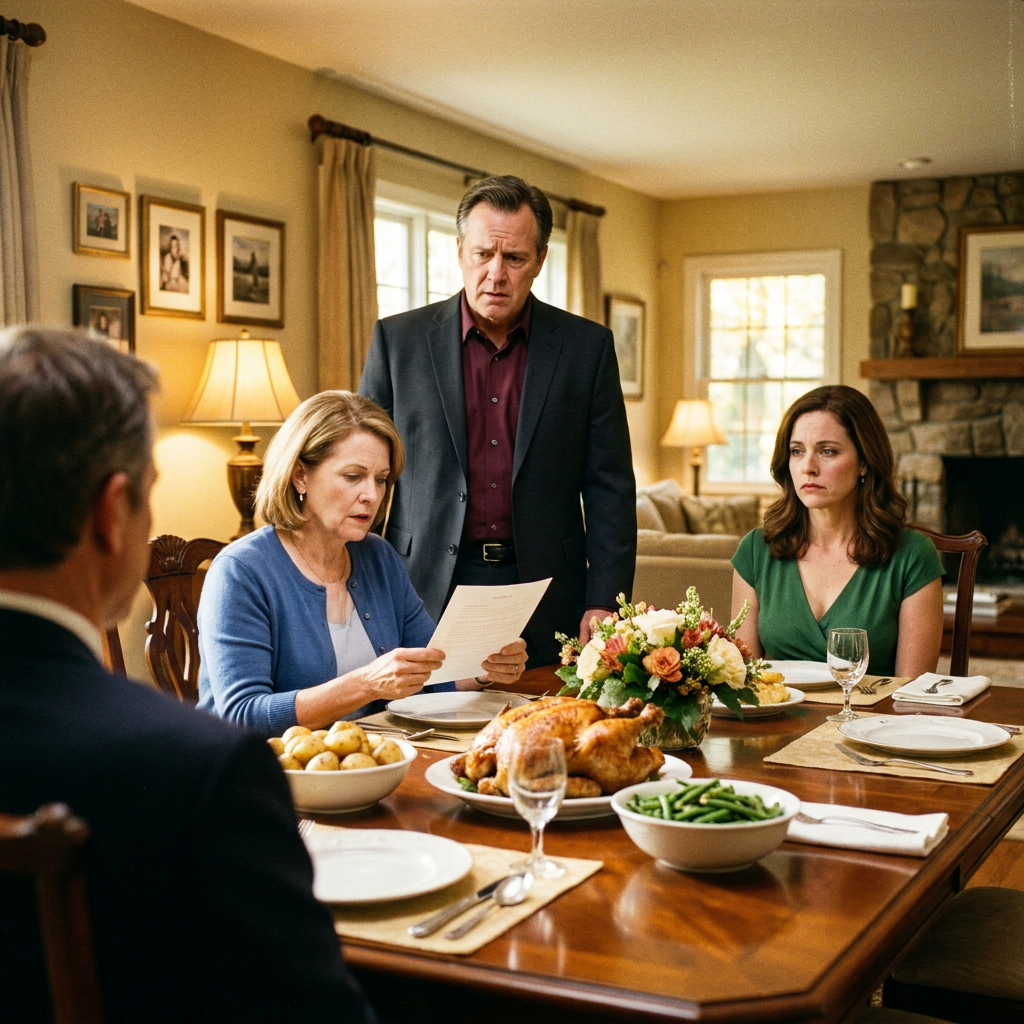
“My son looked me straight in the eye and said, ‘Sarah thinks you’ve become a burden. And honestly, Mom… I think she’s right.’I simply replied, ‘Good to know.’That night, I made one quiet decision.
But at Sunday dinner, with everyone sitting around my table, I looked at my son and said something that left the entire room speechless.”
“Sarah thinks you’re a burden,” David said, placing his coffee mug on my granite counter.
Then he met my eyes.“And honestly, Mom, I agree.”
For a moment, the kitchen became so silent that I could hear the refrigerator running.David was thirty-two years old, standing in the four-bedroom home his father and I had spent decades building.
He was wearing the neatly pressed shirt I had ironed for him that morning.He seemed to be waiting for me to cry.
Instead, I gave him three simple words.“Good to know.”His expression tightened.
“That’s all you’re going to say?”
“What exactly would you like me to say, David? You’ve made your feelings perfectly clear.”He picked up his keys.
“We just need you to be a little more accommodating. We can talk about this properly at Sunday dinner. Sarah’s parents will be there.”
Then he walked out.
I stood alone in my kitchen.
For thirty-two years, I had thought I understood my son.
Apparently, I understood the little boy he used to be.
Not the man standing in front of me.
David and Sarah had moved into my home eight months earlier because rent in the city had become too expensive and they wanted to save money for a house of their own.
I told them they could stay temporarily.
“Six months,” I had said.
“Maybe eight,” David promised.
“Just until we get ahead.”
I gave them the guest rooms.
I adjusted my schedule around theirs.
I cooked most of their meals.
I washed their clothes.
I let them use my garage while my own car sat outside.
I never asked for rent.
I never charged them for groceries.
I never complained when Sarah spent an hour in the shower while I waited to use the bathroom.
I told myself I was helping my son.
Then, slowly, something changed.
Sarah began rearranging my furniture because she thought my decorating style looked “outdated.”
David started suggesting we order more expensive takeout because, as he put it, I could “just put it on my card.”
They filled the refrigerator with food I paid for.
Their cars stayed safely inside my garage while mine remained in the driveway.
They started treating my home like a hotel.
At some point, without realizing it, I had become unpaid household staff inside my own house.
And apparently, I was now a burden.
That night, I went upstairs.
I opened the drawer beside my bed.
Inside was a photograph of Arthur and me standing in front of this house on the day we bought it.
We were younger.
Thinner.
Naive.
Happy.
Arthur had one arm around my shoulders and the other holding the keys.
He had written on the back:
“Our first home. Our forever place.”
Arthur had been gone for six years.
But every corner of that house still carried him.
The scratch on the dining room floor came from the piano bench he had dragged across the room.
The dent in the hallway wall came from when David was nine and tried to practice baseball indoors.
The kitchen cabinets were the ones Arthur had installed himself.
Every mortgage payment.
Every repair.
Every tax bill.
Every sacrifice.
Arthur and I had paid for all of it.
David had contributed nothing.
And yet somehow, I was the burden.
I put the photograph back.
Then I opened my laptop.
I spent the next two hours reviewing my finances.
Retirement accounts.
Savings.
Investments.
Property documents.
Insurance.
Everything.
At 11:47 p.m., I closed the laptop.
I wasn’t angry anymore.
I was clear.
Tuesday morning, Sarah walked downstairs and suddenly stopped.
“There’s no coffee.”
I was sitting on the patio with a cup of chamomile tea and a book.
“The coffee beans are in the pantry,” I said.
She frowned.
“You always make the coffee.”
“I decided to drink tea.”
About ten minutes later, she returned carrying a basket of laundry.
“My silk blouse isn’t clean.”
“I washed my clothes yesterday.”
Her eyes narrowed.
“You didn’t wash ours?”
“The washing machine instructions are in the top drawer.”
She stared at me as though I had lost my mind.
“Is this because of what David said? Are you seriously throwing some kind of tantrum?”
I stood, picked up my tea, and looked directly at her.
“A tantrum is something a child throws when she doesn’t get what she wants.”
I paused.
“You’re thirty years old, Sarah. Wash your own blouse.”
Then I walked past her.
That afternoon, I noticed a glossy brochure partially hidden beneath the mail.
Sunset Pines.
Independent and Assisted Living for the Golden Years.
I picked it up.
The cover showed a smiling gray-haired woman playing bingo.
I was sixty-four years old.
I ran three miles every morning.
I managed my own retirement investments.
I volunteered at the botanical garden.
I drove myself everywhere.
I lived independently.
I didn’t need assisted living.
Then I noticed something written in blue ink on the brochure.
A phone number.
And beneath it:
“Ask about two-bedroom transition units.”
I stared at it.
Suddenly, their plans became clearer.
They weren’t just imagining me somewhere else.
They had already started researching it.
I dropped the brochure into the trash.
That afternoon, I drove to the bank.
After Arthur died, I had added David to one of my checking accounts in case of an emergency.
I sat across from a bank employee.
“I’d like to open a new account in my name only.”
“Of course.”
“And I’d like every card connected to the old account deactivated.”
She nodded.
I transferred the funds.
Then I reviewed my beneficiaries.
I changed nothing impulsively.
Instead, I scheduled an appointment with my attorney.
On my way home, I stopped at the grocery store.
I bought salmon, asparagus, fresh bread, and one bottle of pinot noir.
Only enough for one person.
At six that evening, David opened the refrigerator.
“Mom!”
I continued reading.
“Where’s all the meal prep? Where’s the chicken and protein stuff?”
“I only bought groceries for myself.”
Silence.
Then came the sound of cabinet doors.
A few minutes later, David came back.
“You’re seriously doing this?”
“Doing what?”
“Acting like we don’t live here.”
“You do live here.”
“Then why aren’t you cooking?”
I looked over my glasses.
“Because I don’t want to.”
He stared at me.
“You’ve changed.”
“No.”
I smiled faintly.
“I’ve stopped doing things I don’t want to do.”
That night, they ordered food.
Not for me.
I didn’t mind.
For the first time in months, dinner was peaceful.
Thursday evening, David stormed into my study holding his tablet.
“The Wi-Fi isn’t working.”
“I changed the password.”
His mouth fell open.
“We live here too.”
“The internet account is in my name. You’re welcome to arrange your own service.”
“You’re being ridiculous.”
I finally looked up from my paperwork.
“You told me I was a burden, David. I’m simply trying to make myself less burdensome.”
His face flushed.
“We’re trying to save money, and you’re suddenly acting like some greedy landlord.”
“A landlord collects rent.”
I paused.
“You haven’t paid me a dollar in eight months.”
He slammed the door.
I waited until his footsteps disappeared upstairs.
Then I picked up my phone.
“Marcus? It’s Teresa.”
Marcus had been Arthur’s longtime friend and a licensed property appraiser.
“I need you to come by and give me a valuation on the house.”
There was a pause.
“Are you selling?”
“I’m considering my options.”
He came Friday morning.
He walked through every room.
Checked the basement.
Inspected the roof.
Reviewed the renovations.
Finally, he sat across from me at the kitchen table.
“Teresa, if you listed this properly, you’re looking at somewhere around $780,000.”
I nodded.
“I thought it might be close to that.”
“Maybe more, depending on timing.”
After he left, I sat quietly.
Seven hundred eighty thousand dollars.
A house I had been treating like a family inheritance.
A house my son had apparently begun treating like his future property.
That afternoon, Sarah changed tactics.
She found me outside watering my hydrangeas.
“We’re family,” she said softly.
I turned off the hose.
“What does support mean to you?”
She hesitated.
“Sharing meals. Helping each other with chores. Internet. Things like that.”
Then she added:
“And David said you changed the bank account.”
There it was.
Not concern for me.
Concern for my money.
“My finances belong to me,” I said calmly.
“I worked forty years as an accountant. Arthur worked on the railroad. Everything we have came from decades of work.”
She crossed her arms.
“You have more than enough, Teresa.”
I looked at her.
“Enough for what?”
“Your own son is trying to build a future.”
“And?”
She sighed.
“You could help us.”
“I already have.”
She didn’t answer.
“Sunday dinner is at six,” I said.
“Be on time.”
Sunday evening arrived.
Sarah’s parents, Richard and Linda, arrived at 5:45.
Sarah welcomed them as though she owned the place.
David poured wine without meeting my eyes.
For the first half of dinner, everyone made polite conversation.
Richard asked about the weather.
Linda complimented the roast.
Sarah talked about a neighborhood she and David had been researching.
I listened.
Then David placed his fork beside his plate.
“Mom, Sarah and I want to talk to you about your future.”
I calmly adjusted the napkin on my lap.
Sarah smiled.
“We found this wonderful community called Sunset Pines. They have medical staff, activities, social events, everything.”
David nodded.
“You need more care, Mom.”
I said nothing.
“And Sarah and I need a home.”
There it was.
“We could take responsibility for this place while you move somewhere that’s better suited for you.”
He smiled.
“It’s a win-win.”
The table became completely still.
Richard and Linda looked toward me.
I lifted my wine glass.
“A win-win,” I repeated.
David visibly relaxed.
“Exactly.”
I folded my hands together.
“A few days ago, you stood in my kitchen and told me I was a burden.”
Linda’s eyes widened.
David’s face immediately turned red.
“Mom, you’re taking that completely out of context.”
“No, David.”
I looked directly at him.
“The context doesn’t change the meaning.”
Sarah shifted in her chair.
I continued.
“You think I’m a burden. You think my house should eventually belong to you. You think my money should help finance your lifestyle. And now you want to move me into an assisted-living community I neither need nor want so the two of you can remain here without paying a mortgage.”
Sarah’s smile disappeared.
“That is incredibly unfair. We’re trying to help you.”
“No.”
I held her gaze.
“You’re trying to help yourselves.”
Then I reached into the pocket of my cardigan.
David’s eyes followed my hand.
I removed a folded sheet of paper and placed it beside my dinner plate.
The quiet tap it made against the table sounded louder than everything that had been said that evening.
David leaned forward.
“What is that?”
I slowly unfolded the paper.
“It is a property valuation.”
His face changed.
Sarah looked at David.
“Valuation?”
I nodded.
“This house is currently worth approximately seven hundred eighty thousand dollars.”
Richard sat straighter.
Linda looked uncomfortable.
David swallowed.
“Mom, we’re not asking you to sell.”
“No.”
I looked at him.
“You’re asking me to leave.”
“That isn’t what we said.”
“You suggested assisted living.”
“Because we’re worried about you.”
I laughed quietly.
It wasn’t a bitter laugh.
It was almost sad.
“David, do you know when the last time was that I needed someone to take care of me?”
He didn’t answer.
“When you were nine.”
His eyes lowered.
“You had pneumonia. You were burning with fever. I stayed awake beside your bed for three nights.”
I looked at him.
“You don’t remember that, do you?”
“Mom…”
“You don’t remember me selling my jewelry when your college tuition came up short.”
Sarah looked at him.
“You never told me that,” she whispered.
David didn’t respond.
“You don’t remember Arthur working overtime for years so you could graduate without student debt.”
I paused.
“But I remember.”
The room was silent.
Then I placed another document on the table.
“This is the updated deed.”
David frowned.
“What does that mean?”
“It means the house belongs to me.”
“I know that.”
“No.”
I shook my head.
“You know that technically. But you’ve forgotten what it means emotionally.”
I took a breath.
“It means this is my home.”
David stared at me.
“And I’m not leaving.”
Sarah’s face tightened.
“Then what exactly are you doing?”
I looked at both of them.
“I’m asking you to leave.”
Nobody moved.
David actually laughed.
“You’re kicking us out?”
“Yes.”
“Mom, where are we supposed to go?”
“That’s something you should have considered before deciding where I should live.”
“You can’t do this.”
“I can.”
I slid another document across the table.
“This is a formal thirty-day notice.”
David’s face went pale.
“You already talked to a lawyer?”
“Yes.”
“When?”
“Three days ago.”
Sarah looked furious.
“You planned this.”
“No.”
I looked at her.
“You planned your future around my property.”
“I planned mine around my son.”
That sentence silenced her.
David stood.
“You’re choosing a house over your own son.”
I looked at him for a long moment.
“No, David.”
My voice softened.
“I’m choosing myself.”
He shook his head.
“You’re being cruel.”
I looked at the son I had raised.
“I gave you a home when you needed one.”
“Yes.”
“I gave you food.”
“Yes.”
“I gave you money.”
“Yes.”
“I gave you my time.”
His eyes filled with tears.
“And when I needed nothing except respect, you called me a burden.”
David sat back down.
He couldn’t look at me.
Linda finally spoke.
“David, did you really call your mother a burden?”
He didn’t answer.
Sarah looked at the table.
Richard cleared his throat.
“Maybe we should go.”
Sarah immediately turned toward him.
“Dad!”
He shook his head.
“No.”
He looked at David.
“Your mother is sixty-four, not ninety-four.”
Then he looked at Sarah.
“And you knew that house belonged to her.”
Sarah’s eyes filled with tears.
“This isn’t fair.”
Richard’s expression hardened.
“Fair would have been paying rent.”
Nobody spoke.
Then David whispered:
“Mom, what happens if we can’t find a place?”
I looked at him.
“You’ll figure it out.”
He stared at me.
Just as I had figured it out when I was twenty-three.
When Arthur lost his job.
When David needed braces.
When the roof leaked.
When the bills piled up.
When Arthur died.
Nobody had rescued me.
I had learned how to stand.
My son could learn too.
The next morning, David and Sarah began packing.
The house felt different.
For the first time in eight months, I could hear myself think.
A week later, something unexpected happened.
David came home from work early.
He found me sitting on the front porch.
“Mom?”
I looked up.
He sat beside me.
For several minutes, neither of us spoke.
Then he said:
“I found the brochure.”
I waited.
“The one for Sunset Pines.”
He stared at his hands.
“Sarah found it online. She thought it would be easier if you moved somewhere else.”
I nodded.
“And you agreed.”
“Yes.”
His voice cracked.
“I thought about money.”
I looked at him.
“Only money?”
He shook his head.
“No.”
He swallowed.
“I was embarrassed.”
“About what?”
“Living with my mother at thirty-two.”
I said nothing.
“I told myself I was saving for our future. But I was embarrassed that I couldn’t afford a house.”
He looked at me.
“So when Sarah said you were making our lives difficult, I agreed.”
His eyes were wet.
“I thought if I made you feel like you were the problem, I’d feel less like I was the failure.”
That confession hurt more than his original words.
Because now I understood.
He hadn’t called me a burden because he truly believed I was one.
He had called me a burden because it was easier than admitting he had become dependent on me.
I reached over and touched his hand.
“You made a terrible choice, David.”
“I know.”
“But you’re still my son.”
He started crying.
So did I.
We sat there for a long time.
Finally, I said:
“You’re going to move out.”
He nodded.
“But I’m not abandoning you.”
He looked at me.
“I’ll help you find an apartment.”
His eyes widened.
“But I’m not paying your rent.”
A tiny smile appeared.
“I wouldn’t expect you to.”
“And you’re going to make your own coffee.”
He laughed through his tears.
“Fair.”
“And wash your own clothes.”
“Okay.”
“Good.”
He squeezed my hand.
“I love you, Mom.”
I looked toward the garden.
“I love you too.”
Three weeks later, David and Sarah moved into a small apartment across town.
Sarah never apologized.
David did.
And that was enough for me.
I kept the house.
But I also made another decision.
I didn’t want to spend my retirement protecting a property just so my son could inherit it someday.
So I sold it six months later.
I bought a smaller house with a beautiful garden.
I paid cash.
I donated a portion of the remaining money to the botanical garden where I volunteered.
Another portion went into a scholarship fund in Arthur’s name.
And the rest stayed invested for my future.
The old house sold for $812,000.
When David heard, he didn’t ask for money.
Instead, he sent me a text.
“Congratulations, Mom. You deserve this.”
I smiled.
Then came another message.
“I finally understand what you meant.”
I replied:
“What?”
His response arrived a minute later.
“You weren’t a burden. I was.”
I stared at the words for a long time.
Then I typed:
“You were never a burden either. But being my son doesn’t mean you’re entitled to my life.”
He responded:
“I understand.”
And this time, I believed him.
Months later, on a warm Sunday afternoon, David came over alone.
He brought groceries.
He fixed a loose cabinet hinge.
Then he made coffee.
His coffee wasn’t very good.
I drank it anyway.
We sat outside beneath the hydrangeas.
“Mom?”
“Yes?”
“Do you remember what you said that night?”
“What night?”
“The night I called you a burden.”
I smiled faintly.
“Good to know?”
He laughed.
“Yeah.”
He looked at me.
“I thought you were being cold.”
“I wasn’t.”
“What were you thinking?”
I looked across the garden.
“I was thinking that sometimes the most loving thing a mother can do is stop making life easy for her child.”
David nodded slowly.
“And the most loving thing a son can do?”
I looked at him.
“Learn to stand on his own.”
He smiled.
“I think I’m finally learning.”
I reached for my coffee.
It was terrible.
I took another sip anyway.
Because sometimes love isn’t about making someone comfortable.
Sometimes love is letting them feel the consequences of their choices.
Sometimes love means closing the door they have taken for granted.
And sometimes, when the person you raised tells you that you’re a burden, the most powerful answer isn’t anger.
It isn’t revenge.
It isn’t shouting.
Sometimes, it’s simply:
“Good to know.”
Because those three words can be the beginning of the moment you finally remember something important.
You are allowed to stop earning your place in your own life.
You are allowed to say no.
You are allowed to protect what you worked for.
And you are allowed to love your family without allowing them to use that love against you.
That Sunday dinner was supposed to be the night my son decided what would happen to my future.
Instead, it became the night I decided it for myself.
And for the first time in years, I wasn’t afraid of what came next.
I was looking forward to it.