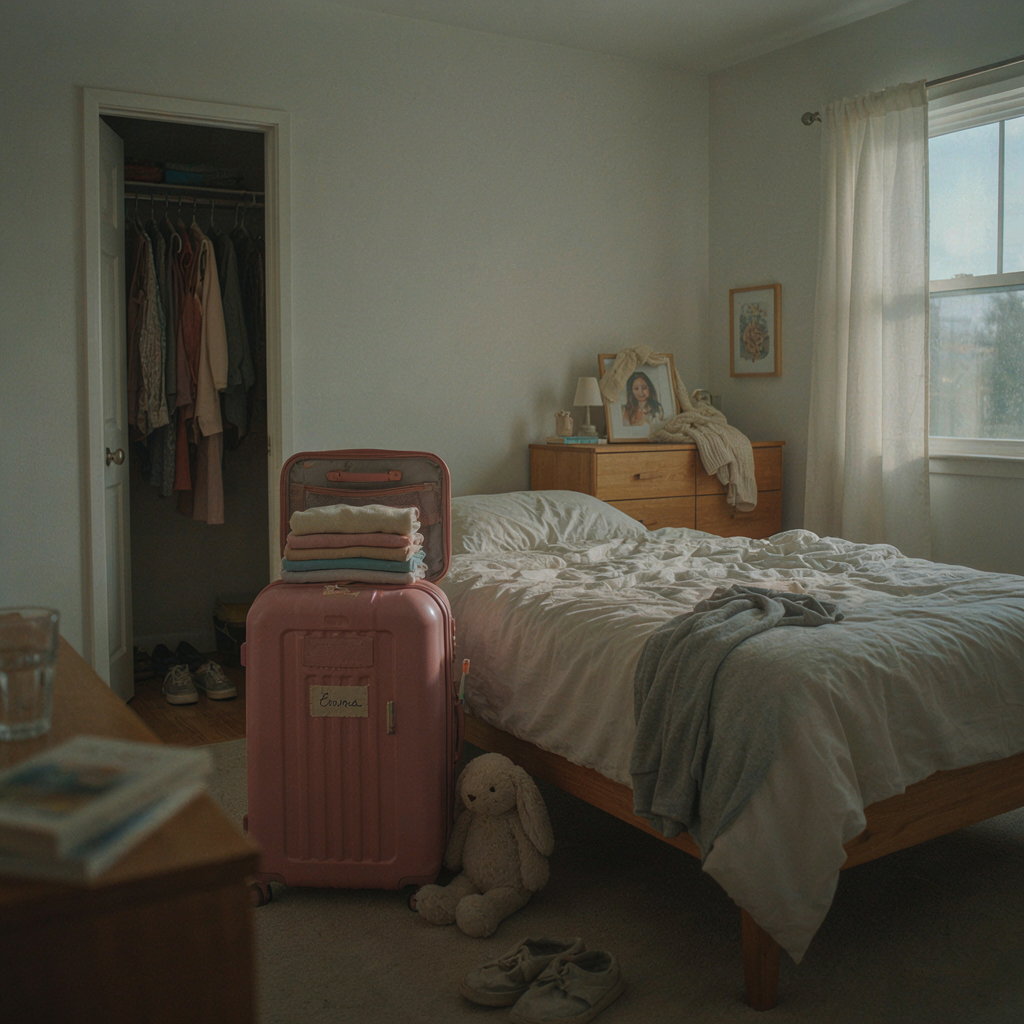
Six months after my sister died, I found my fourteen-year-old niece Emma’s suitcase packed under her bed.Every shirt was folded.Her toothbrush was tucked into the side pocket.Her school uniform was rolled carefully beside two pairs of socks.
And the framed photograph of her mother—the one Emma usually kept beside her lamp—was wrapped in a gray sweater like something fragile she was afraid to break.
I stood in the doorway holding the suitcase handle, unable to breathe.”Emma?”She froze.
She had been sitting cross-legged on the floor, doing homework.
Slowly, she looked up at me.”Where are you going?”Her eyes dropped to the carpet.For several seconds, she said nothing.Then she whispered, “I heard you.”
“Heard me what?””You told Uncle Mark you can’t do this forever.”My stomach dropped.I knew exactly what she meant.
Three nights earlier, after Emma had finally gone to sleep, I had sat at the kitchen table with my brother Mark.
It had been one of the worst nights since my sister Laura died.
Emma had refused dinner.She’d screamed that nobody understood her.Then she’d locked herself in the bathroom for nearly an hour.I had been exhausted.Terrified.
Grieving.And completely overwhelmed.
I’d rubbed my face and whispered to Mark, “I don’t know how long I can do this. I can’t do this forever.”
I had meant the exhaustion.
The appointments.
The nightmares.
The school calls.
The grief.
The responsibility of being the only adult Emma trusted.
But Emma had heard only one sentence.
“I can’t do this forever.”
She looked at me now with the quiet resignation of a child who had already decided what she believed.
“It’s okay,” she said.
“I knew I was temporary.”
Those words broke something inside me.
“Emma, no.”
I dropped to my knees beside her.
“You are not temporary.”
She shrugged.
“You don’t have to pretend.”
“I’m not pretending.”
“I know Mom died and everything changed.”
Her voice trembled.
“I know you didn’t plan to have me.”
I reached for her hand.
She pulled it away.
“I heard you, Aunt Claire.”
My eyes filled with tears.
“I wasn’t talking about you.”
“But you were talking about me.”
“No. Emma, I was talking about how hard everything has been.”
She finally looked at me.
“Isn’t that the same thing?”
I couldn’t answer quickly enough.
And that hesitation hurt her more than any words could have.
She stood and zipped the suitcase.
“I’m going to Uncle Mark’s.”
“Mark doesn’t know you’re coming.”
“He said I could call anytime.”
“He meant if you needed something.”
“I need somewhere to go.”
My heart sank.
“Emma, please.”
She looked at me with tears shining in her eyes.
“I’ll be less work for you.”
Then she walked past me.
That night, I didn’t sleep.
I sat on the edge of my bed until dawn, replaying every conversation we’d had since Laura’s funeral.
Emma arriving at my house with one backpack.
Emma sleeping on the couch the first week because she couldn’t bear sleeping alone.
Emma waking up crying because she’d forgotten for a few seconds that her mother was dead.
Emma refusing to call me “Aunt Claire” for the first month because she said it felt strange.
Emma slowly filling the spare bedroom with books, school papers, hair ties, and the little pieces of herself she had been afraid to unpack.
And now I understood.
She had never believed she lived here.
She had believed she was waiting.
Waiting for me to get tired.
Waiting for someone else to claim her.
Waiting for the moment when I would finally say, “Enough.”
The next morning, instead of taking Emma to school, I drove her somewhere I should have taken her months earlier.
Laura’s house.
The house had been sitting empty since her funeral.
We had never gone inside together.
I had been afraid.
Emma had never asked.
But when I parked outside, she stared through the windshield.
“Why are we here?”
“Because there’s something you need to see.”
She looked nervous.
I unlocked the front door.
Dust covered the entryway.
The air smelled faintly like Laura’s lavender candles.
Emma stopped breathing for a moment.
“Mom’s house.”
I nodded.
We walked inside.
Her eyes moved slowly across the room.
The couch.
The bookshelf.
The little ceramic bowl where Laura always dropped her keys.
Then Emma whispered, “I don’t remember the house looking this small.”
I smiled sadly.
“Everything looks different when someone is gone.”
We went upstairs.
I opened Laura’s bedroom.
Emma stood in the doorway.
Her mother’s perfume bottle still sat on the dresser.
A cardigan still hung from the chair.
A half-finished book rested beside the bed.
Emma walked toward it like she was approaching something sacred.
Then she saw the closet.
Her mother’s clothes were still inside.
She touched one sleeve.
“Why didn’t you take these?”
“I couldn’t.”
“Why?”
“Because they belong to your mom.”
Emma swallowed.
“No. They belong to me.”
She turned toward me.
“Can I keep some?”
“All of them.”
She cried then.
Not loudly.
Just tears running down her cheeks while she held her mother’s cardigan against her chest.
I sat beside her.
After a while, I said, “Emma, I need to tell you something.”
She looked at me.
“When your mom died, I promised myself I’d take care of you.”
“I know.”
“No. I don’t think you do.”
I took a breath.
“I thought taking care of you meant making sure you went to school, ate dinner, had clean clothes, and did your homework.”
Emma looked down.
“But I forgot something.”
“What?”
“You needed to know you belonged somewhere.”
She didn’t speak.
“And I failed at making you feel that.”
Her chin trembled.
“I’m sorry.”
She whispered, “Do you really want me?”
I felt tears burn my eyes.
“More than anything.”
“But you said—”
“I know.”
I reached for her hand.
“I can’t do this forever.”
Her eyes widened.
“I can’t be the person you have to lose when you turn eighteen.”
She stared at me.
“What?”
“I don’t want to be temporary either.”
She didn’t understand.
So I explained.
“I don’t want to be your aunt who helped until the paperwork changed or until you became an adult. I want to be family. For the rest of my life.”
Emma’s face crumpled.
She leaned forward and buried her face against my shoulder.
I held her.
For the first time since Laura died, neither of us tried to be strong.
We cried together in her mother’s bedroom.
But there was something else I hadn’t told Emma.
Something I had discovered two weeks earlier.
Something that had kept me awake every night.
Before Laura died, she had left documents with her attorney.
Documents I had not fully understood.
After we returned home, I made coffee for both of us and placed a folder on the table.
Emma stared at it.
“What’s that?”
“Something your mother left.”
“For me?”
“Yes.”
She hesitated before opening it.
Inside was a letter.
Her name was written across the envelope.
Emma’s hands began shaking.
She opened it.
The letter was short.
But it changed everything.
Emma read silently.
Then she looked up.
“Mom knew she was going to die?”
“No.”
“Then why did she write this?”
“I don’t know.”
Emma looked back at the page.
The letter said that if anything ever happened to Laura, Emma should know that she was loved beyond measure.
It said that her mother had arranged for certain things to be protected for her.
And then came the sentence that made Emma look at me.
“Your mother wrote that I was supposed to be your guardian.”
Emma frowned.
“But you’re already my guardian.”
“Not exactly.”
I opened the second document.
“She named me in her estate plan.”
Emma looked confused.
“What does that mean?”
“It means she wanted you with me.”
Emma’s eyes filled again.
“She chose you?”
“Yes.”
“But Uncle Mark said—”
“What did Mark say?”
Emma went quiet.
“Nothing.”
“Emma.”
“He said Mom probably expected me to stay with him.”
I felt a strange chill.
“When did he say that?”
“At the funeral.”
My heart sank.
“Anything else?”
“He said you had too much going on.”
“What does that mean?”
Emma shook her head.
“I don’t know.”
I did.
Or at least I suspected.
For months, Mark had been telling people that I was struggling to handle Emma.
He had offered to take her “temporarily.”
He had told relatives that Emma might be happier with him.
I had assumed he was trying to help.
Now I wasn’t so sure.
That afternoon, I called Laura’s attorney.
He asked me to come in.
Emma came with me.
The attorney opened another file.
“There is something you both need to understand,” he said.
“Your sister created a trust for Emma.”
I looked at Emma.
Her eyes widened.
“A trust?”
“Yes.”
“What kind of trust?” I asked.
“One funded by several assets.”
He explained that Laura had quietly arranged for money, investments, and the eventual sale of the house to support Emma through college.
I stared at him.
“Why didn’t anyone tell me?”
“Because the trust has a trustee.”
“Who?”
He hesitated.
“Your brother Mark.”
The room went silent.
Emma looked at me.
“Uncle Mark?”
I nodded slowly.
The attorney continued.
“Your sister believed Mark was financially responsible. But the trust does not give him custody rights over Emma.”
“So why has he been telling everyone—”
“I can’t speak to what he has said.”
“But can he take Emma?”
“No.”
Emma exhaled.
Then the attorney said something that changed the entire situation.
“There is one more issue.”
He opened another document.
“Your sister included a condition.”
“What condition?”
“Emma’s trust can only be accessed for her benefit while she is living with the guardian named in the estate documents.”
I stared at him.
“Me?”
He nodded.
“If Emma leaves your care permanently, the trust becomes subject to court review.”
I suddenly understood.
Mark hadn’t just been offering Emma a home.
He had been positioning himself around the money.
I looked at Emma.
She was staring at the floor.
“Did Uncle Mark know?”
The attorney didn’t answer.
He didn’t need to.
That evening, Mark came to my house.
He didn’t knock.
He used the spare key.
When he saw Emma sitting beside me, his expression hardened.
“Emma, pack your things.”
She flinched.
I stood.
“No.”
Mark stared at me.
“This isn’t your decision.”
“Actually, it is.”
“I’m her uncle.”
“And I’m her legal guardian.”
His jaw tightened.
“I’ve been trying to help.”
“I know.”
“Then why are you turning this into a fight?”
“Because Emma packed a suitcase because she thought I didn’t want her.”
Mark looked at Emma.
Then back at me.
“Maybe she understood what you couldn’t.”
Emma stood.
“I heard her.”
Mark softened his voice.
“See? She knows.”
I stepped between them.
“No.”
I pulled the trust documents from the folder.
“She knows what I said. She doesn’t know what I meant.”
Mark’s face changed when he saw the papers.
“You found those?”
“Yes.”
“Claire, you don’t understand the trust.”
“I understand enough.”
He stepped closer.
“Your sister trusted me.”
“She trusted you to manage the money.”
“And she trusted me to look after Emma.”
“No.”
I held up the document.
“She trusted me to look after Emma.”
For the first time, Mark had nothing to say.
Emma stared at him.
“Did Mom want me to live with you?”
Mark’s eyes shifted.
“She wanted what was best for you.”
“That’s not what I asked.”
He sighed.
“Things aren’t simple.”
Emma’s voice became stronger.
“Did she?”
Mark didn’t answer.
I did.
“No.”
Emma looked at me.
“How do you know?”
“Because your mother wrote it.”
I handed her the document.
She read the relevant section.
Her face changed.
Mark stood silently.
Then Emma asked the question neither of us expected.
“Did you know about the trust?”
Mark rubbed his forehead.
“Yes.”
“Before Mom died?”
“Yes.”
“And you still told me Aunt Claire couldn’t keep me?”
Mark looked at me.
“I thought she would eventually give up.”
Emma’s face went pale.
“Why?”
He didn’t answer.
“Why would you want me to leave?”
Mark looked away.
Then he said quietly, “Because your aunt isn’t equipped for this.”
I felt anger rising.
But Emma spoke first.
“You wanted the money.”
Mark looked at her.
“No.”
“You did.”
“I wanted to make sure it was handled properly.”
“You wanted me.”
“No.”
“You wanted Mom’s money.”
Mark’s face tightened.
“That’s enough.”
“No!” Emma shouted.
Everyone froze.
She was crying now.
“You made me think nobody wanted me!”
Mark didn’t respond.
Emma wiped her cheeks.
“I thought Aunt Claire was going to send me away.”
She pointed at him.
“And you knew that.”
Mark lowered his eyes.
“I didn’t mean for you to be hurt.”
“But you didn’t care if I was.”
Silence.
Then Mark walked out.
He didn’t say goodbye.
He didn’t apologize.
He simply left.
The door closed.
Emma stood there shaking.
I hugged her.
“I’m sorry.”
She cried against my shoulder.
“I thought you hated having me.”
“I could never hate having you.”
“But you were tired.”
“I was.”
She looked up.
“And that’s okay?”
“Yes.”
“You’re allowed to be tired?”
I smiled through my tears.
“Yes.”
“Even when you love someone?”
“Especially then.”
She thought about that.
Then she whispered, “Can I unpack my suitcase?”
I laughed through tears.
“Please.”
She went upstairs.
Ten minutes later, she came back carrying the empty suitcase.
“Where should I put it?”
“Closet.”
She smiled.
“Not under the bed?”
“Definitely not under the bed.”
She walked away.
Then she stopped.
“Aunt Claire?”
“Yeah?”
“Can we go back to Mom’s house tomorrow?”
“Of course.”
“I want her blue sweater.”
“The one from the chair?”
“Yes.”
“Then it’s yours.”
She smiled.
“Thanks.”
That night, I heard footsteps in the hallway.
Emma appeared at my bedroom door.
“Can I sleep here?”
“Of course.”
She crawled into the bed beside me.
For a while, neither of us spoke.
Then she whispered, “Do you think Mom knew?”
“Knew what?”
“That I’d be scared.”
I looked at the ceiling.
“I think your mom knew you would be.”
“Did she know you’d help me?”
“I think she hoped I would.”
Emma moved closer.
“Then she was right.”
I closed my eyes.
“Yeah.”
For the first time in six months, I believed it too.
But the story didn’t end with Mark leaving.
Three weeks later, the attorney called.
He told me Mark had resigned as trustee.
Emma and I sat together in the kitchen when I received the news.
“Does that mean he can’t take anything?”
I asked.
“No.”
“Will Emma still have everything her mother left?”
“Yes.”
I looked at Emma.
She smiled.
Then she said something I’ll never forget.
“I don’t care about the money.”
I laughed softly.
“I know.”
“I just want Mom’s things.”
“You’ll have them.”
“And you?”
“What about me?”
“Are you staying?”
My heart broke.
I reached across the table.
“I’m not going anywhere.”
She squeezed my hand.
“You promise?”
“I promise.”
Years later, when Emma graduated from high school, she wore her mother’s blue bracelet.
When she graduated from college, she carried Laura’s photograph.
And when she moved into her first apartment, I helped her unpack.
There was one box she refused to let me touch.
“What is that?” I asked.
She smiled.
“Something important.”
“More important than dishes?”
“Much more.”
She opened it.
Inside was the old suitcase.
The same suitcase I’d found under her bed years earlier.
I laughed.
“You kept it?”
“Of course.”
“Why?”
She pulled out the framed photograph of Laura.
Then she looked at me.
“Because that was the suitcase I packed when I thought I didn’t belong.”
My smile faded.
She continued.
“But I don’t remember it that way anymore.”
“How do you remember it?”
She smiled.
“As the suitcase I packed before I learned I was home.”
I hugged her.
She held me tightly.
And for the first time, I realized something.
Sometimes children don’t need perfect adults.
They need adults who come back.
Adults who explain.
Adults who admit when they were wrong.
Adults who make it impossible for a child to wonder whether they are wanted.
Emma had spent six months believing she was temporary.
It took one suitcase to show me how deeply she’d misunderstood my words.
And it took me much longer to understand something myself.
Family isn’t always the person who shares your blood.
Sometimes family is the person who stays after the hardest night.
The person who hears you say, “I can’t do this forever,” and answers, “You don’t have to do it alone.”
The person who doesn’t just give you a room.
They give you a place in their life.
A permanent one.
And that morning, when Emma unpacked her suitcase for the last time, she didn’t put it beneath the bed.
She put it in the closet.
Empty.
Because she finally understood what I had been trying to tell her.
She wasn’t waiting to be sent somewhere else.
She was home.