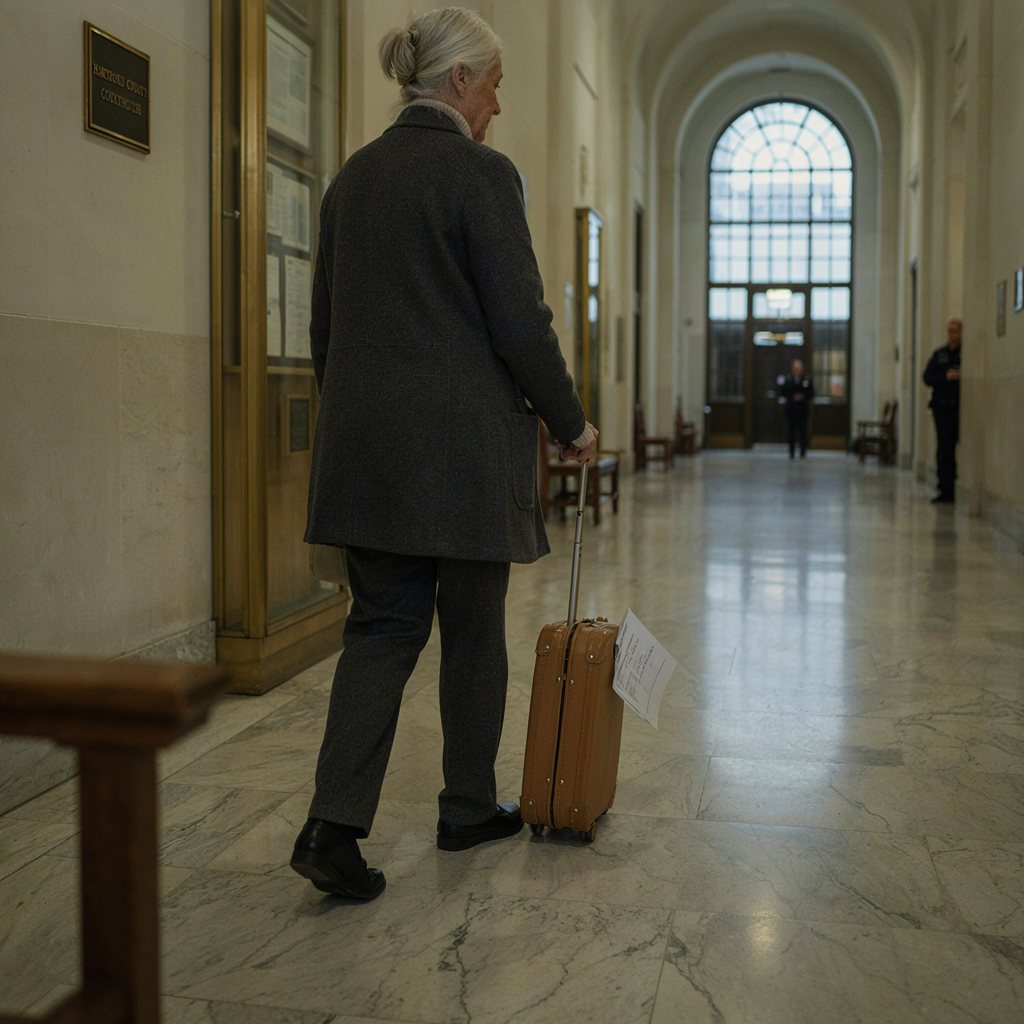
At seventy-eight, I walked out of a Hartford courtroom with one suitcase, a folded court order, and a silence so deep it made the marble hallway feel endless.Behind me, my husband of fifty-two years was laughing.Not loudly.Just enough for me to hear.
He stood beside his attorney, adjusting the cuff of his navy jacket as though he had just closed the most successful business deal of his life.
Then he looked directly at me.”You’re going to regret this,” he said.
I stopped.I turned around.He smiled.”You’ll never see the grandkids again.”
Those words hurt more than losing the house.More than the divorce.More than watching a judge sign papers that seemed to erase five decades of my life with a few strokes of a pen.
Our house on Birchwood Lane was worth approximately $4.5 million.It had been our home for thirty-eight years.
The wraparound porch where I drank coffee every morning.
The tall maple tree my husband and I planted when we were still young enough to believe we would grow old together.
The dining room where every Thanksgiving smelled like nutmeg, roast turkey, cinnamon, and my mother’s apple pie.The upstairs hallway where our children had measured their heights against the doorframe.
The guest room where our grandchildren had slept during summer visits.Gone.
According to the divorce settlement, the property would be transferred into a holding company controlled by my husband.
I had signed away my claim to it.
Not because I wanted to.
Because my attorney had explained that fighting over it could take years, cost hundreds of thousands of dollars, and potentially destroy what little relationship remained between me and my family.
I had chosen peace.
At least, that’s what I told myself.
Outside the courthouse, I stood on the sidewalk and waited for the car my daughter had promised to send.
It never came.
I called her.
No answer.
I called my son.
Straight to voicemail.
I stood there for nearly forty minutes with my suitcase beside me while people hurried past.
Nobody knew that the old woman standing near the courthouse had just lost the house where she had raised an entire family.
Nobody knew that she had once been a young bride who believed the man walking out of that building beside her would hold her hand until death.
Eventually, a taxi stopped.
I gave the driver the address of a small furnished apartment I had rented for thirty days.
As we drove away, I looked through the rear window.
My husband was still standing outside the courthouse.
Still smiling.
I never looked back again.
For the first week, I barely unpacked.
The apartment had white walls, a tiny kitchen, and a window overlooking a parking lot.
There were no maple trees.
No porch.
No grandchildren’s fingerprints on the refrigerator.
No photographs hanging in the hallway.
Just silence.
Every morning I woke up expecting to hear my husband moving downstairs.
Then I remembered.
He wasn’t my husband anymore.
On the ninth day, I received a message from my daughter.
“Mom, please don’t make this harder than it already is.”
I stared at the screen.
I typed:
“Harder for whom?”
I deleted it.
Then typed:
“I love you.”
I sent that instead.
Three dots appeared.
Then disappeared.
No reply came.
That afternoon I found an old photograph in my suitcase.
It showed me at twenty-six, standing beside my husband on our wedding day.
He had thick dark hair then.
I had a ridiculous amount of hairspray in mine.
We were smiling.
I sat on the edge of the bed and studied the photograph for a long time.
I tried to remember when the smiling man in that picture had disappeared.
Perhaps he hadn’t disappeared.
Perhaps I had simply refused to notice what he had become.
Our marriage had not ended suddenly.
It had ended slowly.
A comment here.
A secret there.
Separate bedrooms.
Separate bank accounts.
Meals eaten at different times.
And finally, his announcement one evening that he had “fallen in love with someone who made him feel alive again.”
He was eighty.
I was seventy-eight.
The woman was forty-nine.
I didn’t ask her name.
Some answers aren’t worth having.
What I didn’t understand was why he had fought so hard to take the house.
Until three weeks after the divorce.
That was when everything changed.
It happened on a rainy Tuesday afternoon.
I was sitting near the window, drinking tea, when my phone rang.
The number was unfamiliar.
Connecticut.
I almost ignored it.
Something made me answer.
“Hello?”
There was a pause.
Then a man’s voice.
“Mrs. Whitmore?”
“Yes.”
“Ma’am, my name is Daniel Reeves. I’m calling from Hartford.”
“Who are you?”
“I’m a private investigator.”
My stomach tightened.
“Why are you calling me?”
Another pause.
Then he said something I still remember word for word.
“There’s been an urgent situation involving your husband.”
I stood up.
“What kind of situation?”
“I can’t discuss it over the phone.”
“Is he hurt?”
“No.”
“Is he dead?”
“No, ma’am.”
I exhaled.
“Then what happened?”
“Your husband was taken to the hospital this morning after collapsing at a private meeting.”
I frowned.
“What private meeting?”
“That’s exactly what I’m trying to find out.”
I didn’t understand.
Then he asked:
“Did your husband ever mention a company called Northbridge Holdings?”
I froze.
That name meant nothing to me.
“No.”
“Are you sure?”
“Absolutely.”
“Then I think you need to know what he transferred into that company.”
My hand tightened around the phone.
“What did he transfer?”
Daniel’s voice became quieter.
“Your house.”
“I already know about the house.”
“No, Mrs. Whitmore.”
He paused.
“You’re not understanding me.”
“What?”
“The house wasn’t the asset.”
My heart began pounding.
“What does that mean?”
“It means the house was only the beginning.”
Daniel agreed to meet me the next morning.
I arrived at a small coffee shop in Hartford shortly after nine.
He was waiting near the back.
He looked to be in his early fifties, wearing a gray coat and carrying a leather folder.
He stood when I approached.
“Mrs. Whitmore?”
“Yes.”
He shook my hand.
“I’m sorry you’re being dragged into this.”
“I’ve already been dragged into it. I just don’t know where.”
He opened the folder.
Inside were copies of documents.
Property records.
Bank transfers.
Corporate filings.
Insurance documents.
I stared at them.
“What am I looking at?”
“Northbridge Holdings was created eighteen months ago.”
“By my husband?”
“Indirectly.”
“What does that mean?”
“His attorney created it.”
I looked at the documents again.
Daniel pointed to a line.
“This company purchased your house for $2.1 million.”
I frowned.
“But the house is worth more than twice that.”
“Exactly.”
“Why would my husband sell a $4.5 million property for $2.1 million?”
“Because he didn’t actually sell it.”
I looked up.
“What?”
“He transferred it.”
“To whom?”
“Northbridge Holdings.”
“Who owns Northbridge?”
Daniel hesitated.
“That’s the problem.”
I waited.
He turned another page.
“Your husband isn’t the owner.”
“Then who is?”
Daniel looked directly at me.
“You.”
I laughed.
I couldn’t help it.
“That’s impossible.”
“It’s not.”
He slid a document across the table.
My name was printed on it.
Elizabeth Whitmore.
Owner.
Beneficial beneficiary.
I stared at the paper.
“How?”
“That’s what I’ve been trying to determine.”
“But I signed the divorce settlement.”
“Yes.”
“And I gave him the house.”
“You gave him the right to occupy and control the property under the divorce agreement.”
“What’s the difference?”
Daniel leaned forward.
“The difference is that your husband couldn’t legally give you away something he didn’t own.”
I couldn’t breathe.
“You’re saying…”
“I’m saying the house may still be yours.”
For the next two hours, Daniel explained everything.
Eighteen months before the divorce, my husband had quietly created Northbridge Holdings.
He had been moving money into it.
Not our money.
His business money.
Money connected to several consulting contracts I knew nothing about.
But then something strange happened.
Six months before the divorce, my husband had transferred the house into the company.
The paperwork listed him as manager.
But buried in the corporate documents was a beneficiary agreement.
My name.
My husband had apparently created a structure that would transfer ownership of the property to me under certain circumstances.
“Why would he do that?” I asked.
Daniel shook his head.
“I don’t know yet.”
“Then why did he tell me he was taking the house?”
“Because he expected you to believe him.”
I stared at the rain outside.
Suddenly, something my husband had said during the divorce made sense.
“You’ll never see the grandkids again.”
It hadn’t sounded like an emotional threat.
It had sounded confident.
Almost rehearsed.
I looked at Daniel.
“What does this have to do with my grandchildren?”
“Everything.”
He opened another folder.
Inside was a series of emails.
The first was from my daughter.
My hands began trembling.
“Where did you get these?”
“Your husband had an encrypted email account. Someone gave us access after his collapse.”
I read the first message.
It was from my daughter.
She had written:
“Once Mom signs, Dad will finally have control of everything.”
My stomach dropped.
I read another.
My son had written:
“What about the grandchildren?”
My daughter replied:
“She’ll do anything to keep seeing them.”
I stopped reading.
I pushed the papers away.
“No.”
Daniel said nothing.
“No.”
I stood.
“My children wouldn’t do that.”
“I’m not telling you what to believe.”
He pointed to the documents.
“I’m showing you what was written.”
I sat back down.
The rain outside became heavier.
For fifty-two years, I had thought my family was my greatest achievement.
I had raised two children.
Loved four grandchildren.
Kept every Christmas tradition.
Every birthday.
Every graduation.
Every hospital visit.
I had believed that even if my marriage failed, my children would remain.
Now I wasn’t sure.
That evening, I called my daughter.
She answered immediately.
“Mom?”
“Did you know about Northbridge Holdings?”
Silence.
“Mom, where did you hear that?”
“Did you know?”
Another silence.
Then she whispered:
“Who told you?”
That was all I needed.
I closed my eyes.
“How long?”
“Mom…”
“How long have you known?”
“Since last year.”
My voice broke.
“And you let me walk into that courtroom believing I was losing everything?”
“We didn’t know what Dad was doing!”
“You knew enough.”
She began crying.
“I was scared.”
“Of him?”
“Yes.”
“Then why did you help him?”
“I thought he was protecting us.”
I didn’t understand.
“Protecting you from what?”
She didn’t answer.
“Tell me.”
Finally she said:
“Mom, Dad wasn’t divorcing you because of another woman.”
I sat down.
“Then why?”
“Because people were investigating his company.”
I felt cold.
“What people?”
“Federal investigators.”
Daniel had told me there were financial records.
But he hadn’t told me that.
My daughter continued.
“Dad told us that if they came after him, they could take everything. He said the house needed to be moved somewhere safe.”
“And you believed him?”
“At first.”
“At first?”
“He started transferring money. Lots of it.”
“How much?”
“I don’t know.”
“Then why did you stay quiet?”
“Because Dad threatened to cut us off.”
I closed my eyes.
“And the grandchildren?”
She began crying harder.
“That was his idea.”
“What was?”
“He said if you fought the divorce, we had to stop bringing the kids around you.”
My chest hurt.
“He used my grandchildren to control me.”
“Yes.”
I looked toward the window.
“Where is he now?”
“Still in the hospital.”
“Is he going to recover?”
“I don’t know.”
Neither of us spoke.
Then she said something unexpected.
“Mom?”
“What?”
“I am sorry.”
I didn’t answer.
Because sorry couldn’t rebuild fifty-two years.
But sometimes it can become the first brick.
The next morning Daniel called.
“Mrs. Whitmore, we found something.”
I met him at his office.
He placed a small black notebook on the desk.
“Where did that come from?”
“Your husband’s safe.”
I opened it.
The handwriting was his.
Every page contained dates, names, account numbers, and amounts.
Millions of dollars.
I kept turning pages.
Then I saw my name.
Elizabeth.
Beside it was a handwritten note:
“She must never know.”
My heart stopped.
Below that were three words.
“Protect her.”
I looked at Daniel.
“What does this mean?”
“I don’t know.”
I kept reading.
The entries revealed something far more complicated than a secret affair or a greedy divorce.
My husband had discovered that one of his business partners had been stealing money from the company.
When my husband confronted him, the man threatened to expose financial misconduct involving several executives.
My husband had started moving assets to protect them.
But then he discovered something worse.
The business partner had been using our family’s identities to create fraudulent accounts.
Including mine.
I had unknowingly become connected to millions of dollars in suspicious transactions.
My husband had been trying to separate my name from the accounts.
The problem was that his method was secretive, reckless, and increasingly illegal.
And when investigators began closing in, he decided the easiest solution was to make everyone believe the assets belonged to him.
Including the house.
Including the company.
Including the money.
Including the divorce.
He wanted to appear to be the sole person responsible.
But there was one problem.
He had never told me.
And now the investigators believed I might be involved.
Three days later, two federal agents came to my apartment.
They were polite.
Professional.
They asked questions.
I answered every one.
They showed me documents.
I showed them Daniel’s files.
Then one agent said:
“Mrs. Whitmore, there is something you should know.”
I waited.
“Your husband has been cooperating.”
“With you?”
“Yes.”
“Why?”
“Because he wants to correct the record.”
I almost laughed.
“After everything he did?”
The agent looked uncomfortable.
“He claims he was trying to protect you.”
I thought about the courtroom.
The suitcase.
The empty apartment.
The threat about my grandchildren.
“Protection doesn’t feel like protection when someone takes your life away from you.”
The agent nodded.
“I understand.”
Then he handed me an envelope.
Inside was a handwritten letter.
From my husband.
I recognized the handwriting immediately.
Elizabeth,
If you’re reading this, then I failed.
I failed to protect you quietly.
I failed to protect our children.
And I failed to protect the life we built.
I wanted you to hate me because I thought hatred would keep you away from the investigation.
I wanted you to believe I had taken everything because I thought you would fight me if you knew the truth.
I thought if you walked away angry, you would be safe.
But I didn’t understand what I was taking from you.
I took your home.
I took your dignity.
I used our children.
And worst of all, I used the grandchildren you love.
There was one line that made me stop.
I never stopped loving you.
I folded the letter.
I didn’t forgive him.
Not then.
Maybe not ever.
But I finally understood something.
People can love you and still hurt you.
Sometimes terribly.
Love doesn’t erase damage.
And damage doesn’t erase every complicated thing that came before it.
Two weeks later, my husband was discharged from the hospital.
His attorney contacted me.
There would be another hearing.
Not for divorce.
For the property.
I returned to the same courthouse where I had left with one suitcase.
This time, I carried a folder.
My daughter sat beside me.
My son sat behind us.
Neither said much.
When my husband entered the courtroom, he looked older.
Much older.
He saw me.
Then he stopped.
For a moment, neither of us moved.
Finally, he said:
“Elizabeth.”
I nodded.
“Richard.”
We sat on opposite sides.
The hearing lasted nearly three hours.
The corporate documents were examined.
The property transfer was challenged.
The investigators presented evidence showing that Northbridge had been structured in a way that made me the ultimate beneficiary of the house.
The judge reviewed everything.
At the end, the ruling was clear.
The house could not be awarded to my husband personally because it had not legally belonged to him at the time of the divorce.
The court recognized my beneficial interest.
The property would remain protected while the financial investigation continued.
It wasn’t a clean victory.
There were still legal questions.
Taxes.
Business liabilities.
Assets frozen.
Months of uncertainty ahead.
But one thing was certain.
He had not taken my home.
Not legally.
And neither had the woman he had left me for.
A month later, I returned to Birchwood Lane.
I didn’t go inside immediately.
I stood at the gate.
The maple tree was still there.
Older.
Taller.
Its branches stretched over the driveway.
I touched the trunk.
I remembered planting it with Richard when we were newly married.
He had dug the hole.
I had complained that it was too deep.
He laughed.
“You’ll thank me in forty years.”
Forty years had passed.
Then another twelve.
I walked onto the porch.
The door opened.
My daughter stood there.
Behind her were my four grandchildren.
The youngest ran first.
“Grandma!”
I barely had time to bend down before she wrapped her arms around me.
I cried.
Not the quiet tears I had cried in the apartment.
Not the lonely tears from the courthouse.
These were different.
They were the tears of someone who had finally stopped holding everything inside.
My grandson hugged me next.
Then another.
Then another.
My daughter stood behind them, crying.
“I’m sorry, Mom.”
I looked at her.
“I know.”
“Can you forgive me?”
I took a breath.
“Not all at once.”
She nodded.
“I understand.”
“But you can start earning my trust again.”
She hugged me.
For the first time in months, I let myself lean into someone else’s arms.
Richard never moved back into the house.
The investigation continued for nearly a year.
Several executives were charged.
Millions of dollars were recovered.
Some assets were lost.
Others were returned.
The house remained in a legal trust established for my benefit.
I eventually sold it.
Not because I hated it.
Because I realized something.
A house can hold memories.
But it cannot hold a marriage together.
I sold Birchwood Lane for slightly more than $4.5 million.
With part of the proceeds, I bought a smaller home near the coast.
It had a little porch.
Nothing grand.
Just enough for a rocking chair and a table for morning coffee.
I planted a maple tree in the backyard.
My grandchildren helped me.
The youngest pressed the dirt around the roots with both hands.
“Grandma,” she asked, “will this tree get really big?”
I smiled.
“Eventually.”
“Will you still be here?”
I looked at her.
“Yes.”
She nodded seriously.
“Good.”
That evening, my daughter brought dinner.
My son arrived with dessert.
My grandchildren ran through the house laughing.
For the first time in a year, the rooms were noisy.
Messy.
Alive.
After dinner, I stepped onto the porch.
My daughter joined me.
“Mom?”
“Yes?”
“Do you ever wish you had fought Dad harder?”
I thought about it.
“No.”
She looked surprised.
“Why not?”
“Because I spent fifty-two years fighting for that marriage.”
I looked through the window at my grandchildren.
“At seventy-eight, I decided to fight for something else.”
“What?”
“Myself.”
She smiled through tears.
Then she took my hand.
And we sat together in silence.
Richard called me six months later.
It was the first time we had spoken privately since the divorce.
His voice sounded tired.
“Elizabeth.”
“Yes?”
“I wanted to thank you.”
“For what?”
“For not destroying me.”
I looked out at the maple tree.
“You did enough of that yourself.”
He gave a quiet laugh.
“I suppose I did.”
We were silent.
Then he said:
“Do you remember our first apartment?”
“Of course.”
“The one with the broken radiator?”
“You complained about it every winter.”
“I thought I was funny.”
“You weren’t.”
He laughed again.
For a few seconds, we sounded like the young couple in that old photograph.
Then the silence returned.
“Elizabeth?”
“Yes?”
“I’m sorry.”
This time, I believed he meant it.
But forgiveness wasn’t the same as going back.
“I know,” I said.
“I hope you’re happy.”
I looked through the glass door.
My grandchildren were fighting over the last piece of cake.
My daughter was pretending not to notice.
My son was laughing.
The maple tree stood beneath the evening sky.
“I am,” I said.
And I meant it.
A year after I left the courtroom, I found the original divorce order in an old drawer.
I unfolded it.
The paper was creased from being carried in my suitcase.
For months, I had thought of it as proof that I had lost everything.
Now I saw it differently.
It wasn’t proof of what had been taken from me.
It was proof of the day I finally walked away.
I had believed my life ended at seventy-eight.
It didn’t.
It changed.
I lost a $4.5 million house.
I lost the marriage I thought would last forever.
I lost the illusion that my children would always protect me.
But I gained something I hadn’t known I needed.
The courage to stop measuring my worth by what someone else was willing to leave me.
And sometimes, that is the strangest thing about losing everything.
You discover that everything was never what made you whole.
I still have the photograph from our wedding.
It sits in a drawer.
I don’t hate the young woman in it.
She loved deeply.
She trusted completely.
She built a family.
She survived betrayal.
And when the man she loved told her she would never see her grandchildren again, she walked out anyway.
One suitcase.
One folded court order.
And nothing but uncertainty ahead.
She thought she was leaving her entire life behind.
She didn’t know that thirty days later, a stranger from Connecticut would call her phone.
She didn’t know that the house she believed was gone would lead her to a secret worth millions.
She didn’t know her children would eventually come back.
She didn’t know she would plant another maple tree.
She didn’t know that at seventy-eight, she would discover a new version of herself.
But now, whenever I sit beneath that tree with my morning coffee, I think about the woman I was that day.
And I wish I could go back to the courthouse.
Not to change the ruling.
Not to stop the divorce.
Just to whisper something in her ear before she walked outside.
I would tell her:
“Keep walking.”
“Don’t look back.”
“Your story isn’t ending.”
“It’s finally becoming yours.”