My father left me $430,000.I put it in a savings account and didn’t touch a single dollar for two years.I didn’t even use the interest.That money wasn’t just an inheritance to me. It was the last thing my father had given me.
He had always told me, “Money disappears. What you build with it doesn’t.”So I decided to leave it alone until I knew exactly what I wanted to build.
Then, one Tuesday morning, I walked into my bank expecting to move $10,000 into a certificate of deposit.
The teller typed something into her computer.
Then she stopped.Her fingers froze above the keyboard.She looked at the screen.Then at me.Then back at the screen.“I’m sorry,” she said.“What’s wrong?”She swallowed.
“Can you wait a moment?”She called the manager.That was when I knew something was seriously wrong.
The manager, a man named Mr. Harris, came over and asked me to step into his office.
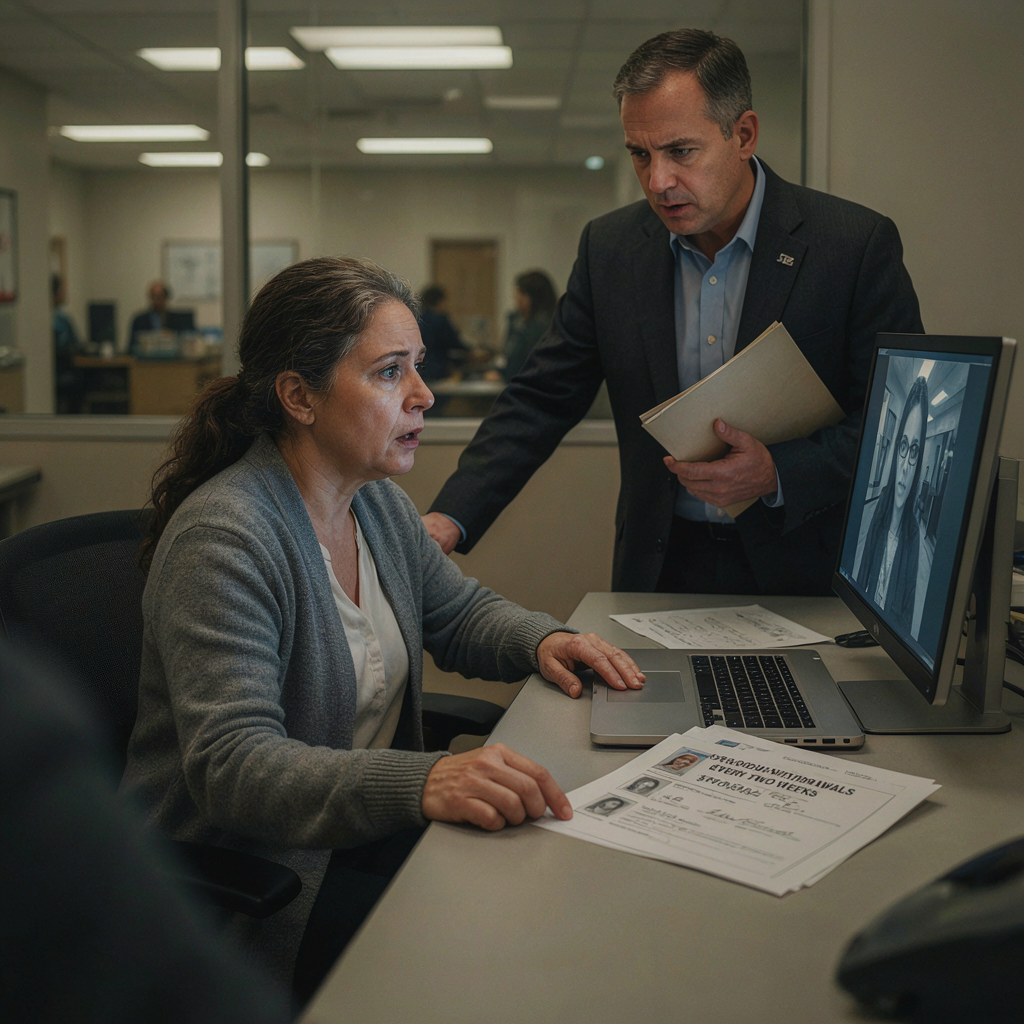
I sat down.He closed the door.Then he turned his monitor toward me.
My savings account showed a balance of $12,041.I stared at it.“That’s impossible.”“I know.”“My account had over four hundred thousand dollars.”“Yes.”“How much?”He hesitated.
“Your original deposit was $430,000.”“Exactly.”He clicked through several screens.
“According to our records, $417,959 was withdrawn over the last two years.”
My mouth went dry.
“I didn’t withdraw anything.”
He nodded slowly.
“That’s why we’re concerned.”
He printed a transaction history.
The withdrawals were almost identical.
$8,000.
$8,000.
$8,000.
Every two weeks.
Sometimes $7,900.
Sometimes $8,100.
All made in person.
No online transfers.
No wire transfers.
No checks.
Someone had physically walked into the bank and taken my money.
I pointed at the page.
“Who authorized these?”
Mr. Harris looked uncomfortable.
“You did.”
“No, I didn’t.”
“According to our records, you did.”
He pulled up the identification documents used during the withdrawals.
My driver’s license number.
My name.
My date of birth.
Everything matched.
I laughed once.
Not because anything was funny.
Because my brain couldn’t understand what I was seeing.
“You have to be mistaken.”
Mr. Harris opened a drawer.
He took out a photocopy.
He placed it on the desk.
My driver’s license.
Or what appeared to be my driver’s license.
Same name.
Same photograph.
Same birth date.
Same signature.
But there was one difference.
The address was wrong.
“Someone has been coming in with your driver’s license,” he said.
I stared at the photograph.
It was me.
Or it looked exactly like me.
Same haircut.
Same glasses.
Same expression.
Even the tiny scar near my left eyebrow was visible.
I leaned closer.
“How did they get this?”
“We don’t know yet.”
“You let someone take almost $418,000 from my account because they had a fake license?”
Mr. Harris lowered his eyes.
“The identification passed our verification procedures.”
I stood.
“Then find the person.”
“We are.”
He reached for a remote.
“I pulled security footage from the most recent withdrawal.”
He turned on the monitor.
The footage showed the bank lobby.
A woman entered.
She wore a beige coat, black pants, white sneakers, and large glasses.
She walked toward the counter.
My heart began beating faster.
Her haircut was identical to mine.
Not similar.
Identical.
She stopped at the teller window.
Then she turned slightly.
I saw her profile.
My stomach dropped.
She looked like me.
Mr. Harris paused the video.
“Do you know her?”
I couldn’t answer.
He looked at me.
“Do you?”
I whispered,
“Yes.”
The woman on the screen was my older sister.
Claire.
My sister had died twelve years earlier.
At least, that’s what I had been told.
Claire was five years older than me.
When we were children, everyone said we looked like twins.
We weren’t twins.
But strangers constantly confused us.
Same dark hair.
Same brown eyes.
Same narrow face.
Same crooked smile.
When we were teenagers, Claire discovered something that made the resemblance even more useful.
She could imitate me.
My voice.
My handwriting.
My posture.
Even my walk.
Once, when we were seventeen, she called our mother pretending to be me.
Mom didn’t realize it wasn’t me until Claire started laughing.
I hated that joke.
Claire loved it.
But when we were twenty-three, something happened that stopped being funny.
Our father discovered that Claire had been stealing money from him.
Not hundreds.
Thousands.
He confronted her.
They had a massive fight.
I remember standing outside his study while they screamed at each other.
Claire shouted,
“You always choose her!”
Dad shouted back,
“Because she doesn’t lie to me!”
Three days later, Claire disappeared.
We were told she had left the state.
Then we heard she had been seen in another city.
Then nothing.
Years passed.
My father refused to discuss her.
Whenever I asked, he’d say,
“She made her choice.”
I eventually stopped asking.
Then Dad died.
And I inherited $430,000.
I had assumed Claire was somewhere alive, but out of my life.
Now I was staring at footage of her walking into my bank.
Except Claire had supposedly been dead for eight years.
“That’s my sister,” I said.
Mr. Harris looked confused.
“Your sister?”
“She died.”
“When?”
“Eight years ago.”
He stared at me.
Then at the screen.
“Are you sure?”
“Yes.”
He rewound the footage.
Claire entered again.
This time I noticed something I hadn’t seen before.
She was carrying a small black purse.
My father had owned that purse.
Not literally.
But I knew it.
It was a brand he used to buy for Mom.
And then I noticed something else.
Claire wasn’t alone.
Someone was waiting outside the bank.
A man in a gray baseball cap.
Mr. Harris zoomed in.
The man’s face wasn’t clear.
But I recognized his posture.
My father.
I couldn’t breathe.
“That’s impossible.”
Mr. Harris looked at me.
“Why?”
“Because my father is dead.”
That afternoon, I went home and opened every box I’d kept from Dad.
Photographs.
Letters.
Tax documents.
Old birthday cards.
Bank statements.
Medical records.
I searched until midnight.
Then I found something.
A photograph taken twenty years earlier.
Claire and me standing beside Dad.
Claire wore a red sweater.
I wore blue.
I flipped the photograph over.
Dad had written:
“Claire and Emily, age 18.”
I stared at Claire’s face.
Then I stared at mine.
The resemblance was frightening.
But there was one detail.
Claire had a tiny mole beneath her right ear.
I had never had one.
The woman in the bank footage had it.
I replayed the footage.
There it was.
A tiny dark spot beneath her right ear.
Claire.
Alive.
I called the police.
Detective Miller arrived the next morning.
I explained everything.
He reviewed the footage.
Then he examined the withdrawal records.
“Did you authorize any withdrawals?”
“No.”
“Did you give your sister access to your account?”
“No.”
“Did your father know your banking information?”
“Yes.”
“Could he have known your identification number?”
“Probably.”
Detective Miller looked at me.
“There’s something you should know.”
“What?”
“Your sister isn’t listed as deceased.”
I stared at him.
“What?”
“There is no death certificate for Claire.”
“That’s impossible.”
“I checked.”
He placed a folder on my table.
Claire’s name.
No death record.
No burial record.
No obituary.
Nothing.
According to the government, my sister had simply disappeared.
Not died.
Disappeared.
I felt sick.
“Then why did my father tell me she was dead?”
Detective Miller didn’t answer.
Instead, he asked,
“Did your father ever tell you exactly where she died?”
“No.”
“Did you ever see a body?”
“No.”
“Funeral?”
“No.”
“Death certificate?”
“No.”
He closed the folder.
“Then I think you’ve been lied to for a very long time.”
The bank investigation uncovered something even worse.
The withdrawals hadn’t started after Dad died.
They had started six months before he died.
That meant someone had been stealing my inheritance while my father was still alive.
But there was another problem.
Every withdrawal occurred on a Wednesday.
Every two weeks.
And every withdrawal was exactly $8,000.
Detective Miller created a timeline.
January 9.
January 23.
February 6.
February 20.
March 6.
The pattern continued.
Someone had withdrawn more than $400,000 without raising enough suspicion to trigger an immediate investigation.
Then Detective Miller found something.
A second bank account.
It was under my name.
I had never opened it.
Money from my savings account had been deposited there before being withdrawn in cash.
The account had been opened eleven months before Dad died.
The signature looked like mine.
But it wasn’t.
“Who opened it?” I asked.
Detective Miller looked at the paperwork.
“Your father.”
My hands went cold.
“Why?”
“We don’t know.”
Then he found the beneficiary.
Claire.
My supposedly dead sister.
That night, I received a text message from an unknown number.
It said:
Stop looking.
I stared at it.
A second message appeared.
You have no idea what you’re uncovering.
Then a third.
Your father didn’t leave you $430,000.
I called Detective Miller immediately.
He told me not to respond.
But I couldn’t stop thinking about that sentence.
Your father didn’t leave you $430,000.
The next morning, I went through Dad’s old safe.
I’d opened it after his funeral, but I had never examined everything carefully.
Underneath a stack of property documents was a sealed envelope.
My name was written on it.
In Dad’s handwriting.
I opened it.
Inside was a single sentence.
If Claire comes back, don’t trust her.
My hands trembled.
Underneath that was another sentence.
If someone tells you I stole from you, believe them.
I read it again.
Then again.
There was one final line.
The money was never yours.
I didn’t understand.
Then I heard a noise downstairs.
A door closing.
I froze.
Someone was inside my house.
I grabbed my phone and quietly walked toward the stairs.
A shadow moved across the hallway.
I called the police.
The person ran.
By the time officers arrived, he was gone.
But he’d left something behind.
A photograph.
It showed my father.
Claire.
And me.
Standing together.
But I had never seen the photograph before.
On the back, Dad had written:
Three people knew the truth.
Detective Miller became convinced that Dad had built an elaborate financial system to protect something.
The $430,000 wasn’t an inheritance.
It was bait.
Money was being moved through accounts to hide its real purpose.
We traced the withdrawals.
Most of the cash went nowhere.
At least, not electronically.
But one thing kept appearing.
A storage facility.
Every time Claire withdrew $8,000, she visited the same storage facility within forty-eight hours.
Unit 214.
I had never heard of it.
Detective Miller got a warrant.
We opened the unit.
Inside were boxes.
Dozens of them.
Each box was labeled with a date.
Inside were bank records, photographs, passports, driver’s licenses, property deeds, and identification documents.
And then we found the most terrifying thing.
There were photographs of me.
Hundreds.
Me leaving work.
Me entering restaurants.
Me walking through parking lots.
Me shopping.
Me at home.
Someone had been watching me for years.
But there was something else.
A mannequin stood in the corner.
It had my exact height.
My exact haircut.
My glasses.
And clothes identical to the ones I wore.
Detective Miller looked at me.
“They were practicing.”
“Practicing what?”
He didn’t answer.
Because he had found a video camera.
On it was footage of Claire.
She was standing in front of a mirror.
She practiced my voice.
My walk.
My facial expressions.
Then she smiled.
And said,
“Emily won’t know the difference.”
I felt like I was going to be sick.
But the video continued.
Claire turned toward someone standing off camera.
“Once the money is gone, she’ll blame me.”
A man’s voice answered.
“That’s the point.”
I knew that voice.
Dad.
We watched the entire recording.
Claire asked,
“What happens if she finds out?”
Dad answered,
“She won’t.”
“And if she does?”
“Then she gets the truth.”
Claire laughed bitterly.
“She deserves it.”
Dad said,
“She deserves the chance to survive it.”
The video ended.
Detective Miller looked at me.
“Your father was alive when this was recorded?”
“Yes.”
“How long before he died?”
“About four months.”
We searched the storage unit again.
Behind a false wall, we found another box.
Inside was a medical file.
My father’s name.
The diagnosis was devastating.
He had been dying.
He knew he had only months left.
But that wasn’t the worst part.
The file contained a note from his doctor.
Patient believes family member may be attempting financial fraud.
My father hadn’t been protecting Claire.
He had been investigating her.
But why?
We kept searching.
Then we found a second set of documents.
This time, they were about me.
My birth certificate.
My childhood medical records.
My adoption papers.
I stared at the page.
Adoption papers.
I had never been adopted.
At least, I’d never been told I was.
I looked at Detective Miller.
“What is this?”
He read the document.
Then looked at me.
“Emily, your father wasn’t your biological father.”
The room spun.
“No.”
“There are records here.”
“No.”
He handed me a document.
My mother’s name was listed.
But under the father’s name was someone else.
A man I’d never heard of.
Then Detective Miller found a hospital record.
Two baby girls.
Born twelve minutes apart.
One was named Claire.
The other was named Emily.
But only one baby had been registered under my mother’s name.
The other had been registered under another woman.
I stared at the paperwork.
“Are you saying Claire and I aren’t sisters?”
Detective Miller shook his head.
“No.”
“You’re saying…”
“You and Claire are identical twins.”
I stopped breathing.
Identical twins.
My entire life had been a lie.
My father had adopted me when I was a baby.
Claire was my biological twin.
My mother had died shortly after giving birth.
Dad had raised me.
Claire had been raised by another family.
Years later, Dad found her.
He brought her back into our lives.
But Claire had grown up angry.
She believed Dad had chosen me.
The truth was more complicated.
Dad had discovered that Claire’s adoptive parents had been involved in financial crimes.
They had used Claire’s identity as a child to establish accounts and hide money.
When Dad found her, he tried to protect her.
But Claire had already learned how to survive by deception.
And eventually, she joined the people who had raised her.
Dad realized she was using my identity because our resemblance made it nearly impossible to detect.
That’s why he created the $430,000 account.
He wanted to lure her out.
He transferred money into an account she believed she could steal.
Then he documented everything.
The withdrawals.
The fake licenses.
The storage unit.
The surveillance.
Everything.
But why had he left the money to me?
Because he knew he was dying.
And he knew that once he died, Claire would try to take everything.
He wanted the money to be traceable.
He wanted her caught.
The inheritance wasn’t simply an inheritance.
It was evidence.
We found Claire three days later.
She was sitting in a motel room.
She didn’t run.
She looked at me.
For the first time, I saw myself looking back.
She smiled sadly.
“You finally found me.”
I couldn’t speak.
She stood.
“Do you hate me?”
“Yes.”
She nodded.
“I deserve that.”
“Why did you steal from me?”
“I didn’t.”
I stared at her.
“You withdrew $418,000.”
“Yes.”
“Then what do you mean?”
She sat down.
“Your father told me to.”
I froze.
“What?”
“He wanted me to take it.”
“Why?”
“Because he knew someone else was watching the account.”
She reached into her bag.
She pulled out a letter.
My father’s handwriting.
I read it.
Claire, take the money exactly as instructed. Do not keep any of it. Move it to the storage unit. If they believe you stole it, they will come for you.
I looked at Claire.
“Who are they?”
She shook her head.
“That’s the part Dad never told me.”
Then she pulled out another photograph.
A man stood beside my father.
I recognized him immediately.
Detective Miller.
My blood turned cold.
I looked at Claire.
“That’s impossible.”
She whispered,
“Your detective isn’t investigating the theft.”
She slid another document toward me.
It showed bank transfers.
Payments.
Names.
Dates.
And at the bottom was Detective Miller’s signature.
He had been receiving money from the same people who had been manipulating my father’s accounts.
I suddenly understood.
My father hadn’t trusted the police.
That’s why he’d hidden everything.
That’s why he used Claire.
That’s why he created the storage unit.
He knew someone inside law enforcement was involved.
And now that person knew we’d found the evidence.
The next morning, Detective Miller disappeared.
His phone was found abandoned.
His car was found two states away.
But the evidence was enough.
Federal investigators took over.
The storage unit became the center of a massive investigation involving identity theft, money laundering, forged documents, and financial fraud.
The $418,000 wasn’t gone.
Most of it had been sitting untouched in cash inside the unit.
Dad had made sure Claire never spent it.
The remaining amount had been transferred through accounts designed to expose the people behind the scheme.
My father had spent his final months building a trap.
And it worked.
Dozens of people were eventually arrested.
The bank returned the missing money to me.
But I didn’t feel rich.
I felt robbed.
Not of money.
Of my childhood.
My family.
My understanding of who I was.
Months later, Claire came to see me.
She was facing prison.
She sat across from me.
“You know what’s strange?” she said.
“What?”
“For my entire life, I thought you were the lucky one.”
I said nothing.
“You got Dad. You got the house. You got the inheritance. You got the family.”
I looked at her.
“And you got my identity.”
She lowered her eyes.
“I know.”
There was a long silence.
Then she said,
“I didn’t want to become you.”
I almost laughed.
“You spent years pretending to be me.”
“I wanted to become the person Dad loved.”
That sentence hurt more than anything else.
Because I realized Claire hadn’t been stealing my money.
She had been trying to steal a life she thought should have been hers.
Before I left, Claire handed me one final envelope.
“Dad told me to give you this if we were ever caught.”
I opened it that night.
There was a photograph of two newborn babies.
Two identical girls.
One was me.
One was Claire.
On the back, Dad had written:
I didn’t choose between you. I chose to save you both.
Then came the final line.
If you are reading this, it means the woman with your face finally led you to the truth.
I cried for the first time since he died.
The $430,000 eventually became something else.
I used part of it to create a foundation for victims of identity theft.
I kept some for myself.
Not because I needed it.
Because Dad had wanted me to have something that couldn’t be stolen.
But I never kept the original bank statement.
I framed it.
The balance at the top read:
$12,041.
Underneath it was the handwritten note I added.
Sometimes losing everything is how you discover what was really yours.
And every now and then, I still think about the security footage.
The woman walking into the bank.
My haircut.
My glasses.
My walk.
My face.
The woman who looked exactly like me.
For two years, I thought she had stolen my inheritance.
I was wrong.
She had stolen something much more valuable.
My certainty about who I was.
And in the end, the money wasn’t the inheritance my father left me.
The truth was.